
Key Takeaways
- Scaling paid search on a small team starts with fixing account architecture, conversion tracking, and review cadence before adding headcount, because automation only works on clean signal.
- Segment campaigns by conversion economics rather than tidy themes, and limit channels to what the team can actively manage so Smart Bidding gets the volume it needs to learn.
- Treat conversion tracking as a measurement floor with one source-of-truth definition per event, documented ownership, and a patch cadence for plugins flagged with security exposure 5.
- Honor privacy and security obligations in the measurement layer by excluding raw identifiers, passing consent state, and disclosing analytics services the way public-sector sites do 3.
- Replace Friday optimization blocks with a tiered cadence that assigns daily work to automation, weekly sweeps to an analyst seat, and monthly and quarterly structural decisions to a strategist.
- Assign different KPIs to awareness, consideration, and conversion campaigns so each cadence tier reacts to the right metric instead of judging the whole account on a single ROAS view 9.
- Route repetitive search term review, RSA triage, and pacing checks to AI workflows so human seats concentrate on target CPAs, channel mix, and creative direction.
- Choose between in-house pod, retainer, and AI-assisted execution based on which cost shape holds management overhead steady as media spend moves between $150K and $500K per month 1.
The Real Bottleneck Isn't Headcount
Most demand gen managers running paid search at scale assume the next hire fixes the ceiling. It usually doesn't. A two-person team managing $150K to $500K per month in Google Ads spend hits a wall not because there are too few hands, but because the account, the measurement layer, and the review rhythm were never designed to feed automation clean signal. Adding a third specialist to a noisy account multiplies coordination overhead without improving where the money goes.
The teams that run lean at this spend level treat PPC scaling as three connected problems. Account architecture decides what Smart Bidding learns from. Conversion tracking decides whether that learning is real or hallucinated. Review cadence decides what a human actually touches versus what an automated workflow handles before it reaches a queue.
The financial discipline behind this is older than the platform. The Small Business Administration's marketing guidance is direct on the point: marketing and sales costs must be compared against the revenue they generate, on a continuous basis, not as a quarterly retrospective 1. For a SaaS account spending six figures monthly, that comparison only works if the data feeding it is structured, attributed, and trusted.
What follows is an operating model, not a tactics list. It assigns work to automation, to an analyst seat, and to a strategist seat, and it identifies the upstream levers that determine whether a small team can hold spend efficiency as budgets grow. Headcount is the last variable to add, not the first.
Account Architecture as the Upstream Lever
Segmenting for Signal, Not for Tidiness
Most accounts inherited by a small team were built by someone who confused organization with performance. Campaigns are split by match type, by ad group theme, by alphabetical product name, or by whatever taxonomy felt clean in a planning doc. That structure flatters the spreadsheet and starves the algorithm. Smart Bidding learns from conversion volume inside a campaign; fragmenting that volume across fifteen tightly themed campaigns slows learning, widens cost-per-acquisition variance, and creates the false impression that the account is underperforming when it is actually under-consolidated.
The segmentation question worth asking is not how to group keywords, but how to group conversion signal. Campaigns should be split when the underlying customer economics actually differ: a trial signup for a $599/month product versus an enterprise demo request versus a self-serve free tier are three different value events with three different target CPAs. They belong in separate campaigns because their bidding logic diverges. A campaign targeting U.S. mid-market and one targeting U.S. SMB on the same product, by contrast, usually belongs together unless conversion rates and deal sizes diverge by a meaningful margin.
A peer-reviewed analysis of a Google Ads campaign found that user acquisition and on-site behavior must be evaluated together, not as separate dashboards, to understand what a campaign actually produced 8. That principle drives the segmentation decision. If two campaigns produce indistinguishable downstream behavior, they are one campaign wearing two labels. Consolidating them gives Smart Bidding twice the signal density and cuts the number of objects a lean team has to monitor without losing any strategic resolution.
Why Focus Beats Sprawl at $150K/Month
At $150K per month in spend, the temptation is to run every campaign type Google offers: Search, Performance Max, Demand Gen, Display, YouTube, and a Shopping feed if there is anything to feed. A two-person team cannot maintain creative refresh, audience hygiene, and exclusion management across six campaign types. Each surface that goes unmanaged becomes a leak.
Massachusetts state marketing guidance puts the operational logic plainly: it is better to master one platform than to put out haphazard content across many 10. The same principle applies inside Google Ads. A small team running Search and a single Performance Max campaign with disciplined asset groups will outperform the same team running four channels in maintenance mode. Focus concentrates the conversion volume that bidding strategies need, and it concentrates the human attention that creative quality demands.
The practical implication is a deliberate channel sequence. Search carries the load until search query coverage is saturated and conversion tracking is trusted. Performance Max enters next, with first-party audience signals and asset groups segmented by product line rather than by ad format. Display and YouTube are added only when the analyst seat has spare capacity for placement exclusions and brand safety review. Adding a channel is a staffing decision, not a checkbox.
Test Autonomous PPC Optimization With Live Campaigns
Experience automated waste reduction and optimization in your Adwords account, using your actual campaigns, for seven days.
Conversion Tracking Integrity: The Measurement Floor
Building a Tracking Stack Smart Bidding Can Trust
Smart Bidding is a regression model trained on the conversion events a team chooses to feed it. If those events fire inconsistently, duplicate across tag managers, or attribute the same signup to two different campaigns, the algorithm optimizes toward noise. A small team's first scaling task is not bid strategy selection. It is making sure the conversion column on every report represents the same real-world event.
Three integrity threads converge here.
- The first is effectiveness: Google's conversion tracking is the reporting layer used to determine whether ad spend produced an outcome, as documented in federal privacy assessments of the service 2. If the tag fires on a thank-you page that also loads after refresh, the reported outcome inflates.
- The second is dependency: third-party ad tracking, including the search platforms used here, relies on cookies to attribute conversions and serve retargeted ads 4. Cookie consent rejections, ITP behavior in Safari, and cross-domain handoffs degrade that attribution silently.
- The third is security exposure. NIST documented a stored cross-site scripting vulnerability in a conversion and analytics plugin in 2025 5. The same plugins a lean team relies on to ship measurement faster are an attack surface that must be patched on the same cadence as any other production dependency.
The operational fix is a single source-of-truth conversion definition per value event, server-side where feasible, with a documented owner, a tag-firing audit cadence, and a patch schedule. Without that floor, every downstream automation amplifies bad data.
Privacy and Security Surface of the Measurement Layer
SaaS demand gen teams selling into regulated buyers inherit the privacy posture of every measurement tag they install. That fact rarely shows up in a PPC scaling guide, but it changes which conversion events a small team is allowed to send and how those events must be disclosed. Public-sector privacy policies illustrate the disclosure standard plainly: Indiana's recovery-services site documents that Google Ads conversion tracking is an analytics service operating on the page, and discloses it as such to users 3. Enterprise SaaS buyers expect the same transparency in vendor privacy notices, and procurement reviews flag its absence.
The practical implications for a lean team are narrow but firm. Conversion payloads should exclude email addresses, account IDs, or other identifiers unless enhanced conversions are configured with hashing and a documented legal basis. Consent state must be passed to the tag, not assumed. The cookie reliance noted earlier means retargeting audiences shrink in privacy-strict browsers, and a small team should expect attribution gaps rather than chase them with workarounds that create new compliance exposure.
Security maintenance sits in the same lane. A measurement plugin with a stored XSS vulnerability is a production incident the demand gen function owns, not a someone-else problem. Quarterly review of every tag, plugin, and container script belongs in the cadence outlined next, alongside the bid and creative reviews that get more attention.
A Tiered Review Cadence That Replaces Optimization Fridays
Daily, Weekly, Monthly, Quarterly: Who Owns What
The Friday afternoon optimization block is the symptom of an account without a cadence. A two-person team that opens the platform every Friday to hunt for problems will spend most of that block re-discovering issues that an automated rule could have flagged on Tuesday. Worse, the same review session ends up mixing tasks that belong to three different time horizons, which is why budget pacing decisions get made next to creative approvals next to attribution audits, and none of them get the attention they need.
A tiered cadence separates the work by frequency and by who acts on it.
- Daily belongs to automation: budget pacing alerts, anomaly detection on cost-per-conversion, disapproval flags, and tracking-tag heartbeat checks. These run as rules, scripts, or third-party monitors. A human only sees them when a threshold breaks.
- Weekly belongs to the analyst seat: a thirty-minute search term review on Tuesday, negative keyword sweeps, RSA asset performance triage, audience exclusion updates, and a check on which automated alerts fired and what they cost before correction.
- Monthly belongs to the strategist seat: campaign-level CPA and ROAS against target, bid strategy adjustments, channel-mix decisions, and a creative refresh brief.
- Quarterly belongs to the strategist plus a measurement owner: conversion definition audit, tag and plugin patch review, attribution model check, and a structural decision on whether any campaign should be consolidated or retired.
The Library of Congress measurement guide makes the underlying point: there is no single best metric, and ROI should be defined against campaign goals and context rather than a universal yardstick 11. A cadence chart only works when each tier reacts to the metric appropriate to its horizon, which is the lens for the next section.
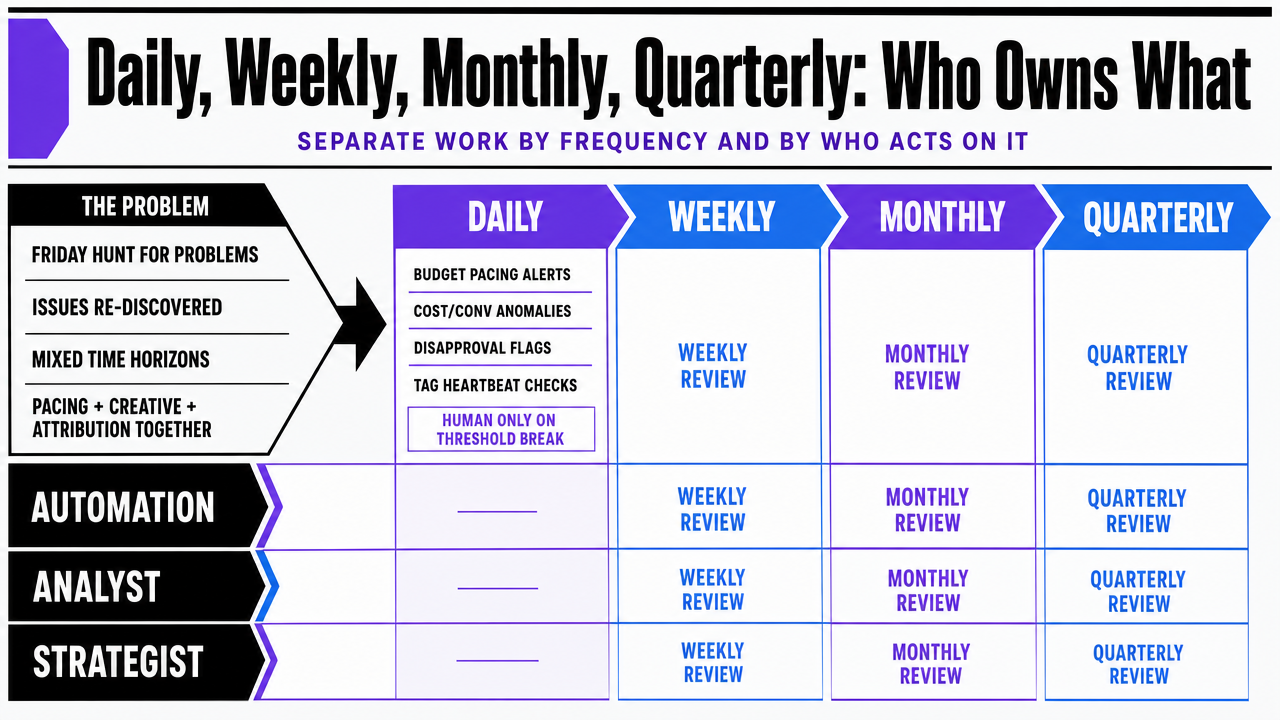 Visualize the tiered review cadence operating model described in the section, showing which work is owned by automation, analyst, and strategist seats across four time horizons
Funnel-Stage KPIs So the Cadence Has Something to React To
A cadence without a KPI assignment collapses into a single ROAS view, and a single ROAS view punishes the campaigns that are doing upper-funnel work. Awareness campaigns get killed for not producing trial signups in week two. Brand campaigns get credited with conversions they only assisted. The cadence stops being useful because every tier is reacting to the same number applied to different jobs.
Peer-reviewed work on advertising measurement makes the point that effectiveness should be evaluated by different metrics at different stages of the sales funnel, not by a single outcome variable applied uniformly 9. Translated into a SaaS account:
- Awareness campaigns are measured by reach efficiency, view-through engagement, and assisted conversion lift in branded search.
- Consideration campaigns are measured by qualified site behavior: pricing-page sessions, documentation views, session depth, and demo-page scroll.
- Conversion campaigns are measured by CPA, ROAS, and pipeline contribution against a stated target.
The methodological corollary comes from a Google Ads campaign analytics study that evaluated user acquisition together with on-site behavior rather than treating clicks as the endpoint 8. For a small team, that means the consideration-tier KPI cannot live inside Google Ads alone. The cadence has to pull GA4 engagement signals into the weekly analyst review, not just platform conversion counts, because consideration campaigns will look underperforming in the Ads UI even when they are producing the on-site behavior that precedes a demo request three weeks later.
The practical effect on the cadence is that each tier gets its own KPI dashboard view. Daily automation watches conversion-tier CPA and pacing. Weekly analyst review covers consideration-tier engagement and conversion-tier search terms. Monthly strategist review covers awareness-tier lift and the cross-funnel mix.
See How Leading Teams Automate PPC Optimization at Scale
Request a walkthrough of AI-powered workflows that minimize wasted spend and accelerate PPC campaign testing—purpose-built for agencies and enterprise marketing teams managing multiple accounts or locations.
Where AI Specialist Workflows Absorb the Repetitive Layer
The cadence in the previous section assigns roughly fifteen to twenty hours of recurring weekly work to an analyst seat that, on a two-person team, usually does not exist as a dedicated role. Search term review, negative keyword sweeps, RSA asset rotation, audience exclusion updates, pacing checks against month-to-date targets, and tracking-tag heartbeat monitoring fill that time. None of it requires strategic judgment most weeks. It requires consistency, pattern recognition across thousands of rows, and the discipline to act on small anomalies before they compound.
That is the layer where AI specialist workflows earn their place on a lean team. A search term review that takes an analyst forty minutes can run as a classification pass that flags only the queries that diverge from intent, cluster into a new theme, or exceed a cost threshold without converting. RSA asset triage stops being a manual exercise in reading thirty headlines and becomes a ranked list of which assets to retire, which to test against, and which to keep based on impression-weighted conversion contribution. Budget pacing becomes an alert with a recommended reallocation, not a spreadsheet rebuild on Thursday afternoon.
The human seats do not disappear; they move up the stack. The strategist still sets target CPAs, approves channel additions, writes the creative brief, and decides whether a campaign gets consolidated. The analyst seat, if it exists, reviews the AI-surfaced decisions before they ship. The Library of Congress measurement guide is worth keeping in view here: ROI must match campaign goals and context, which means a human still owns the definition of what good looks like 11. The repetitive analysis that proves whether the account is moving toward that definition is what gets absorbed.
Staffing Economics: In-House Pod vs. Retainer vs. AI-Assisted Execution
The economic question facing a SaaS demand gen lead at $150K per month in paid search is not which model is cheapest in absolute terms. It is which model holds management overhead as a stable percentage of media spend as the budget moves toward $300K or $500K, and which one keeps the cost shape variable rather than fixed when a product line is cut or a quarter underdelivers. SBA guidance frames the underlying test plainly: marketing and sales costs must be compared against the revenue they generate, on an ongoing basis 1. The three common staffing models hold that ratio in different ways.
An in-house pod of two PPC specialists carries the lowest variable cost per incremental dollar of spend once the seats are filled, because additional budget does not require additional headcount until the account complexity changes. The tradeoff is a fixed cost shape: two fully loaded salaries plus tooling sit on the P&L whether the account spends $80K or $200K in a given month. Management overhead, expressed as a percentage of media spend, drops as budget rises and spikes when budget contracts. Roughly fifty to seventy hours per week of human attention are committed regardless of demand.
An agency retainer flips the shape. Overhead is contractually fixed per month, often layered with per-channel or per-account-manager fees, and human attention is rationed across a portfolio of clients. The variable cost on incremental spend is low, but the floor is high, and the hours per week of senior strategist time on the account are usually in the single digits once onboarding ends.
An AI-assisted execution layer with a single strategist holds a different curve. Fixed cost is the strategist seat plus the platform fee; variable cost on incremental media spend is near zero because the repetitive analysis layer absorbs additional volume without additional hours. Human attention concentrates on decisions that affect target CPA, channel mix, and creative direction, typically eight to fifteen hours per week. The ratio of management overhead to media spend compresses as budget scales, which is the property a small team running toward $500K per month actually needs.
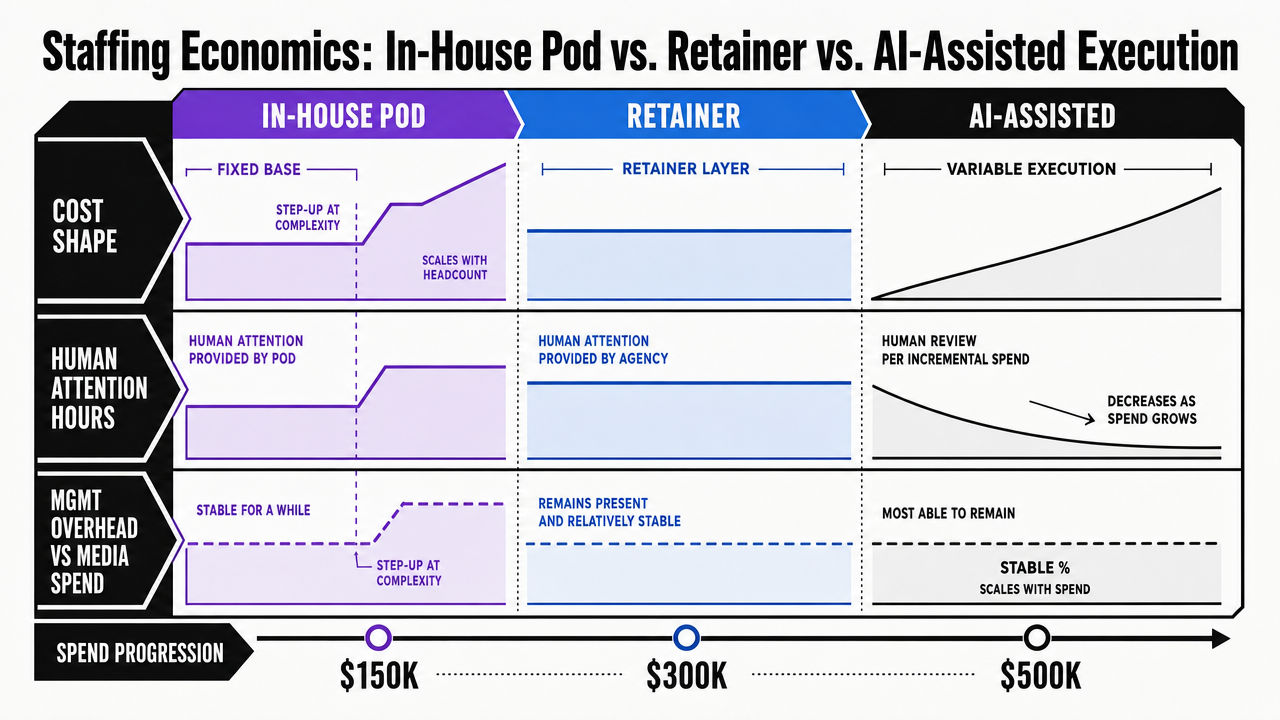 Compare the three staffing models discussed in the section across cost shape, human attention hours, and how management overhead scales with media spend
Automate Adwords Optimization Without Expanding Your Team
Access an AI-driven platform that continuously identifies wasted spend, tests new strategies, and delivers account-level insights—freeing your team from manual PPC analysis and enabling scalable campaign management across all clients or locations.
When This Operating Model Shifts: Multi-Location and Portfolio Operators
The operating model described so far assumes a single SaaS account with a coherent product taxonomy. Multi-location healthcare operators and agency portfolio managers running paid search across ten, fifty, or two hundred sub-accounts inherit a different problem shape, and the cadence has to bend before it breaks.
The core difference is that conversion signal does not consolidate cleanly across locations. A dermatology group running Google Ads for forty clinics cannot pool conversions into one campaign without losing the geographic bidding logic that makes the spend work. Each location needs its own conversion definition, its own landing page, and often its own tracking container, which multiplies the integrity surface introduced earlier. The HHS privacy assessment already flagged that conversion tracking is the layer used to determine ad effectiveness 2; at forty locations, that determination has to hold forty times without forty audits.
The cadence shifts from per-campaign to per-cohort. Weekly analyst review groups locations by performance band rather than by name, surfacing the bottom decile for action and leaving the stable middle on automated rules. Monthly strategist review covers the cohort structure itself: which locations should be promoted, demoted, or paused. Portfolio operators applying the same logic to client accounts gain the same compression, with the strategist seat acting as a portfolio manager rather than a hands-on optimizer.
Platform Concentration and the Case for Automation Literacy
One vendor controls the auction, the bidding model, the match-type behavior, and the conversion API a small team depends on. That concentration is not a new concern. Harvard Business School's library captured the argument more than a decade ago: consolidation in sponsored search raises the risk of higher advertising rates and reduced competition for advertisers 7. A two-person team cannot vote against that structure, but it can refuse to be passive inside it.
Automation literacy is the practical hedge. When Smart Bidding shifts a target CPA model mid-quarter, or broad match expansion pulls spend into queries the campaign was not designed for, the team that understands what the algorithm is optimizing toward catches the drift in the weekly review. The team that treats the platform as a black box absorbs the cost and reports it as a market change.
Reading auction insights, query reports, and bid simulator outputs as a regular practice is what keeps a lean operator in control of the variables that still belong to the advertiser: budget, target, creative, and conversion definition.
Frequently Asked Questions
References
- 1.Marketing and sales | U.S. Small Business Administration - SBA.
- 2.Third Party Websites and Applications Privacy Impact Assessment.
- 3.Know the Facts Advertising Privacy Policy - IN.gov.
- 4.Internet-Based Advertising.
- 5.CVE-2025-6201 - NVD.
- 6.Working Paper: Defining and Measuring the Digital Economy.
- 7.Google-Yahoo Ad Deal is Bad for Online Advertising - Baker Library.
- 8.Website Analytics of a Google Ads Campaign for a Men's Mental ....
- 9.Subjective or objective: How the style of text in computational ... - PMC.
- 10.Chapter 8: Marketing, Promotions, & Social Media - Mass.gov.
- 11.Metrics and Cost - Influencer Marketing: A Research Guide.