
Key Takeaways
- The agency efficiency curve plots output per labor hour against gross margin across three zones: Labor-Linear, Hybrid Drag, and AI-Redesigned, with workflow design determining position.
- Loaded labor costs for a standard production pod frequently exceed $440,000 annually for just three sourced roles, meaning six to eight retainers at $12,000 are needed before covering non-labor overhead.
- Layering AI onto legacy briefing, revision, and approval cycles produces only 0.1 to 0.6 percent productivity gains 5, while approval-first redesign compresses coordination hours where margin actually leaks.
- Repricing retainers around deliverable volume and outcome metrics, rather than hours, aligns compensation with faster turnaround and prevents efficiency gains from becoming unbilled discounts to clients.
The Math Behind a Shrinking Retainer
A $12,000 monthly retainer might seem substantial initially, but its profitability diminishes rapidly after accounting for payroll. For instance, a marketing manager earning a median annual salary of $161,030 3 and a market research analyst at $76,950 4 can quickly consume a significant portion of that retainer. When you add other essential roles like a senior copywriter, media buyer, and account director, the labor cost often outweighs the retainer, leading to a situation where the agency works for the team's expenses rather than generating profit.
This scenario highlights the core issue of shrinking retainers. Client demands have grown to include more channels, faster turnarounds, and clearer proof of business impact, while the cost of skilled labor continues to rise. This isn't a pricing or client problem; it's a workflow inefficiency that manifests as gross margin compression on the P&L, often resistant to an influx of new business.
This article will explore this phenomenon using a diagnostic framework known as the agency efficiency curve.
Defining the Agency Efficiency Curve
Output per Labor Hour as the Hidden Variable
Traditional agency metrics like revenue per employee, utilization, and effective hourly rate are merely outputs. The underlying driver for all these is output per labor hour: the volume of client-ready deliverables produced per hour of loaded labor. Gross margin is directly tied to this ratio. Increasing output per hour without increasing costs expands margins. Conversely, if output per hour remains stagnant while wages climb, margins will compress, irrespective of new client acquisition.
The U.S. Bureau of Labor Statistics (BLS) data underscores the wage pressure. Marketing managers earn a median of $161,030 3, and market research analysts earn $76,950 4. Both roles are projected to see employment growth through 2034, indicating sustained competition for talent. If agencies remain tethered to traditional brief-review-revise workflows, every annual salary increase will inevitably erode margins.
The efficiency curve visually represents this relationship, plotting output per labor hour against gross margin. An agency's position on this curve is determined by its workflow design, not by the sheer effort of its team.
The Three Zones: Labor-Linear, Hybrid Drag, AI-Redesigned
The efficiency curve is divided into three distinct zones, each characterized by a unique workflow and a corresponding margin ceiling.
Labor-Linear. In this zone, every new deliverable necessitates a proportional increase in headcount. Acquiring a second content client requires hiring another copywriter, and a third PPC account demands an additional media buyer. Margins here are primarily dictated by utilization rates and pricing discipline, with a floor set by loaded wages and no inherent operating leverage. Most agencies generating under $10 million in revenue operate within this zone.
Hybrid Drag. Agencies in this zone have adopted AI tools, sometimes extensively, but have not fundamentally altered their underlying workflows—briefs, revision rounds, status calls, and manual QA processes remain unchanged. While copywriters may draft content faster, they often face longer review cycles. Analysts might pull data more quickly, only to spend the saved time in additional meetings. Consequently, output per hour sees only modest improvements. Margins tend to remain flat or even decline, as tool subscriptions add costs without significantly reducing labor. McKinsey's research suggests that generative AI, when integrated into existing structures, may only contribute 0.1 to 0.6 percent to annual labor productivity growth through 2040 5. This represents the margin ceiling for agencies that treat AI as a mere add-on.
AI-Redesigned. This zone is characterized by a complete overhaul of the workflow, centered around approval-first execution. Recommendations, drafts, and reports are pre-assembled, allowing human talent to focus on critical judgment calls rather than production tasks. McKinsey's State of AI 2024 survey revealed that organizations applying AI to marketing and sales frequently reported revenue increases exceeding 5%, alongside cost efficiencies in service operations 12. This significant gap between the macro average and applied lift highlights the potential gains when the operating model, not just the toolkit, is transformed.
Agencies do not progress up this curve by chance. Moving between zones requires a deliberate redesign of what constitutes a deliverable, who approves it, and how team hours are allocated.
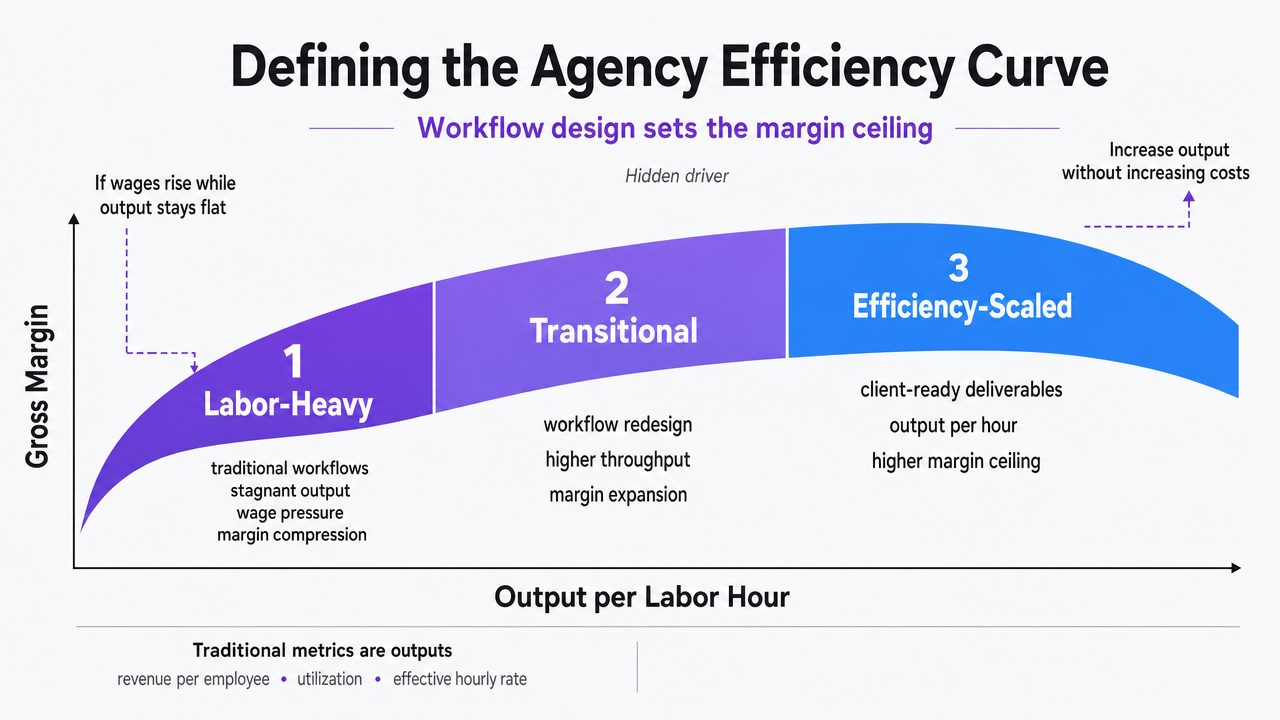 Visualize the three zones of the efficiency curve framework introduced in this section, showing how workflow design determines margin ceiling
The Labor Floor: What a Production Pod Actually Costs
Before considering AI or new tools, the labor floor fundamentally limits an agency's earning potential. This floor is not theoretical; it represents the total loaded wages for all personnel directly involved in client work, and it consistently trends upward.
Let's examine three roles closely tracked by the U.S. Bureau of Labor Statistics for agency production. In May 2024, marketing managers reported a median annual wage of $161,030 3, and market research analysts earned $76,950 4. Advertising sales agents had a median wage of $61,460, with projected employment decline of 6% from 2024 to 2034 due to automated buying platforms 11. These figures are base salaries, not loaded costs. When employer taxes, benefits, paid time off, software licenses, and a share of overhead are factored in, most agencies apply a loaded multiplier of 1.3x to 1.5x. This means a $161,030 marketing manager can cost the agency between $210,000 and $240,000 annually before any client work is even initiated.
Compiling these loaded costs for a typical production pod quickly reveals the financial challenge. A pod comprising one marketing manager for strategy, one to two research analysts for audience insights and reporting, and production roles such as a senior copywriter, designer, media buyer, and account director, can incur annual loaded costs well into the high six figures or even low seven figures before any retainers are secured. The loaded cost for just the two BLS-tracked strategy roles alone (one marketing manager and two analysts) can range from $310,000 to $370,000 per year.
This represents the labor floor. Every retainer, every billed hour, and every deliverable must exceed this cost before any margin can be realized. Furthermore, this floor increases annually. With marketing management employment projected to grow 6% through 2034 3, the associated wage pressure is a persistent factor. Agencies that maintain flat retainer pricing while this labor floor rises are, by definition, moving down the efficiency curve.
See Where Your Agency Efficiency Curve Breaks
Experience automated marketing execution and measure real efficiency gains on active campaigns in your agency workflow.
Pod Economics: Loaded Cost Against Retainer Count
Translating the labor floor into a pod-level cost provides specific insights into margin discussions. The two roles with publicly available BLS wage data form the basis of this calculation; other roles require operator input due to wide market variations in loaded rates for senior copywriters, designers, media buyers, and account directors.
The table below models a standard six-to-eight-person production pod. It uses a 1.4x loaded multiplier—the midpoint of the typical 1.3x to 1.5x range—applied to the BLS medians for the two sourced roles. This multiplier accounts for employer taxes, benefits, PTO, software, and allocated overhead. Rows for other roles are left for agency-specific input.
| Pod Role | Base (May 2024) | Loaded @ 1.4x |
|---|---|---|
| Marketing manager (1) | $161,030 3 | $225,442 |
| Market research analyst (1) | $76,950 4 | $107,730 |
| Market research analyst (2nd, optional) | $76,950 4 | $107,730 |
| Senior copywriter | enter loaded rate | — |
| Designer | enter loaded rate | — |
| Media buyer | enter loaded rate | — |
| Account director | enter loaded rate | — |
| Sourced subtotal (3 roles) | $440,902 |
The sourced subtotal alone—one marketing manager and two analysts, fully loaded—exceeds $440,000 annually before any production roles are added. Once the four production roles are included at market rates, most pods will incur annual costs in the high six to low seven figures.
To cover these costs, a pod needs approximately six to eight active accounts, each with a $12,000 monthly retainer, just to break even on labor, before considering rent, tools, sales expenses, or owner distributions. Winning more accounts with the same pricing structure will not improve the math; the solution lies in increasing the output per hour that a single pod can deliver.
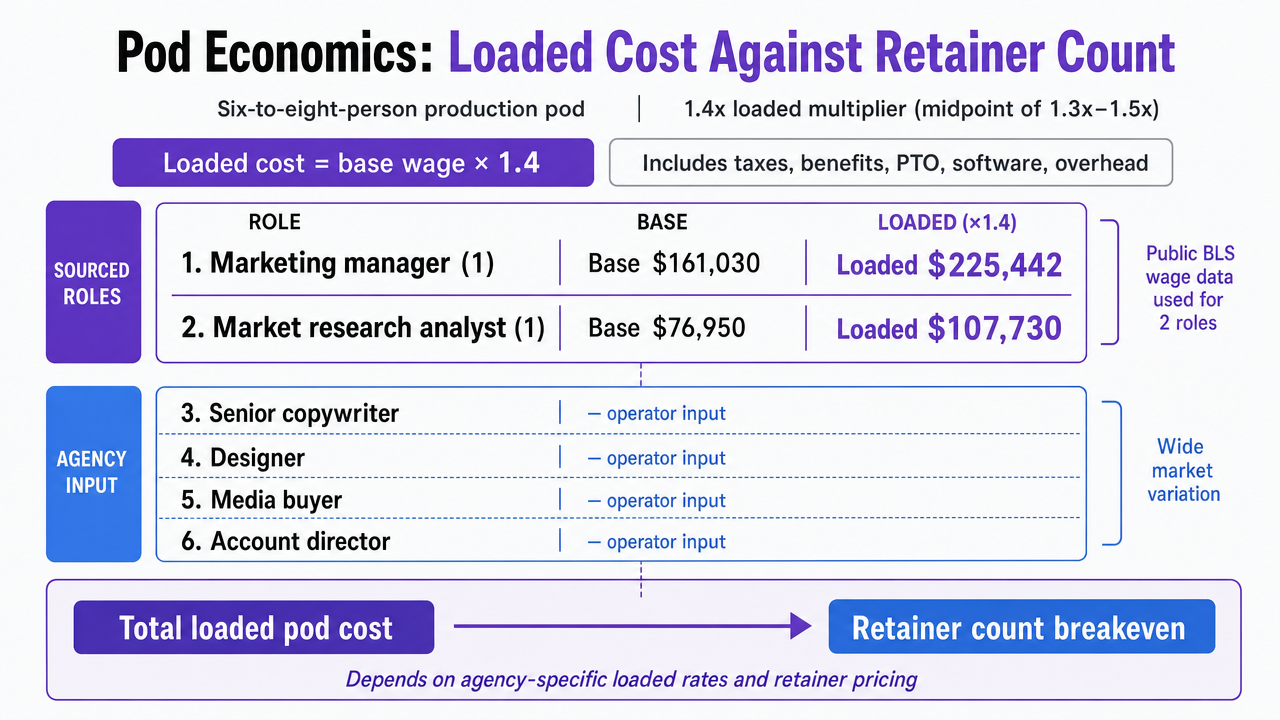 Visualize the pod cost stack and the retainer-count breakeven math described in this section
Hybrid Drag: Why Tools Layered on Old Workflow Fail
A prevalent margin trap for agencies is not the resistance to AI, but rather its adoption without corresponding workflow changes. For example, a copywriter might draft a blog post in 40 minutes instead of four hours, but if the piece then enters a five-day approval loop involving two revision rounds and a status call, the initial time savings are negated. Output per hour barely improves, and the P&L now bears additional software subscription costs on top of unchanged labor expenses.
Research supports this pattern. McKinsey's macro estimate projects that generative AI will contribute only 0.1 to 0.6 percent to annual labor productivity growth through 2040 under typical adoption scenarios 5. This range assumes AI tools are integrated into existing task structures, which is common practice for many agencies. A Harvard Professional & Executive Education review of the 2024 State of Marketing AI report similarly notes that while routine tasks like copy generation, data mining, and visual creation become significantly faster, the surrounding processes—briefing cycles, approval chains, and client reviews—often remain inefficient 10.
Hybrid drag has a distinct impact on the P&L: software costs increase, utilization appears better on paper due to reduced production hours, and the effective hourly rate might slightly improve. However, gross margin either remains flat or declines because the reclaimed hours are absorbed by meetings, communication overhead, and rework, rather than being converted into additional billable output or reduced headcount. The agency becomes faster at individual tasks but not more efficient as a business. To move up the efficiency curve, agencies must address the workflow itself, not just the tools within it.
Pinpoint Where Agency Margins Stall—And What Data-Driven Teams Do Differently
Request a personalized analysis revealing how AI-powered coordination eliminates production drag, reduces overhead, and restores margin control for agencies managing multi-channel campaigns at scale.
Where the Margin Actually Returns: Coordination, Not Creation
The initial impulse when adopting AI is to apply it to creative tasks: drafting blogs, generating ad variants, or spinning up social captions. While this is the visible work agencies are paid for, it doesn't represent the majority of labor hours. Most hours are spent in the coordination gaps between creation and delivery—briefing calls, internal reviews, client feedback loops, status updates, reformatting for multiple channels, and follow-up communications.
A Harvard Business School working paper on AI's impact on work patterns quantified this coordination drag. Among knowledge workers who frequently used an AI tool, time spent on email decreased by 31% per week, and document completion accelerated by 5% to 25% 8. The reduction in email is particularly relevant for agencies, as email often serves as a proxy for coordination inefficiencies—threads stemming from ambiguous briefs, misunderstood revision requests, or status inquiries that a shared dashboard could easily address. When coordination is compressed, reclaimed hours appear as usable blocks on the calendar, which is essential for improving utilization.
The implications for pod economics are direct. A senior copywriter who saves six hours a week from coordination can produce an additional two or three pieces of client work, or the pod can reduce the need for a coordination-heavy role without impacting creative capacity. Neither outcome materializes when AI is solely focused on drafting speed. Both become achievable when the workflow itself minimizes the areas where hours are typically lost—approvals, handoffs, and the numerous small clarifying exchanges that accumulate into significant time drains.
Margin reappears on the P&L from the same place it vanished: the coordination between people, not the individual keystrokes. Agencies that measure AI adoption solely by drafting speed will continue to miss this. Those that measure it by hours removed from coordination—shorter meetings, fewer email threads, status calls replaced by automated feeds—will see their position on the efficiency curve improve.
Task Automation Is Not Occupation Replacement
The most sensationalized aspect of the AI-in-agencies discussion often frames it as an extinction event for roles like copywriters and account managers. However, research offers a more nuanced and actionable perspective: AI automates tasks, not entire occupations. MIT Sloan's review of recent labor market research indicates that when AI can perform a majority of tasks within a job, the share of workers in that role decreases by approximately 14% 6. This is a significant shift, but far from complete replacement, and it unfolds over years, not quarters.
For agency owners, this means no single role on the pod disappears. Instead, the allocation of hours within each role changes. A senior copywriter still retains ownership of voice, argumentation, and client judgment, but the hours previously spent on mechanical first-drafting are compressed. An account director continues to manage client relationships, while the coordination involved in status updates is streamlined. A media buyer still develops bid strategies, but report assembly becomes more efficient. The pod doesn't shrink by firing a copywriter; it shrinks—if the owner chooses—by requiring fewer copywriters to manage the same account load, or by maintaining headcount while doubling the deliverable volume per retainer.
This distinction is crucial for how owners plan hiring strategies in relation to the efficiency curve. Replacing occupations is a demographic shift. Compressing tasks, however, is a workflow decision that directly impacts margin.
Compliance as a Margin Line, Not a Legal Line
While most agency owners categorize FTC compliance under legal risk, on the P&L, it functions as a margin factor. Every substantiation check, claim review, and endorsement disclosure adds hours to accounts already struggling with gross margin. These hours multiply as AI increases the volume of copy, testimonials, and ad variants flowing through the production pod.
FTC guidelines mandate that advertising claims be truthful, non-deceptive, and evidence-based, with substantiation available before a claim is run 1. In September 2024, the FTC launched Operation AI Comply, targeting companies whose AI-related marketing claims lacked sufficient proof 2. For agencies, this shifts the focus from whether QA occurs to its cost per deliverable. A manual review process—where a copywriter drafts, an account director checks, a legal or client-side reviewer approves, and revisions are sent back—can turn a 40-minute AI-drafted piece into a five-day bottleneck. When multiplied across a pod producing ten times the volume enabled by AI, QA can become the single largest source of hybrid drag.
Governed approval workflows transform this cost structure. When substantiation, disclosure rules, and claim history are integrated into the same system that generates the draft, the review process shifts from a coordination problem to a straightforward sign-off. Compliance work still happens, but it no longer consumes the pod's valuable marginal hours. Agencies relying on manual QA incur a hidden efficiency tax on every AI-generated asset. Conversely, agencies with structured approval loops convert regulatory requirements into a repeatable, low-cost step, thereby protecting both margin and client relationships.
Quantify and Correct Inefficiencies in Your Agency Workflow
Get actionable benchmarks and AI-driven recommendations to pinpoint where production costs erode your margins—so you can recapture efficiency and scale client delivery without extra headcount.
Redesigning the Workflow: Approval-First Execution
The transition from Hybrid Drag to AI-Redesigned is not about choosing a tool, but about redefining the role of human judgment in the production sequence. The traditional model involves humans initiating work: a strategist writes a brief, a copywriter drafts, a reviewer edits, and an account director routes to the client. Each step is a manual action, with coordination occurring between every stage. In contrast, an approval-first model inverts this sequence. Recommendations, drafts, target lists, and reports arrive pre-assembled with their underlying rationale. The human role is compressed to a single, high-value action: approve, revise the direction, or reject. Execution then proceeds automatically upon sign-off.
The economic impact of this shift is structural. McKinsey's State of AI 2024 survey found that organizations leveraging AI in marketing and sales frequently reported revenue increases exceeding 5%, alongside cost benefits in service operations 12. These gains materialize when AI handles the assembly work, freeing humans to make judgment calls related to brand voice, strategy, client risk, and brand fit. The pod maintains creative control but stops expending its most expensive hours on the mechanical tasks surrounding it.
Three key shifts define this redesign in practice:
- First, briefs evolve from documents written by strategists into inputs that a system reads directly from live account data.
- Second, reviews transform from meetings into sign-offs against queued recommendations with visible rationales.
- Third, reporting shifts from a weekly assembly task to a continuous feed linked to the KPIs established in the retainer.
Each of these changes eliminates a category of coordination hours from the pod's weekly schedule.
The outcome aligns with what the efficiency curve rewards: fewer hours per deliverable, increased deliverables per pod, and a governance trail that satisfies both client oversight and regulatory substantiation without adding review cycles. The pod retains ownership of its core creative work, while the workflow absorbs the tasks that were silently eroding margins.
Repricing Around Output, Not Hours
The final, often delayed, step in shifting the efficiency curve is altering how retainers are structured. Hourly billing and headcount-based retainers traditionally embedded the pod's labor floor into every proposal. However, once workflows are streamlined and a pod can deliver more per hour, hourly logic penalizes the agency for its own efficiency gains. The faster the team becomes, the fewer hours it can bill for the same deliverable.
Output-based pricing reverses this dynamic. The retainer specifies the deliverables the client will receive—e.g., published pieces, launched campaigns, scored calls, pipeline movement—and the pod's economics are tied to delivery, not timesheets. McKinsey's research on B2B sales productivity found that top-quartile performers generate approximately 2.5 times the gross margin per sales dollar compared to bottom-quartile peers, a difference driven by operational discipline rather than pricing tactics 7. A similar principle applies to agency retainers: pods with the highest margin per retainer dollar are not necessarily charging more, but rather delivering more per hour and pricing accordingly.
Three repricing strategies emerge from this approach:
- First, link retainer tiers to deliverable volume and outcome metrics, rather than staffing plans.
- Second, eliminate hourly change-order language for AI-assisted work, pricing revisions as flat units instead.
- Third, define scope in quantifiable units that clients can easily track, ensuring that faster turnaround becomes a value-added feature for which the pod is compensated, rather than an unbilled discount.
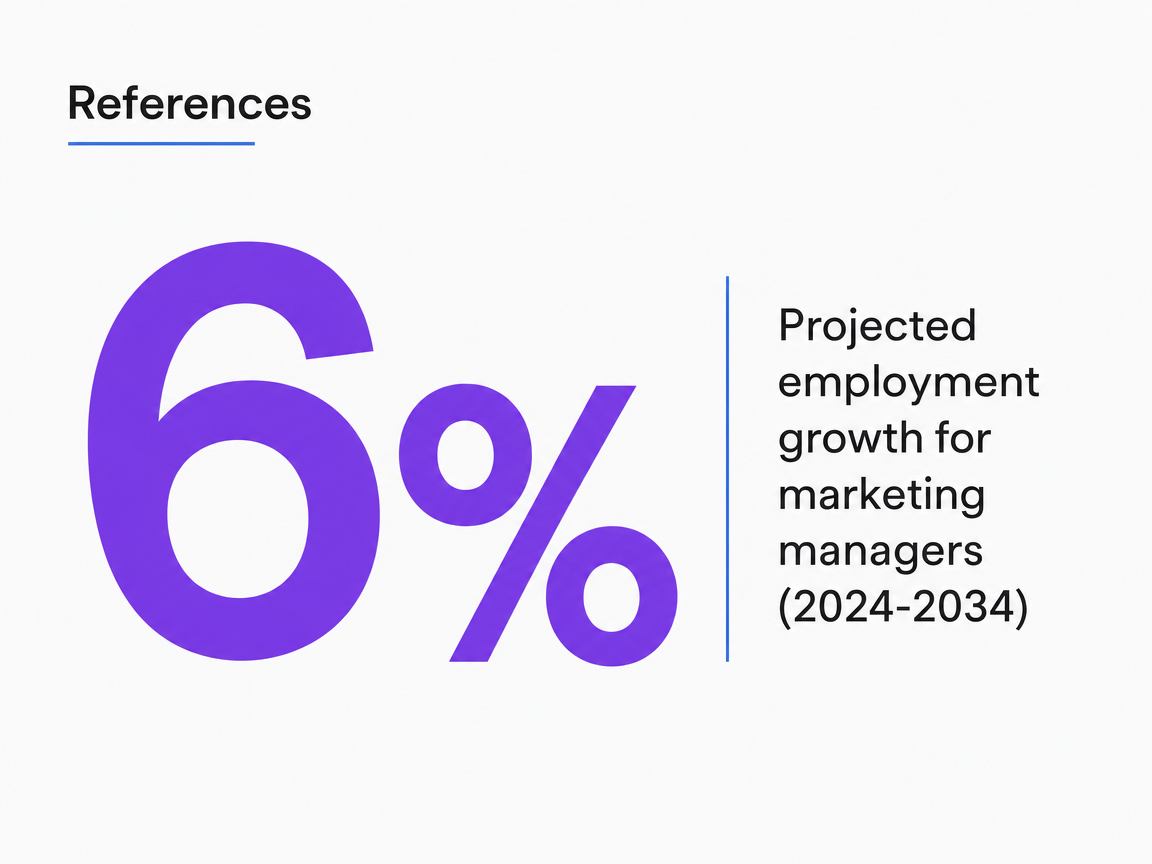 Projected employment growth for marketing managers (2024-2034)
Projected employment growth for marketing managers (2024-2034)
Frequently Asked Questions
References
- 1.Advertising and Marketing.
- 2.FTC Announces Crackdown on Deceptive AI Claims and Schemes.
- 3.Advertising, Promotions, and Marketing Managers.
- 4.Market Research Analysts.
- 5.The economic potential of generative AI: The next productivity frontier.
- 6.How artificial intelligence impacts the US labor market.
- 7.How top performers outpace peers in sales productivity.
- 8.Shifting Work Patterns and Productivity with AI.
- 9.Online Advertising and Marketing.
- 10.AI Will Shape the Future of Marketing.
- 11.Advertising Sales Agents.
- 12.The State of AI in Early 2024.