
Key Takeaways
- Automating the client reporting loop recovers the 4-12 hours per account per month spent pulling data and drafting monthly decks, freeing senior time for interpretation.
- Specialist AI drafting splits first-draft production from editorial judgment, letting writers move from three long-form pieces a week to eight without gutting quality.
- Standardizing briefs and prefilling them from prior client data eliminates the revision rounds and translation meetings that quietly consume account lead capacity.
- A PSA backbone makes utilization, realization, and account-level margin visible weekly, so repricing, restaffing, and killing loss-making retainers happen while numbers can still move.
- Internal AI enablement built around prompts, workflows, and quality gates outperforms buying more seats, since only 17% of sales and marketing pros get job-specific AI training 3.
- Shifting senior producers from drafting to judgment work protects realized rates and retention, but only if the comp model stops rewarding billable output.
- Connecting research, drafting, and QA agents across the workflow eliminates the handoff tax that single-tool deployments leave untouched 12.
- Measuring ROI on decision quality alongside hours saved captures the compounding gains — better pitch win rates, retention, and campaign performance — that pure productivity metrics miss 13.
- Scanning the AI tools category honestly means matching specialist, horizontal, or coordinated execution platforms to the actual operational bottleneck rather than the shiniest option.
- Reframing capacity around agentic execution loops instead of FTEs is where the ten plays converge, letting agencies stop hiring linearly with revenue 9.
Why the Efficiency Gap Is an Operating Model Problem
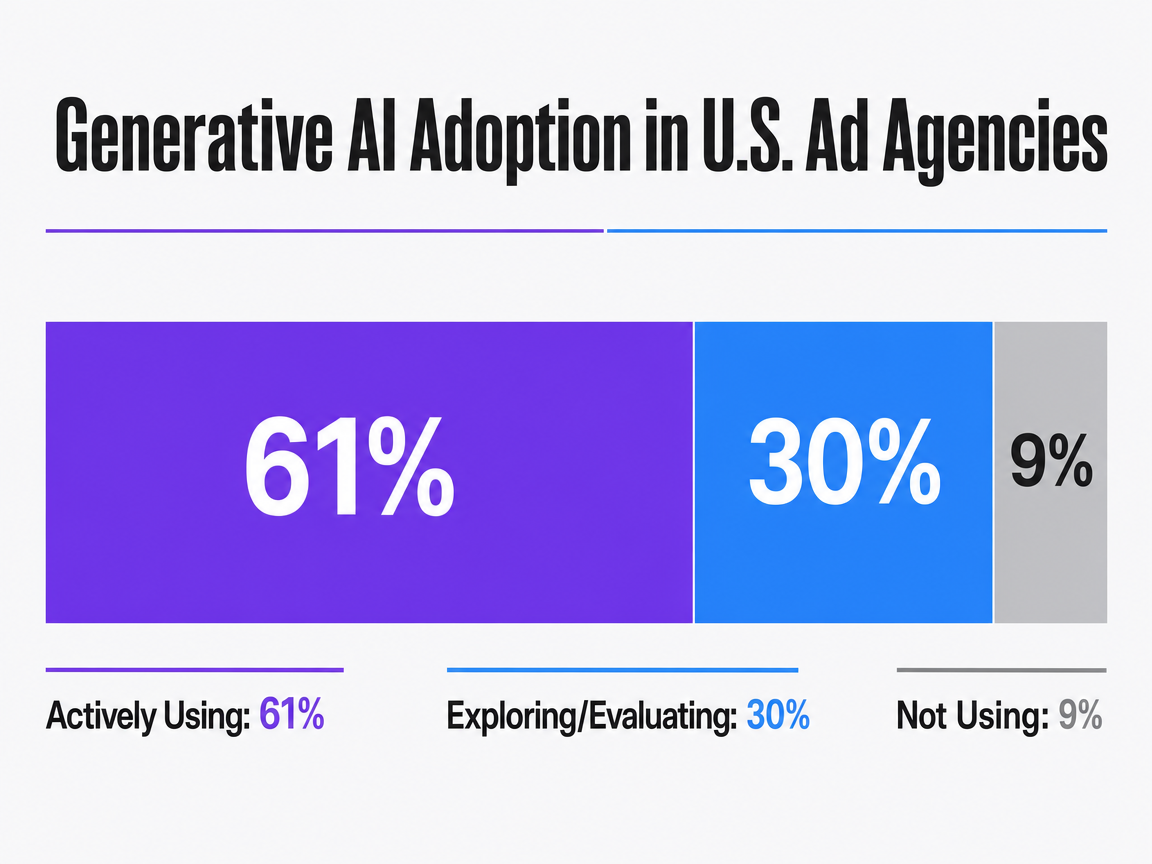
Generative AI is no longer a differentiator inside U.S. marketing agencies. Forrester's 2025 read on the category puts 61% of U.S. ad agencies in active use, 30% exploring or evaluating, and only 9% not using generative AI at all 1. When 91% of the field is already inside the tent, tool adoption stops being the variable that separates efficient agencies from bloated ones.
The variable that still moves margin is how the work is organized around those tools. Most agencies bolted AI onto sequential production: strategist briefs writer, writer drafts, editor reviews, PM assembles the deck, account lead presents. Insert a drafting model and each step gets a little faster, but the handoff tax, the status meetings, and the rework cycles all survive intact.
The agencies compressing cost-to-serve have done something harder. They redesigned the loop so specialist AI handles drafting, data pulls, and reporting, and senior humans concentrate on judgment calls and client approvals. The rest of this piece works through ten plays that shift an agency from AI-as-feature toward AI-as-operating-model, ranked by margin impact and how hard they are to actually ship.
 Generative AI Adoption in U.S. Ad Agencies
A breakdown of generative AI adoption among U.S. advertising agencies, based on a Forrester report. The data shows 91% are either using or exploring AI, with 61% actively using it.
How to Read the Ten Plays: Margin Impact vs. Implementation Difficulty
The ten plays that follow are not equal, and they are not interchangeable. Some can be shipped inside a quarter with the tools an agency already owns. Others require rewiring how work moves between strategists, producers, and account leads — closer to a nine-month change program than a Q3 initiative.
Two axes matter when reading them. The first is margin impact: how directly the play reduces hours-per-deliverable, lifts utilization, or protects gross margin per account. The second is implementation difficulty: how much operating model change, tooling investment, and senior time it demands before the savings show up in the P&L. McKinsey's 2025 read on enterprise AI captures the tension — most organizations report use-case-level gains, but only a minority have redesigned work enough to see full business impact 11.
Plays 1 through 3 sit in the low-difficulty, fast-payback quadrant. Plays 4 through 7 demand more coordination but move margin more permanently. Plays 8 through 10 are structural. Read them as a sequence, not a checklist.
Trial Run: Streamline Agency Workflows in Days
Experience measurable efficiency gains by executing real client campaigns with full workflow automation for seven days.
Ten Efficiency Plays for Modern Agencies
Play 1 — Automate the Client Reporting Loop
Reporting is the single most repeatable production task inside most agencies, and it is where the fastest margin recovery hides. Pulling GA4, GSC, ad platform, and call-tracking data into a monthly deck consumes 4 to 12 hours per account per month across analysts, PMs, and account leads. Multiply that across a 40-account book and the reporting loop alone can absorb an entire FTE at senior rates.
The play is straightforward: connect data sources to a templated report engine, let AI generate the narrative summary against a house style, and route the draft to an account lead for a 15-minute review instead of a half-day build. Deloitte's 2026 enterprise read shows why the payback is fast — 66% of organizations already report productivity gains from AI, with reporting and analytics near the top of the list 13.
The honest counterpoint: regulated verticals — legal, behavioral health, healthcare — still need a human layer on any claim language before the report reaches the client. Automate the pull and the draft; keep senior eyes on the interpretation.
Play 2 — Compress Content Production With Specialist AI Drafting
Content is where most agencies burn their junior hours and where AI drafting has the cleanest before/after picture. Harvard's executive education group puts it plainly: routine tasks like writing copy, mining consumer data, and creating visuals that once took hours can now be done in minutes with AI 10. The delta is not a rounding error — it is the difference between a writer producing three long-form pieces a week and eight.
The efficiency comes from splitting drafting from judgment. A specialist model handles the first draft against a brief, a house voice guide, and the SEO parameters. A senior editor spends the saved time on structural edits, subject matter accuracy, and the strategic angle. Cost-per-deliverable drops because the writer is no longer staring at a blank page; the editor is no longer rewriting from scratch.
Where this play breaks: technical verticals with heavy SME input. If every draft needs a physician, attorney, or licensed clinician to validate substance, AI compresses the drafting hours but not the review bottleneck. Route those workflows through SME-first briefs rather than SME-last edits, or the savings evaporate at the review gate.
Play 3 — Standardize Briefs and Kill Discovery Rework
The cheapest efficiency play is the one nobody wants to run: fixing the brief. Rework driven by ambiguous inputs — vague goals, missing brand guardrails, undefined success metrics — is one of the largest hidden costs in agency delivery. It shows up as revision rounds, kickoff meetings that should have been documents, and account leads translating between clients and producers.
The move is to lock a single brief template per service line, prefill it with client-side data the agency already holds (past campaigns, brand voice, audience segments, KPI history), and require sign-off before any production hour is logged. AI can populate 60 to 80% of the fields from prior work, leaving the strategist to validate and add the strategic angle.
The counterpoint worth naming: templates that are too rigid produce generic work. The template is a floor, not a ceiling. Senior strategists should still add the sharp angle that separates a mediocre campaign from a good one — the brief just stops eating their morning.
Play 4 — Invest in a PSA Backbone for Utilization and Margin Visibility
Most agencies cannot answer three questions in real time:
- which accounts are underwater,
- which people are underutilized, and
- which service lines carry the fattest margin.
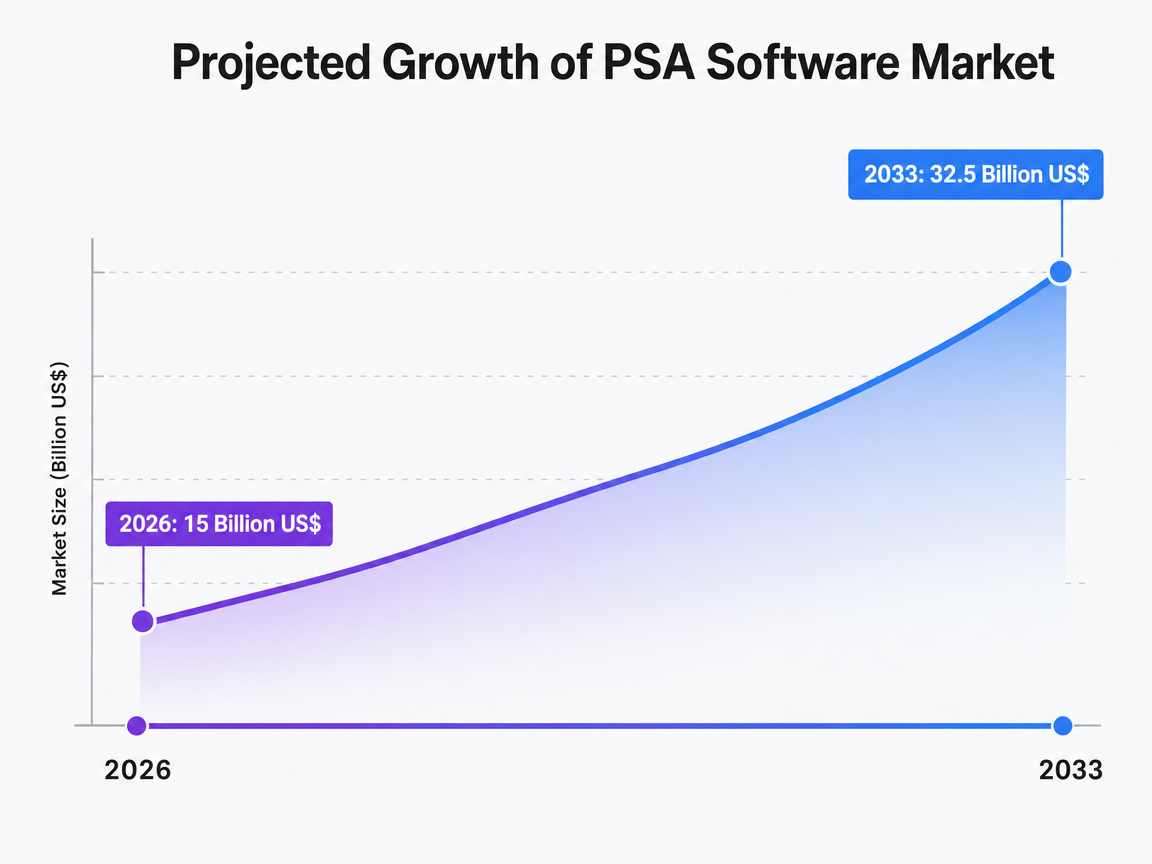
Professional services automation platforms exist to answer those questions, and peer investment is accelerating. The global PSA software market is projected to grow from $15.0 billion in 2026 to $32.5 billion by 2033, an 11.7% CAGR 6. Agencies are voting with capex.
The play: instrument time, project scope, and revenue against a single ledger. Once utilization, realization, and account-level margin are visible weekly rather than at quarter-close, the operating decisions that protect margin — repricing a scope, moving a producer, killing a loss-making retainer — get made when they can still move numbers.
PSA is not a small lift. Implementations run three to nine months, adoption depends on discipline, and the ROI shows up after teams actually change how they log work. The counterpoint: for shops under 15 people, a well-configured project tool plus a monthly margin review may deliver 70% of the value at 10% of the cost. Match the tool weight to the operation.
Play 5 — Build Internal AI Enablement Instead of Buying More Seats
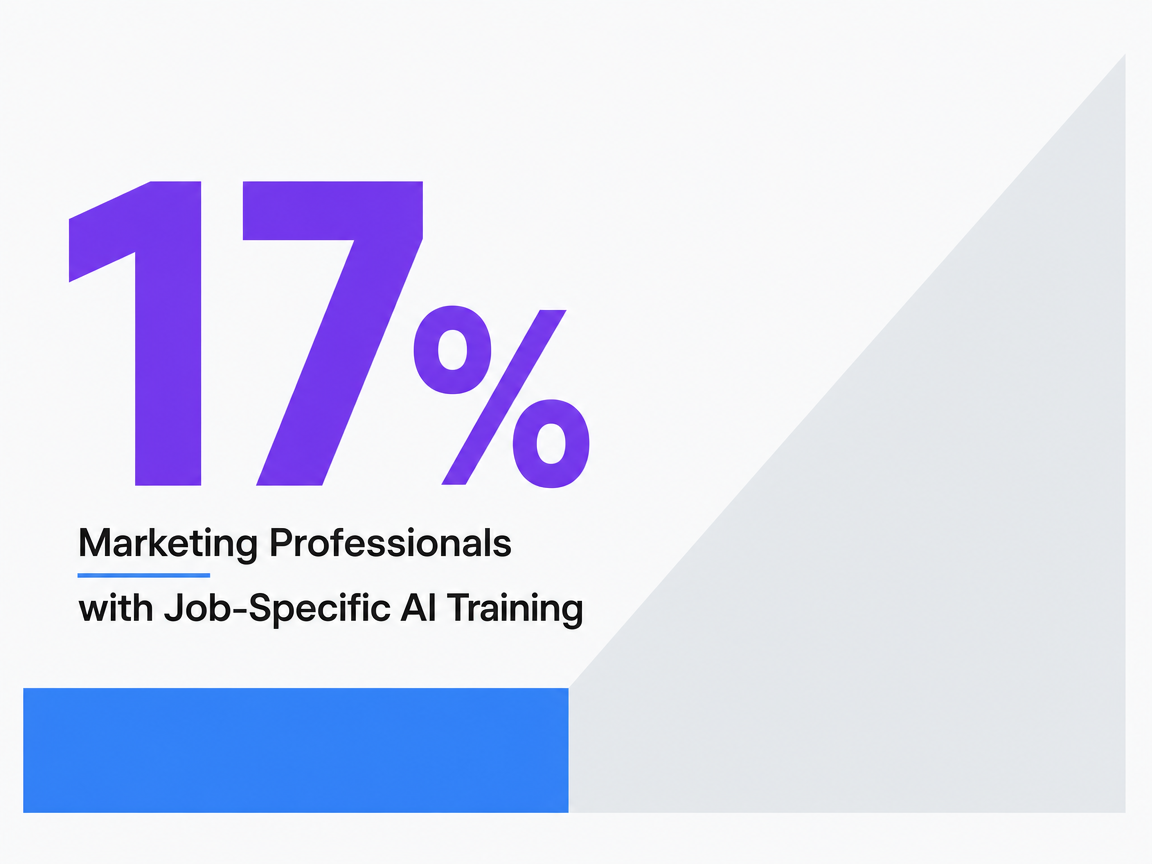
Buying every producer a seat on a generative AI tool and calling it a rollout is the most common — and most expensive — mistake in the category. Only 17% of sales and marketing professionals report having received comprehensive, job-specific training on AI 3. The other 83% are extracting a fraction of the tool's value while the license fees compound.
The play is enablement, not procurement. Build a small internal library of prompts, workflows, and quality checkpoints tuned to the agency's actual service lines. Pair every new AI tool rollout with a two-week structured onboarding: what the tool does well, where it fails, which review gates catch its failure modes. Measure adoption by workflow completion, not login frequency.
Where this play stalls: agencies that treat enablement as an L&D project rather than an operational one. If the person running enablement does not sit inside production, the training drifts from the actual work. Anchor enablement to the senior producers who own delivery quality; their prompts and playbooks become the house standard.
Play 6 — Shift Senior Talent From Output to Judgment
The economics of senior time have inverted. When a strategist could bill $250 an hour for producing a deck, output was the product. When AI produces a competent first draft of that deck in 20 minutes, the billable value shifts to what the strategist adds on top: the sharp diagnosis, the counterintuitive recommendation, the read of a client's actual business situation.
The play is deliberate: pull senior producers out of drafting rotations and put them on client judgment work — quarterly business reviews, positioning debates, escalated account calls. Backfill the drafting with AI plus mid-level editors. Agencies that make this shift protect senior retention (the work gets more interesting) and lift realized rates (the output is harder to commoditize).
The trap: promoting the shift without changing the comp model. If senior producers still get measured on billable hours, they will hoard drafting work to hit their number. Retool the scorecard around client outcomes, retention, and account margin, or the org chart will fight the operating model.
Play 7 — Connect Agents Across the Workflow, Not Just Inside One Task
Most AI deployments inside agencies are point solutions: a drafting tool, a research tool, a reporting tool, each sitting on a different login with a different data model. PwC frames the same gap from the other side: few businesses are connecting agents across workflows and functions, even though that is where the real value sits 12.
The play is integration, not tool proliferation. A research agent that hands its output to a drafting agent that hands its output to a QA agent — with human approval gates in between — compresses cycle time far more than any single tool can. The handoff is where hours die in most agencies, and the handoff is exactly what agent chains eliminate.
The honest limit: connected agent workflows require clean data plumbing and clear approval schemas. Agencies without a canonical source of truth for briefs, brand guidelines, and client accounts will find their agents disagreeing with each other. Fix the data model before wiring the agents.
Play 8 — Measure ROI on Decision Quality, Not Just Hours Saved
Hours saved is the easiest AI metric to report and the least interesting one to a P&L. A more useful frame comes from Deloitte's 2026 enterprise study: 53% of organizations cited improved insights and decision-making from AI 13. The decision-quality number is where compounding returns live.
The play is to track both, separately:
- On the productivity side: hours per deliverable, cycle time, cost-per-report, cost-per-content-piece.
- On the decision-quality side: win rate on pitches informed by AI research, campaign performance versus prior-quarter baseline, client retention on accounts using AI-driven recommendations, average time from insight to action.
Where agencies get this wrong: they instrument productivity because it is easy and stop there. The problem is that productivity gains are largely one-time — you compress the hours, and that is the ceiling. Decision-quality gains compound because better decisions produce better client outcomes, which produce longer retention and higher expansion. Report both to the leadership team monthly. If the decision-quality metrics do not move after 12 months, the AI investment is being used defensively, not offensively.
Play 9 — Scan the Category Honestly Before You Buy
The AI marketing tools category is crowded and getting more so, with the broader AI-in-marketing market projected to reach $217.33 billion by 2034 7. That growth is producing three distinct kinds of platforms agency owners should be able to distinguish before writing any checks.
- The first is single-function specialists — Jasper, Copy.ai, Surfer, Clearscope on the content side; Semrush and Ahrefs with expanding AI features on the SEO side. These are strong at one task and cheap to trial, but they leave the integration problem to the agency.
- The second is horizontal AI platforms like ChatGPT Enterprise and Claude for Work, which give producers general-purpose capability but no service-line-specific workflows.
- The third — the newer category — is coordinated AI execution platforms that connect specialist agents across services with human approval gates. Vectoron sits here, positioned around six specialist strategists (content, SEO, PPC, backlinks, social, call intelligence) routed through a unified approval workflow.
The honest guidance: match the category to the operating gap. If the bottleneck is drafting speed, a specialist tool is enough. If the bottleneck is coordination between drafting, publishing, and reporting, the specialist tool will not fix it. Diagnose the actual constraint before buying the shinier platform.
Play 10 — Reframe Capacity Planning Around Agentic Execution Loops
The final play is the hardest and the most valuable: stop planning capacity in FTE-equivalents and start planning it in execution loops. BCG frames the operating-model version of this argument directly — the real opportunity lies in AI's ability to help marketing leaders reinvent their entire operating model to generate more profitable growth, not just faster campaigns 9.
Traditional capacity planning asks how many writers, strategists, and PMs the agency needs to service its book. Agentic capacity planning asks how many concurrent execution loops the agency can supervise — where each loop is a research-to-draft-to-QA-to-publish sequence run by AI with humans at approval gates. A senior producer who used to manage two accounts can supervise six or eight loops when the drafting and reporting hours are absorbed by agents.
This is where the ten plays converge. Automated reporting, compressed drafting, standardized briefs, PSA visibility, connected agents, and judgment-focused seniors are not separate initiatives — they are the components of an operating model where the unit of capacity is a loop, not a person. Agencies that get here stop hiring linearly with revenue. That is the margin unlock the tactical plays only hint at.
See Real-World Agency Efficiency Gains in Action
Request a walkthrough of operational playbooks and workflow automations that leading agencies use to cut production overhead and increase delivery speed—supported by before-and-after metrics.
If You Manage Multiple Locations: The Consolidation Economics
Where the Efficiency Math Changes for Multi-Location Operators
A note on audience: the plays above apply to any mid-sized agency, but the economics tilt hard when the client is running 20, 80, or 400 locations. Owners servicing law firm networks, DSO groups, senior living portfolios, or regional home services chains face a different constraint — the same campaign structure has to run across every location with local variants, local KPIs, and local pipeline data.
In that model, the efficiency question stops being "how do we produce faster?" and becomes "how many locations can one senior strategist supervise before quality slips?" Multi-location guidance from Outliant argues for centralized CRM, marketing automation, and project management tooling paired with location-specific KPIs like conversion rate, CAC, and local engagement 8. Centralization is the only way the per-location cost curve bends.
The plays that matter most here are automated reporting, standardized briefs, PSA visibility, and connected agent workflows. Skip drafting compression on its own — it does not solve the coordination tax that is eating margin across a 100-location book.
Manual Pods vs. PSA-Templated vs. AI-Orchestrated: A Directional Comparison
The table below is directional, not prescriptive. It uses variables the operator supplies (location count, current hours per location per month, current $/location/month) and expresses the three delivery models in relative terms. Absolute dollar figures depend on the agency's utilization baseline and blended rates, so those are left to the reader. The PSA market context — $15.0B in 2026 growing to $32.5B by 2033 at 11.7% CAGR 6 — signals where peer investment is flowing.
| Delivery Model | Hours per Location / Month | Locations per Senior Supervisor | Directional Gross Margin Swing |
|---|---|---|---|
| Manual pod (account team per cluster) | Baseline (100%) | 15–25 | Baseline |
| PSA + templated production | ~60–70% of baseline | 30–50 | +5 to +12 points |
| AI-orchestrated approval workflow | ~30–45% of baseline | 60–100+ | +12 to +25 points |
Two honest caveats. First, the ranges assume a clean data model — briefs, brand guardrails, and account-level KPIs living in one system rather than scattered across drives. Agencies missing that foundation will not hit the top of the AI-orchestrated range regardless of tooling. Second, regulated verticals (legal, healthcare, behavioral health) compress the upper bound because human review gates are non-negotiable on claim language and clinical content. The margin swing is still real; it just lands closer to the middle of the range.
The operational takeaway: the shift from manual pods to PSA-templated is a tooling and process change. The shift from PSA-templated to AI-orchestrated is an operating model change. Owners servicing multi-location books should sequence in that order — templating first, orchestration second — or the agent layer will amplify whatever coordination problems already exist.
 Projected Growth of PSA Software Market
Forecast for the Professional Services Automation (PSA) software market, projected to grow from US$ 15 billion in 2026 to US$ 32.5 billion by 2033.
See Real-World Agency Efficiency Gains in Action—Free Trial Access
Benchmark your agency’s workflows against AI-driven efficiency models. Get immediate access to approval-first automation, transparent performance reporting, and proven strategies that reduce production overhead without compromising quality or client oversight.
Sequencing: What to Do This Quarter vs. This Year
Ten plays is a lot to hold at once. The practical sequence is narrower than it looks. In the next 90 days, an agency owner should ship the low-difficulty, fast-payback trio: automated reporting, brief standardization, and structured AI enablement for the senior producers who own delivery quality. Those three move hours out of the P&L before the fiscal year closes and require no operating model change.
Inside the next 12 months, the harder work sits in PSA instrumentation, the senior-to-judgment shift, and connected agent workflows. These demand comp changes, data-model cleanup, and approval schemas that survive contact with production. Sequence templating before orchestration — agents amplify whatever coordination problems already exist.
The 24-month horizon is where capacity gets replanned around execution loops rather than headcount. That is the operating-model move BCG argues actually moves enterprise value, not just campaign speed 9. Owners who ship the tactical trio this quarter earn the credibility — and the margin room — to fund the structural work next.
 Marketing Professionals with Job-Specific AI Training
Marketing Professionals with Job-Specific AI Training
Frequently Asked Questions
References
- 1.The State Of Generative AI Inside US Marketing Agencies, 2025.
- 2.The Transformative Impact of Generative AI on Marketing Agencies.
- 3.How AI Is Redefining Marketing Agency Value (and How To Adapt).
- 4.AI in 2024: Marketing's Mindful Machine Makeover.
- 5.How AI Is Transforming Marketing (2024).
- 6.Professional Services Automation Software Market Trends, 2033.
- 7.10 Eye Opening AI Marketing Stats | Digital Marketing Institute.
- 8.The Secrets to Successful Multi-location Business Marketing.
- 9.From Campaigns to Business Value: How AI Will Transform Marketing.
- 10.AI Will Shape the Future of Marketing.
- 11.The state of AI in 2025: Agents, innovation, and transformation.
- 12.AI agent survey.
- 13.The State of AI in the Enterprise, 2026.