
Key Takeaways
- AI-generated production kits collapse the brief-to-first-draft cycle, turning 40-hour drafting into an 8-hour approval loop and multiplying deliverable volume without adding senior headcount.
- Agentic orchestration replaces linear campaign builds with parallel execution, accelerating campaign creation and execution by ten to fifteen times when workflows are redesigned around approval gates 4.
- Reallocating senior hours away from review queues into strategy and validation captures the margin gain, since AI-assisted skilled work showed a 38% performance lift in controlled research 10.
- Consolidating the martech stack behind a single approval layer raises approval density by removing context switching between tools, addressing the fragmentation Forrester flags as the main adoption barrier 1.
- Shifting pricing and staffing from per-hour billables to per-approval throughput lets agencies either raise output per account or reprice on outcomes rather than surrender margin gains.
- Measuring delivery on cost per deliverable, cycle time, and client-reported quality exposes the gap McKinsey found between the 80% chasing efficiency and the 39% reporting EBIT impact 5.
- Redeploying talent into strategy and account expansion, not backfill, compounds revenue per account, aligning with patent research showing AI often augments rather than displaces skilled workers 16.
- Standardizing governance with logged approvals, explicit scope, and visible reasoning protects client trust so autonomous execution steps do not erode retention when errors occur 12.
- Unifying content, SEO, PPC, social, and call intelligence under one AI approval workflow is the structural redesign MIT Sloan links to maximum value from AI 11.
Why margin math has changed for independent agencies
Forrester projects that US advertising agencies and related services firms will shed roughly 32,000 jobs to automation by 2030, or 7.5% of the workforce 13. This projection signals a shift in the labor content of deliverables, suggesting that the cost of production is about to fall. Agencies that redesign their delivery processes to leverage AI will capture the difference between traditional pricing and new, lower costs.
The pressure on independent agency margins stems from a fundamental change in production costs, not just retainer compression. MIT Sloan research indicates that AI creates the most value when organizations redesign workflows around it, rather than simply integrating tools into existing processes 11. Agencies that use generative AI merely as a copy assistant will see minimal gains. Those that rebuild their delivery flow around AI execution, with human oversight, will achieve significant throughput improvements.
The IAB's 2025 report confirms this trend, noting that agencies and publishers have adopted AI in media campaigns at a higher rate than brands, primarily focusing on efficiency 9. This indicates a shifting competitive landscape that agencies must adapt to.
The following nine examples illustrate how agencies can leverage AI, ranging from low-friction task automation to complete operating model redesign. Each example addresses a specific margin mechanic:
- throughput per approver
- cycle time
- cost per deliverable
- senior-hour reallocation
- stack consolidation
These examples serve as a diagnostic framework rather than a prescriptive menu.
Test Real-Time Agency Workflow Automation Now
Experience measurable efficiency gains by running live client campaigns during your trial—no commitments required.
Nine examples of AI leverage for agencies
Collapse the brief-to-first-draft cycle with AI-generated production kits
The most accessible margin improvement involves eliminating the time lag between an approved brief and a usable first draft. Traditionally, this period includes kickoff calls, junior research, moodboarding, and initial drafts that often require significant strategist rewrites. While labor-intensive, much of this work doesn't directly contribute to what the client values.
AI-generated production kits significantly shorten this gap. A single prompt sequence, incorporating the brief, brand voice guidelines, and previous deliverables, can generate a starter package including an outline, draft copy, visual direction, and initial headlines or ad variants. This allows strategists to begin with a structured foundation rather than a blank page. Harvard's executive education group highlights that AI is already transforming marketing by automating repeatable analytical and creative tasks, from lead scoring to campaign generation 17.
The primary margin mechanic here is cycle time. A process that once took 40 hours from brief to draft can become an 8-hour approval and refinement loop. This enables the same team to handle five times the deliverable volume with consistent senior utilization. The Forrester agency genAI report identifies organizational barriers, not technical ones, as the main hurdle to adoption 1. For this approach to succeed, teams must view the first draft as a starting point for refinement, not a creative territory to defend. Agencies that overcome this psychological barrier will quickly realize throughput gains.
Replace linear campaign builds with agentic orchestration
A linear campaign process—moving sequentially from brief to strategy, creative, media plan, trafficking, and QA—is inherently inefficient. Each handoff introduces delays, requires re-explaining context, and can lead to version inconsistencies. Agentic AI addresses this by executing these steps in parallel. AI agents can simultaneously manage audience selection, creative variations, channel-specific adaptations, and initial media plans.
McKinsey estimates that agentic systems can accelerate marketing campaign creation and execution by ten to fifteen times 4. This acceleration applies to agentic systems that orchestrate multi-step workflows, not just single content generators. The benefit is measured in campaign creation and execution speed, translating to improved cycle time and throughput per team.
MIT Sloan explains that agentic AI executes multi-step plans, utilizes external tools, and interacts with digital environments, allowing it to manage more of the fulfillment sequence rather than isolated tasks 12. This means media planners don't wait for creative teams, and traffickers don't wait for final copy. Work progresses in parallel with agent-produced first passes, and human approvers intervene at critical decision points.
The pitfall is treating agentic AI as merely a faster copywriter. The true benefit emerges when the entire campaign workflow is redesigned for parallel execution with approval gates, rather than simply speeding up one step in an outdated sequence. BCG emphasizes the importance of redesigning end-to-end creative and media processes over optimizing individual campaigns 6.
Reallocate senior hours away from review queues
Senior time represents the most expensive input on an agency's P&L and is frequently misallocated. In traditional models, principals and senior strategists spend significant billable hours reviewing junior work, marking up drafts, and managing revisions. This is an internal cost, not a service clients directly pay for.
Once AI handles initial production, a clear opportunity arises for reallocation. Seniors can shift from correcting drafts to focusing on shaping inputs and validating outputs at decision points. The margin mechanic here is senior-hour reallocation: the same senior headcount can produce more strategic work weekly because review queues are significantly reduced.
It's crucial to understand where AI provides genuine assistance. MIT Sloan research found a 38% performance increase among skilled workers using GPT alone, and a 42.5% increase when GPT output was combined with a human-written overview 10. However, the same study noted performance declines when AI was used outside its capability boundaries. This research focused on discrete knowledge-worker tasks, not comprehensive strategic judgment.
This finding suggests a routing rule: senior review adds value when applied to tasks within AI's capability, where models produce credible drafts that benefit from expert refinement. Conversely, human review of AI output for tasks outside this boundary can degrade quality below what a strategist would produce from scratch. Efficiency gains require senior judgment to identify which tasks are suitable for AI. Agencies that manage this routing effectively can convert review time into pipeline development, new service design, or account expansion.
Consolidate the martech stack behind a single approval layer
Agencies often accumulate numerous tools: content platforms, SEO suites, ad managers, social schedulers, multiple analytics dashboards, and project management tools. The CMO Survey indicates that companies allocate approximately 19.9% of marketing budgets to martech, projected to reach 30.9% within five years, yet struggle with underutilization and measuring impact 8.
The efficiency gain isn't about reducing software purchases, but about routing all software outputs through a single approval layer. When recommendations, drafts, and executions from various specialist domains—like SEO briefs, ad copy, backlink targets, and social calendars—converge in one interface for approval, the switching cost between tools becomes negligible. Approvers no longer need to reconstruct context across multiple tabs.
The margin mechanic is approval density: the number of approved decisions a senior can make per hour when coordination overhead is removed. Forrester's genAI agency report identifies organizational fragmentation as a primary adoption barrier 1. A consolidated approval layer structurally resolves this fragmentation, reducing the need for excessive meetings.
A simple diagnostic is to count how many separate interfaces a senior interacts with to ship a single deliverable. If the answer is more than two, the agency is incurring unnecessary costs due to an inefficient stack.
Convert per-hour billable work into per-approval throughput
Traditional agency P&Ls are based on blended hours: senior and junior rates multiplied by their respective hours and utilization, minus overhead. While this model still governs pricing and staffing for many independent shops, it no longer accurately reflects how work is produced.
When AI generates first drafts, media plans, keyword clusters, or ad variants, the labor content of a deliverable is no longer measured in hours. Instead, it's measured in approvals: the number of decisions a senior signs off on daily, the context required for each approval, and the automated steps that follow.
A directional unit-economics comparison is valuable. A traditional deliverable might involve four junior hours plus one senior review hour, priced at a blended rate. An AI-orchestrated equivalent might require only fifteen minutes of senior approver time and automated execution, with no junior hours. The key variables are utilization, approver density, and cost per approval, with dollar figures depending on each agency's rate card. The underlying pattern remains consistent.
PwC's ANA-linked analysis describes this shift as moving beyond sequential campaign processes, balancing human judgment with AI to drive measurable value 15. This creates two pricing strategies: maintain rates while increasing output per account, growing revenue without additional headcount; or reprice based on outcomes, which demands the measurement discipline discussed next. Agencies that continue to price by hours while producing via approvals effectively give away margin gains. The goal of redesign is to capture these gains, not to forfeit them.
Measure delivery on outcomes AI-agent adopters actually report
Efficiency claims without a robust measurement framework are merely internal marketing. AI adoption intensifies this problem because throughput gains can be substantial enough to be obscured by vanity metrics if not closely monitored.
PwC's survey of AI-agent adopters offers a useful reporting benchmark. Among executives whose organizations have deployed AI agents, 57% reported cost savings, 55% reported faster decision-making, and 54% reported improved customer experience 2. While these are self-reported outcomes from broad AI agent adopters, not specific to agency delivery, they indicate which metrics are valued by early adopters.
For an agency, this translates to three key metrics for monthly operations reviews:
- Cost per deliverable, benchmarked against pre-AI baselines
- Cycle time from brief to publish, measured in business days
- Client-reported quality and responsiveness, sampled quarterly
McKinsey's 2025 AI survey highlights a critical warning for any measurement effort: 80% of respondents set efficiency as an AI objective, but only 39% reported EBIT impact at the enterprise level 5. This gap between stated objectives and realized margin is where many implementations fail. For agencies, this means celebrating faster drafts while net income remains unchanged. The three metrics above are designed to bring this discrepancy to light.
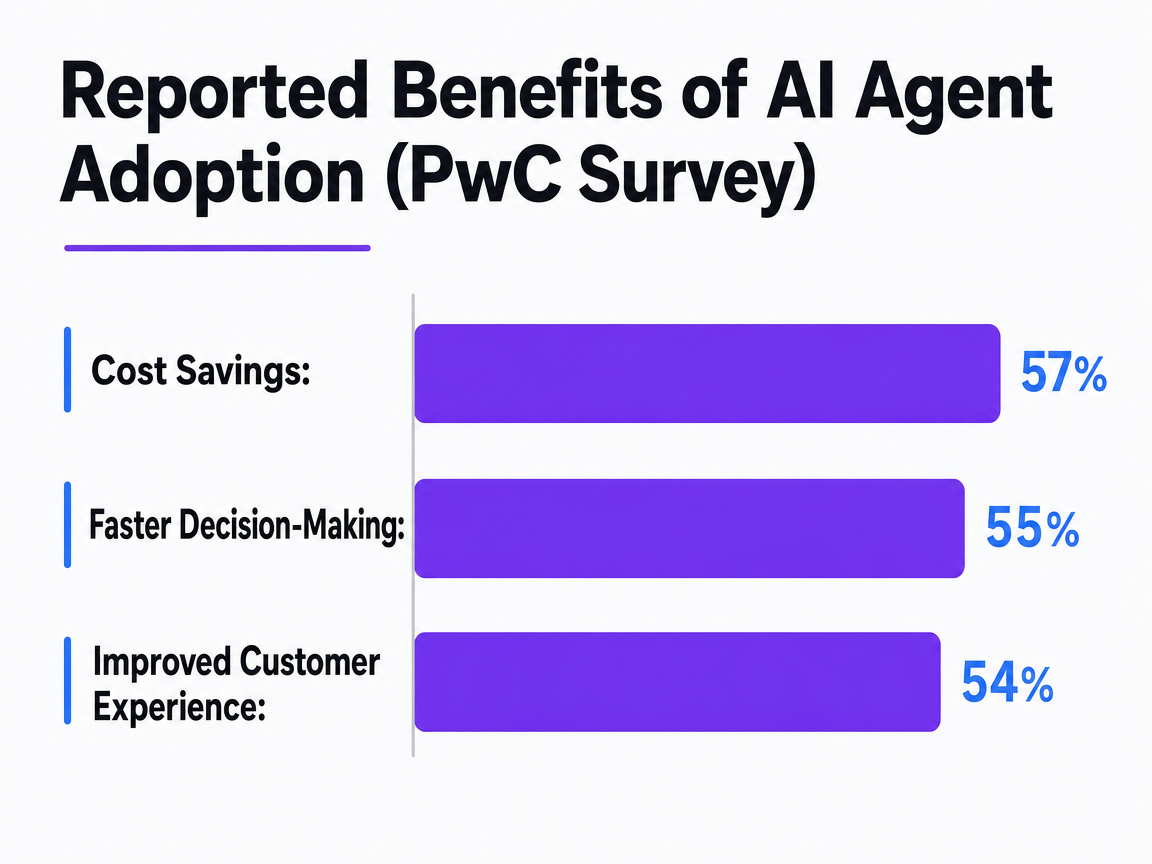 Reported Benefits of AI Agent Adoption (PwC Survey)
A PwC survey of AI-agent adopters shows the percentage of respondents reporting key business benefits.
Redeploy talent into strategy and account expansion, not backfill
The immediate reaction to AI absorbing production work is often headcount reduction. This overlooks the true drivers of agency revenue. Independent agencies grow by expanding existing accounts, adding new services, and moving into higher-value strategy work that clients previously handled internally. These growth opportunities are lost if talent capable of driving expansion is let go.
A Georgia State University study analyzing patent data on generative AI innovations found that many AI innovations augment workers, leading to higher employment for those with new skills, rather than displacing them 16. While this finding applies broadly, the operating pattern is directly relevant to agencies. Firms that use AI to increase output while redeploying talent into higher-value roles experience growth. Firms that use AI solely for one-time cost savings will find themselves competing on a smaller service offering.
Ideal redeployment targets are roles often understaffed in independent shops:
- senior strategists for quarterly business reviews
- analytics leads for custom measurement frameworks
- account directors for architecting service expansions
The strongest production talent should be moved into these roles. The margin mechanic here is revenue per account, which compounds over time, unlike one-off cost savings from headcount reductions.
Standardize governance so autonomous steps stay inside client trust
Autonomous execution without proper governance risks client relationships. The efficiency gains from AI orchestration are sustainable only if clients trust that nothing ships without accountable human sign-off. This trust erodes quickly if unreviewed content, ad copy, or outreach messages reach the market with factual errors or off-brand tones.
In an AI-orchestrated workflow, governance is not an afterthought but an integral part of the workflow structure. This includes defining which steps require approval, who approves them, what information the approver sees, and what is logged. MIT Sloan's coverage of agentic AI emphasizes that guardrails, KPI design, and controls are essential to prevent misinterpretations of benefits 12.
Three practices are crucial:
- every recommendation should include its underlying reasoning, allowing approvers to evaluate the logic, not just the output;
- approvals must be logged with timestamps and approver identity for accountability;
- and approval scope must be explicit, meaning approvers sign off on specific artifacts, not general permissions for AI to continue producing similar work.
The margin implication is client retention. Agencies that implement AI-produced work under a documented approval structure will retain clients through the transition. Those relying on implicit trust will face retention costs when errors occur. In this model, governance is not overhead; it is the mechanism that ensures durable throughput gains.
Unify the operating model around one AI approval workflow
While the first eight examples address specific margin levers, the ninth is structural: unifying the entire delivery operation around a single approval workflow. This workflow should span content, SEO, PPC, backlinks, social, and call intelligence, with specialist AI generating recommendations and human approvers providing sign-off within one interface.
MIT Sloan's workflow research directly supports this, stating that AI delivers maximum value when organizations redesign workflows, not just automate individual tasks 11. An agency operating separate approval loops for content, paid media, SEO, and social tools is merely automating tasks. An agency that routes all specialist domains through a unified command center, where recommendations are ranked, approved, and executed in a single queue, has fundamentally redesigned its workflow.
This structural change alters the margin math significantly. Approval density increases due to the elimination of context switching. Cycle time decreases as handoffs between specialist domains are removed. Senior hours are reallocated because there's one consolidated review queue instead of many. Measurement becomes clearer as every decision, execution, and outcome resides within a single system of record.
Platforms like Vectoron are designed around this pattern, utilizing specialist AI strategists across major channels and routing all recommendations through a single approval layer before execution. The key question for agencies is not which platform to choose, but whether they are willing to redesign their operating model rather than simply adding more tools to an outdated one. BCG's analysis of AI-first operating models suggests that operational scale, large teams, and expensive coordination overhead become less critical as this model is adopted 7. The efficiency gains from the first eight examples are real, but the compounding benefit comes from integrating them into a unified delivery architecture.
See Real-World Agency Efficiency in Action—Scale Client Delivery Without Extra Overhead
Request a walkthrough of AI-powered workflows proven to reduce production bottlenecks, coordinate multi-channel execution, and protect margins—all designed for agencies managing high-volume client portfolios.
If you manage a multi-brand or holding-company portfolio
For principals managing multiple agencies or specialty brands under a holding structure, the efficiency calculus shifts. At this level, the primary cost is often duplication, not production.
A typical holding structure often features parallel finance, HR, and delivery leadership across each agency, along with separate martech stacks. The CMO Survey indicates martech accounts for roughly 19.9% of marketing budgets, projected to reach 30.9% within five years 8. This spend is rarely consolidated across multiple brands, as each agency often defends its unique tooling as part of its identity.
The strategic move at the portfolio level is to implement one shared AI approval workflow across all brands. Brand voice, client governance, and pricing can remain distinct at the account layer. BCG's analysis of AI-first operating models highlights that operational scale and extensive coordination overhead diminish in importance with this shift 7. For a portfolio owner, this translates to a single delivery architecture supporting multiple client-facing brands, with a significantly smaller shared services footprint.
See Real-World Agency Efficiency Wins in Action
Access a library of data-backed operational playbooks and workflow automations designed for agencies aiming to increase delivery speed, reduce production costs, and improve margin—without additional headcount.
Where these examples fail: the jagged frontier caveat
None of the nine examples are universally applicable. MIT Sloan's controlled research on skilled workers showed a 38% performance increase with GPT alone and 42.5% when combined with a human-written overview, but also documented performance declines when AI was applied outside its capability boundary 10. The current capabilities of AI models are uneven, and tasks that appear similar to strong AI performance can sometimes fall outside its effective range.
For agencies, three failure patterns frequently emerge:
- AI-generated media strategy in regulated industries where nuance is critical for compliance;
- creative concept development for brands whose voice relies on cultural specificities not internalized by the model;
- and measurement synthesis for accounts where the causal link between spend and outcome is genuinely ambiguous.
In these scenarios, automating for throughput can degrade the deliverable below what a human strategist would produce.
The operational solution is a routing rule, not a complete halt. Agencies should quarterly map their deliverable inventory against AI's current capabilities, moving tasks between AI-orchestrated and traditional paths as model capabilities evolve.
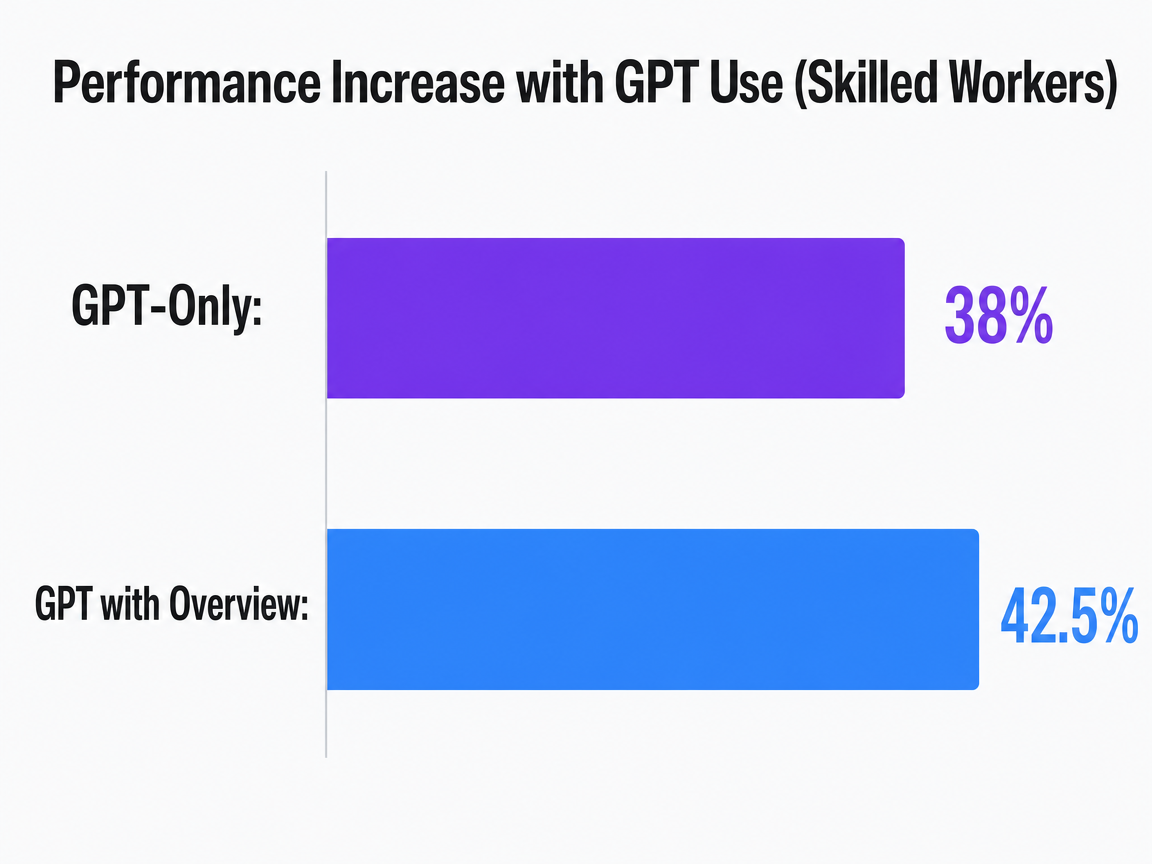 Performance Increase with GPT Use (Skilled Workers)
A study reported by MIT Sloan found that using GPT improved performance for highly skilled workers by 38%, and by 42.5% when the AI output was paired with a human-written overview.
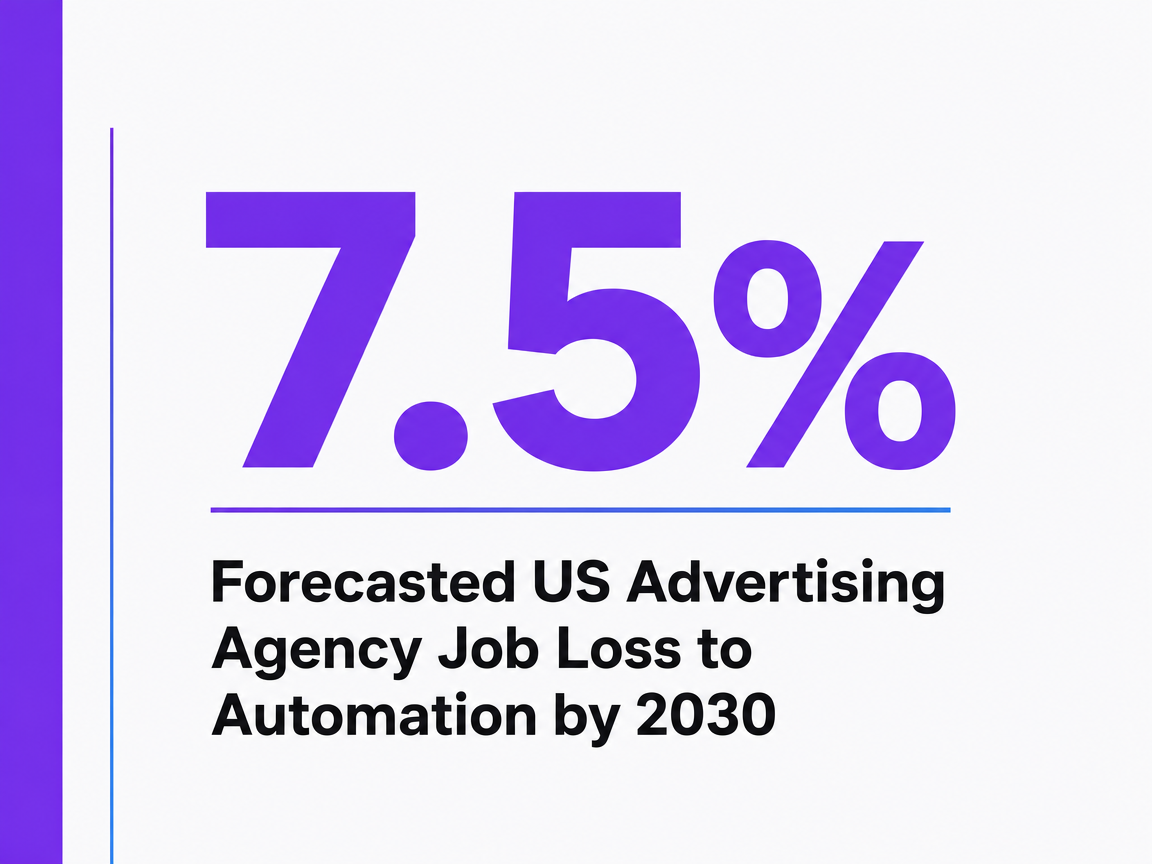 Forecasted US Advertising Agency Job Loss to Automation by 2030
Forecasted US Advertising Agency Job Loss to Automation by 2030
Frequently Asked Questions
References
- 1.The State Of Generative AI Inside US Marketing Agencies, 2025.
- 2.AI agent survey: PwC.
- 3.The economic potential of generative AI: The next productivity frontier.
- 4.Reinventing marketing workflows with agentic AI.
- 5.The State of AI: Global Survey 2025 - McKinsey.
- 6.From Campaigns to Business Value: How AI Will Transform Marketing - BCG.
- 7.How Companies Can Prepare for an AI-First Future.
- 8.The CMO Survey: Marketers Spend on New Technologies as They Battle Usage and Impact - Duke/Fuqua.
- 9.State of Data 2025: Evolution of AI for Media Campaigns.
- 10.How generative AI can boost highly skilled workers' productivity.
- 11.How AI is reshaping workflows and redefining jobs - MIT Sloan.
- 12.Agentic AI, explained.
- 13.Advertising Agencies In The US Will Automate 7.5% Of Jobs By 2030.
- 14.Robots and the Economy - The Role of Automation in Driving ....
- 15.Marketing in the AI era: To matter more or cost less? - PwC.
- 16.New Study Reveals Generative AI Boosts Job Growth and Productivity.
- 17.AI Will Shape the Future of Marketing.