
Key Takeaways
- Margin leaks between the pitch and invoice, where briefing translation, status reconciliation, and revision loops consume billable time that never reaches a client deliverable.
- Four levers compound only when pulled together: utilization as a diagnostic signal, operating-model redesign around value streams, agentic AI inside production, and outcome-based pricing.
- Under hours-based retainers, efficiency shrinks revenue; outcome-based pricing inverts the arithmetic so productivity gains flow into margin instead of foregone invoice hours.
- Start narrow: pick one account, map its value stream, and route briefing, revision, and QA cycles through approval-governed agents before renegotiating pricing across the book.
Where Agency Margin Actually Leaks
Margin does not disappear at the pitch or the invoice. It bleeds out between them, in the space where briefs get rewritten, status calls run long, and revision rounds pile up against a fixed retainer. Most owner-operators can already name the leaks: the account manager translating a client email into a brief, the strategist reviewing the brief the account manager wrote, the specialist waiting on assets, the QA pass that catches what the last handoff missed. Every one of those steps is billable internally and unbillable externally.
The uncomfortable arithmetic is that the classic efficiency playbook—tighter timesheets, better project management, a new PM tool—works on the symptoms and leaves the mechanism intact. Production capacity is still a function of headcount. Revenue is still a function of hours. Efficiency gains cannibalize the top line.
The agencies holding 15–25% net margins in 2025 are treating the problem as an operating-model question, not a discipline question. That means redesigning how internal and external capabilities are configured to deliver work 2, replacing manual briefing and production cycles with agentic workflows 6, and shifting how the work is priced so productivity stops eating revenue. The rest of this piece breaks down where that redesign actually happens, and what each lever is worth when it stacks on the others.
The Diagnostic: Four Compounding Levers
Why Utilization Alone Stopped Scaling Margin
Healthy production shops still aim for 50–80% billable utilization on producers and 15–25% net margin at the firm level. Those ranges are the industry-referenced ceiling, not a starting line. An agency already operating at 72% utilization with 19% net margin has almost nowhere left to push through discipline alone. The next point of billable time comes out of QA, strategy, or someone's evening.
The ceiling is arithmetic. Under an hours-based retainer, revenue scales linearly with billable hours logged, while the useful work embedded in those hours has been climbing far faster than hours have. A senior strategist reviewing an AI-drafted brief in fifteen minutes produces the same client-facing artifact that used to consume two hours of a coordinator's time. Under hours-based pricing, that productivity gain shows up as lost revenue, not expanded margin.
Delivery KPIs designed around utilization also miss the shift. Deloitte's operating-model work argues that sustainable performance depends on measuring value streams and delivery outcomes rather than input hours 9. Agencies still running the old scoreboard—hours logged, utilization percentage, revenue per head—are optimizing a system whose ceiling was set before AI agents entered the delivery stack. The diagnostic has to move upstream, to how work is structured and priced in the first place.
The Four Levers That Compound
Four levers move margin in 2025, and they compound only when pulled together. Isolated, each one produces a bump and stalls. Stacked, they reset the delivery economics of the firm.
- Utilization discipline as a signal. Utilization stops being a target and becomes a diagnostic instrument—a way to detect where coordination overhead, revision loops, or unclear scope are eating capacity. The metric points at the leak; it does not close it.
- Operating-model redesign around delivery. The configuration of internal teams, external partners, and AI capabilities has to be built for the work the agency actually ships, not the org chart it inherited. Deloitte frames the modern operating model as connected, dynamic, and ecosystem-based, refined iteratively rather than launched as a multi-year program 2. McKinsey adds that operating-model redesign is now the mechanism organizations use to close the gap between strategy and delivered performance 3.
- Agentic AI inside production. AI agents absorb the briefing, drafting, coordination, and QA cycles that historically sat between strategy and shipped work. McKinsey characterizes agentic workflows as accelerators of campaign delivery when governed properly 6, and treats agents as integrated workflow partners rather than point tools 7.
- Outcome-based pricing. Pricing on results rather than hours converts every productivity gain from a revenue subtraction into a margin addition. Without this lever, the first three cap out fast.
The rest of the article takes each in turn.
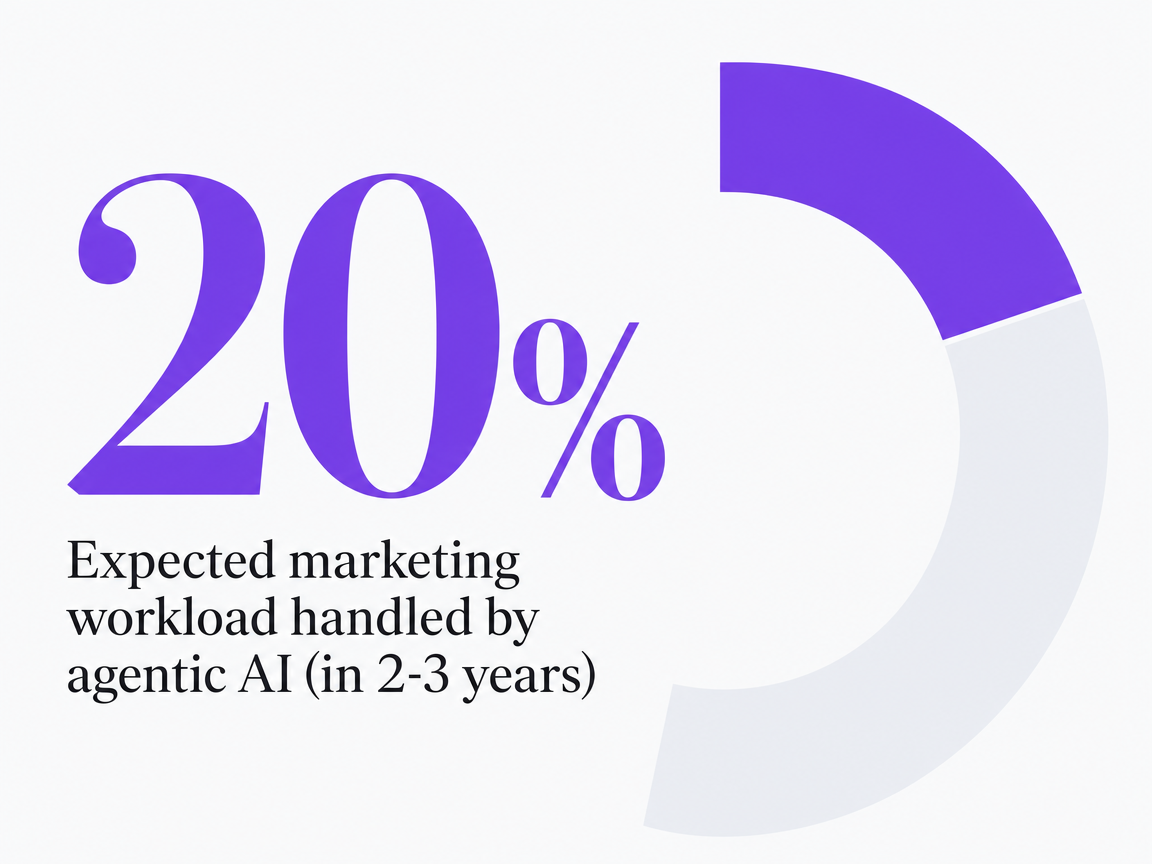 Expected marketing workload handled by agentic AI (in 2-3 years)
Expected marketing workload handled by agentic AI (in 2-3 years)
Test AI-driven agency workflows with real campaigns
Experience measurable efficiency gains by executing and publishing actual client content during your free trial.
Utilization Discipline as a Signal, Not a Target
Utilization taken as a target creates a predictable failure mode: producers pad time to hit the number, coordinators book internal reviews to fill gaps, and the metric climbs while margin flattens. Utilization taken as a signal does the opposite. It becomes an instrument for locating where coordination overhead, revision loops, and unclear scope are draining capacity that never reaches a client deliverable.
The reframing matters because the underlying benchmark ranges have not moved much. Production staff still cluster in the 50–80% billable band, and firm-level net margin still sits in the 15–25% range for well-run shops. What has changed is the interpretation. When a strategist's utilization spikes to 85% for three weeks, the useful question is no longer whether the number is high enough. It is which account, which brief, and which revision cycle absorbed the surge—and whether that pattern is repeating across the book.
Deloitte's product operating model framework treats delivery KPIs as instruments tied to value streams rather than headcount productivity 9. Applied to an agency, the shift looks like this: replace "hours logged per producer" with "hours per shipped asset by account," then watch which accounts drift outside the expected band. Drift usually points at scope creep, undertrained coordinators, or briefing friction that hours-based dashboards mask.
Discipline still matters. The next efficiency gain, though, comes from acting on what utilization data reveals about the delivery stack—not from squeezing another point out of the producers already inside the band.
Operating-Model Redesign Around Delivery, Not Departments
From Service Lines to Value Streams
Most agency org charts are still drawn as service lines: an SEO pod, a paid pod, a content team, a social team, each with its own lead, its own utilization dashboard, and its own briefing template. The client, meanwhile, does not buy SEO. The client buys qualified pipeline, booked appointments, or ranked pages that convert. The gap between how the work is organized internally and how value is consumed externally is where most coordination overhead accumulates.
Deloitte's framing is direct: an operating model is the configuration of internal and external capabilities into the optimal design for executing work necessary to meet customer needs, and effective models are connected, dynamic, ecosystem-based, and refined iteratively rather than launched as a static program 2. Applied to an agency, that means reorganizing around value streams—qualified leads for a legal client, booked consults for a behavioral health group, ranked commercial pages for a home services multi-location—rather than around the disciplines that happen to contribute to each.
McKinsey adds the mechanism. Operating-model redesign is how organizations close the gap between strategy and delivered performance, using iterative design refinement rather than one-shot restructuring 3. For an agency, the iteration usually starts with a single account: map the value stream end-to-end, identify where handoffs cross service-line boundaries, and collapse the coordination layer that exists only because the org chart demanded it. The service lines do not disappear; they stop being the unit of delivery.
Shared Services, Delivery KPIs, and Ownership Choices
Once value streams replace service lines as the unit of delivery, the supporting scaffold has to change with them. Deloitte's product operating model framework names the pillars that matter most for agencies rethinking production: value streams, a fit-for-purpose operating model, integrated shared services, delivery KPIs, and streamlined tools 9. Read as an agency scaffold, that translates into four concrete redesign decisions.
- Integrated shared services. Research, brand governance, analytics, and QA stop living inside each service pod and consolidate as shared capabilities that every value stream draws on. The duplication tax—three versions of the same competitor research, four different QA checklists—comes off the books.
- Delivery KPIs tied to outcomes. Hours logged and utilization percentage give way to metrics attached to what the value stream produces: cost per shipped asset, cycle time from brief to publish, KPI movement per account. Utilization stays on the dashboard as a signal, not the scoreboard.
- Streamlined tools. The stack collapses toward fewer, more integrated systems. Every additional tool adds a coordination surface; agencies running twelve point solutions across five pods are paying for the seams.
Ownership is the fourth choice, and Deloitte treats it as a first-order question: who owns digital and AI capability, how it reports, and how it is embedded across the organization 10. For most agencies, that resolves into a single call—whether AI capacity sits inside a central production function or gets distributed into each value stream. Both work; picking one and staying committed matters more than the choice itself.
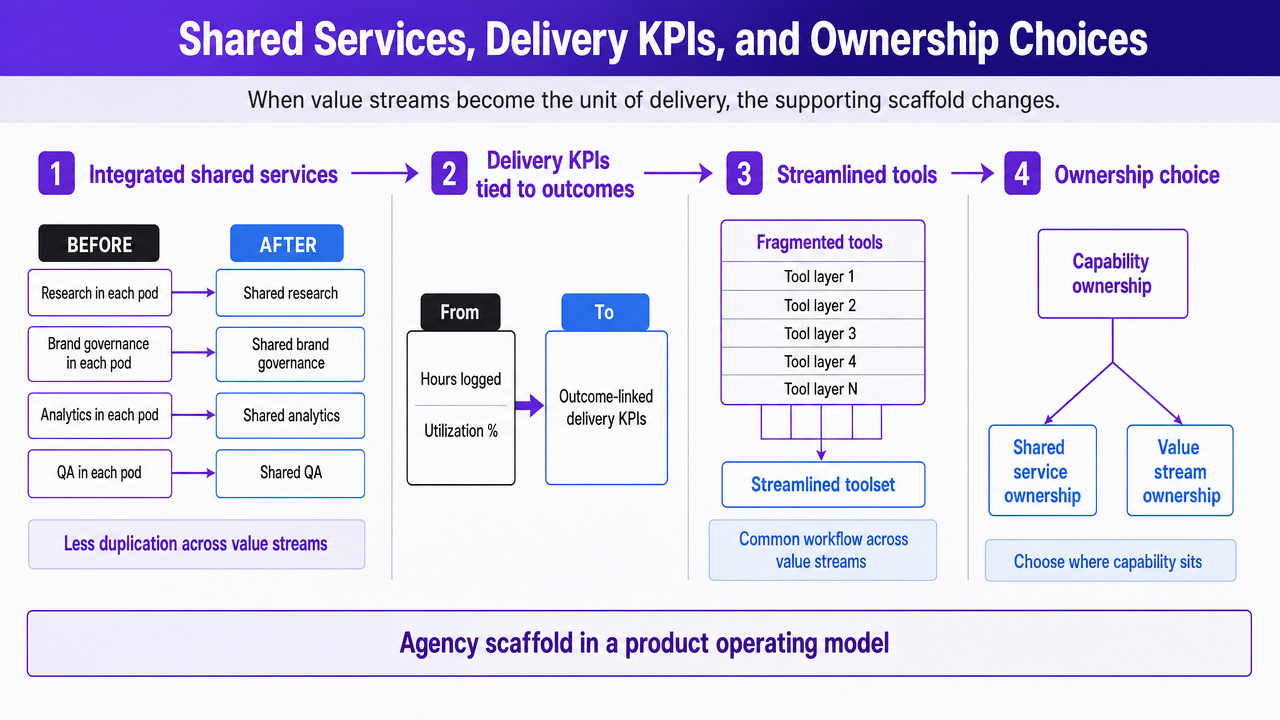 Visualize the four redesign decisions (integrated shared services, delivery KPIs, streamlined tools, ownership choice) named in this section from Deloitte's product operating model framework
See How Leading Agencies Cut Production Overhead Without Sacrificing Quality
Request a walkthrough of approval-first automation workflows proven to reduce project cycle times and maintain full creative oversight for complex, multi-channel campaigns.
Agentic AI in Production: Replacing Cycles, Not Roles
What Agents Actually Absorb in a Delivery Stack
The instinct when agencies first evaluate AI is to look for role replacements: which producer gets automated, which coordinator becomes redundant. That framing misreads what agents actually do inside a delivery stack. Agents absorb cycles, not roles. The strategist still owns strategy. The account lead still owns the client relationship. What disappears is the connective tissue between them—the briefing translation, the status reconciliation, the third revision that only exists because the first brief was ambiguous.
McKinsey's explainer draws the distinction that matters: AI agents handle less predictable, natural-language tasks that rule-based automation cannot, which is why they can absorb work that has historically required a human in every loop 8. In a production stack, that means an agent can read a client email, draft a brief that a strategist reviews rather than writes, generate a first-pass asset, and route it into QA—all inside the same workflow, without the four handoffs that pattern normally requires.
McKinsey's follow-on argument is that scaling this only works when agents are treated as integrated workflow partners, not add-on tools bolted onto the existing stack 7. An agency that buys a content-generation tool, a research tool, and a scheduling tool has added three coordination surfaces. An agency that redesigns the briefing-to-publish workflow around agents removes them. The efficiency gain lives in the redesign, not the tool.
Where AI Is Already Moving the Numbers
The strongest quantitative anchor available on AI's operational impact comes from McKinsey's 2024 global survey. Respondents most often report cost benefits in service operations and meaningful revenue increases from AI use in marketing and sales 4. Two things are worth pulling out of that finding before applying it to agency economics.
The survey measures self-reported outcomes across business functions at organizations that have adopted AI, not audited P&L impact at agencies specifically. It does, however, name the pattern: cost decreases concentrate in service and operations work—the coordination, drafting, and administrative cycles that dominate agency production—while revenue gains concentrate in the marketing and sales functions where AI is applied to campaign work and personalization. For an agency, both sides of that finding land in the same building. Production is service operations. The output is marketing.
Harvard's analysis of AI in marketing reinforces the mechanism. AI compresses time spent on repetitive, data-driven tasks and pulls more usable insight out of the martech stack the agency is already paying for 1. Neither source claims a specific productivity multiplier for agency work, and inventing one would misread the evidence. The directional read is what matters: the functions where AI has already moved measurable numbers are the same functions that dominate agency delivery hours. That is why the operating-model redesign in Section 4 is the precondition, not the sequel, to capturing the gain.
The Approval Loop That Keeps Brand Integrity Intact
Speed without governance is how AI-augmented production becomes a brand liability. McKinsey's agentic AI work is direct about the trade-off: agentic workflows accelerate campaigns, and that acceleration requires stronger governance to protect brand integrity as agents take on more of the delivery cycle 6. The mechanism most agencies land on is an approval loop with humans stationed at the decisions that carry brand or client risk—messaging positioning, claims, publishing—while agents execute everything upstream and downstream of those gates.
The design principle is that agents recommend and execute; humans approve. Signals from the account—qualified calls, ranked pages, campaign performance—feed the agent. The agent produces a ranked recommendation with the reasoning attached. A strategist approves, edits, or rejects. Approved work executes automatically. Results feed back into the next signal cycle.
This is what makes agentic production compatible with the client relationship an agency has built. Nothing ships without sign-off. Every recommendation carries its rationale. Utilization data still flows, but the scoreboard has moved to cycle time between signal and approved execution—which is the metric that actually correlates with margin once hours stop driving revenue.
Outcome-Based Pricing: The Only Model That Rewards Efficiency
Every lever discussed so far—utilization as a signal, operating-model redesign, agentic production—runs into the same wall under hours-based pricing. When revenue is a function of hours logged, efficiency is a tax on the top line. A brief that used to take four coordinator hours and now takes forty minutes of strategist review does not expand margin. It shrinks the invoice.
Outcome-based pricing inverts the arithmetic. Fees attach to what the value stream produces—ranked commercial pages, qualified consults booked, cost per acquired patient—rather than to the hours behind them. Productivity gains stop being subtractions from revenue and start compounding into margin. The same shipped result costs the agency less to produce next quarter, and the client still pays the agreed price for the outcome delivered.
The move is not a pricing exercise. It is an operating-model consequence. Deloitte's framing of the modern operating model as a configuration of internal and external capabilities designed to meet customer needs 2only fully resolves when the commercial contract also measures customer needs rather than input hours. McKinsey's operating-model work makes the same point about closing the strategy-to-performance gap through iterative redesign 3—the redesign includes how the work is sold.
The sequencing matters. Agencies that shift pricing before redesigning delivery expose themselves to fixed-fee losses on unreformed production. Agencies that redesign delivery without shifting pricing hand every efficiency gain back to the client. The two moves are one move, staged: rebuild the delivery stack around value streams and agentic production first, then reprice the retainers whose economics have already changed underneath.
Streamline Multi-Channel Delivery With Approval-First Automation
Access an AI-powered workflow that reduces production overhead by up to 47%, coordinates specialist execution across all channels, and provides full oversight on every client deliverable—without expanding your team.
If You Run a Multi-Client Portfolio: The Per-Account Economics
The math changes when the unit of analysis shifts from the firm to the account. Owner-operators running a book of 15, 30, or 60 retainers already know that portfolio-level margin is an average of per-account margins that vary wildly—some accounts subsidize others, and the subsidizers are usually the ones with the tightest scope and the fewest revision rounds. Redesigning the delivery stack changes the shape of that distribution, and the change is easier to see one account at a time.
The variables that move are the same in every model: blended FTE cost per producer hour, hours consumed per account per month, tool-stack cost allocated per account, and retainer price. What differs is how many hours the model requires to ship the same output. McKinsey's finding that cost benefits concentrate in service operations while revenue gains concentrate in marketing and sales work applies directly here—agency production sits on both sides of that line 4.
| Model | Producer hours/account/mo | Blended cost/hour | Tool allocation | Delivery cost/account |
|---|---|---|---|---|
| A. FTE-based production | H | C | T | (H × C) + T |
| B. FTE + point AI tools | ~0.7H | C | T + Δ | (0.7H × C) + T + Δ |
| C. AI-agent-integrated with approval gates | ~0.3H | C | T + Δ' | (0.3H × C) + T + Δ' |
The directional read: as producer hours per account fall, gross margin per retainer expands at flat client pricing—until pricing itself moves. Model B typically stalls because point tools add coordination surfaces even as they compress task time 7. Model C compounds because agents are integrated into the workflow rather than bolted on, and the approval gate keeps brand risk contained without reintroducing the handoffs that ate Model A's margin 6. Run the substitution across the book and the subsidizer accounts stop subsidizing—every account moves toward the same expanded margin band.
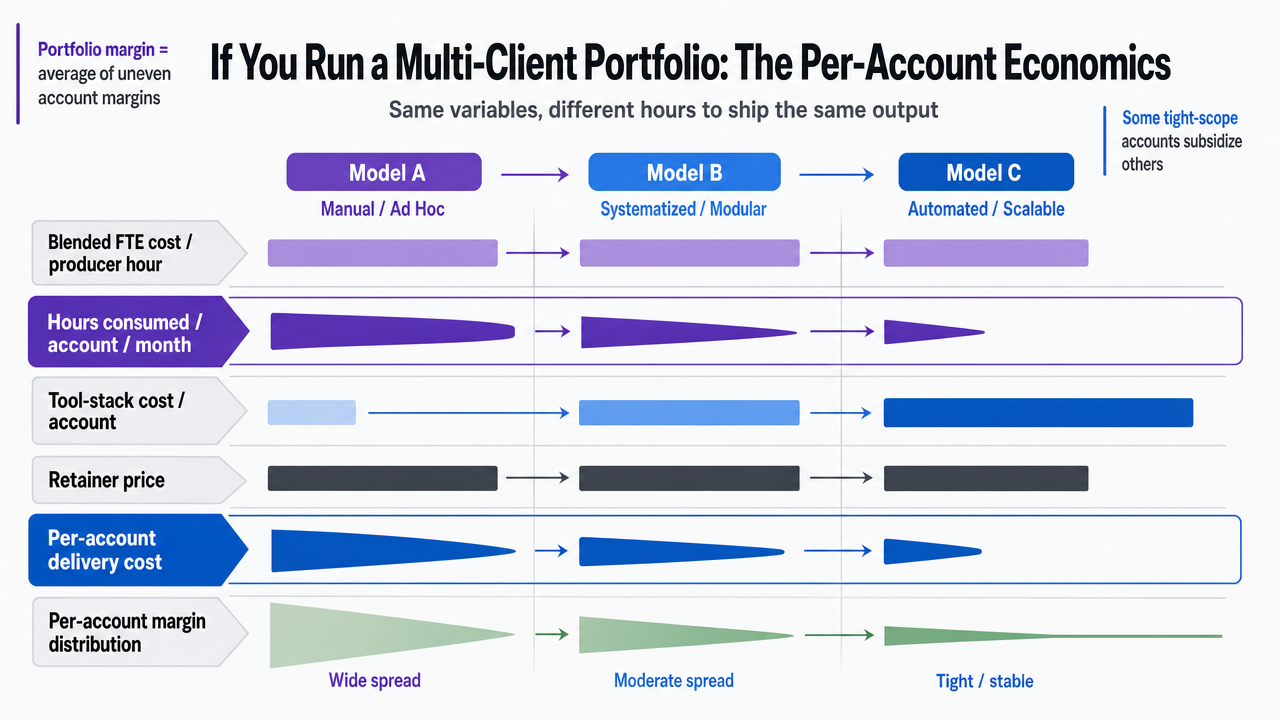 Visualize the three delivery models (A, B, C) and their per-account cost structure as presented in the section's table, showing the directional shift in producer hours and delivery cost
The Operator Decision Ahead
The four levers do not have to be pulled at once, but they do have to be pulled in order. Utilization data locates the leaks. Operating-model redesign restructures the delivery stack around value streams. Agentic production absorbs the coordination cycles that used to justify the headcount. Outcome-based pricing converts every gain from the first three into margin instead of foregone revenue.
The near-term call for most owner-operators is narrower than a full transformation program. Pick one account, map the value stream end-to-end, and identify the two or three cycles—briefing, revision, QA—where an approval-governed agent could execute what a coordinator does today 6. Measure cycle time and cost per shipped asset before and after. If the delta holds across a second and third account, the redesign has legs and the pricing conversation with the client base becomes the next move.
Platforms like Vectoron exist to compress that first-account experiment into weeks rather than quarters. The decision the market is settling in 2025 is not whether AI enters the delivery stack. It is which agencies redesign around it before the retainer math forces the question.
Frequently Asked Questions
References
- 1.AI Will Shape the Future of Marketing.
- 2.Designing an Operating Model for Changing Market Needs.
- 3.A new operating model for a new world.
- 4.The state of AI in early 2024.
- 5.The contribution of benchmarking to quality improvement in healthcare.
- 6.Reinventing marketing workflows with agentic AI - McKinsey.
- 7.Agents for growth: Turning AI promise into impact - McKinsey.
- 8.What is an AI agent? - McKinsey.
- 9.Product operating Model Framework | Deloitte US.
- 10.Digital operating models | Deloitte Insights.