
Key Takeaways
- Treat enterprise SEO partner selection like an ERP evaluation, using weighted criteria and long-term fit rather than an unstructured RFP that rewards pitch charisma over operating substance 10.
- Score candidates against six criteria: revenue attribution, technical scale through automation, AI execution capability, operating-model fit, martech integration depth, and reporting transparency with buyer-owned analytics 1.
- Assign weights that match the stakes—revenue attribution at 25 percent, technical scale and AI execution at 20 percent each—and require artifacts as evidence, not pitch claims 8.
- Compare three operating models head-to-head: traditional agencies scale with headcount, in-house builds concentrate cost and risk, and AI-powered platforms decouple production from headcount 3, 5.
- Multi-location and portfolio operators should reweight toward content velocity per location, governance consistency, and time-to-first-publish, disqualifying any partner whose cost curve bends upward with N 9.
- End the pitch when a partner refuses buyer analytics ownership, hides methodology, lacks AI governance for regulated content, or presents retainer terms as the operating model 1, 6.
- Move from scorecard to signature through paid pilots, contract redlines on ownership and governance, and kill criteria tied to leading indicators at 90, 180, and 365 days 9.
Why SEO Partner Selection Now Looks Like an ERP Evaluation
Enterprise SEO is no longer a creative services purchase. It is a multi-year operating decision that touches revenue attribution, technical infrastructure, content production velocity, and how marketing fits inside the rest of the company's approval workflow. That makes the right comparison not another agency RFP, but the structured vendor selection process finance teams already run for ERP systems, where defined criteria, weighted scoring, and long-term fit determine the outcome 10.
The shift is visible in how analysts now frame the category. Forrester's 2025 Wave for SEO solutions explicitly positions itself as guidance for selecting the right provider against structured criteria like analytics depth, integrations, automation, and support for complex enterprise needs 8. The same rigor belongs at the agency layer. Deloitte's 35th CMO Survey captures the parallel pressure on marketing leaders, who report appetite for "some risk-taking and disciplined experimentation" while defending budgets against economic uncertainty 2. Disciplined experimentation does not survive an unstructured vendor pick.
What follows is a procurement-grade framework: six scoring criteria, a weighted scorecard, a three-model comparison covering traditional agencies, in-house builds, and AI-powered execution platforms, and a redline of pitch answers that should end an evaluation on the spot.
The Six Criteria That Belong on the Scorecard
Revenue Attribution Over Ranking Reports
The first criterion separates serious enterprise partners from agencies still selling 2015. A partner that cannot tie organic sessions to pipeline stages, opportunity creation, and closed revenue is selling activity, not outcomes. Ranking dashboards and traffic graphs are inputs. The scorecard should weight outputs.
Ask candidates to describe, in writing, how they instrument organic search against the buyer's funnel: which events fire into the CRM, how assisted conversions are credited, how branded versus non-branded organic is separated, and how content groups are mapped to revenue cohorts. Vague answers about "holistic reporting" are a failed test. Deloitte's CMO research captures the pressure underneath this requirement, with marketing leaders pushing for "disciplined experimentation" to defend budgets against economic uncertainty 2. Disciplined experimentation requires a closed feedback loop from query to revenue.
The strongest candidates will already speak the language of multi-touch attribution windows, content-to-opportunity decay curves, and pipeline contribution by topic cluster. They will also disclose the limits of their model, including dark-social blind spots and the noise inherent in last-touch reporting. A partner who pretends attribution is solved is overselling. A partner who cannot frame the problem at all does not belong on the shortlist.
Technical Scale Without Proportional Headcount
Enterprise SEO at scale means tens of thousands of URLs, dynamic templates, faceted navigation, internationalization, and continuous Core Web Vitals work. A partner whose technical capacity grows linearly with headcount cannot keep up with a site that ships weekly. The scorecard should reward partners who operate technical SEO through tooling and automation, not analyst hours.
Forrester's analysis of the enterprise SEO category argues exactly this point: managing complex programs now depends on platform-mediated capabilities for data consolidation, workflow, and reporting, which are difficult to replicate through human services alone 3. The follow-on Wave research evaluates providers explicitly on automation and integration depth, signaling that the market has moved past consultant-hour models for site-wide technical work 8.
In the RFP, demand specifics. How does the partner monitor log files at scale? What triggers an alert when crawl budget collapses on a template? How are hreflang or canonical regressions caught before they hit production? A partner who answers with "our team reviews monthly" is describing a sampling exercise. The right answer describes an automated detection layer with humans in the loop on prioritization, not discovery.
AI Execution Capability as a Non-Negotiable Test
Generative search and AI-assisted production are no longer adjacent topics. They are the operating environment. Forrester's coverage of generative AI documents how the technology is changing how business users interact with marketing systems, accelerating content production and decision support across functions that intersect heavily with SEO 6. The same research flags governance, bias, and quality-control risks as material concerns, especially in regulated verticals where unreviewed AI output creates legal and clinical exposure 6.
An enterprise SEO partner needs concrete answers on four AI capability tests:
- First, content velocity: how many editorial-quality units can the partner produce per location, per month, without sacrificing review rigor?
- Second, LLM citation tracking: how does the partner measure share of voice inside ChatGPT, Perplexity, Gemini, and Google AI Overviews, and how does that data feed back into the content roadmap?
- Third, governance guardrails: what is the documented review chain for AI-assisted output in regulated topics, and who signs off?
- Fourth, prompt-to-publish workflow: where do humans approve, where does automation execute, and how is every decision logged for audit?
Candidates who cannot demonstrate all four are not AI-capable. They are AI-curious. A partner who has bolted ChatGPT onto a content brief template is not operating in the new environment; they are decorating the old one. The scorecard weight here should be high, because the cost of getting it wrong in legal, healthcare, or behavioral health verticals is not a ranking dip. It is a compliance event.
Operating-Model Fit With Your Approval Workflow
An agency that cannot live inside the buyer's approval workflow is a structural mismatch, regardless of talent. McKinsey's research on operating models argues that enterprises increasingly need cross-functional teams, clear accountabilities, and data-driven decision-making to close the gap between strategy and execution 9. The same research identifies friction between legacy agency engagement structures, built around campaigns and retainers, and the agile, cross-functional models that high-performing organizations now run 7.
Translated to SEO procurement: a partner who needs three-week briefing cycles, separate creative reviews, and a quarterly business review to change direction is incompatible with marketing teams that ship weekly. The scorecard should test how the partner ingests requests, how approvals are routed, who has commit authority on what, and how fast a flagged issue moves from detection to fix in production.
Ask for a workflow diagram. Ask which collaboration tools the partner uses natively and which it forces the buyer to adopt. Ask how the partner handles a same-day escalation when a competitor launches a comparable page. Partners who answer with retainer terms are describing a billing model. Partners who answer with a governed execution loop are describing an operating model.
Integration Depth With the Existing Martech Stack
Enterprise SEO does not run in isolation. It feeds and is fed by the CMS, the CDP, the analytics platform, the experimentation suite, and the marketing automation system. Forrester's research on experience optimization shows how leading programs now integrate SEO with experimentation and personalization to optimize full journeys rather than rankings in isolation 4. A partner who treats SEO as a standalone channel will produce work that strands inside the marketing stack.
Score candidates on documented integrations, not aspirational ones. Which CMSes do they push content into directly versus hand off as documents? How do they sync schema, internal links, and metadata changes through version control? How does their reporting layer write back into the buyer's BI environment so finance can see organic contribution without a separate login?
The disqualifier here is a partner who delivers work as PDFs, decks, or spreadsheets that the in-house team then has to re-enter into production systems. That handoff tax is where most enterprise SEO programs lose velocity. The right partner reduces the number of systems the in-house team touches, not the number of meetings on its calendar.
Reporting Transparency and Analytics Ownership
The final criterion is the one most often skipped in procurement and most often regretted in year two. Guidance from the Arkansas Small Business and Technology Development Center frames the test plainly: the buyer must retain ownership of analytics accounts, and transparency in methodology is "central to a successful partnership" with an SEO agency 1. The principles scale upward. An enterprise buyer who lets an agency hold the GA4 property, the Search Console verification, or the Looker Studio data sources is renting visibility into its own business.
Contract language should require that all analytics accounts, tag containers, search consoles, and reporting dashboards sit under the buyer's ownership from day one, with the agency added as a user. Reporting cadence should be defined in the SOW with specific deliverables, not "monthly check-ins." Methodology disclosures should cover how keyword opportunities are sized, how content priorities are ranked, and how attribution windows are set.
A partner who resists any of these terms is signaling that opacity is part of the business model. That is a scorecard zero, regardless of how the partner performs on the other five criteria.
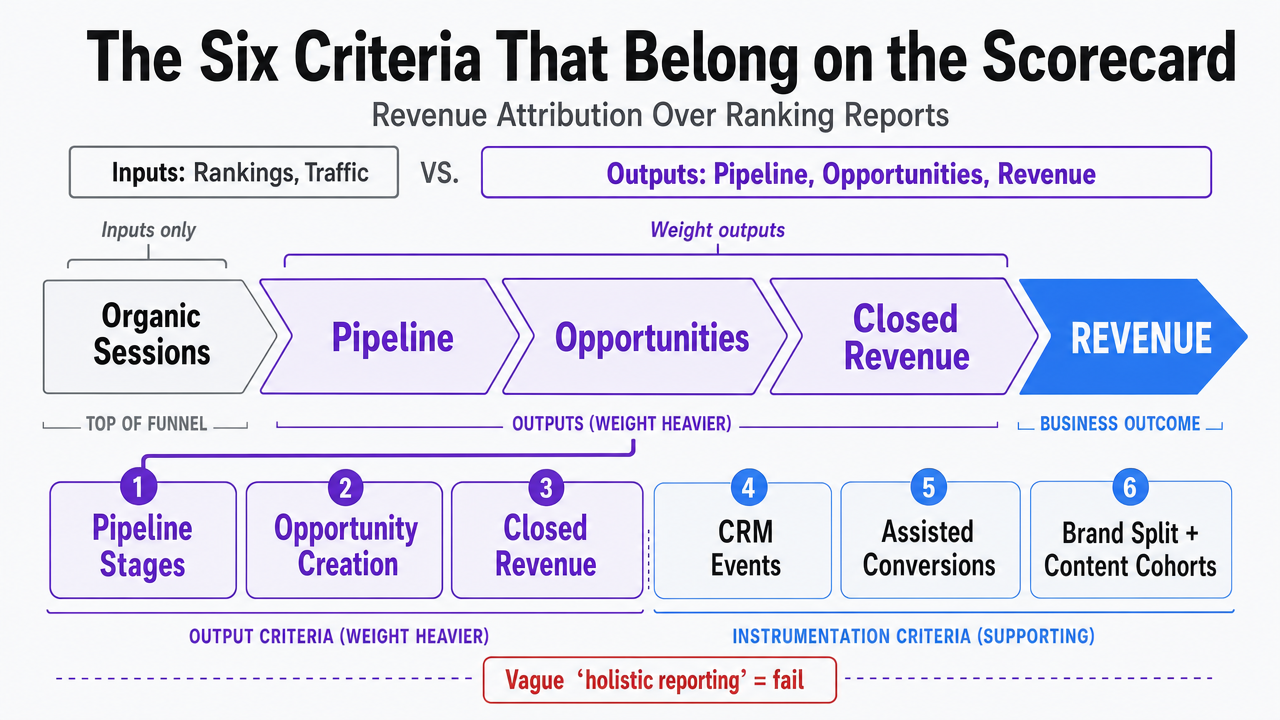 Visualize the six weighted evaluation criteria as a process framework, directly mirroring the scorecard breakdown discussed in this section and the next
Test Enterprise SEO Workflows in a Live Environment
Experience real-time SEO execution and measure impact on your actual site before making a long-term commitment.
Building the Weighted Scorecard
The six criteria carry different stakes, so the scorecard should reflect that. Deloitte's ERP selection guidance is explicit on the point: structured vendor evaluation depends on weighted criteria tied to use-case fit, scalability, and long-term operating value, not equal-weight checklists 10. The same logic applies to enterprise SEO procurement.
A defensible starting weight distribution looks like this:
- Revenue attribution carries 25 percent, because it is the criterion the CFO will audit first and the one most agencies score lowest on.
- Technical scale carries 20 percent, given that enterprise sites fail at the template and crawl layer before they fail at the content layer.
- AI execution capability carries 20 percent, reflecting that generative search and content velocity now define whether a partner can keep pace at all.
- Operating-model fit carries 15 percent, integration depth carries 10 percent, and reporting transparency carries 10 percent.
The lower-weighted criteria are not less important; they function as gates. A partner who fails reporting transparency outright should not pass the gate regardless of total score.
Score each criterion on a 1-to-5 scale against documented evidence the partner provides, not pitch claims. Require artifacts: sample dashboards with revenue mapping, log-file monitoring screenshots, AI governance documentation, workflow diagrams, integration lists, and analytics ownership clauses already drafted in their standard SOW. Multiply, sum, and rank. Forrester's 2025 SEO Wave applies the same structured comparative method at the platform layer, and the discipline transfers cleanly to the agency layer 8.
The output is not a winner. It is a defensible recommendation the marketing VP can put in front of finance with the math shown.
Three Operating Models, One Decision
The Traditional Enterprise Agency
The traditional enterprise SEO agency still wins on one dimension: senior strategic counsel from people who have shipped at scale before. A principal who has run organic for a Fortune 500 retailer or a national health system carries judgment that no tooling replicates, particularly on enterprise-specific problems like migrations, brand consolidation, and crisis recovery.
The constraints are structural, not personal. Agency capacity scales with headcount, which means content velocity, technical audits, and reporting cadence are all rate-limited by billable hours. Retainer economics push the partner toward strategy decks and quarterly reviews because that is where margin lives. Execution work gets junior staff or offshore production, and the partner's incentive is to keep scope expanding, not to compress it. McKinsey's research on operating models flags the friction directly: legacy agency engagement structures, built around campaigns and retainers, sit awkwardly inside the agile, cross-functional models high-performing organizations now run 7.
The In-House Build
Bringing enterprise SEO in-house has a longer track record than the AI-platform discourse suggests. A Harvard Business School analysis found that nearly half of U.S. advertisers operated some form of in-house advertising unit by the late 1990s, with the trend already accelerating in tech and creative industries 5. The scope of that finding matters: it covers advertising broadly, not SEO specifically, and reflects a market three decades ago. The economic logic, however, has held. When a capability is core to revenue and the workload is steady, internalization usually wins on cost per output and on institutional knowledge retention.
The trade-offs are equally durable. Building in-house means recruiting a technical SEO, a content lead, an analytics owner, and an editorial bench, then keeping that team current as the algorithmic and generative-search environment shifts every quarter. HBS researchers note the persistent tension between in-housing's cost advantage and the loss of outside perspective that external partners provide 5. For most marketing VPs, a pure in-house build pencils out only when search volume justifies four or more dedicated FTEs and the company can absorb the hiring cycle.
The AI-Powered Execution Platform
The third model treats SEO as a platform-mediated capability with humans on approval rather than on production. Forrester's category analysis argues that enterprise SEO programs increasingly depend on platforms for data consolidation, workflow, and reporting, and that this shift raises the operating bar for any partner that still bills by the hour 3. The 2025 SEO Wave reinforces the direction, evaluating providers explicitly on automation, integration depth, and support for complex enterprise needs 8.
Compared head-to-head, the three models diverge sharply on the variables that matter to a marketing VP defending CAC:
- A traditional agency requires headcount that scales with content units and technical surface area, runs governance through retainer reviews, and integrates with the martech stack through hand-offs.
- An in-house build concentrates headcount on the buyer's payroll, runs governance through internal approvals, and integrates natively but at the cost of bench depth 5.
- An AI-powered execution platform compresses headcount needs, lifts content velocity per location, and routes governance through an approval workflow that writes back into the existing stack 3.
See How Enterprise SEO Execution Can Scale Without Added Headcount
Request a walkthrough of unified, approval-driven workflows designed for enterprise-scale SEO—eliminating vendor sprawl and manual oversight while maintaining full strategic control.
If You Operate Multiple Locations or a Portfolio
The calculus changes when the buyer is a multi-location operator, a DSO, an MSO, or a private-equity-backed services platform. The unit of work is no longer the corporate site. It is the location page, the practitioner profile, and the local landing template multiplied by however many sites the portfolio owns. A 40-location DSO ships more discrete SEO assets in a quarter than most B2B enterprises ship in a year.
That volume rewrites the scorecard weights. Content velocity per location, governance consistency across markets, and time-to-first-publish become the variables that determine whether organic actually contributes to same-store growth. McKinsey's operating-model research is blunt on this point: closing the gap between strategy and performance depends on cross-functional execution and clear accountabilities, not on adding more reviewers to a slower process 9.
The three operating models diverge sharply once N locations enter the equation.
| Variable | Traditional Enterprise Agency | In-House Build | AI-Powered Execution Platform |
|---|---|---|---|
| Headcount to support N locations | Scales near-linearly with N | Fixed bench, capacity-constrained as N grows 5 | Decoupled from N; governance scales, not production |
| Content units per location per month | Rate-limited by billable hours | Rate-limited by editorial bench | Rate-limited by approval throughput 3 |
| Technical SEO coverage | Sampled audits | Native but bench-dependent | Automated detection, human prioritization 8 |
| Approval workflow | Retainer reviews | Internal routing | Governed loop with audit log |
| Time-to-first-publish | Weeks per location | Variable | Days, gated by sign-off |
Portfolio operators should weight content velocity and governance consistency at 30 percent or higher combined, and treat any partner whose cost curve bends upward with N as a structural mismatch.
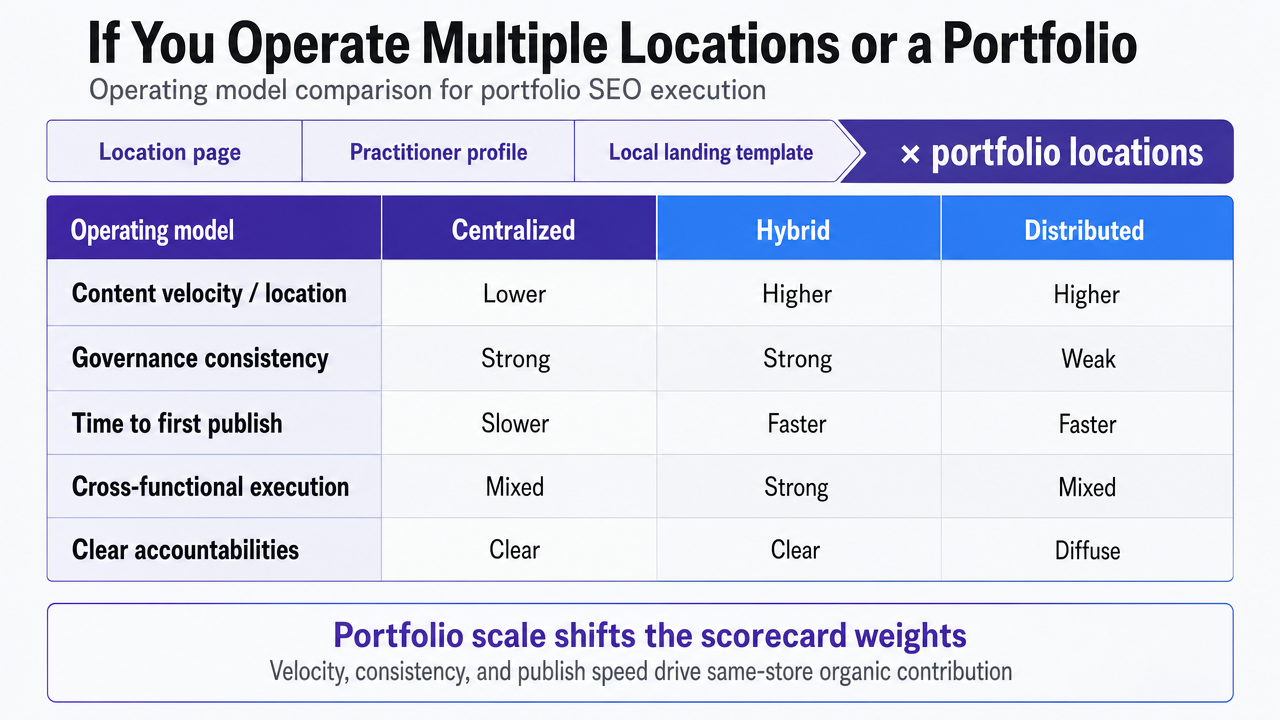 Translate the in-article comparison table of three operating models across five variables into a clean visual matrix, supporting the section's portfolio-operator framing
Disqualifying Answers in the Pitch Meeting
Most pitch meetings reward charisma. A disciplined evaluation rewards specificity. Eight answers from a candidate agency should end the conversation regardless of how strong the rest of the deck looks.
- Any version of "we'll set up the analytics for you" without volunteering buyer ownership of GA4, Search Console, tag manager, and BI data sources. Analytics ownership belongs to the buyer from day one 1.
- A refusal to commit reporting cadence and deliverables in the SOW, substituted with "monthly strategy syncs."
- Opacity on keyword sizing methodology or content prioritization logic. If the partner cannot explain how opportunities are ranked, the roadmap is improvisation 1.
- No documented AI governance policy. Partners shipping AI-assisted content into legal, healthcare, or behavioral health without a named review chain are creating compliance exposure, not velocity 6.
- No answer on LLM citation tracking or generative-answer share of voice.
- Technical SEO described entirely as quarterly audits rather than continuous monitoring.
- Integration with the buyer's CMS, CDP, and BI stack described as "we'll deliver recommendations" rather than direct writes.
- Retainer terms presented as the operating model.
Any single answer is a scorecard zero. Two should end the meeting.
See How Automated SEO Execution Outperforms Traditional Agency Models
Access a live dashboard showcasing real-time SEO pipeline metrics, automated content production, and approval-first workflows designed for enterprise-scale efficiency—without expanding your team or juggling multiple vendors.
Running the Decision: From Scorecard to Signature
A defensible recommendation needs a defensible process. Three steps move the scorecard from a working document to a contract finance will sign.
- Step one: run a paid pilot, not a pitch. Award two or three finalists a scoped, paid engagement covering a discrete slice of work—one site section, one location cluster, or one technical problem area—on a four-to-six-week clock. Pilots reveal what RFPs hide: how the partner actually ingests requests, how fast approvals close, whether the integration claims survive contact with the buyer's stack, and whether AI-assisted output meets review standards in the buyer's vertical. McKinsey's operating-model research is direct on the underlying point: closing the gap between strategy and performance depends on execution and governance capabilities, not on pitch quality 9.
- Step two: redline the contract before negotiating price. Analytics ownership, reporting cadence, methodology disclosure, AI governance documentation, and integration write access belong in the SOW as non-negotiable terms 1. Partners who push back on these clauses are signaling how year two will go.
- Step three: write the kill criteria into the agreement. Define the leading indicators—content velocity, time-to-publish, qualified organic pipeline contribution—that trigger a contract review at 90, 180, and 365 days. The best enterprise SEO partner is the one whose model holds up under that scrutiny, whether the answer is a traditional agency, an in-house build, an AI-powered execution platform like Vectoron, or a hybrid of the three.
Frequently Asked Questions
References
- 1.How to Evaluate an SEO Agency.
- 2.2026 CMO Survey | Deloitte US.
- 3.Every Company Needs An SEO Platform.
- 4.Experience Optimization Solutions, Q4 2024.
- 5.Should You Bring Advertising Expertise In-House? - Baker Library (HBS Working Knowledge).
- 6.Generative AI Trends For All Facets of Business.
- 7.The State of Organizations in 2023.
- 8.Search Engine Optimization Solutions, Q3 2025.
- 9.A new operating model for a new world.
- 10.ERP selection and vendor criteria for core financials.