
Key Takeaways
- Siloed channel execution leaves no single party owning the joined data layer, so cost-per-converted-patient becomes a quarterly reconstruction; fix it by routing spend, click, and EHR data into an operator-controlled warehouse 10.
- Eighteen-month agency contract cycles cannot keep pace with two-to-three-week internal optimization loops, turning QBRs into post-mortems; resolve the gap by moving data delivery, not reporting, to a daily warehouse cadence 6.
- Retainers bundle opaque budget allocation with HIPAA exposure the agency cannot legally absorb, concentrating risk in patient-testimonial assets; counter it with consent-keyed custody held by the operator and campaign-level fee transparency 5.
- Replacing an underperforming agency works only in sequence — instrument the warehouse, rewrite contracts against measurable outcomes, then migrate scope by service line rather than channel — to avoid rebuilding the same silos under a new vendor.
Why the Agency Conversation Moved to the CFO's Desk
The pressure on healthcare marketing budgets in 2025 is no longer arriving from peer benchmarks or board curiosity. It arrives from finance, with a spreadsheet open and a line-item question about why a multi-site retainer cannot produce a converted-patient number that ties back to the general ledger. That shift in venue — from the VP Marketing's desk to the CFO's — is the real story behind the current wave of agency reviews at multi-location operators.
The Numbers Healthcare CFOs Are Already Citing
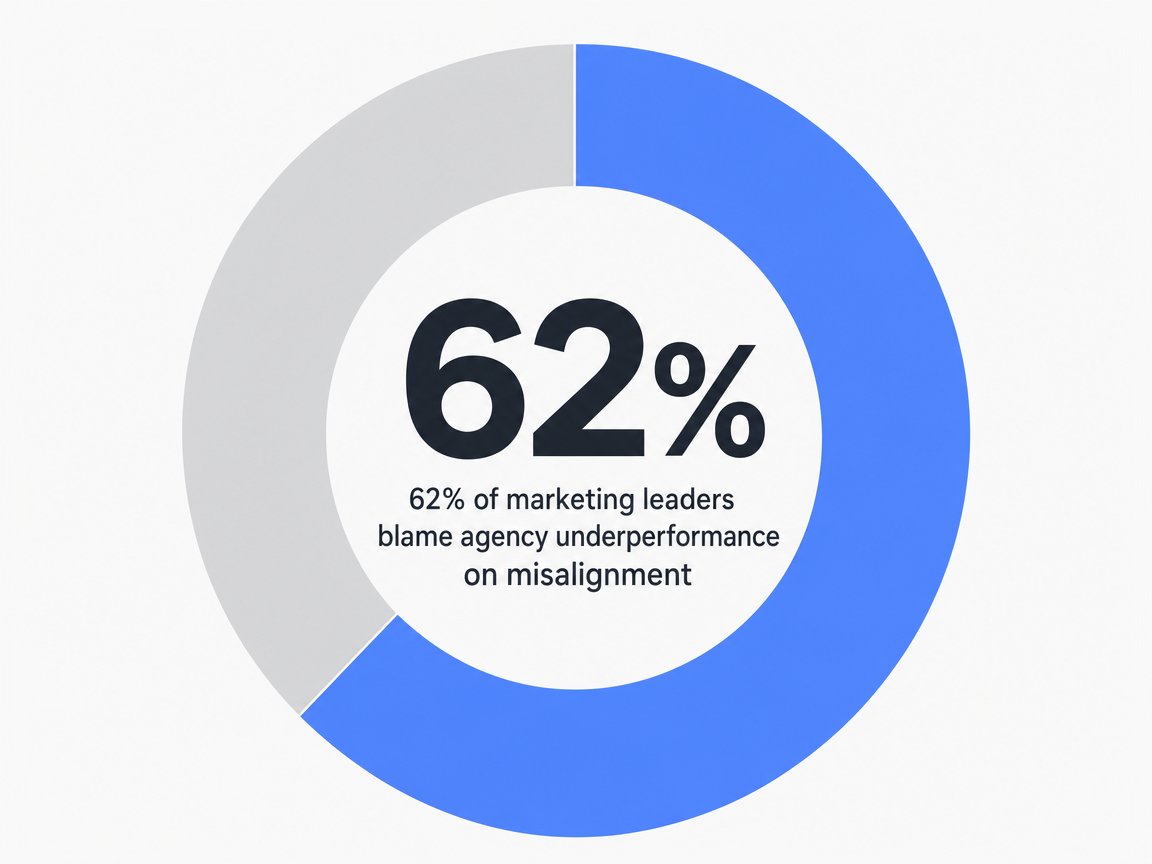
Three figures are doing most of the work in those finance conversations. Forrester's CMO benchmark study, which tracks agency performance across healthcare, B2B, and consumer segments, found that 62% of marketing leaders cite a lack of strategic alignment with business goals as the primary cause of agency underperformance 4. The American College of Healthcare Executives, surveying healthcare executives directly, reports that 71% rank lack of marketing measurement and ROI transparency as their top frustration with agency partners 11. The American Marketing Association's annual study adds the operational layer: 42% of marketing organizations say their agencies cannot accurately track ROI across multiple channels or locations, and 58% say agencies lack transparency in how budgets are allocated 10.
 62% of marketing leaders blame agency underperformance on misalignment: 62%
None of these figures, on their own, would justify a contract change. Read together, they describe a category-wide measurement problem rather than a vendor-selection problem. The Forrester sample covers marketing leaders broadly. ACHE's number is healthcare-executive-specific. AMA's percentages are organization-level and industry-mixed. Stacking them gets a CFO to the same conclusion the operator has already reached: the dashboards arriving on the 30th of the month do not reconcile to the patients who showed up that month, at the locations where they showed up, for the service lines the system actually wants to grow.
Three Amplifiers Healthcare Carries That Other Verticals Don't
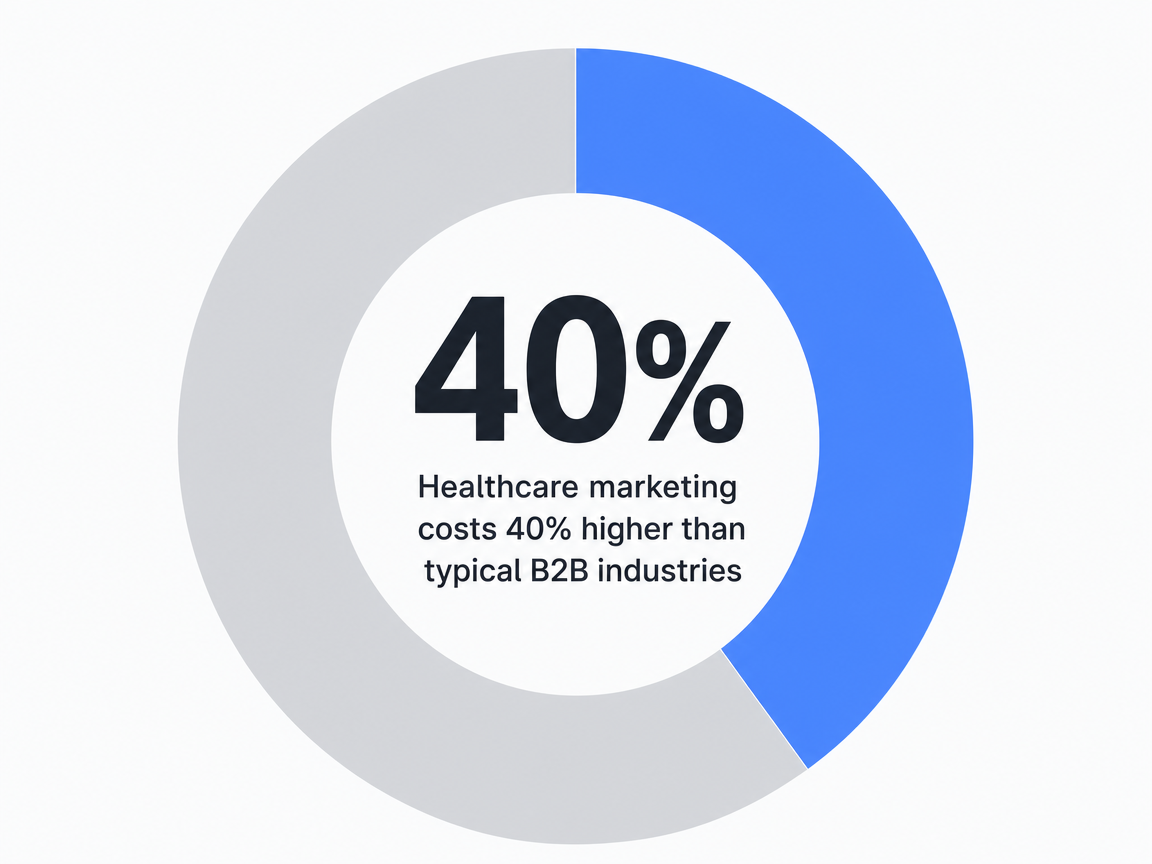
Healthcare operators face the same agency-ROI questions as every other vertical, with three amplifiers stacked on top. The first is cost structure. Health Affairs research finds that healthcare organizations carry roughly 40% cost inflation in marketing relative to B2B industries because of compliance overhead and specialized talent requirements, yet convert at equivalent rates 9. Every dollar that does not convert is a more expensive dollar in healthcare than in adjacent categories.
The second is acquisition variance. CMS performance data shows patient acquisition cost ranging from $120 to $800 per converted patient across health systems 7. That spread is too wide to be explained by market or service-line differences alone. It is the operational signature of measurement gaps — agencies optimizing toward the metrics they can see while the cost-per-converted-patient drifts.
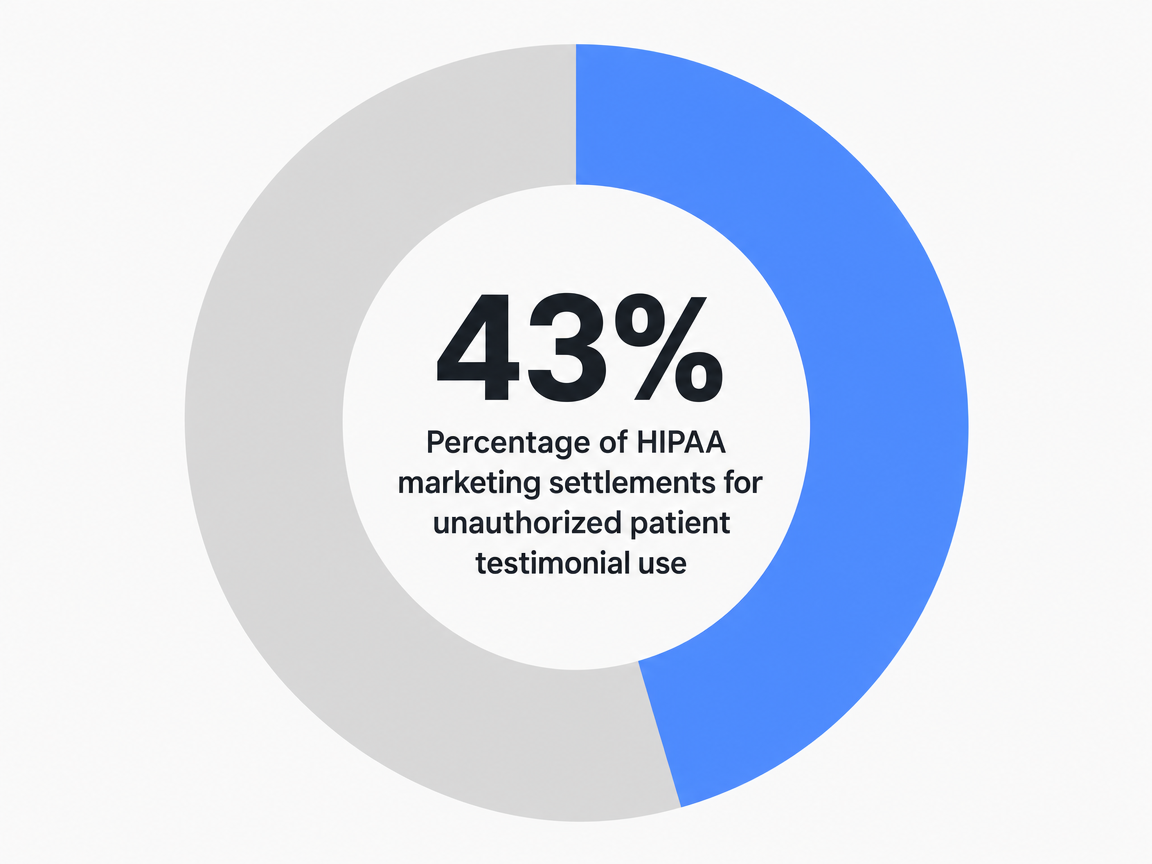
The third is regulatory exposure. HHS enforcement data identifies unauthorized use of patient testimonials and health information as the leading HIPAA marketing violation category, accounting for 43% of marketing-related settlements since 2020 5. Retail and SaaS retainers do not carry that liability tail. Healthcare retainers do, and the contract form rarely transfers it cleanly. These three pressures — inflated cost base, wide acquisition variance, retained liability — are why the CFO is now part of the conversation rather than a downstream approver of it.
Mistake One: Siloed Channel Execution Across Sites and Service Lines
The first failure pattern shows up in the org chart, not in the campaign brief. A multi-location operator typically buys paid search from one team at the agency, programmatic display from another, SEO from a third, and social from a fourth. Each pod reports against its own channel KPIs. None of them owns the question the operator actually needs answered: how much did the system spend, across all channels, to acquire a converted patient at the Grand Rapids orthopedic clinic last week, and was that number better or worse than the same query for the Lansing clinic.
The Data Layer No One Owns
Channel silos are not a service-delivery problem. They are a data-custody problem. Inside the agency, each channel pod uses the reporting environment its platform vendor provides — Google Ads, DV360, Meta Business Suite, the SEO tool of choice — and stitches the results into a monthly slide deck. The stitching happens in spreadsheets, by hand, after the fact. The operator sees the deck. The operator does not see the joins.
That custody arrangement is what the American Marketing Association captured when it found that 42% of marketing organizations report their agencies cannot accurately track ROI across multiple channels or locations, and 58% report agencies lack transparency in how budgets are allocated 10. The AMA sample is industry-mixed and organization-level, not healthcare-specific, but the mechanism it describes is sharper in healthcare because the converted-patient event sits inside an EHR or scheduling system the agency cannot legally touch. The agency reports leads. The operator carries the burden of joining leads to appointments, appointments to procedures, procedures to revenue.
When no single party owns the joined data layer, two things happen. Channel performance reports drift toward the metrics each pod can produce without help — impressions, clicks, form fills — because those metrics do not require a join. And the cost-per-converted-patient number, which is the only figure a CFO recognizes, becomes a quarterly reconstruction exercise rather than a live operating metric. The drift is not malicious. It is the predictable behavior of a system where the people executing the work do not hold the data that scores the work.
The Agency Rebuttal, and Where It Collapses
The standard agency response to the silo critique is reasonable on its face. Channel specialization exists because the platforms reward specialization. A paid search analyst who also runs programmatic display does both jobs worse than two analysts running them separately. Cross-channel attribution is genuinely hard, particularly in healthcare, where HIPAA constraints block the cookie-and-CRM joins that retail and SaaS take for granted. Asking the agency to deliver clean cost-per-converted-patient reporting across 22 sites and seven service lines, the argument goes, is asking for engineering work the retainer does not fund.
The rebuttal collapses on the question of who should fund it. Harvard Business Review's analysis of agency underperformance found that agency success metrics — hours billed, deliverables completed — are structurally misaligned with client success metrics like revenue generated and cost-per-acquisition, and that this misalignment explains roughly 60% of documented agency underperformance 8. The HBR finding is not healthcare-specific, but it explains why the engineering work the operator needs almost never gets quoted into the retainer. The agency is not paid to build the layer that would make its own performance auditable. Asking it to do so without a fee change is asking it to volunteer a tool that would shorten its contract.
Modeled Preventable Spend at 5, 15, and 30 Sites
The CFO meeting needs a number, not a thesis. The number that survives scrutiny is not a benchmark borrowed from another operator. It is a scenario model, built from two sourced inputs, with the math disclosed.
The inputs: CMS performance data places per-converted-patient cost between $120 and $800 across health systems 7, and Health Affairs research finds healthcare organizations carry roughly 40% cost inflation in marketing relative to B2B industries because of compliance overhead and specialized talent requirements 9. The 40% premium is not a savings claim. It is the share of the spend base most exposed to the silo problem — the bucket where compliance review, channel-pod overhead, and reporting reconstruction sit on top of working media.
 Healthcare marketing costs 40% higher than typical B2B industries: 40%
The model assumes a multi-location operator running 1,000 converted patients per site annually, a midpoint acquisition cost of $460 (the CMS range midpoint), and a preventable-spend band defined as 10% to 25% of the 40% premium-exposed portion. The lower bound assumes well-instrumented operators; the upper bound assumes operators with fully siloed channel reporting. At 5 sites, that yields roughly $92,000 to $230,000 in annual preventable spend. At 15 sites, $276,000 to $690,000. At 30 sites, $552,000 to $1.38 million.
Three caveats belong on the same page as the chart. First, the CMS range covers wide variance across service lines and markets; an orthopedic-heavy operator sits closer to the high end, a primary-care-heavy operator closer to the low end. Second, the 10%-to-25% preventable share is a modeling assumption, not a measured figure — it represents the band of waste attributable specifically to channel-silo reporting gaps, separate from market or creative inefficiency. Third, preventable does not mean recoverable in year one; the recovery curve depends on how quickly the data layer gets rebuilt.
The table's purpose is narrow. It gives the VP Marketing a defensible directional figure to put in front of finance, with the inputs visible, so the conversation moves from "agencies waste money" — which the CFO has heard before — to "here is the modeled exposure at our site count, here are the two sources, here is the assumption I am making about the preventable share." That framing wins the meeting because it invites the CFO to challenge the assumption rather than the premise.
Test a Scalable Alternative to Agency Retainers
Experience automated, compliant healthcare content production and publish live results with zero upfront commitment.
Mistake Two: Reporting Cycles That Outlast the Optimization Window
Channel silos describe what the agency cannot see. Reporting cadence describes when the operator cannot act. The two failures compound: even if the data layer were clean, a quarterly business review arriving 90 days after the spend decision is a post-mortem, not an optimization input. Patient acquisition does not move on a quarterly clock, and the contract form that governs most retainer relationships was not built to support a faster one.
Eighteen-Month Contracts Against Two-Week Optimization Loops
The cleanest comparative figure in the agency-cadence research comes from the American Medical Association's practice management tracking: medical practices working with agencies report average 18-month contract cycles, while practices using in-house teams achieve optimization adjustments within 2 to 3 weeks 6. The AMA sample is practice-level rather than enterprise-level, which understates the gap at multi-location operators where contract review windows often stretch longer. The ratio is roughly 30-to-1 between how often the agency relationship gets re-scoped and how often a high-functioning internal team can change a bid strategy, swap a landing page, or pull a service-line budget.
That ratio determines what kind of question the operator can answer. A behavioral health intake program with a 60-day enrollment window cannot wait until the next quarterly business review to redirect spend away from a creative variant that stopped converting in week three. An orthopedic line bidding into a volatile auction during a competitor's market entry needs intra-week pacing decisions, not a slide titled "recommendations for Q4."
The contract is not the only constraint. The reporting infrastructure that sits inside the agency's stack — the dashboards built for monthly delivery, the analyst rotation built for monthly review, the QBR rhythm built for retention — all reinforce the same cadence. Faster reporting is technically possible at most agencies. It is rarely commercially native, because the retainer was priced against the slower one.
Why the Attribution Argument Resolves at the Warehouse, Not the Dashboard
Agencies push back on cadence critique by pointing at attribution complexity. Healthcare conversions happen offline, the argument runs, and a converted patient may not appear in any system the agency can query for 30 to 60 days after the click. Reporting weekly on a 60-day signal produces noise, not insight. The argument is technically correct and operationally beside the point.
The operator does not need the agency to produce a clean cost-per-converted-patient number on a weekly cadence. The operator needs the agency's spend data, click data, and creative metadata to land in a warehouse the operator controls, on a daily or near-daily basis, where the joins to the EHR, the call tracking system, and the scheduling platform can happen on the operator's side of the wall. The reporting cadence question is really a data-delivery cadence question.
Resolved at the warehouse, the attribution debate stops being adversarial. The agency keeps optimizing against the leading indicators it can see in-platform. The operator builds the converted-patient view on top, joining at the patient-record layer the agency cannot legally touch. Both sides see the same numbers because both sides are reading from the same warehouse. The 30-to-1 cadence gap closes not because the agency moved faster, but because the optimization conversation moved out of the QBR slide and into a dataset that updates on its own schedule.
Stop Margin Erosion: End Hidden Inefficiencies in Agency-Led Marketing
Learn how leading healthcare marketers are replacing high-cost retainers with scalable, compliant automation—delivering higher patient acquisition ROI across all locations with fewer operational delays.
Mistake Three: Retainers That Absorb Unattributed Spend and Compliance Liability
The retainer is the contract form that ties the first two failures together and adds a third one of its own. It funds work that cannot be cleanly attributed, on a cadence the operator cannot accelerate, while leaving compliance exposure on the operator's balance sheet regardless of which party caused the breach. The retainer's defenders treat opacity and liability allocation as separate questions. They are not. They are the two halves of the same instrument.
Budget Opacity as a Contract Feature, Not an Accident
Most multi-location healthcare retainers are written as a fixed monthly fee against a scope of work — a list of channels managed, a count of campaigns produced, a cadence of reporting deliverables. The dollar amount inside that fee is rarely broken out by working media versus agency labor versus platform fees versus production costs. The operator approves a number. The agency allocates the number.
That allocation pattern is what the American Marketing Association measured when it found that 58% of marketing organizations report their agencies lack transparency in how budgets are allocated 10. Inside a healthcare retainer, the opacity has a specific shape. A $180,000 monthly fee covering paid search, programmatic, SEO, and social across 22 sites does not arrive at the operator with a per-site, per-channel, per-cost-category breakdown. It arrives as a slide showing aggregate impressions, blended cost-per-click, and total leads.
Harvard Business Review's analysis explains why the contract is shaped this way. Agency success metrics — hours billed, deliverables completed — are structurally misaligned with client success metrics like revenue and cost-per-acquisition, and that misalignment accounts for roughly 60% of documented agency underperformance 8. The retainer is the contract form that crystallizes the misalignment. It bills against inputs the agency controls and reports against outputs the agency cannot fully measure. Opacity is not a bug in the instrument. It is what keeps the instrument profitable to deliver.
The HIPAA Liability the Retainer Doesn't Transfer
The compliance question sits inside the retainer critique because the retainer is the contract form that fails to transfer the liability it appears to cover. A standard agency master services agreement includes a HIPAA business associate addendum, indemnification language, and references to the agency's internal review process. None of those clauses move the regulatory exposure off the covered entity in the event of an enforcement action.
HHS enforcement data shows where that exposure concentrates. Unauthorized use of patient testimonials and health information in marketing materials is the leading violation category, accounting for 43% of HIPAA marketing settlements 5. For a multi-location operator running 200 testimonial assets across 20 sites — patient stories on landing pages, video clips in social campaigns, before-and-after imagery in service-line creative — the consent custody question is operational, not theoretical. Each asset needs a documented consent form, a retention date, a permitted-use scope, and a withdrawal pathway. The settlement-share data identifies the threshold control: consent-keyed custody of every asset that uses identifiable patient information, held by the operator, queryable on demand.
 Percentage of HIPAA marketing settlements for unauthorized patient testimonial use: 43%
When the retainer is the only governing document, the consent records typically live in the agency's project management system, attached to creative briefs, organized by campaign rather than by patient. That arrangement survives normal operations. It does not survive an OCR inquiry. The operator that needs to produce a specific patient's signed authorization, the date it was collected, the assets it covered, and the date it was withdrawn cannot do so by emailing the agency and waiting. The control has to sit inside a system the operator owns, with the agency granted scoped write access. Anything else leaves the 43% violation category as a liability the operator has agreed to carry without the documentation infrastructure to defend it.
Eliminate Costly Agency Inefficiencies With Data-Driven Automation
Access a unified AI platform engineered to reduce manual bottlenecks, ensure regulatory compliance, and deliver measurable improvements in patient acquisition—without the overhead of traditional digital marketing agency retainers.
The Replacement Sequence: Instrument, Contract, Migrate
The order matters more than any single decision inside it. Operators who switch agencies before instrumenting their own data layer rebuild the same opacity under a new logo. Operators who rewrite contracts before defining the warehouse end up with strong-looking SLAs and no way to verify them. Operators who migrate scope channel-by-channel discover that paid search and SEO at a single orthopedic line are easier to coordinate than paid search across five service lines run by four different vendors. Sequence first, then execute.
Instrument the Data Layer Before Anything Else
The first move is the one that creates leverage for everything that follows. The operator stands up a warehouse — Snowflake, BigQuery, Redshift, the choice matters less than the ownership — and routes ad platform spend, click data, call tracking, form submissions, and EHR-side appointment and procedure records into it on a daily cadence. The agency keeps its in-platform optimization. The operator gains the join.
Two design decisions determine whether the layer survives contact with a real campaign. First, the spend ingestion has to be at the campaign-and-creative level, not the channel-aggregate level, so cost-per-converted-patient queries can resolve down to the asset that drove the appointment. Second, the patient-side join has to happen on the operator's side of the HIPAA wall, with hashed identifiers leaving the EHR and matching against ad-platform user IDs only inside the warehouse. The agency never touches the joined table.
This step takes 60 to 120 days at most multi-location operators. It does not require the agency to be replaced, renegotiated, or even informed beyond the technical handoff of platform credentials and naming conventions.
Rewrite the Contract Against the Warehouse
Once the warehouse is producing reconciled cost-per-converted-patient numbers by site and service line, the contract rewrite becomes a different conversation. The operator is no longer asking the agency to be transparent about budget allocation. The operator already has the allocation, queryable, on its own infrastructure. What the contract needs to do is align fees against outcomes the warehouse can measure.
Three clauses do most of the work. A data-delivery SLA, written against specific tables and refresh windows, replaces the monthly reporting deliverable. A scope-of-work that lists campaigns, creative versions, and bid strategies — not channels and hours — replaces the blended retainer line. And a termination-for-data-portability clause guarantees that the operator retains every asset, account, and audit log if the relationship ends, eliminating the lock-in that historically funded retainer renewals.
Harvard Business Review's analysis of agency underperformance found that misaligned success metrics account for roughly 60% of documented underperformance 8. The contract rewrite is where that misalignment gets corrected, because the warehouse now produces the metric both sides have to read from.
Migrate Scope by Service Line, Not by Channel
The conventional migration path moves channel-by-channel: bring SEO in-house first, then paid search, then social. That path optimizes for the org chart the agency built and inherits its silos in the process. The operator ends up with internal pods that mirror the external pods, and the cost-per-converted-patient question stays trapped between them.
Migrating by service line inverts the problem. The behavioral health line moves first as a complete unit — paid search, landing pages, SEO, call handling, retargeting — under a single owner accountable to the warehouse number. Orthopedics moves next. Cardiology after that. Each migration is a self-contained P&L with a measurable conversion outcome, and the operator learns whether the new operating model works at one service line before extending it.
The replacement layer at this stage can be an internal team, a performance-based vendor, or an AI-driven production platform like Vectoron that handles strategy, content, technical SEO, and paid execution from a single account-level plan. The choice depends on the operator's appetite for headcount versus tooling. The sequence — instrument, contract, migrate — does not.
Frequently Asked Questions
References
- 1.How to Measure Marketing Effectiveness: 6 Key Strategies for Success.
- 2.The Impact and Challenges of Digital Marketing in the Health Care Industry.
- 3.The Impact of Marketing Strategies in Healthcare Systems.
- 4.The State of Marketing: Forrester's Annual CMO Benchmark Study.
- 5.HHS HIPAA Marketing Compliance Guidelines.
- 6.American Medical Association: Healthcare Leadership & Practice Management.
- 7.Centers for Medicare & Medicaid Services: Healthcare Data & Performance Systems.
- 8.Harvard Business Review: Marketing Effectiveness & Agency ROI.
- 9.Health Affairs: Healthcare Policy & Finance Research.
- 10.American Marketing Association: State of Marketing Report.
- 11.American College of Healthcare Executives: Healthcare Leadership & Management.