
Key Takeaways
- Enterprise SEO buying decisions now hinge on pipeline outcomes and system coordination rather than rankings, backlinks, or monthly PDFs judged in isolation 1, 3.
- Enterprise-grade means governed execution: standardized on-page mechanics, editorial rules, analytics wired to revenue, and change management that outlasts staff turnover 1, 2, 9.
- Evaluate firms across six criteria — technical coverage, content governance, analytics integration, approval workflow, vertical expertise, and outcome-anchored reporting — with named artifacts, not narrative claims.
- Traditional retainers, hybrid firms with proprietary tooling, and AI-execution platforms each carry different coordination costs; name the model before comparing pitches 1, 3.
- Multi-location operators should price the current vendor stack on coordination hours and handoff lag, not retainer size, when weighing consolidation 3.
- Structure the RFP as a weighted scorecard requiring specific artifacts per criterion, and carry those artifacts into the master service agreement as operational commitments.
- Watch for 60-day red flags: delayed analytics access, missing governance artifacts, audits without pre-publish controls, and reports leading with keyword positions 1, 2, 7.
- By day 90, expect a validated analytics schema, signed-off editorial standards and metadata rules, and technical baselines codified as CMS-enforced controls 1, 2, 7, 8.
Why the buying decision has changed
The job description for an enterprise search engine optimization firm has quietly rewritten itself. Five years ago, the buying team wanted rankings, backlinks, and a monthly PDF. Today, the marketing VP owns a pipeline number, and the firm's output is judged against qualified calls, bookings, and sales-accepted leads — not keyword positions in isolation.
That shift matters because SEO is no longer a single-tactic discipline. Peer-reviewed research now frames it as a multi-method practice spanning technical architecture, content quality, structure, and links 3. Federal guidance echoes the same operational scope: NIST positions search visibility as one component of an integrated marketing and sales system tied directly to analytics and continuous improvement 1. A firm selling deliverables outside that system is selling activity, not outcomes.
Two structural forces are behind the reframe. Search engines have raised the quality bar in high-stakes categories, punishing content that lacks demonstrable authority. And in-house teams have consolidated budget authority, pushing back on vendor stacks where one agency writes, another audits, and a third reports — with no one accountable to revenue.
The buying decision, then, is a coordination decision. The firms worth hiring operate as execution partners against live business signals. The rest still sell rankings.
What 'enterprise-grade' actually means operationally
Vendors use the word "enterprise" to signal scale, but the operational definition is narrower and more testable. An enterprise-grade firm runs SEO as a governed system: standardized on-page mechanics across thousands of URLs, documented editorial rules, analytics wired into revenue reporting, and a change-management process that survives staff turnover. The neutral benchmarks for that system come from federal and institutional guidance, not agency marketing decks.
The Department of Energy's SEO standard sets the operational floor: unique page titles, proper heading hierarchy, natural keyword usage, and descriptive summaries applied consistently across a site 2. Columbia's starter guide reinforces the point by treating SEO as an ongoing process that depends on content quality and technical structure working together, not as a one-time audit 9. A firm that cannot describe how it enforces those basics across a large URL inventory — templates, QA checkpoints, publishing gates — is selling audits, not governance.
NIST raises the bar one level higher. It frames search visibility as one component of an integrated marketing and sales system tied to target audiences and analytics used to continuously improve the site 1. That framing is the actual dividing line. An enterprise-grade firm connects keyword and content decisions to pipeline signals and iterates against them. A retainer vendor produces deliverables and waits for the next scope call. The buying team should ask for the specific artifacts — the editorial standard, the analytics schema, the QA rubric — before signing anything.
Test enterprise-scale SEO execution risk-free now
Experience full-scale optimization and publish live content before making any commitment.
Six criteria for evaluating an enterprise SEO firm
Technical SEO coverage tied to site architecture
Technical coverage is the first filter because it is the easiest to verify and the hardest to fake at scale. The buying team should ask a candidate firm to describe how it manages title uniqueness, heading hierarchy, canonical logic, internal link depth, and crawl budget across a URL inventory in the tens of thousands. Federal guidance treats these as non-negotiable baselines rather than optimization ideas 2.
A strong firm answers with process, not adjectives. It shows the templates that generate compliant page furniture at publish time, the QA rules that block a page from shipping when a title collides or a heading skips a level, and the crawl monitoring that flags orphan URLs before they lose equity. Columbia's starter guide is blunt on the underlying point: technical structure and content quality function as one system, and neither survives without the other 9.
The wrong signal is a firm that leads with a one-time technical audit deliverable. Audits describe problems; architecture-linked technical SEO prevents them from recurring. The buying team should ask for the specific control — the pre-publish check, the CI test, the CMS validation rule — that keeps the fix in place after the audit invoice clears.
Content governance and editorial standards at scale
Content governance is where most enterprise engagements quietly fail. A firm that writes 40 blog posts a quarter without an editorial standard produces 40 different voices, 40 different keyword approaches, and 40 different linking patterns. Peer-reviewed guidance is consistent that keyword placement, title construction, and inbound linking materially affect discoverability, which means inconsistency is not a stylistic issue — it is a ranking issue 5, 6.
The artifacts the buying team should demand are specific:
- An editorial standard document covering voice, structure, keyword integration, and internal linking rules.
- A topical map showing how clusters connect to commercial pages.
- A metadata standard that extends to downloadable assets — the NLR guidance is explicit that PDFs, spec sheets, and gated content need descriptive titles, keywords, and metadata to remain discoverable inside a large content library 8.
Georgia's public-sector standard adds the governance layer: structured content workflows and compliance-oriented publishing practices that survive contributor turnover 7.
The test question is simple. Can the firm show the standard, the training material for writers, and the QA rubric editors use before publish? If the answer is a portfolio of individual articles rather than a governance system, the firm is a production shop, not an enterprise partner.
Analytics integration with sales and pipeline systems
Rankings and sessions are inputs. The number a VP of Marketing carries into a QBR is pipeline sourced from organic — qualified calls, form conversions, sales-accepted leads, and closed revenue attributed to search touchpoints. NIST is direct that analytics belongs at the center of the marketing system, not on a monthly export, and that the site should be improved continuously against those signals 1.
An enterprise-grade firm arrives with an analytics schema, not a request for one. It expects to instrument GA4 events against CRM stages, tie call-tracking data to landing-page cohorts, and reconcile organic conversions with the pipeline object model the sales team already uses. A firm that asks the in-house team to "send us the data monthly" has removed itself from the feedback loop that makes SEO work.
The buying team should ask for the specific integrations the firm has stood up in the last two engagements: which CRM, which call-tracking system, which BI layer, and which dashboards were reviewed weekly. Vague answers here predict vague reporting later.
Approval workflow and stakeholder coordination
Enterprise SEO stalls in the approval layer more often than in the execution layer. Legal review, brand review, compliance sign-off, and subject-matter-expert input each add friction, and a firm without a workflow model absorbs that friction into missed publish dates. The peer-reviewed literature frames SEO as a multi-method discipline that requires coordination across roles 3— the operational consequence is that approvals are part of the method, not an obstacle to it.
A candidate firm should describe its approval workflow in concrete terms: how briefs are routed, who signs off at which stage, how revisions are tracked, and how stalled items surface before they become quarterly problems. Public-sector governance standards codify this expectation, treating structured content workflows as a baseline for large publishing operations 7.
The test is whether the firm can name the approval SLAs it holds itself to and the ones it needs from the in-house team. Firms that expect unlimited internal responsiveness while delivering vague timelines of their own will not scale past 20 pieces a month.
Vertical expertise where content authority is scored
Vertical fit is where content authority failures cost the most. In healthcare, legal, financial services, and other high-stakes categories, search engines score content quality against expertise and trust signals that generalist writers cannot fabricate. A study of the September 2018 Google Medical Update documented that websites which did not meet high ranking criteria for health and medical information were demoted in ranking after that date, and the paper analyzes the specific quality thresholds behind the demotions 4. The scope matters: the finding is drawn from health and medical properties, but the underlying quality-scoring pattern has been extended to adjacent YMYL categories in subsequent core updates.
For a VP hiring in one of these verticals, the operational implication is direct. A firm without demonstrable subject-matter workflows — clinician review, attorney sign-off, licensed-professional bylines, credentialed source citations — is a liability against the next quality update, not just a slower producer of average content.
The buying team should ask for named examples. Which clinicians reviewed content for which client. Which credentialed authors are on the byline plan. How disputed medical, legal, or financial claims are sourced and versioned. A firm that answers with "our writers have industry experience" is not equipped for a category where content quality is scored against professional expertise.
Reporting cadence anchored to business outcomes
A monthly PDF that opens with keyword-position charts is a warning sign. The reporting cadence that supports an in-house VP maps organic activity to the outcomes the CEO reads on a scorecard: qualified pipeline, cost per acquired customer, and closed revenue by source. NIST frames analytics as the continuous-improvement layer of the marketing system, not a retrospective artifact 1.
The specifics to require in contract are the reporting frequency, the metrics hierarchy, and the review format:
- Weekly operating reports for execution teams.
- Monthly business reviews with pipeline attribution, content performance against topical clusters, and technical health indicators.
- Quarterly strategy reviews that reset priorities against the CRM data, not against a rankings tracker.
The firm should also commit to what it will change in response to the numbers. A reporting cadence without a decision cadence is theater. The buying team should ask, in the RFP, for a sample monthly report from an active client — redacted for confidentiality — and the meeting agenda that follows it. That artifact reveals more about the firm than any capabilities deck.
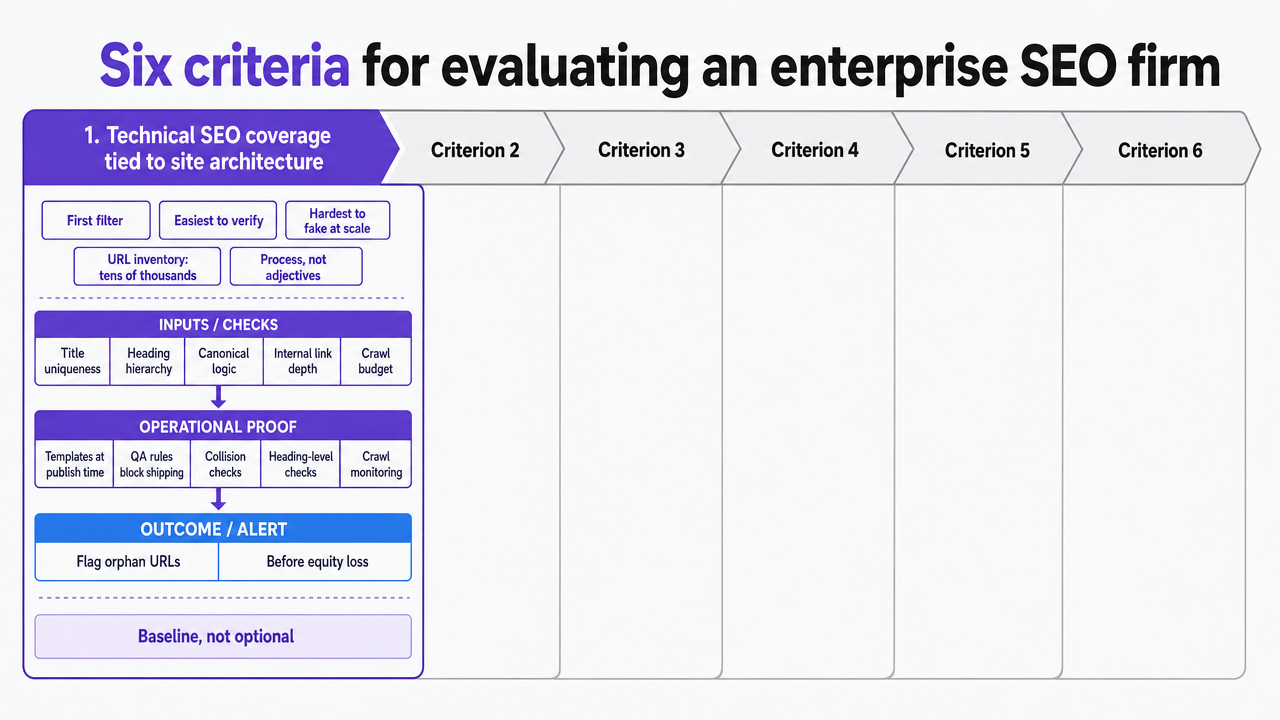 Visualize the six evaluation criteria as a cohesive framework the buying team can use, directly supporting the six subsections that follow
Traditional retainers, hybrid firms, and AI-execution platforms
Three operating models now compete for the enterprise SEO budget, and each carries a different coordination cost. The buying team benefits from naming the model before comparing the pitch decks.
The traditional retainer sells staff hours. A pod of strategists, writers, and analysts works against a monthly scope, and the in-house team absorbs the coordination load between technical fixes, editorial output, and reporting. The model still fits organizations with mature internal ops and a single dominant priority. Its weakness is throughput: peer-reviewed work frames SEO as a multi-method discipline spanning technical, content, and link factors 3, and a retainer pod scales linearly with headcount added to each method.
The hybrid firm bundles execution with proprietary tooling — a crawler, a content brief generator, a rank tracker — and charges a platform fee alongside services. It compresses some coordination costs but rarely closes the loop between production and pipeline. Reporting still arrives as an export rather than a live signal, and the in-house team remains the integrator between the firm's tooling and the CRM.
The AI-execution platform is the newer category. It treats strategy, production, and publishing as one governed workflow, with specialist models handling technical audits, content drafts, metadata, and reporting under human approval at each stage. The value is not speed for its own sake — NIST's framing of analytics as the continuous-improvement layer of the marketing system applies here 1— but the removal of the handoff tax between vendors. The trade-off is that the in-house team must own approval quality, because the platform executes what it is told to ship.
See How Enterprise SEO Automation Outpaces Traditional Firm Models
Request a data-driven analysis of your current SEO workflow and learn how AI-powered execution platforms can streamline multi-location campaigns without increasing team size.
Consolidation economics for multi-location operators
For multi-location operators — DSO groups, home services franchises, senior living portfolios, behavioral health networks, and regional law firms — the search vendor stack tends to sprawl faster than the pipeline it produces. A group with 40 locations often carries an SEO retainer, a separate content agency, a technical consultant on project fees, a link-building vendor, and an analytics contractor stitching dashboards together. Each contract solves one method of a discipline that peer-reviewed research treats as a single system spanning technical, content, and link factors 3. The in-house team pays the integration tax.
The consolidation question is not "which vendor is cheapest." It is "what does coordination between these vendors actually cost." That cost shows up in three places: duplicated scoping, conflicting recommendations, and the internal hours spent reconciling reports that do not agree. A worksheet helps the buying team price it honestly.
| Line item | Current monthly cost | In-house hours / month | Unified execution model |
|---|---|---|---|
| SEO strategy retainer | $A | H1 | Single workflow |
| Content production agency | $B | H2 | Single workflow |
| Technical SEO consultant | $C | H3 | Single workflow |
| Link acquisition vendor | $D | H4 | Single workflow |
| Analytics / reporting contractor | $E | H5 | Single workflow |
| Stack total | $A+B+C+D+E | ΣH | Consolidated fee + approval time |
Two numbers matter more than the retainer subtotals. The first is ΣH, the internal hours the in-house team spends coordinating across the stack each month. The second is the lag between a technical finding and a published fix — the days lost in the handoff from consultant to agency to CMS. Multi-location operators with 40 or more sites feel both costs at scale: a single title-tag pattern change can require three vendor tickets and two weeks of chase.
Consolidation does not automatically mean lower spend. It means fewer seams. The buying team should price the current stack against a unified execution model on total cost of coordination, not on retainer size alone, and require any candidate to show how technical, editorial, and reporting work move through one approval workflow rather than five inboxes.
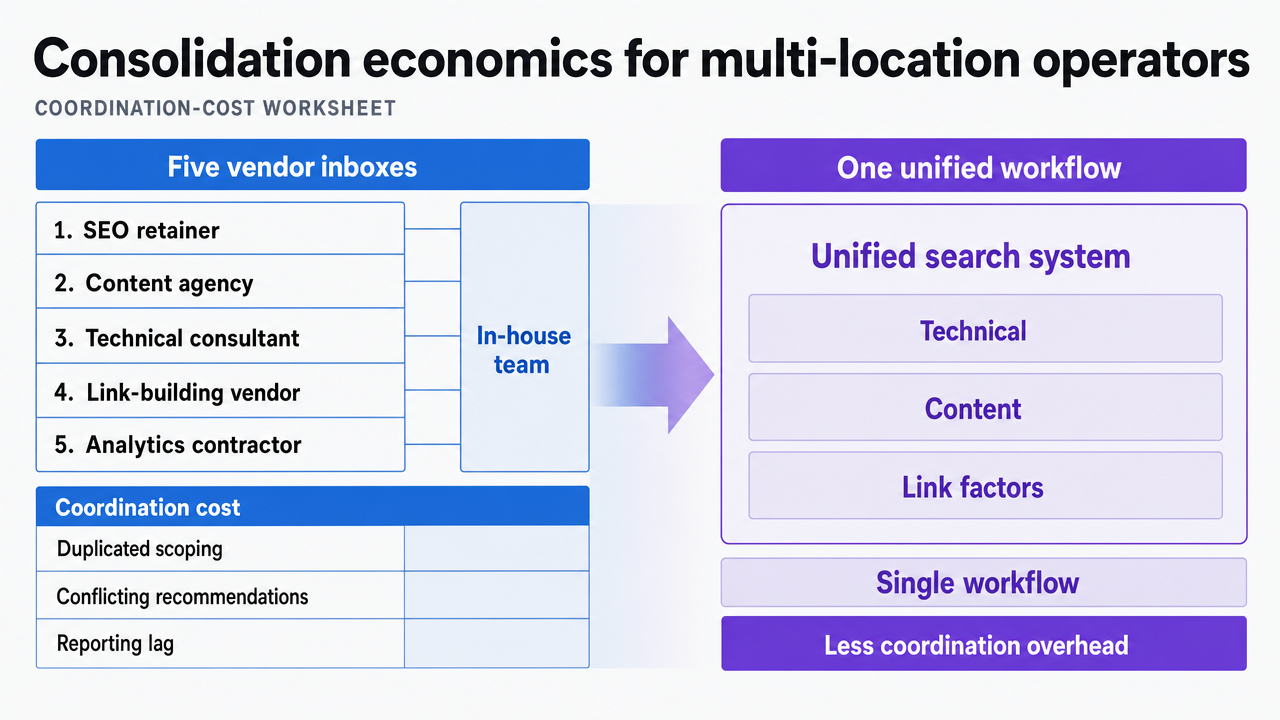 Render the vendor stack coordination-cost worksheet from the article as a clear comparison infographic, mirroring the table's structure and highlighting the shift from five vendor inboxes to one unified workflow
Running the RFP: a scorecard the buying team can use
An RFP that asks vendors to "describe your SEO methodology" invites marketing copy. An RFP structured as a weighted scorecard forces specifics — and gives the buying team a defensible artifact when the CFO asks how the decision was made.
The scorecard should mirror the six evaluation criteria and require named artifacts, not narrative answers. Each row lists a capability, the artifact that proves it, and a weight the buying team calibrates against its own priorities. A healthcare group weights vertical expertise higher; a manufacturer with a 60,000-URL catalog weights technical coverage higher.
| Criterion | Required artifact | Weight |
|---|---|---|
| Technical SEO coverage | Pre-publish QA rules, crawl monitoring cadence, CMS validation examples 2 | W1 |
| Content governance | Editorial standard, topical map, metadata rules for downloadable assets 7, 8 | W2 |
| Analytics integration | Named CRM, call-tracking, and BI integrations from two recent engagements 1 | W3 |
| Approval workflow | Documented SLAs, routing model, stalled-item escalation path | W4 |
| Vertical expertise | Named credentialed reviewers, byline plan, source-versioning process | W5 |
| Reporting cadence | Redacted sample monthly report, post-report decision agenda | W6 |
Two rules keep the scorecard honest. Vendors that answer with capabilities decks instead of artifacts score zero on that row — the artifact is the point. And the buying team scores independently before consolidating, so a single champion cannot skew the result.
The scorecard also becomes the master service agreement's exhibit A. The artifacts the firm submitted during evaluation become the operational commitments during execution, which shortens the distance between the sales promise and the first quarterly review.
Automate Enterprise SEO Execution Without Expanding Your Team
Access an AI-powered platform that coordinates content, technical SEO, and link building strategies—driven by real-time analytics and human approval—to streamline organic pipeline creation for multi-location and high-stakes service brands.
Red flags that surface within 60 days of signing
The first 60 days of an engagement expose whether the firm's pitch matched its operating model. A few patterns show up early and predict the trajectory of the next four quarters.
- The kickoff runs on introductions instead of instrumentation. A firm that spends week three still "getting access" to GA4, the CRM, and the call-tracking system has no analytics schema of its own. NIST guidance treats analytics as the continuous-improvement layer of the marketing system 1— a firm that cannot wire into it inside 30 days will not report against pipeline in month six.
- Deliverables arrive without governance artifacts. Draft posts land in the shared drive, but no editorial standard, topical map, or metadata rule set precedes them. Public-sector guidance is explicit that structured content workflows are the baseline for large publishing operations 7, and their absence early is a durable problem, not a startup lag.
- Technical work is described as an audit rather than a control. The firm presents a spreadsheet of title and heading defects 2with no pre-publish QA rule to prevent recurrence. The same errors will reappear in the next crawl.
- Reporting opens with keyword positions. If the first monthly review leads with rankings rather than qualified pipeline, the firm has already defined success on its own terms — and the buying team should renegotiate the scorecard before month three.
What the first 90 days should produce
A useful diagnostic for whether the engagement is on course is the artifact inventory at day 90. Not rankings, not a traffic chart — the specific documents and controls that prove the firm operates as a governed system rather than a monthly deliverables pipeline.
- By day 30, the analytics schema should be wired in and validated: GA4 events mapped to CRM stages, call-tracking reconciled to landing-page cohorts, and a shared dashboard reflecting the pipeline metrics the VP already reports upward 1.
- By day 60, the editorial standard, topical map, and metadata rules should be signed off, with the first cohort of content produced against them and QA'd through the documented workflow 7, 8.
- By day 90, the technical baseline should be codified as pre-publish controls rather than a static audit — title uniqueness, heading hierarchy, and canonical logic enforced at the CMS layer, not tracked in a spreadsheet 2.
The first quarterly review should open with pipeline attribution and topical-cluster performance, followed by a decision list the firm commits to executing. If day 90 arrives with drafts but no governance artifacts, the engagement is producing activity, and the scorecard needs to be reopened before month four.
Frequently Asked Questions
References
- 1.Marketing and Sales Strategies for Manufacturers | NIST.
- 2.Search Engine Optimization Best Practices - Department of Energy.
- 3.Search engine Performance optimization: methods and techniques.
- 4.Google Medical Update: Why Is the Search Engine Decreasing ....
- 5.Search engine optimization: What is it and why should we care?.
- 6.Search engine optimization for scientific publications: How one can get noticed and why this should be considered.
- 7.3.3 Search Engine Optimization (SEO) | Digital Services & Solutions.
- 8.Search Engine Optimization | Communication Standards | NLR.
- 9.Search Engine Optimization Starter Guide.
- 10.Four More Marketing Action Items for Manufacturers.