
Key Takeaways
- Pipeline growth stalls when the handoff layer between marketing and sales is undefined; tightening lead definitions, SLAs, and closed-loop reporting outperforms adding another acquisition channel 4.
- Treat lead generation as six instrumented stages in a closed loop, capture, enrichment, scoring, routing, nurture, and feedback, with SEO, paid, and link development feeding one scoring engine rather than separate funnels.
- Heuristic point scoring plateaus as buying signals shift; quarterly ML recalibration against closed-won and closed-lost data, with interpretable feature contributions reps can act on, sustains conversion gains 10.
- Audit definitions and instrumentation before investing in models: teams without signed MQL, SAL, and SQL definitions, source-level conversion reporting, or rejection write-back are doing definition work, not model work.
Process maturity beats channel volume
Most SaaS growth programs hit a pipeline ceiling not because their channels underperform, but because the connective tissue between channels is undefined. Adding another paid campaign or content cluster to an immature lead management system produces more raw volume and roughly the same qualified pipeline. Forrester's lead management maturity framework makes the case directly: organizations that standardize lead definitions, instrument closed-loop reporting, and enforce follow-up discipline see better sales follow-up rates and higher close rates on marketing-generated leads than peers running heavier channel investment without that backbone 4.
The practical implication for a VP of Marketing is uncomfortable. The next unit of pipeline growth is more likely to come from tightening the handoff between marketing-qualified and sales-accepted leads, recalibrating a scoring model, or fixing routing SLAs than from a fourth acquisition channel.
This article treats lead generation as an instrumented operating system with six stages, shared definitions across marketing and sales, machine learning-driven prioritization, and a coordination layer that ties SEO, paid, and link development to one scoring engine. Each section is built around evidence on what actually moves conversion rates and which workflow steps reward automation first.
The lead management lifecycle as an instrumented system
Six stages, one closed loop: capture, enrichment, scoring, routing, nurture, feedback
A scalable lead generation process is best modeled as six instrumented stages connected in a closed loop. Each stage produces a data signal that the next stage consumes, and the final stage feeds outcome data back to the first.
- Capture records the inbound event: form submission, demo request, content download, paid click, or sales-development outreach reply. The signal is source, campaign, channel, and the explicit fields the prospect provided.
- Enrichment appends firmographic and technographic data from third-party providers and from product-usage signals where available, so that downstream scoring has more than just self-reported attributes to work with.
- Scoring assigns a probability of conversion based on enriched attributes and behavioral patterns. Recent peer-reviewed work shows that machine learning approaches outperform static point systems on this stage specifically because the underlying buying signals shift over time and across segments 10.
- Routing sends the prioritized lead to the right owner: a self-serve nurture track, an SDR queue, or an account executive directly. McKinsey's review of ML deployments in B2B sales describes ML-powered routing producing prioritized lists that change which prospects sellers touch first 8.
- Nurture handles the leads not yet ready to talk to sales, using a mix of automated sequences and human intervention at defined thresholds.
- Feedback closes the loop by writing disposition data, deal stage progression, and revenue outcomes back to the scoring model and the capture-stage attribution.
The system breaks when any stage drops its signal. A capture form that does not record campaign source disables attribution. A routing rule that ignores score forces sellers to re-prioritize manually. A feedback stage with no write-back to scoring leaves the model frozen on stale assumptions. The instrumentation matters as much as the stages themselves.
Shared definitions and SLAs between marketing and sales
The lifecycle only functions when marketing and sales agree on what each handoff means. Forrester's lead management maturity framework places shared lead definitions and closed-loop reporting at the center of the maturity progression, and links higher maturity to better sales follow-up rates and higher close rates on marketing-generated leads 4.
Three definitions carry most of the weight. An MQL specifies the score threshold, the required enrichment fields, and the disqualifying attributes. An SAL records sales acceptance within a defined window, typically measured in business hours rather than days. An SQL confirms a qualified opportunity has been created in the CRM with a stage, amount, and close date.
SLAs make those definitions operational. A first-touch SLA on inbound demo requests, measured in minutes for high-score leads and hours for medium-score, removes the most common pipeline leak. A rejection SLA requiring sales to return rejected MQLs to marketing within a fixed window with a reason code feeds the scoring model the negative examples it needs to recalibrate.
Without these definitions and SLAs, channel investment compounds the disorder rather than the pipeline. A marketing team can double content output and paid spend and still see flat SQL volume because the handoff layer absorbs the extra volume as noise. The diagnostic question is simple: can the team produce a single report showing MQL volume, SAL conversion rate, SQL conversion rate, and median time between stages, by source, last quarter? If not, definition work precedes any new channel investment.
Coordinating SEO, paid, and link development as one acquisition motion
Most SaaS marketing orgs run SEO, paid acquisition, and link development as parallel workstreams with separate goals, separate dashboards, and separate definitions of a good lead. That fragmentation shows up downstream as inconsistent lead quality, duplicate attribution, and sales teams that treat inbound from one channel differently than another for no defensible reason.
The fix is structural. SEO content, Google Ads campaigns, and backlink acquisition should feed a single scoring engine and a single routing layer, with channel and campaign retained as attributes the model can weigh rather than as separate funnels with separate rules.
Three coordination points carry the load:
- Taxonomy. Campaign, content cluster, and referring-domain tags must be standardized at the capture stage so that GA4, Search Console, SEMrush, and the CRM speak the same vocabulary. Without a shared taxonomy, attribution rolls up to channel buckets that hide which content asset or which paid keyword actually produced revenue.
- Intent mapping. Each channel produces leads at different points in the buying cycle: organic content tends to capture earlier-stage research behavior, branded paid search tends to capture in-market intent, and backlink-driven referral traffic varies by source domain authority and topical relevance. The scoring model should treat channel and content type as features, not as filters that pre-sort leads into separate nurture tracks.
- Feedback. When sales rejects a lead from a specific paid keyword cluster or content topic, that disposition has to write back to both the scoring model and the channel-level optimization decisions. McKinsey's review of ML deployments in B2B sales describes this loop directly, where ML-powered routing and prioritization depend on outcome data flowing back to the model rather than stopping at a closed-won flag 8.
The orchestration layer is where most SaaS programs lose the most pipeline. A coordinated motion means an SEO team that knows which content clusters produce SQLs versus MQLs that disqualify on company size, a paid team that bids on keyword groups validated by downstream revenue rather than by form-fill volume, and a backlink program that prioritizes referring domains whose traffic converts in the scoring model. None of that requires consolidating channels under one manager. It requires consolidating the data definitions and the scoring engine those channels feed.
Test a Complete Lead Generation Workflow Now
Validate your lead generation strategy on real channels and measure qualified pipeline impact before committing.
Lead scoring as the core engineering problem
Why heuristic point systems plateau
The conventional lead score is a weighted point system: ten points for a job title containing "director," fifteen for a company size above 200, five for a pricing page visit, minus ten for a free email domain. It is easy to build, easy to explain, and easy to defend in a quarterly business review. It also stops improving after the first calibration.
The plateau has a specific cause. Heuristic point systems encode the team's prior beliefs about which attributes predict conversion. Those beliefs are usually right at the moment the model is built and progressively wrong afterward, because product positioning shifts, ICP definitions tighten, new competitors change which segments convert, and the buying committee for a given deal size expands or contracts. A static point system cannot detect any of that. It will keep assigning fifteen points to a 200-person company long after the ICP has narrowed to 500-person companies with a specific tech stack.
The systematic review of lead scoring models reaches the same conclusion from the evidence: well-designed scoring models lift conversion rates and sales productivity compared with heuristic approaches, and the gap widens as the underlying buying signals shift over time 10. A point system that is not re-fit against recent outcome data is functionally a snapshot of last year's pipeline assumptions.
ML-based scoring: variables, recalibration cadence, and interpretability
A machine learning approach treats lead scoring as a supervised prediction problem: given a set of features about the lead, the account, and the behavior to date, what is the probability this lead converts to an SQL within a defined window? The peer-reviewed B2B SaaS case study built exactly this kind of model and reported that the analytics-based scoring approach significantly improved sales team efficiency by focusing effort on higher-potential leads, with measurable gains in downstream conversion 7. The broader systematic review confirms the pattern across multiple deployments: structured, data-driven scoring models outperform heuristic point systems on conversion and sales productivity 10.
The variables that carry the most signal fall into four groups:
- Firmographic features include company size, industry, geography, and funding stage.
- Technographic features include the prospect's existing stack, where compatibility or competitive overlap predicts fit.
- Behavioral features include session depth, pages visited, content topic mix, return visits, and time-to-second-touch.
- Source features include channel, campaign, content cluster, and referring domain.
The model weighs these features against historical outcomes rather than against the team's intuition.
Recalibration cadence is the operational variable most teams underestimate. A scoring model that is re-fit annually drifts the same way a heuristic point system does. Quarterly recalibration against the most recent closed-won and closed-lost data, with the rejection reasons sales returns under the SLA discussed earlier, is the minimum cadence for a B2B SaaS pipeline with quarterly product and positioning shifts.
Interpretability is the constraint that decides whether sales actually uses the score. Black-box models that output a single number without feature contributions get ignored the first time a rep disagrees with the ranking 10. A scoring system that surfaces the top three contributing features for each lead, in language a rep can act on, gets used. The engineering goal is a model that is accurate enough to lift conversion and transparent enough that the sales team trusts the prioritized queue.
Routing and next-best-action: where orchestration lives
Scoring assigns a probability. Routing converts that probability into an action with an owner, a deadline, and a defined next step. The handoff between those two stages is where most B2B SaaS pipelines lose hours that compound into lost deals.
A working routing layer reads three inputs in sequence: the lead score, the account context, and the available capacity of the receiving team. A high-score lead from a target account with a named AE goes directly to that AE with a same-business-hour SLA. A high-score lead from an untouched account routes to an SDR queue segmented by territory and product line. A medium-score lead with strong behavioral signal but weak firmographic fit goes to a nurture track that escalates to human outreach only when a defined behavioral threshold trips. The rules are explicit, auditable, and tied to the scoring model's feature contributions rather than to ad-hoc rep preferences.
Next-best-action guidance sits on top of routing. McKinsey's review of ML deployments in B2B sales describes models that score leads and produce prioritized lists telling account executives which prospects to touch first, with suggested actions attached 8. The orchestration value is not the recommendation itself; it is the consistency. Every rep works the same prioritized queue against the same SLAs, and every rejection writes back to the scoring model with a reason code. That feedback is what keeps routing from drifting into the same plateau heuristic scoring hits in section four.
See How Leading Teams Engineer High-Volume, Scalable Lead Generation
Request a walkthrough of unified lead generation workflows proven to coordinate SEO, paid, and backlink channels for efficient, cross-channel customer acquisition at scale.
Nurture: where automation helps and where it doesn't
The case for automated nurture is intuitive: a sequence runs on its own, every lead gets touched, and the marketing team scales without proportional headcount. The 2025 American Marketing Association review of nurture research complicates that case. The study found that automation does improve the quality and consistency of lead interactions, but it does not uniformly raise conversion rates across industries 5. Automation is a quality-control mechanism more than a conversion lever, and treating it as the latter is where most SaaS programs misallocate budget.
The split that holds up under the evidence is by deal complexity and buying-committee size. Single-stakeholder, lower-ACV products convert reasonably well on fully automated sequences because the prospect can self-educate, decide, and transact without a human touch. Multi-stakeholder, higher-ACV products do not. Once a buying committee involves three or more people across procurement, security, and the line-of-business owner, automated email does not move the deal forward; it informs an internal champion who then runs the deal manually.
The operational design that reflects this is hybrid. Automated sequences handle the early-stage signal building: case studies sent against the prospect's industry, pricing-page revisit triggers, content matched to the topic cluster that produced the original capture. Human intervention triggers at defined behavioral thresholds: a pricing-page visit by a second contact from the same account, a return demo-page visit within seven days, or a security-questionnaire content download. The threshold logic is explicit, not at SDR discretion.
The mistake to avoid is the all-automated nurture that runs for ninety days with no escalation path. Those tracks produce the engagement metrics the AMA study warns about: open rates rise, click rates look healthy, and pipeline conversion stays flat 5. The fix is fewer sequences with sharper escalation rules, not more sequences with longer cadences.
AI-augmented execution inside the existing CRM and MAP stack
The premise behind most AI-in-marketing pitches is replacement. The premise that holds up under the evidence is augmentation inside the stack the team already runs. McKinsey's review of generative AI in B2B sales estimates the productivity opportunity at $0.8 trillion to $1.2 trillion globally across sales and related functions 1. That figure is a global aggregate across all B2B sales worldwide, not a per-company benchmark and not a forecast any single SaaS org should plan against. It sets the scale of the opportunity, not the size of any one team's uplift.
The deployments that produce measurable gains share a pattern. They sit on top of the existing CRM and marketing automation platform rather than replacing them, and they target the three workflow steps where repetitive cognitive load is highest: enrichment, draft generation, and prioritization. McKinsey's broader synthesis of AI in B2B sales describes the same pattern, with gen AI used to boost seller productivity and automate repetitive tasks across the lead-to-close journey rather than to run autonomous outbound at scale 2.
Three deployments carry most of the early value:
- AI-assisted enrichment that reads a captured lead, queries firmographic and technographic sources, and writes back to the CRM with confidence scores attached.
- Draft generation for outreach and nurture content, where the model produces a first draft personalized against the prospect's industry and recent behavior, and a human edits before send.
- Prioritization assistance that surfaces the top features driving each lead's score and the suggested next action, which McKinsey describes as ML models producing prioritized lists that change which prospects sellers touch first 8.
The peer-reviewed review of an AI lead generation system reaches the same conclusion from a different angle: combining transformer-based NLP with reinforcement learning improves identification of high-value leads, but the authors flag data quality, domain generalizability, and the need for human oversight as limits on full autonomy 6. The operational read is that AI augmentation works inside a governed workflow with human review at defined checkpoints. It does not work as a black box that writes to the CRM without an audit trail.
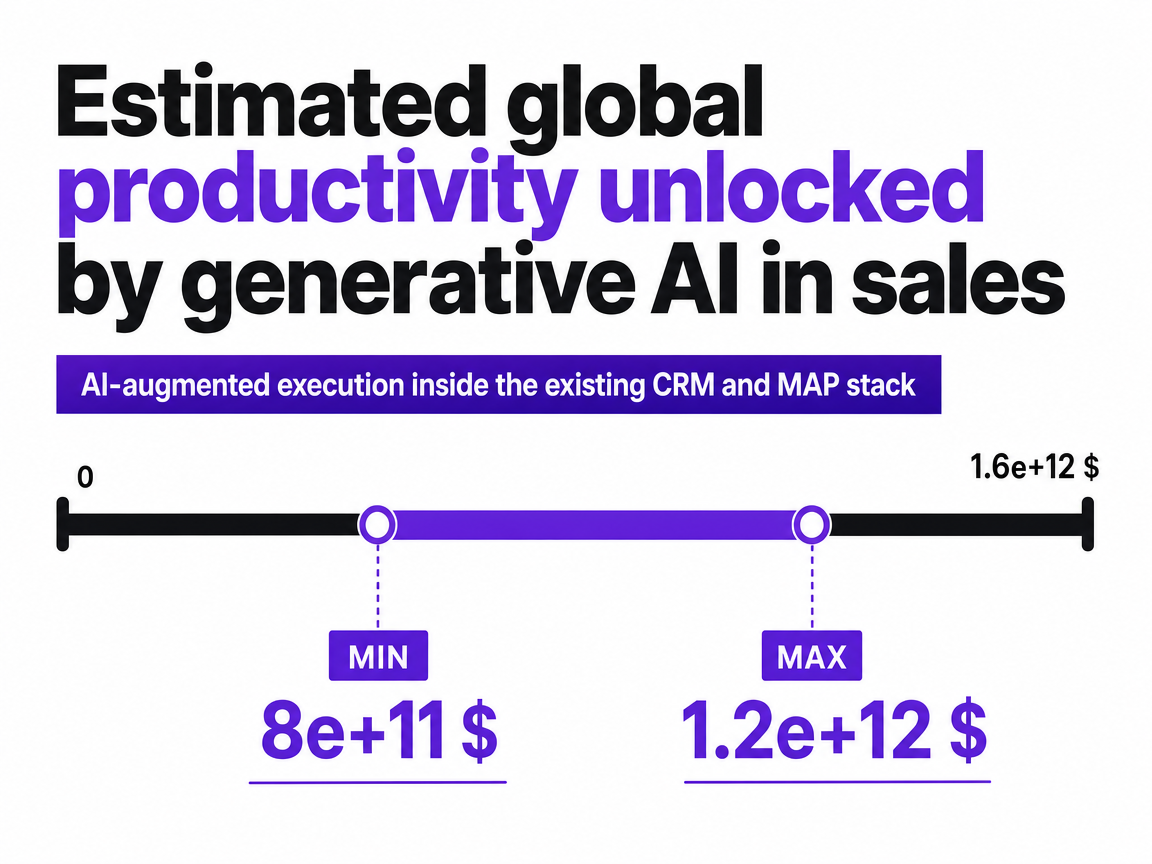 Estimated global productivity unlocked by generative AI in sales
McKinsey estimates that generative AI could unlock between $0.8 trillion and $1.2 trillion in productivity across sales and related functions globally. This represents the total value across all B2B sales worldwide.
Implement a Data-Driven Lead Generation Engine at Scale
Access a unified platform for orchestrating SEO, paid media, and backlink strategies—validated by real-time analytics—to streamline lead generation across all channels and business units.
If you manage multiple healthcare locations: regulated capture and consolidation economics
HIPAA-constrained capture, authorization, and AI governance
For multi-location healthcare operators, the constraints on lead capture change materially. The HIPAA Privacy Rule treats most marketing communications that use protected health information as requiring written patient authorization, with narrow exceptions for face-to-face communications and certain treatment-related contact 3. That definition reshapes the capture stage. A form that asks a prospective patient to describe symptoms, condition history, or current medications crosses into PHI territory the moment that data is associated with an identifier, and the downstream enrichment, scoring, and nurture workflows inherit the same restrictions.
The operational design that holds up is a two-tier capture model. Tier one collects only non-PHI inquiry data: service line interest, location, and contact method. That data flows into the standard scoring and routing engine. Tier two, triggered after explicit authorization, captures the clinical detail needed to route to the right provider or care navigator. Mixing the tiers in a single form is the most common compliance error and the most common reason scoring data gets quarantined.
AI governance compounds the requirement. The peer-reviewed survey of AI in healthcare flags data protection, transparency, bias, and accountability as the four governance dimensions that any autonomous system handling patient-adjacent data must address 9. For lead generation, that translates to audit trails on every model decision, human review checkpoints before any PHI-adjacent message sends, and documented recalibration logs the compliance team can produce on request.
Comparing traditional agency retainers to an AI operating system across locations
The economics shift the moment a growth program crosses from one location to a portfolio. Traditional agency retainers scale linearly with location count because the underlying cost drivers, account manager hours, per-location reporting, and manual handoffs between SEO, paid, and content teams, all multiply with each added site or service line. An AI operating system run at the account level keeps most of those cost drivers fixed, with execution capacity scaling against data volume rather than against location count.
The variables that decide the comparison are structural, not invented dollar figures.
| Cost driver | Traditional agency retainer | AI operating system |
|---|---|---|
| Account management | Per-account or per-location hours | Fixed at the account level |
| Channel coordination | Manual handoffs between SEO, PPC, backlink teams | Shared scoring and routing engine |
| Reporting | Per-location dashboards assembled manually | Account-level rollup with location filters |
| Scaling behavior | Linear with location count | Sub-linear; scales with data volume |
| Content production | Per-asset pricing with review cycles | Production engine with governed review checkpoints |
Vectoron's post-trial pricing of $599 per month is one anchor for the AI-operating-system column at the entry point, with execution capacity covering all sites and service lines under a single growth program. The comparison the finance team will care about is not the headline retainer figure but the slope. A traditional retainer line climbs with each new location. An account-level system holds the line flatter, which is what makes the consolidation case in a portfolio with five, fifteen, or fifty locations.
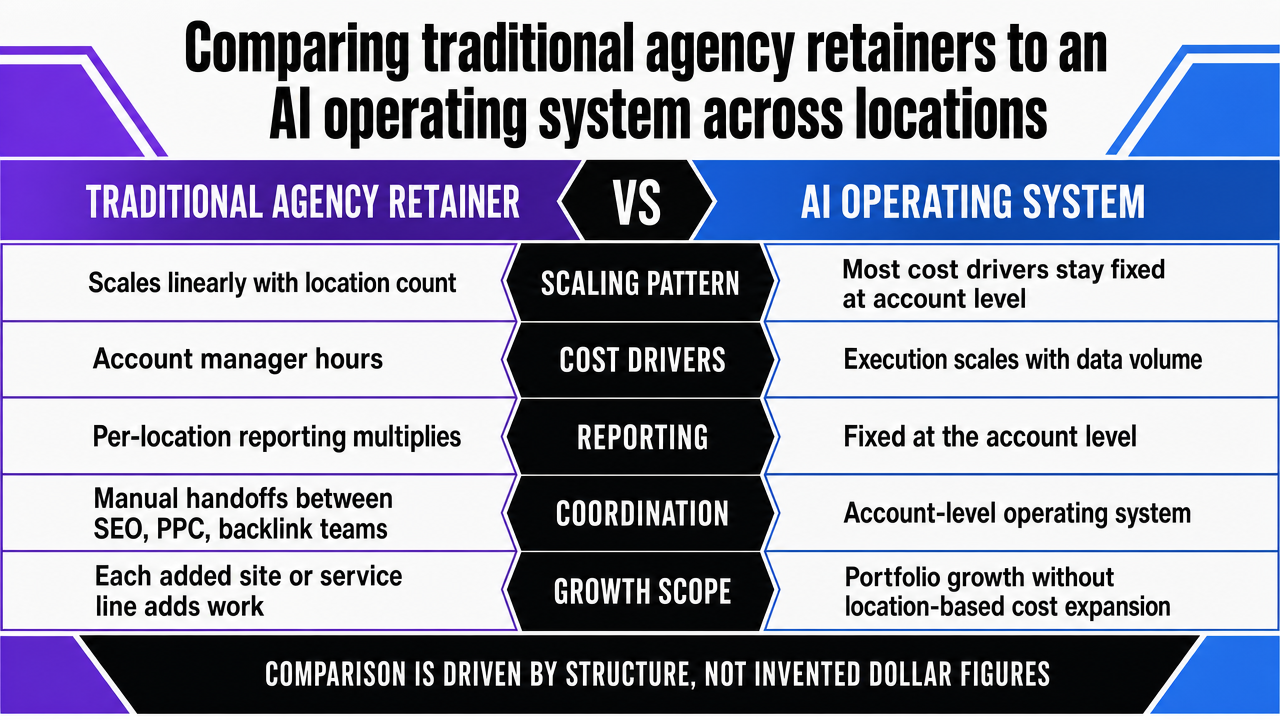 Render the section's comparison table as a clean side-by-side framework so readers can scan the structural cost-driver differences between traditional agency retainers and an AI operating system
A maturity self-assessment for the next four quarters
The Forrester maturity framework is useful as a diagnostic when it is reduced to operational questions a marketing team can answer in a single planning session 4. The eight below sort a program into one of three positions: definition work pending, instrumentation work pending, or model work pending.
Definitions and SLAs. Can the team produce a one-page document, signed by the CRO, that defines MQL, SAL, and SQL with the score thresholds and required fields? Is there a first-touch SLA on high-score inbound, measured in minutes? Does sales return rejected MQLs within a fixed window with a reason code?
Instrumentation. Does every captured lead carry source, campaign, content cluster, and referring domain into the CRM without manual stitching? Can the team produce MQL-to-SAL-to-SQL conversion and median stage time by source for the last quarter?
Scoring and feedback. Is the scoring model re-fit at least quarterly against recent closed-won and closed-lost outcomes 10? Do rejection reason codes write back to the model? Do reps see the top features driving each lead's score?
A team answering yes to fewer than three is in definition work. Three to five, instrumentation work. Six or more, model work, where platforms such as Vectoron coordinate scoring, routing, and channel execution against one account-level plan.
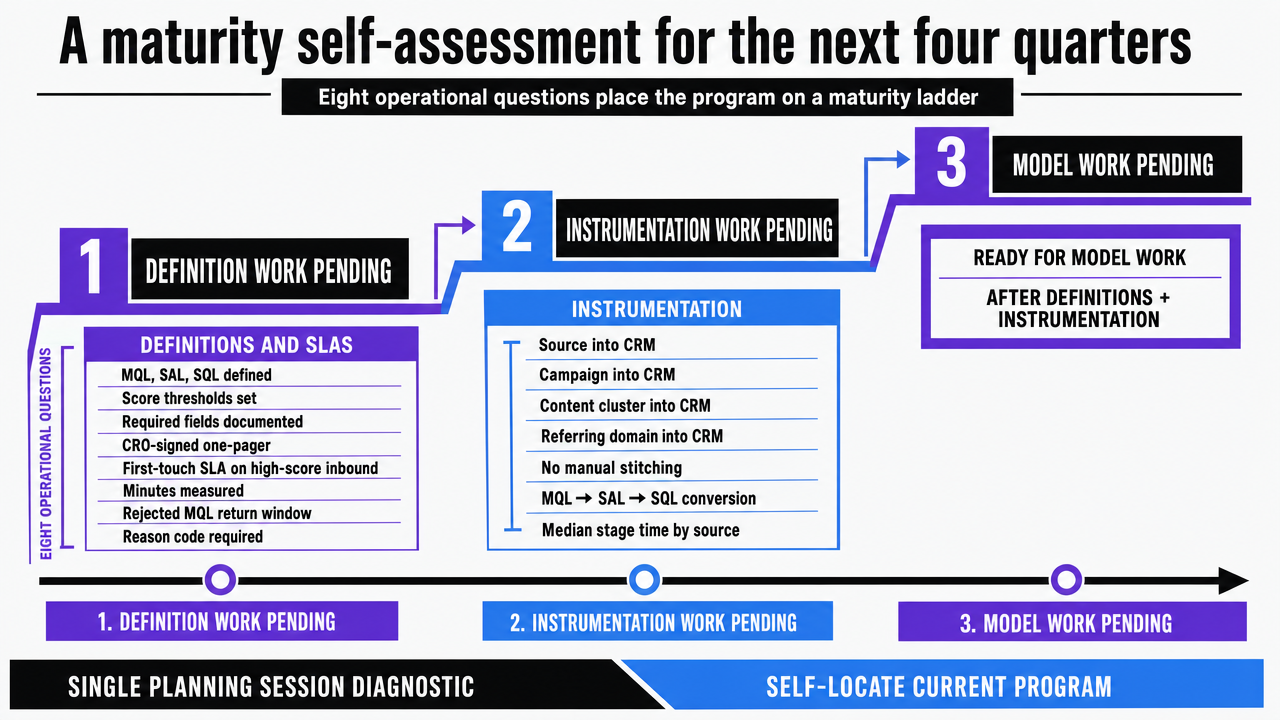 Turn the section's three-position diagnostic into a visual maturity ladder so VPs of Marketing can self-locate their program based on the eight operational questions referenced
Frequently Asked Questions
References
- 1.An unconstrained future: How generative AI could reshape B2B sales.
- 2.Unlocking gen AI in B2B sales.
- 3.Marketing | HHS.gov.
- 4.Four Ways To Grade Lead Management Maturity.
- 5.Does Automated Lead Nurturing Really Work? A New Study Challenges the Hype.
- 6.A review of AI-based business lead generation: Scrapus as a case study.
- 7.The relevance of lead prioritization: a B2B lead scoring model based on data analytics and machine learning.
- 8.Five ways B2B sales leaders can win with tech and AI.
- 9.Ethical and regulatory challenges of AI technologies in healthcare.
- 10.The state of lead scoring models and their impact on sales performance.