
Key Takeaways
- Audit the briefing cycle before touching the vendor list, since latency and handoff waste reveal workflow problems that no rate negotiation or vendor swap will fix.
- Route recurring content, SEO, paid search, and social production to an AI execution layer where VPs approve ranked recommendations with rationale, not finished assets.
- Renegotiate remaining consultant spend around episodic judgment work like M&A repositioning, category creation, or board narrative, and cut engagements that fail that test.
- Track briefing-to-publish latency and external spend per sourced pipeline dollar monthly, since these throughput metrics expose whether the workflow was rebuilt or merely relabeled.
The advisory layer is no longer the bottleneck
The traditional marketing consultant model was designed for a market where senior strategic thinking was scarce and execution was relatively inexpensive. This dynamic has inverted. Today, in-house marketing leaders have abundant access to frameworks, benchmarks, and playbooks, often at no cost. Their primary challenge is the throughput required to implement these strategies across various channels like content, SEO, paid media, backlinks, social media, and call data, quickly enough to impact the pipeline.
The financial realities highlight this shift. Marketing budgets as a share of firm revenue decreased from 10.1% in Spring 2024 to 7.7% in Fall 2024, marking the lowest level recorded by The CMO Survey in recent waves 2. Concurrently, marketers anticipate martech's share of budgets to rise from 19.9% today to 30.9% within five years 1. This scenario involves reduced overall funding, a larger portion allocated to platforms, and unchanged growth targets.
This economic reality leaves little room for scaling through traditional retainer hours. For most VPs, the bottleneck is no longer access to strategic insights but rather the execution layer: who produces the work, the speed of approvals, and the direct link between output and pipeline. This article addresses this as a core operating model challenge.
Why the consultant model was priced for a different decade
Budget compression colliding with martech expansion
Two key data points illustrate why the traditional consultant retainer is fundamentally mispriced. The CMO Survey's Fall 2024 report indicated that marketing budgets, as a percentage of firm revenue, fell from 10.1% in Spring 2024 to 7.7% in Fall 2024 2. Over the same period, the survey panel projected martech's share of marketing budgets to grow from 19.9% to 30.9% within five years 1.
These opposing trends specifically challenge the consultant model. A shrinking total budget means less capital is available for advisory work that doesn't directly produce tangible assets. The increasing allocation to martech platforms and licenses further reduces the remaining funds for external strategists. This creates a double squeeze on the budget available for retainer-based consulting.
For a VP tasked with justifying every external expenditure to a CFO, the implication is clear: growth spending must prioritize platforms, where output compounds, over services, where output is limited by billable hours. This shifts the conversation from how much to spend on advice to how little advice is needed to still achieve measurable results.
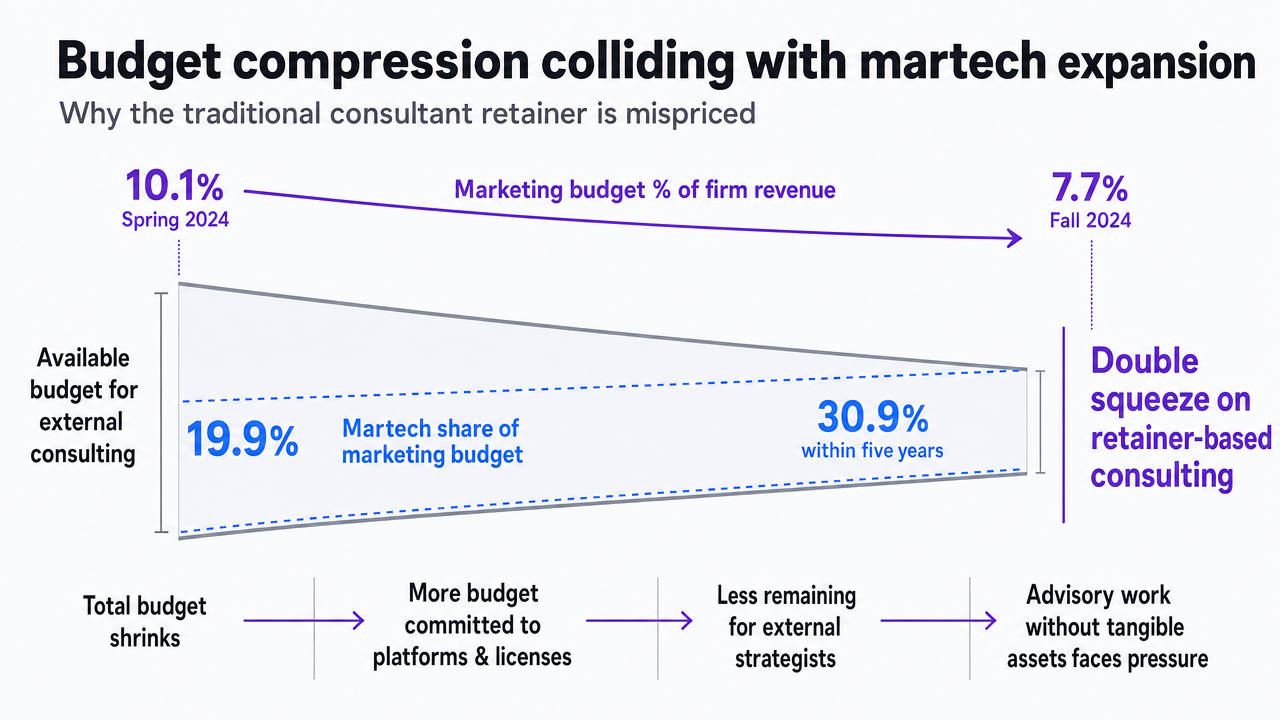 Visualize the budget compression and martech expansion paradox that anchors this section's argument about consultant model mispricing
What consultants actually sell, and what teams actually need
The term "consultant" encompasses at least three distinct economic transactions, and confusing them often leads to overspending by VPs.
- A strategy consultant offers a point of view, such as positioning, category framing, or ICP redefinition.
- An agency-of-record provides ongoing capacity for campaign planning and execution.
- A freelance specialist sells hours for specific tasks like technical SEO audits or paid search builds.
Most in-house teams already possess the strategic insights. VPs in mid-market and growth-stage roles typically bring frameworks, segmentation expertise, and current category understanding. What they often lack, especially with flat budgets, is the production bandwidth to translate these insights into executed work across content, SEO, paid media, backlinks, social, and call data on a weekly basis. Harvard Business Review's framework for AI marketing strategy emphasizes that gains stem from workflow redesign, not from adding more analysis on top of existing processes 6.
The core mismatch is that consultants sell judgment by the hour, while teams require execution by the queue. A retainer delivering a quarterly report and a few workshops doesn't directly impact pipeline numbers that the CEO monitors weekly. The crucial question is whether each external dollar purchases a shippable deliverable or merely an informative document.
The hidden cost is coordination, not the hourly rate
Focusing on hourly rates misses the true cost of traditional consultant relationships: coordination overhead. This includes lengthy brief writing, status calls to align disparate vendors, and approval processes that can extend a two-day production task into a three-week cycle.
Evidence supports this. WFA and MediaSense found that a significant majority of major advertisers believe current agency models are inadequate for future needs, citing agility, transparency, and integration with in-house teams as key concerns 10. Additionally, the 4As/ANA research on agency tenure reveals that the average cost of an agency pitch is substantial, indicating that switching is so expensive that brands often tolerate misalignment to avoid it 13.
For an in-house VP, the implication is operational, not contractual. A 15% reduction in a retainer's hourly rate doesn't fix a workflow that loses two weeks per asset due to handoffs. The critical metric is briefing-to-publish latency, measured in days. Compressing this timeline makes the case for paying a senior strategist to attend status calls unsustainable.
Experience AI-driven marketing execution firsthand
Test a fully automated, approval-based workflow and measure live results with your own content during the trial.
The structural break: brands are already redesigning these relationships
Major advertisers consider the current agency model unfit
Dissatisfaction with traditional external marketing relationships is not merely anecdotal; it's reflected in data from the buy side. WFA, in collaboration with MediaSense, surveyed senior marketers at multinational brands and reported that a significant majority view current media agency models as unsuitable for future purposes. Agility, transparency, and integration with in-house teams were identified as primary concerns 10. MediaSense's accompanying analysis further details active experimentation with in-housing, hybrid models, and specialist partnerships that combine internal capabilities with platform infrastructure 11.
The scale of this sentiment is important. This isn't just a survey of small, discontented brands. The respondents manage substantial global media budgets and are openly questioning a model that has dominated their industry for decades. When the world's largest advertisers describe their existing relationships as misaligned with operational needs, the assumption that a retainer is the default scaling tool becomes untenable.
For an in-house VP, the practical takeaway is that the buy side has already embraced redesigning these arrangements. The question is no longer whether to challenge the legacy model, but rather which components of it still provide sufficient value to retain.
Even agencies are productizing toward platforms
Agencies themselves are proactively adapting to impending disruption. Forrester's 2024 predictions suggested that agencies would move beyond commoditized services by integrating AI across their operations and developing bespoke AI products leveraging client first-party data, thereby adopting the platform logic of AI-native marketing tools 8. Marketing Dive's summary of this research highlighted a specific data point: Forrester anticipates that concerns over AI misuse will lead to a 10% increase in agency reviews, potentially causing some digital agencies to disappear as the "digital" qualifier becomes obsolete 9.
A 10% increase in reviews is significant, especially in an industry where reviews are costly, politically sensitive, and typically avoided. This indicates clients are willing to incur switching costs rather than tolerate uncertainty about their agency's AI usage. The prediction also confirms that agencies view productization, not increased headcount, as their future path, with strategic deliverables increasingly moving towards a platform model.
This redefines the choice for in-house teams. If the agency model is converging on platform economics, then directly adopting a governed AI execution layer removes an intermediary margin without sacrificing the capabilities that initially justified agency engagement. The ultimate goal remains the same; the method of achieving it is the key consideration.
Switching costs in the legacy model are punishingly high
The persistence of the traditional model, despite widespread dissatisfaction, is largely due to the high friction involved in leaving it. Research by the 4As and ANA on agency tenure found that the average client-agency relationship length has more than doubled since 2016 12. While this might appear as loyalty, it primarily reflects the prohibitive cost of agency reviews. Detailed economics in the accompanying PDF describe agency pitches as significant six-figure undertakings for clients, not including the internal time consumed by selection committees and transition periods 13.
This cost structure incentivizes inertia. A VP who suspects misalignment with their current agency still faces a six- to twelve-month replacement process, with no guarantee of improved performance from the next agency. Consequently, the relationship often continues, and the misalignment deepens.
A modular execution layer alters this dynamic by reducing the unit of switching. Routing a content workstream or a paid search build to a governed platform doesn't require a category review, a pitch, or a transition plan measured in quarters. The decision is reversible, a crucial property missing from the legacy model.
Move Beyond Consultant Bottlenecks With Unified AI Marketing Execution
See how enterprise marketing teams and agencies are replacing fragmented consultant workflows with data-driven, approval-first automation—streamlining campaigns, reducing overhead, and accelerating pipeline growth without adding headcount.
From advisory layer to execution layer: the operating model shift
Humans approve, machines produce
The operating model that replaces the traditional retainer is not fully automated. Instead, it's a system where humans manage the approval gate, and machines handle the production work. The VP retains ownership of positioning, ICP definition, and final shipping decisions. The key change is that the labor supporting each approved decision shifts from billable hours to platform-driven output.
There is a strong executive consensus on this direction. Harvard Business Review Analytic Services surveyed 615 executives across various functions, finding that two-thirds agree AI in marketing and sales will be critical for their company's competitiveness 7. This high level of agreement among senior leaders suggests that the strategic debate is largely settled, with the focus now on implementation.
For a VP, this establishes the approval-first model as the default, rather than an aggressive option. The relevant design choice is no longer whether to integrate AI into the workflow, but rather where the human approval gate is placed, what each gate is authorized to release, and how quickly a ranked recommendation can move from review to live work without compromising the judgment that defines the role.
Redesign the workflow before adding the tool
A common pitfall is acquiring a platform first while retaining the existing briefing cycle. In such cases, the new tool inherits all the approval steps, status meetings, and handoff delays that made the old model inefficient, negating any potential productivity gains. Harvard Business Review's framework for AI marketing strategy explicitly states that returns come from rebuilding the workflow, not from layering AI onto legacy processes designed around human throughput limitations 6.
Practically, this means starting with a process map before a vendor demonstration. Identify the origin of a content brief, everyone involved, the time from draft to publication, the number of revision rounds, and how many people touch it without adding value. The steps that exist for organizational comfort, rather than critical judgment, are the first to be eliminated.
This redesign also clarifies what the approval gate is actually approving. A VP signing off on a ranked recommendation with supporting rationale is different from a VP reviewing a finished deliverable for tone. The former scales; the latter does not. Building the workflow around ranked recommendations, rather than completed assets, transforms approval into a leverage point instead of a bottleneck.
Where consultants still win: M&A, category creation, board narrative
An objective assessment must acknowledge areas where consultants still outperform platforms. Three categories stand out:
- M&A repositioning, which involves merging brand architectures under intense scrutiny and political risk;
- category creation, focused on defining new buying frameworks rather than competing within existing ones; and
- board narrative work, where the deliverable is a defensible story justifying future marketing investment to the CFO.
Each of these shares a characteristic that resists productization: the output is a judgment call made under conditions the buyer cannot fully specify in advance. The value derives from a senior outsider who has observed similar situations in other companies. This is the true offering of a strategy consultant, and it warrants investment.
The mistake lies in paying retainer rates for such judgment and then expecting the same firm to handle weekly content production. The execution layer should manage recurring tasks, while consultants are reserved for episodic, high-stakes decisions where external pattern recognition is invaluable.
Move Beyond Consultant Bottlenecks With Unified AI Marketing Execution
See how enterprise marketing teams and agencies are replacing fragmented consultant workflows with data-driven, approval-first automation—streamlining campaigns, reducing overhead, and accelerating pipeline growth without adding headcount.
A 90-day sequencing playbook for in-house teams
Days 1–30: audit the briefing cycle, not the vendor list
While the initial impulse might be to review and cut vendors, a more effective first step is to map the end-to-end briefing cycle for one recurring workstream, such as content or paid search. Document every stage from request to publication: who writes the brief, who approves it, how long it waits in a queue, the number of revision rounds, and how many individuals touch it without making substantive changes.
This audit typically reveals workflow inefficiencies rather than vendor problems. It often exposes a process with excessive "comfort hops," a pattern highlighted by HBR's AI marketing strategy framework, which cautions against integrating new tools into outdated processes 6. Measure briefing-to-publish latency in days; this single metric will serve as the baseline for the subsequent 90 days.
Days 31–60: route recurring execution to an AI layer
With the latency baseline established, the second month focuses on shifting recurring production away from retainer hours. Obvious candidates include content briefs, on-page SEO tasks, paid search builds, and social distribution, as these are repetitive and their quality can be verified against ranked recommendations rather than subjective taste.
The gains come from redesigning the process. Forrester's prediction that agencies will productize around AI and first-party data confirms this strategic direction 8. Going direct eliminates the intermediary margin. Two design principles are crucial: the VP approves ranked recommendations with rationale, not finished assets, and each approved item ships without a second human gate. Re-measure briefing-to-publish latency at day 60. If it hasn't significantly compressed, the workflow was merely copied, not rebuilt.
Days 61–90: renegotiate what stays with specialist consultants
By day 60, recurring work should be flowing through the execution layer, reducing the reliance on retainers. The final month involves renegotiating the purpose of any remaining external spend. The criterion is strict: does this engagement provide a judgment call that a platform cannot make, such as M&A repositioning, category creation, or board-level narrative?
If the answer is yes, restructure it as episodic project work with a defined scope. If no, terminate the engagement. The 4As/ANA data showing a doubling of average client-agency tenure since 2016 12 indicates how infrequently this conversation occurs, largely because replacing a full agency is prohibitively expensive. Modular routing removes this barrier. Conclude the 90 days by reporting two key metrics to the CFO: latency reduction and external spend per published asset.
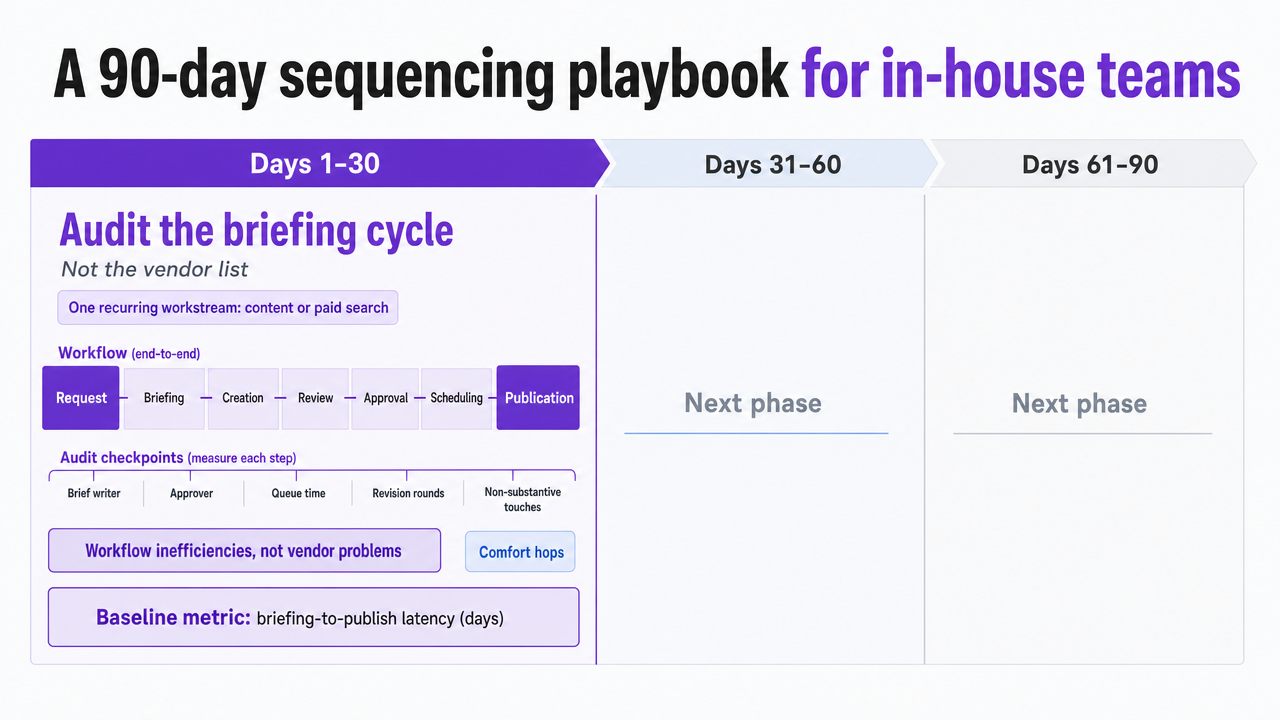 Visualize the three-phase 90-day operating model transition described in the section's subsections
If you manage multiple locations: consolidating the vendor stack
This section specifically addresses VPs managing marketing across multiple locations, such as law firms, behavioral health groups, DSOs, home services, senior living, and multi-site healthcare. The vendor stack problem differs significantly for five or fifty locations compared to a single site.
At scale, vendor relationships often accumulate haphazardly. A retained strategy consultant sets quarterly direction. A content agency handles location-specific pages. A separate SEO vendor manages local listings and technical audits. A paid media agency runs Google and Meta campaigns. A social media vendor posts to each location's accounts. While each relationship might be individually justifiable, collectively they create a burden of weekly briefings, monthly status calls, and a coordination tax that escalates with every new location.
| Function | Current vendor type | Engagement structure | Coordination overhead | Under consolidation |
|---|---|---|---|---|
| Strategy | Retained consultant | Monthly retainer | Quarterly readouts, workshops | Episodic project work, in-house VP owns recurring direction |
| Content | Content agency | Per-asset or retainer | Briefs, revision rounds per location | AI execution layer, VP approves ranked queue |
| SEO | Specialist vendor | Monthly retainer | Audit cycles, listing handoffs | AI execution layer, location-level recommendations |
| Paid media | Performance agency | % of spend + fees | Build approvals, weekly syncs | AI execution layer with VP gate on budget shifts |
| Social | Social vendor | Retainer per location | Calendar approvals per market | AI execution layer, governed by brand rules |
The primary benefit is not merely line-item savings on individual vendors, but the ability to collapse the entire briefing graph. WFA and MediaSense found that major brands prioritize integration with in-house teams as a key driver for model redesign 10. At a multi-location scale, integration is a compounding variable, and consolidation is the only way to prevent it from overwhelming the operational calendar.
Measuring the new model against pipeline, not deliverables
The retainer model incentivized outputs because consultants could promise deliverables like decks, workshops, and audits. The execution-layer model requires different metrics; otherwise, savings might be redirected into activities that don't impact the CFO's bottom line.
Two metrics are paramount. First, briefing-to-publish latency, measured in days from approved recommendation to live asset. Second, external spend per sourced pipeline dollar, calculated across content, SEO, paid media, social, and call-driven conversions. Neither metric counts deliverables; both measure throughput directly tied to revenue. This framing is already accepted as competitively decisive by two-thirds of 615 executives surveyed by Harvard Business Review Analytic Services 7.
Reporting these two numbers monthly provides financial legibility that a quarterly consultant readout cannot. A latency reduction from three weeks to four days, coupled with a decreasing cost per sourced pipeline dollar, strongly validates the new model. If neither number improves, it indicates the workflow was merely relabeled, not fundamentally rebuilt.
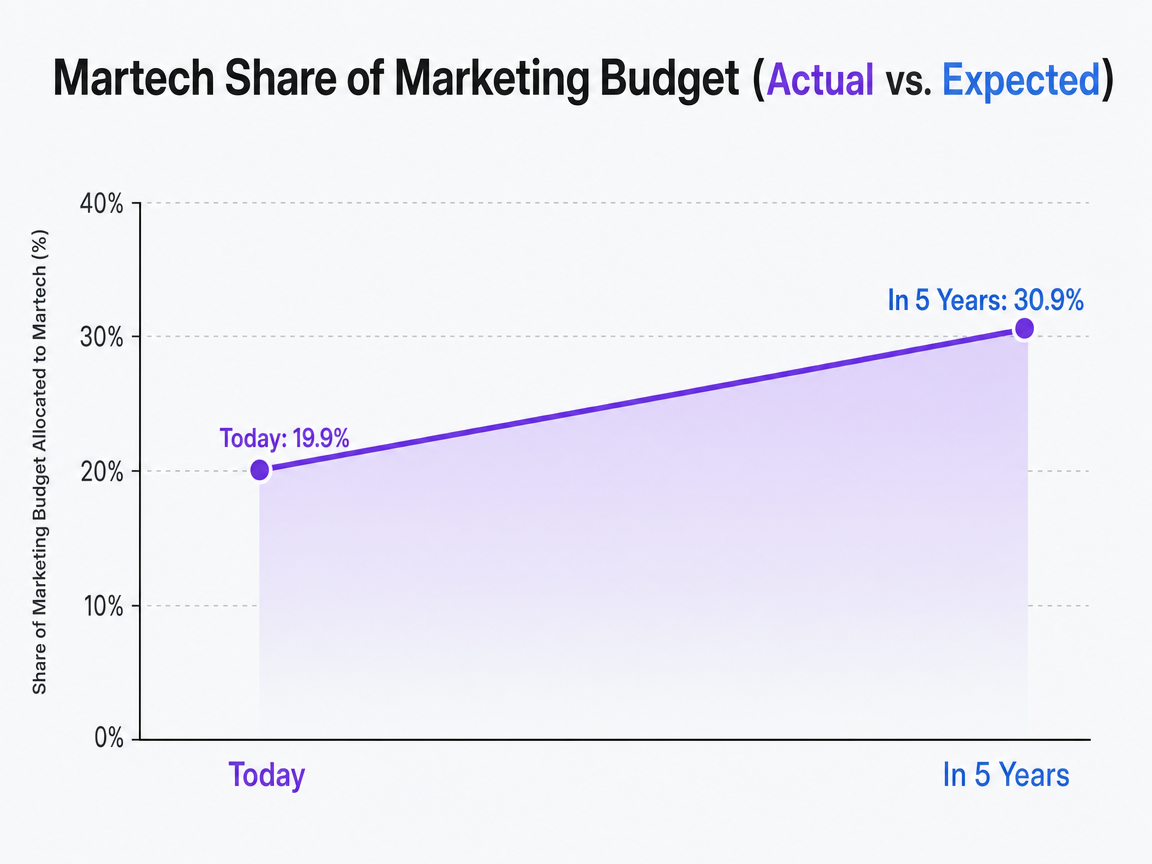 Martech Share of Marketing Budget (Actual vs. Expected)
Shows the current and projected share of marketing budgets allocated to marketing technology (Martech), indicating a significant planned increase in investment.
Frequently Asked Questions
References
- 1.The CMO Survey: Marketers Spend on New Technologies as They Battle Usage and Impact.
- 2.The CMO Survey – Highlights and Insights Report – Fall 2024.
- 3.The CMO Survey – Topline Report – March 2023.
- 4.AI Will Shape the Future of Marketing.
- 5.AI Is Upending Marketing on Two Fronts.
- 6.How to Design an AI Marketing Strategy.
- 7.Artificial Intelligence and the Future of Sales and Marketing.
- 8.Predictions 2024: Agencies.
- 9.AI will permanently upend the agency landscape in 2024, Forrester predicts.
- 10.The Future of Media Agency Models: Change is Coming.
- 11.The Future of Media Agency Models.
- 12.4As & ANA Client Agency Relationship Tenure Report.
- 13.Client-Agency AOR Relationship Tenure (ANA/4As PDF).
- 14.Trends in Agency Compensation (ANA).