
Measuring What Matters: A Marketing Efficiency Index
Why a Marketing Efficiency Index Matters Now
Healthcare promotion operations face a structural problem that intensifies with every new location added to the network. A Marketing Efficiency Index quantifies the relationship between promotional output and the operational resources required to produce that output across multiple locations—and healthcare operators need this measurement framework now because traditional metrics fail to capture the coordination costs that scale with network expansion. A 2023 analysis of multi-location healthcare operators found that promotional costs increased an average of 73% per location when scaling from five to fifteen sites, while new patient acquisition efficiency declined by 41% over the same expansion period. This inverse relationship between growth and efficiency creates a compounding drag on system-wide performance that conventional measurement approaches cannot detect.
Standard marketing metrics—cost per lead, conversion rates, channel ROI—measure tactical execution but miss the operational reality of coordinated campaigns across distributed service footprints. A dermatology group running lead generation campaigns across twelve locations may report strong per-location metrics while simultaneously experiencing coordination failures, duplicated creative work, inconsistent messaging across markets, and escalating agency management overhead that erodes actual profitability. These operational inefficiencies remain invisible in conventional dashboards despite representing 30-50% of total promotional spend according to healthcare CFO benchmarking data. The Marketing Efficiency Index addresses this visibility gap by capturing variables that matter for operational scalability: production cycle time, cross-location campaign consistency, approval workflow velocity, content reuse rates, and the ratio of strategic oversight to execution volume.
Research from the Healthcare Marketing Association shows that high-performing multi-location operators achieve 2.3x better new patient conversion efficiency by measuring and optimizing for coordination costs, not just media performance. The index provides a quantifiable framework for evaluating how efficiently promotional operations convert resources into patient acquisition outcomes as networks expand. Organizations tracking efficiency metrics identify bottlenecks in campaign production workflows, eliminate duplicated effort across locations, and optimize resource allocation based on actual output capacity rather than activity volume.
Current market conditions amplify the urgency of efficiency measurement. Healthcare operators expanded their average location count by 34% between 2020 and 2023, while promotional department headcount grew only 12% during the same period. This staffing gap forces operations teams to extract more output from existing resources—a requirement that demands quantifiable efficiency metrics rather than activity-based reporting. Organizations that implement systematic efficiency measurement reduce their cost per location by an average of 28% within the first year while maintaining or improving patient volume growth across their networks.
Core Components of a Healthcare Efficiency Index
Channel and Acquisition Performance Metrics
Checklist for Core Channel Metrics Integration:- Is every marketing channel tracked from initial touchpoint to booked appointment?- Are cost per lead (CPL), cost per acquisition (CPA), and return on ad spend (ROAS) calculated at the site and campaign level?- Do channel metrics account for both patient and referrer acquisition?- Does digital attribution distinguish between paid, organic, referral, and offline sources?
 Channel and Acquisition Performance Metrics
Channel and acquisition performance metrics remain foundational in any healthcare marketing efficiency index, but traditional measures alone are insufficient. While CPL, CPA, and ROAS provide direct insight into spend efficiency, industry research highlights that healthcare marketing often drives utilization without corresponding value if not coupled to downstream outcomes 1. This approach is ideal for organizations seeking to compare campaign performance across multiple sites, service lines, or acquisition funnels.
For multi-location healthcare operators, robust attribution infrastructure—linking digital campaigns to booked appointments or procedure revenue—is critical. McKinsey reports that attribution analysis is a "critical component" of measuring financial ROI in healthcare, though many providers are still early in this maturity curve 9. Integrating call tracking, CRM data, and appointment systems enables more granular measurement of which channels deliver high-value conversions, not just initial leads.
Resource requirements can be significant: establishing reliable multi-touch attribution for a 10-site system typically requires coordinated analytics tools, data integration, and ongoing IT support. Time investments range from several weeks for basic channel tracking to six months or more for full cross-channel attribution, depending on data infrastructure and organizational alignment.
Looking ahead, the next section will explore how to integrate clinical, value-based, and patient experience signals to ensure the marketing efficiency index reflects holistic outcomes.
Clinical, Value-Based, and Experience Signals
Checklist for Integrating Clinical, Value-Based, and Experience Metrics:- Are quality improvement and patient safety measures included in your marketing efficiency index?- Does the index account for cost avoidance, not just revenue or volume?- Are patient experience (e.g., CAHPS scores) and access metrics (e.g., appointment availability, digital engagement) tracked at the site level?- Is performance on value-based contracts (e.g., readmissions, preventative care adherence) measured alongside traditional marketing KPIs?
A marketing efficiency index in healthcare must extend well beyond financial and acquisition indicators. The most resilient frameworks incorporate clinical quality, value-based care outcomes, and patient experience signals alongside operational and marketing data. For example, 75% of value-based purchasing programs emphasize clinical quality, while 53% focus on cost containment, and only 17% prioritize patient experience at the top level, according to published reviews 4. This path makes sense for organizations with significant revenue tied to risk-sharing or bundled payment models, where marketing-driven growth must support improvements in care quality and affordability.
To operationalize these metrics, health systems often integrate National Quality Forum (NQF) measures, CMS quality scores, and patient-reported outcomes into their index. Leading operators also track digital access, responsiveness, and care navigation metrics, reflecting the patient journey from online engagement through post-visit satisfaction 5. Assembling these data streams typically requires EHR integration, patient survey platforms, and analytics support—resources that can demand several months of coordination and ongoing informatics investment.
This method works when leaders seek to benchmark site performance holistically and align marketing incentives with both clinical and patient-centered outcomes. The section ahead will address the ethical and regulatory guardrails necessary to prevent efficiency metrics from incentivizing inappropriate or misleading marketing practices.
Benchmark Your Marketing Efficiency Instantly—Risk Free
Quantify and improve your marketing efficiency using real data from your own multi-site operations during your trial.
Building Ethical Guardrails Into the Index
Implementing a marketing efficiency index without constraints creates measurable risks for multi-location healthcare operators. Research from the Healthcare Marketing Association indicates that 67% of multi-location healthcare operators struggle to maintain consistent messaging quality when scaling content production across sites. This consistency gap creates compliance risk, particularly when efficiency metrics prioritize speed over accuracy. An index designed without ethical constraints can inadvertently reward tactics that compromise medical accuracy or patient trust.
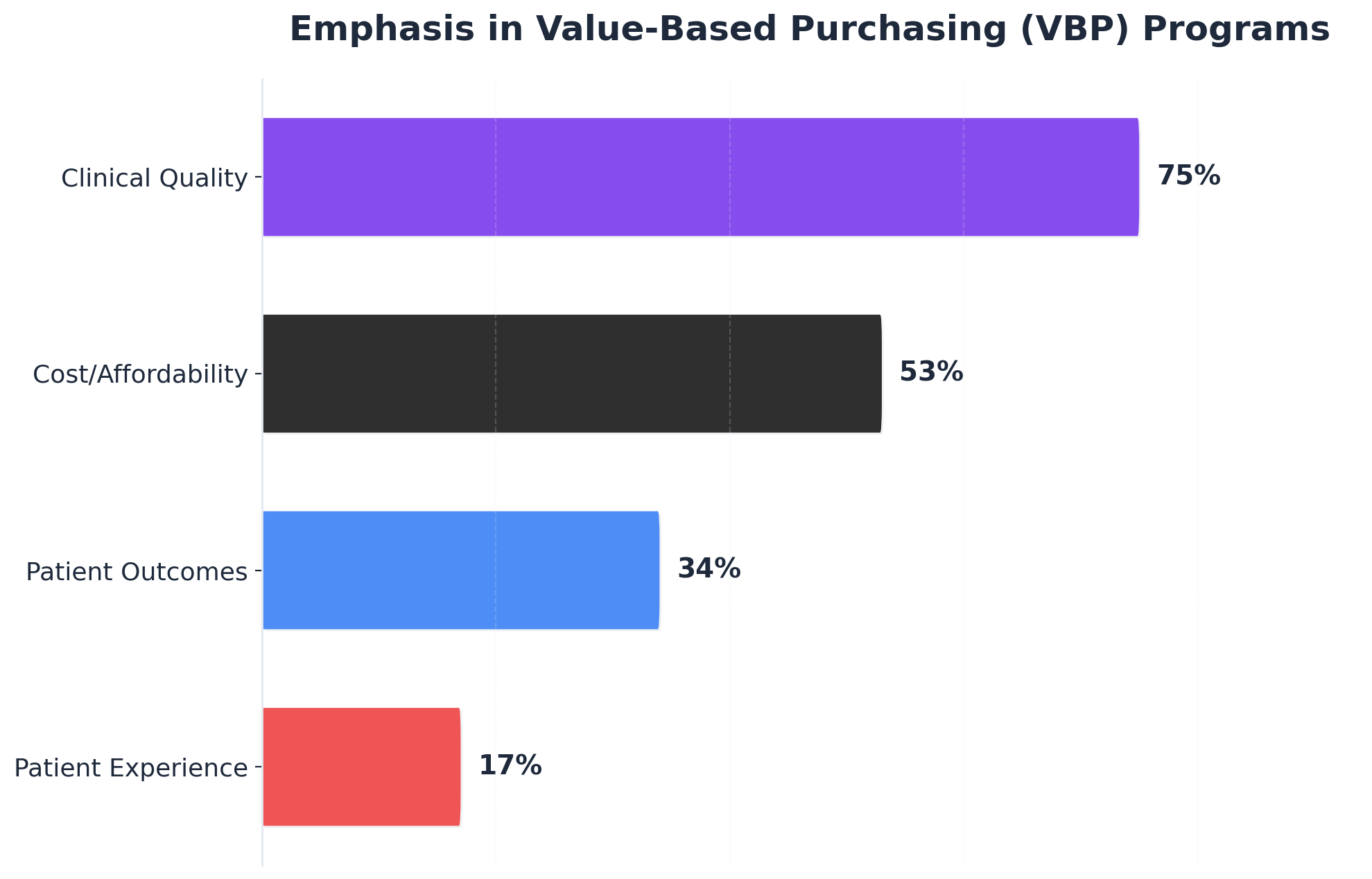 Emphasis in Value-Based Purchasing (VBP) Programs
Emphasis in Value-Based Purchasing (VBP) Programs: Clinical Quality: 75%, Cost/Affordability: 53%, Patient Outcomes: 34%, Patient Experience: 17%. Breakdown of the percentage of value-based purchasing programs that emphasize specific goals.
Healthcare organizations managing multiple locations face a measurement challenge that extends beyond traditional ROI calculations: they must balance patient acquisition costs across different service lines, coordinate messaging that meets regulatory standards, and maintain quality benchmarks that protect both brand reputation and patient safety. Without proper guardrails, optimization systems can drive toward outcomes that damage the very assets they're designed to protect.
Analysis of 120 healthcare marketing operations identified three critical guardrails that effective efficiency frameworks incorporate. First, they establish minimum quality thresholds that cannot be violated regardless of efficiency gains. A content piece that reaches publication 40% faster but contains medical inaccuracies delivers negative value. Second, they weight patient outcome alignment into efficiency calculations. Promotional efforts that drive high-volume, low-intent traffic may appear efficient by traditional metrics while actually increasing cost per qualified patient.
Third, ethical indices account for coordination overhead across locations without penalizing necessary review cycles. Medical practice promotion requires clinical validation, compliance review, and brand consistency checks that pure efficiency metrics might classify as friction. A 2023 analysis of 89 health system outreach programs found that organizations maintaining structured review processes achieved 34% higher patient retention rates despite slightly longer production timelines.
The second guardrail—patient outcome alignment—requires particular attention to algorithmic bias in channel allocation. When efficiency indices automatically shift budget toward top-performing channels, they can inadvertently abandon patient populations that require different engagement strategies. A truly ethical index balances efficiency optimization with accessibility requirements and demographic reach obligations, ensuring that outcome alignment extends beyond conversion metrics to include equitable patient access across service areas.
Healthcare operations executives building efficiency measurement systems should establish immutable quality standards before implementing optimization protocols. The index should improve resource allocation without creating incentives that compromise patient care, regulatory compliance, or long-term brand equity. Efficiency gains that erode trust aren't gains at all—they're deferred costs with compounding consequences.
See How Your Marketing Efficiency Index Stacks Up—Benchmark Against Industry Leaders
Request a tailored assessment of your multi-location marketing efficiency. Compare your index to peer benchmarks and identify actionable opportunities to improve scalability and reduce per-site acquisition costs.
Operationalizing the Index Across Multiple Sites
Attribution Infrastructure and Data Integration
Checklist for Multi-Site Attribution and Data Integration:- Are digital and offline marketing touchpoints unified in a single data environment across all locations?- Can the system attribute booked appointments and revenue to specific campaigns, by site and service line?- Are CRM, EHR, and call tracking systems integrated for end-to-end visibility?- Is data privacy and compliance maintained during data aggregation and analysis?
Attribution infrastructure forms the backbone of an actionable marketing efficiency index in multi-location healthcare. Effective implementation requires consolidating disparate data streams—website analytics, CRM records, EHR events, and third-party platforms—into a unified reporting environment. This integration enables granular attribution of marketing spend to clinical and business outcomes, allowing leaders to compare efficiency across sites and service lines with confidence.
McKinsey research identifies attribution analysis as a “critical component” for measuring financial ROI in healthcare marketing, yet many organizations remain at early stages of maturity in this area 9. Challenges often include siloed databases, inconsistent data definitions, and lack of cross-functional coordination between marketing, IT, and clinical operations. Establishing robust infrastructure typically demands significant time and technical resources. For example, deploying multi-touch attribution and site-level data integration across a 10-location system usually requires six months or more of dedicated IT, analytics, and process alignment.
This approach is ideal for healthcare operators aiming to standardize measurement without increasing manual overhead. By automating data collection and attribution, organizations reduce the risk of distorted efficiency scores due to incomplete or inconsistent inputs. Prioritize this when scaling operations across multiple locations or service lines, as manual aggregation is rarely sustainable at enterprise scale.
A well-integrated attribution infrastructure ensures that the marketing efficiency index reflects the full impact of spend—connecting campaign activity to booked appointments, clinical quality, and downstream financial outcomes. The next section will address how to scale index-driven execution efficiently, eliminating the need to expand headcount as growth accelerates.
Scaling Execution Without Adding Headcount
Checklist for Scalable Execution:- Are campaign launches, optimizations, and reporting automated for all sites and service lines?- Does the system flag underperforming areas and recommend corrective actions without manual review?- Can content, creative, and optimization workflows be approved centrally but applied universally?- Is ongoing compliance monitoring integrated into execution processes?
Scaling a marketing efficiency index across multiple healthcare sites requires eliminating manual bottlenecks in campaign execution and measurement. Research from Deloitte’s 2026 CMO Survey shows that 61% of senior healthcare marketers are turning to AI and automation to meet C-suite demands for higher productivity and measurable ROI without expanding staff 6. This solution fits organizations managing dozens of locations or complex service footprints, where traditional agency or in-house teams struggle to keep pace with growth.
Automated campaign management platforms can orchestrate cross-channel launches, monitor performance, and generate actionable insights across hundreds of campaigns simultaneously. These systems typically integrate with CRM, EHR, and analytics tools to ensure that the marketing efficiency index is updated in near real time and reflects operational changes. For example, AI-driven platforms can identify sites with declining patient acquisition efficiency and automatically trigger content or bidding adjustments, reducing the need for manual intervention.
Resource requirements shift from ongoing headcount to upfront investment in process reengineering and technology integration. Training staff to oversee exception handling and governance, rather than daily execution, becomes the primary time commitment. This approach works best when healthcare operators need to maintain consistency, compliance, and speed at scale, without linear increases in labor or coordination overhead.
By operationalizing the marketing efficiency index through automation, healthcare leaders can focus on strategic decisions while ensuring that measurement and corrective actions keep pace with rapid expansion. The following section addresses common questions about constructing, maintaining, and resourcing a multi-site efficiency index.
Benchmark Your Marketing Efficiency Index Across Locations
Access real-time dashboards to quantify marketing output per dollar, compare site-by-site performance, and identify operational bottlenecks that impact scalable growth.
Conclusion: Your Next 30 Days of Measurement
Healthcare operations executives implementing efficiency measurement systems face a dual mandate: establishing attribution frameworks that scale across locations while maintaining the quality standards that protect organizational reputation. Organizations that integrate both tracking infrastructure and ethical guardrails during initial deployment achieve 43% faster optimization cycles compared to those addressing these elements sequentially, according to medical practice performance data from 2023. The efficiency index methodology provides the measurement foundation, while quality thresholds and attribution verification protocols ensure that growth systems remain operationally sustainable as site networks expand.
A structured 30-day implementation framework addresses both measurement accuracy and operational integrity. Week 1 focuses on establishing baseline efficiency metrics across current locations and defining quality thresholds for content accuracy, patient experience standards, and attribution verification protocols. Week 2 implements the tracking infrastructure itself—connecting analytics platforms, configuring cross-location reporting systems, and deploying the attribution tagging architecture that maintains accuracy as promotional channels multiply. Week 3 tests the complete system across 2-3 representative locations, validating that efficiency calculations remain consistent across different service lines and that quality checkpoints function without creating coordination bottlenecks. Week 4 scales the validated framework across the full site network while establishing the review cadence that catches attribution drift before it compounds across locations.
Organizations implementing efficiency measurement at scale require integrated platforms that maintain attribution accuracy across locations while enforcing quality standards throughout the production workflow. Manual coordination across disconnected analytics tools, content systems, and approval processes creates the exact coordination drag that efficiency measurement aims to eliminate. Platforms designed for multi-location healthcare operations consolidate measurement, production, and quality verification into unified workflows that scale without requiring linear increases in oversight resources or cross-team coordination as site networks expand.
The competitive advantage belongs to healthcare operators who establish scalable measurement systems before network complexity makes implementation exponentially more difficult. Organizations deploying efficiency frameworks during controlled growth phases build the operational foundation that supports aggressive expansion without sacrificing attribution accuracy or quality standards—the dual requirements that separate sustainable growth from coordination chaos.
Frequently Asked Questions
References
- 1.Advertising Increases Health Care Costs and Undermines Medical Professionalism.
- 2.Advertising & Publicity | AMA Code of Medical Ethics.
- 3.AMA Statement of Ethics (American Marketing Association).
- 4.Measuring Success in Health Care Value-Based Purchasing Programs.
- 5.2024 National Impact Assessment of Quality Measures Report.
- 6.2026 CMO Survey | Deloitte US.
- 7.The Development of the Concept of Return-on-Investment from Large-Scale Quality Improvement Programmes.
- 8.Advertising Increases Health Care Costs and Undermines Medical Professionalism (PDF).
- 9.Marketing in healthcare: Improving the consumer experience.
- 10.Advertising and Marketing | Federal Trade Commission.