Key Takeaways
- Holistic Measurement: The marketing efficiency ratio (MER) aggregates total revenue against total spend, exposing inefficiencies that channel-specific metrics like ROAS often hide.
- Industry Benchmarks: A healthy MER varies significantly by sector—healthcare typically targets >3.0, while high-growth SaaS may tolerate lower ratios temporarily due to LTV.
- AI Advantage: Replacing traditional agency headcount with AI-powered content production drastically reduces the cost denominator, immediately improving your efficiency ratio.
- Actionable Framework: Implement a 30-day plan starting with a baseline calculation, moving to data consolidation, and finalizing with AI-driven operational shifts.
A Practical Framework for Marketing Efficiency Ratio
Why Marketing Efficiency Ratio Matters Now
The Shift from Channel Metrics to Holistic ROI
Checklist: Is Your Measurement Still Siloed?
- Do you rely on channel-level metrics like ROAS or CPA for critical budget decisions?
- Are your attribution models limited to last-click or single-touch interactions?
- Can you quantify marketing’s impact on total business revenue, or just campaign-specific performance?
The shift from channel-specific metrics to a holistic return on investment (ROI) framework is fundamentally reshaping how marketing effectiveness is evaluated. Traditionally, organizations optimized for isolated KPIs—such as cost per acquisition (CPA) or return on ad spend (ROAS)—within walled gardens like Google Ads or Facebook. However, these metrics often mask inefficiencies by ignoring the broader impact of cross-channel interactions and complex customer journeys.
The marketing efficiency ratio addresses this gap by aggregating all marketing investments and comparing them to total revenue generated, rather than evaluating performance in silos. This approach is critical for businesses facing increased acquisition costs—up 60% in the last five years—where maximizing every marketing dollar is essential for profitability5. Companies adopting holistic measurement have uncovered profit opportunities as high as 6% simply by reallocating spend based on a comprehensive view of marketing’s impact1.
This strategy is particularly effective for organizations seeking to justify budgets, reduce waste, and adapt to omnichannel buying behaviors. By replacing the bloated costs of traditional agency models with streamlined, AI-enabled production, marketing teams can significantly improve this ratio. As more marketers prioritize integrated measurement, the focus shifts from isolated wins to enterprise-wide outcomes.
Calculating Your Baseline MER in 15 Minutes
Quick Assessment Tool: 3-Step Baseline MER Calculation
 Calculating Your Baseline MER in 15 Minutes
- Gather Spend: Sum your total marketing spend for the last full month (include paid media, content production, technology fees, and labor).
- Retrieve Revenue: Identify total revenue generated in the same period.
- Calculate: Divide revenue by marketing spend using the formula below.
MER = Total Revenue / Total Marketing Spend
Calculating your baseline marketing efficiency ratio requires less than 15 minutes if core numbers are accessible. For example, if a business spends $25,000 on marketing and generates $75,000 in revenue, the MER is 3.0. This is generally considered a strong ratio by industry standards, indicating that only 30% or less of revenue is consumed by marketing efforts1, 4.
This step requires a single stakeholder with finance access and basic spreadsheet skills; no specialized tools are necessary for an initial calculation. However, accuracy depends on including all marketing-related expenses, not just media or campaign costs. This approach works best when organizations need a fast gut-check before deeper analysis or AI-driven optimization. With only 23% of marketers measuring spend holistically, even a basic MER calculation can reveal hidden inefficiencies or opportunities8.
Industry-Specific Marketing Efficiency Ratio Benchmarks That Matter
Healthcare and Financial Services Standards
Assessment Checklist: Is Your MER Calculation Industry-Ready?
- Are compliance and regulatory review costs included in your marketing expense calculations?
- Do you track patient or client acquisition costs by location or segment?
- Is your reporting aligned to annual industry benchmarks for marketing spend as a percentage of total revenue?
Healthcare and financial services operate under strict regulatory scrutiny, impacting both how marketing efficiency is measured and what constitutes a healthy ratio. In healthcare, average marketing budgets represent 7.2%–9.6% of total revenue, with recent years showing a downward trend due to cost pressures and margin sensitivity4. A marketing efficiency ratio (MER) above 3.0 is generally considered strong, as it signals that only about 30% of revenue is allocated to marketing—a critical threshold given that healthcare customer acquisition costs can be among the highest across industries4, 5.
| Metric | Healthcare | Financial Services (Wealth Mgmt) |
|---|---|---|
| Marketing Budget (% of Revenue) | 7.2% – 9.6% | Varies by AUM |
| Target MER | > 3.0 | > 3.0 (High LTV focus) |
| Acquisition Cost (CAC) | High (varies by specialty) | $2,167 – $4,056 per client |
This solution fits organizations where compliance, multi-location operations, and high-touch acquisition models require granular cost attribution. For healthcare providers, integrating patient acquisition costs by facility reveals margin gaps that often remain hidden when using blended figures alone4. The effort to achieve industry-aligned MER reporting typically involves a cross-functional team (marketing, compliance, finance) and can require several weeks to build a reliable, audit-proof dataset.
SaaS, E-commerce, and Agency Expectations
Decision Framework: Does Your Business Model Require a Dynamic MER Target?
- Is your growth tied to recurring revenue (SaaS), transactional volume (e-commerce), or client retainers (agency)?
- How volatile are your customer acquisition costs (CAC) quarter-to-quarter?
- Do you use lifetime value (LTV) modeling to set efficiency targets?
SaaS, e-commerce, and agency businesses each require tailored benchmarks when evaluating their marketing efficiency ratio. SaaS companies, especially in high-growth phases, often see fourth-quartile performers spending heavily to acquire revenue.
"Fourth-quartile SaaS companies may spend up to $2.82 to acquire $1 of new annual recurring revenue—an MER of just 0.35, signaling an urgent need for efficiency improvements."5
In contrast, SaaS leaders typically achieve a marketing efficiency ratio above 2.0, but expectations climb as LTV rises and churn falls. E-commerce presents a different profile. Median customer acquisition cost stands at $156, with top-performing brands maintaining a marketing efficiency ratio between 3.0 and 6.0—spending 16% to 33% of revenue on marketing6. This approach is ideal for retailers balancing aggressive growth with sustainable margins, especially as paid media costs climb.
Agencies, meanwhile, should build MER tracking into client reporting, as efficiency transparency is now a competitive differentiator. Agencies serving e-commerce or SaaS clients may find that transparent MER benchmarks improve client retention and justify fees, provided reporting accounts for both creative and operational costs10.
Building a Four-Legged Measurement Framework
Integrating Attribution Models with MER Tracking
Decision Tool: Attribution-Integration Readiness Checklist
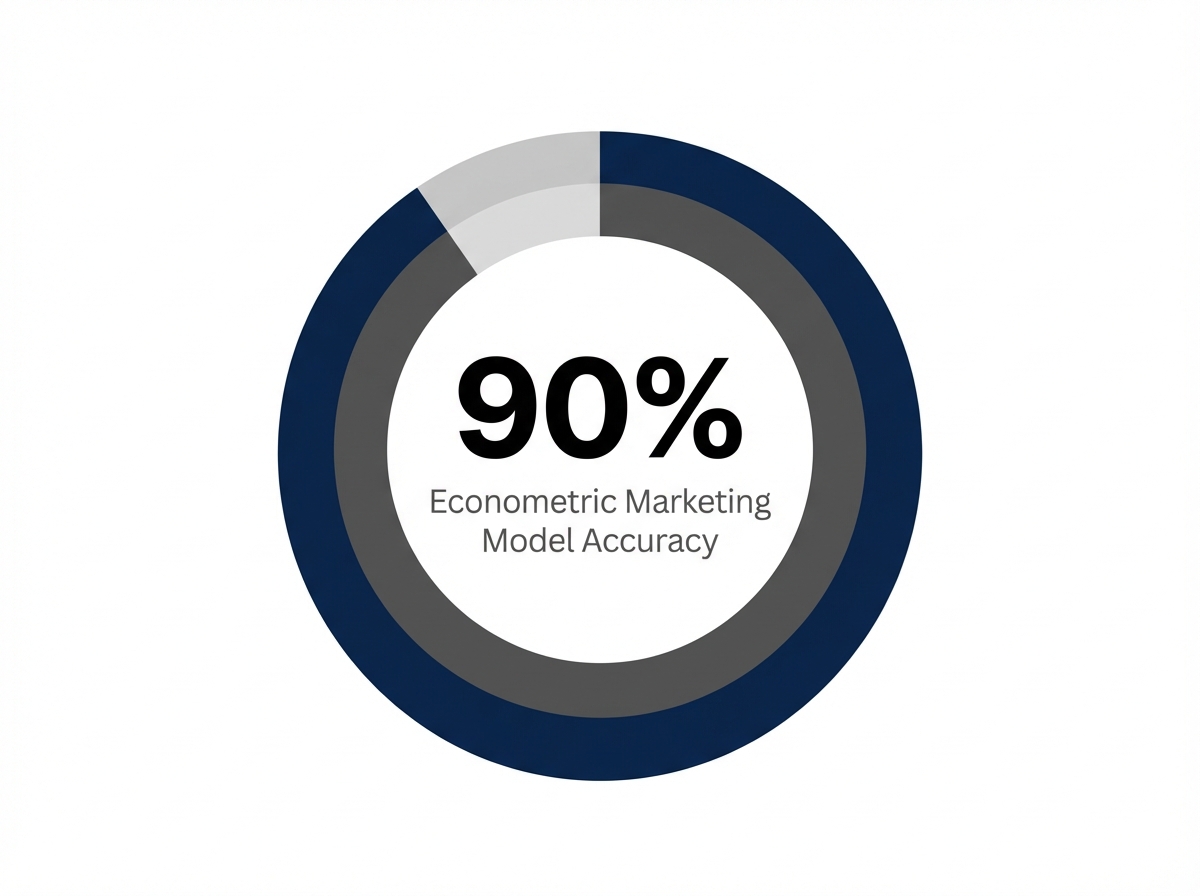 Prediction Accuracy of Econometric Marketing Models: 90%
- Are you using only last-click or single-touch attribution models?
- Can your attribution system track customer journeys across paid, owned, and earned channels?
- Do you have processes in place to reconcile discrepancies between platform-reported conversions and actual revenue?
Integrating attribution models with marketing efficiency ratio (MER) tracking is essential for capturing the true impact of marketing investments beyond simple channel-level returns. Multi-touch attribution (MTA) models allocate revenue credit across all customer interactions, while marketing mix modeling (MMM) uses statistical analysis to estimate the contribution of each channel. When combined, these approaches enable organizations to triangulate real marketing ROI, reducing the risk of bias or incomplete insights1.
For example, econometric models can predict marketing impact with over 90% accuracy, supporting more reliable MER calculations and scenario planning9. This approach is ideal for teams seeking to move past superficial metrics like ROAS and capture the influence of long, multi-channel buying cycles common in B2B, healthcare, and SaaS. Implementing integrated attribution with MER tracking typically requires cross-functional collaboration between marketing, analytics, and finance.
Budget Reallocation Based on Efficiency Data
Budget Reallocation Decision Matrix: When and Where to Move Spend
- Trigger: Is your marketing efficiency ratio (MER) below industry benchmarks for a specific channel or campaign?
- Analysis: Can you identify underperforming segments where spend consistently yields low incremental revenue?
- Opportunity: Are there channels consistently exceeding the MER target, suggesting opportunity for increased investment?
Reallocating budget based on efficiency data allows organizations to systematically shift spend from low-return channels to high-performing ones, directly improving overall marketing ROI. BCG’s research demonstrates that using a holistic measurement framework, including the marketing efficiency ratio, can unlock profit improvements of up to 6% simply by identifying and redirecting inefficient spend1. This path makes sense for marketing teams looking to counteract rising acquisition costs—now up 60% over the past five years—by investing only where returns justify the expense5.
Resource requirements for budget reallocation include access to clean, timely MER data at the channel or campaign level, collaboration between finance and marketing, and an analytics platform capable of supporting frequent scenario modeling. Time investments vary: initial reallocation cycles can be completed in two to four weeks for mid-sized teams, while ongoing optimization benefits from monthly or quarterly reviews.
Unlock Data-Driven Marketing Efficiency Insights Instantly
Access Vectoron’s advanced dashboard to benchmark, track, and optimize your marketing efficiency ratio with AI-powered analytics built for agencies and enterprise teams.
Unlock Data-Driven Growth With Advanced Marketing Efficiency Insights
Connect with Vectoron to discover actionable strategies and AI-powered analytics for maximizing your marketing efficiency ratio across all campaigns—built for agencies and enterprise-scale brands aiming for measurable impact.
Optimizing Marketing Efficiency Ratio Through AI-Driven Operations
Artificial intelligence transforms how marketing teams track and improve their Marketing Efficiency Ratio by fundamentally altering the cost structure of content production. Traditional agency models rely on heavy headcount and manual processes, which bloats the "Marketing Spend" denominator of your MER equation. By replacing this outdated model with AI-powered content production, organizations can deliver measurably better outcomes at a fraction of the cost, enabling marketing teams to scale without adding headcount.
Modern AI systems continuously monitor campaign performance across paid search, social media, display advertising, and email marketing. These platforms automatically flag underperforming segments, recommend budget reallocation strategies, and predict which creative variations will drive the strongest returns. This level of granular analysis enables marketing teams to make data-backed decisions within hours rather than waiting for monthly performance reviews.
Content production efficiency directly impacts MER in content-heavy marketing strategies. AI-powered content systems enable rapid iteration and testing of messaging variations across blog posts, product descriptions, and email campaigns. By maintaining conversion rates while reducing content production timelines from weeks to days, organizations can improve MER by 15-25% in strategies where content drives significant traffic and conversions.
The ability to test ten headline variations in the time previously required for one allows marketing teams to identify high-performing content faster, optimizing the revenue side of the MER equation. This accelerated testing cycle proves particularly valuable for e-commerce businesses and B2B companies where content directly influences purchase decisions. Furthermore, predictive analytics powered by AI forecast future MER performance based on historical patterns, seasonal trends, and market conditions, giving leaders visibility into how budget adjustments will impact overall efficiency before committing resources.
The integration of AI into marketing operations creates a continuous improvement cycle. Systems learn from every campaign, automatically applying insights to future initiatives. Teams that implement AI-driven optimization typically see MER improvements of 25-40% within the first six months as algorithms identify and eliminate inefficiencies across the marketing stack.
Frequently Asked Questions
Your Next 30 Days: From Measurement to Action
The transition from traditional marketing measurement to MER-based optimization doesn't require a complete operational overhaul—but it does establish the foundation for AI-powered automation. Start by establishing your baseline MER: divide total revenue by total marketing spend across all channels for the past 90 days. This single metric becomes your North Star for both immediate optimization and future AI implementation.
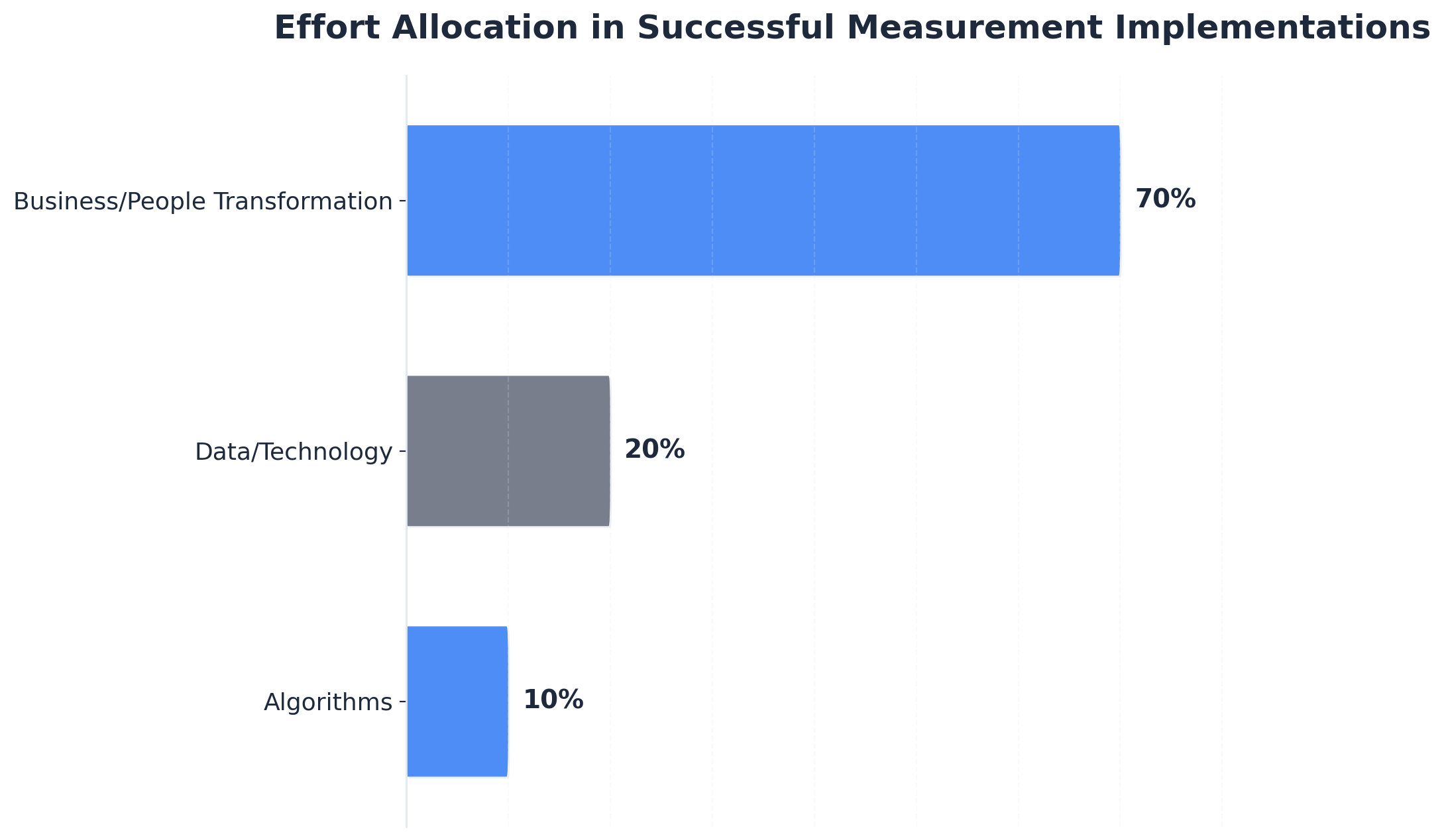 Effort Allocation in Successful Measurement Implementations
Effort Allocation in Successful Measurement Implementations (Shows the breakdown of effort required for successful marketing measurement implementations, emphasizing the human element over technology.)
Week one focuses on data infrastructure. Consolidate spending data from all platforms into a single dashboard, ensuring every dollar is accounted for. This unified data structure becomes essential when introducing AI tools in month two. Week two introduces daily MER tracking, revealing patterns that monthly reports miss. By week three, shift budget toward channels and campaigns that consistently improve overall MER, even if their individual ROAS appears lower.
The final week tests operational efficiency gains through AI integration. AI-powered content production can reduce creative costs by 60-80% while maintaining output quality, directly improving MER without cutting media spend. This creates budget flexibility to test new channels or scale winning campaigns while your measurement framework captures the true impact.
Marketing teams that complete this 30-day framework typically identify 15-25% efficiency gains from measurement improvements alone within the first quarter. When combined with AI-powered automation in subsequent months, total efficiency gains reach the 25-40% range. This staged approach proves that better measurement drives better outcomes, while creating the data foundation that makes AI tools dramatically more effective at optimizing marketing efficiency.
References
- 1.The Four-Legged Approach to Understanding Marketing ROI | BCG.
- 2.Marketing in the AI era: To matter more or cost less?.
- 3.The AI Reckoning: Why Marketers Think 2026 Is a Make-or-Break Year.
- 4.The ROI of Digital Marketing for Multi-Location Health Organizations.
- 5.Customer Acquisition Cost Benchmarks — 44 Statistics Every Marketing Leader Should Know.
- 6.Ecommerce Marketing Benchmarks: 2026 Metrics You Need to See.
- 7.Cost Per Lead by Industry: 2026 Benchmarks & Insights.
- 8.Marketing, Re-Engineered: What Great Marketing Operations Look Like in 2026.
- 9.Marketing Spend Optimization: How to Reduce Waste and Improve Efficiency.
- 10.Why we're measuring creative ROI too narrowly - MarTech.