
Key Takeaways
- Marketing budgets have structurally reset at 7.7% of revenue 4, making headcount and agency additions unworkable levers for hitting expanded pipeline targets under flat spending envelopes.
- A lean operating model rests on three load-bearing pillars: outcome owners replacing channel specialists, concentration on two or three proven channels, and AI-assisted execution expanding surface area per FTE.
- A single approval queue with named operator sign-off keeps AI execution accountable, preserves brand judgment, and prevents the coordination tax that fragmented tool stacks and vendor rosters reintroduce.
- Start with diagnosis, not procurement: map channels against pipeline contribution over two quarters, then audit where operator hours go before deciding which agencies, tools, and roles the new stack actually requires.
Budget compression is now the default operating condition
Marketing leaders are not working through a temporary budget dip. They are operating inside a structural reset. The CMO Survey's Fall 2024 report found that marketing budgets as a share of company revenue fell from 10.1% in Spring 2024 to 7.7% by Fall 2024, the lowest level recorded in more than a decade 5. Gartner's 2025 CMO Spend Survey then showed budgets holding at that same 7.7% of revenue into 2025, unchanged year over year 4.
That flat line is the planning reality every VP of Marketing is now expected to deliver against.
The implication is simple and uncomfortable. The historical lever for scaling output—hiring another channel specialist, retaining another agency, layering another point tool on top of the stack—assumed a budget envelope that no longer exists. Pipeline targets, conversion goals, and multi-channel coverage expectations have not contracted to match. In most growth-stage and multi-location service businesses, they have expanded.
What follows is not a motivational argument for doing more with less. It is an operating-model argument. When budget-as-percent-of-revenue is structurally pinned, the marketing function has to be redesigned around three load-bearing decisions: how roles are scoped, how channels are concentrated, and how execution is augmented. The leaders outperforming peers under these conditions are the ones treating lean as the default architecture, not an emergency posture.
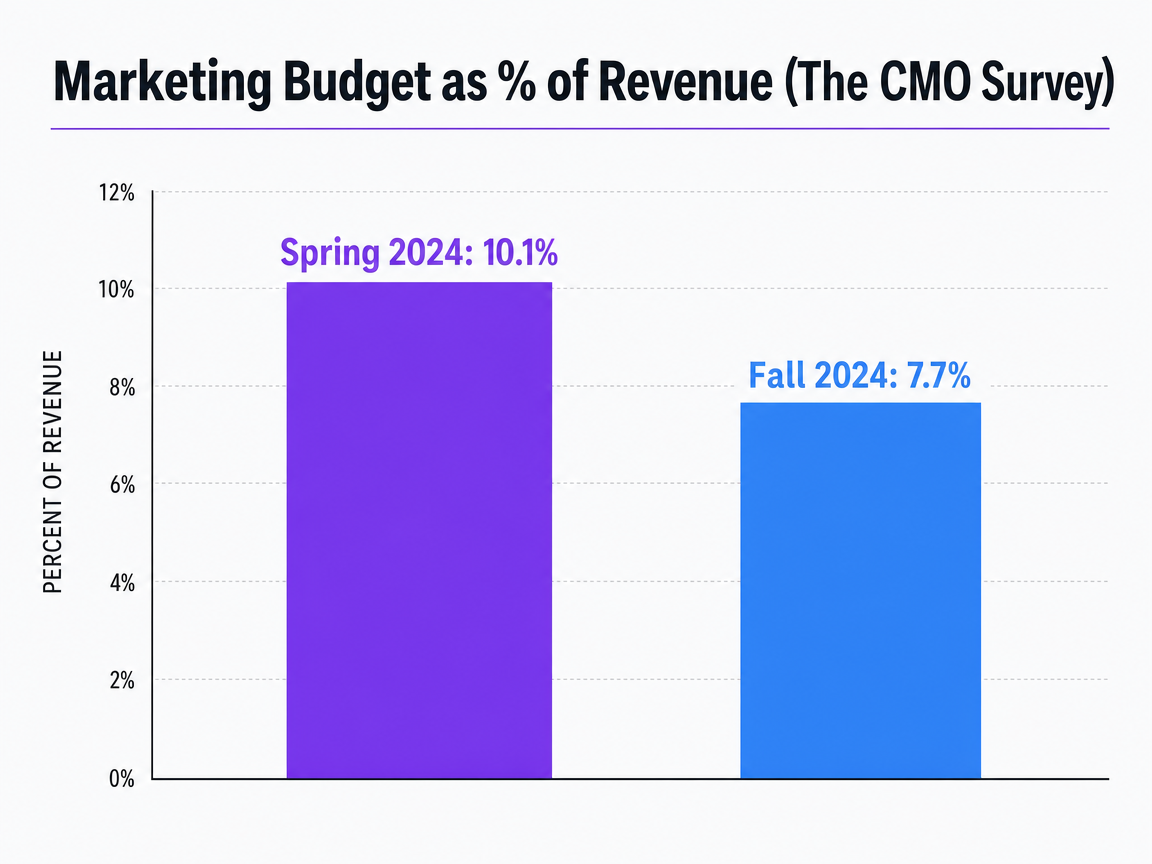 Marketing Budget as % of Revenue (The CMO Survey)
This data from The CMO Survey shows a sharp decline in marketing budgets as a percentage of company revenue within a single year, highlighting increasing budget pressures.
Why hiring stopped being a lever
The headcount math VPs already ran
Most VPs of Marketing have already attempted the obvious response to expanding pipeline targets: add a channel specialist, retain a second agency, or move a freelancer onto retainer. The math breaks before the offer letter goes out. With budget-as-percent-of-revenue holding at 7.7% into 2025 4, a fully loaded mid-level hire consumes a meaningful share of the discretionary envelope before producing a single qualified lead.
The compounding problem is what that hire displaces. A new specialist needs onboarding, tooling, briefing cycles, and review bandwidth from the VP who is already the bottleneck. Each agency added to the roster creates a parallel coordination tax: weekly status calls, asset reviews, and reporting reconciliations across vendors that do not share data models.
The result is a familiar pattern. Headcount goes up, output goes up modestly, and cost-per-pipeline-dollar gets worse. The lever that worked at 10.1% of revenue 5 does not work at 7.7%.
What team-size benchmarks actually show as companies scale
Lean is not a workaround. It is what benchmark data already describes as the norm. Pave's analysis of sales and marketing team structures found that as companies scale, marketing headcount tends to shrink proportionally relative to sales, with technology and shared services absorbing the work that would otherwise require additional bodies 12.
That pattern is reinforced by firm-level evidence on AI investment. Brookings, synthesizing research on AI's effects on firms and workers, reports that a one-standard-deviation increase in AI investment is associated with roughly 2% additional annual sales and employment growth over a decade, alongside a workforce shift toward smaller, more technically capable teams and fewer middle managers 11.
Read together, the two data points reframe the lean question. The marketing org chart that delivers above-benchmark growth at this revenue stage is not the one with the most specialists. It is the one where a small group of operators owns outcomes and orchestrates execution through systems built for scale.
That redesign is the subject of the next section.
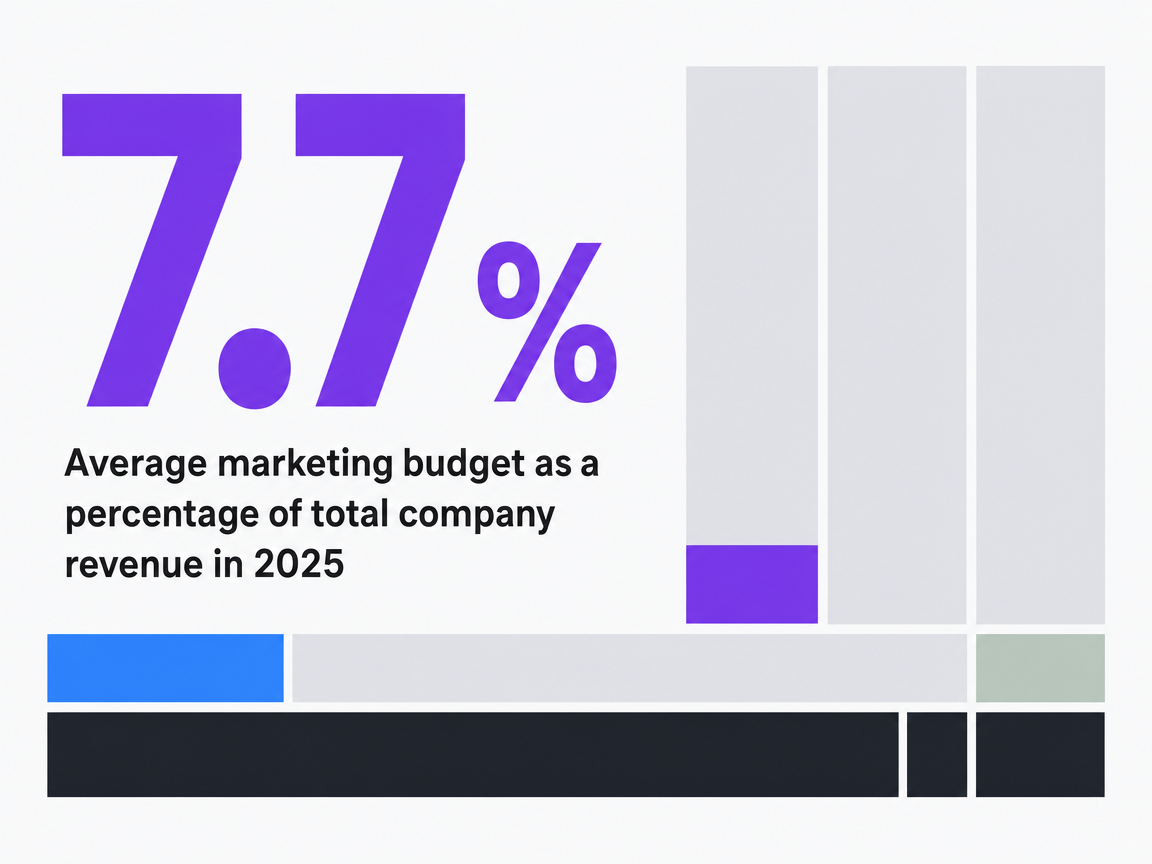 Average marketing budget as a percentage of total company revenue in 2025
Average marketing budget as a percentage of total company revenue in 2025
Test Lean Marketing Execution With Full Access
Validate pipeline impact and workflow efficiency using your actual campaigns during a risk-free trial.
The three load-bearing pillars of a lean operating model
Role design: outcome owners replace channel specialists
The default marketing org chart still reflects a channel-era logic: one specialist per surface. An SEO manager, a paid lead, a content writer, a social coordinator, a lifecycle marketer. Each owns a craft. None owns a number.
That structure breaks under flat budgets. When the VP is the only person whose performance review is tied to pipeline, every specialist's output gets re-prioritized through one bottleneck. Briefing cycles lengthen. Channels drift out of sync because nobody below the VP is paid to make them work together.
The lean redesign collapses channel headcount into outcome-owner roles. Three roles cover most growth-stage and multi-location service businesses:
- A Pipeline Owner accountable for qualified leads and cost per lead across acquisition channels,
- A Conversion Owner accountable for booked appointments, qualified calls, and lifecycle progression, and
- A Brand Owner accountable for organic authority, positioning, and creative quality across surfaces.
Each role owns a number that appears on the CEO's dashboard. Each orchestrates execution across multiple channels rather than producing inside one.
This is consistent with the operating principle that scaling comes from removing friction and building repeatable systems, not from adding craft headcount 1. It also tracks with what Brookings reports at the firm level: AI-investing companies shift toward smaller teams with fewer middle managers and more technically capable operators 11.
The role design question is not who writes the email. It is who owns whether the email moved the number.
Channel concentration: fewer bets, deeper execution
A lean team cannot run a wide channel portfolio at depth. The arithmetic does not allow it. Spreading three outcome owners across eight active channels produces shallow execution on all of them and competitive execution on none.
The concentration discipline is to identify the two or three channels that already produce the majority of qualified pipeline, then route incremental budget and operator attention there until the curve flattens. The Align Today framing is direct: double down on top-performing channels rather than maintaining presence everywhere 1. Channels that have not produced measurable pipeline contribution in two consecutive quarters get paused, not optimized.
For multi-location service businesses, the channels that usually survive this filter are local organic search, conversion-optimized paid search on high-intent queries, and a single content surface that compounds authority. Display, broad social, and exploratory channels move to a test budget with a defined kill threshold.
Concentration is the prerequisite for the third pillar. An AI execution layer multiplies output on the channels a team has decided to own. It cannot rescue a portfolio that was never prioritized in the first place. Lean teams that skip this step end up with faster mediocrity across eight surfaces instead of compounding performance on three.
AI-assisted execution: the surface area per FTE expands
The first two pillars set the structure. The third changes what one operator can credibly own.
McKinsey's analysis of generative AI in consumer marketing estimates that the technology can increase marketing productivity by 5 to 15 percent of total marketing spend, with use cases spanning personalized creative, next-best-action recommendations, and accelerated experimentation 6. A separate McKinsey study of generative AI in marketing and sales quantifies the downstream effect: companies investing in AI see revenue uplift in the range of 3 to 15 percent and sales ROI uplift of 10 to 20 percent 18. That is the productivity envelope a lean team is operating inside—not a speculative range, but the band industry research now treats as the working assumption.
The operational consequence is a measurable expansion of execution surface area per full-time equivalent. A Conversion Owner who once managed lifecycle email for one segment can now own segmentation, copy variants, send-time logic, and post-send analysis across multiple segments because the production work compresses. A Brand Owner can maintain a content cadence across two or three surfaces that previously required a writer, an editor, and a coordinator.
The qualifier matters. The SME productivity study found that gains depend on operator skill and tool fit, not on adoption alone—productivity impairments occur when teams use AI tools without the underlying discipline to direct them 7. Surface area per FTE expands when the operator owns the strategic decision and the AI layer absorbs the production load. It contracts when the team treats AI as a faster way to do the wrong work.
This is why the three pillars are load-bearing together, not in sequence. Outcome owners define what to produce. Channel concentration defines where. AI-assisted execution defines how much. Remove any one and the model reverts to the headcount math that already stopped working.
The approval-first workflow that holds it together
The three pillars collapse without a coordination layer. Outcome owners can define the work, channel concentration can narrow it, and an AI execution layer can produce it—but if approvals scatter across email threads, Slack channels, and agency status calls, the lean model reintroduces the same coordination tax it was supposed to eliminate.
The fix is a single approval queue.
An approval-first workflow routes every recommendation through the same path: signal in, ranked recommendation generated, human approval required, execution triggered, KPI impact returned to the queue. Nothing ships without a named operator signing off, and every approved item carries the strategic reasoning that produced it. This is the governance discipline that lets a small team orchestrate volume without losing creative control or brand judgment.
The structural argument for this design comes from Forrester's analysis of converged revenue marketing platforms, which finds that unifying automation, analytics, and orchestration into one system produces meaningful efficiency gains that fragmented tool stacks cannot match 15. The risk Forrester also flags is real: convergence only delivers when teams actually use the governance layer. A single queue that nobody reviews is worse than five queues that three people own.
For a lean team, the approval queue is the throttle and the audit trail. It keeps the AI execution layer accountable to a human decision, and it keeps the outcome owners accountable to a measurable result.
See How Leading Teams Scale Marketing Output Without Adding FTEs
Request a demo to benchmark your current workflow against AI-powered execution platforms designed for multi-channel, enterprise-grade marketing—no additional headcount or agency overhead required.
Resolving the martech paradox: convergence over collection
The contradiction inside most marketing organizations is now well documented. CMSWire's analysis of CMO survey data found that 83% of CMOs expected martech budgets to increase in 2024, even as the same population continued to report low utilization rates across the tools already in place 3. The CMO Survey reinforces the pattern: companies are spending roughly 19.9% of marketing budgets on technology, with that share projected to grow to 30.9% within five years, while complaints about underused capability persist 13.
A lean team cannot afford to live inside that paradox.
The collector model—one tool per channel, one license per use case, one dashboard per vendor—creates a coordination tax that scales faster than the team does. Each new tool adds a login, an integration risk, a data model that does not match the others, and a quarterly review meeting nobody runs. The implicit assumption behind a sprawling stack is that someone has the bandwidth to operate it. Under a flat budget, no one does.
The convergence argument has structural support. Forrester's analysis of revenue marketing platforms finds that consolidating automation, analytics, and orchestration into a unified system produces efficiency gains that fragmented stacks cannot match, specifically because lean teams stop spending operator cycles on integration glue 15. The question for a VP is not which tool to buy next. It is which three tools are doing the work of the eight currently on the invoice.
The adoption context makes the case more urgent. Microsoft's 2024 Work Trend Index reports that 75% of global knowledge workers are already using AI at work, often through tools they brought in themselves 8. McKinsey's State of AI survey found that one-third of organizations are using generative AI regularly in at least one business function 20. AI-assisted execution is no longer a strategic bet a lean team is evaluating. It is the substrate the team already operates inside, whether the VP has sanctioned it or not.
The choice is governance. A converged execution layer with a single approval queue turns ambient AI use into auditable output. A collector stack turns it into shadow work.
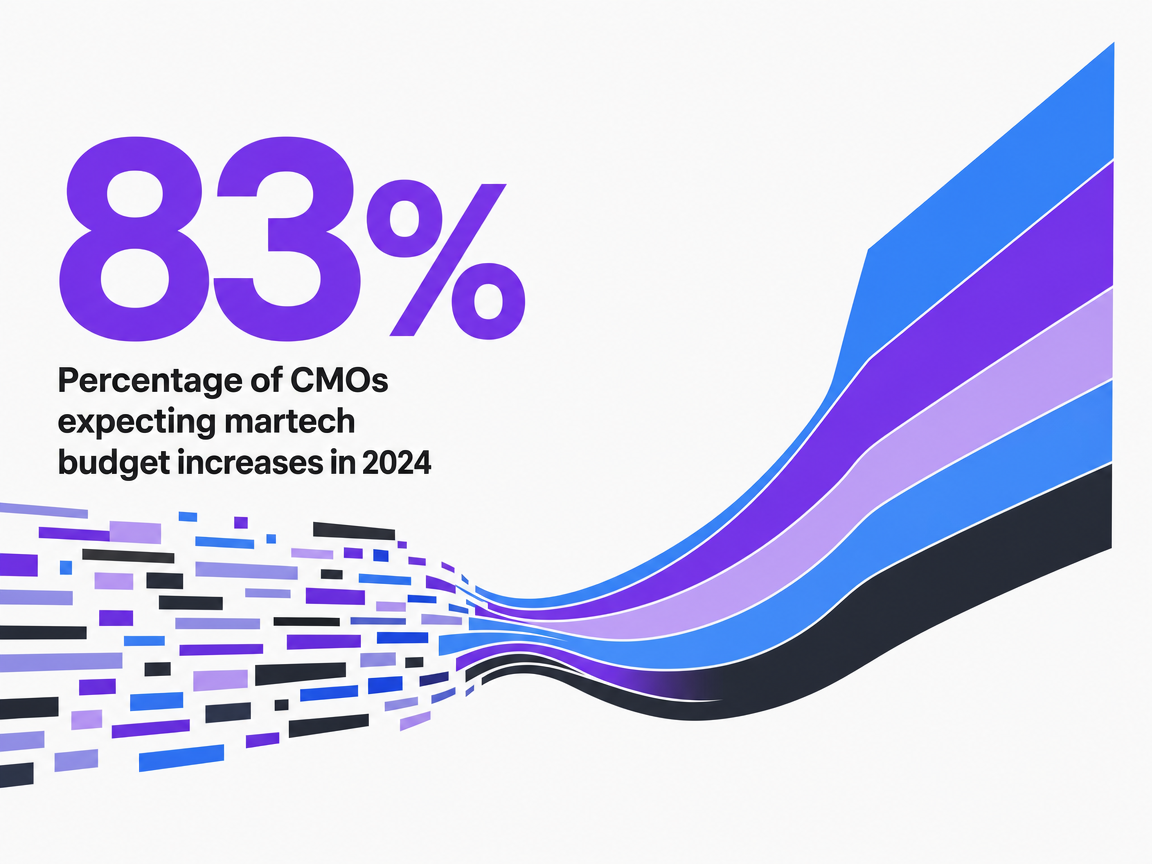 Percentage of CMOs expecting martech budget increases in 2024
Percentage of CMOs expecting martech budget increases in 2024
The keep / push / cut decision framework
What stays in-house
Three categories of work do not leave the building:
- Strategy stays in-house: channel mix decisions, budget allocation across the portfolio, positioning, and the quarterly call on what gets paused.
- Judgment stays in-house: brand voice arbitration, sensitive creative decisions, and any approval that carries legal or reputational weight.
- Customer signal interpretation stays in-house: the read on what qualified calls, booked appointments, and pipeline movement actually mean for next quarter's plan.
These categories share a property. They are the decisions that determine whether the rest of the work is worth doing. Outsourcing them to an agency or an AI layer collapses the feedback loop that makes lean possible in the first place.
The Flowla framing on revenue operations is direct: the unified insight layer and the decision authority around it cannot sit outside the team that owns the number 2. A lean team that pushes strategy to a vendor has not gone lean. It has gone blind.
What pushes to the AI execution layer
Production volume pushes. Variant generation, draft copy, segmentation logic, on-page SEO output, ad creative iterations, social asset resizing, lifecycle email sequencing, and routine reporting are the work an AI execution layer absorbs without degrading quality, provided the strategic brief is sound. McKinsey's productivity range of 5 to 15 percent of total marketing spend reflects exactly this kind of work being compressed 6.
Repetitive operations push. Lead scoring, list hygiene, UTM tagging, cross-channel campaign assembly, and multi-channel scheduling are the tasks Vena's automation research identifies as the highest-yield candidates for removing manual cycles from a small team 10.
One qualifier holds. The SME productivity research shows that AI gains materialize when operators have the skill to direct the tools and the tool fit is right; when either is missing, productivity can move backwards 7. The push works when an outcome owner writes the brief and reviews the output. It fails when production runs without a human steering it.
What an agency still earns
The agency line item is not eliminated. It is narrowed.
Three categories still justify an external retainer:
- Specialized creative production that requires craft beyond a generalist team, such as broadcast video, original photography, or brand identity work.
- Regulated or technical execution where a vendor carries credentialing the in-house team does not, such as medical-legal review or complex paid media within restricted verticals.
- Short-horizon expertise injections, such as a launch playbook or a category-entry strategy where the team needs senior experience for a defined window.
Everything else that an agency historically delivered, the monthly content calendar, the SEO retainer, the social management contract, has become the work the AI execution layer absorbs at materially lower cost and faster cycle time. The agency that survives the cut is the one solving a problem the converged layer cannot.
Automate Multi-Channel Campaigns Without Expanding Your Team
Access a unified AI-powered platform to execute SEO, content, and paid campaigns at scale—maintain full oversight while reducing manual workload and eliminating vendor coordination bottlenecks.
If you manage multiple locations: the consolidation economics
For VPs running marketing across a portfolio of locations—multi-site dental groups, behavioral health networks, regional law firms, home services rollups, senior living operators—the headcount math is the same as a single-site business, but the coordination tax compounds with every door. Each location historically carries its own freelance writer, its own local SEO vendor, its own paid search contact, and its own monthly reporting deck. The lean redesign is not about cutting any one of those line items. It is about collapsing the operating model that requires all of them.
The comparison below is structural, not a dollar quote. Operators fill in their own retainer variables.
| Operating dimension | Traditional stack | Lean stack |
|---|---|---|
| Channels covered per location | Split across 2–3 agencies + freelance | Content, SEO, PPC, social, calls in one workflow |
| Approval cycle time | Multi-day across vendor email threads | Single queue, same-day sign-off |
| Fixed monthly cost (per location) | Agency retainer A + retainer B + freelance pool | One platform fee + in-house strategist time |
| Briefing overhead | Separate brief per vendor, per location | One brief, multi-location execution |
| Reporting cadence | Multiple decks, reconciled manually | Unified KPI view across locations |
The efficiency claim sits on two evidence points already established in this article: McKinsey's 5–15% productivity band on marketing spend 6 and Forrester's finding that converged platforms produce gains fragmented stacks cannot match because operators stop spending cycles on integration glue 15. For a 12-location operator, the multiplier is not 5–15% once. It is that band applied across every location's production load, with the briefing-cycle overhead removed from the VP's calendar in parallel.
The decision is not which agency to renew. It is whether the operating model still requires them at all.
Where the brand fits, and where to start
The argument in this article is category-level, not vendor-level. A lean marketing team works when three things hold together: outcome owners scoped around numbers, a concentrated channel portfolio, and an AI execution layer routed through a single approval queue. Any platform that delivers that architecture is a candidate. Any stack that fragments it is the problem the architecture was designed to solve.
The starting move is diagnostic, not procurement. Map the current channel portfolio against pipeline contribution over the last two quarters. Identify which channels survive the concentration filter. Then audit where operator hours actually go—how many are spent on briefing cycles, vendor reconciliation, and production work the AI execution layer should be absorbing under the 5–15% productivity band 6.
Converged AI execution platforms, including Vectoron, are built for this operating model. The decision worth making this quarter is whether the current stack still requires the team it was sized for, or whether the team can now run a different stack.
Frequently Asked Questions
References
- 1.How Scaling Businesses Can Grow Marketing with a Lean Team.
- 2.How to Scale Revenue Operations Without Scaling Headcount.
- 3.What's Up With Martech Spending Madness for CMOs?.
- 4.Marketing budgets stagnate from 2024 to 2025: report.
- 5.The CMO Survey: Highlights and Insights Report – Fall 2024.
- 6.How generative AI can boost consumer marketing.
- 7.Exploring the potential of AI to increase productivity in small and medium-sized enterprises.
- 8.AI at Work Is Here. Now Comes the Hard Part..
- 9.28 AI marketing statistics you need to know in 2025.
- 10.70 Business Automation Statistics Driving Growth in 2025.
- 11.The effects of AI on firms and workers.
- 12.Team Size Benchmarks for Sales & Marketing.
- 13.The CMO Survey: Marketers Spend on New Technologies as They Battle Usage and Impact.
- 14.The state of AI in early 2024: Gen AI adoption spikes and the focus on value intensifies.
- 15.Converging Platforms For Greater Efficiency: The Rise Of Revenue Marketing Platforms.
- 16.Global Marketing Automation Spending Will Reach $25 Billion By 2023.
- 17.Marketing Automation Technology Forecast, 2017 To 2023 (Global).
- 18.Marketing and sales soar with generative AI.
- 19.The economic potential of generative AI: The next productivity frontier.
- 20.The state of AI in 2023: Generative AI's breakout year.