
Key Takeaways
- Per-location retainers in the $300-$500 range fall below the scope floor where SEO can fund technical work, content, and reporting, so pool spend into one account-level program 3.
- Ranking reports inflate dashboards with informational keywords while revenue stays flat; pair every ranking claim with booked appointment lift by service line and location 5.
- Agency tech stacks routinely deploy heatmap, call tracking, and analytics tools that touch identifiable data, exposing operators to fines of $100 to $50,000 per violation without executed BAAs 4.
- Google Business Profile and citations drive roughly 40% of local visibility, and practices generating six or more reviews monthly hit top-three rankings in 89% of cases 89.
- Generic medical content under a marketing byline fails YMYL evaluation; assign named clinician authors, document a review trail, and add last-reviewed dates to every page 10.
- Running each location through a separate agency fragments keyword maps, schema, and reporting, so move strategy ownership above the location line into one taxonomy and one production engine 7.
- Sales-cycle promises of page-one rankings in 60 days break the engagement by month three; document the four-to-six-month curve in writing with deliverables mapped to specific months 16.
The structural mismatch behind underperforming healthcare SEO retainers
Nearly 65% of healthcare businesses report dissatisfaction with their SEO agency, and 47% switch providers within the first year of engagement 2. For a VP of Marketing overseeing 15, 50, or 200 locations, that churn rate is not a vendor management nuisance. It is a recurring write-off that erases the first six months of every new engagement and resets the learning curve on patient acquisition data.
The diagnosis most boards hear is tactical: the last agency picked the wrong keywords, missed technical fixes, or under-delivered on content. The actual failure pattern sits one layer deeper. Traditional SEO agencies are priced and staffed around per-location retainers, with account managers coordinating handoffs between siloed specialists. Multi-location healthcare operators run on account-level data, account-level compliance obligations, and account-level revenue reporting. The two operating models do not line up.
That mismatch shows up in predictable places. Budgets get sliced thin enough to fall below the threshold where SEO can produce measurable movement 3. Reports default to keyword rankings instead of booked appointments because rankings aggregate cleanly across locations and revenue does not 5. HIPAA exposure compounds quietly when third-party tools in the agency stack lack Business Associate Agreements 4. Brand inconsistency multiplies as each location's marketing operates as its own project 7.
The seven mistakes that follow are symptoms a VP can already see in the dashboard. Each one is mapped to a healthcare-specific cost vector and a remediation pattern that scales at the account level rather than the site level. The framing is diagnostic, not prescriptive: read it as an audit the marketing team can run before the next quarterly review.
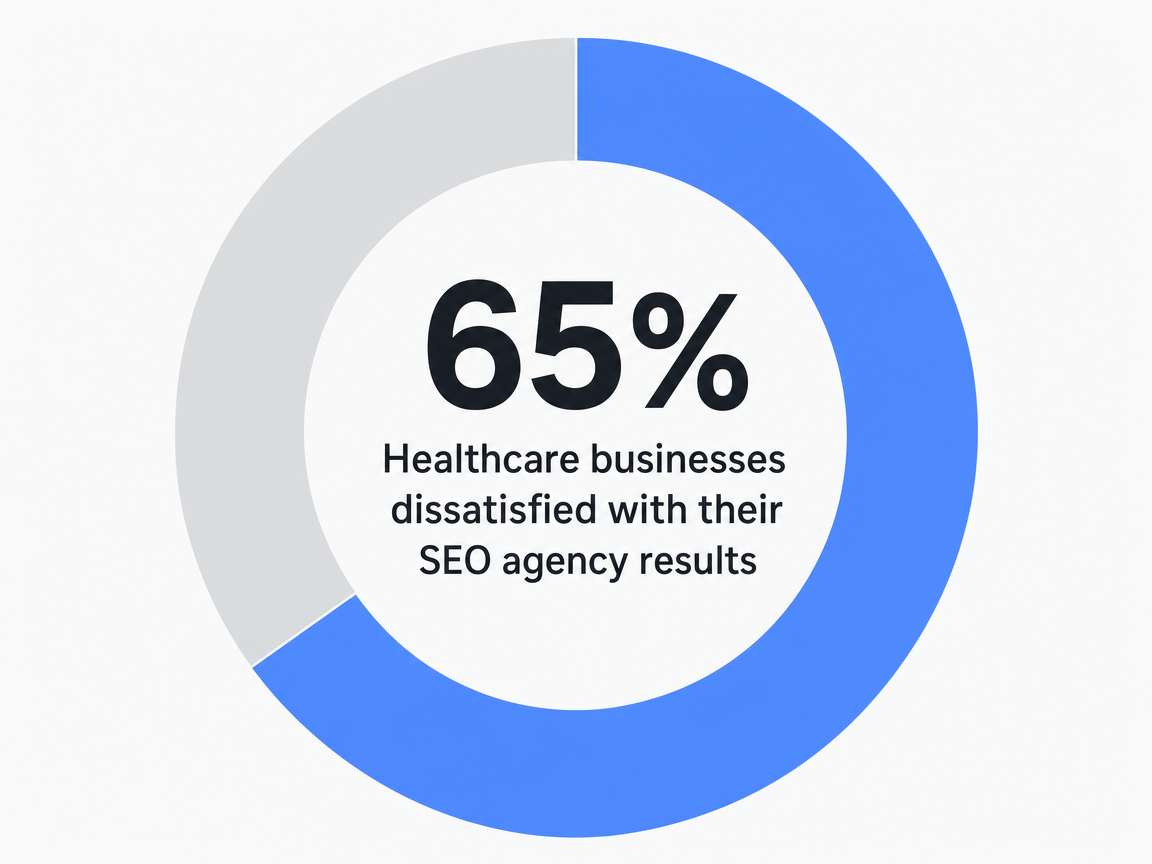 Healthcare businesses dissatisfied with their SEO agency results: 65%
A diagnostic the VP can run before the next quarterly review
The seven mistakes map to seven questions a marketing team can answer in an afternoon. Pull the last quarterly report from the current SEO agency and run it against this checklist before the next executive review.
- Does the aggregate spend, divided by location count, sit above the $300 to $500 monthly failure threshold for any single site 3?
- Is every ranking improvement paired with a corresponding lift in booked appointments by service line and location 5?
- Has every third-party tool deployed on operator properties been inventoried with an executed Business Associate Agreement 4?
- Is review velocity tracked monthly per location, with six or more new reviews as the operating target 8?
- Does each medical content piece carry a named clinician author, a review trail, and a last-reviewed date 10?
- Does one keyword taxonomy, one technical baseline, and one reporting layer cover every site, or do markets run as separate projects 7?
- Was a four-to-six-month ranking timeline documented in writing, with deliverables mapped to months 1?
Any question answered "no" identifies budget already at risk. Three or more identify a structural problem the next agency switch will not solve.
Mistake 1: Pricing the engagement below the floor where SEO can function
The first symptom shows up on the invoice, not the dashboard. A 15-location operator signs an SEO retainer at $400 per location, treats it as a reasonable per-site investment, and ends up with $6,000 a month in spend that produces no measurable movement in patient acquisition. The agency is not necessarily incompetent. The math is broken before the kickoff call.
SEO campaigns priced in the $300 to $500 monthly range cannot fund the scope of work modern search demands 3. That budget has to cover technical maintenance, keyword strategy tied to commercial intent, content production, internal linking, schema, outreach, and reporting. Agencies operating in that range either run at a loss, which they do not, or deliver a thin slice of the required work, which produces the underperformance the VP later attributes to agency failure 3.
The per-location billing model masks the problem. A $400 line item per site looks defensible next to a regional ad buy. Aggregated across 15 locations, the same operator could fund a single account-level program with adequate scope for the entire footprint. Instead, the budget is sliced into 15 underfunded engagements, each duplicating overhead on strategy calls, status reports, and account management that produces no compounding value across sites.
The remediation pattern is consolidation. Multi-location operators see better return when total SEO spend is pooled into one account-level program with a single content engine, one technical baseline applied across all sites, and shared authority work that benefits every location. The question is not whether the per-location number looks reasonable. It is whether the aggregate spend, organized differently, would clear the threshold where SEO can actually function 3.
Test Unified SEO Execution for All Locations
Experience real-time, system-driven SEO results across your entire healthcare network with no commitment.
Mistake 2: Reporting rankings instead of booked appointments
The quarterly report arrives with a green arrow next to 47 keywords that moved up. The same quarter, scheduled visits are flat and patient acquisition cost ticked up. The agency presents the deck as a win. The CFO asks why the marketing line item grew without a corresponding lift in revenue. That gap is the second mistake, and it is the most common reason healthcare marketing leaders lose internal credibility on SEO spend.
Keyword rankings aggregate cleanly into a slide. Booked appointments do not. Ranking reports pull from third-party tools that scrape positions for whatever terms the agency selected. Many of those terms are informational rather than commercial. A practice can rank in the top three for queries like "causes of knee pain" or "is back pain serious" while ranking nowhere for the high-intent terms that actually fill the schedule, such as "orthopedic surgeon accepting new patients" in a specific metro 5. The first set inflates the dashboard. The second set drives revenue.
The reporting failure is partly a measurement infrastructure problem. Healthcare marketing teams routinely run with attribution gaps that obscure which channels produce booked visits, which leaves rankings as the only metric the agency can show without ambiguity 12. When the measurement layer cannot connect organic sessions to scheduled appointments by service line and location, the agency defaults to what its tools can produce. The VP then inherits a report that looks rigorous and answers the wrong question.
The remediation sequence is ordered. Tie organic sessions to call tracking, form submissions, and EHR scheduling data at the location level. Separate informational keyword performance from commercial-intent performance in every report 5. Demand that any ranking improvement claim be paired with the corresponding lift in qualified inquiries for the same service line. Agencies that cannot produce that pairing are not running an SEO program. They are running a rank tracker.
Mistake 3: Treating HIPAA and BAAs as a marketing footnote
The third mistake hides in the agency's tech stack, not its deliverables. A marketing director signs a master services agreement with an SEO agency, ticks the compliance box because the agency claims to run HIPAA-aware campaigns, and never sees the downstream contracts. The agency uses a heatmap tool, a call tracking platform, a chat widget, and an analytics layer. Each of those vendors touches identifiable visitor data on healthcare websites. Each one needs a Business Associate Agreement. Most do not have one in place 4.
The financial exposure is not theoretical. HIPAA violations carry fines from $100 to $50,000 per incident, with an annual cap that can reach $1.5 million for a single category of violation 4. For a 50-location operator running pixel tracking, conversion tags, and session recording across every site, a single non-compliant vendor in the agency's stack can generate violations at scale before anyone in the marketing department knows the tool was deployed. The agency presents the campaign as standard SEO work. The legal liability sits on the operator's balance sheet.
Vendors unwilling to sign a BAA are the clearest red flag, and the question rarely gets asked because compliance reviews focus on the agency contract rather than the chain of subcontractors behind it 4. The chain typically runs from the healthcare operator to the marketing agency, then to the analytics provider, the tag manager, the form processor, and the ad platform. A break at any link voids the protection.
The remediation is procedural. Before any new SEO engagement, the marketing team should request a written inventory of every third-party tool the agency will deploy on operator-owned properties, paired with executed BAAs for each one that touches visitor data. Tools without a BAA come out of the stack. Agencies that cannot produce the inventory in writing have already answered the compliance question, and the answer is not the one a board wants to defend.
Stop Wasting SEO Budget: Optimize Multi-Location Growth With Data-Driven Precision
Connect with experts to benchmark your current SEO spend, uncover inefficiencies, and discover how unified, AI-powered workflows deliver measurable cost savings and higher patient acquisition across every location.
Mistake 4: Neglecting Google Business Profile and review velocity at the location level
Local pack visibility is where most healthcare search traffic actually converts, and it is also where agency neglect compounds fastest across a multi-location footprint. A regional dermatology group can rank a service-line page on the corporate domain for a metro keyword and still lose the patient to a competitor whose Google Business Profile sits at the top of the map pack with current photos, accurate hours, and a steady stream of recent reviews. The map pack is the storefront. The website is the brochure inside.
The contribution math is unambiguous. Google Business Profile optimization accounts for roughly 25% of local search visibility for healthcare practices, and local citations across business and health directories contribute another 15% when applied systematically across every location 9. That is 40% of the local ranking signal sitting in surface-level fields most agencies treat as a one-time setup task. Hours, service categories, attributes, photos, Q&A, posts, and primary category selection all decay without active maintenance, and decay at a 50-location operator means 50 separate profiles drifting out of date in parallel.
Review velocity is the second half of the equation, and it is where the steepest performance gap shows up. Practices that generate six or more new reviews per month sustained over six months reach top-three Google Business Profile rankings in 89% of cases 8. Practices chasing total review count without a consistent monthly cadence lose ground to smaller competitors with better velocity. The signal Google reads is freshness and frequency, not historical volume. A location with 800 reviews and nothing new in five months underperforms a location with 90 reviews and eight added last month.
Agencies running per-location retainers rarely build the operational machinery to drive that cadence. Review generation requires integration with the EHR or practice management system, post-visit messaging triggered at the right interval, response workflows for both positive and negative reviews, and reporting that tracks velocity by location rather than aggregate count. None of that fits inside a content-and-rankings retainer. The remediation pattern is to treat GBP and review velocity as account-level infrastructure, not as line items on a per-site SEO checklist 7. One review request system, one response protocol, one profile maintenance cadence, applied uniformly across every location, with velocity tracked as a primary KPI alongside booked appointments.
Mistake 5: Publishing content that fails E-E-A-T under YMYL scrutiny
Healthcare websites sit inside Google's Your Money or Your Life category, which means content quality is evaluated against a stricter bar than almost any other industry. The fifth mistake is publishing volume that ignores that bar. A 30-location orthopedic group can pay for 150 blog posts a year on topics like "signs of a torn meniscus" or "recovery after rotator cuff surgery," watch traffic climb, and still lose ranking ground to smaller competitors whose content carries verifiable clinical authorship.
Google now treats first-hand experience as a ranking signal equivalent to credentials and expertise 10. Generic medical explainers written by freelance copywriters and reviewed by no one fail that test. The content reads as encyclopedic rather than clinical. It does not reference specific patient cases, regional treatment patterns, or the practice's own outcomes data. Under YMYL scrutiny, that gap is read as a trust deficiency, and the page underperforms regardless of how well it is optimized for the target keyword 10.
The authorship layer compounds the problem. Many agency content programs publish under a generic "medical team" byline or attribute posts to a marketing director with no clinical background. E-E-A-T evaluation looks for verifiable author credentials, transparent practice information, and content that demonstrates the author's actual expertise 10. Pages without that signal sit at a structural disadvantage on every YMYL query the practice cares about.
The remediation is workflow, not volume. Medical content needs a defined review chain that pairs a clinical reviewer with the writer before publication, and the review has to leave a documentable trail 13. Each piece should carry a named clinician author with credentials, a reviewer signature, a last-reviewed date, and citations to primary medical sources. Topics should map to the conditions the practice actually treats and the outcomes it can speak to with authority. Multi-location operators that try to scale content without a clinical review pipeline end up paying for output that erodes domain trust faster than it builds rankings 13.
Mistake 6: Running each location as a separate SEO account
The sixth mistake is organizational, not tactical. A 25-location MSO signs five regional agencies because each market "needs local expertise." Each agency builds its own keyword map, its own content calendar, its own reporting template, and its own technical baseline. Eighteen months in, the corporate marketing team has 25 sets of location pages with inconsistent schema, five different review response tones, three different definitions of a qualified lead, and no way to compare which markets are actually working.
Fragmented execution across locations produces fragmented data, and fragmented data produces decisions that cannot be defended at the executive level 7. When each location operates as its own marketing project, the organization loses the ability to identify which tactics produce results and replicate them across the footprint. A content angle that lifts conversions in the Phoenix market never reaches Denver because the two agencies do not share a strategy table. A technical fix that resolves a Core Web Vitals issue in one site stays siloed there while the other 24 sites carry the same defect.
The brand layer suffers in parallel. Patients researching a multi-location system expect consistent messaging, voice, and quality across every touchpoint 7. What they encounter instead is a Detroit location with a polished service-line page, a Cleveland location with a 2019-era stub, and a Pittsburgh location whose blog hasn't been updated since the last agency rotation. The same brand reads as three different practices, and the operator pays for that incoherence in conversion rate at every location that lags.
The remediation is not picking a better agency for each market. It is moving strategy ownership above the location line. One keyword taxonomy applied across all sites with local variables. One content production engine that publishes service-line pages on a consistent template. One technical baseline audited across the full domain footprint. One reporting layer that compares locations against each other and against the system average. Markets still need local inputs, but the strategy, production, and measurement infrastructure has to live at the account level for the operator to see the forest the agencies have been ignoring 7.
Eliminate Costly SEO Agency Errors with Data-Driven Automation
Gain access to an AI-powered platform that unifies content, SEO, PPC, and backlink execution—delivering measurable ROI improvements and total visibility across all locations from a single strategic dashboard.
Mistake 7: Selling timeline fantasies instead of managing the 4–6 month curve
The seventh mistake is set in motion during the sales cycle. An agency promises page-one rankings in 60 days to win the contract, the VP brings that timeline back to the CMO, and the executive team builds quarterly revenue forecasts around it. By month three, when ranking movement is still concentrated in long-tail informational queries, the engagement is already politically dead. The agency did not fail at SEO. It failed at expectation setting, and the operator paid for the gap.
Realistic sequencing is well documented. Technical remediation typically takes two to three months, content production and on-page work layer in over the next three to four months, and meaningful ranking movement on commercial-intent terms tends to surface in the four-to-six-month window 1. Agencies that promise faster outcomes are either compressing the work, skipping the technical foundation, or setting a number they know will erode trust later 6. Saying "meaningful ranking improvement in four to six months" and delivering at month four builds credibility. Saying "page one in 60 days" guarantees the relationship breaks before the strategy can compound 6.
The damage is sharper at the multi-location level. A 40-location operator running a six-month SEO program has 40 separate technical baselines to audit, 40 sets of location pages to rebuild, and 40 Google Business Profiles to bring current before content velocity matters. Compressing that into a 60-day promise forces the agency to skip the sequence and chase visible wins on the easiest terms in the easiest markets, leaving the harder locations untouched. The quarterly report shows movement. The system-wide patient acquisition number does not.
The remediation runs in two directions. Agencies need to document the timeline in writing, including which deliverables land in which month and which metrics will move when 6. Marketing leaders need to push back on any pitch that skips the technical-then-content sequence or compresses ranking timelines below the four-to-six-month floor 1. A program that protects the curve produces compounding results into year two. A program that sells against the curve produces another switch in month eleven, another six-month reset, and another line item the CFO learns to discount.
The consolidation math: per-location retainers versus account-level execution
The seven mistakes share a common amplifier: per-location billing. When SEO is purchased one site at a time, the budget at each location has to clear the threshold below which agency work cannot produce measurable movement. That floor sits at $300 to $500 per month for a single site 3. Any retainer at or below that range forces the agency to skip technical depth, content quality, or measurement infrastructure. Every retainer above it duplicates strategy and account management overhead across locations that could share both.
The table below runs the math for a hypothetical 15-location operator. The agency retainer column uses the failure-zone benchmark from sourced research 3 alongside two illustrative figures a VP can replace with their own contracts. The account-level column uses one anchored input, the trial program rate available through the publisher of this analysis, with all other figures marked illustrative.
| Variable | Per-location retainer (low) | Per-location retainer (mid, illustrative) | Account-level execution |
|---|---|---|---|
| Monthly cost per location | $400 3 | $2,500 (illustrative variable) | $40 effective (illustrative) |
| Total monthly spend, 15 locations | $6,000 | $37,500 | $599 program rate |
| Strategy ownership | Per-site, fragmented | Per-site with account manager | One account-level plan |
| Content velocity per location | Below scope floor 3 | Variable, siloed calendars | Shared production engine |
| Reporting cadence | 15 separate reports | 15 reports, rolled up manually | One account view, location splits |
Two patterns surface in the math. The low-retainer column sits inside the failure zone by definition 3, and multiplying it by 15 locations does not buy escape velocity—it buys 15 underfunded engagements. The mid-retainer column clears the per-site floor but pays for 15 redundant strategy decks, 15 separate keyword maps, and 15 account manager check-ins, none of which compound across the footprint 7. Aggregate spend rises while system-level coherence stays flat.
The account-level column changes the unit of work. One keyword taxonomy, one technical baseline, one content engine, one review velocity protocol, and one reporting layer applied across every location. The cost per location falls because the overhead does not duplicate. The output per location rises because best practices identified at one site propagate to the rest 7. Whether an operator uses the figures above or substitutes their own contract values, the structural conclusion holds: per-location billing creates a mathematical floor that pushes agencies into the failure pattern documented earlier in this analysis 3, and account-level execution is the only operating model that scales with the footprint instead of against it.
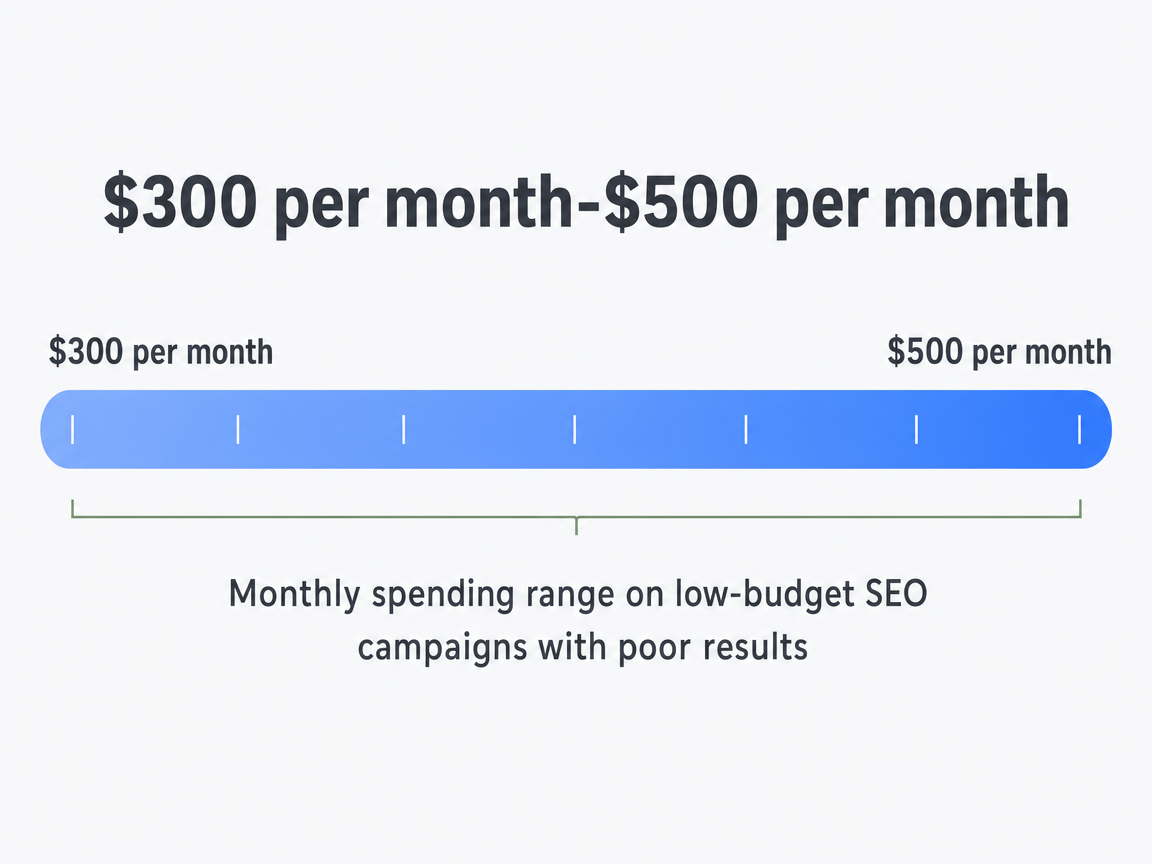 Monthly spending range on low-budget SEO campaigns with poor results: $300 per month-$500 per month
Frequently Asked Questions
References
- 1.6 SEO Mistakes That Waste Budget and Kill Website Growth.
- 2.The Real Reason SEO Agencies Fail To Deliver Results.
- 3.Why Low-Budget SEO Campaigns Fail | Straight North.
- 4.Red Flag: Your Healthcare Marketing Vendor Won't Sign a BAA.
- 5.Why Rankings Alone are a Poor Measure of Marketing Success - Medical Marketing Guru.
- 6.How to Handle Unrealistic Client Expectations: A Guide For Marketing Agency Owners.
- 7.Multilocation Marketing in Healthcare: The Biggest Challenges.
- 8.Healthcare Marketing Benchmarks 2026.
- 9.Local SEO For Healthcare: A Complete Guide | Intrepy.
- 10.E-E-A-T in Healthcare: How to Create Compliant, High-Ranking Content.
- 11.Current Challenges for Healthcare Services and the Opportunities..
- 12.The Hidden Cost of Bad Measurement: Why Healthcare Marketers Waste Budget.
- 13.Medical Content Reviews: Streamline Approvals & Compliance.
- 14.How Pharma Marketing Teams Manage Creative Approvals.
- 15.AI in Healthcare Marketing: How to Balance Personalization and Privacy..
- 16.How to Build a Marketing Technology Stack in Healthcare.