
Key Takeaways
- Choosing between SEO vendors is really choosing between operating models: retainer-based human handoffs versus platform-based continuous loops, which determines every downstream performance metric.
- Continuous strategy loops ingest GA4, Search Console, and competitor data daily, replacing quarterly slide-deck reviews and collapsing the gap between signal and published response 3.
- Measurement tied to pipeline and conversion paths replaces rank reports, since Forrester finds SEO has been mis-measured as a technical output rather than a revenue investment 7.
- Content velocity and editorial quality stop being a tradeoff when drafting, linking, and schema run in parallel while human reviewers gate source verification and claim approval 2.
- Technical SEO becomes a deployment log rather than a backlog when schema, redirects, and meta updates execute as code against the CMS instead of waiting in Jira 8.
- Intent mapping by buyer stage and SERP shape replaces keyword volume calendars, because matching content to commercial intent is what actually ties search work to revenue 7.
- Multi-location operators gain unit economics where the 41st location enters an existing backlog same-day, instead of triggering a new contract, onboarding sprint, and per-site retainer 8.
- Regulated categories require documented governance anchored to frameworks like NIST AI RMF, with logged reviewers, retrievable citations, and audit trails per asset 1, 12.
- Unit economics shift from hours per deliverable to output per editor, where the marginal cost of the next asset approaches review time alone instead of compounding headcount 2.
- A 30-minute audit across strategy cadence, measurement, governance, technical execution, intent, coordination, risk, and unit economics reveals whether to renew or rebuild the current vendor.
Why the SEO Vendor Decision Is Really an Operating Model Decision
Growth leaders evaluating SEO companies in 2026 are not comparing tactics. The tactical playbook—technical audits, content clusters, link acquisition, schema, internal linking—has been commoditized across the vendor landscape. What separates current vendors is how the work gets produced, measured, and governed. That is an operating model question, not a service-line question.
Forrester has argued for years that SEO fails when treated as a standalone technical discipline disconnected from broader marketing and business outcomes 7. The same research line concludes that scaling search performance requires centralized tooling and workflow, not stacked headcount 8. Both points reframe the buying decision. A Head of Growth choosing between vendors is really choosing between two delivery architectures: a retainer-based service layer staffed by humans handing work across calendar gaps, or a platform-based system running continuous strategy, production, and measurement loops.
The distinction matters because every downstream metric—cost per published asset, time from brief to live page, attribution clarity, governance auditability—flows from that architecture choice. Comparing a deliverable list across vendors obscures the real variable. The eight differences that follow are not feature gaps. They are consequences of which operating model a search function is built on, and they predict where performance will compound or stall over a 12-month horizon.
Continuous Strategy Loops Replace Quarterly Retainer Reviews
Legacy retainer agencies operate on a calendar cadence. A strategist runs an audit at onboarding, recommends a roadmap, then revisits priorities in a quarterly business review. Between those checkpoints, the plan is frozen even when Search Console data, SERP volatility, or competitor publishing patterns have already invalidated the original assumptions. The artifact—a slide deck—becomes the unit of strategy.
AI-native SEO operations invert that cadence. Strategy is a running process that ingests GA4, Search Console, rank data, and competitor movement on a continuous basis, then surfaces prioritized actions as conditions change. McKinsey's 2025 workplace AI research, which surveyed enterprise adoption across functions, identifies workflow redesign around AI as the dominant predictor of where productivity gains actually materialize rather than stall in pilot stages, with the firm sizing the long-term corporate-use-case opportunity at $4.4 trillion in added productivity growth potential 3. The implication for search is direct: an SEO function built on AI-assisted workflows produces a recalibrated plan weekly or daily, not quarterly.
The operational difference shows up in three places:
- First, time between a ranking shift and a published response collapses from weeks to days because no strategist–writer–editor handoff queue gates the work.
- Second, the strategy artifact is a live priority queue, not a deck, which means decisions are auditable in version history rather than reconstructed from email threads.
- Third, the marginal cost of revisiting strategy approaches zero, so reprioritization happens at the speed of the data instead of the speed of the next scheduled meeting.
For a Head of Growth, the practical test is simple: ask a vendor how many strategy changes the account logged in the last 30 days, and whether each change is traceable to an input signal.
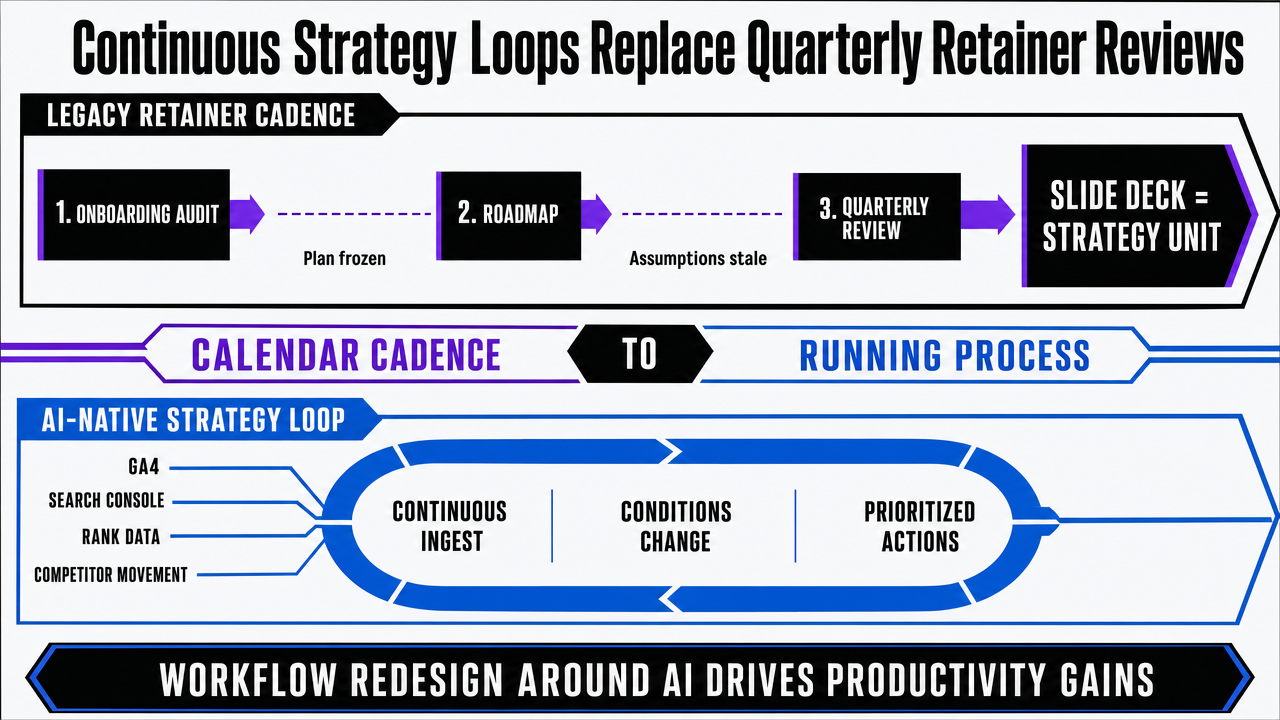 Visualize the contrast between quarterly retainer strategy cadence and continuous AI-native strategy loops described in this section
Measurement Tied to Revenue, Not Ranking Reports
Ranking dashboards are the most common deliverable in legacy SEO retainers and the least useful one for a Head of Growth. A position-two listing for a high-volume term tells the buyer nothing about whether the page converted, what the assisted-conversion path looked like, or how the asset contributed to pipeline against a target CAC. Forrester's critique of the discipline lands on this point directly: SEO has been measured as a technical output rather than as a marketing investment tied to business outcomes 7. The vendors still optimizing toward keyword visibility reports are solving a problem the buyer no longer has.
Modern SEO operations close that gap by wiring measurement into the same data layer that runs strategy. GA4 events, Search Console queries, CRM-stage transitions, and paid-channel attribution feed a unified view where each published asset carries a downstream conversion record, not just a rank trajectory. McKinsey's medtech digital marketing research, which surveyed companies that integrated analytics, channel coordination, and personalization into a single operating capability, found that more than 90 percent of surveyed firms reported digital marketing success improved by 10 percent or more after the shift 5. The scope matters: the figure reflects self-reported performance gains among medtech marketers who restructured around integrated digital operations, not a universal benchmark across every vertical. The signal it carries for SEO buyers is that measurement integration—not incremental tactical execution—is the variable producing double-digit improvements.
The operational consequence for a Head of Growth is a different vendor scorecard. Instead of asking how many keywords moved into the top ten, the relevant questions become:
- Which published assets sit in active conversion paths?
- What is the cost per pipeline-qualified visit by topic cluster?
- How quickly can underperforming pages be identified and rewritten against the conversion data rather than the rank data?
A platform-based search operation can answer those questions on demand because the measurement model and the production queue share a database. A retainer agency producing a monthly rank report cannot, because the data the report is built on never touched the team's content prioritization logic in the first place.
Experience Autonomous SEO Content Workflows Risk-Free
Test data-driven SEO execution and publish real content with a full-access, commitment-free trial.
Content Velocity With Editorial Governance
The most common failure mode in legacy content production is a tradeoff that does not need to exist: either the agency ships fast and the editorial quality drifts, or the editorial process is tight and the publishing calendar collapses to two or three pieces a month. Both outcomes trace back to the same workflow shape—linear handoffs between a strategist, a freelance writer, an editor, and a publishing coordinator, where each stage waits on the last and capacity is bounded by the slowest human in the chain.
AI-native SEO operations decouple velocity from quality by treating them as separate control layers in the same workflow. Drafting, structural editing, internal-link mapping, and schema generation run as parallel automated steps, while editorial judgment—source verification, brand voice, claim review, and final approval—stays human and gated. McKinsey's gen AI economic potential research, which modeled productivity impact across knowledge-work functions including marketing and sales, frames the opportunity as a fundamental change in output per hour rather than a tooling upgrade 2. The implication for SEO is that a single editor can govern the output of what previously required a full pod, provided the production system is built to surface only the decisions that need human input.
The peer-reviewed literature on generative AI in healthcare reinforces the same operating principle from the risk side: AI can extend non-clinical functions including marketing, but the outputs require validation before publication 11. A modern SEO operation encodes that validation as a workflow step—medical accuracy review, citation checks, factual claim approval—rather than as a hope. The practical test for a Head of Growth evaluating a vendor is whether the production system can show, per asset, which steps were AI-executed, which were human-reviewed, and who signed off. Vendors that cannot answer that question are running velocity without governance, which is the failure mode that produces compliance incidents and brand-voice drift at scale.
Technical SEO Automation Compresses Implementation Cycles
Technical SEO has always been a queue problem. A crawl audit surfaces 400 issues—orphaned pages, redirect chains, broken canonicals, slow Core Web Vitals, missing structured data, indexable parameter URLs—and the engineering ticket sits behind product roadmap items for two quarters. Legacy agencies typically deliver the audit, hand off a PDF, and bill for the same findings six months later because nothing was implemented.
Modern SEO operations treat technical execution as automation surface rather than recommendation output. Schema generation, internal link mapping, meta tag updates, redirect rule management, image optimization, and sitemap regeneration run as code-level actions against the CMS or a middleware layer, not as Jira tickets a developer might pick up next sprint. Forrester's platform argument applies directly here: centralized tooling that touches the production environment compresses the gap between identification and remediation from quarters to hours 8. The audit and the fix collapse into the same workflow step.
For a Head of Growth, the diagnostic is whether a vendor's technical work shows up as a backlog or as a deployment log. Ask how many technical changes pushed live in the last 30 days, what percentage required engineering involvement, and how rollback works when a schema change breaks a template. Vendors still delivering quarterly audit PDFs are charging implementation rates for diagnostic work, while platform-based operations are billing once and executing continuously against the same finding set.
See How Leading SEO Companies Achieve Greater Efficiency and Measurable ROI
Get a data-driven walkthrough of AI-powered SEO workflows proven to cut costs, reduce manual touchpoints, and deliver consistent ranking improvements for complex, multi-site operations.
Intent Modeling Beats Keyword Lists
Keyword volume is a lagging indicator. A list of 2,000 head and mid-tail terms tells a vendor what people searched for last quarter, not what stage of a buying decision each query represents or which queries actually correlate with pipeline. Legacy agencies still build content calendars from that list because it is the artifact the retainer was sold against—a deliverable that looks rigorous in a kickoff deck and produces a predictable monthly output of briefs.
Modern SEO operations replace the keyword list with an intent map. Queries are clustered by buyer stage, jobs-to-be-done, and the SERP shape the query actually returns, so a single topic cluster might split into three production tracks:
- Problem-aware comparison content
- Evaluation-stage feature analysis
- Decision-stage implementation guidance
Each track ships into a different page template, conversion path, and measurement event. Forrester's argument that SEO has been mis-measured as a technical output rather than a marketing investment lands directly on this distinction—matching content to commercial intent is the work that ties search to revenue, and a keyword-volume calendar cannot do it 7.
The diagnostic for a Head of Growth is whether a vendor's briefs reference SERP intent classification and downstream conversion event, or whether they reference search volume and difficulty score. The first vendor is building a system around what the query is trying to accomplish. The second is filling a spreadsheet.
Multi-Property Coordination Through a Single Operating Layer
This is where the operating-model gap becomes most visible, and where the audience widens from SaaS growth leaders to multi-location healthcare operators and portfolio agencies running search across 10, 50, or 200 sites. Legacy retainer structures price the work by location. Each clinic, branch, or service-line site gets its own scope, its own account manager, its own onboarding cycle, and its own monthly fee. A regional dental group with 40 offices ends up with 40 parallel engagements that share neither a content backlog, a technical audit history, nor a measurement layer. Coordination becomes a meeting, not a system.
Forrester's argument that every company needs a centralized SEO platform applies most directly to portfolio operators, where the cost of fragmented tooling and duplicated strategy compounds with each additional property 8. The same point lands in healthcare specifically: McKinsey's survey of health system executives found digital and AI investment prioritized precisely because workforce constraints and patient acquisition pressure cannot be solved by adding more agency relationships 6. A single operating layer—one content backlog, one technical change log, one measurement model, one approval queue—runs all properties under one account-level plan instead of 40 disconnected ones.
The unit economics shift accordingly. The traditional cost shape scales linearly with location count, while a platform-based model treats incremental locations as variable cost approaching zero on the strategy and tooling layers.
| Cost component | Per-location retainer model | Account-level platform model |
|---|---|---|
| Strategy | R retainer × N locations | Single account fee |
| Account management | Overhead per engagement | Not staffed; workflow-based |
| Onboarding | N parallel cycles | One account-level setup |
| Tooling | Per-seat or per-site licenses | Included in platform fee |
| Marginal cost of location N+1 | ~R + overhead | Approaches zero |
| Reference price point | Varies by vendor | $599/mo post-trial (one disclosed example) |
Variable comparison anchored to Forrester's platform consolidation argument 8. R = retainer per location, N = location count.
For a multi-location operator, the diagnostic is whether adding the 41st location requires a new contract, a new onboarding sprint, and a new line item, or whether it enters the existing account-level backlog the same day. Vendors still pricing by location are charging for coordination overhead the operator is supposed to be buying their way out of.
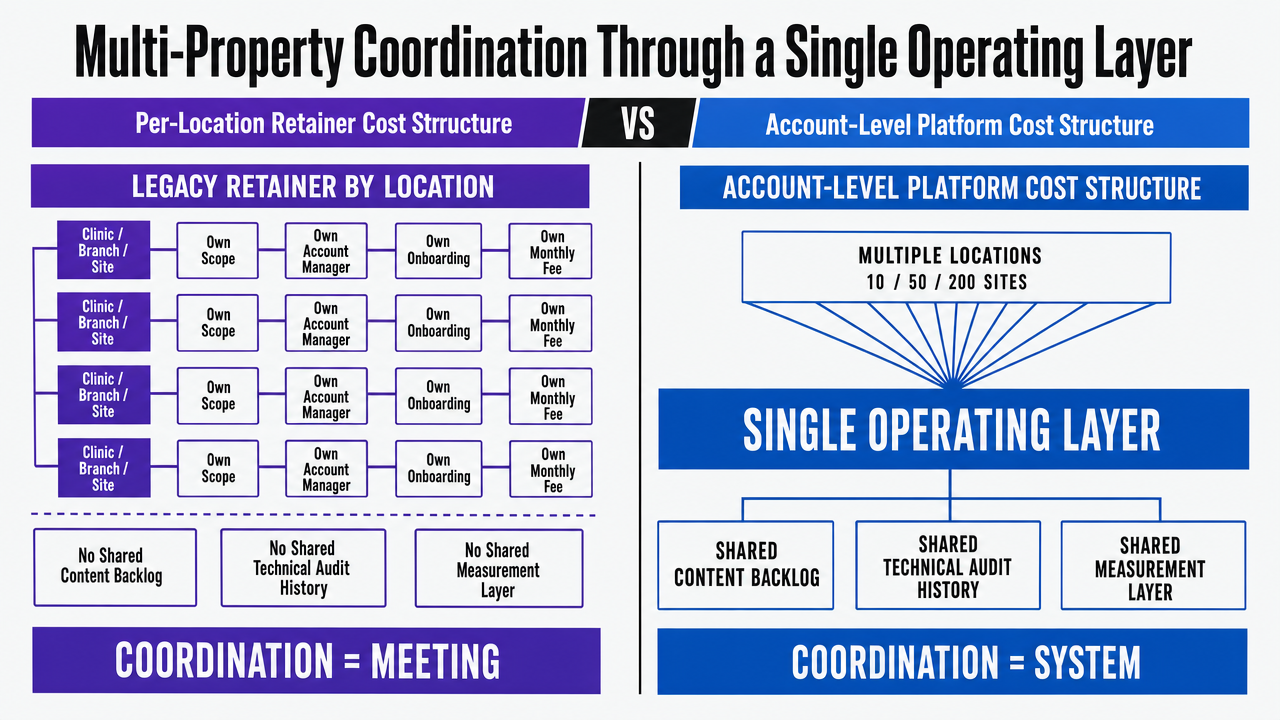 Visualize the comparison table in this section showing per-location retainer cost structure versus account-level platform cost structure
Risk Controls and AI Governance for Regulated Categories
This section narrows specifically to growth leaders running search in regulated verticals—healthcare operators, financial services, legal, and any category where a published claim can trigger a regulatory review or a patient-safety event. The governance bar here is not aesthetic. It is the difference between a vendor that can survive an audit and one that cannot.
The stakes have moved because adoption has moved. McKinsey's 2026 healthcare update, surveying healthcare leaders on gen AI status, found that roughly half of respondents say their organizations have implemented gen AI and more than 80 percent have deployed their first use cases to end users 4. The scope is important: the figures reflect self-reported implementation among healthcare executives, not a measure of governance maturity. What the data signals is that AI is no longer a pilot conversation in this vertical, which means an SEO vendor producing healthcare content without a documented risk framework is now the outlier, not the norm.
A modern SEO operation in regulated categories anchors its workflow to a recognized risk framework rather than improvising controls per client. The NIST AI Risk Management Framework provides the public-sector reference point most enterprise buyers benchmark against, with a 2026 concept note extending the framework toward trustworthy AI in critical infrastructure contexts 1. The peer-reviewed healthcare literature adds the operational layer: generative AI outputs in medical contexts require explicit validation steps, privacy controls, and human review before publication, particularly for content that could influence care decisions 12. Trust dynamics compound the requirement—research on AI medical advice has documented that perceived credibility can lead users to act on AI-generated guidance even when its clinical appropriateness is uncertain, which means a healthcare SEO page carries a reader-action consequence that a SaaS comparison post does not 10.
The governance controls that distinguish a defensible operation from a liability are concrete: documented prompts and model versions per asset, medical-accuracy review with named reviewers logged per claim, source citation requirements with retrievable references, an audit trail showing which steps were AI-executed and which were human-approved, and a defined escalation path when a draft surfaces a claim outside the reviewer's authority. Legacy agencies typically document none of this because their workflow predates the requirement. The diagnostic for a regulated-category operator evaluating an SEO vendor is to ask for the governance artifact directly: the written policy, the reviewer credentials, the audit log format, and the framework reference. Vendors who cannot produce those documents on request are running uncontrolled AI inside regulated content, which is the exposure the operator is supposed to be eliminating, not absorbing.
Experience Autonomous SEO Execution That Outpaces Legacy Agency Models
Gain instant access to continuous, AI-driven SEO workflows that deliver measurable ranking improvements for every location and service line—without the delays, manual handoffs, or per-location billing of traditional agencies.
Unit Economics: Output Per Employee, Not Hours Per Deliverable
The economic logic of a legacy retainer prices the work in billable hours against deliverables: a strategist hour, a writer hour, an editor hour, a developer hour, stacked into a monthly invoice that scales with scope. The math is honest within its own frame, but it ties the cost curve directly to headcount. Doubling output means roughly doubling the pod, which is why agency P&Ls show gross margin compression as accounts grow rather than the operating leverage a Head of Growth would expect from a maturing channel.
AI-native SEO operations change the denominator. The relevant unit is no longer hours per deliverable but output per employee, where a single editor governs a production system that ships at multiples of what a traditional pod could absorb. McKinsey's research on the economic potential of generative AI, which modeled productivity impact across knowledge-work functions including marketing and sales, treats the shift as a step change in output per hour rather than an incremental tooling improvement, with the firm sizing the cumulative opportunity in the trillions of dollars across the global economy 2. The scope is broad—an enterprise-wide modeling exercise, not an SEO-specific benchmark—but the direction it establishes for content operations is clear: productivity gains come from redesigning the workflow, not from adding seats to the existing one.
For a Head of Growth, the diagnostic question changes accordingly. Instead of asking what a vendor's monthly retainer covers in deliverable units, the relevant questions are:
- How many published, governed assets does the operation ship per editor per month?
- What is the marginal cost of the next asset once the system is running?
- Does the cost curve flatten or steepen as volume grows?
Retainer vendors answer the first question with a fixed deliverable count and the third question with a higher invoice. Platform-based operations answer the first with a multiple and the third with a marginal cost that approaches the cost of review time alone. That is the unit-economics gap the rest of the eight axes ultimately roll up into.
How to Audit a Current SEO Vendor Against the Eight Axes
The eight axes only matter if a growth leader can apply them to the vendor currently sitting on the invoice. The audit below is structured as a single 30-minute exercise: pull the last 90 days of vendor artifacts, then score the engagement against eight diagnostic questions, one per axis.
- Strategy cadence. How many prioritized strategy changes did the account log in the last 30 days, and is each traceable to an input signal (rank movement, Search Console query shift, competitor publish, conversion data)?
- Measurement model. Can the vendor name the top five published assets by pipeline-qualified visits this quarter, or only by ranking position?
- Production governance. Per asset, is there a record showing which steps were AI-executed, which were human-reviewed, and who signed off?
- Technical execution. Does technical SEO work appear as a deployment log of changes pushed live, or as a backlog of audit findings?
- Intent mapping. Do briefs reference SERP intent classification and downstream conversion events, or search volume and difficulty scores?
- Property coordination. For operators running more than one site, does adding a property enter the existing backlog same-day, or trigger a new contract and onboarding sprint?
- Risk framework. In regulated categories, can the vendor produce a written governance policy referencing a recognized framework such as NIST AI RMF 1?
- Unit economics. Does the next published asset cost more, the same, or less than the last one, and is the curve documented?
A vendor scoring on fewer than five of these axes is being paid for a delivery model the buyer has already outgrown. The decision is then a rebuild question, not a renewal question. Platforms like Vectoron are built around these eight axes specifically because each one is where the legacy retainer model breaks under current volume and governance demands.
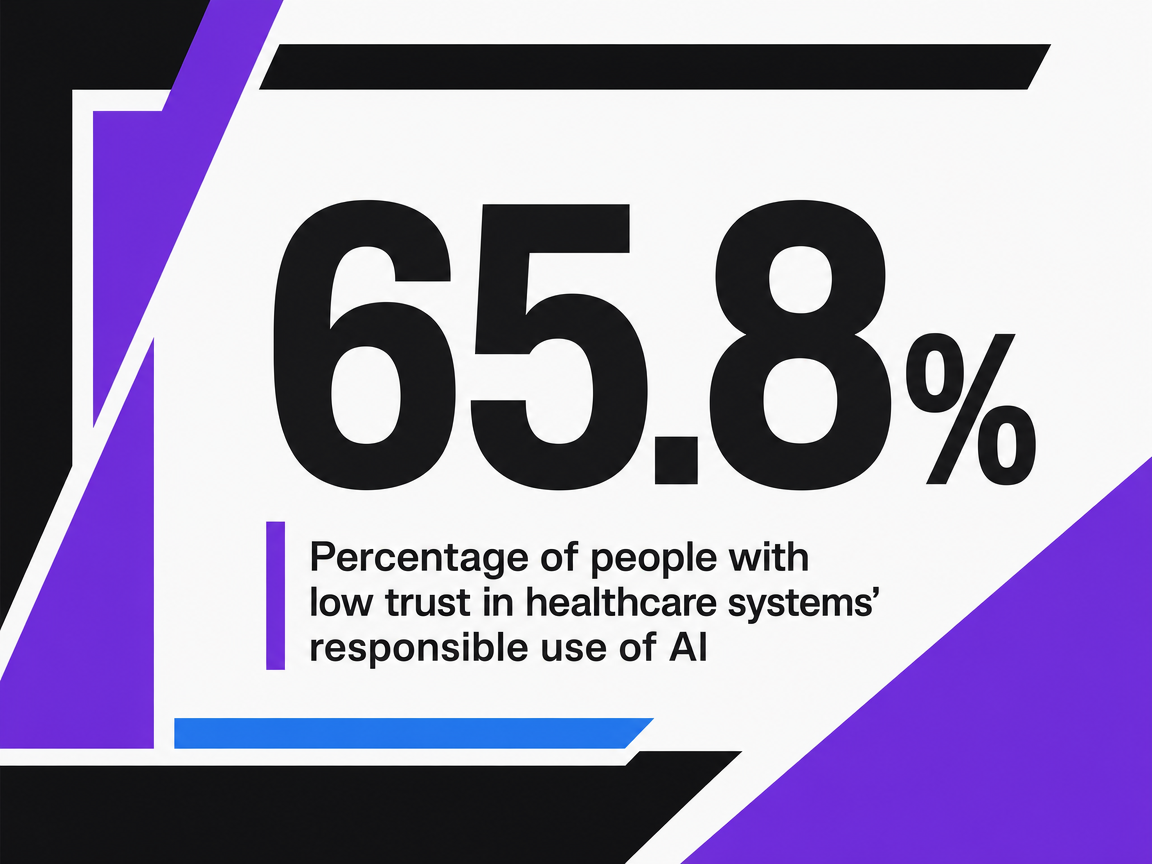 Percentage of people with low trust in healthcare systems' responsible use of AI
Percentage of people with low trust in healthcare systems' responsible use of AI
Frequently Asked Questions
References
- 1.AI Risk Management Framework | NIST.
- 2.The economic potential of generative AI: The next productivity frontier.
- 3.AI in the workplace: A report for 2025.
- 4.Generative AI in healthcare: Adoption matures as agentic AI emerges.
- 5.The rise of digital marketing in medtech.
- 6.Digital transformation: Health systems' investment priorities.
- 7.SEO Must Solve Its Marketing Problem.
- 8.Every Company Needs An SEO Platform.
- 9.Most people do not trust healthcare systems to use artificial intelligence responsibly.
- 10.FIU Business research finds trust in AI medical advice may outpace its safety.
- 11.Generative Artificial Intelligence Use in Healthcare - PMC.
- 12.Generative AI in Medical Practice: In-Depth Exploration of Privacy ....