
Key Takeaways
- Missed deadlines and scope creep usually signal one of three distinct problems—coordination drag, process immaturity, or capacity shortage—and each requires a different fix rather than a default PM hire.
- The economic case for an SEO project manager rests on specialist utilization: top professional services teams hit 75-80%, and a PM only pays off when recovered senior strategist hours exceed fully-loaded cost 8.
- A single PM realistically coordinates 15-25 client workflows, so agencies scaling past 75 clients should redesign the role around exception handling backed by workflow tooling and AI-assisted execution.
- Run a 30-day diagnostic on utilization, documented workflows, and unbilled scope before drafting a job description—most agencies need a mix of SOPs, tooling, and selective PM hiring, not a single intervention.
The coordination problem hiding behind the staffing question
Most agency heads considering an SEO project manager are not actually short on project management talent; they lack a working system. Senior strategists, once efficient, now spend significant time in meetings and chasing content, leading to slipped deadlines and scope creep. The immediate reaction is often to hire a PM, but this misinterprets the core issue.
Industry guidance suggests that growth stalls because non-scalable tactics are not systemized, not due to a lack of coordination staff 12. Operational challenges in agencies with 25-100 clients—such as complex project management, inconsistent standardization, client communication issues, and quality variance—often appear as staffing gaps but stem from insufficient process maturity and tooling 13.
An SEO project manager, defined as the operational integrator between strategists, content teams, and clients 1, can effectively resolve coordination issues once a clear workflow is established. However, hiring a PM before such a workflow exists merely creates an expensive human router for existing inefficiencies. The crucial decision is identifying whether coordination, process maturity, or specialist capacity is the actual constraint, and which intervention will yield the fastest results.
Diagnose the bottleneck before you write the job description
Three failure modes that look identical from the outside
Agencies crossing the 25-client threshold frequently encounter four symptoms:
- project management complexity overwhelming current systems,
- inconsistent standards across client accounts,
- variable client communication, and
- quality issues only surfacing through complaints 13.
While these may seem like a single problem, they often have distinct root causes.
These symptoms typically arise from three different underlying issues:
- First, a coordination failure occurs when a workflow exists but lacks clear ownership for handoffs between technical SEO, content, and link acquisition.
- Second, process immaturity means workflows are undocumented or inconsistent, leading to custom delivery models for each client 12.
- Third, a capacity issue arises when senior strategists are simply oversubscribed, making coordination efforts ineffective.
Each root cause requires a specific intervention. Coordination failures can be addressed by a project manager or a robust workflow system. Process immaturity demands SOP documentation, templated deliverables, and appropriate tooling; adding a PM to an undocumented process only organizes chaos. Capacity problems necessitate hiring, outsourcing, or AI-assisted execution to absorb production hours. Misdiagnosing the problem leads to ineffective solutions.
Before creating a job description, agencies should ask: which of these three issues is causing missed deadlines, and what evidence supports this conclusion?
Why misdiagnosis ends with a PM and the same bottleneck
A common scenario involves an agency head observing missed deadlines and strategist complaints, then hiring an SEO project manager. The new PM implements Gantt charts and standups, but deadlines continue to slip, and strategists merely shift from status meetings to standups.
This pattern persists because a project manager enforces discipline within an existing workflow; they do not create the workflow itself. Scaling an SEO agency relies on systemizing tactics and maturing processes, not merely adding headcount to an undocumented delivery model 12. When processes are ad hoc, a PM becomes an expensive, throughput-limited human queue.
Another failure mode is hiring a PM to address a capacity problem. If senior strategists are already at 90% billable load, a coordinator cannot recover their time. The work must be redistributed—to junior staff, outsourced partners, or AI-assisted execution—to alleviate the backlog. A PM in this situation will simply manage an ever-growing queue.
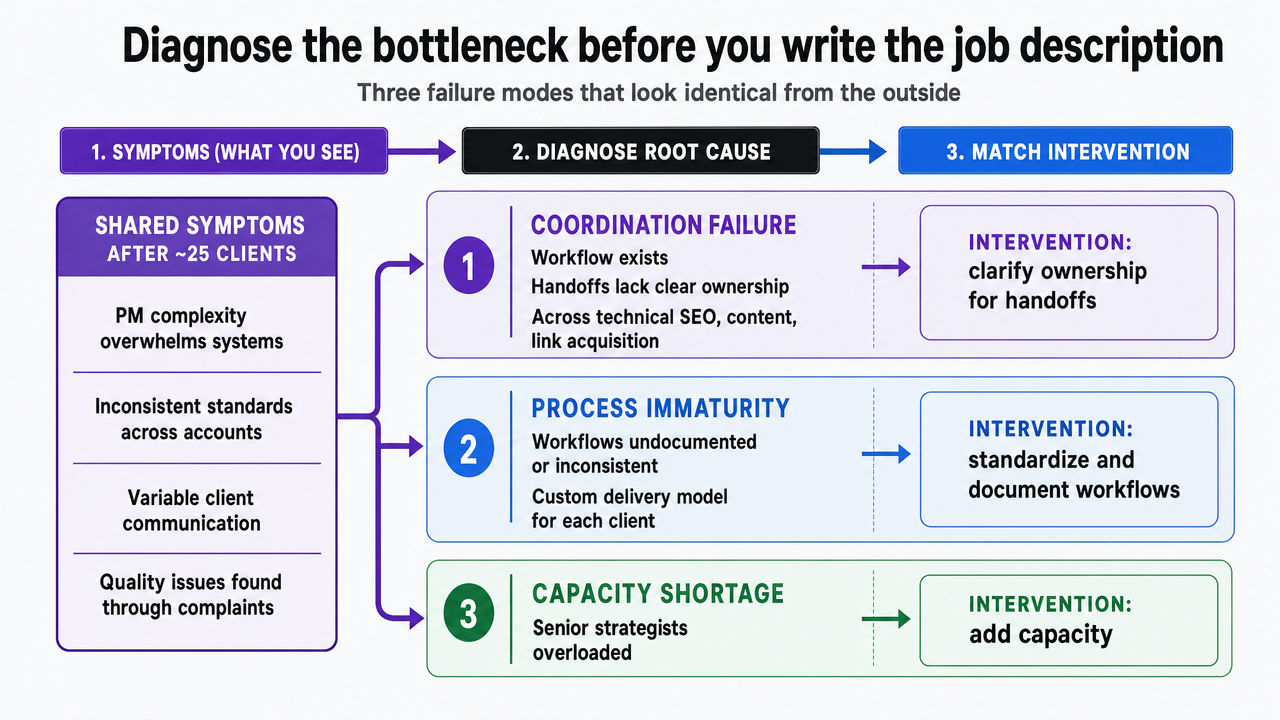 Visualize the three distinct failure modes (coordination failure, process immaturity, capacity shortage) and their corresponding interventions, since the section explicitly frames these as a diagnostic framework
Utilization is the economic hinge, not communication
Agency heads often justify a project manager hire with qualitative benefits like smoother handoffs or fewer client issues. While valuable, the true economic justification lies in specialist utilization—the percentage of senior strategist hours spent on billable, revenue-generating work, rather than administrative tasks.
Professional services benchmarks indicate that top-performing teams achieve 75-80% utilization, while underperformers fall below 60% 8. This gap, when applied to senior SEO strategists billing premium rates, differentiates a profitable agency from one that scales revenue without proportional margin growth. Utilization, alongside realization and leverage, is central to professional service firm profitability 11.
This perspective reframes the PM hiring decision. A PM doesn't create billable hours but reclaims hours senior strategists spend on coordination—meetings, internal communication, scope clarification. If a strategist's utilization is 55% due to eight hours weekly lost to administration, the economic case for a PM is clear: compare the PM's fully-loaded cost against the value of recovered billable hours across the strategist team, factoring in realization rates.
Conversely, if senior strategists already operate at 78% utilization and coordination issues are concentrated among junior staff, a PM hire addresses the wrong bottleneck. The investment should target the actual source of inefficiency.
Test AI-driven SEO project management in action
Experience hands-on workflow automation and publish live SEO content during your trial—see measurable efficiency gains firsthand.
What the role actually does, and where it stops working
The operational integrator scope
Job descriptions consistently define an SEO project manager as the link between specialists, clients, strategists, content producers, and developers 1. This involves translating roadmaps into tasks, ensuring accountability, and managing the project lifecycle from objectives to reporting 3.
An effective PM reduces three types of waste:
- status reporting time for senior strategists,
- handoff delays between technical audits, on-page implementation, and link acquisition 10, and
- client-side ambiguity by centralizing inbound requests.
This is significant, but the PM's scope is limited by existing processes. A PM operates workflows; they don't create them. If an agency lacks documented service blueprints, the PM will spend their initial months developing processes, which is process work, not project management.
Scope creep, written changes, and margin defense
A critical, often underestimated, function of a PM is defending margins against scope creep. Retainer erosion often results from small, unbilled requests—an extra blog post, an unapproved competitor analysis, or an unscheduled redirect audit. Project management best practices emphasize clear written agreements on scope, the willingness to decline out-of-scope requests, and documenting changes before work begins 7. Frameworks for creative and marketing agencies highlight expectation-setting and structured project plans to prevent delays and dissatisfaction 6.
For an agency with 30 clients, where each account quietly absorbs two unbilled hours weekly, a PM who implements a written change-order process can recover significant margin. Strategists often agree to requests to maintain client relationships, but PMs are tasked with enforcing scope boundaries. This single behavior can justify the role, provided the volume of scope requests is substantial.
The ceiling: one PM, finite client books
The PM role reaches its limit at a certain throughput. A single SEO project manager can effectively coordinate a finite number of accounts, typically between 15 and 25, depending on retainer complexity. Exceeding this number turns the PM into the very bottleneck the agency sought to eliminate.
This cap is structural. PM hours per client per week have a minimum for tasks like status review, deliverable QA, client communication, and internal escalation. When the client book surpasses this limit, agencies usually hire a second PM, increasing overhead, or add account managers, which introduces another routing layer and reintroduces handoff problems.
This highlights the limitations of a purely staffing-based solution. The role scales linearly with client count, not geometrically. For agencies aiming to grow from 50 to 150 clients without proportional headcount increases 15, a different approach is needed—such as tooling, AI-assisted execution, or both—to support the PM layer.
Three scaling paths compared on agency economics
When considering how to add 20 clients without increasing senior strategist headcount, three distinct paths emerge, each impacting utilization, cost, and throughput differently. The optimal choice depends on the agency's specific constraints, not on perceived professionalism.
The economic constant remains: top-performing professional services teams maintain 75-80% specialist utilization, while underperformers are below 60% 8. The path that most efficiently closes this utilization gap, at the lowest fully-loaded cost per recovered hour, will maximize margin.
| Dimension | A. Dedicated SEO PM | B. Process maturity + PM tooling | C. AI-assisted execution with human approval |
|---|---|---|---|
| Primary cost driver | PM fully-loaded salary | SOP build hours + tool licenses | Platform subscription + approval time |
| Specialist hours reclaimed per week | Coordination hours only | Coordination + light production hours | Coordination + production hours |
| Utilization recovery target | 60% → 70-75% 8 | 60% → 70% 8 | 60% → 75-80% 8 |
| Time to deploy | 60-90 days (hire + ramp) | 90-180 days (document + adopt) | 30-60 days (configure + approve) |
| Capacity ceiling | 15-25 client workflows per PM | Bounded by specialist hours | Bounded by approval throughput |
| Margin impact mechanism | Scope discipline 7 | Standardized delivery 12 | Production absorption + scope discipline |
| Best paired with | Documented workflows | Mid-tier coordinator role | Senior strategist judgment layer |
Three paths for adding 20 clients without adding senior strategists. Utilization targets reference professional services benchmarks 8.
Path A is effective when workflows are established, and the primary issue is coordination drag—status updates, handoff delays, and unbilled scope. The PM's value here is in enforcing written change-order discipline to protect retainer margins 7. Path B is suitable when delivery varies by strategist and documented service blueprints are absent. Tooling without SOPs creates chaos, while SOPs without tooling remain unused 12.
Path C fundamentally alters the equation by recovering production hours, not just coordination time. White-label partnerships have demonstrated that agencies can boost revenue by up to 47% by outsourcing delivery under strict project governance 14. AI-assisted execution applies this principle without the quality variance of external partners, provided all outputs receive specialist approval. These paths are not mutually exclusive; the error lies in choosing one and expecting it to resolve all utilization gaps independently.
Scale SEO Execution Without Expanding Your Project Management Overhead
See how unified, AI-powered workflows enable your agency to coordinate multi-client SEO—preserving quality and oversight while reducing manual project management demands.
A decision framework tied to agency stage
10-25 clients: process before payroll
At this stage, agencies are typically small enough that founders or heads of SEO are directly involved in most accounts. Hiring a project manager here often addresses the wrong problem. Inconsistent deliverables usually stem from a lack of documented processes for technical audits, on-page sprints, or link building, rather than a lack of work routing.
The most impactful intervention is documentation. Agencies should map each service line into a repeatable workflow with defined inputs, owners, and outputs 12. Standardizing the initial 30, 60, and 90 days of client engagement ensures consistent execution. This should be coupled with a workflow tool to house templates and a written change-order policy to prevent scope creep 7.
If coordination issues persist after workflow documentation, the next hire should typically be a senior strategist with light coordination duties, not a dedicated PM. Investing in a router before the route exists merely escalates the cost of existing inefficiencies.
25-75 clients: hybrid coordination
This is the stage where the PM question becomes relevant. The client volume is sufficient that senior strategists are losing billable hours to status updates, handoff management, and scope clarification. Documented workflows may exist, but enforcement across accounts is inconsistent, leading to quality variations depending on strategist workload.
The economics favor a dedicated SEO project manager, often in a hybrid capacity. A single PM can manage workflow enforcement, change orders, and client cadence for 20-25 accounts, while mid-tier account coordinators handle lighter administrative tasks for the remaining clients 13. The PM's measurable contribution includes recovered senior strategist hours and converting unbilled scope into change orders 7.
This role should be integrated with workflow tooling and, for high production volumes, AI-assisted execution for templated deliverables that undergo specialist approval. This combination protects per-client margins by absorbing production hours that would otherwise consume senior strategist capacity, while the PM maintains client relationships and scope discipline.
75-150 clients: PMs as exception handlers, not status hubs
Beyond 75 clients, the linear scaling model breaks down. Staffing one PM per 20 accounts would require three to seven PMs, each with unique communication styles and reporting cadences, making the coordination layer itself a source of complexity.
Agencies growing to this size without proportional headcount increases 15 redesign the PM role. Routine tasks like status reporting, deliverable QA against standards, and standard client communications are automated through workflow platforms, automated reporting, and AI-assisted execution with specialist approval. PMs then focus on exceptions flagged by the system: scope disputes, at-risk renewals, or custom scopes outside templated blueprints.
At this stage, the PM role becomes higher-leverage and less common. One PM might manage 40-60 accounts by handling exceptions, as 80% of routine tasks are automated. This improves per-client margin because coordination costs scale sublinearly. Agencies that fail to adapt and continue hiring PMs for tasks that software can handle will struggle to scale efficiently.
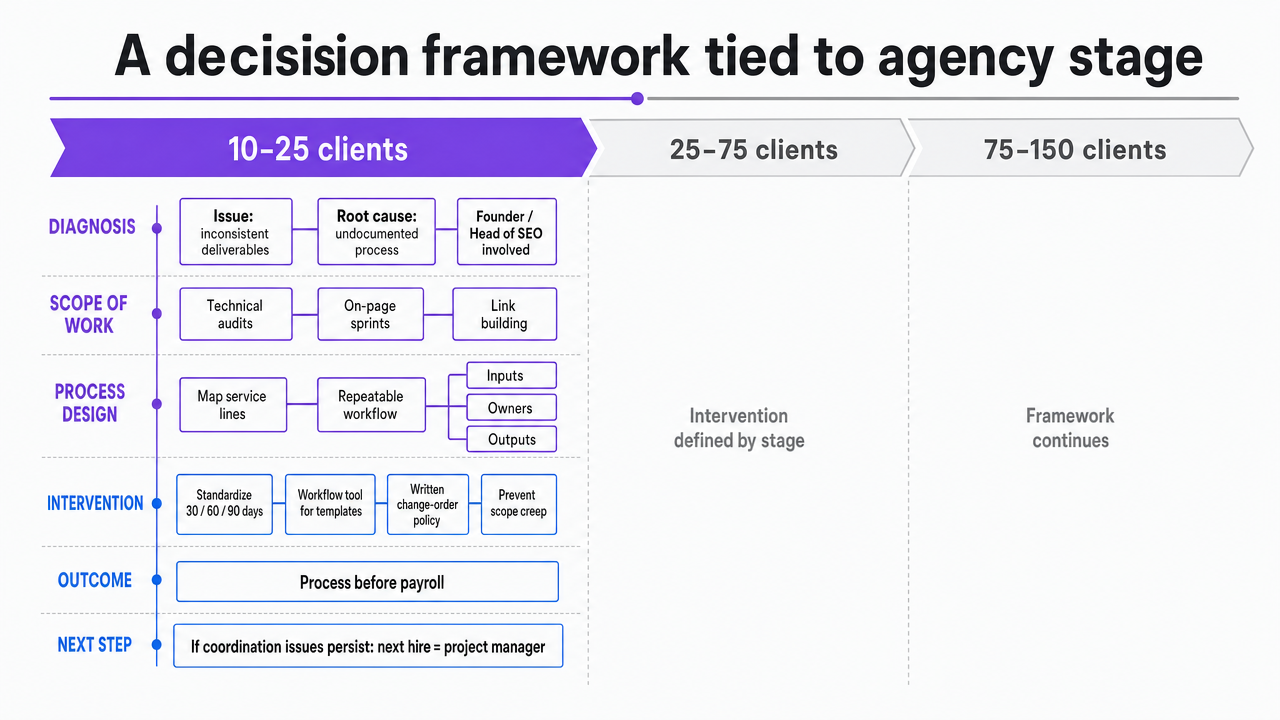 Visualize the three agency-stage decision framework (10-25, 25-75, 75-150 clients) with corresponding recommended interventions, since the section is structured as a clear staged operating model
If you manage a portfolio of agency brands or white-label partners
The dynamics shift when managing multiple agency brands or a network of white-label partners. The coordination challenge extends beyond internal teams to inter-organizational relationships.
Hiring a dedicated SEO project manager for each brand in a portfolio duplicates the role without a shared underlying system. Agencies pursuing white-label growth have reported revenue increases of up to 47% through partner-driven delivery, but only when project coordination, written SLAs, and repeatable processes are robust enough to maintain quality across partner boundaries 14. Without this governance, outsourced capacity can introduce the very quality variance it was meant to eliminate.
The portfolio-level decision is whether to centralize. A shared workflow platform, a standardized service blueprint across brands, and a senior coordination function managing partner-level SLAs typically offer better cost-per-recovered-hour performance than individual brand PM hires. AI-assisted execution is particularly well-suited here, standardizing production output before partner review and routing everything through specialist approval—mirroring the governance required for successful white-label partnerships 14, but without partner-specific quality variations.
Scale SEO Execution Without Adding Project Management Overhead
Access a unified approval workflow that coordinates multi-channel SEO tasks, automates routine execution, and delivers measurable outcomes—freeing your team to focus on strategy, not administrative oversight.
The human layer tooling cannot replace
While workflow software and AI-assisted execution can handle production and routing, they cannot replicate human judgment regarding client satisfaction, unspoken concerns, or nuanced renewal conversations. Research indicates that client satisfaction is directly linked to the emotional intelligence of the individual managing the relationship—skills like stakeholder understanding, conflict de-escalation, and soft-skill management significantly influence project success 16.
This has practical implications for staffing. Tasks requiring interpretation of tone, history, and unspoken priorities are most resistant to automation. Status reports, deliverable QA, and templated production can be managed by governed workflows. However, difficult conversations cannot. An agency that automates everything below the relationship layer still needs a human—a PM, senior strategist, or account lead—to manage the client interface.
The point is not that tooling fails, but that the PM role narrows. At scale, the most valuable PMs are those whose time is dedicated to judgment and complex problem-solving, not to chasing status updates that a system already tracks.
How to decide in the next 30 days
Before drafting a job description, conduct a diagnostic. Analyze last quarter's timesheet data for senior strategists to calculate actual billable utilization. If it's below 65% 8, identify where the missing hours went: status work, handoff chasing, scope clarification, or rework due to undocumented standards.
Then, answer three key questions:
- Are service workflows documented per client type, or do strategists improvise?
- How many unbilled scope requests occurred last month, and what would written change orders have recovered 7?
- Which deliverables are templated enough for governed automation, and which require senior judgment?
The answers will guide the intervention. Process gaps require SOP development before hiring. Coordination drag on an existing workflow justifies a PM with measurable utilization recovery targets. High production volume overwhelming strategists points towards AI-assisted execution with specialist approval—the core of Vectoron's approach. Most agencies will need a combination of these solutions, but none should hire a PM before completing this diagnostic.
Frequently Asked Questions
References
- 1.Hire An SEO Project Manager.
- 2.What is an SEO Project Manager? | Skills Needed + FAQ.
- 3.SEO Project Manager | Longhouse Branding & Marketing.
- 4.SEO Project Manager.
- 5.What Are the Benefits of a Dedicated SEO Project Manager?.
- 6.Project Management Best Practices for Creative Agencies.
- 7.8 client satisfaction guidelines every project manager should know.
- 8.How to Measure Professional Services Utilization Rate - A Guide for SaaS Executives.
- 9.PMI: Navigating Creative Campaign Challenges.
- 10.SEO Project Management: A Start to Finish Guide.
- 11.The Relationship Between Utilization and Profitability in Professional Service Firms.
- 12.How to Develop a Systemic Plan for Scaling Your SEO Agency.
- 13.7 Challenges in Scaling SEO Agency Operations.
- 14.How to Scale Your Agency with White Label Local SEO Services.
- 15.Scaling Your Marketing Agency: Proven Strategies and Insights.
- 16.Impact of Emotional Intelligence on Client Satisfaction In Project Management.
- 17.Mastering Project Management: Best Practices for Marketing Agencies.
- 18.Project Management: Tools & Digital Marketing Impact.