
Key Takeaways
- Healthy reseller economics sit in a 40–60% gross margin band, and falling below it usually means the agency is absorbing unpriced production, revisions, and reconciliation work 1.
- Reseller selection is now an operating model decision, since labor-heavy production can no longer sustain margins as agencies face a projected 15% headcount cut in 2026 7.
- Pricing tiers built on verifiable deliverables instead of hours protect margin under client scrutiny and let clients adjust scope without renegotiating contracts.
- AI-augmented execution platforms compress strategy-to-publish cycles from weeks to days and can lift margins 50–65% by integrating approval and reporting into one surface 6.
- A defensible vetting rubric tests reporting integration in the agency's CRM, per-deliverable SLAs, link source disclosure, named escalation contacts, and a paid pilot in a tough vertical.
- Multi-location verticals require per-location wholesale pricing, brand governance enforcement, and aggregated portfolio plus location reporting, or the intended margin erodes through rework 9.
- Switching reseller models works best in three waves—new accounts first, then at-risk and low-margin clients, then strategic accounts with parallel reporting—to protect retention during the transition.
The Margin Math Behind Reseller Decisions in 2026
Reseller economics start with a defensible margin band. Healthy white-label SEO packages typically yield 40–60% gross margin, calculated on the difference between wholesale fulfillment cost and the retail price charged to the client 1. Agencies operating below this range often absorb unitemized production costs.
The financial impact is significant. A $2,500 monthly retainer at 30% gross margin leaves $750 for account management, reporting, sales, and tooling before any operating profit. The same retainer at 55% gross margin yields $1,375—nearly double the contribution per account, without altering client-facing scope. This difference, multiplied across a substantial client base, can determine an agency's sustainability.
In 2026, this margin band faces increased pressure. Forrester projects an additional 15% headcount reduction across marketing agencies, following 2025 cuts, indicating a structural shift in agency value creation rather than a temporary adjustment 7. Agencies relying on labor-heavy internal production to maintain 40–60% margins now compete with operating models that have eliminated entire production layers.
This analysis approaches reseller selection as a margin and capacity engineering decision, exploring pricing, partner criteria, and fulfillment models.
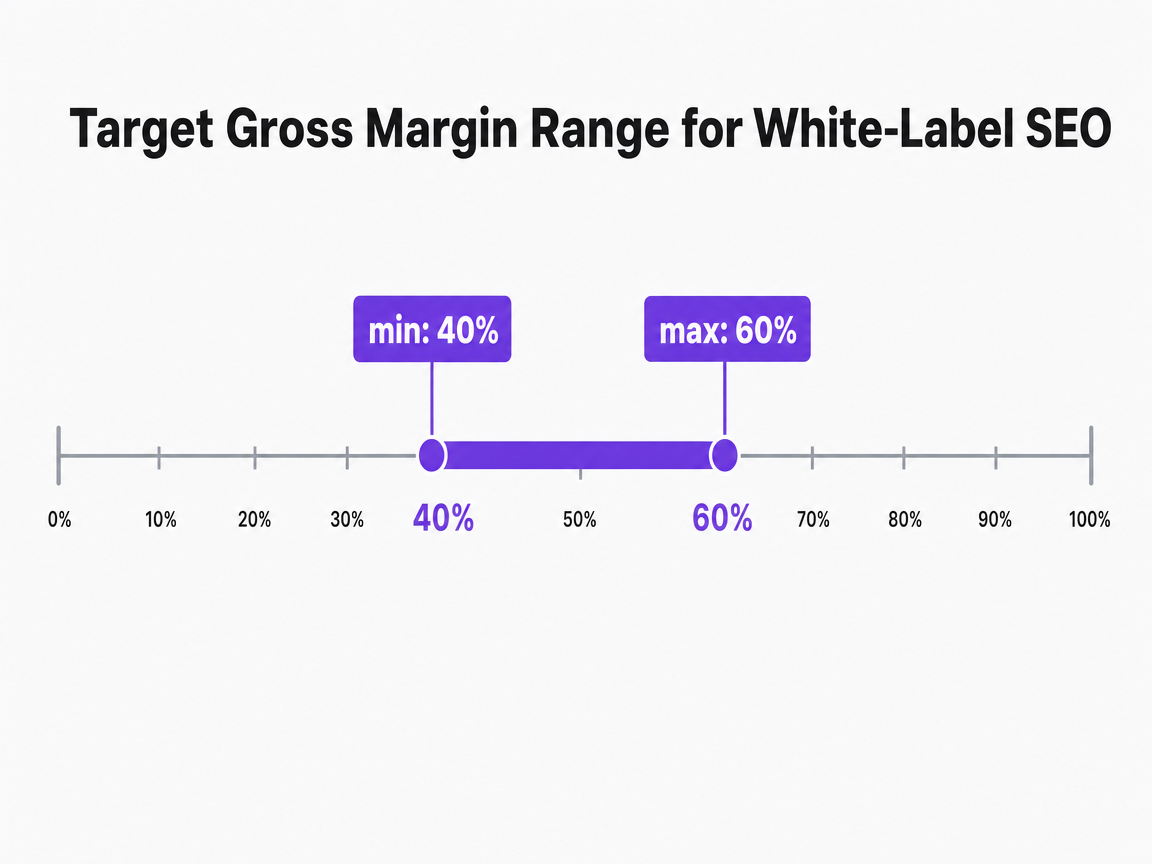 Target Gross Margin Range for White-Label SEO
Represents the healthy and profitable gross margin range (40% to 60%) that agencies typically target when marking up white-label SEO services.
Why Reseller Selection Became an Operating Model Question
Headcount Pressure and the End of Labor-Heavy Agency Math
Procurement-style reseller decisions were relevant when agency growth meant adding staff. That era has ended. Forrester characterizes the 2026 headcount reductions as a reinvention of agency value creation, not merely an efficiency drive. They caution that agencies cutting staff without rethinking their operating model risk a downward spiral of declining margins and commoditized services 7. Reseller selection is central to this reevaluation, as it dictates whether an agency maintains an in-house fulfillment team or converts it to a variable cost model.
The financial realities are stark. A team comprising a senior SEO strategist, content lead, link builder, and reporting analyst can incur annual costs exceeding half a million dollars, excluding benefits and tooling. For an agency managing 30 accounts, this production stack consumes a significant portion of the gross margin. Research on outsourcing benefits highlights cost savings and higher profit margins as primary outcomes of SEO outsourcing for digital agencies, alongside improved scalability and faster turnaround times 2.
The question is no longer whether to use a reseller, but which fulfillment model allows the agency to maintain margins while reducing its production layer.
CMO Demand for Fewer, More Integrated Partners
Client-side buying behavior has also evolved. Forrester's analysis indicates that CMOs prefer frictionless partner models, consolidating their vendor rosters to fewer providers that integrate into existing workflows and data, rather than engaging isolated tactical vendors 9. For example, a marketing director for a personal injury firm now seeks a unified view of performance, not separate SEO, PPC, and content reports on different schedules and formats. Agencies that provide integrated reporting gain a competitive advantage.
This preference redefines reseller criteria. A white-label partner that simply delivers a branded PDF monthly is operating in a model clients are moving away from. McKinsey's research on marketing operating models demonstrates the benefits of consolidation, finding that integrated models can cut costs by up to 20% while boosting marketing effectiveness 6. Agencies that streamline reseller output through a single approval and reporting interface capture this integration premium. Conversely, agencies that integrate a reseller into a fragmented system may lose these savings due to increased project management overhead.
Partner selection now prioritizes data interoperability and workflow compatibility over deliverable counts.
Test AI-powered SEO delivery workflows risk-free
Run live SEO campaigns and measure real operational efficiency during your trial—no commitment required.
Pricing Tiers That Hold Margin Under Client Scrutiny
Building Tiers Around Verifiable Deliverables, Not Hours
Hour-based pricing invites client scrutiny and renegotiation. When a client questions the output of "20 hours of SEO," the agency ends up defending timesheets instead of outcomes. Tiers built on verifiable deliverables—such as published content units, earned links from specified sources, technical audits with actionable remediation, and tracked keyword rankings—justify the retail price because each item is tangible and inspectable by the client.
Practitioner guidance suggests maintaining the 40–60% gross margin band against the wholesale cost of each specific deliverable, rather than a general monthly retainer 1. This approach influences tier construction. For instance, a starter tier priced at $1,500 retail with a wholesale cost of $675 achieves a 55% gross margin. This tier could include three blog posts, one technical audit refresh, and two earned links, each with defined quality standards. A growth tier priced at $3,500 retail maintains the same margin only if the wholesale components scale proportionally, requiring the reseller partner to price its inputs similarly.
Beyond margin protection, this approach enhances sales velocity. Deloitte's CMO research notes that marketing leaders, facing economic uncertainty, prefer flexible, scalable resources for disciplined experimentation over fixed commitments 8. Deliverable-based tiers allow clients to adjust scope without contract renegotiation, accelerating upsell conversions.
Hidden Costs That Erode the Spread
The theoretical 55% gross margin often diminishes in practice due to hidden costs. Project management overhead is a primary culprit. Each reseller deliverable that arrives outside the agency's reporting system necessitates reformatting, reconciliation, and follow-up communication. Account managers handling 12 to 15 reseller-supported accounts can spend a full day per week on such translation work, which is unbilled to the client and unaccounted for in the initial margin model.
Revision cycles represent another significant cost. A content asset requiring multiple rounds of specialized edits—common in regulated industries like personal injury or healthcare—can negate the cost savings intended by the reseller arrangement. While outsourcing offers faster turnaround and higher profit margins, misalignment on quality standards and communication can quickly erode these benefits 2. Agencies that fail to factor revision costs into wholesale contracts end up subsidizing them from their gross margin.
Reporting reconciliation is a third issue, where data resides in the reseller's dashboard, the agency's CRM, and the client's preferred view simultaneously. Multi-client tools can mitigate this, but only if the reseller's outputs are structured for seamless integration into shared platforms 4.
Despite these challenges, the revenue potential remains strong. A 2025 industry ranking, based on self-reported data, indicated that agencies adopting white-label SEO saw average revenue increases of 35–50% within 12 months 3. This figure reflects top-line growth, but only agencies that proactively address and engineer out hidden costs before scaling their client base truly realize the full margin.
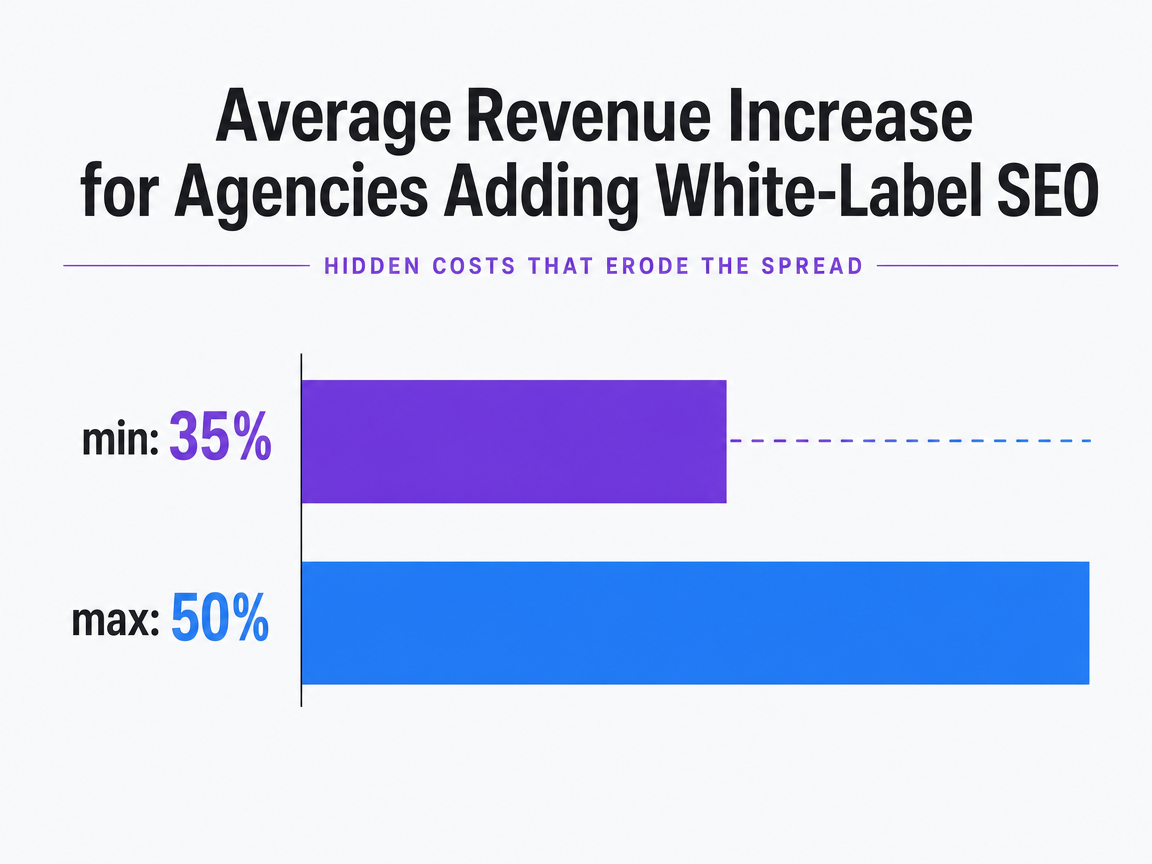 Average Revenue Increase for Agencies Adding White-Label SEO
Represents the average revenue increase (35% to 50%) reported by agencies within 12 months of adding white-label SEO services.
Three Fulfillment Models Compared
In-House Production: Control at the Cost of Capacity
Maintaining SEO production internally offers direct quality control and eliminates disclosure risks. However, it limits capacity to what the strategist-to-account ratio can sustain before output quality declines. A typical team of four—strategist, writer, link builder, and reporting analyst—can generally support 20 to 30 active retainers before deliverable delays occur, depending on the complexity of the industry.
The margin profile presents a greater challenge. High loaded labor costs consume the gross margin that is typically allocated for sales, account management, and operating profit 1. Forrester's view of the 2026 contraction as a re-evaluation of value creation suggests that agencies maintaining labor-intensive production models are defending a system that the market is actively devaluing 7.
In-house production remains valuable for accounts requiring bespoke editorial judgment, such as litigation firms or behavioral health networks with specialized content needs. For most other clients, capacity limitations become the primary constraint long before quality concerns arise.
Traditional White-Label Vendors: Predictable, Slow, Margin-Capped
Traditional white-label vendors address capacity limitations by offering fulfillment as a standardized, packaged service. They typically provide published wholesale pricing and standardized deliverables, allowing agencies to scale client accounts without increasing payroll. Research on outsourcing benefits highlights cost savings, scalability, and faster turnaround as key advantages for digital agencies 2.
However, operational weaknesses emerge during the monthly cycle. Most white-label providers rely on briefing forms, weekly updates, and monthly deliverable batches. A content order placed early in the month might not be delivered until late in the month, and revision requests add further delays. This means the strategy-to-publish cycle can take weeks, forcing agencies to forecast client needs far in advance or absorb delays as an account management cost.
Reporting integration is another limitation. White-label dashboards often consist of branded PDFs or vendor-hosted portals that do not seamlessly integrate with the agency's CRM or the client's preferred reporting view. CMOs are increasingly moving away from such fragmented reporting, favoring partners that integrate with existing workflows and shared data 9. Agencies using traditional reseller stacks may appear to maintain a 40–60% gross margin on paper, but often lose 10 to 15 percentage points to reconciliation labor.
AI-Augmented Execution Platforms: Compressed Strategy-to-Publish Loops
AI-augmented execution platforms fundamentally redesign the fulfillment process. They integrate signal capture, ranked recommendations, human approval, and execution into a single workflow, eliminating the batch-and-handoff cycles common in traditional reseller models. McKinsey's 2025 AI survey indicates that high-performing organizations are re-engineering workflows around AI, rather than simply adding it to existing processes, with half of these top performers planning to transform their businesses using AI 5.
For agencies, the operational benefits are significant. Tasks like content briefing, technical audit remediation, and link prospecting, which previously involved multiple human handoffs, are consolidated into a single approval interface. Strategy-to-publish cycles, which might take 18 to 25 days with traditional white-label arrangements, are reduced to a few days. Account manager reconciliation overhead decreases because outputs are already structured for the agency's reporting system.
The integration premium directly contributes to margin improvement. McKinsey's operating model research shows that marketers adopting integrated models can reduce costs by up to 20% while increasing marketing effectiveness 6. An agency that routes reseller-equivalent execution through a unified approval and reporting system directly benefits from this premium, while still ensuring human oversight on every deliverable. This model requires strong governance discipline: approval-first execution only maintains quality if the agency diligently uses the approval step, rather than merely rubber-stamping to clear queues.
Per-Account Economics Across the Three Models
Assuming a constant retail price of a $2,500 monthly retainer, the three models yield distinct contribution profiles. The table below uses the 40–60% gross margin band as the baseline for white-label services 1 and incorporates the up-to-20% cost reduction from integrated operating models as the AI-augmented delta 6.
| Per-Account Variable | In-House Production | Traditional White-Label | AI-Augmented Execution |
|---|---|---|---|
| Gross margin ceiling | ~30–45% | 40–60% 1 | 50–65% (white-label band plus integration delta) 6 |
| Capacity per account manager | 5–8 accounts | 12–15 accounts | 20–30 accounts |
| Strategy-to-publish cycle | Variable, internal queue | 2–4 weeks per batch | Days, approval-gated |
| Reporting integration | Native if built | Vendor portal / branded PDF | Unified approval and KPI surface |
| Client-facing disclosure risk | None | Moderate (vendor footprint) | Low (agency-controlled surface) |
The contribution gap is substantial. An agency managing 40 accounts with a 15-point margin difference can shift hundreds of thousands of dollars in annual gross margin simply by choosing a different fulfillment model for the same retail book.
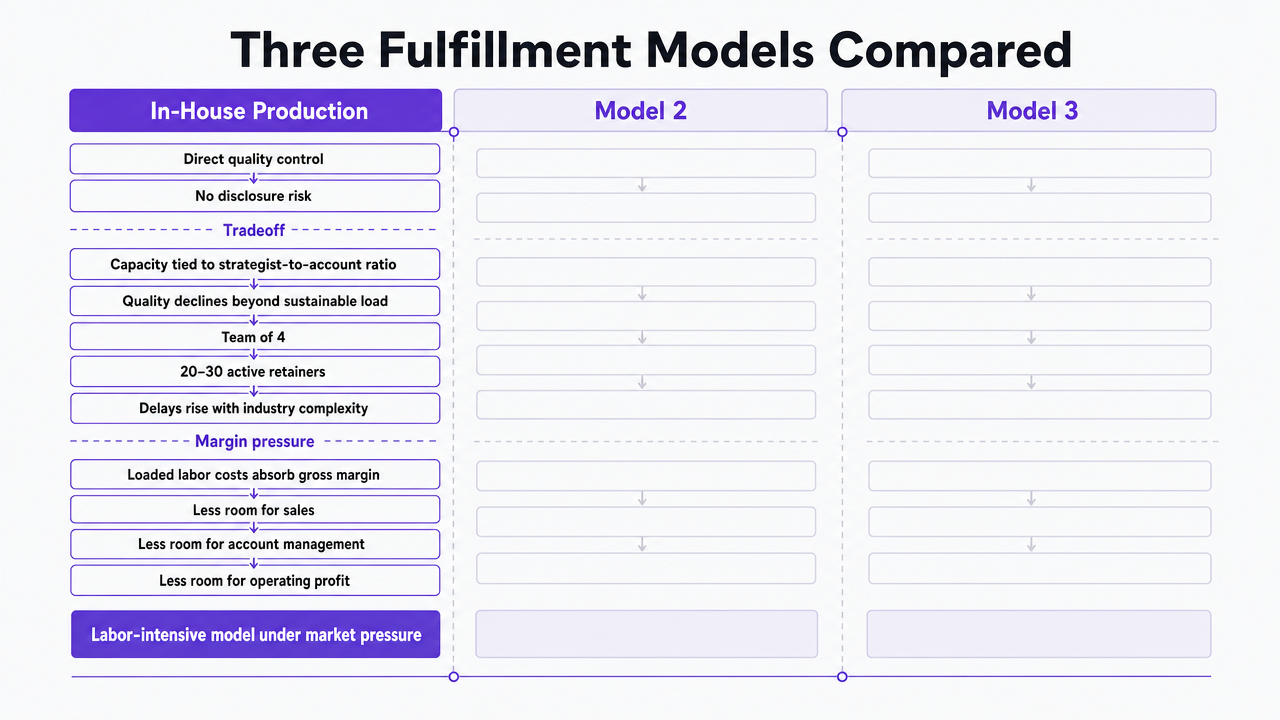 Process comparison infographic visualizing the three fulfillment models side-by-side, directly supporting the section's comparative analysis without duplicating the table
Analyze the ROI Impact of Advanced SEO Reseller Packages for Your Agency
Connect with a strategist to benchmark your current SEO production costs and explore data-driven options to scale delivery, reduce operational overhead, and protect client outcomes.
A Partner-Vetting Rubric That Survives Contact With Clients
Reporting Integration and Data Handoff
The initial vetting question concerns the mechanical process of how a partner's output integrates with the agency's reporting system. A reseller providing CSV files, branded PDFs, or vendor-portal screenshots requires the account manager to manually re-enter data before it reaches the client. This reconciliation labor is not reflected in the wholesale quote but becomes apparent when the margin model is reviewed later.
Practitioner reviews of white-label SEO tools indicate that platforms gaining agency adoption in 2025 standardize multi-client reporting and integrate seamlessly into shared dashboards, eliminating manual aggregation 4. To vet this, ask prospective partners to push a sample week of rank tracking, technical audit findings, and content delivery into a test instance of the agency's CRM or reporting tool before signing any contract. Partners unable to do this without custom integration are unlikely to do so later.
A second crucial aspect is data ownership. Keyword sets, backlink records, and audit history should reside in systems controlled by the agency, not solely within the reseller's portal. Data portability protects the account if the partnership terminates mid-contract.
SLA Structure, Link Source Disclosure, and Escalation Path
Service-level agreements (SLAs) warrant more thorough examination than typically given in reseller contracts. Turnaround times should be specified per deliverable type, not as a vague monthly bundle. A content asset with a 10-business-day SLA is operationally distinct from one within a general "monthly package" timeline. This distinction becomes critical when a client requires a rapid publish for a legal update or a new service launch.
Link source disclosure differentiates reliable partners from potential liabilities. The contract should mandate category-level disclosure for every link placement—e.g., editorial guest post, niche edit, digital PR, sponsored mention—along with the destination domain's traffic floor and topical relevance criteria. Partners who refuse this level of disclosure may be protecting sourcing methods the agency would not approve if fully aware. While outsourcing offers faster turnaround and specialized expertise, quality misalignment is a key factor that erodes these benefits 2.
The escalation path is the third structural element. Identify the specific individual responsible for addressing client quality disputes and their guaranteed response window. "Account manager" is insufficient. A named contact with a 24-hour response SLA is the standard necessary when a client, such as a personal injury firm, raises concerns about off-brand content.
Content QA Loop and Vertical Fluency
Quality assurance often fails when there's a gap between the reseller's generic standards and the agency's specific vertical needs. Generic SEO content might pass grammar and plagiarism checks but still be unusable for a behavioral health network requiring HIPAA-compliant language or a dental DSO navigating state-specific advertising regulations. The QA process must assess vertical fluency, not just superficial errors.
The most effective vetting protocol is a paid pilot, not just a sample portfolio review. Commission two or three assets in the agency's most challenging vertical—where revision cycles currently consume the most margin. Evaluate three key metrics: factual accuracy against source material, handling of compliance language, and the number of revision rounds needed to reach publishable quality. McKinsey's AI survey highlights that high performers redesign workflows around AI for measurable cost and revenue benefits 5. Similarly, reseller partners with QA processes tailored to the agency's verticals deliver assets that publish on the first pass. Partners treating QA as a generic editorial sweep effectively pass the cost of revisions back to the agency.
If You Manage Multi-Location Service Verticals
The economics discussed previously primarily apply to single-location service accounts. Multi-location operators—such as dental support organizations with 40 practices, home services franchises with regional brands, or senior living portfolios across states—introduce three specific changes to wholesale math that reseller package construction must accommodate.
First is location-multiplier pricing. A dental DSO doesn't purchase one SEO retainer; it requires location-level optimization across each practice URL, Google Business Profile, and review platform. Reseller partners quoting a flat retainer for the parent brand will lose margin when the DSO requests location-specific reporting. Tier construction must price the per-location wholesale cost separately from the brand-level strategic layer, then bundle them into a single retail figure that maintains the 40–60% gross margin band 1.
Second is governance complexity. A 25-location HVAC franchise needs consistent deployment of corporate-approved messaging while retaining local market specificity. McKinsey's operating model research identifies the tension between centralized control and local autonomy as a defining challenge in modern marketing structures, noting that integrated models achieve measurable cost reductions when this balance is resolved 6. Resellers unable to enforce brand standards across numerous location assets create rework that erodes the margin intended by location-multiplier pricing.
Third is reporting aggregation. Multi-location CMOs assess performance at both the portfolio and individual location levels simultaneously. They consolidate vendor rosters around partners that can provide both views without manual compilation 9. A reseller delivering 25 individual location reports has already failed to meet this critical client need.
Benchmark and Streamline Your Agency’s SEO Delivery—With Data-Driven Oversight
Access a unified platform to automate, coordinate, and transparently manage high-volume SEO reseller workflows—enabling agencies to cut production overhead, maintain quality standards, and track ROI on every client campaign.
Sequencing the Switch Without Disrupting Existing Accounts
Transitioning reseller models is primarily an account-retention exercise, then a margin optimization. Agencies that execute this smoothly typically manage the transition in three distinct waves, rather than a single cutover.
- Wave one involves the new-business cohort. New accounts acquired after the decision to switch are onboarded directly onto the new fulfillment model. This avoids legacy reporting expectations and builds internal operational fluency with the new platform, generating case data for the account management team to use in subsequent waves.
- Wave two addresses at-risk and low-margin accounts. Clients already operating below the 40–60% gross margin band 1, or those flagged for potential churn in the near future, are transitioned next. The downside risk is limited, as these accounts were not profitable under the old model. This wave provides quick feedback on whether the new fulfillment model improves contribution before renewal discussions.
- Wave three focuses on the strategic book. Anchor accounts are moved last, often with parallel reporting for one cycle. This ensures clients experience continuity before the old workflow is retired. Forrester's research on frictionless partners emphasizes that CMOs consolidate around providers offering integrated views without manual stitching 9, which is precisely what the parallel-run period demonstrates.
Frequently Asked Questions
References
- 1.How Much to Mark Up White Label SEO Services for Profit.
- 2.5 Key Benefits of SEO Outsourcing for Digital Marketing Agencies.
- 3.Top 10 White Label SEO Agencies in 2025 for Effective Client Growth.
- 4.Best White Label SEO Tools for Agencies in 2025.
- 5.The State of AI: Global Survey 2025.
- 6.Connecting for growth: A makeover for your marketing operating model.
- 7.Predictions 2026: Marketing Agencies Resign Their Agency.
- 8.2026 CMO Survey.
- 9.The Agency Landscape Converges On Frictionless Partner Models.
- 10.Meet your new MOM (Marketing Operating Model).