
Key Takeaways
- Reseller plan selection has shifted from a price-per-deliverable decision to a governance choice that determines approval rights, disclosure liability, data ownership, and audit-ready reporting.
- Agencies now resell to access AI-enabled capabilities clients expect by default, with 83% of outsourcing buyers reporting AI in vendor services 8, reframing the decision as skills access rather than labor arbitrage.
- Evaluate plans across five axes: approval control with brief, draft, and publish gates; disclosure posture; outcome-tied reporting; data ownership and exit terms; and capability depth across content, links, technical, and local.
- Compare traditional white-label, freelance networks, and AI-assisted platforms by turnaround, approval control, disclosure risk, and account manager hours absorbed, since coordination cost often outweighs sticker price 6.
- The August 2024 FTC reviews rule and the 2023 endorsement-guide update extend advertiser liability into review workflows, testimonials, and case study reuse that reseller contracts historically ignored 9, 10.
- For multi-client portfolios, run margin math that includes loaded account manager hours and QA overhead, not just plan cost, to see which model holds its margin across the book 6.
- Redline auto-renewals beyond thirty days, one-directional indemnification, vague service levels, broad data-use licenses, and non-competes that reach the agency's own clients before signing any reseller contract.
- A focused afternoon of due diligence—approval logs, compliance checklist, margin worksheet, and a contract read across termination, data, and indemnification—produces a defensible vendor choice.
The Reseller Decision Has Changed: From Labor Arbitrage to Governance
Five years ago, an agency owner picked an SEO reseller plan the way a contractor picks a lumber yard: cheapest reliable supply, decent turnaround, no surprises on the invoice. The selection criteria fit on a sticky note—price per blog post, link tier, monthly minimum.
That sticky note no longer covers the actual risk. Three forces have shifted what a reseller plan needs to deliver. The FTC finalized its updated endorsement guides in 2023 and approved a separate final rule on consumer reviews and testimonials in August 2024, both of which extend advertiser liability into ground that reseller contracts rarely address 9, 10. Outsourcing itself has moved from labor arbitrage to a skills-access decision, with AI capability now embedded in most vendor relationships rather than offered as a premium tier 5. And clients increasingly request reporting that can survive an internal audit, not a screenshot of rankings.
The practical consequence: a reseller plan is now a governance instrument. It determines who approves work before it ships under the agency's name, who carries disclosure liability when a testimonial gets reused, who owns the data when the relationship ends, and whether monthly reporting maps to outcomes the client's CFO will accept. The sections that follow treat plan selection as that kind of decision—five evaluation axes, a compliance filter most reviews skip, and the margin math behind each fulfillment model.
Why Agencies Resell Now: Skills Access, Not Just Cost
The motive behind reselling has flipped. A decade ago, agencies bought white-label SEO to dodge headcount during demand spikes. The math was simple: a freelancer or offshore shop could produce a blog post for less than the loaded cost of an in-house writer, and the margin difference covered the account manager.
That logic no longer drives the decision at the top of the market. Deloitte's 2024 global outsourcing survey of more than 500 executives found that 83% report leveraging AI as part of their outsourced services, which reframes outsourcing as a vehicle for accessing capabilities clients now expect by default rather than a labor-cost play 8. The same research positions in-sourcing and outsourcing as two sides of a skills-access question, not a binary spend decision 5. Translation for agency owners: clients increasingly assume the agency has access to entity-aware content models, programmatic technical audits, and link analysis pipelines that no five-person shop builds from scratch.
Forrester's 2024 demand-marketing research reinforces the operational side of this shift, finding that coordinated multi-channel execution outperforms isolated channel work in modern B2B buying 7. A reseller plan that delivers blog posts in a vacuum, with no connection to the client's PPC landing pages or local search footprint, drags performance reports in the wrong direction.
The selection question becomes: which reseller model gives the agency the skill stack clients now treat as table stakes, without surrendering control over what ships under the agency's brand?
Test-drive a fully managed SEO workflow today
Experience real-time, production-ready SEO execution with live approvals and measurable outcomes during your trial.
Five Evaluation Axes for an SEO Reseller Plan
Approval Control: Who Signs Off Before Work Ships
Approval control is the axis most reseller plans bury in the onboarding PDF. The question is binary: does the agency see and sign off on every deliverable before it publishes under a client's brand, or does the vendor push work live on a calendar and send a report afterward?
Calendar-push fulfillment was tolerable when reseller output was limited to blog posts and a monthly link drop. It stops being tolerable the moment a vendor's content model writes about a regulated industry, a competitor by name, or a client claim the agency cannot substantiate. Once that copy lives on the client's domain, the agency owns the consequences regardless of who drafted it.
A defensible approval model has three checkpoints worth confirming in writing:
- a brief-level approval before production begins,
- a draft-level review with redline rights, and
- a publish gate the agency triggers rather than the vendor.
Plans that fold approval into a single "client review" step typically mean the agency is approving on the client's behalf, which compresses turnaround and increases the volume of work the agency has to defend if a deliverable misses. Buyers should ask vendors to walk through a real approval log from an active account, not a sales deck diagram.
Disclosure and Compliance Posture as Procurement Filter
Compliance posture belongs in the procurement filter, not the legal appendix. The FTC's truth-in-advertising framework requires that endorsements be honest and not misleading and that material connections be disclosed, and the codified guidance at 16 CFR Part 255 sets the substantiation bar for performance claims and testimonials 1, 3.
A reseller plan touches this surface constantly: the case studies the vendor offers as proof, the testimonials the agency reuses in pitch decks, the review-generation workflows bundled into local SEO packages, and the performance language baked into monthly reports. The FTC's 2023 update to the endorsement guides clarified that advertiser liability can extend to deceptive endorsements, not just the narrower category of paid influencer disclosures 9.
Three procurement questions filter most vendors quickly:
- Will the vendor warrant in writing that case studies and testimonials provided to the agency reflect actual client results and consented use?
- Does the review-generation workflow comply with the FTC's stance on incentivized and gated reviews 2?
- Does the contract assign liability for deceptive claims to the party that authored them, rather than leaving it implied?
Vendors that hesitate on the first question rarely improve on the next two.
Reporting That Survives Client Audit
Reporting is the axis clients increasingly use to renew or churn. A keyword-rank screenshot and a backlink count no longer satisfy a CFO who treats marketing as a line item with attribution expectations.
The reporting test has two parts. First, does the report tie SEO output to outcomes the client tracks—qualified leads, booked appointments, revenue-weighted conversions—rather than activity counts? Second, can the underlying data be exported in a form the client could hand to an internal auditor or a successor agency without losing fidelity? Forrester's 2024 demand research emphasizes that coordinated multi-channel execution and measurable delivery mechanisms are what move B2B buyers, which means SEO reporting that sits in isolation from paid, local, and lifecycle data tends to underperform in client reviews 7.
Practical filter: ask the vendor for a sample report from a comparable account, with PII redacted. If the sample stops at rankings and traffic without connecting to lead or revenue signals, the reselling agency will end up rebuilding the report layer internally, which erases part of the margin the reseller plan was supposed to protect.
Data Ownership and Exit Terms
Data ownership is where reseller relationships quietly turn expensive. The artifacts that accumulate over twelve to twenty-four months—keyword research files, content briefs, technical audits, link prospecting databases, GSC and GA4 connections, schema templates, internal linking maps—represent the operational memory of a client account. If the vendor owns those artifacts or retains them in proprietary tooling, exiting the relationship means rebuilding from zero.
The contract language to confirm is narrow and specific. The reselling agency should hold a perpetual, royalty-free license to all deliverables, source files, and working data produced under the engagement. Access credentials to client-owned properties—Search Console, analytics, CMS, ad accounts—should remain with the client or the agency, never solely with the vendor. Exit clauses should specify a defined offboarding window, the format of data export, and the disposition of any vendor-controlled tooling that touched the client environment.
Plans that bundle proprietary dashboards or "managed" rank-tracking platforms warrant extra scrutiny. The convenience during the relationship becomes a switching cost at the end of it, and that cost is rarely modeled in the original margin calculation.
Capability Depth: Content, Links, Technical, and Local
The fifth axis is whether the plan actually covers the surface area an SEO engagement now requires. Content alone does not move rankings for clients in competitive verticals; technical health, internal linking, schema, link acquisition, and local entity management all carry weight, and the gaps show up in quarterly reviews.
Deloitte's 2024 outsourcing research frames the shift cleanly: outsourcing is increasingly a skills-access decision rather than a labor-cost play, with AI capability embedded across vendor relationships 5. For a reseller plan, that translates into a capability inventory the agency should request in writing—who handles technical audits and at what depth, how link acquisition is sourced and vetted, whether local SEO covers GBP optimization and citation hygiene or stops at directory submissions, and how content production handles entity coverage and topical authority rather than isolated blog posts.
Plans that specialize narrowly can still earn a slot in the stack, but only when the agency has paired them with complementary fulfillment for the gaps. A plan sold as full-service that quietly subcontracts technical and local work is the failure mode worth catching during evaluation, not after.
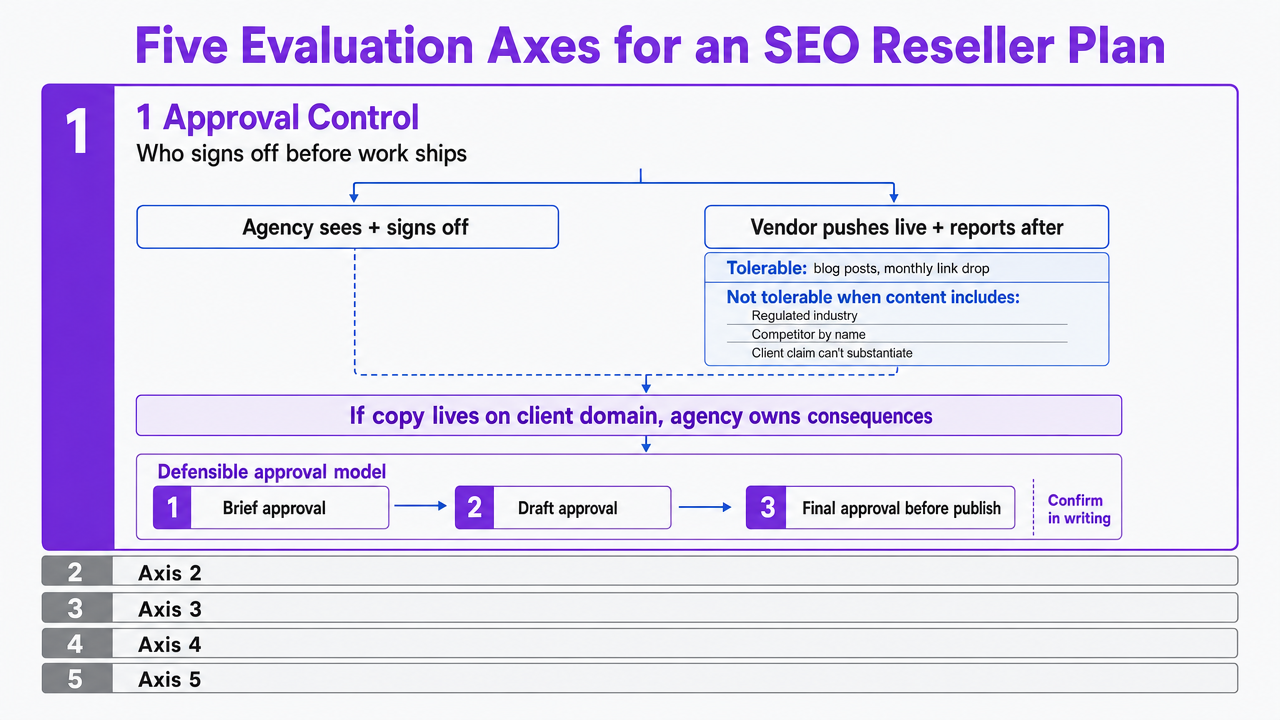 Visualize the five evaluation axes as a structured framework that readers can scan and reference
Comparing Three Fulfillment Models Side by Side
Three fulfillment models dominate the reseller market in 2025, and they trade off the same four variables:
- turnaround range,
- approval control,
- disclosure risk exposure, and
- the account manager hours the reselling agency absorbs to keep the work clean.
Forrester's 2024 benchmark work on outsourcing spend reinforces that disciplined vendor evaluation has to compare cost against value across multiple operational dimensions, not price alone 6.
| Variable | Traditional white-label | Freelance network | AI-assisted platform |
|---|---|---|---|
| Turnaround range | 10–20 business days per content cycle | 5–15 business days, writer-dependent | 24–72 hours to draft, then approval-gated |
| Approval control | Calendar-push common; redlines on request | Variable by contractor; no standard gate | Approval-first by design; publish blocked until sign-off |
| Disclosure risk exposure | Moderate—case studies and testimonials often pre-packaged | High—claims and sourcing inconsistent across writers | Lower when substantiation is logged per deliverable |
| Account manager hours per client/month | 6–12 hours coordinating briefs and revisions | 10–18 hours managing handoffs and QA | 2–6 hours reviewing queued recommendations |
The traditional white-label shop optimizes for predictable unit cost but pushes coordination overhead back onto the reselling agency. Freelance networks flex on capacity and price but concentrate disclosure risk at the writer level, where substantiation for performance claims and testimonials is hardest to enforce 3. AI-assisted platforms compress turnaround and centralize approval, which moves the agency's hours from chasing drafts to reviewing ranked output—the same skills-access shift Forrester's 2024 outsourcing benchmarks frame as the defensible reason to outsource at all 6. The right answer depends on which variable the agency is actually short on: cash, capacity, or oversight bandwidth.
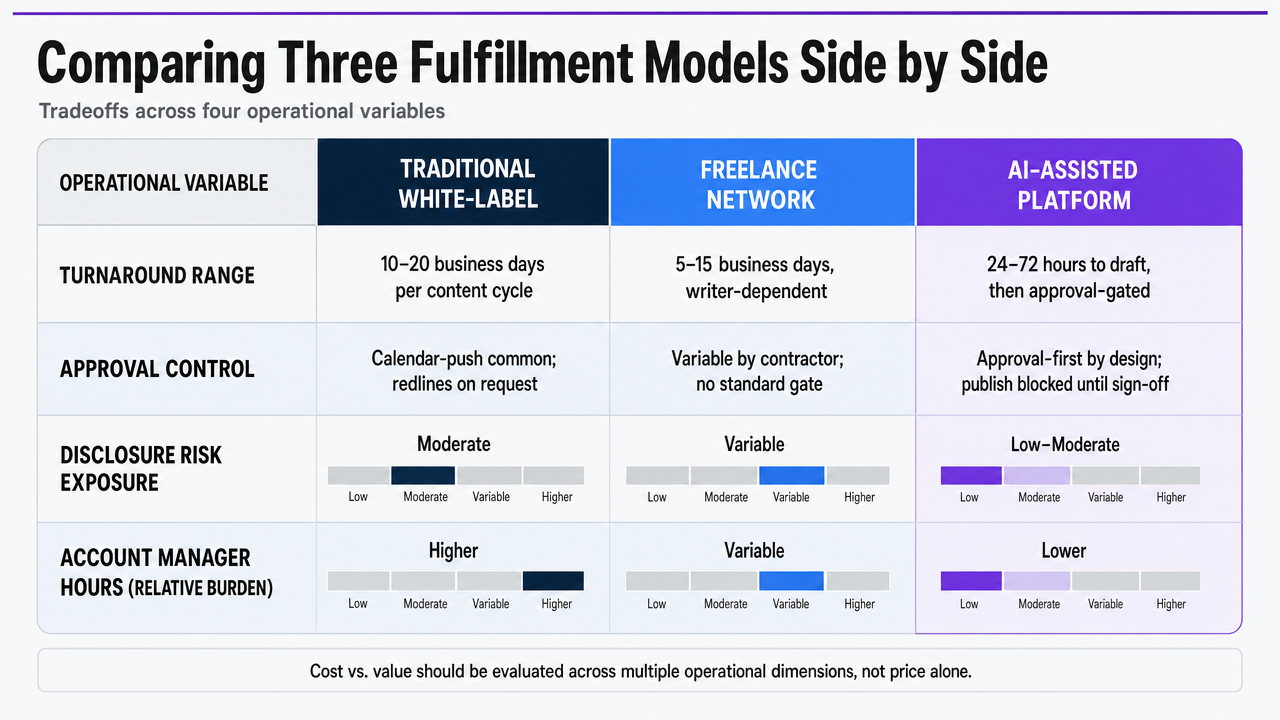 Visualize the comparison table of three fulfillment models across four operational variables to make tradeoffs scannable
See How Leading Agencies Streamline SEO Delivery at Scale
Request a data-driven walkthrough of multi-client SEO execution platforms designed to reduce production overhead and improve ROI for agencies managing complex portfolios.
The Compliance Section Most Reseller Reviews Skip
What the August 2024 Reviews Rule Changed for Resellers
The FTC's final rule on the use of consumer reviews and testimonials was approved in August 2024 after public comments and hearings, and it reshapes the surface area an SEO reseller plan touches every month 10. The rule targets fake reviews, suppression of negative reviews, and undisclosed insider endorsements—exactly the territory where reputation management add-ons and review-generation workflows operate.
For a reselling agency, the practical effect runs in three directions:
- Any review-acquisition workflow the vendor bundles into a local SEO package becomes a compliance artifact the agency has to defend, not a feature it can take on faith.
- Testimonials displayed on a client's site or recycled into the agency's own pitch materials need a substantiation trail showing the endorser is real and the experience is accurately represented 3.
- Suppression patterns—gating negative feedback before it reaches a public review surface—now sit on the wrong side of an enforceable rule rather than an advisory guide.
Reseller plans that predate the 2024 rule often still describe review tactics in language the rule no longer tolerates. That language is the first place to look during contract review.
Material Connections, Testimonials, and Case Study Reuse
Material connections are the second compliance surface reseller plans expose. The FTC's framework requires that connections affecting the credibility of an endorsement—payment, free service, employment, family relationship—be disclosed clearly, and the 2023 update to the endorsement guides extended advertiser liability into deceptive endorsement territory that resellers historically treated as the vendor's problem 9, 4.
Three patterns recur in reseller materials:
- Case studies pulled from the vendor's roster and rebadged into the agency's pitch deck without consent or substantiation.
- Testimonials displayed without identifying that the reviewer received a service discount or affiliate consideration.
- Anonymized "results" claims—"clients saw 340% traffic growth"—stated without the sample, time frame, or methodology that would let a regulator or client auditor reconstruct the number.
The fix is contractual rather than editorial. The vendor warrants that every case study, testimonial, and performance claim handed to the agency carries documented consent and substantiation, and the agency reserves the right to audit that documentation before reuse 1.
A Disclosure Checklist to Run Against Any Reseller Contract
The checklist below collapses the obligations from the FTC's endorsement guides, the codified rule at 16 CFR Part 255, and the August 2024 reviews rule into procurement-ready questions 1, 3, 10.
- Does the vendor warrant that all supplied case studies and testimonials reflect actual results with documented client consent?
- Are material connections—discounts, free services, employment, affiliations—disclosed wherever endorsements appear under the agency's brand 2?
- Does the review-acquisition workflow prohibit gating, suppression, or incentivized review patterns the 2024 rule now forbids 10?
- Are performance claims accompanied by sample size, time frame, and methodology sufficient to substantiate them under 16 CFR Part 255 3?
- Does the contract assign liability for deceptive endorsements to the party that authored them, rather than defaulting to the reselling agency 9?
A vendor that answers five of five in writing has earned the next conversation. Anything less goes back to the procurement queue.
If You Manage a Multi-Client Portfolio: Margin Math That Holds Up
The framing shifts here. The five evaluation axes apply to any agency reselling SEO, but the math below is for operators carrying a portfolio of clients—typically eight or more active retainers—where fulfillment choices compound across the book rather than affecting a single P&L line. Forrester's 2024 outsourcing benchmarks make the case that disciplined cost evaluation has to weigh vendor spend against the operational hours and risk exposure that survive the contract, not the sticker price alone 6.
The worksheet below uses a $2,500 illustrative monthly retainer as the comparison anchor and three fulfillment models as the variable. Every number is a plug-in, not a benchmark claim. Operators should replace the ranges with their own loaded hourly rate, current vendor invoices, and measured QA time per account.
| Line item (per client, per month) | Traditional white-label | Freelance network | AI-assisted platform |
|---|---|---|---|
| Client retainer (illustrative) | $2,500 | $2,500 | $2,500 |
| Reseller plan cost | $800–$1,200 | $600–$1,000 | $500–$900 |
| Account manager hours × loaded rate ($75/hr assumed) | 6–12 hrs ($450–$900) | 10–18 hrs ($750–$1,350) | 2–6 hrs ($150–$450) |
| QA and disclosure overhead | $100–$200 | $150–$300 | $75–$150 |
| Illustrative gross margin range | $200–$1,150 | -$150–$1,000 | $1,000–$1,775 |
Two patterns are worth flagging. The freelance network column produces the widest margin variance because account manager hours scale unpredictably with writer turnover and revision cycles—the line item operators most often underestimate. The AI-assisted column compresses the account manager load by shifting time from chasing drafts to reviewing queued recommendations, which is where the portfolio economics improve at scale: ten clients at six recovered hours each is sixty hours of weekly capacity returned to the operator.
The worksheet is not a verdict. It is the structure for running the same calculation against an actual portfolio, with the operator's own retainer mix, loaded rates, and current vendor invoices substituted in. Forrester's benchmark framing applies: the right reseller plan is the one that holds its margin across the book after coordination cost is counted, not the one that prices lowest on the order form 6.
Standardize and Scale SEO Reseller Delivery With Data-Driven Workflows
Access a unified platform to coordinate multi-client SEO campaigns, automate reporting, and maintain transparent oversight—all with measurable impact on margin, workflow efficiency, and campaign outcomes.
Red Flags in Reseller Contracts
Most reseller contracts read clean on the first pass. The risk hides in clauses that look like boilerplate until a client churns, an audit lands, or a deliverable misfires.
Five clauses warrant a redline before signature:
- Auto-renewal terms longer than thirty days lock the agency into a vendor whose performance may have drifted by month four.
- Non-compete or non-solicitation language that extends to the agency's own clients—rather than just the vendor's other resellers—surrenders accounts the agency built.
- Indemnification clauses that flow only one direction leave the reselling agency carrying liability for deceptive endorsements the vendor authored, which the FTC's 2023 update made an enforceable exposure rather than a theoretical one 9.
- Data clauses that grant the vendor a license to use client work product for case studies or model training, without consent or opt-out, conflict with the substantiation and disclosure expectations under 16 CFR Part 255 3.
- Vague service-level language. "Best-effort" delivery, "industry-standard" turnaround, and "reasonable" revision counts give the vendor unilateral control over what the contract actually requires.
Replace each with a number—business days to draft, revisions included per deliverable, response time on escalations. Vendors that resist quantification usually have a reason, and that reason shows up in month three.
A One-Afternoon Due Diligence Run
The evaluation work in this article fits inside a single afternoon if it is sequenced correctly. The sequence below assumes the agency owner has two to three shortlisted vendors and the contracts in hand.
- First hour: pull the approval log and a redacted sample report from each vendor. If either artifact requires more than a day to produce, the vendor has answered the question.
- Second hour: run the five compliance questions from the disclosure checklist against each contract and mark the warranties that are missing or hedged 1, 10.
- Third hour: drop current retainer mix, loaded hourly rate, and quoted plan cost into the margin worksheet for each model, then flag any column where account manager hours push gross margin below the agency's portfolio threshold 6.
- Final hour: read the termination, data ownership, and indemnification clauses back to back across the shortlist. The contract that survives all four passes is the one worth a reference call.
The output of the afternoon is not a vendor choice. It is a defensible short answer to the question a client or partner may ask later: why this fulfillment model, under this contract, for this book of business.
Frequently Asked Questions
References
- 1.FTC's Endorsement Guides: What People Are Asking.
- 2.Endorsements, Influencers, and Reviews - Federal Trade Commission.
- 3.16 CFR Part 255 -- Guides Concerning Use of Endorsements and Testimonials in Advertising.
- 4.Guides Concerning the Use of Endorsements and Testimonials in Advertising.
- 5.Global outsourcing survey 2024.
- 6.2024 Global Outsourcing Benchmarks - Forrester.
- 7.The State Of Demand, Account-Based, And Customer Marketing, 2024.
- 8.Global outsourcing survey 2024.
- 9.Guides Concerning the Use of Endorsements and Testimonials in Advertising.
- 10.Rulemaking: Use of Consumer Reviews and Testimonials.