
Key Takeaways
- Reseller selection is a supervision decision, not a procurement one — the agency, as advertiser of record, inherits substantiation duties for every claim it repeats 4, 8.
- Repeating a reseller's traffic lifts, rankings, or case studies requires methodology, raw data, and date-stamped pulls on file before publication, since vendor decks do not meet the FTC evidentiary bar 8, 9.
- Borrowing from legal outsourcing ethics, agencies must vet reseller competence, preserve client confidentiality, screen geographic conflicts, and secure informed consent before any deliverable ships 2.
- A four-band scorecard — Competence, Confidentiality, Claims & Disclosure, Control & Reporting — exposes reseller weaknesses; two No marks in any band ends the conversation before pricing 1, 2, 7, 8.
- White-label, freelance, and AI-execution stacks each carry different supervision burdens, but liability for unsubstantiated claims stays with the agency regardless of model 8, 10.
- Approval-first fulfillment captures reasoning, source data, and claim language at sign-off, satisfying reasonable-basis substantiation and producing audit-ready records rather than quarterly recaps 7, 8, 9.
- Regulated verticals — law, behavioral health, dental, senior living — demand vertical-specific writers, documented review processes, and disclosure-ready templates, or the account does not belong with that reseller 1, 5, 9.
- MSA terms must include a claims warranty, substantiation pass-through, endorsement consent files, standing access to raw data, and indemnity naming disclosure violations as specific triggers 1, 7, 8, 10.
The supervision decision hiding inside a reseller contract
Most reseller pitches arrive framed as a procurement question: which vendor offers the deepest discount, the fastest turnaround, and the cleanest white-label dashboard. That framing misses what the agency is actually signing. Under FTC truth-in-advertising rules, claims in advertisements must be truthful, non-deceptive, and evidence-based, and that obligation sits with the advertiser of record regardless of who produced the asset 4. When an agency repeats a reseller's ranking report, traffic projection, or case study in its own sales motion, it inherits the substantiation burden for every objective claim inside it 8.
That makes reseller selection a supervision decision, not a sourcing decision. The closer analogue is how regulated professions outsource: the supervising party is permitted to delegate the work, but not the duty of competence, confidentiality, and disclosure to the end client 2. Agencies serving law firms, behavioral health groups, dental practices, and senior living operators face the same structure one layer removed. The contract terms that matter most are the ones governing claims, evidence retention, and approval rights, not the wholesale price per blog post.
Why the agency, not the reseller, is the advertiser of record
FTC substantiation applies to every claim the agency repeats
The reseller's deck shows a 312% organic traffic lift. The agency drops the number into a pitch deck, a homepage tile, and a case study PDF. At that moment the agency, not the reseller, becomes the entity responsible for proving it. FTC policy requires a reasonable basis for express and implied objective claims before they reach the audience, and the burden sits with the advertiser disseminating the claim 8. "My reseller said so" is not substantiation.
The training materials extend this further: anecdotes, internal sales reports, and vendor-supplied recap decks generally do not meet the evidentiary bar, and health or safety-adjacent claims demand competent and reliable scientific evidence 9. That matters when agencies sell into behavioral health or dental groups and inherit copy about outcomes, recovery, or patient acquisition.
Failure to substantiate is not a soft risk. The Commission has identified specific substantiation failures as deceptive or unfair practices subject to civil penalties 10. Agencies that repeat reseller ranking lifts, lead-volume promises, or revenue attribution figures need the underlying methodology, raw data, and date-stamped pulls on file before publication, not after a demand letter.
Endorsements, case studies, and reseller-supplied social proof
Case studies and testimonials are the most common artifacts an agency lifts directly from a reseller's marketing kit. The FTC's endorsement guidance treats them as advertising claims in their own right: an endorsement cannot communicate anything the advertiser could not legitimately claim independently, and material connections that a meaningful share of consumers would not expect must be disclosed clearly and conspicuously 1.
Two operational consequences follow. First, when a reseller writes a case study about an agency's client and the agency republishes it, the agency must hold the underlying performance evidence and the client's documented consent to use their name, results, and any logos. Second, if the testimonial originated from someone with a financial relationship to the reseller, or from a client incentivized to provide it, that connection has to surface in the disclosure language, not in a footer the reader will not see.
Disclosure control on landing pages, advertorials, and SERP assets
Reseller content rarely arrives with disclosures attached. Guest post placements, syndicated articles, and advertorial-style landing pages frequently blur the line between editorial and paid promotion, and FTC online advertising guidance requires that the nature of the advertising be clear to the reader regardless of who produced the asset 5. The agency, as the party publishing or distributing the content on the client's behalf, owns that clarity.
Placement mechanics matter as much as language. The Dot Com Disclosures update directs that disclosures be clear and conspicuous across every device used to view the ad, placed as close as possible to the triggering claim, and not buried in pop-ups that block-and-tackle technology routinely suppresses 6. Agencies inheriting reseller-built mobile landing pages, SERP-targeted snippets, or interstitial lead-gen flows should audit each asset against those placement rules before it goes live and require the reseller to ship disclosure-ready templates rather than retrofit them under deadline.
Evaluate SEO delivery at scale—risk-free for 7 days
Test real client-ready SEO campaigns in your workflow before making any commitment.
Borrowing the supervision doctrine from legal outsourcing ethics
Competence vetting before the first deliverable ships
The North Carolina bar's outsourcing opinion sets a useful floor: a supervising lawyer may delegate work to non-lawyer or foreign assistants only after confirming the assistant is competent to perform the task, understands the applicable ethical rules, and will operate within them 2. Translated into a reseller context, that means competence vetting cannot stop at a portfolio review and a sample audit. The agency principal needs documented evidence that the production team behind the white-label brand has worked in the client's vertical, understands the relevant disclosure mechanics, and can produce on-demand artifacts showing how rankings, traffic, and lead figures were measured.
Practical vetting items follow from that standard:
- named writers and SEOs assigned to the account,
- sample rank reports with raw data exports rather than screenshots,
- link-acquisition methodology in writing, and
- a documented escalation path when a deliverable fails QA.
If a reseller cannot produce those before signing, the supervision burden has already shifted entirely to the agency.
Confidentiality, conflicts, and informed client consent
The same opinion requires the supervising lawyer to preserve client confidences, screen for conflicts, and obtain the client's advance informed consent to the outsourcing arrangement 2. Agencies operate one layer removed but inherit the underlying duties through their MSA. A reseller with access to a law firm's intake data, a behavioral health group's call recordings, or a dental DSO's patient lead forms is touching information the end client treats as confidential or regulated.
Three contract terms address this directly:
- A named confidentiality clause that flows from the agency-client MSA into the agency-reseller agreement without dilution.
- A written conflicts policy that prevents the reseller from working with the client's direct competitors in the same geography during the engagement.
- A disclosure clause permitting the agency to name the reseller to its clients when the client asks, since informed consent cannot exist if the relationship is hidden.
When bundled SEO becomes a regulated business transaction
California's opinion on lawyers providing non-legal services treats bundled offerings as business transactions with the client, requiring terms that are fair and reasonable, fully disclosed in writing, and accompanied by advice that the client may seek independent counsel 3. The structural lesson for agencies selling into law firms is that any co-branded marketing or SEO bundle a firm resells to its own clients carries that framework downstream.
The cleaner posture is to keep the agency's reseller arrangement invisible to the firm's clients and to refuse bundling structures that tie the agency's fees to firm-level legal outcomes. Where co-branded packages are unavoidable, the written terms should mirror the disclosure language the firm would use in any other business transaction with its client base.
A vetting scorecard for reseller due diligence
Procurement teams default to feature checklists. The agency principal signing the MSA needs something different: a scorecard organized around the duties the agency cannot delegate. Four bands cover the exposure surface — Competence, Confidentiality, Claims & Disclosure, and Control & Reporting — and each item maps to a governing source so the document holds up under a client audit or a regulatory inquiry.
Competence. : Named production team with vertical experience, written link-acquisition methodology, sample rank reports with raw data exports, and a documented QA escalation path 2. Co-branded or bundled offerings sold into law firms require fairness terms and written disclosure consistent with business-transaction rules 3.
Confidentiality. : Back-to-back confidentiality clauses flowing from the client MSA into the reseller agreement, a geographic conflicts policy preventing direct-competitor engagements, and a disclosure right permitting the agency to name the reseller to clients on request 2.
Claims & Disclosure. : Substantiation files retained for every performance number the agency may repeat — methodology, raw pulls, date stamps, and the reasonable-basis logic behind any objective claim 8, 9. Endorsement and testimonial reuse governed by documented client consent and material-connection disclosures 1. Advertorial, native, and syndicated placements shipped with disclosure-ready templates that satisfy clear-and-conspicuous placement across devices 5, 6. Indemnity language acknowledging that unsubstantiated claims expose both parties to civil penalty risk 10.
Control & Reporting. : Audit-grade access to underlying data, not screenshots; reporting that is promptly available and actionable rather than published once a quarter 7; and approval rights on every asset before publication.
Scored items get Yes, Partial, or No. Two or more No marks in any band ends the conversation before pricing is discussed.
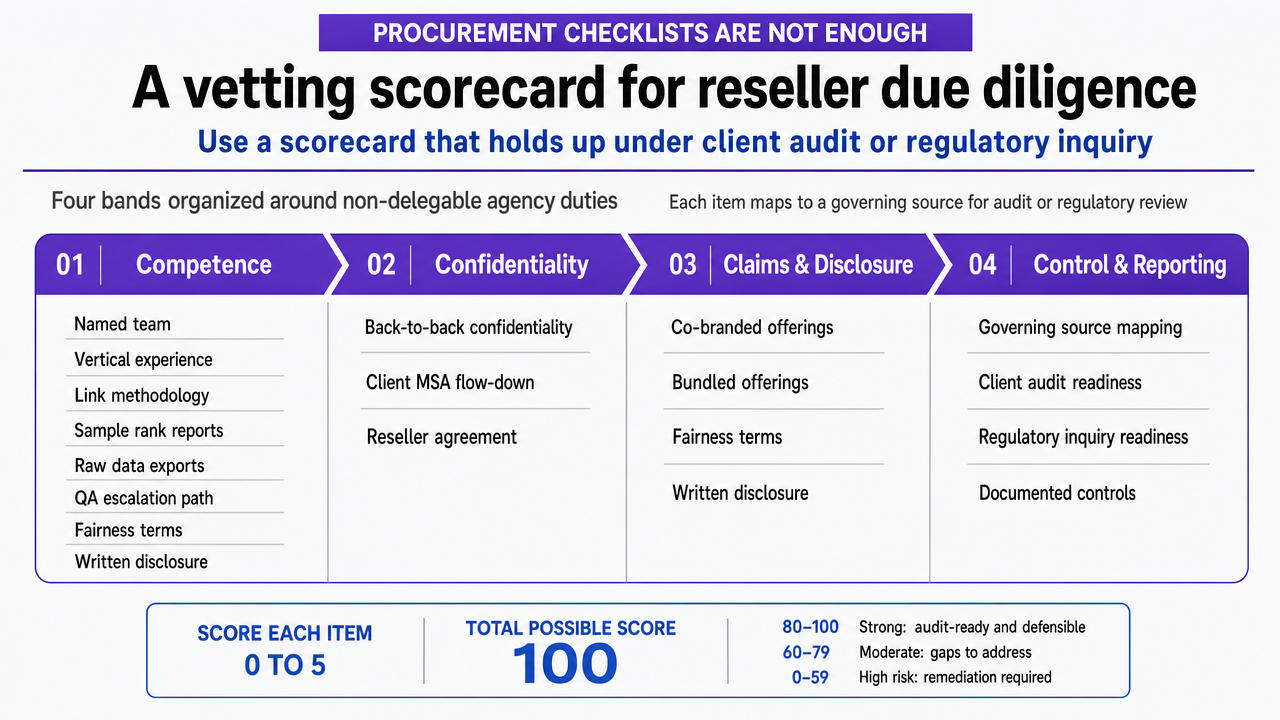 Visualize the four-band scorecard framework (Competence, Confidentiality, Claims & Disclosure, Control & Reporting) that the section explicitly defines as the vetting structure
Evaluate SEO Reseller Plans with Unmatched Data Transparency and Workflow Control
See how leading agencies maintain client oversight and quality standards at scale with AI-powered SEO delivery, real-time performance metrics, and unified approval processes—all without expanding internal teams.
Three fulfillment models, scored against supervision burden
Traditional white-label reseller stacks
The white-label reseller is the model most agency principals already know: a wholesale provider produces blog posts, link placements, technical audits, and rank reports under the agency's brand. The supervision burden in this model is concentrated in two places. The agency must hold its own substantiation files for any performance number the reseller delivers, because FTC policy attaches the reasonable-basis duty to the disseminating advertiser regardless of who ran the campaign 8. And the agency must extract disclosure-ready templates for any advertorial, native, or syndicated placement the reseller ships 5.
Most white-label dashboards report on outputs, not evidence. Screenshots of ranking gains, traffic graphs without methodology notes, and link reports without source-data exports leave the agency holding a claim it cannot defend on demand. Vetting at this layer turns on whether raw exports, link-acquisition methodology, and named production assignments are contractually available, not on the price per deliverable.
Freelance and offshore production stacks
A freelance or offshore stack distributes the production work across multiple contractors the agency assembles directly: writers, link builders, on-page technicians, and a project manager stitching the outputs together. The cost structure improves, but the supervision surface fragments. Each contractor is a separate competence assessment, a separate confidentiality flow, and a separate point where client data — intake forms, call recordings, CRM exports — can land in an environment the agency has not audited 2.
Conflicts policing also gets harder. A freelance SEO working across a roster of agencies may already be optimizing for a client's direct competitor in the same metro. Without written, geography-scoped exclusivity terms in each contractor agreement, the agency cannot give a regulated-vertical client the informed-consent assurance the supervision doctrine assumes 2.
AI-execution platforms with human approval workflow
The newer category routes production through AI specialists — content, on-page, links, reporting — and gates every output behind a human approval step before it publishes. The supervision burden does not disappear in this model; it relocates. Instead of QA-ing finished deliverables after the fact, the agency principal or strategist signs off inside a workflow that surfaces the underlying reasoning, source data, and ranked recommendation before execution.
That structure maps cleanly onto the FTC substantiation standard: the reasonable-basis logic, raw inputs, and methodology behind any performance claim are captured at the point of approval rather than reconstructed from screenshots later 8, 9. It also gives the agency a single audit trail across content, link work, and reporting, which satisfies the transparency standard that information be promptly available and actionable rather than published quarterly 7. The trade-off is that the approval queue becomes the supervision bottleneck — if the principal does not staff it, the model collapses back into rubber-stamping.
Supervision coverage compared across the three models
Scoring the three models against the six supervision criteria from the vetting scorecard exposes where each one defaults to the agency and where the model itself carries the load. The matrix below uses Yes, Partial, and No — not invented percentages — because the underlying sources establish duties, not market benchmarks.
- Substantiation evidence retained 8, 9: traditional white-label, Partial (outputs delivered, raw data inconsistent); freelance stack, No (evidence scattered across contractors); AI-execution with approval, Yes (captured at sign-off).
- Disclosure control 5, 6: white-label, Partial; freelance, No; AI-execution, Yes when templates are governed centrally.
- Endorsement compliance 1: white-label, Partial (testimonials often arrive without consent files); freelance, No; AI-execution, Partial — the platform does not generate client consent, the agency still does.
- Confidentiality handling 2: white-label, Partial; freelance, No; AI-execution, Yes under a single data-handling agreement.
- Audit-ready reporting 7: white-label, Partial; freelance, No; AI-execution, Yes.
- Penalty exposure 10: all three remain Yes for the agency — the model changes the evidence trail, not the liability.
Two Partials in the same band is the practical threshold for renegotiating contract terms before the next renewal.
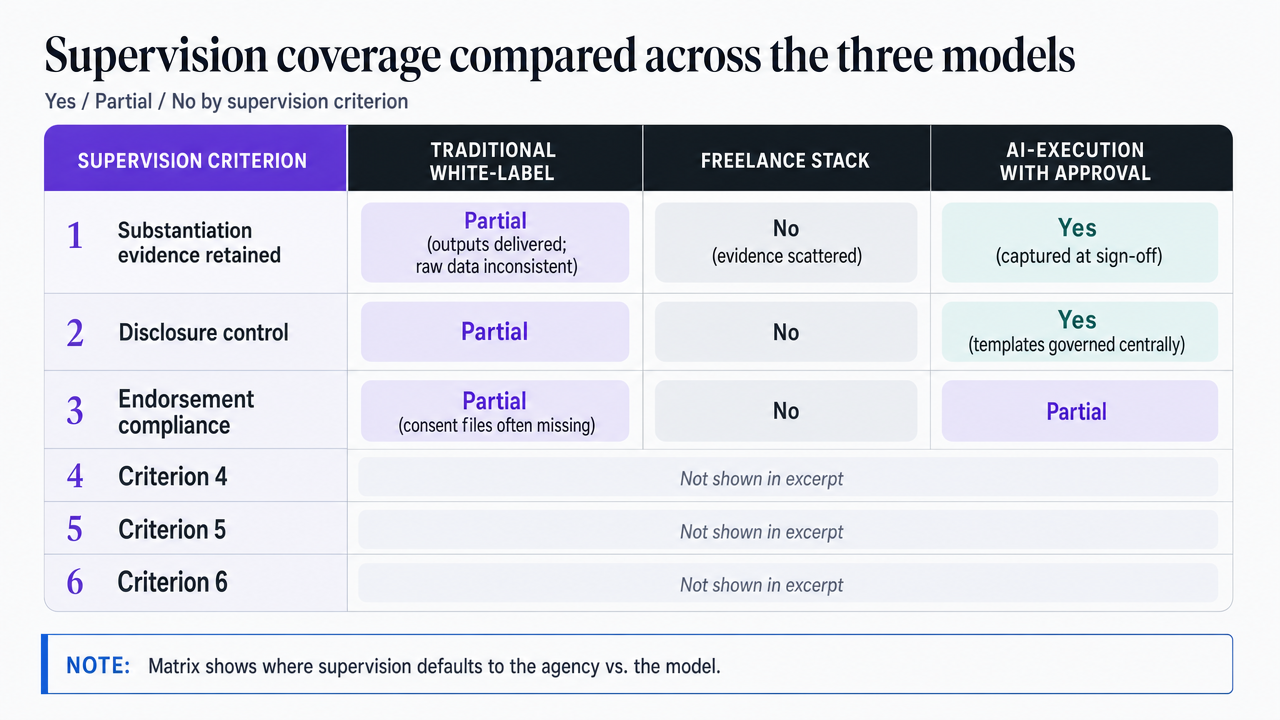 Visualize the comparison matrix the section explicitly lays out: three fulfillment models scored Yes/Partial/No across six supervision criteria
Approval-first fulfillment as the operating standard
The defensible posture across all three fulfillment models converges on a single workflow rule: nothing publishes without a documented human sign-off, and the sign-off captures the reasoning, the source data, and the claim language at the same moment. That standard satisfies two regulatory expectations at once. The reasonable-basis doctrine requires that substantiation exist before an objective claim reaches the audience, not after it is challenged 8. And FTC training materials reject reconstructed evidence — anecdotes, recap decks, vendor sales materials — as a substitute for contemporaneous documentation 9.
Approval-first fulfillment also resolves the reporting problem. Transparency standards treat information as transparent only when it is promptly available and actionable, not merely published 7. An approval workflow produces that artifact natively: each decision generates a time-stamped record of what was proposed, what evidence supported it, who approved it, and what shipped. A quarterly white-label dashboard does not.
The standard imposes one operational cost. The agency principal — or a delegated strategist with sign-off authority — has to staff the approval queue daily. When that role is vacant, the queue clears by default rather than by judgment, and the supervision benefit collapses. Hiring the reviewer is the trade the model demands.
Gain Full Oversight and Quality Assurance on Every SEO Reseller Campaign
Access a centralized platform to approve, monitor, and evaluate all outsourced SEO deliverables—ensuring adherence to your agency’s standards, client KPIs, and reporting requirements without adding operational burden.
Regulated verticals as the stress test
Law firms, behavioral health, dental, and senior living
Regulated-vertical clients expose every weakness in a reseller arrangement that single-location service businesses tolerate. A law firm's intake page cannot carry an unsubstantiated outcome claim, a behavioral health group's content cannot suggest clinical results without competent and reliable scientific evidence 9, and a dental DSO's review widgets cannot reuse patient testimonials without documented consent and material-connection disclosures 1. Senior living operators add a third layer: family decision-makers researching care often qualify as a vulnerable audience, and disclosure failures around sponsored placements or advertorial pages draw faster scrutiny 5.
The vetting consequence is straightforward. A reseller that handles these accounts must produce vertical-specific writers, a documented review process for clinical or legal language, and a disclosure-ready template library for every content format it ships. If any of those three artifacts cannot be produced in writing during diligence, the account does not belong with that reseller — regardless of price.
If the agency manages multi-location or portfolio operators
The scope shifts here from single-client supervision to portfolio economics. Agencies serving DSOs, multi-site law firms, senior living groups, and home services franchises do not add one supervision queue per client — they add one per location, and the cost compounds with every site brought into the engagement.
The table below isolates the cost drivers that scale with location count. Operator-supplied variables are marked; the only fixed numeric input is the published platform price point of $599/mo post-trial. The worked example is illustrative, not a benchmark.
| Cost driver (per location) | In-house production | Traditional white-label reseller | AI-execution platform with approval |
|---|---|---|---|
| Content production hours | Operator variable (Hp) | Reseller pass-through rate | Included in platform fee |
| Briefing & QA overhead | Hp × locations | Hp × locations (briefing does not consolidate) | Template-governed; near-flat across locations |
| Supervisory review time | Operator variable (Hs) | Hs × locations | Hs consolidated in approval queue |
| Substantiation/evidence retention 8, 9 | Manual file build | Manual; raw data often unavailable | Captured at sign-off |
| Incremental cost per added location | Linear | Linear | Sub-linear above the platform fee |
Illustrative worked example: at 12 locations, with Hs set to two supervisory hours per location per month, the white-label model demands 24 review hours monthly before any deliverable QA. The AI-execution model consolidates the same audit trail into one queue, with platform cost fixed at $599/mo. Operators should populate Hp and Hs from their own time tracking before signing.
Contract terms that keep the agency in control
Claims, indemnity, and substantiation pass-through
The MSA is where the supervision posture either holds or quietly collapses. Three clauses do most of the work:
- A claims warranty: the reseller represents that every performance figure, ranking lift, traffic projection, and lead-volume number it delivers is supported by contemporaneous methodology and raw data, and agrees to produce both within a defined response window when the agency requests them.
- A substantiation pass-through obligation requiring the reseller to deliver source files — date-stamped exports, query-level data, link acquisition logs — alongside any deliverable the agency may repeat in client-facing materials 8, 9.
- Indemnity language that names unsubstantiated claims, deceptive disclosures, and endorsement-rule violations as specific triggers, not generic third-party liabilities 1, 10.
The endorsement clause needs its own line item. Any testimonial or case study the reseller supplies must arrive with documented client consent, a material-connection disclosure if one applies, and a representation that the underlying performance evidence is on file 1. Without those three artifacts, the asset does not enter the agency's marketing library.
Data handling, audit rights, and reporting access
Data terms determine whether the agency can answer a client's audit request without calling the reseller first. The contract should grant standing access to raw analytics, search console exports, link source data, and call tracking records — not screenshots, not PDF recaps — with the agency designated as the controller of any end-client data the reseller touches 2. Pair that with a defined data-retention window so substantiation files remain available after the engagement ends, since penalty exposure for past claims does not expire with the contract 10.
Audit rights need teeth. The agency should reserve the right to inspect link acquisition methodology, content production logs, and disclosure templates on reasonable notice, and require reporting that is promptly available and actionable rather than delivered on a quarterly cycle 7. A reseller unwilling to grant continuous data access is signaling that its reporting cannot survive a serious review.
Frequently Asked Questions
References
- 1.FTC's Endorsement Guides: What People Are Asking.
- 2.2007 Formal Ethics Opinion 12 – Outsourcing Legal Support Services.
- 3.Formal Opinion No. 1995-141 – Provision of Non-Legal Services.
- 4.Advertising and Marketing | Federal Trade Commission.
- 5.Online Advertising and Marketing | Federal Trade Commission.
- 6.FTC Staff Revises Online Advertising Disclosure Guidelines.
- 7.Accountability and Transparency at ICANN.
- 8.FTC Policy Statement Regarding Advertising Substantiation.
- 9.Advertising Substantiation Principles.
- 10.Penalty Offenses Concerning Substantiation.