
Key Takeaways
- Ahrefs anchors the diagnostic layer with keyword and backlink intelligence, consolidating research work but stopping short of execution, so production still lives in other systems.
- Semrush pairs diagnostic breadth with white-label client reporting, making it the strongest consolidation play for agencies running 15 to 60 small-to-mid-market accounts.
- Screaming Frog remains the irreplaceable technical workhorse for crawl, migration, and schema validation, surfacing remediation lists no diagnostic platform can replicate at depth.
- Conductor consolidates research, briefs, workflow, and QA into one system of record, but its seat economics only pencil out against enterprise retainers.
- BrightEdge folds AI search visibility into enterprise measurement, reflecting its own data that AI traffic grows fast but still trails organic in conversions 9.
- seoClarity is built for portfolio scale, handling content scoring and rank tracking across thousands of pages for agencies running 30 to 80 content-heavy accounts.
- Moz Pro earns its lane through Domain Authority and Moz Local, covering link metrics and multi-location citation management for mid-market agencies without a second license.
- Vectoron sits in the AI execution layer with approval-gated workflows, removing production hours while keeping output aligned with Google's helpful-and-original standard 3.
The agency math problem behind every SEO stack decision
Agency SEO leads are not running out of tactics. They are running out of hours per retainer. The average SEO retainer hovers around $3,000 per month, which sets a hard ceiling on how many specialist hours a single account can absorb before margin collapses. Add 15 to 80 clients across legal, healthcare, home services, and multi-location portfolios, and the question stops being "which tool has the best keyword database" and becomes "which stack lets one strategist do the work of three without breaking quality."
That math is why the tooling debate matters. Search is still where the work pays off. BrightEdge data shows organic search drives 53% of all site traffic, paid search adds 15%, and every other channel combined accounts for the remaining 32% 2. Agencies are not allocating effort to a niche channel. They are allocating it to the channel that produces roughly two-thirds of measurable client traffic.
Forrester frames the modern SEO platform as a system of record, not a point tool, supporting workflow, collaboration, and execution across teams 1. That framing reshapes the buying decision. The question is no longer feature-by-feature. It is layer-by-layer: which platform handles diagnostics, which handles content production, which handles links, and which handles the AI execution layer that compresses delivery time across the book of business. The eight platforms in this shortlist are evaluated against that operating model, not against a spec sheet.
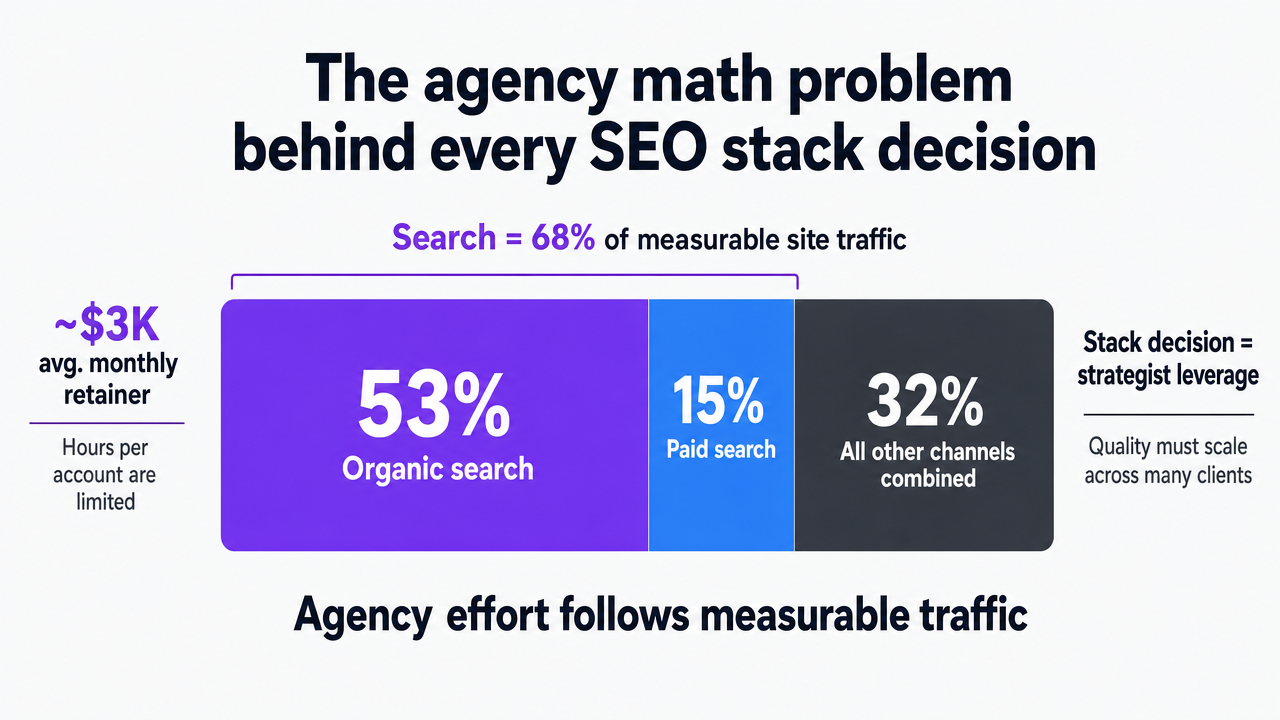 Visualize the BrightEdge channel traffic breakdown that anchors the section's argument that search dominates measurable client traffic
How this shortlist was scored: the agency delivery model lens
Most agency tool roundups score platforms on feature count. That approach fails the operator. A keyword database matters less than where a platform sits in the delivery sequence and how many hours it removes from the retainer.
The eight platforms here were evaluated against five criteria tied to agency P&L, not vendor marketing pages.
- Delivery layer fit. Does the platform anchor diagnostics, content production, link acquisition, technical health, or AI execution? Forrester treats modern SEO platforms as systems of record that support workflow, collaboration, and execution across teams 1, so each tool is mapped to the layer where it actually replaces specialist hours.
- Portfolio scalability. Whether the platform's reporting, project structure, and user permissions hold up across 15 to 80 client accounts without forcing manual reconciliation.
- Governance and approval controls. Whether the tool supports human oversight on automated or AI-assisted output, in line with Google's guidance that automation is acceptable only when paired with editorial judgment 3.
- Consolidation value. Whether the platform absorbs work that would otherwise require two or three point tools, reducing license sprawl and onboarding drag.
- Integration with BI and analytics stacks. Whether SEO data flows into the dashboards clients and account leads already read, rather than living inside a closed reporting UI 7.
Each entry is scored on those five dimensions, not on whether it has the largest keyword index or the prettiest interface.
Trial AI-driven SEO execution at full scale
Experience automated, agency-grade SEO workflows and launch real campaigns before you commit.
Where each platform sits in the agency delivery stack
Forrester's framing of SEO platforms as systems of record that support workflow, collaboration, and execution across teams gives agency heads a useful sorting principle 1. Tools are not interchangeable. Each one anchors a specific layer of the delivery model, and the wrong substitution creates either redundancy or coverage gaps.
The matrix below maps the eight platforms covered in this shortlist across five delivery layers, with notes on best-fit agency size and the consolidation role each plays.
| Platform | Primary delivery layer | Best-fit agency size | Consolidation role |
|---|---|---|---|
| Ahrefs | Diagnostic (keyword + link) | 15–80 accounts | Replaces standalone backlink and keyword tools |
| Semrush | Diagnostic + client reporting | 15–60 accounts | Replaces separate reporting and rank-tracking licenses |
| Screaming Frog | Technical (crawl, migration) | Any size | Anchors audit and migration work; rarely replaced |
| Conductor | Diagnostic + content workflow | Enterprise retainers | Consolidates research, briefs, and content QA |
| BrightEdge | Measurement + AI search visibility | Enterprise retainers | Replaces separate AI-visibility and rank tools |
| seoClarity | Content optimization at scale | 30–80 accounts | Consolidates content scoring and rank tracking |
| Moz Pro | Link metrics + local | Mid-market | Covers local SEO without a second license |
| Vectoron | AI execution (approval-gated) | 15–80 accounts | Replaces production hours across content, links, and reporting |
Read the matrix as a layer map, not a ranking. An agency rarely needs every cell filled. It needs one strong anchor per layer that is actually load-bearing for the book of business.
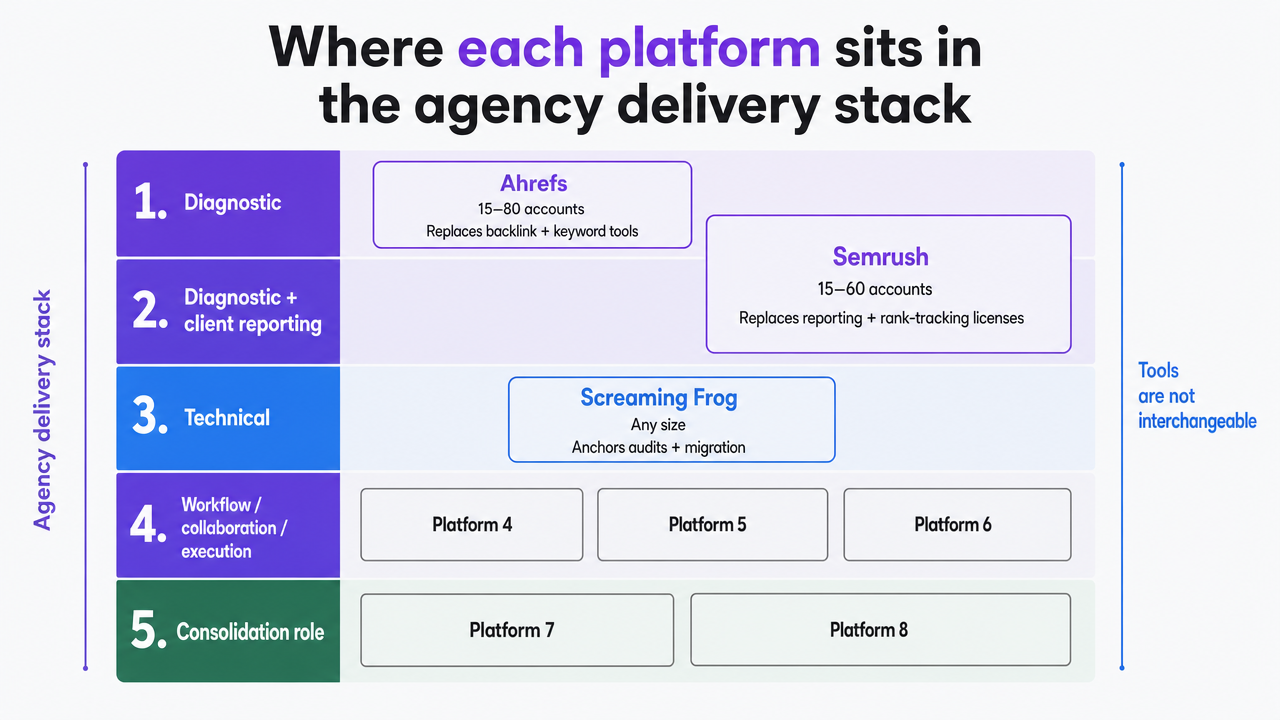 Translate the comparison table into a scannable layered diagram showing where each of the eight platforms sits across the five delivery layers
The eight platforms, evaluated by delivery role
Ahrefs — diagnostic layer anchor for keyword and link intelligence
Ahrefs sits squarely in the diagnostic layer. Its keyword database, backlink index, and Site Explorer are the workhorses agency strategists reach for when scoping a new client, sizing a content gap, or pricing a recovery engagement. Forrester's framing of SEO platforms as systems of record fits Ahrefs cleanly on the research side, where rank tracking, link monitoring, and competitive intelligence feed the brief that downstream production teams execute against 1.
The operator value is consolidation. An agency running Ahrefs across the book of business rarely needs a second backlink tool or a standalone keyword research subscription. Site Audit covers most technical diagnostics that do not require a deep crawler, and Rank Tracker handles portfolio-level visibility checks without an extra license.
Where Ahrefs stops short is execution. It surfaces the gap and ranks the opportunity, but the brief, the draft, the approval, and the publish step still live in other systems. Agency heads who try to stretch Ahrefs into a delivery platform end up rebuilding workflow in spreadsheets. Treat it as the diagnostic anchor and pair it with whatever layer handles production hours.
Semrush — broad diagnostic with reporting and client-facing dashboards
Semrush competes with Ahrefs on diagnostic breadth and pulls ahead on client-facing reporting. The platform's project structure, white-label dashboards, and scheduled report exports are the reason many agencies standardize on it for accounts that require monthly deliverables with a logo on top. Forrester names Semrush among the platforms providing unified insight into search performance, and the agency use case maps directly to that framing 1.
Operationally, Semrush absorbs work that would otherwise sit in two or three places. Position Tracking replaces a standalone rank tool. Site Audit handles technical health checks below the depth a dedicated crawler would catch. The Content Marketing toolkit covers brief generation and on-page scoring, which removes a separate content optimization license from the stack for mid-market accounts.
The trade-off shows up at the high end of the portfolio. Enterprise accounts with complex multi-domain structures or aggressive AI search reporting needs tend to push Semrush past its comfort zone. For agencies running 15 to 60 accounts in the small-to-mid-market range, it remains the most defensible consolidation play in the diagnostic layer.
Screaming Frog — technical layer workhorse for crawl and migration audits
Screaming Frog is the one tool on this list that almost never gets replaced. It anchors the technical layer for site audits, replatforming projects, redirect mapping, and structured data validation. Google's Search Gallery defines the rich result types and schema requirements agencies are expected to operationalize, and Screaming Frog is the crawler most teams use to verify implementation at scale 10.
The operator math is straightforward. A senior strategist running Screaming Frog can audit a 50,000-URL site in an afternoon, surface broken canonicals, orphaned pages, and missing hreflang, and hand a remediation list to dev. No diagnostic platform replicates that depth of crawl control.
The limitation is that Screaming Frog produces findings, not deliverables. Agencies still need a system to route those findings into client work, track remediation, and report on technical health over time. Treat it as the audit and migration workhorse, not the reporting layer. Every agency in this shortlist's target range should have at least one license on the team and a defined process for when it gets pulled into a project.
Conductor — enterprise diagnostic and content workflow for larger retainers
Conductor targets the enterprise end of the agency book. Forrester lists it alongside the platforms that function as systems of record, and the product is built for that scope: research, content briefs, workflow routing, and quality assurance integrated into a single interface 1. Agencies servicing enterprise retainers with multiple stakeholders per account get the most operational value from it.
The consolidation case is real. Conductor absorbs keyword research, content brief generation, on-page scoring, and reporting into one platform that account leads, content strategists, and client-side marketers can all use without separate logins or hand-off documents. For agencies that bill against enterprise retainers, the licensing cost is defensible against the alternative of stitching three or four tools together with project management overhead.
It is not the right anchor for a mid-market book. The pricing structure and the depth of the workflow features assume a client team large enough to consume them. Agencies running primarily $3,000-per-month retainers will find the seat economics work against margin. Conductor earns its place when the client roster skews toward enterprise accounts with multi-stakeholder approval chains.
BrightEdge — measurement and AI search visibility for portfolio reporting
BrightEdge built its reputation on enterprise measurement, and that remains the operator value: portfolio-level reporting that ties organic performance to revenue, with AI search visibility folded into the same dashboard. Forrester groups it with the platforms that function as systems of record for search performance, and the agency case sits in the same lane 1.
The AI search question is where BrightEdge's positioning matters most for agency heads defending budget. BrightEdge's own data shows AI search traffic has grown at double-digit rates, but still produces less activity and fewer conversions than organic search 9. That data point lines up with Google's framing that optimizing for AI features is still SEO, not a separate discipline 5. The operator conclusion is that AI visibility belongs inside the SEO platform, alongside rank tracking and content performance, rather than as a separate AEO tool with its own subscription.
BrightEdge fits agencies servicing enterprise accounts that need a single measurement layer for both classic SERPs and AI Overview citations. For smaller books, the licensing economics rarely justify the depth. Use it where reporting sophistication is the deliverable clients are actually paying for.
seoClarity — content optimization and rank tracking at portfolio scale
seoClarity is built for agencies that need content scoring and rank tracking to hold up across thousands of pages and dozens of clients without breaking. Forrester lists it among the SEO platforms providing unified insight across enterprise teams, and the product's strength shows in the volume of data it can keep performant in a single workspace 1.
The operator value is portfolio scale. Content Fusion handles on-page optimization scoring across large content libraries, and the rank tracking infrastructure absorbs keyword sets that would slow down a mid-market tool. Agencies running 30 to 80 accounts with heavy content workflows get the most from seoClarity because the platform's data model is designed for that load rather than retrofitted to handle it.
The trade-off is interface density. seoClarity rewards strategists who invest time in learning the platform; it punishes casual users with a steep ramp. Agencies that standardize on it should plan onboarding time for new hires and accept that client-facing reports often need a lighter touch downstream. Treat it as the content optimization and rank anchor for high-volume agency books.
Moz Pro — link metrics and local layer for mid-market agencies
Moz Pro sits in a narrower lane than the diagnostic giants, and that is the operator point. Forrester names Moz among the established SEO platforms, and the product holds its position primarily through Domain Authority as an industry-recognized link metric and through Moz Local as a multi-location citation manager 1.
For mid-market agencies servicing local service businesses, multi-location brands, or franchise operators, Moz Pro often covers the local SEO and link metric layer without forcing a second license. The keyword tools and rank tracking are functional rather than market-leading, which is the correct expectation given the price point.
The platform is not the right anchor for enterprise-scale technical work or for agencies whose differentiation is content depth. Use it where the client mix skews toward local search, citation management, and link metric reporting that account leads can hand a client without translation. Above that profile, the diagnostic layer belongs with Ahrefs or Semrush.
Vectoron — AI execution layer with human approval workflows
Vectoron occupies a different layer than the seven platforms above it. The diagnostic and technical tools surface gaps, score opportunities, and report on outcomes. Vectoron handles the production hours between those steps: content drafted, links pursued, technical fixes queued, and reporting compiled, with every recommendation routed for human approval before anything ships.
That approval-first design matters for agency governance. Google's guidance treats automation, including AI, as acceptable when the primary purpose is not to manipulate rankings and when the output is helpful and original 3. The same documentation warns that generating many pages without adding user value can violate spam policies on scaled content abuse 4. An execution layer that forces a strategist sign-off on every recommendation keeps agency work on the right side of that line.
The operator value is hours removed from the retainer. A specialist who used to draft, optimize, link-plan, and report across eight accounts can supervise the same work across 20 when the production layer compounds. Vectoron fits agencies running 15 to 80 accounts that have hit the headcount ceiling and need to scale delivery without abandoning editorial control.
See How Top Agencies Streamline SEO Execution at Scale
Connect with our team to review real-world workflows for automating multi-client SEO delivery—without increasing headcount or sacrificing oversight. Get actionable insights tailored for agency operations.
The AI execution layer under Google's guardrails
The execution layer is where agency economics actually break. Diagnostic platforms surface the work, but a strategist still has to draft the brief, write the page, build the link, queue the technical fix, and assemble the report. That is the labor that drives retainer hours past margin. AI execution platforms compress those steps, but only inside guardrails that Google has already drawn.
The relevant policy is narrow and specific. Google states that using automation, including AI, is acceptable when the primary purpose is not to manipulate rankings and the output is helpful and original 3. The same documentation defines the failure mode: generating many pages without adding user value falls under spam policy on scaled content abuse 4. Agency heads reading those two rules together get a clear operating bar. AI can do the production work. It cannot do the judgment work.
The practical design pattern that satisfies both rules is an approval-first loop. A platform reads live signals from the account, ranks recommendations, presents them to a strategist with the reasoning attached, waits for sign-off, executes the approved work, and measures the outcome. Nothing ships without a human decision. That structure keeps the production volume on the right side of 4 while preserving the quality threshold Google evaluates under E-E-A-T 3.
Agencies that bolt AI onto existing diagnostic tools without that gate end up with the failure mode the spam policy names. Agencies that treat the execution layer as a governed step inside the delivery model get the hours back without ceding editorial control.
Reporting, BI integration, and the consolidation case
Reporting is where the consolidation argument either holds up or collapses. Agency heads can run a clean diagnostic-plus-execution stack and still bleed margin if every account lead is rebuilding the same client deck inside a different platform UI each month.
The practical fix is pushing SEO data into the BI layer the rest of the business already reads. Looker, Tableau, and HubSpot remain the common enterprise shortlists for analytics, which means SEO platforms earn their consolidation value by exporting cleanly into those environments rather than competing with them 7. An agency that funnels rank, traffic, content scoring, and link data into a single BI workspace can produce a standardized client report from a template instead of a strategist's afternoon.
Forrester's framing reinforces the point. SEO platforms now function as systems of record, scored on workflow, collaboration, and execution support, not just data depth 11. The operator question is which platform anchors that record and which tools feed it. An agency running Ahrefs or Semrush for diagnostics, Screaming Frog for technical, and an execution layer for production hours only needs one of those endpoints wired to BI. The rest deliver into it.
Consolidation pays off when license count drops and report assembly time drops with it. If neither moves after a tool swap, the stack was reshuffled, not consolidated.
Streamline Agency SEO Operations with Unified AI-Driven Workflows
Access a centralized platform to coordinate multi-client SEO execution, automate repetitive tasks, and measure performance improvements—without increasing headcount or losing strategic oversight.
If you manage multi-location or franchise portfolios
Multi-location and franchise work changes the tooling math. Agency heads running these accounts are not optimizing one site against one keyword set. They are coordinating 40, 200, or 2,000 location pages against local intent, citation consistency, and a parent brand that wants centralized reporting without losing local relevance.
The diagnostic layer holds up across this scope, but with adjustments. Moz Pro earns its place when Moz Local handles citation management at volume that would otherwise force a separate vendor. Semrush and Ahrefs cover the keyword and link side, though portfolio-level rank tracking across hundreds of location pages benefits from seoClarity's data model when the location count crosses the threshold where mid-market tools slow down.
Structured data discipline becomes load-bearing at this scale. Google's Search Gallery documents the schema required for local business rich results, and inconsistent implementation across locations is the single most common failure mode in franchise audits 10. The execution layer matters more here, too: producing and approving location-specific content at volume is where Google's scaled content abuse rule applies most directly, so an approval-gated production loop is not optional 4.
A 90-day rollout sequence for swapping or layering tools
Stack changes fail when an agency tries to swap everything at once. A 90-day sequence, run in three 30-day blocks, lets delivery leads layer tools without breaking client reporting mid-month.
- Days 1–30: anchor the diagnostic and technical layer. Standardize on one diagnostic platform across the book and confirm Screaming Frog coverage for crawl and migration work. Map every active client to that anchor and retire duplicate keyword or backlink licenses. Validate structured data coverage against Google's Search Gallery requirements before any content layer changes 10.
- Days 31–60: wire reporting into the BI layer. Push diagnostic and rank data into Looker, Tableau, or HubSpot so account leads pull from one source instead of rebuilding decks in each tool's UI 7. Lock the template before adding the execution layer.
- Days 61–90: introduce the AI execution layer on two or three accounts. Run approval-gated production against Google's guidance that automation is acceptable only when output is helpful and original 3. Measure hours removed per retainer. Expand to the full book only after the approval workflow holds.
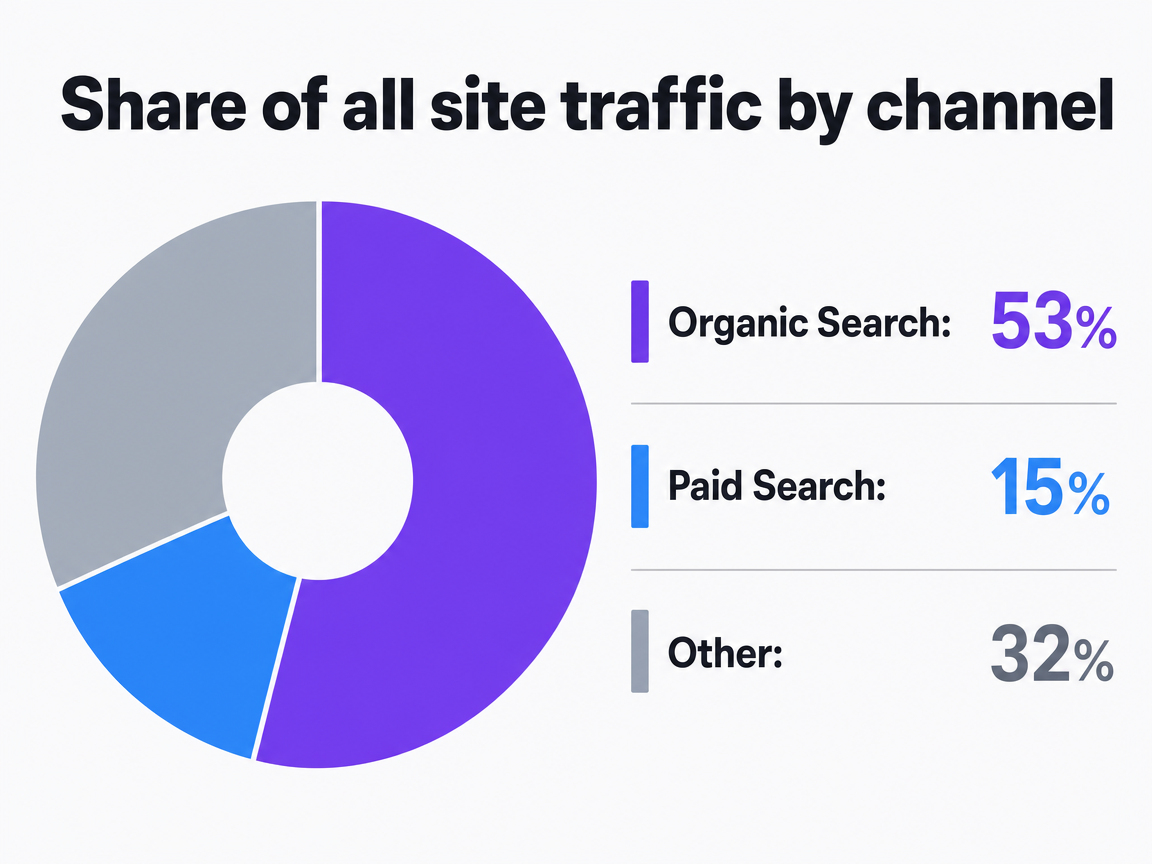 Share of all site traffic by channel
Breakdown of average website traffic sources, based on a BrightEdge study, highlighting the contribution of organic and paid search.
Frequently Asked Questions
References
- 1.Every Company Needs An SEO Platform.
- 2.Organic search responsible for 53% of all site traffic, paid 15% [Study].
- 3.Google Search's guidance about AI-generated content.
- 4.Google Search's Guidance on Generative AI Content on Your Website.
- 5.Google's New AI Search Guide Calls AEO And GEO 'Still SEO'.
- 6.Search Engine Optimization (SEO) Starter Guide.
- 7.Marketing SEO Platform Comparison.
- 8.Current Trends in Enterprise SEO Platforms.
- 9.AI search grows, but organic search dominates conversions.
- 10.Search Gallery.
- 11.Search Engine Optimization Solutions, Q3 2025.