
Key Takeaways
- The bottleneck in agency SEO has moved from execution to judgment, so team design should route more decisions through senior strategists rather than adding production headcount.
- A core plus execution layer topology keeps portfolio prioritization, diagnostic interpretation, and final approval with senior humans while the execution layer produces briefs, drafts, audits, and reports.
- Governed drafts with source traceability and pre-run QA let one strategist anchor 15-20 accounts instead of 8-10, making approval throughput the metric that determines healthy delivery.
- Treat GEO as a monitoring problem for the execution layer, raise the editor bar in high-stakes verticals, and sequence the transition over quarters starting with reporting 1.
Execution stopped being the bottleneck
For most of the last decade, agency SEO leaders scaled by adding headcount: a writer, a technical specialist, a junior analyst, a link builder. Delivery capacity was tied directly to staffing because execution was the primary constraint. Briefs waited on strategists, drafts on writers, and audits on the few who mastered specific tools.
This constraint has shifted. Tasks like drafting, keyword clustering, technical crawling, on-page recommendations, competitive gap analysis, and reporting can now be produced faster than a senior strategist can review them. McKinsey's 2024 survey found 65% of organizations regularly use generative AI, nearly doubling the share from ten months prior, with marketing and sales showing the largest jump 8. This indicates widespread adoption, not just experimental pilots.
The new bottleneck is judgment. This includes deciding which topics warrant investment, which recommendations to implement, and which client relationships can absorb significant technical changes. Approval throughput, rather than production throughput, now limits an agency's delivery capacity.
This necessitates a re-evaluation of the organizational structure. A team optimized for faster SEO execution is addressing a problem that is no longer the primary limiting factor. Instead, a team designed to route more decisions through senior judgment, supported by an efficient execution layer, is better equipped to tackle the challenges agency leaders face in 2025.
The core + execution layer topology
What senior humans still own
The redesigned team model reserves a select number of critical decisions for senior personnel. Portfolio prioritization is paramount: determining which accounts receive aggressive content investment, technical remediation, or are in retention mode for a given quarter. This requires judgment informed by client relationships, commercial pressures, and competitive intelligence that an execution layer cannot fully replicate.
Strategists also retain ownership of diagnostic interpretation. When organic traffic to a client's commercial pages drops, the key is not just identifying the URL-level anomaly, but understanding its root cause. This could be a Google update, a competitor's strategy, a canonicalization error from a recent migration, or a shift in query intent. Machines can flag the anomaly, but humans interpret its significance.
Final approval also falls under senior responsibility. Every published deliverable, technical change to a client site, and outreach strategy must pass through a designated strategist. MIT Sloan research on AI adoption from 2010 to 2023 indicates that firms with significant AI use experienced approximately 6% higher employment growth and 9.5% higher sales growth over five years, with roles being reshaped rather than eliminated 5. This model expands the senior strategist's role, rather than diminishing it.
What the execution layer absorbs
All tasks downstream of a strategist's decision are handled by the execution layer. This includes keyword clustering for large sites, competitive gap analysis across multiple domains, generating first-draft briefs and copy, schema generation, internal linking recommendations, log file summaries, ranking movement digests, GEO citation monitoring, and monthly client reporting narratives.
These tasks no longer require a human to start from a blank page. However, human review, editing, and approval are still essential before anything is delivered to a client or goes live. The execution layer produces, but it does not independently publish or implement.
The widespread adoption of generative AI in marketing, as noted by McKinsey's 2024 survey 8, signifies that AI-assisted execution is no longer a competitive advantage but a fundamental requirement for delivery capacity. Agencies that still view AI-assisted execution as a mere productivity experiment are falling behind. Leading teams have integrated AI across their production processes, with governance ensuring quality surpasses what a junior writer could achieve alone. Strategists review clustered outputs, not raw data, which significantly improves throughput.
Why layering agents onto legacy briefs fails
A common mistake is to maintain existing workflows and simply insert AI at each handoff point. For example, a strategist writes a brief, AI drafts content, a writer edits, an editor reviews, and the strategist approves. While one step might be faster, the overall productivity gain is marginal, often leading to frustrated senior staff reviewing more drafts of similar quality.
McKinsey's research on agentic AI in marketing workflows emphasizes that significant gains come from reimagining the entire workflow, not just adding AI to existing processes 3. A redesigned SEO workflow doesn't begin with a strategist writing a brief. Instead, the execution layer produces a comprehensive package—including research, clustered targets, a draft, schema, internal links, and a proposed publishing sequence—which the strategist then evaluates as a decision point, not just a document.
This inverts the traditional work distribution. Instead of strategists spending a majority of their time creating inputs for the execution layer, the execution layer generates both inputs and outputs. Strategists then focus their time on deciding what to ship, revise, or discard. This shifts the bottleneck from production to approval, aligning with the goals of the redesigned organizational structure.
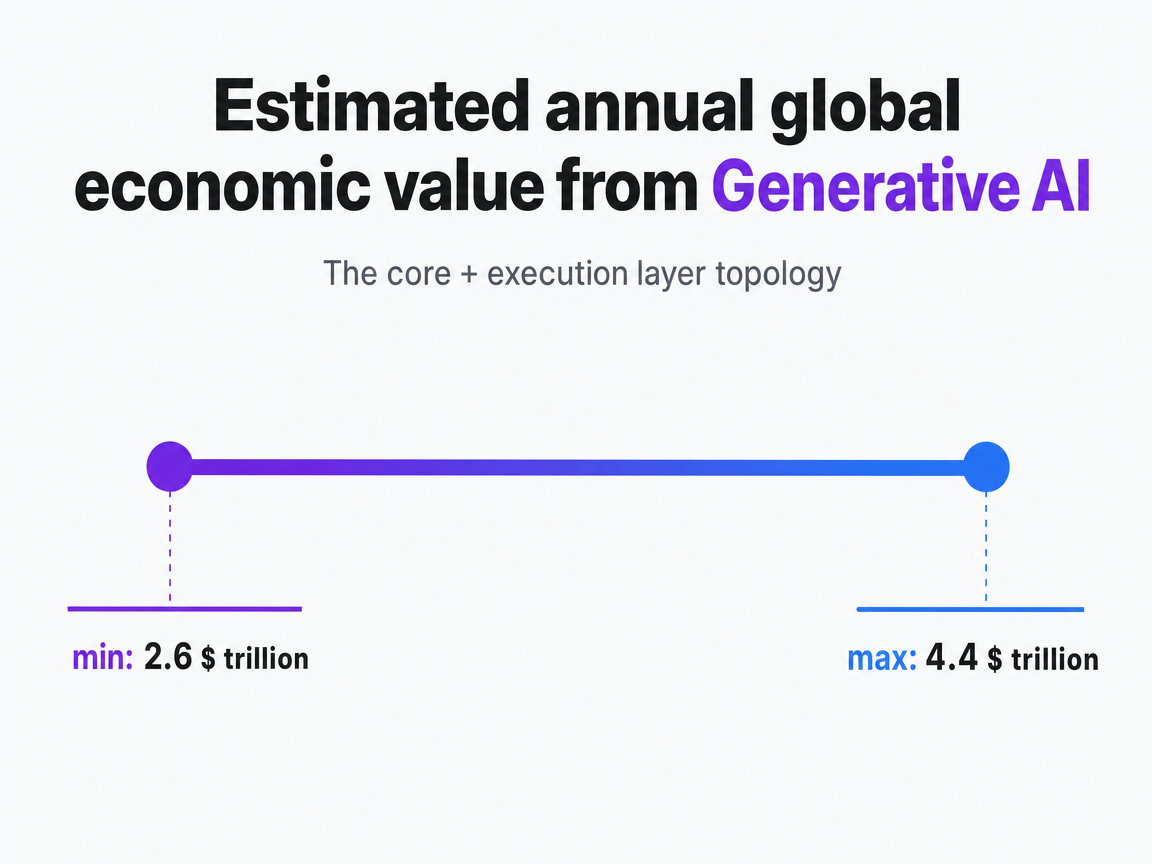 Estimated annual global economic value from Generative AI
McKinsey Global Institute estimates that generative AI could add $2.6 trillion to $4.4 trillion annually to the global economy.
Capacity math: accounts per strategist
The economic justification for this team redesign hinges on the "accounts per senior strategist" ratio. In a traditional agency pod, a strategist typically manages 8 to 10 accounts. Exceeding this limit often leads to strategists being overwhelmed by brief production, review queues, and client communication within a standard work week. Scaling traditionally means adding another strategist, writer, analyst—five to six people to handle the next 8 to 10 clients. This compresses margins as salaries are incurred before new revenue covers fully loaded costs.
A core plus execution layer pod fundamentally alters this dynamic. When the execution layer produces research packages, first-draft briefs, technical audits, GEO monitoring digests, and monthly reporting narratives, a senior strategist's role shifts from input production to decision routing. This makes managing 15 to 20 accounts per strategist achievable, as the strategist's primary constraint becomes review capacity, not production capacity.
McKinsey's economic modeling estimates a productivity lift in the marketing function of 5 to 15 percent of total marketing spend, contributing to a broader estimate of $2.6 to $4.4 trillion in annual global economic value across all functions 2. This range applies to the entire marketing function, not just SEO, and assumes end-to-end workflow redesign rather than isolated tool adoption. The higher end of this range is observed by agency operators when the execution layer replaces the briefing cycle entirely.
For a delivery pod, a 10 to 15 percent productivity lift is less significant than the impact of strategists no longer writing briefs. This single change frees up 15 to 20 hours of weekly work from a senior strategist's schedule, enabling them to absorb a second tier of accounts. Doubling accounts-per-strategist is not merely a productivity claim; it's a task-mix claim. The tasks that previously limited a strategist's throughput are moved to the execution layer, allowing the remaining tasks—prioritization, diagnostic analysis, and approval—to be managed efficiently when inputs are pre-assembled.
Test AI-powered SEO team workflows in practice
Experience hands-on execution and see measurable SEO content output within your own approval process.
A pod comparison table for delivery leaders
The table below compares a traditional pod with a core + execution layer pod, keeping the core structure constant and varying only what the execution layer handles. Salaries are omitted due to wide variations across markets. The focus is on the ratio of senior review capacity to account load, and where production work occurs.
| Dimension | Traditional pod | Core + execution layer pod |
|---|---|---|
| Senior strategists | 1 | 1 |
| Content lead / editor | 1 | 1 |
| Writers | 2 | 0 (execution layer drafts) |
| Technical SEO specialist | 1 | 0 (execution layer audits, strategist reviews) |
| Analyst / reporting | 1 | 0 (execution layer assembles, editor reviews) |
| Accounts anchored | 8–10 | 15–20 |
| Briefs authored by strategist | All | None (strategist approves pre-assembled packages) |
| Primary strategist constraint | Production throughput | Approval throughput |
| Deliverables per account per month | Flat or declining as pod scales | Stable or rising as review workflow matures |
Two points in the table warrant further explanation. The "0" in the writers row does not imply that writing disappears; rather, first-draft production is moved off the salaried headcount. The editor still edits, and the strategist still approves. Secondly, the "constraint" row highlights the shift. When approval becomes the limiting factor, adding a second senior strategist effectively doubles capacity because the execution layer scales without additional hiring 3.
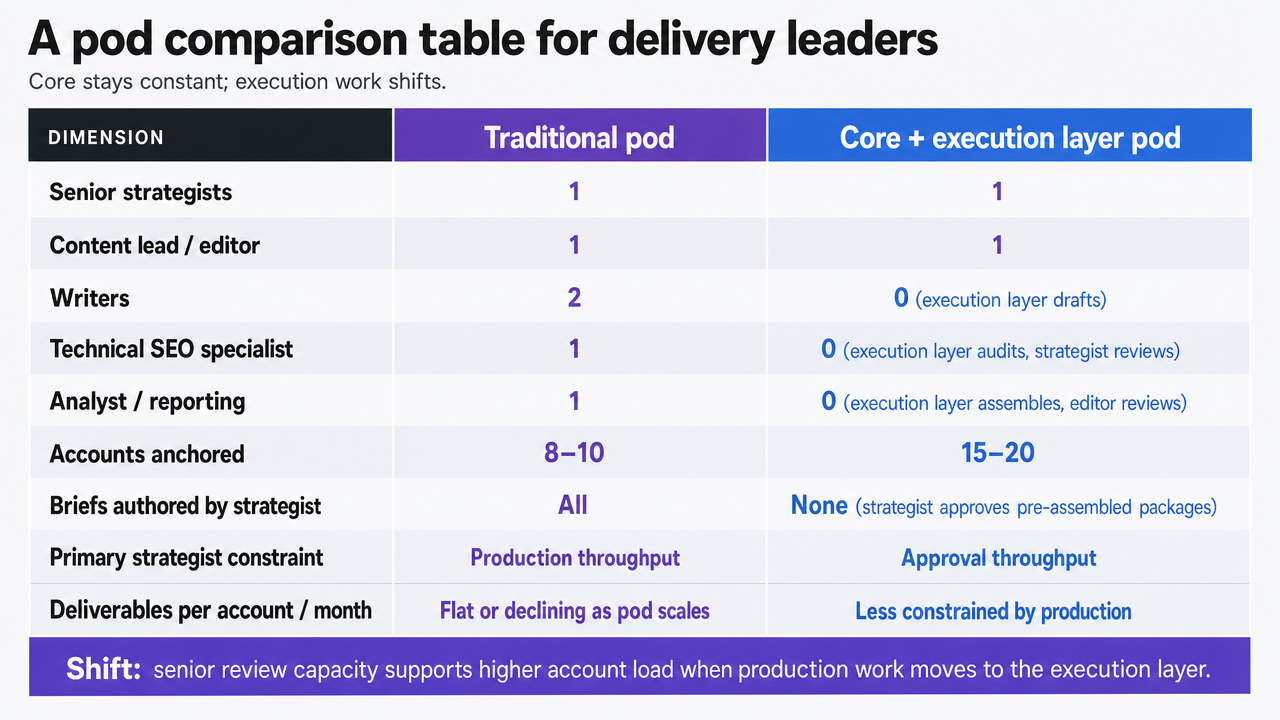 Side-by-side comparison of traditional pod versus core + execution layer pod, reinforcing the accounts-per-strategist shift and role composition described in the section
The approval workflow that keeps quality intact
Governed drafts, not raw outputs
The question of quality frequently arises in discussions about redesigned SEO teams, often framed incorrectly. The concern isn't whether an execution layer can produce a draft, but rather the state in which that draft reaches the strategist.
A governed draft differs from a raw output in three key ways: it includes source traceability for all factual claims, a structured brief explaining the topic, angle, and target cluster, and a pre-run QA check against the client's editorial guidelines, banned phrases, and brand voice. The strategist receives a complete package, not just a document. This significantly reduces review time because the strategist is evaluating judgment, not searching for errors.
Raw outputs necessitate line editing, which is an inefficient use of a senior strategist's time. Governed drafts, conversely, facilitate decision-making: ship, revise a specific angle, kill a topic, or reprioritize a cluster. This shift is crucial for workflow efficiency.
McKinsey's work on agentic AI explicitly states that returns stem from human-agent collaboration within redesigned processes, not from unsupervised output 3. The governance layer enables this collaboration. Without it, the execution layer generates a high volume of content that strategists must manually triage, effectively recreating the old bottleneck under a new guise.
Throughput as the new quality metric
In a traditional pod, quality was assessed at the artifact level: the quality of a blog post, the cleanliness of an audit, or the defensibility of a recommendation. While these checks remain important, they are no longer the primary indicator of a healthy delivery operation.
In a redesigned team, the leading indicator is approval throughput: the number of decisions a senior strategist processes per week, the average review time, and the rework rate. When approval throughput increases without a parallel rise in rework, the workflow is compounding efficiently. If rework increases, it signals that the execution layer is operating outside its governance parameters, requiring tighter upstream constraints.
This is a quantifiable process. Metrics to track include:
- review time per deliverable,
- revision rounds before publication, and
- post-publication defect rates.
A pod managing 15 to 20 accounts per strategist should demonstrate stable or declining review times per deliverable over a quarter, as feedback loops improve the execution layer's outputs. If review time is increasing, the workflow has likely reverted to line editing, and the solution lies in upstream governance, not additional headcount.
See How Leading Agencies Scale SEO Teams Without Adding Headcount
Request a walkthrough of AI-driven workflows that automate high-volume SEO execution, streamline oversight, and maintain quality—purpose-built for agencies managing complex, multi-client portfolios.
GEO as a team-design problem, not a checklist
Most agency responses to generative engine optimization (GEO) treat it as a new tactical layer: adding schema, creating citation-worthy content blocks, and monitoring LLM outputs. This perspective overlooks the fundamental structural difference between GEO and traditional SEO. GEO is not merely an additional checklist item for strategists; it represents a scope change that the team topology must accommodate.
The scope change stems from the evolving nature of visibility. McKinsey's analysis of AI search reveals that a brand's own websites often account for only 5 to 10 percent of the sources AI search engines reference in their answers 4. The remaining 90 to 95 percent comes from third-party sources: review sites, industry publications, forums, aggregators, competitor coverage, and structured data feeds. A team focused solely on owned properties optimizes only a small fraction of the overall surface area.
This has direct implications for team design. GEO monitoring—tracking which sources LLMs cite for a client's category, which competitors are named, and which third-party pages need influence—is a continuous surveillance task across numerous surfaces per account. No senior strategist can manually sustain this across 15 to 20 accounts. This task belongs in the execution layer, running on a schedule, and surfacing citation shifts and source-mix changes for review.
The strategist's role remains focused on response decisions. When a competitor gains citations for a commercial query while the client does not, the strategist determines the appropriate action: a content push on owned properties, a PR angle targeting the cited third-party source, a schema fix, or a structural rewrite of how the client presents authority signals. The execution layer identifies the pattern; the strategist makes the strategic move.
Agencies that view GEO as a mere tactical add-on often find strategists spending nights manually checking LLM outputs. Agencies that recognize GEO as a monitoring problem empower the execution layer to handle surveillance, freeing up capacity for strategists to strategically respond to the insights generated.
High-stakes verticals raise the approval bar
This section focuses on agencies with a significant client base in high-stakes verticals such as healthcare, legal, behavioral health, senior living, or financial services. While the redesigned team model still applies, the approval workflow must bear greater scrutiny for each decision.
The reason is the potential for severe downstream consequences. A systematic review of online health information seeking behavior found that accuracy, readability, and ease of understanding determine whether consumers act on what they read. Poor-quality content can mislead patients, despite increased access to information 7. With nearly 60% of U.S. adults researching health topics online and many booking appointments based on that research 9, a fluent-but-inaccurate paragraph on a clinic's website is not just a ranking issue; it's a patient safety concern with regulatory and reputational implications.
This necessitates additional elements in a governed draft before it reaches the strategist. Source traceability is mandatory; every clinical claim requires a citation to a primary source captured by the execution layer during research, which the strategist reviews alongside the copy. Readability grading against the client's target audience is checked upstream. Automated gates screen for banned phrases—such as off-label claims, guarantees of outcome, or superlatives that trigger bar association or FTC scrutiny—before human review.
Consequently, the editor role in high-stakes verticals often requires subject-matter credentials beyond general editorial skills. This might include a former paralegal editing legal content or a registered nurse reviewing patient education pages. The execution layer increases production, but the editor's expert veto becomes the operational safeguard that allows the strategist to trust the increased throughput.
Scale SEO Execution Without Expanding Your Team
Access a unified platform that automates multi-client SEO workflows, delivers measurable improvements in content velocity and ranking, and maintains strategic oversight at every stage—no additional hires required.
If the agency runs a multi-location or portfolio book
This section addresses agency leaders whose client mix includes multi-location operators, such as DSO groups, regional law firm networks, home services franchises, senior living portfolios, or urgent care chains. The core plus execution layer topology remains relevant, but the unit of work changes. The "account" is no longer a single site but a parent brand with 20 to 200 location pages, each possessing unique local intent, review profiles, and citation footprints.
This scale immediately overwhelms a traditional pod. A strategist managing a 60-location DSO cannot personally review monthly updates to local landing pages, GBP posts, review-response cadences, and citation cleanups for each location. In the redesigned model, the execution layer handles per-location production—including location page refreshes, structured data, GBP content, and citation audits—and aggregates these outputs into a portfolio-level review queue for the strategist to process in batches. Approval occurs at the pattern level: for instance, a template change is approved for all 60 locations, or an outlier location requires a bespoke fix.
The economics are favorable because the strategist's judgment scales across multiple locations that share a template, while the execution layer manages the per-location variations. One senior strategist can effectively manage a portfolio account that would traditionally require three strategists in a conventional pod.
Transition sequencing without emergency restructuring
Implementing this redesign does not necessitate an immediate, disruptive overhaul. Yale's Budget Lab, after examining exposure and automation metrics in the labor market since ChatGPT's release, found no discernible disruption in occupational composition, indicating stability rather than upheaval 1. This context is valuable for agency leaders under pressure to adapt quickly. The transition can be phased over quarters, not weeks.
A practical sequence begins with a single pod and a specific account tier:
- First, shift the reporting layer: monthly narratives, ranking digests, and technical audit summaries are low-risk tasks to move to the execution layer because the strategist reviews the assembled output before client delivery. Tracking rework rates and review times from day one establishes the governance framework for subsequent phases.
- Next, move brief production. This change significantly frees up a strategist's calendar but is also the most likely to cause quality regressions if the governance layer is weak. Editors play a more critical role during this phase.
- Draft production and technical audit generation follow, once the earlier phases have stabilized.
Hiring decisions should be paused rather than reversed. Attrition naturally redistributes roles within the redesigned topology, as positions evolve to focus on review and approval, mirroring the task-level patterns observed by MIT Sloan in AI-adopting firms 5. Emergency restructuring is a reactive measure taken when leaders delay too long. A sequenced transition, initiated proactively, allows for a smoother, more controlled evolution.
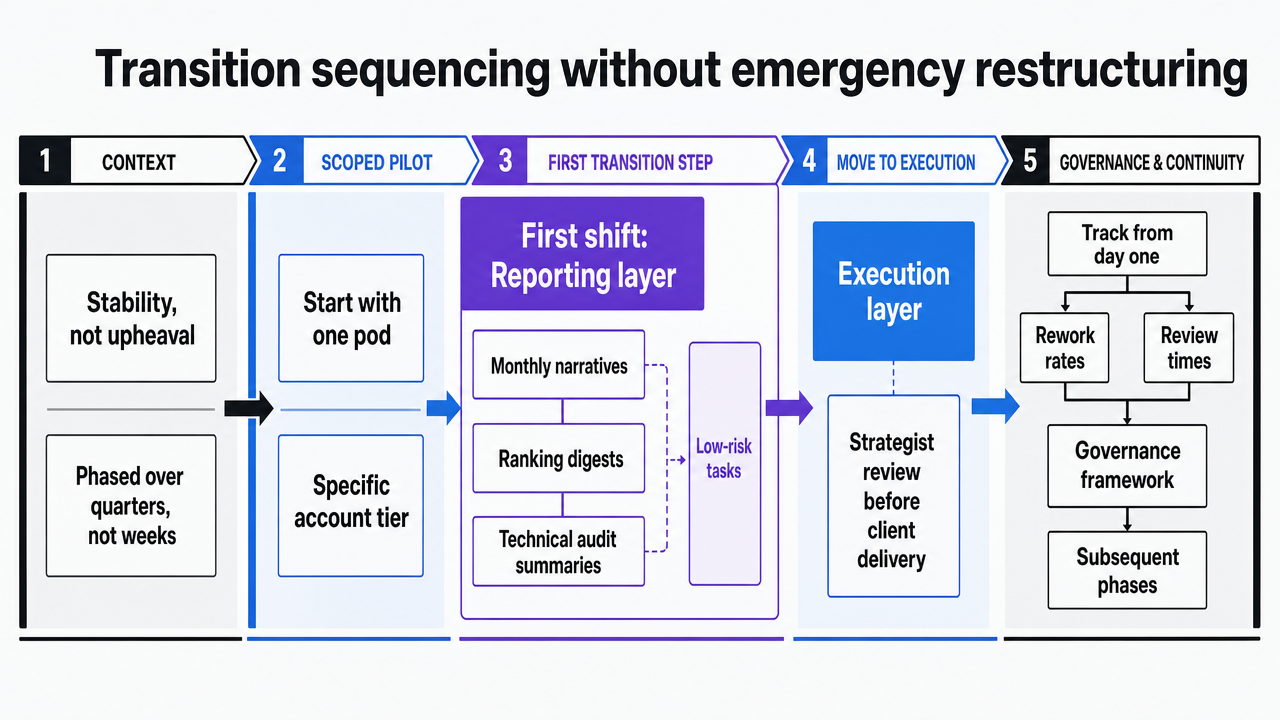 Visualize the sequenced quarterly transition plan described in this section, showing the order of layers moved to the execution layer
Frequently Asked Questions
References
- 1.Evaluating the Impact of AI on the Labor Market: Current State of Affairs.
- 2.The economic potential of generative AI: The next productivity frontier.
- 3.Reinventing marketing workflows with agentic AI.
- 4.Winning in the age of AI search.
- 5.How artificial intelligence impacts the US labor market.
- 6.AI Will Shape the Future of Marketing.
- 7.Online Health Information Seeking Behavior: A Systematic Review.
- 8.The state of AI in early 2024.
- 9.Discover the Impact of Digital Marketing on Healthcare Industry.