
Key Takeaways
- Screaming Frog absorbs the junior technical SEO's audit work, running templated crawls across portfolios while senior strategists still decide which findings actually warrant action.
- Ahrefs replaces the analyst pulling competitive research decks, but mapping keywords to a client's qualified-lead motion remains a strategist's call.
- Semrush consolidates rank tracking, site audits, and templated reporting, freeing senior staff to write the narrative layer that drives client retention.
- Clearscope automates the brief-writing assembly line, a category Boston University research identifies as highly substitutable 8, leaving the editorial angle to humans.
- Surfer collapses on-page revision cycles from three handoffs to one, though high scores alone do not guarantee a page reads well enough to hold rankings.
- Pitchbox absorbs the outreach coordinator role, letting two coordinators run twenty client campaigns instead of ten, while senior staff still own the pitch asset and relationships.
- AlsoAsked eliminates manual SERP mining for topic clusters, mapping People Also Ask chains into structures that strategists then translate into editorial decisions.
- Looker Studio reduces recurring client reporting labor to near zero through templated dashboards, leaving senior staff to write the commentary clients actually need.
- Vectoron operates at the orchestration layer, routing recommendations across content, SEO, and approvals so coordination cost stops scaling faster than the client portfolio.
Why the tenth specialist costs more than the stack
The math on hiring the next mid-level SEO specialist stopped working sometime around 2023. Mid-level roles now account for 59% of all SEO job postings, and US marketing employment expanded 12% between 2022 and late 2024 6. Agency heads of SEO are competing for the same shrinking pool of qualified candidates that in-house teams, SaaS companies, and consultancies are bidding on, while client retainers have not moved at the same rate.
The substitution signal is sharper inside the labor data itself. A study summarized by Harvard Business School Working Knowledge tracked job postings before and after ChatGPT's launch and found that postings for highly automatable roles fell by roughly 13%, while postings for more analytical, technical, or creative roles grew by about 20% 7. The measure is job postings, not actual hiring or output, so it captures employer intent rather than realized productivity. The direction is what matters for agency operators: the work that gets templated, repeated, and produced at volume is the work the market is no longer staffing up to do.
Forrester's 2025 evaluation of SEO platforms tracks the same shift from the supply side, noting that buyers should expect platforms combining data, automation, and workflow rather than point tools that require an analyst to glue outputs together 10. The agency question is no longer whether to add a tenth specialist. It is which categories of tooling absorb the production layer so the existing senior team can stay on strategy, QA, and the client conversations that still demand a human.
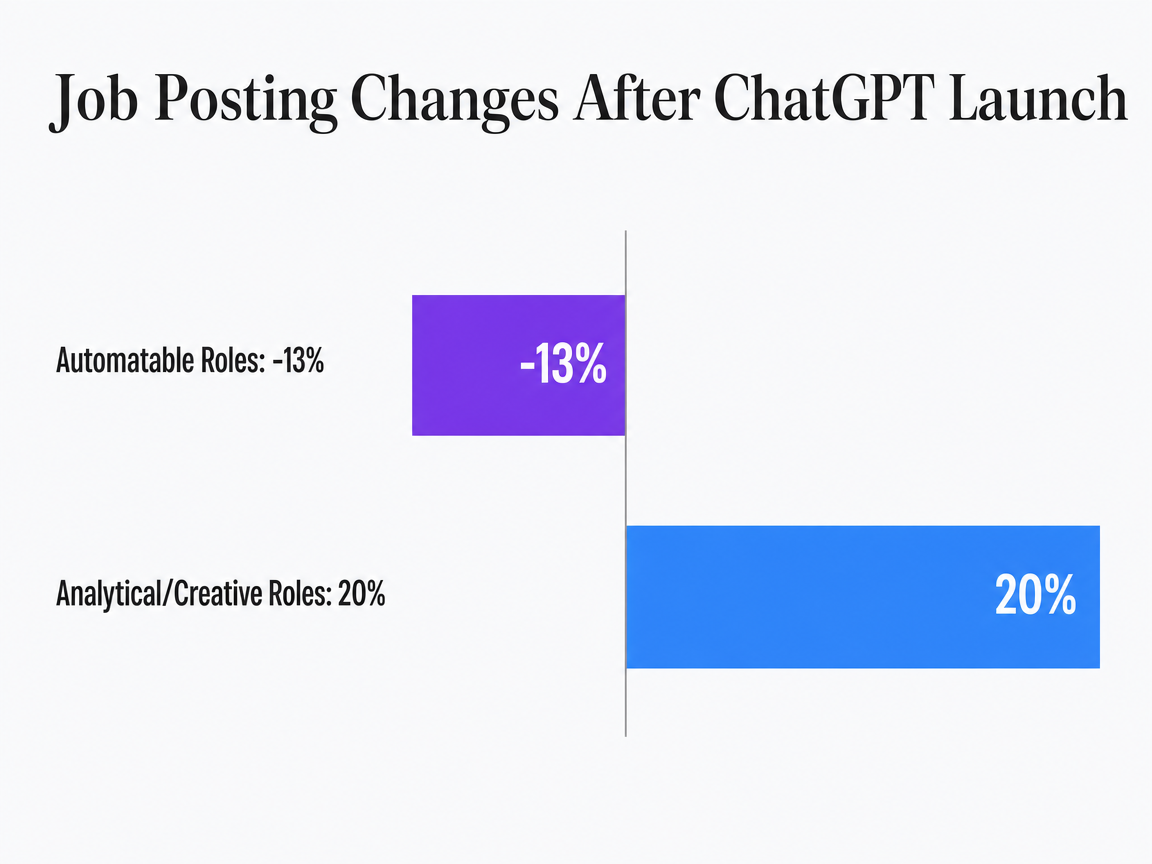 Job Posting Changes After ChatGPT Launch
Comparison of the percentage change in job postings for roles with high automation exposure versus roles requiring more analytical/creative skills after ChatGPT's launch.
How to read this list: roles displaced, judgment retained
Each tool below is filed under the agency role it most directly absorbs, not the feature category it sits in on a vendor comparison grid. Forrester's Q1 2025 landscape splits SEO solutions by buyer type and use case rather than by feature parity for the same reason: capability overlap is high, but the work each platform actually removes from a delivery pipeline varies sharply 3. A rank tracker and a content brief tool may both advertise AI assistance; one displaces an analyst pulling weekly position reports, the other displaces a strategist drafting outlines.
The nine entries are ordered roughly along the delivery pipeline, from technical audit through orchestration. Each entry names the role displaced, the production task absorbed, and the judgment call that has to stay with a senior human. The last entry steps up a layer to the workflow that connects the other eight, since Forrester's 2025 Wave evaluation treats integrated workflow and reporting as the differentiator separating mature platforms from point tools 10. Read the list as a stack architecture, not a shopping cart.
Test AI-driven SEO execution on live projects
Experience automated SEO workflows and publish real content before making any commitment.
The nine tools, mapped to the agency roles they absorb
Screaming Frog: the technical auditor who never sleeps
The role this displaces is the junior technical SEO who spends Mondays crawling client sites and Tuesdays writing up what broke. Screaming Frog runs the crawl in minutes against templated audit configurations, then surfaces the broken redirects, orphaned pages, duplicate title tags, hreflang errors, and indexability flags an analyst would otherwise transcribe by hand into a spreadsheet.
The production task absorbed is the audit itself: crawl, classify, export, deduplicate, prioritize by URL value. Configured once per client template, it produces consistent output across a 40-account portfolio without an analyst touching the keyboard between runs. Scheduled crawls catch regressions inside hours rather than at the next quarterly review.
What does not transfer is the interpretation. The crawl returns 4,200 thin-content URLs; a senior strategist still has to decide which are pruned, which are consolidated, and which the client's legal team will not let anyone touch. Screaming Frog removes the data-collection layer that consumed roughly half a specialist's week. It does not remove the judgment about which findings matter for a specific client's revenue model.
Ahrefs: the keyword and competitive researcher on retainer
Competitive research, done by hand, is one of the most expensive recurring tasks on an agency P&L. An analyst pulls a client's domain, three competitor domains, a content gap report, a backlink intersection, and a SERP overview, then assembles a research deck. Repeat across every new account and every quarterly planning cycle. Ahrefs collapses that workflow into a few queries.
The production layer it absorbs is keyword discovery at scale, traffic estimation, content-gap analysis, and backlink intelligence on competitor domains. Forrester's 2025 landscape report categorizes these capabilities as the foundational data layer agencies should expect from any mature SEO platform 3. Ahrefs runs the crawl and refreshes the index continuously; the analyst stops being a data-collector and becomes a reviewer.
The judgment that has to stay human is which keywords actually map to a client's qualified-lead motion versus which are vanity traffic. A 12,000-volume keyword in the bankruptcy vertical can be worth less to a law firm than a 90-volume keyword with clear commercial intent. Ahrefs surfaces the universe of options. Ranking them against a client's actual book of business is still the strategist's call.
Semrush: the rank tracker and reporting analyst rolled together
Semrush sits one rung up from a pure data tool because it bundles position tracking, site audit, and templated reporting into a single workspace. The role it most directly absorbs is the reporting analyst who spends Friday afternoons pulling rank changes across 30 client domains, calculating share-of-voice deltas, and pasting screenshots into client decks.
Scheduled position tracking against a defined keyword set runs continuously. Movement alerts fire when a target keyword drops more than a configured threshold, replacing the manual scan an analyst would otherwise do weekly. Site Audit reruns on cadence and flags regressions against the prior crawl, which means the technical and ranking layers update without an analyst initiating either job.
Where Semrush still requires a human is in the narrative layer of a client report. A 14-position drop on a head term means something different the week after a Google core update than it does the week after a client pushed a botched template change. The tool collects and visualizes. The strategist explains why, and what the client should approve next. That interpretive layer is also where retention is won or lost, which is why senior staff time gets reallocated here rather than eliminated.
Clearscope: the content brief writer with a scoring model
Content briefs are the most templated work in an agency's SEO delivery. A specialist pulls the top ten ranking URLs for a target keyword, extracts the entities and subtopics each one covers, builds an outline, and hands a writer a document with target word counts and required terms. That sequence is exactly what Clearscope automates: scrape the SERP, extract terms weighted by frequency and competitor coverage, generate a target content grade, and surface the questions and related concepts the page should answer.
A Boston University study of an online freelance marketplace found significant demand shifts in categories with high generative AI exposure, with clients substituting AI for human labor on standardized, text-heavy tasks 8. Brief writing sits squarely in that category. The work is structured, the inputs are observable, and the output follows a repeatable schema.
What Clearscope does not absorb is the angle. A grade-A brief on "estate planning checklist" optimized against the top ten SERP results will produce a page indistinguishable from those ten results unless a strategist injects a point of view, a client-specific case structure, or a proprietary data point. The tool removes the assembly labor. The editorial decision about why a reader should choose this page over the other ten still belongs to a human who understands the client's voice and authority position.
Surfer: the on-page optimizer that compresses revision cycles
Surfer overlaps with Clearscope on brief generation, but its higher-leverage function is the live editor that scores a draft in progress against on-page signals. The role it displaces is the editor doing line-by-line term coverage checks before a draft moves to QA. That review used to consume 30 to 45 minutes per page; Surfer's scoring panel collapses it to a glance.
The revision cycle is where the time savings compound. Instead of a writer submitting a draft, an editor flagging missing terms and weak heading structure, the writer rewriting, and the editor re-reviewing, the writer self-corrects against the score in real time. Three handoffs become one.
The judgment Surfer does not replace is whether a high-scoring page actually reads well. A 92-grade page stuffed with related terms can still feel mechanical, and pages that feel mechanical do not earn the engagement signals that hold a position once a core update lands. The on-page score is a floor for production quality, not a ceiling for editorial quality.
Pitchbox: the link prospector and outreach coordinator
Link building is the workflow agencies most often outsource because it is labor-intensive and difficult to systematize. Pitchbox attacks the labor side directly. The role absorbed is the outreach coordinator who builds prospect lists, finds verified contact emails, sends sequenced pitches, and tracks replies across hundreds of threads per month.
Prospect discovery against competitor backlink profiles, contact enrichment, personalized merge fields, scheduled follow-ups, and reply detection all run inside one workflow. An agency that previously needed two coordinators to run outreach for ten clients can run twenty with the same headcount because the operational ceiling is no longer how many email threads a human can track.
What the tool does not change is the underlying offer. Pitchbox sends pitches faster; it does not make a thin guest-post pitch land at a publication that already gets 200 a week. Senior staff still own the content asset being pitched, the angle, and the relationship escalation when a high-value target replies. The economics improve because the coordination layer no longer scales linearly with volume.
AlsoAsked: the SERP researcher behind topic clusters
AlsoAsked is the narrowest tool on this list and earns its slot for a specific reason: it eliminates the manual SERP-mining a strategist does when planning a topic cluster. The tool maps People Also Ask chains around a seed query into a branching tree, exposing the question hierarchy Google has already validated as related.
The role it absorbs is the content strategist clicking through PAA boxes for an hour to sketch a cluster architecture by hand. AlsoAsked surfaces the same structure in a single export, ready to translate into a content brief queue or an internal-linking map.
What the tool does not decide is which branches deserve a page versus a section heading versus nothing at all. A six-branch chain may map to one pillar and two supporting pages for a B2B SaaS client, and to nine separate pages for a multi-location service brand chasing local intent. The mapping is structural; the page-level call stays editorial.
Looker Studio: the reporting coordinator at zero marginal cost
Reporting is where agency margin quietly bleeds. A coordinator builds a deck per client per month, pulls data from four sources, formats it, writes commentary, and sends. Across 40 accounts, that is one full-time role consumed by an output clients skim in under three minutes. Looker Studio reduces the recurring labor to near zero once templates are built.
The absorbed task is data assembly: connect Search Console, GA4, the rank tracker, and the call-tracking platform; build the visualizations once; clone the template per client; let the dashboard refresh on its own. The coordinator role compresses into a template-maintenance function rather than a per-client production function.
The judgment that has to remain human is the commentary layer. A dashboard that shows organic sessions up 14% and qualified calls flat is a problem clients need explained, not graphed. Senior staff write the interpretation. Looker handles everything that precedes it, which is most of the hours the coordinator role used to absorb.
Vectoron: the orchestration layer across content, SEO, and approvals
The eight tools above each remove a layer of production labor inside one stage of the pipeline. The job they collectively do not handle is the coordination between stages. A brief generated in Clearscope still has to be routed to a writer, scored in Surfer, audited against the Screaming Frog crawl, tracked in Semrush, and reported in Looker. The connective tissue is usually a project manager and a Slack channel.
Vectoron sits at that layer rather than competing with the point tools. It runs as a coordinated set of specialist strategists across content, SEO, paid, backlinks, social, and call intelligence, with every recommendation routed through a single approval workflow before anything ships. Forrester's 2024 prediction that agencies will shift toward solution-oriented, AI-enabled delivery models points at exactly this architecture: AI does the analysis and execution, humans hold the approval and judgment layer 4.
What stays with senior staff is the approval itself. Every recommendation surfaces with the strategic reasoning attached, and nothing executes without sign-off. The role displaced is the project manager and the handoff layer, not the strategist. For an agency running 30 to 80 accounts, that consolidation is where the headcount math changes meaningfully, because coordination overhead scales faster than production hours once the portfolio crosses a certain size.
What still has to stay human
Three categories of work resist the substitution pattern, and senior staff who try to delegate them to tooling tend to lose accounts.
- The first is the client conversation when results are flat. A dashboard can show that organic sessions declined 8% quarter-over-quarter; it cannot tell a healthcare client whether to absorb that drop while a new service line ramps or reallocate budget into paid. That call requires reading the room, the contract, and the client's internal politics at once.
- The second is editorial judgment on assets that carry brand or legal risk. A scored brief produces a structurally sound page, but a personal injury firm publishing a settlement-figures page or a behavioral health network writing about medication-assisted treatment needs a human who understands disclosure requirements and the client's positioning. The freelance marketplace research showing AI substitution in standardized text work is precisely about standardized work 8. Non-standard pages are where the substitution breaks down.
- The third is the strategic call about which client problems are worth solving at all. Tools surface options; humans decide which ones map to the account's actual economics.
Scale Agency SEO Delivery Without Adding Headcount
See how leading agencies are leveraging AI-powered workflows to coordinate, approve, and execute SEO strategies faster—while maintaining quality and oversight across client portfolios.
Where headcount and tool spend compound across a stack
The cost picture inside a mid-sized agency is rarely a single line item. It is a stack of point-tool seats, a layer of analyst hours stitching outputs together, and a coordination tax that grows faster than the client list. The compounding effect is what surprises operators who run the math for the first time: doubling the book of business rarely doubles tool spend, but it tends to more than double the analyst hours required to make the tools speak to each other.
McKinsey's macro estimate puts the annual value pool from generative AI at $2.6 to $4.4 trillion, with marketing and sales identified as one of the largest contributing functions 2. That figure is not an agency P&L number, but it explains why platform vendors keep raising the automation ceiling and why analyst-priced labor keeps getting more expensive relative to software. The structural pressure is moving spend from headcount toward tooling, and agencies that resist the shift end up subsidizing it with margin.
A representative breakdown for a 40-account agency looks roughly like this:
| Stack layer | Typical configuration | Cost driver ||---|---|---|| Technical audit | 1 crawler, shared license | Per-seat, fixed || Keyword & competitive data | 1 enterprise platform, 3-5 seats | Per-seat, scales with team || Content brief & on-page | 2 tools, per-user or per-document | Scales with output volume || Link prospecting | 1 outreach platform, 2-3 seats | Scales with campaign count || Reporting | 1 dashboard tool, templated | Near-zero marginal cost || Coordination labor | PM hours across all layers | Scales faster than accounts |
The coordination row is where the compounding shows up. Tool spend stays roughly linear; the human glue between tools does not.
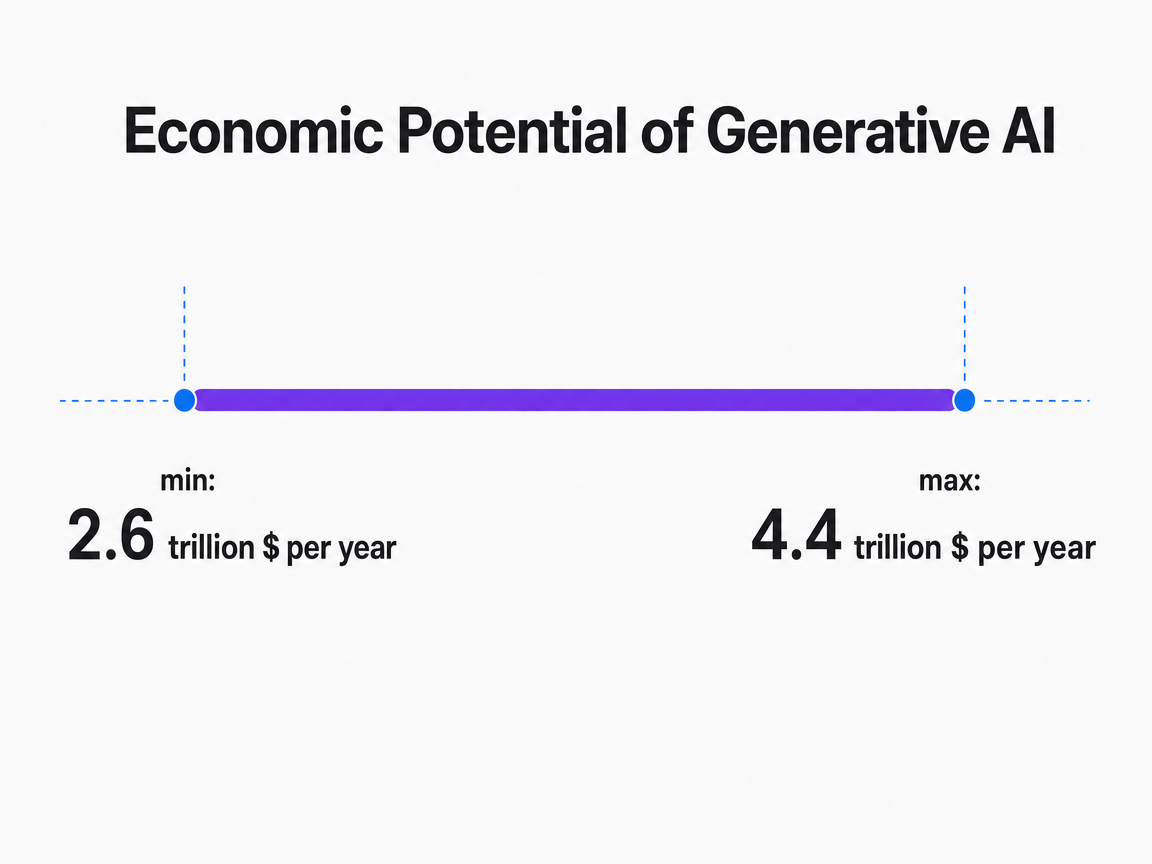 Economic Potential of Generative AI
McKinsey's estimate of the annual economic value generative AI could add to the global economy.
If the agency runs a portfolio of niche brands or franchise clients
A note on audience scope: this section is for agency leaders running multi-location franchise systems, DSO networks, senior living portfolios, or any book where the same brand replicates across 20 to 400 locations. The stack logic above changes when the unit of work is a location rather than a domain.
The production layer compresses further at portfolio scale because the brief, the on-page template, and the schema pattern are shared across locations. One Clearscope brief seeds 80 location pages. One Looker template reports across every market. The economics of point tools improve because the per-asset cost gets divided across the location count, not the client count.
The coordination layer, by contrast, gets worse. A 60-location dental network generates 60 GBP feeds, 60 review streams, 60 local-pack rank sets, and 60 call-tracking pools that have to roll up into one client conversation. Forrester's 2025 Wave evaluation specifically flags integrated workflow and reporting as the differentiator separating mature platforms from point tools, which is exactly the gap that opens at portfolio scale 10. The orchestration layer is no longer optional once a single client account contains more endpoints than most agencies' entire book.
Automate Multi-Client SEO Execution Without Expanding Your Team
Get access to an integrated platform that coordinates content, technical SEO, and reporting—enabling your agency to deliver scalable results across all clients while maintaining strategic oversight and measurable performance.
Assembling the stack without stapling tools together
Eight point tools plus a project manager is not a stack; it is a tax. Each license sits in its own dashboard, each export lands in a different format, and the analyst who used to do the work now spends the same hours moving outputs between tabs. Forrester's Q3 2025 Wave explicitly flags integrated workflow and reporting as the line separating mature SEO platforms from collections of features, which is the same line that separates a real stack from a stapled one 10.
The architectural call for an agency head of SEO is whether the connective tissue lives in software or in headcount. If it lives in headcount, every new client adds coordination hours that compound faster than production hours. If it lives in an orchestration layer with approval routing built in, the senior team stays on the judgment work the tools cannot do: client conversations, editorial calls on brand-risk pages, and the decision about which surfaced recommendations actually ship. The nine entries above only return their full value when that routing question is answered before the seats are bought, not after.
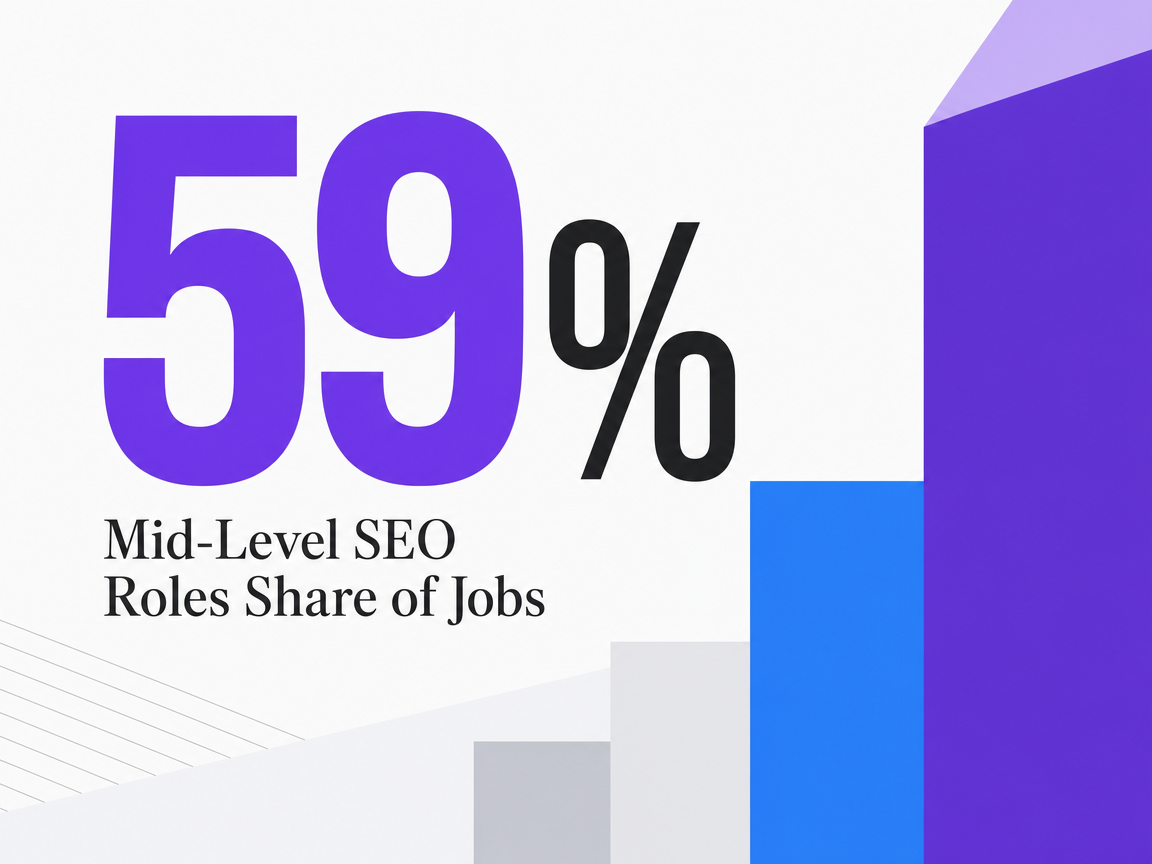 Mid-Level SEO Roles Share of Jobs
Mid-Level SEO Roles Share of Jobs
Frequently Asked Questions
References
- 1.The state of AI in 2023: Generative AI's breakout year.
- 2.The economic potential of generative AI: The next productivity frontier.
- 3.The Search Engine Optimization Solutions Landscape, Q1 2025.
- 4.Predictions 2024: AI Accelerates Agencies' Shift To Solutions.
- 5.Key Insights From The Forrester Experience Optimization Solutions Wave, Q4 2024.
- 6.Marketing & SEO Jobs: Growth Trends and Insights.
- 7.Enhance or Eliminate? How AI Will Likely Change These Jobs.
- 8.Who Is AI Replacing? The Impact of Generative AI on Online Freelancing Platforms.
- 9.AI Tools Reshape Job Application Process.
- 10.The Forrester Wave™: Search Engine Optimization Solutions, Q3 2025.