
Key Takeaways
- Social media management pricing has decoupled from labor hours, with senior talent costs rising 14% year-over-year while 38% of agencies remain stuck in the $1,001–$2,500 retainer band 23, 21.
- A four-tier ladder — Foundation, Growth, Strategic, Enterprise — resolves benchmark noise and lets agencies price against strategic scope rather than post counts, with fewer than 10% of agencies currently reaching the underpopulated $10,000+ bands 21.
- AI-assisted execution belongs on the variable cost line, not the SOW: compressing production 40–60% moves a $2,500 retainer from unprofitable $125-per-hour yield to $210–$250 without touching the rate 22.
- Repricing sequencing matters — tie adjustments to scope refreshes, trim rather than discount when clients resist, and lead multi-location pitches with annual portfolio math where consolidated programs beat both stitched retainers and in-house hires 1, 7.
The pricing model has decoupled from the labor hour
For two decades, social media management pricing tracked labor. Hours worked, posts published, platforms covered. That math no longer holds. Senior social directors now average $147,086 in total compensation after a 14% year-over-year jump 23, while 38% of agencies still cluster their monthly retainers between $1,001 and $2,500 21. The floor of talent cost is rising faster than the ceiling of what most agencies charge.
The result is a squeeze felt at every tier. Sortlist's dataset of more than 10,000 projects puts the market median at $1,500 to $4,500 per month 1. Premium tiered ladders reach $25,000 or more for enterprise programs 2. Between those poles, agencies pricing by hour or by post count are quietly losing gross margin on retainers they signed 18 months ago.
AI-assisted execution complicates the picture from the other direction. Production time on captions, cutdowns, and community drafts is collapsing, which means the input cost of a $2,500 retainer looks nothing like it did in 2023. Agencies that still price the output are pricing an artifact of the old cost structure.
The rethink is not about charging more or less. It is about pricing the right thing. Strategy, platform judgment, and outcome accountability sit on one side of the ledger. Production hours sit on the other, and they are moving toward a variable cost line rather than the pricing basis. The sections that follow reconcile the benchmark noise into a defensible ladder, and then work through the labor math that sets the floor beneath it.
Reconciling the benchmark noise into one pricing ladder
What 10,000+ projects and agency surveys actually say
Published benchmarks disagree because they measure different populations. Sortlist's dataset of more than 10,000 posted projects puts typical monthly management between $1,500 and $4,500, with top-tier multi-account, content-heavy engagements reaching $10,000 or more 1. WebFX, drawing on a broader sample that mixes freelancers and agencies, reports an average range of $500 to $5,000 per month 3. Digital Agency Network widens it further to $500–$10,000 depending on platform and engagement depth 20.
Fresh Content Society's 2026 tiered ladder tells a different story from the same market. Starter packages sit at $2,000–$6,000, Growth at $7,000–$12,500, Strategic at $13,000–$20,000, and Enterprise at $25,000 or more per month 2. The ladder is not describing a different service — it is describing what senior involvement, multi-channel coordination, and paid-media integration cost when priced correctly.
The gap between Sortlist's $1,500–$4,500 median 1 and Fresh Content Society's $13,000–$20,000 Strategic tier 2 is not a data error. It is the difference between what buyers request on procurement marketplaces and what agencies charge when they lead with strategy rather than deliverables. HoneyBook's guidance to experienced managers reinforces the middle ground: $75–$150 hourly or $3,000–$5,000+ monthly for retainers 5.
Two conclusions follow. First, the modal market — where most retainers actually sit — clusters in the low four figures, closer to Sortlist's median than to any premium tier. Second, the ceiling is real but thinly populated. Agencies pricing against the average will always look expensive to buyers anchored on freelancer rates and cheap to buyers ready for Strategic-tier work. The ladder in the next section resolves the mismatch.
The four-tier ladder agencies should price against
A defensible ladder collapses the benchmark spread into four bands, each anchored on what the retainer buys rather than how many posts it produces.
Foundation: $1,500–$3,000 per month. : Single-brand, one to two platforms, published content and community response, monthly reporting. This band tracks the lower half of the Sortlist median 1 and the modal Databox retainer cluster where 38% of agencies operate 21. It is the entry point that competes directly with senior freelancers charging $3,000–$5,000 monthly 5. Agencies pricing below $1,500 are not competing — they are subsidizing.
Growth: $3,000–$7,000 per month. : Two to four platforms, strategy documentation, paid-organic coordination, quarterly planning cycles. This spans the upper Sortlist band 1 into Fresh Content Society's Starter–Growth transition 2. The 22% of agencies at $2,501–$5,000 retainers largely live here 21. Margin protection depends on scope discipline, not price.
Strategic: $7,000–$15,000 per month. : Multi-platform, senior oversight, integrated paid media, analytics reviews with client leadership. Fresh Content Society's Growth and Strategic tiers overlap this range 2. WebFX notes multi-platform engagements can reach $500–$5,000 per platform per month, which explains the top of this band when four or five platforms stack 3. Fewer than 10% of surveyed agencies price here 21, which is precisely why it protects margin.
Enterprise: $15,000+ per month. : Complex account structures, executive social, category leadership, or emerging-platform depth. Sortlist flags TikTok full management medians at $14,050 with a top range near $20,000 1, and Fresh Content Society's Enterprise tier begins at $25,000 2.
The ladder does not fix the pricing problem on its own. It sets the frame the labor math and cost-structure analysis in the next sections use to defend each band.
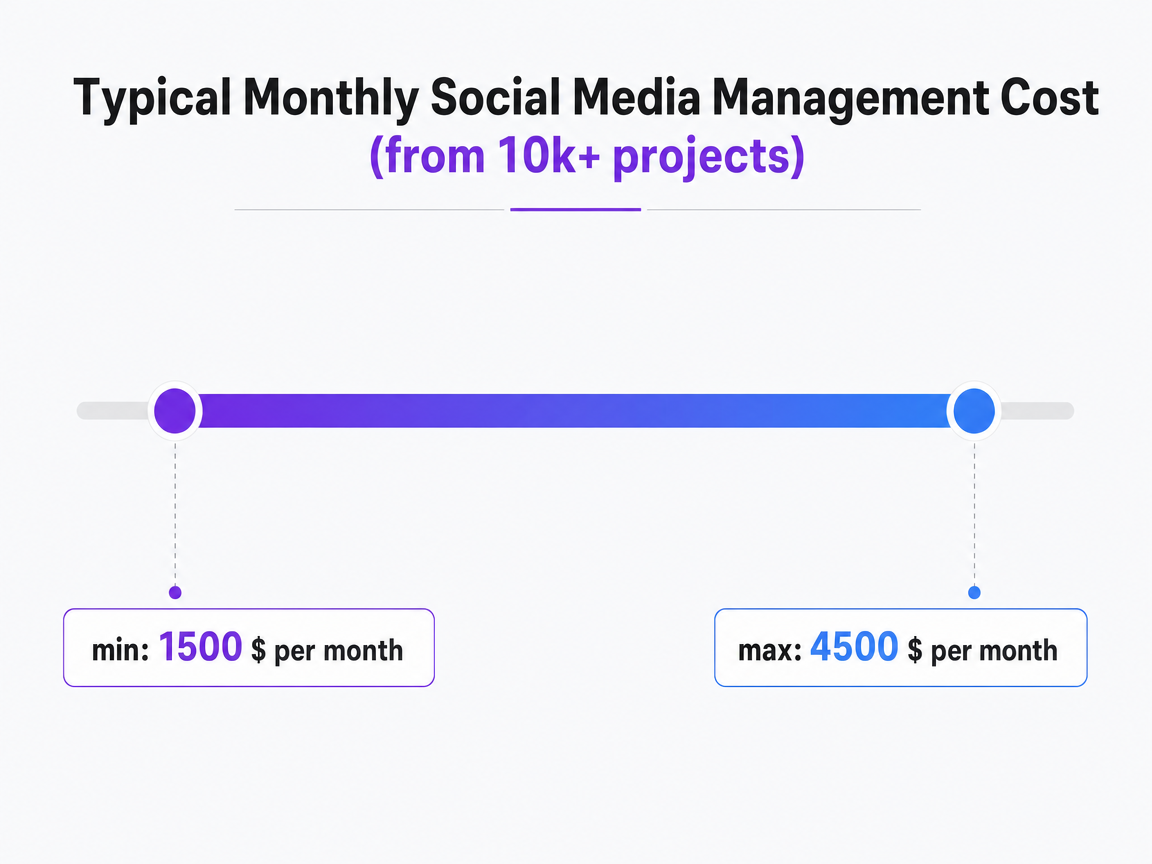 Typical Monthly Social Media Management Cost (from 10k+ projects)
Based on data from over 10,000 projects, this shows the typical monthly cost for social media management, with top-tier services exceeding this range.
Experience true social ROI without production drag
Trial lets you validate social media workflow efficiency and real client-ready results before committing.
The labor math that sets the pricing floor
Fully loaded cost, retainer yield, and the margin equation
The floor of any defensible retainer is not what competitors charge. It is what the delivery team costs. PayScale puts the average U.S. social media manager base salary at $60,808, with the range running from $41,000 to $88,000 22. Load that base with payroll taxes, benefits, software, and allocated overhead at a conservative 1.35 multiplier and the fully loaded cost lands between roughly $82,000 and $119,000 per year for a mid-level operator.
Strategic oversight sits above that. The BLS reports an average annual wage of $166,410 for marketing managers, which works out to roughly $80 per hour of senior time 15. A retainer that consumes eight hours of manager attention per month is absorbing $640 in strategy cost before a single post is drafted.
Now the yield side. A single account manager billing a productive 25 hours per week across clients generates about 100 billable hours monthly. To clear a 40% gross margin on the loaded cost above, that manager needs to yield roughly $140–$165 per billable hour in retainer revenue. A $2,500 retainer that consumes 20 hours of blended senior and mid-level time yields $125 per hour. That retainer is not profitable at target margin. It is subsidized by the retainers priced above it.
The equation gets tighter when a client asks for a fifth platform or a weekly reporting call. Scope creep at a $2,500 retainer does not erode margin. It erases it. Agencies pricing at the modal band need scope discipline enforced by the contract, not by goodwill, or they need production cost pulled down through automation. The next section shows where most agencies actually sit against that math.
Where the Databox distribution shows agencies actually land
Databox's survey of agency retainers gives the clearest picture of where the market actually clusters. Roughly 38% of agencies price their monthly retainers between $1,001 and $2,500. Another 22% sit at $2,501–$5,000. Fewer than 10% reach the $10,001–$15,000 band 21. Six out of ten agencies operate below the point where the labor math in the previous section produces a target margin without heavy automation.
That distribution explains a lot of the anxiety in principal conversations about pricing. The gravitational pull toward the $1,001–$2,500 band is not accidental. It is where small and mid-market buyers have been trained to expect retainer fees, and it is where competitive pressure from freelancers charging $75–$150 per hour concentrates 5. Agencies that build their book here can grow revenue, but they cannot grow margin without changing the cost of delivery.
The thin premium band tells the other side of the story. If fewer than one in ten agencies charges above $10,000 per month 21, the Strategic and Enterprise tiers described in the pricing ladder are not crowded. They are underpopulated. The barrier is not client willingness to pay at that level. Fresh Content Society's tiered ranges 2 and Sortlist's top-tier medians above $10,000 1 both confirm demand exists. The barrier is positioning, senior involvement, and the discipline to walk away from work that anchors the book in the modal band.
Agencies rethinking their pricing rarely need to blow up the model. They need to shift the distribution of their own book upward by two segments and price the bottom tier so it stops subsidizing the rest.
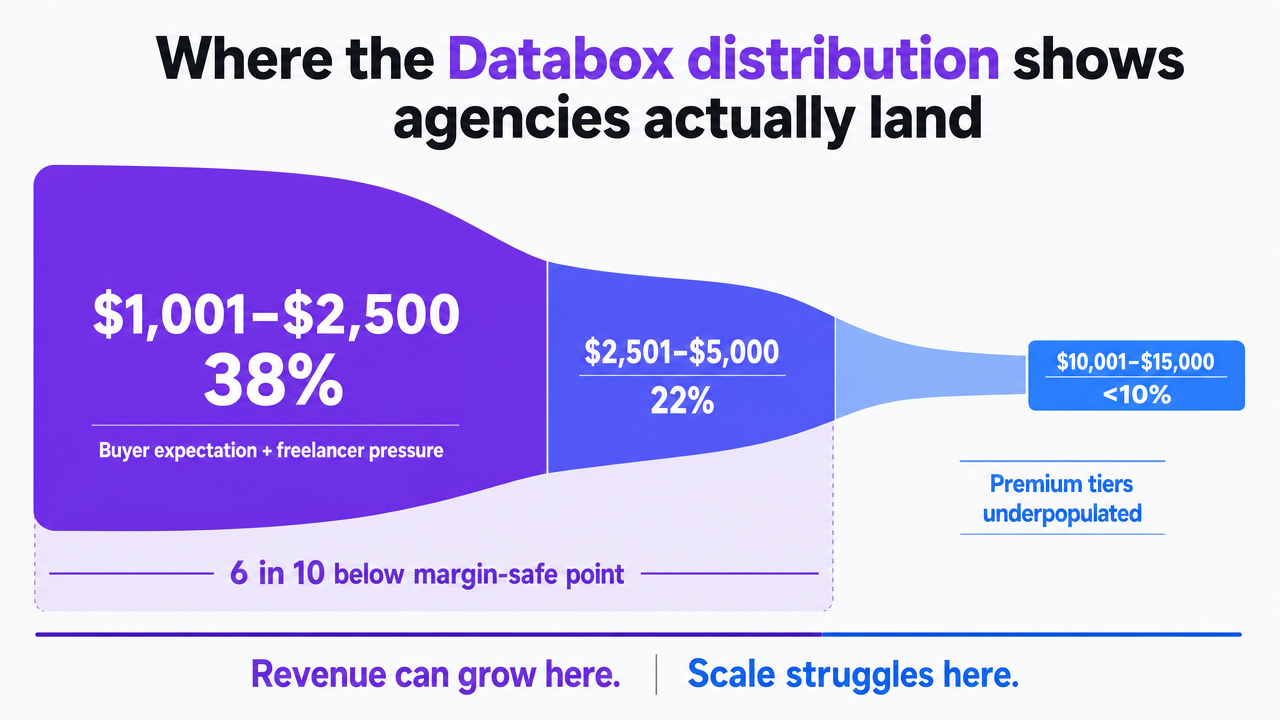 Show the actual distribution of agency monthly retainer bands from the Databox survey, directly supporting the section's core argument that most agencies cluster in the low bands while premium tiers remain underpopulated
AI-assisted execution as a cost-structure input, not a feature
Most pricing conversations about AI still treat it as a product line — an add-on service, a value-add bullet on the SOW. That framing misses what actually moves the margin equation. AI-assisted execution is a change to the cost of goods sold, not a feature to sell.
Consider what a $2,500 retainer looks like under the labor math established earlier. Twenty blended hours of senior and mid-level time yields roughly $125 per billable hour, below the $140–$165 threshold a mid-level operator needs to clear 40% gross margin against a fully loaded cost of $82,000–$119,000 22. The retainer is unprofitable at target margin. Now hold the price constant and compress production time on drafts, cutdowns, first-pass captions, and community responses by 40–60%. The same $2,500 retainer consumes 10–12 hours instead of 20. Yield jumps to $210–$250 per hour. Margin moves from negative to healthy without a single conversation about rate.
The same math changes the Strategic tier from the other direction. A $10,000 retainer priced against 60 hours of blended time yields $167 per hour — thin for the level of senior involvement Fresh Content Society's Strategic band assumes 2. Compress production, redirect the recovered hours toward strategy, planning, and executive-visible reporting, and the retainer defends its price on the work clients actually notice.
Two implications follow for how principals should think about it. Production cost belongs on the variable-input line of the P&L, alongside stock imagery and scheduling software, not on the pricing basis. And the competitive threat from AI-native shops is not that they charge less. It is that they run the modal band profitably while incumbents subsidize it. Repricing without changing the cost structure protects revenue for one renewal cycle. Changing the cost structure protects the book.
Explore Data-Driven Social Media Management Pricing Strategies
Request a custom analysis of your current social media delivery costs and discover how AI-powered workflow automation can reduce production overhead while maintaining client oversight and measurable quality.
Build, buy, or automate: the client's math against the agency
The pricing conversation agencies rarely see is the one clients have on their own whiteboard. When a marketing lead considers pulling social in-house, the question is not whether the current agency is good. It is whether the annual outlay looks defensible next to a full-time hire.
Run the numbers the way clients do. A fully loaded in-house social media manager costs $80,000 to $120,000 per year once salary, benefits, taxes, and software are counted 7. Twelve months at the Databox modal retainer of $1,001 to $2,500 yields $12,000 to $30,000 in agency spend 21. Twelve months at the Sortlist median of $1,500 to $4,500 yields $18,000 to $54,000 1. Even at the top of the median band, the agency comes in at roughly half the cost of a single mid-level hire — before the client accounts for recruiting, ramp time, or the risk of a bad fit.
That gap is the agency's structural advantage, and most principals underplay it in renewal conversations. A client threatening to in-house at a $3,000 monthly retainer is proposing to triple or quadruple their annual social spend to gain one person's capacity, without the platform breadth, backup coverage, or senior oversight the agency delivers. The math favors the agency until the retainer climbs above roughly $7,000 monthly, at which point the build-vs-buy conversation becomes legitimate rather than rhetorical.
The automate option is where the calculus shifts again. AI-assisted execution platforms compress the production hours inside the retainer, which lets an agency defend a $3,000 to $5,000 price point at a margin the in-house alternative cannot match. The client sees the same output. The agency keeps the yield. Principals walking into renewal meetings should bring the annual comparison, not the monthly one — the yearly figure is where the agency's cost advantage stops sounding like a sales line and starts looking like arithmetic.
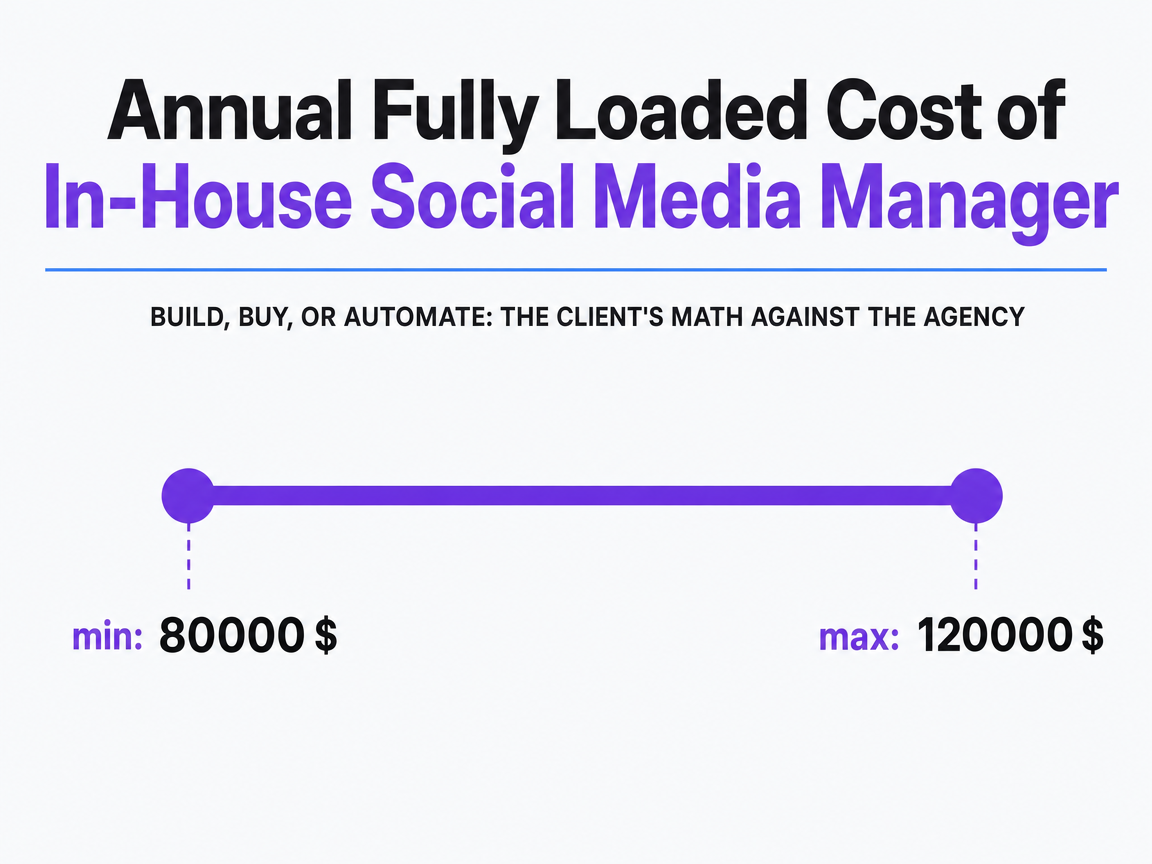 Annual Fully Loaded Cost of In-House Social Media Manager
Represents the estimated total annual cost, including salary and benefits, for an experienced in-house social media manager.
What clients can actually afford: budget-share reality check
Retainers do not exist in isolation. They compete for a slot inside a marketing budget that has its own arithmetic, and principals who ignore that math end up quoting numbers clients cannot fund without cutting somewhere painful.
Small businesses currently direct about 14.9% of their marketing budget to social media 8. The Business Development Bank of Canada puts total marketing spend at 2–5% of revenue for B2B firms and 5–10% for B2C 9, while the SBA recommends 7–8% of gross revenue on marketing and advertising, rising to 10–12% when profits sit under $5 million 10. Stack those together and a $5 million B2C client with a 7% marketing budget carries roughly $350,000 in annual marketing spend, of which social's share works out to about $52,000 per year — or $4,300 per month.
That number lands squarely inside the Growth band of the pricing ladder and above the Databox modal retainer 21. It also explains why quotes above $7,000 monthly stall with clients under $8 million in revenue: the retainer would consume more of the marketing budget than social is allocated. Principals pricing the Strategic tier should qualify on client revenue before the discovery call, not after the proposal.
Compare Your Social Media Management Costs to AI-Driven Benchmarks
Access live pricing data and workflow automation models to evaluate how your current social media delivery stacks up on cost, margin, and output volume against top-performing agencies.
If the client operates multiple locations: consolidation economics
The math changes when the client is a 10-location dental group, a regional home services brand, or a multi-office law firm. Growth-team leaders on that side of the table are running a different calculation than single-brand marketers, and agencies pricing them like ten separate accounts are leaving margin on the floor for both sides.
Run the three options a multi-location operator actually weighs.
- Per-location retainers at the Sortlist median of $1,500 to $4,500 per month 1 scale to $180,000 to $540,000 per year across ten locations.
- A consolidated multi-platform program at $5,000 to $15,000 monthly 7 lands at $60,000 to $180,000 per year for the same footprint.
- One fully loaded in-house social lead costs $80,000 to $120,000 annually 7, but covers strategy and oversight only, not per-location execution.
| Delivery model (10 locations) | Monthly range | Annual range | What it covers |
|---|---|---|---|
| Per-location retainers | $15,000–$45,000 1 | $180,000–$540,000 | Ten separate accounts, duplicated overhead, uneven quality |
| Consolidated program | $5,000–$15,000 7 | $60,000–$180,000 | Central strategy, localized execution, shared reporting |
| In-house social lead | — | $80,000–$120,000 7 | One strategist, no per-location production capacity |
The consolidated program wins on price against ten stitched-together retainers and wins on scope against a single hire. That is the pitch multi-location operators are already making internally, and agencies quoting ten separate $2,500 retainers to a DSO or franchise group are losing the deal to a competitor who priced the portfolio.
AI-assisted execution changes the ceiling on the consolidated model. Central strategy stays fixed. Per-location production — localized captions, geo-tagged variants, review responses, community engagement per market — is where hours multiply and margins collapse. Compressing that production layer is what lets an agency defend a $10,000 monthly consolidated program across ten locations at a margin the per-location model cannot reach, while giving the client output that reads as local at every address. Principals pitching multi-location work should lead with the annual portfolio number, not the per-location line item. The portfolio number is where the agency's cost structure becomes an argument, not just a quote.
Repricing without losing the book
Repricing an existing book is where most principals hesitate, and the hesitation is expensive. Every month a $2,000 retainer stays priced against a 2023 cost structure is a month of subsidized delivery. The sequencing matters more than the size of the increase.
- Start with the annual review clause, not the renewal conversation. HoneyBook's guidance to build annual rate reviews into the contract from day one removes the awkwardness of raising fees mid-relationship 5. For legacy clients without that clause, tie the first adjustment to a scope refresh rather than a rate hike. Repackage the deliverables into the tier the account actually consumes. A client paying $2,000 for what is functionally Growth-band work at $3,000–$7,000 monthly is not being asked to pay more; they are being asked to pay correctly.
- Do not discount when clients push back. Adjust scope 5. Dropping one platform, moving reporting from weekly to monthly, or shifting community response to business hours preserves the rate and preserves the margin. Clients who accept the trimmed scope reveal their true budget. Clients who reject it reveal the account was never priced sustainably.
- Move the price change from hourly output to outcome anchors on the same cycle 4. Engagement growth, qualified inbound, or share of voice on a defined competitor set gives the retainer something to defend at renewal that a post count cannot. Losing 10–15% of a legacy book during a reprice is not a failure. It is the cost of ending the subsidy.
Frequently Asked Questions
References
- 1.[2025 Benchmark] Social media management pricing from 10,000+ projects.
- 2.Social Media Management Pricing 2026.
- 3.Social Media Management Pricing in 2026.
- 4.Freelance Social Media Manager Rates in 2026.
- 5.How to price your social media management services - HoneyBook.
- 6.How Much to Charge for Social Media Management?.
- 7.How Much Does a Social Media Marketing Agency Cost in 2026?.
- 8.Small business marketing budget statistics for 2026.
- 9.What is an average marketing budget for a small business?.
- 10.Small Business Marketing Budget.
- 11.How To Set B2B Social Media Budgets (Formula + Examples).
- 12.Marketing spend as a percentage of revenue: how much to budget?.
- 13.How Much Should You Spend on Digital Marketing in 2026?.
- 14.4 Factors to Consider When Creating a Digital Marketing Budget.
- 15.Marketing Managers.
- 16.Social media specialist : Career Outlook.
- 17.Social Media Manager Job Outlook.
- 18.Media and Communication Occupations.
- 19.How to Get the Most From Your Marketing Budget.
- 20.Social Media Marketing Agency Pricing Guide for 2024.
- 21.How Much Should Your Marketing Agency Charge for its Retainer Fee?.
- 22.Social Media Manager Salary in 2026 | PayScale.
- 23.2025 Social Media Salary Report: What Managers Really Earn | Tellos.