
Key Takeaways
- Agency cost decomposes into monitoring, bonding, and residual loss — most of it hides in payroll hours, fee premiums, and missing pipeline rather than on the agency invoice 9.
- Switching to performance or hybrid fees relocates cost instead of removing it, since agents price risk back through higher bases or drift toward easier KPIs 7, 8.
- Multi-vendor stacks add a fourth category the classic framework misses: coordination cost, which compounds at the seams between agents and shows up as calendar load, reporting reconciliation, and decision latency 1, 5.
- The highest-leverage move is governance — who sees work before it ships and how fast it reaches market — not vendor selection or fee renegotiation, because residual loss survives both 8.
Where the marketing dollar actually goes
A marketing VP signing off on next quarter's agency invoices is not really approving creative or media — they are approving a settlement of accounts on three things they cannot fully observe: how much oversight their team had to spend, how much premium they paid to align the agency's incentives, and how much output never showed up in pipeline. Economists call that bundle agency cost. On a P&L, it hides inside line items labeled retainer, software, and headcount.
The pressure to surface it is sharper now than in any recent cycle. The CMO Survey reports that U.S. marketing spend grew 5.8% year over year while marketing budgets as a share of company revenue dropped from 10.1% to 7.7%, a finding drawn from CMO-level respondents across U.S. companies and not from any single vertical 10. Absolute dollars rose. The slice of the corporate pie shrank. That gap forces a question most VPs already feel in their calendar: every dollar inside the agency relationship now has to defend itself against in-house execution and against newer AI-driven alternatives flagged in Deloitte's 2026 CMO Survey of more than 300 marketing leaders 11.
The rest of this piece treats agency cost the way the underlying economic literature does — as a decomposable problem with specific cost types, each with its own contract lever — and translates each one into the artifacts a VP actually controls: meetings, reports, fee structures, and the work that ships.
The three-part decomposition, translated for marketing operations
Monitoring: what oversight actually costs a VP
Jensen and Meckling defined monitoring as the resources a principal spends to observe and constrain an agent's behavior 9. In a corporate finance setting, that meant board oversight, audits, and reporting requirements. In a marketing department, it means something more mundane: the standing 8 a.m. Tuesday with the SEO agency, the QBR deck the paid media team builds every ninety days, the QA pass on every blog draft before it goes live, the dashboard subscription a VP renews because no single agency report aggregates pipeline cleanly.
Monitoring is the cost category most VPs systematically underestimate, because almost none of it sits in the agency invoice. It sits in payroll. A senior marketing manager spending six hours a week reviewing agency output, plus two hours coordinating across vendors, plus four hours preparing internal reporting, is a monitoring line item — roughly a third of an FTE — that never appears on a procurement spreadsheet.
The legal-services literature treats this as a feature, not a bug, when it works. The defense of the billable hour rests on exactly this logic: time-based reporting gives the client a granular record of effort that can be inspected and compared across providers 12. That argument generalizes. A weekly hours log from a content team is monitoring infrastructure. So is a click-by-click media plan reconciliation.
The problem is that monitoring scales with vendor count, channel count, and contract opacity. Three agencies do not require three times the oversight of one — they require more, because the marginal hour goes to reconciling conflicting reports rather than reading any single one. That math is what makes monitoring the first place to look when the budget gets squeezed.
Bonding: fee structures as incentive contracts
Bonding costs are what the agent spends — or what the principal pays the agent to spend — to credibly commit to acting in the principal's interest 9. In marketing, that translates almost entirely into how the contract is priced.
A pure retainer is a weak bond. The agency gets paid the same whether the campaign hits or misses, so the only commitment mechanism is reputational. A commission model bonds the agency to spend volume but not to outcome quality, which is why the advertising industry spent two decades migrating away from it. The UCLA compensation history documents the steady displacement of commission-only arrangements by fee, performance, and hybrid structures, driven by advertiser demand for tighter incentive alignment 6. Performance fees raise the stakes: the agency accepts revenue variance in exchange for upside if results land.
Every bonding mechanism has a price. The Colorado Law analysis of alternative fee arrangements in litigation makes this explicit — contingency and flat-fee structures shift risk onto the agent, who then prices that risk back into the engagement, sometimes through higher base fees and sometimes through behavior the client did not anticipate, such as settling cases early to lock in a return 7. The marketing parallel is direct. A performance-fee SEO contract tied to ranking improvements creates strong incentives to chase the rankings that move fastest, which are not always the rankings tied to qualified pipeline.
The digital marketing pricing literature frames the same trade-off in information terms: contract structure allocates risk between principal and agent based on who has better information about effort and outcomes 8. When the agency knows more about what is actually driving results — which is almost always true in paid media and technical SEO — performance contracts can transfer risk efficiently. When the principal cannot verify what the agent did, bonding fees compensate for an asymmetry that monitoring alone cannot close.
The useful question is not whether to add a performance component. It is which behaviors the bond actually rewards, and which it quietly punishes.
Residual loss: the gap nobody invoices for
Residual loss is whatever value disappears after monitoring and bonding have done their work 9. It is, by construction, the part of agency cost that no contract can fully eliminate — the gap between the outcome a perfectly aligned, perfectly informed agent would produce and the outcome the actual arrangement produces.
In marketing, residual loss is the off-brief landing page that ships because the brief was ambiguous and nobody caught it in QA. It is the six-week delay between a competitor's pricing change and the response campaign, because the approval chain ran through three accounts and a media buyer on PTO. It is the budget that ran on broad-match keywords for a quarter past the point the data said to pause them. None of it shows up on an invoice. All of it shows up in pipeline.
The digital marketing pricing analysis is direct about the source: information asymmetry produces residual loss whenever the agent's effort or judgment cannot be fully observed, regardless of fee structure 8. Monitoring reduces the asymmetry. Bonding aligns the incentive. Residual loss is what survives both.
That survival is the reason the cost category matters most for marketing leaders running constrained budgets. Monitoring hours can be cut. Fee structures can be renegotiated. Residual loss compounds quietly until a year-end pipeline review forces the reconciliation. The practical implication is that the highest-leverage place to attack agency cost is rarely the line item — it is the information architecture that determines how much residual loss the line item generates.
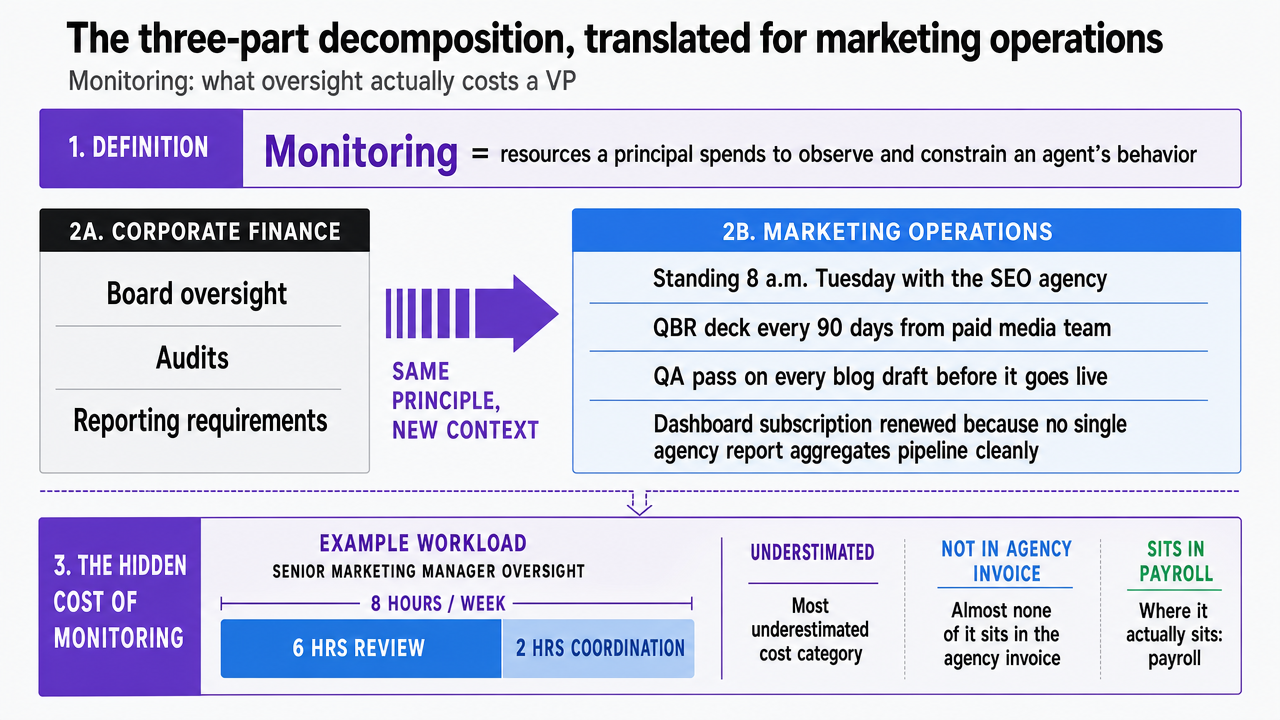 Visualize the Jensen-Meckling three-part decomposition translated into marketing operations terms, directly supporting the section's framework explanation
Experience streamlined marketing execution at scale now
Test drive end-to-end, real-world campaign deployment and see measurable cost efficiency in your workflow.
Coordination cost: the fourth category most P&Ls miss
The classic decomposition assumes one principal and one agent. Marketing rarely works that way. A VP at a multi-location services company typically runs a content shop, a paid media agency, an SEO specialist, a creative studio, and an internal team — five principals and agents pointing at the same pipeline, each with their own scope of work and reporting cadence.
That structure introduces a cost category the original framework absorbs into residual loss but operators feel as its own line: coordination cost. It is the overhead of getting independent agents to act as if they were one.
The legal literature on team-based representation is the cleanest analog. Research on multi-counsel engagements finds significant agency costs between issuing companies and their legal counsel when responsibility is shared across multiple actors, with individual accountability diluted as team size grows 1. The mechanism transfers directly. When the paid media agency and the SEO agency both touch landing pages, neither owns conversion rate. When the content shop writes and the creative studio designs, neither owns publication date. Each agent has a defensible explanation for why a missed outcome was someone else's input.
The shared-agency literature surfaces the same problem from the other direction. Analysis of whether competing brands should use the same advertising agency catalogs the scale and scope trade-offs that drive consolidation decisions: a single agency captures cross-channel efficiencies but introduces conflict-of-interest risks and information-leakage concerns that a multi-agency stack avoids 5. The trade is real in both directions. Splitting work across specialists reduces conflict exposure and concentration risk. It multiplies the seams.
Coordination cost shows up in three observable places.
- The first is calendar load: cross-vendor syncs, integration meetings, and the recurring 'who owns this' email thread.
- The second is reporting reconciliation, where the VP or a senior manager spends hours per month aligning numbers that should match but do not, because each agency pulls from its own attribution model.
- The third is decision latency. A pricing-page rewrite that touches copy, design, dev, and paid landing-page testing moves at the speed of the slowest approval in the chain — usually measured in weeks, not days.
None of this is captured in the standard monitoring/bonding/residual loss model because the framework assumes the agents do not interact. In modern marketing operations, they interact constantly, and the friction is its own budget item.
Why compensation redesign relocates cost instead of removing it
The case for time-based billing as a monitoring tool
Time-based billing has a worse reputation than it deserves. The standard critique — that hourly rates reward slow work and punish efficiency — is correct in spirit and incomplete in practice. The contrarian academic defense reframes the billable hour as a monitoring mechanism: a structured record that lets a client impose discipline on an agent and compare effort across providers in matters where outcomes are uncertain and effort is hard to observe directly 12. The framing is drawn from legal services, where outcome variance is high and the principal cannot easily judge what a competent lawyer should have done. Marketing has the same structural problem in technical SEO, complex paid media builds, and any campaign where the agency's judgment calls compound over months.
A detailed hours log is information. It tells the principal which channels actually consumed senior attention, which projects ran over because scope crept, and which retainer line items quietly absorbed the agency's least experienced staff. That visibility is the bond. Strip it out — move to a flat fee with no effort reporting — and the monitoring infrastructure goes with it. The fee gets cleaner. The information gets worse. Whether that trade reduces total agency cost depends entirely on how much residual loss the lost visibility creates.
Performance and hybrid fees: better incentives, new blind spots
The migration away from commission-only compensation in advertising was driven by exactly the problem time-based billing addresses imperfectly: commission rewarded media volume rather than outcome quality, and advertisers wanted contracts that paid for results 6. Hybrid structures — a base retainer plus a performance component tied to leads, qualified opportunities, or revenue — became the default. On paper, the bond tightens. In practice, the cost moves.
The Colorado Law analysis of alternative fee arrangements catalogs the migration mechanics. Outcome-based contracts shift risk from principal to agent, and the agent prices that risk back into the engagement, sometimes through higher base fees and sometimes through behavioral changes the principal did not anticipate, such as settling matters early to lock in a return rather than pursuing higher-variance outcomes 7. The marketing version is direct.
- A performance fee tied to lead volume incentivizes the cheapest leads, not the qualified ones.
- A fee tied to ranking improvements pushes effort toward the keywords that move fastest, which correlate poorly with the keywords that convert.
- A fee tied to revenue requires an attribution model both parties trust, and most do not.
The digital marketing pricing literature is precise about why: contract structure allocates risk based on who has better information about effort and outcomes, and in most agency relationships the agent knows more than the principal about which inputs actually drive results 8. Hybrid fees do not close that asymmetry. They re-price it. The principal still pays for the information gap — just in a different column of the contract.
The operational implication for a VP is narrower than it looks. Compensation redesign cannot eliminate agency cost. It can only move it between monitoring, bonding, and residual loss, and the right mix depends on which category the current operation generates most cheaply. A team with strong analytics infrastructure can absorb monitoring efficiently and should push harder on hybrid fees. A team without it will pay for bonding and never see the residual loss the bond was supposed to prevent.
See How AI-Driven Execution Reduces Agency Overhead Costs
Request a cost breakdown and discover how unified automation can cut briefing cycles, status meetings, and vendor management—supported by real performance benchmarks for agencies and enterprise teams.
The contrarian read: VPs may be under-investing, not overspending
Most agency-cost conversations assume the principal is overpaying. The legal-services research suggests the opposite problem is at least as common.
A Duke study comparing outside counsel selection between major U.S. public companies and private-equity-owned companies in financing transactions found that public companies systematically chose lower-ranked law firms than comparable PE sponsors, and concluded that public companies may well be spending too little on outside counsel rather than too much 3. The mechanism is internal agency cost. A general counsel managing a procurement process, a budget committee scrutinizing legal spend, and a CFO benchmarking against peer averages all push toward defensible cost discipline, not toward the firm that would actually maximize transaction value. The frictions inside the principal's own organization produce under-investment.
The Yale market-information analysis sharpens the point. Agency cost is one input into outside-counsel selection, but reputation, signaling, and information gaps about firm quality matter just as much, and clients routinely make selection errors in both directions 4.
The marketing translation is uncomfortable. A VP who has spent two budget cycles cutting agency line items, consolidating vendors, and pushing fees down may have reduced visible spend while increasing residual loss — the part of agency cost no procurement report tracks. The discipline that looks rigorous on the budget review can be the same discipline that under-resources the work most likely to move pipeline. The diagnostic question is not whether the agency line is too high. It is whether the current spend is buying enough capability to close the information gap that produces residual loss in the first place.
If you manage multiple locations: an execution-model comparison
The math changes when one VP is responsible for pipeline across fifteen dental offices, forty home services franchises, or a behavioral health group operating in eight states. Each location has its own local SEO footprint, paid media geography, and call-handling workflow. Monitoring load, bonding cost, and residual loss do not scale linearly with location count — they compound, because every agent added to the stack introduces new seams.
Three execution models dominate the multi-location market:
- A multi-agency stack assigns specialists to each channel, often with separate vendors for SEO, paid search, social, and content.
- A single full-service agency consolidates the work under one roof.
- An approval-first AI execution platform routes channel work through specialist systems that surface ranked recommendations, then ships only what the VP signs off on.
The trade-offs are not symmetric. The shared-agency literature catalogs the scale and scope effects that drive consolidation: a single agency captures cross-channel efficiencies but raises conflict-of-interest exposure when the agency serves competing brands, and concentrates information risk in one vendor relationship 5. Splitting work across specialists reduces that exposure and adds coordination overhead in its place. The compensation history shows the fee side moving the same direction — away from commission, toward hybrid structures that price effort and outcome separately 6. The digital marketing pricing analysis frames the underlying constraint: contract structure allocates risk based on who has better information, and in multi-location operations the information gap widens with every additional agent and every additional market 8.
| Cost category | Multi-agency stack | Single full-service agency | Approval-first AI execution |
|---|---|---|---|
| Monitoring load | High — multiple reports, reconciled manually | Moderate — one report, limited channel depth | Low — unified dashboard, channel-level detail |
| Bonding / fee structure | Retainer per vendor, often hybrid fees 6 | Consolidated retainer, blended performance terms | Subscription with approval gate on every deliverable |
| Residual loss | High — seams between channels, slow response 8 | Moderate — single attribution model, shallower expertise | Low to moderate — depends on signal quality and approval cadence |
| Coordination overhead | High — cross-vendor syncs, conflict exposure 5 | Low internally, moderate for VP oversight | Low — single workflow, specialist systems coordinated |
The table is a diagnostic, not a verdict. A multi-location operator with deep internal analytics can absorb monitoring efficiently and may extract more value from a specialist stack than from consolidation. An operator without that infrastructure pays for coordination cost twice — once in calendar load, once in the residual loss the seams generate — and the consolidation case strengthens accordingly.
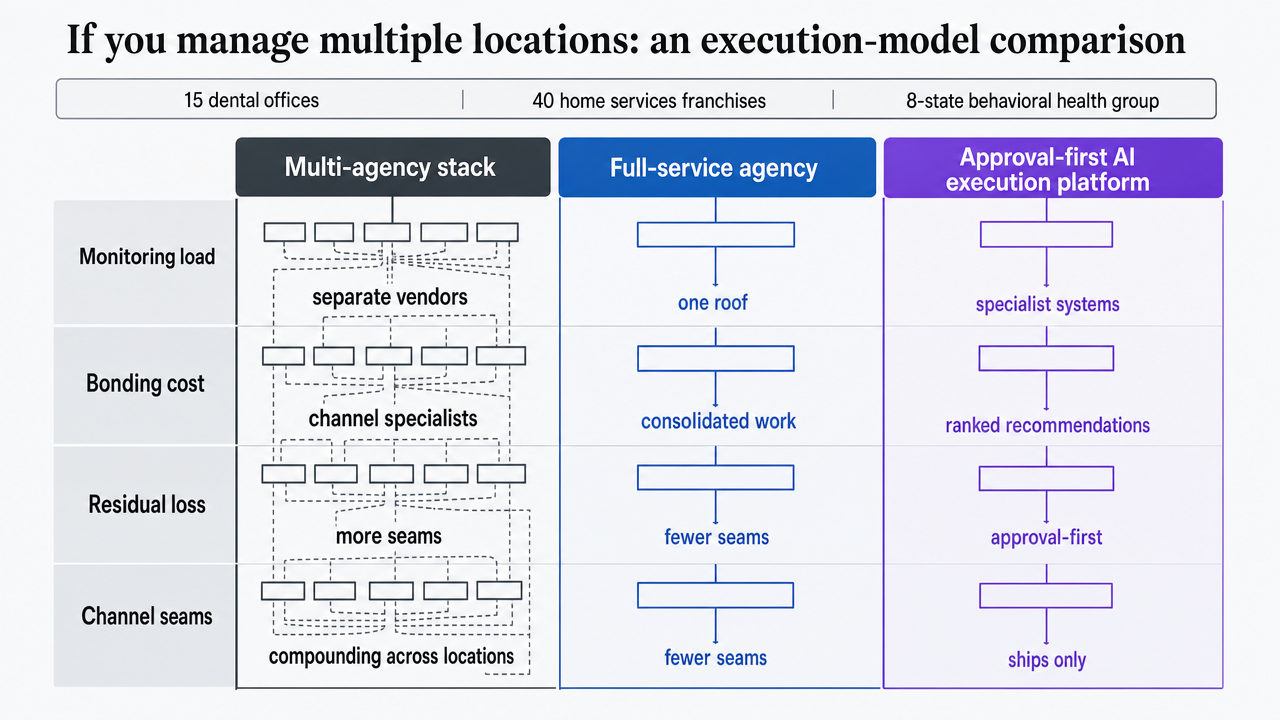 Reinforce the comparison table by visualizing the three execution models against the four cost categories, supporting the section's comparative framework
Quantify and Cut Hidden Agency Costs with Real-Time Data
Access granular analytics on every category of agency cost—billable hours, coordination overhead, and campaign inefficiencies—enabling in-house teams to benchmark, forecast, and optimize spend across channels without losing control.
Governance, not vendor selection, sets the ceiling
The pattern across every cost category points the same direction. Monitoring scales with vendor count and contract opacity. Bonding mechanisms relocate cost rather than remove it 7. Residual loss survives both, fed by the information asymmetry that fee structure alone cannot close 8. Coordination cost compounds at the seams between agents 1. The common variable is not which agency is on retainer — it is how the principal sees what the agents are doing and how quickly approved work reaches market.
That reframes the lever. A VP who consolidates three vendors into one captures coordination savings and gives up specialist depth. A VP who renegotiates from retainer to hybrid fees tightens the bond and pays for the new asymmetry through a higher base or behavioral drift toward easy KPIs 6. Neither move changes the underlying governance: who sees the work before it ships, on what cadence, against what signal.
Approval-first execution is the structural answer most procurement conversations skip. When every deliverable routes through a single workflow that ranks recommendations against live pipeline data and ships only what the VP signs off on, three things collapse into one process. Monitoring becomes the approval queue. Bonding becomes the subscription. Residual loss shrinks to the gap between signal quality and approval cadence. Deloitte's 2026 CMO Survey of more than 300 marketing leaders documents the broader migration toward AI-driven execution under exactly this budget pressure 11. Vectoron operates that workflow for teams running it directly.
Frequently Asked Questions
References
- 1.The Agency Costs of Teamwork.
- 2.Ethical Rules, Agency Costs and Law Firm Structure.
- 3.Agency Costs in Law-Firm Selection: Are Companies Under-Spending on Counsel?.
- 4.Market Information and the Elite Law Firm.
- 5.Should Competitors Share the Same Advertising Agency?.
- 6.Evolution of Advertising Agency Compensation.
- 7.Alternative Fee Arrangements and Agency Costs in Entrepreneurial Litigation.
- 8.Pricing Digital Marketing: Information, Risk Sharing and Performance.
- 9.Theory of the Firm: Managerial Behavior, Agency Costs and Ownership Structure (PDF reprint).
- 10.The CMO Survey: Despite Uncertainty, Marketing Budgets Rebound.
- 11.2026 CMO Survey | Deloitte US.
- 12.In Defense of the Billable Hour: A Monitoring Theory of Law Firm Fees.