
Key Takeaways
- Treat partner selection as risk underwriting rather than vendor shopping, since penalty exposure and FTC liability transfer to the reselling agency regardless of awareness 1.
- Request 20 to 30 live placements with sourcing method declared per link, then run WHOIS, hosting, and template checks to expose mislabeled PBN or paid inventory.
- Grade every sample against four observable disclosure criteria drawn from the FTC native advertising standard: present, above the headline, plain language, and visible without interaction 3.
- Audit the vendor's outreach playbook, sender-domain inventory, and unsubscribe propagation process to confirm CAN-SPAM compliance before inheriting prospecting liability 10.
- Require placement-level attribution mapping links to target URLs, organic session change, and conversion events, because activity metrics describe production rather than performance 5.
- Raise the sourcing floor for YMYL clients by requiring credentialed named authors and documented editorial standards, since aggressive SEO optimization can undercut trust signals 6.
- Concentrate volume across two or three deeply vetted partners once managing ten or more accounts, collapsing per-account vetting cost while strengthening governance leverage 8.
- Compress the four audits into a five-day rubric producing dated artifacts, with sub-4 scores on disclosure or outreach triggering automatic rejection regardless of composite.
Vetting as Risk Underwriting, Not Vendor Shopping
The agencies that scale white label link building without taking on penalty exposure treat partner selection as risk underwriting. They are not comparing vendor decks on referring-domain counts and turnaround time. They are pricing the probability that a partner's sourcing, disclosure, and outreach practices will eventually surface as a manual action, an FTC inquiry, or a client offboarding email.
That shift matters because the regulatory floor moved while the link industry kept selling the same product. The FTC's Endorsement Guides apply to paid reviews, influencer links, and testimonial placements that frequently appear inside white label link inventories, regardless of whether the buying agency knew those mechanics were used 1. The agency reselling the placement inherits the disclosure obligation. A partner who cannot describe, in writing, how its placements meet the material-connection standard is not a discount option. It is unpriced liability sitting on the buying agency's balance sheet.
Operators running 5 to 50-person shops feel this asymmetrically. A single penalized client account can consume more strategist hours in cleanup, audits, and retention conversations than the entire vendor relationship generated in margin across a year. The math does not favor speed over diligence.
A defensible vetting framework scores partners on four axes that map to actual risk: where links come from, how placements are disclosed, how outreach is conducted, and how outcomes are measured. Each axis ties to a specific evidence artifact a vendor must produce, not a sales claim. The remainder of this piece works through those audits in order, then converts them into a one-week go/no-go rubric that an operations lead can run without senior intervention. The point is repeatable diligence, not bespoke evaluation per deal.
The Sourcing Audit: Where Links Actually Come From
The first vendor artifact worth requesting is a representative sample of 20 to 30 live placements from the last 90 days, with the sourcing method declared for each. Editorial earned coverage, sponsored content with disclosure, undisclosed paid placement, private blog network insertion, and influencer placement all generate links. They do not generate equivalent risk. A partner that cannot or will not categorize its own inventory is signaling that the categorization would not survive scrutiny.
The categories matter because the FTC defines material connection by the economic relationship, not by the SEO intent. If a vendor pays a publisher, gifts a product, or arranges a quid-pro-quo placement, the relationship triggers disclosure obligations regardless of whether the placement was framed as a guest post, a resource mention, or an organic editorial reference 1. Vendors that describe their inventory as "editorial" while their procurement workflow involves payment to publishers are mislabeling material connections. That mislabeling is the exposure.
Private blog networks sit in a separate category. They violate Google's spam policies on link schemes directly, and the buying agency carries the ranking-loss risk on its client's domain rather than the vendor's. No disclosure language fixes a PBN placement because the underlying network exists to manipulate ranking signals. Operators auditing samples should run referring-domain footprints, hosting overlap, and content templating checks on a random subset. A vendor that returns three samples from sites sharing the same WHOIS pattern, theme, or boilerplate author bios is selling PBN inventory under a different label.
Influencer placements raise a third question. The FTC's endorsement framework applies to any compensated endorsement, including arrangements brokered through an intermediary 1. A white label partner that arranges influencer links without contractually requiring disclosure language is creating liability that flows back to the agency reselling the placement. The sourcing audit should produce a written matrix from the vendor mapping each placement type to its disclosure mechanic and its Google policy posture. Vendors that resist producing this matrix have answered the vetting question without realizing it.
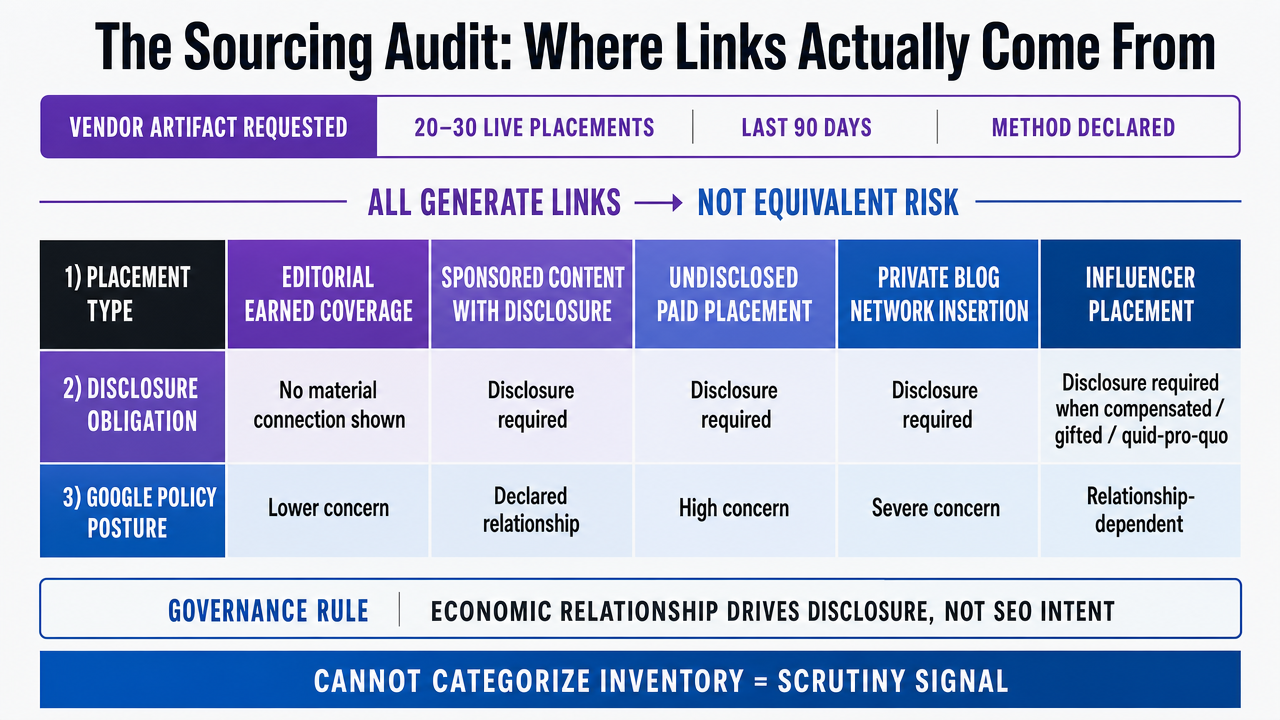 Visualize the section's sourcing categorization matrix mapping placement types to disclosure obligation and Google policy posture, which is the core artifact the section instructs operators to request from vendors
The Disclosure Audit: What a Compliant Placement Looks Like
Sourcing tells an operator where a link came from. Disclosure tells the operator whether the placement, as published, will hold up under FTC scrutiny. These are separate audits because a vendor can source ethically and still ship non-compliant final assets, and a vendor can disguise paid sourcing behind disclosure language that fails the clarity test.
The FTC's native advertising guidance sets the standard the buying agency should hold partners to. Disclosures on sponsored content must appear in front of or above native ad headlines, use plain language a consumer would understand, and remain visible before the reader encounters the promotional message 3. A disclosure buried below the byline, hidden behind a hover tooltip, or written as "partner content" without further context does not satisfy the standard. The FTC's position is that an advertisement should not suggest or imply to consumers that it is anything other than an ad 3.
That translates into a concrete sample-review checklist. When the vendor produces its 20 to 30 placements from the sourcing audit, each one gets graded on four observable criteria:
- disclosure exists,
- disclosure sits at or above the headline,
- disclosure language is clear to a non-marketer, and
- disclosure remains visible without user interaction.
Placements that fail any of the four criteria are non-compliant inventory, regardless of how the vendor categorized them. Agencies should expect a meaningful failure rate on first review, especially among vendors who have not been audited by a buyer before.
Influencer and testimonial-driven placements raise a parallel standard. The FTC's endorsement framework requires that any material connection between an endorser and a marketer be disclosed clearly and conspicuously when the connection could affect how consumers weigh the endorsement 4. For white label partners brokering influencer links, this means the contract with the influencer must specify the disclosure language and placement, and the published post must reflect it. Agencies vetting vendors should request the contractual template the vendor uses with influencers. A partner that cannot produce a template, or whose template treats disclosure as optional, is operating outside the endorsement guides 9.
Two failure patterns recur across vendor samples. The first is the "sponsored by" line placed at the foot of the article, where a reader who scans the headline and first paragraph never sees it. The second is the use of industry-insider language—"partner post," "contributor content," "in collaboration with"—that does not communicate a paid relationship to a general audience. Both patterns fail the clarity test the FTC has applied repeatedly, and both are common in inventory marketed as premium editorial placement 3.
The disclosure audit ends with a written attestation. The vendor signs a document confirming that every placement delivered will meet the four-criteria standard, and that the buying agency will receive a screenshot or archived URL of each placement at delivery. That paper trail is what converts a verbal compliance claim into something an agency can rely on when a client's legal team asks how the program was governed.
Test AI-powered link building execution now
Experience hands-on delivery of real white label links in your own campaigns before making any commitment.
The Outreach-Compliance Audit: CAN-SPAM and Inherited Liability
Most white label partners build inventory through outbound email at volume. That workflow sits squarely inside the FTC's CAN-SPAM rules, which govern commercial messages and give recipients the right to stop email marketing 10. When the buying agency resells those placements, it inherits exposure for the prospecting layer it never touched.
Three vendor practices recur in failed audits:
- Pitches sent from spoofed or misleading sender domains violate the identification standard.
- Subject lines that mask the commercial nature of the request fail the deception test.
- Outreach sequences that ignore unsubscribe requests, or route them to addresses the vendor does not monitor, breach the opt-out mechanics CAN-SPAM requires 10.
Each pattern is common in volume-driven link shops, where outreach is operated by contractors working from rotating mailboxes.
The audit artifact is the vendor's outreach playbook. Agencies should request the templates used in the last 60 days, the sender domain inventory, and the unsubscribe handling process in writing. A compliant partner can produce a sender-identification scheme that reflects the actual business, subject lines that describe the request honestly, a physical postal address in the message body, and a monitored unsubscribe path that propagates across the vendor's entire mailbox pool. Partners that cannot describe the unsubscribe propagation step are running parallel campaigns from disposable infrastructure, which is the operational tell that the program is built to evade rather than comply.
The downstream consequence matters because outreach liability does not stay contained at the vendor. When a publisher complaint, ISP block, or regulator inquiry traces back to a campaign promoting a client's domain, the client's brand sits on the message. The buying agency answers the call. A vendor contract that omits CAN-SPAM representations and indemnification for outreach conduct shifts that risk back onto the agency by default.
The Measurement Audit: Organic Revenue Over DR Thresholds
Sourcing, disclosure, and outreach audits answer whether a partner is safe to resell. Measurement answers whether the partner is worth reselling. Most vendor reports default to activity metrics: links placed, average domain rating, referring domain growth, anchor distribution. Those numbers describe production, not performance. A vendor that cannot connect its placements to organic sessions, ranking movement on commercial keywords, and downstream revenue on the client's tracked conversion events is selling output, not outcomes.
The academic record supports the shift. A peer-reviewed analysis of digital inbound marketing found that effective combinations of SEO and inbound activity can significantly and positively affect firm performance when measured against economic outcomes rather than activity volume 5. The study examined how organic visibility and link-driven traffic translate into measurable returns, which gives operators a defensible reason to push vendor reporting past link counts and toward revenue contribution. Agencies that anchor partner scorecards in activity metrics are measuring the easier number, not the right one.
The audit artifact is the vendor's reporting template, populated with three consecutive months of data on an active client account. A measurement-ready partner ships placement-level attribution: each link mapped to the target URL, the keyword cluster it supports, the change in organic sessions on that URL over a 60 to 90-day window, and the conversion events tied to those sessions in the client's analytics. Partners that produce this reporting have integrated with client measurement stacks. Partners that resist the request are building inventory in isolation from outcomes.
A five-axis vendor scorecard makes the framework portable. Operators score each partner on editorial sourcing, disclosure mechanics, CAN-SPAM outreach, organic-revenue measurement, and reporting transparency, with each axis graded against the specific artifact requested in the prior audits. The composite score becomes the go/no-go input. It also becomes the document a junior strategist can defend in a partner review, and the basis for renegotiating scope when a vendor underperforms on revenue contribution despite hitting placement volume targets.
See How Leading Agencies Streamline White Label Link Building Oversight
Connect with a specialist to review data-driven frameworks for evaluating link building partners, ensuring measurable quality and full transparency at scale.
High-Stakes Verticals: Why YMYL Clients Raise the Floor
The vetting framework tightens further when the end client operates in a Your-Money-Your-Life vertical. Law firms, behavioral health practices, dental groups, and senior living operators sit inside Google's heightened quality bar for content that affects health, finances, or legal outcomes. A partner whose inventory clears the standard for a SaaS client may still fail when the destination URL is a personal injury landing page or a Medicare-eligible service line.
A peer-reviewed evaluation of diabetic retinopathy websites found that higher SEO scores were not consistently aligned with optimal readability and accessibility, with the authors noting room for improvement in the balance between search performance and content quality on health information sites 6. The finding generalizes a useful caution rather than a market statistic: partners optimizing aggressively for ranking signals can ship placement content that undercuts the user-trust signals YMYL clients depend on. Thin contributor bios, AI-generated host content, and templated outreach posts all carry less weight on a legal services domain than on a software blog.
The audit adjustment is straightforward. For YMYL accounts, operators raise the sourcing threshold to require named authors with verifiable credentials on host sites, refuse syndicated or rewritten host content, and document the editorial standards of every publisher in the placement sample. Partners that cannot meet the elevated floor stay assigned to lower-stakes accounts in the portfolio. The vetting framework becomes tiered, not uniform.
If an Agency Manages 10+ Client Accounts: Consolidating Vetting Economics
The framework changes shape once an agency runs more than ten active client accounts through a shared white label partner. The unit economics of vetting shift from a per-deal cost into a portfolio investment, and the math starts favoring the rigorous version of the audit rather than the abbreviated one.
The intuition runs against the way most agencies budget diligence. A two-client shop weighs vendor audit hours against the margin on two accounts and tends to shortcut the disclosure and outreach reviews. A twelve-client portfolio amortizes the same audit across every account routed to that partner, which collapses the per-client cost while raising the downside if a single placement triggers a manual action that contaminates the broader client roster. Diligence gets cheaper per account and more consequential at the same time.
The consolidation table below uses transparent variables rather than invented benchmarks. Operators populate it with their own strategist rate and audit scope.
| Variable | Worked example |
|---|---|
| Audit hours per vendor (sourcing + disclosure + outreach + measurement) | H |
| Loaded strategist rate | R |
| Total vetting cost per vendor | H × R |
| Client accounts assigned to vendor | N |
| Vetting cost per account | (H × R) ÷ N |
| Illustration: H=20, R=$150, N=2 | $1,500 per account |
| Illustration: H=20, R=$150, N=12 | $250 per account |
The portfolio operator also gains a second economy: a single compliance attestation, outreach playbook, and reporting template cover every account routed to that partner. The disclosure audit from earlier in the framework becomes a one-time artifact rather than a recurring negotiation. Doctoral research on small-business outsourcing notes that while delegating digital marketing can produce expertise and resource efficiency, those gains depend on strategic oversight and performance measurement that scale with account volume 8. Portfolio agencies are the ones positioned to install that oversight as a fixed cost.
The operational takeaway is concentration discipline. Operators running ten or more accounts benefit from routing volume to two or three deeply vetted partners rather than spreading risk across a long tail of lightly audited vendors. Concentration lowers vetting cost per account, raises the partner's incentive to maintain compliance posture, and gives the agency a defensible answer when a client asks who governs the link program supporting their domain.
Evaluate Link Providers With Data-Driven Precision
Access a unified platform to benchmark, monitor, and approve every link building initiative—eliminating manual vetting, briefing cycles, and reporting overhead for agency teams managing high-volume client campaigns.
A One-Week Go/No-Go Rubric for Any Vendor
The four audits compress into a five-day evaluation that an operations lead can run without senior involvement. Each day produces a dated artifact the agency keeps on file, and the composite output is a defensible recommendation rather than a gut call.
- Day one — sourcing. The strategist requests 20 to 30 live placements from the last 90 days with sourcing method declared per link, then runs WHOIS, hosting, and template checks on a random subset. Vendors that decline the request or return mislabeled inventory exit the funnel here.
- Day two — disclosure. Every sample placement is graded against four observable criteria drawn from the FTC native advertising standard: disclosure present, positioned at or above the headline, written in language a non-marketer understands, and visible without user interaction 3. A failure rate above 20 percent on the sample is a no-go.
- Day three — outreach. The vendor produces its 60-day outreach playbook, sender-domain inventory, and unsubscribe propagation process. Missing artifacts or evasive answers on opt-out handling trigger an automatic no-go under CAN-SPAM exposure 10.
- Day four — measurement. The vendor delivers three consecutive months of placement-level attribution on an active account, mapping links to target URLs, organic session change, and conversion events.
- Day five — composite scoring. Each axis receives a 1 to 5 grade. Partners scoring below 4 on disclosure or outreach are rejected regardless of composite. Partners scoring 4 or higher across all five axes enter a 90-day trial with quarterly re-audit.
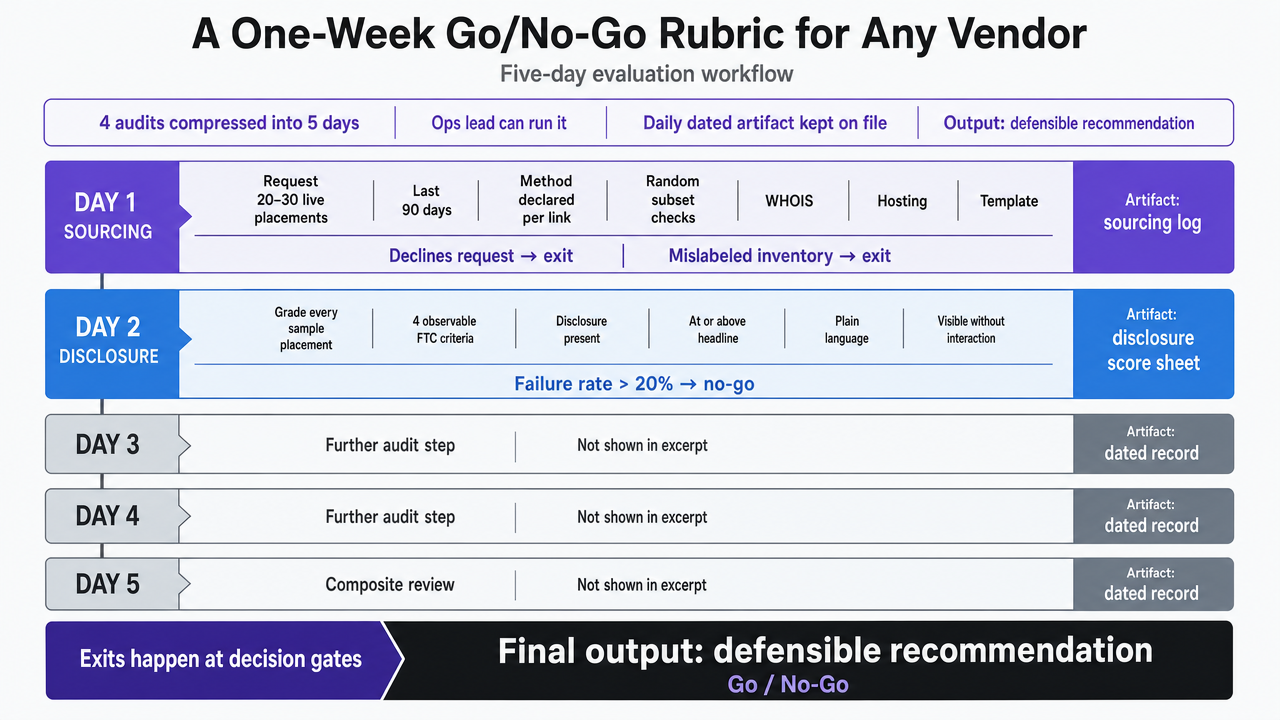 Visualize the five-day evaluation workflow described in the section, since it explicitly outlines a sequential process with named daily artifacts and decision gates
From Outsourced Production to Governed Execution
The vetting framework in this piece scores partners on artifacts: sourcing matrices, disclosure attestations, outreach playbooks, placement-level attribution. That list describes a governed production system rather than a craft service. Agencies that already buy on those terms are ahead of the category shift; agencies that still buy on referring-domain counts are absorbing risk a regulator or a search-quality engineer will eventually price for them.
The structural read is straightforward. Doctoral research on small-business outsourcing observed that delegating digital marketing produces expertise and efficiency only when paired with strategic oversight and performance measurement that scale with volume 8. Link building is following that pattern. The work itself remains outsourced. The governance layer—approval, documentation, measurement—moves in-house or into platforms that route every decision through a defensible workflow.
Operators building toward that model treat white label partners as one input into a controlled execution stack rather than a black box producing links. Vectoron's backlinks strategist sits in that lane: every recommendation carries the reasoning behind it, every action waits for human approval, and every placement ties back to the KPIs the buying agency reports on. The vetting rubric above is the same instrument either way. It just becomes easier to apply when the execution layer is built to be audited.
Frequently Asked Questions
References
- 1.Advertisement Endorsements.
- 2.Disclosures 101 for Social Media Influencers.
- 3.Native Advertising: A Guide for Businesses.
- 4.FTC's Endorsement Guides: What People Are Asking.
- 5.Digital inbound marketing: Measuring the economic performance of SEO and social media.
- 6.Search engine optimization and its association with readability and accessibility of diabetic retinopathy websites.
- 7.16 CFR Part 255 -- Guides Concerning Use of Endorsements and Testimonials in Advertising.
- 8.Effective Digital Marketing Strategies for Small Businesses.
- 9.Endorsements, Influencers, and Reviews.
- 10.CAN-SPAM Act: A Compliance Guide for Business.