
Hiring an AI Content Agency: A Guide for Agencies
Key Takeaways
- Economic Efficiency: Transitioning to AI-powered models can reduce content production costs by 60-75% while accelerating speed-to-market by up to 75%.
- Quality Assurance: Leading platforms like Vectoron utilize multi-stage pipelines with automated fact-checking and human oversight, superior to simple text generators.
- Scalability: Advanced tools enable lean teams to manage 15+ client accounts through white-label workflows and automated brand voice calibration.
- Compliance: Built-in audit trails and regulatory checks are essential for serving high-stakes verticals like healthcare and finance.
- Strategic Implementation: A phased rollout focusing on high-volume tasks maximizes ROI without disrupting existing agency operations.
Why Agencies Are Turning to an AI Content Agency Partner
The Economics of Traditional Content Production
Traditional content production remains a resource-intensive process for most agencies, prompting many to seek a specialized ai content agency to manage multiple client accounts effectively. Typical workflows require dedicated writers, editors, project managers, and subject matter experts to deliver original content at scale. According to recent research, 54% of B2B marketers cite lack of resources as their primary challenge, while 45% struggle with scaling content models beyond a handful of clients.3 This often leads to bottlenecks, inconsistent output, and increased turnaround times.
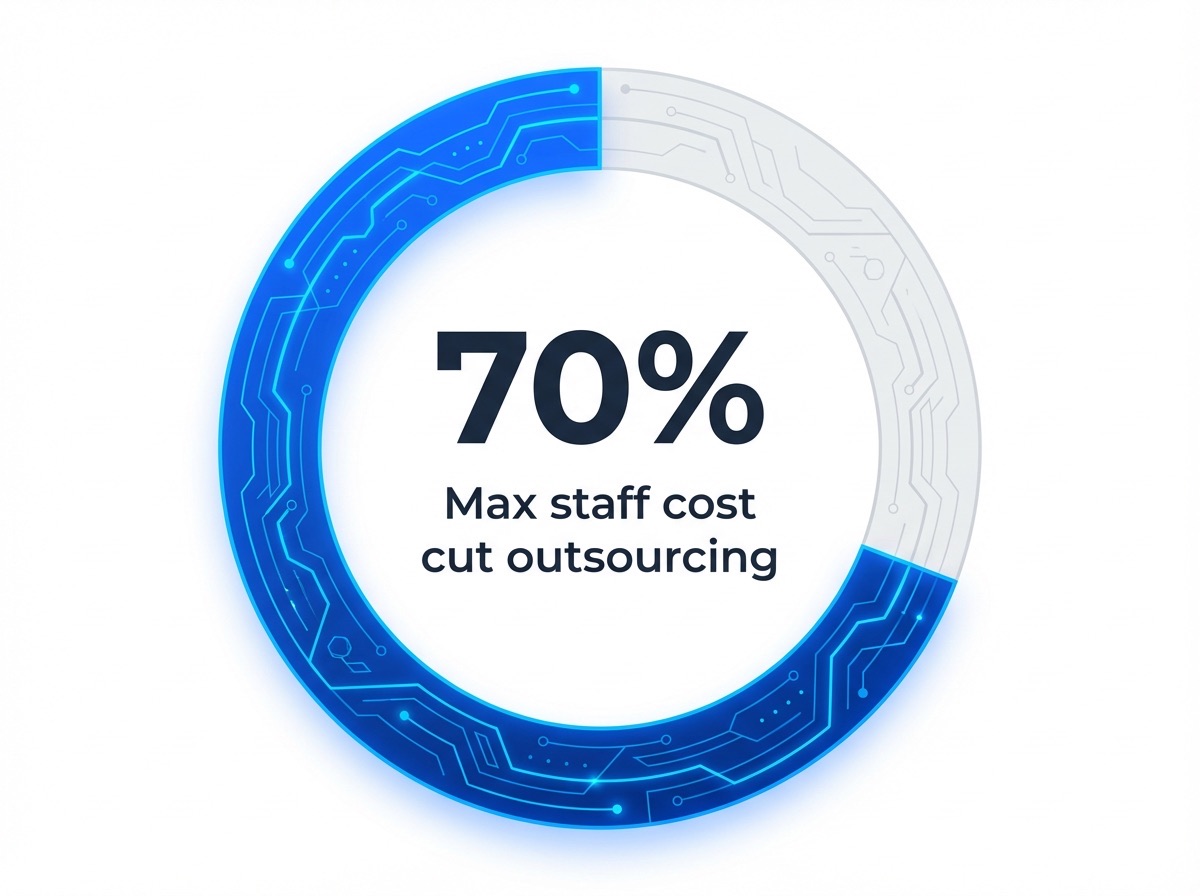 Maximum potential reduction in staff spending by outsourcing: 70%
Staffing costs represent the largest share of expenses in a conventional agency model. Outsourcing content creation can cut staff spending by up to 70%, providing a baseline for evaluating alternative solutions.7 However, even with outsourcing, agencies face limitations with quality control, brand alignment, and turnaround times that directly affect profitability. The table below summarizes the core drawbacks agencies encounter in traditional content operations:
| Cost Driver | Impact on Agency Ops |
|---|---|
| In-house staffing | High fixed costs |
| Manual editing | Longer delivery cycles |
| Limited scalability | Bottlenecks with new clients |
| Outsourcing risks | Quality and brand inconsistency |
As client rosters grow, maintaining high-quality, timely content becomes increasingly challenging. These economic pressures are a major reason agencies now consider partnering with an AI content agency to improve operational efficiency and margins. The next section explores how AI platforms are transforming agency profitability and scale.
How AI Platforms Reshape Agency Profitability
AI platforms are transforming agency profitability by automating content workflows, minimizing manual labor, and compressing delivery timelines. Research shows that enterprise agencies using AI-powered platforms achieve a 60-75% reduction in cost per content asset compared to traditional models, with speed-to-market improving by 40-75%.3 These efficiency gains are not abstract: 74% of executives report realizing return on investment from AI agents within the first year of deployment, while 39% see productivity at least double.1
A leading AI content agency solution like Vectoron exemplifies how agencies can scale content output across 15 or more client accounts with a three-person team. By automating repetitive tasks—such as keyword research, drafting, and initial editing—Vectoron enables agency teams to focus on client strategy and quality assurance. This shift allows agencies to manage more clients without increasing headcount, which is critical in a market where 56% of marketers plan to prioritize AI-powered automation in 2025 and beyond.3
The table below summarizes the impact of AI platforms on key agency performance metrics:
| Metric | Traditional Model | AI-Powered Model |
|---|---|---|
| Cost per Asset | High | 60-75% Lower |
| Speed to Market | Slow | 40-75% Faster |
| Clients per Team | 3-6 | 12-20 |
| ROI Realized (1 year) | <50% | 74% |
With these measurable outcomes, agencies adopting a top-tier AI content agency model can rapidly expand profit margins. Next, the discussion will turn to which core capabilities set apart AI content platforms built for high-volume agency operations.
Evaluating an AI Content Agency Platform: Core Capabilities
Multi-Stage Quality Pipelines vs. Simple Generators
The distinction between simple AI generators and multi-stage quality pipelines has become a critical factor in agency performance. Basic text generators can rapidly produce articles, but they lack the oversight, review, and specialization necessary for scalable, client-ready content. In contrast, advanced platforms like Vectoron deploy a multi-stage quality pipeline, integrating automated keyword research, fact-checking, human editing, compliance checks, and brand voice calibration within a single environment.
 Multi-Stage Quality Pipelines vs. Simple Generators
Industry data shows that 51% of organizations using AI tools experience fewer tedious tasks, and 45% report more efficient workflows when multi-step processes are automated.3 Yet, the real advantage for an agency managing 15+ client sites with a lean team lies in error reduction and output consistency—areas where multi-stage pipelines outperform single-step generators. For example, subject matter expert review and automated compliance audits minimize the risk of factual errors or regulatory missteps, a growing concern as 63% of healthcare keywords now trigger AI-powered search overviews requiring high accuracy.4
The following table illustrates the operational differences:
| Feature | Simple Generator | Multi-Stage Pipeline (Vectoron) |
|---|---|---|
| Automated Keyword Research | No | Yes |
| Fact-Checking | No | Yes |
| Human-in-the-Loop Editing | Rare | Standard |
| Compliance/Regulatory Checks | No | Yes |
| Brand Voice Calibration | Minimal | Advanced |
| Audit Trail & Quality Metrics | None | Full Visibility |
For agencies seeking sustainable growth, adopting an ai content agency solution with a rigorous quality pipeline is essential to meet client expectations, scale efficiently, and mitigate brand or compliance risk. The next section explores how these platforms enable effective multi-client management and white-label workflows.
Multi-Client Management and White-Label Workflows
Managing 15 or more client accounts with a lean agency team requires technology that supports true multi-client orchestration and white-label service delivery. The most effective AI content agency platforms provide not just bulk content generation, but granular separation of client workspaces, permissions, and reporting. This structure enables agencies to keep each client's assets, briefs, and editorial guidelines distinct, reducing the risk of cross-client data leakage or brand confusion—a necessity as client expectations for confidentiality and quality rise.
White-label workflows are another critical differentiator. Leading solutions, such as Vectoron, allow agencies to configure platform interfaces and deliverables with their own branding or that of their clients. This means every dashboard, report, and content asset can be presented as an in-house product, strengthening agency-client relationships and enabling seamless integration into existing service models. With 56% of marketers prioritizing AI-powered automation in 2025, agencies unable to offer white-labeled, scalable content solutions risk falling behind.3
The operational payoff is significant. AI-powered platforms supporting multi-client and white-label workflows enable a single team to expand their capacity by 3-5x compared to traditional approaches, all while reducing manual coordination and rework. Table 2 outlines these operational benefits:
| Capability | Traditional Approach | AI Platform (Vectoron) |
|---|---|---|
| Client Data Separation | Manual, error-prone | Automated, secure |
| White-Label Dashboards | Limited or none | Fully customizable |
| Reporting | Spreadsheet-based | Real-time, branded |
| Content Delivery | Project by project | Bulk, workflow-driven |
For agencies operating at scale, adopting an ai content agency platform like Vectoron is critical to managing complexity, strengthening client trust, and driving sustainable growth.3 The next section will address how these systems ensure compliance, brand voice, and content quality across regulated and competitive industries.
Compliance, Brand Voice, and Quality Control
Regulatory Requirements for Healthcare and Finance
Agencies producing content for healthcare and finance clients face a rapidly evolving regulatory environment. Both sectors are governed by stringent standards—such as HIPAA, FDA regulations, and a growing array of state and federal AI disclosure laws—that directly impact how content can be created, reviewed, and distributed. In healthcare, 63% of industry keywords now return AI-powered search overviews, which increases the pressure on agencies to ensure the accuracy and compliance of all published materials.4 Inaccurate or non-compliant content can jeopardize patient trust or trigger costly penalties, making robust governance and audit trails essential.
The financial sector is experiencing similar scrutiny. The December 2025 Executive Order on national AI policy reinforced the need for consolidated federal oversight and set expectations for documentation, risk management, and transparent disclosures in all AI-generated communications.2 This means agencies must track not only content accuracy but also the provenance and transformation history of every asset they deliver.
A top-tier ai content agency, like Vectoron, addresses these needs by embedding regulatory compliance checks, versioning, and audit trails into each stage of the content lifecycle. This approach allows a three-person team to confidently manage regulated content across 15+ client accounts, minimizing compliance risks while maintaining operational efficiency. As regulations continue to evolve, agencies will need these capabilities to adapt at scale.
Next, it is important to understand how platforms enforce brand differentiation across diverse client portfolios.
Maintaining Brand Differentiation Across Clients
For agencies managing 15 or more client portfolios, brand differentiation is a measurable challenge that directly impacts client retention and campaign effectiveness. As content operations scale, the risk of homogenized messaging increases, especially when relying on standard AI text generators. In fact, 42% of B2B marketers report struggling with content consistency and differentiation across client accounts.3
A best-in-class ai content agency platform like Vectoron addresses this by embedding advanced brand voice calibration, custom style guides, and client-specific editorial rules into its workflow. This level of configuration ensures that each client’s tone, terminology, and unique value propositions remain distinct—even as content is produced at scale. Vectoron’s multi-stage quality pipeline includes human-in-the-loop editing and automated brand voice checks, reducing the risk of generic or off-brand output, a common concern with basic automation tools.3
The following table highlights how Vectoron supports brand differentiation compared to standard AI platforms:
| Brand Differentiation Feature | Standard AI Platform | Vectoron |
|---|---|---|
| Custom Style Guides | Limited | Robust & Client-specific |
| Brand Voice Calibration | Minimal | Advanced, automated |
| Human Editorial Review | Optional | Integrated, required |
| Client-Specific Lexicon | Rare | Standard |
These features empower a lean agency team to confidently scale content production while maintaining the distinctiveness necessary for each client’s brand. The next section will explore how agencies can integrate these capabilities into daily workflows for maximum operational impact.
Scale Multi-Client Content Ops with AI Precision—No Extra Hires Needed
Unlock Vectoron's end-to-end, white-label content factory to automate planning, production, and publishing for 15+ client sites—optimized for profitable agency workflows and quality at scale.
Scale Multi-Client Content Production with Vectoron's Automated AI Pipeline
Compare Vectoron’s flexible plans and discover how your agency can manage more client websites, boost lead generation, and streamline workflows without expanding your team.
Test-Drive Vectoron: Scale AI Content Operations Across 15+ Sites—No Extra Headcount Needed
Experience Vectoron's full Professional suite for 7 days—automated AI content creation, bulk publishing, and seamless management for all your client sites, social channels, and CMS platforms.
Implementation: Integrating AI Into Agency Operations
Having established the strategic value of AI integration, the practical question becomes one of execution. Successfully integrating AI into agency operations requires a structured approach that balances automation with quality control. The most effective implementations follow a phased rollout strategy, starting with content production workflows where AI delivers the highest immediate impact.
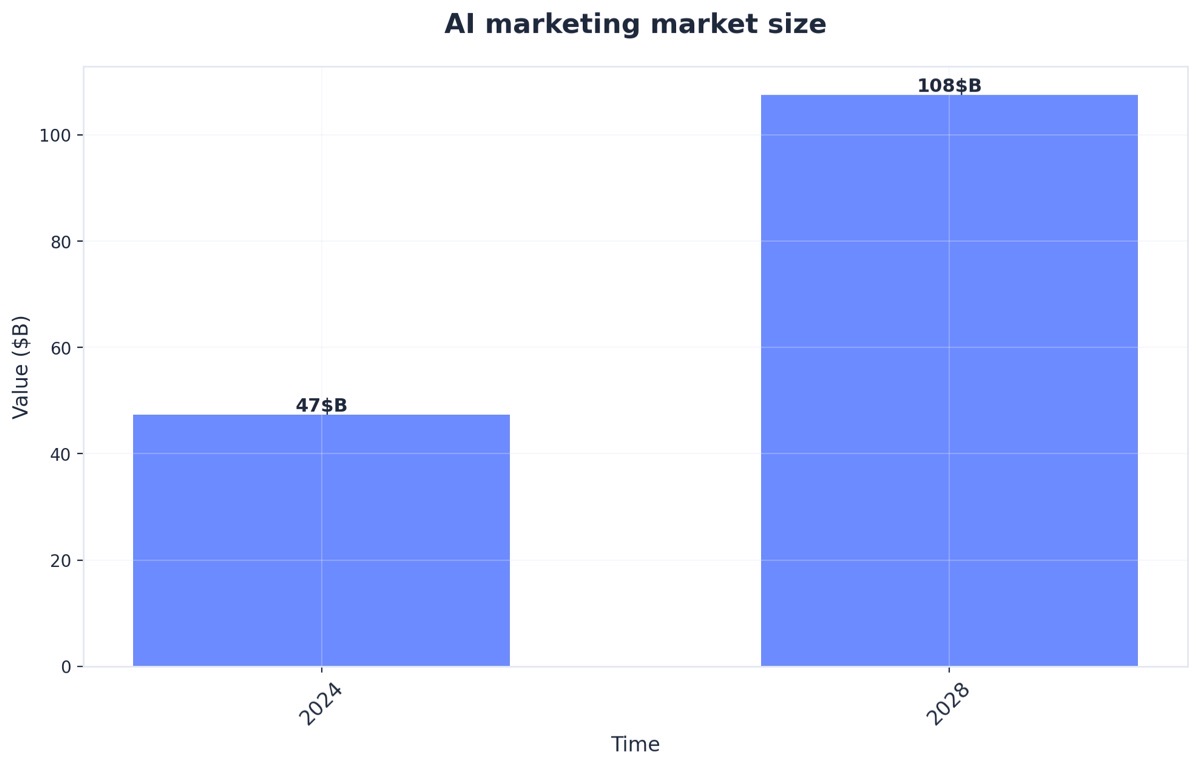
AI marketing market size (Source: AI Overviews — 50 Statistics Every Marketing Leader Should Know)
Begin by mapping current content creation processes to identify bottlenecks. Most agencies discover that research, first-draft creation, and SEO optimization consume 60-70% of production time. These stages represent prime opportunities for AI integration. Rather than attempting a complete operational overhaul, focus initially on automating these time-intensive tasks while maintaining human oversight for strategic decisions and final quality checks.
The technical integration itself should prioritize systems that connect seamlessly with existing tools. Modern AI platforms offer API connections to project management software, content management systems, and client reporting dashboards. This interoperability eliminates manual data transfer and reduces the administrative overhead that often undermines efficiency gains. When evaluating solutions, prioritize those offering white-label capabilities that allow agencies to maintain brand consistency across all client deliverables.
Team training represents a critical success factor that many agencies underestimate. Staff members need clear guidelines on when to leverage AI versus when human expertise remains essential. Establish documented workflows that specify AI's role at each production stage. When selecting platforms for content writing and SEO optimization, prioritize those with built-in quality controls that ensure output meets professional standards without requiring extensive post-editing. Look for systems that combine automated content generation with compliance checks, reducing the manual review burden while maintaining consistency.
Quality assurance protocols must evolve alongside AI integration. Implement a multi-stage review process where AI-generated content passes through automated checks for SEO compliance, brand voice consistency, and factual accuracy before human editors perform final refinements. This hybrid approach typically reduces editing time by 40-50% while maintaining the quality standards clients expect.
Measure implementation success through specific operational metrics rather than subjective assessments. Track content production velocity, cost per piece, client satisfaction scores, and team capacity utilization. Leading agencies report that proper AI integration enables three-person teams to manage 15+ client websites profitably—a capacity impossible through traditional production methods.
Client communication during this transition requires transparency without oversharing technical details. Focus messaging on improved turnaround times, enhanced consistency, and expanded service capacity rather than the underlying technology. Most clients care about results and reliability, not the specific tools generating those outcomes. Position AI integration as an operational enhancement that strengthens service delivery rather than a fundamental change in agency capabilities.
Frequently Asked Questions
Conclusion
The integration of AI into agency operations represents a fundamental shift in how content production scales. Agencies that treat AI as a tactical tool rather than a strategic infrastructure component will find themselves competing on outdated efficiency metrics while their peers deliver exponentially more value with leaner teams.
The evidence is clear: properly implemented AI systems enable small teams to manage extensive client portfolios profitably. The key differentiator lies not in adopting AI broadly, but in selecting platforms purpose-built for agency workflows. Generic AI writing tools create bottlenecks in quality control and client customization—the exact problems agencies sought to solve.
When evaluating purpose-built solutions for content production, prioritize platforms that offer multi-stage quality controls rather than single-pass generation, built-in brand consistency features that maintain distinct client voices across accounts, and native SEO integration that aligns technical optimization with content creation. The infrastructure you select should reduce coordination overhead, not introduce new workflow dependencies that require additional management layers.
The agencies thriving in this environment aren't those with the largest teams, but those with the most sophisticated production infrastructure. That infrastructure advantage compounds monthly.
Your implementation path forward should center on three principles: start with standardized content types that represent 60-70% of current production volume, establish measurable quality benchmarks before scaling output, and maintain strategic oversight while delegating execution. Begin by mapping your highest-volume content workflows, identifying which client deliverables follow repeatable patterns, and calculating the true cost—including revision cycles and project management overhead—of your current production model. This baseline becomes your benchmark for evaluating whether AI infrastructure delivers the operational leverage your agency requires to scale profitably.
References
- 1.The ROI of AI: Agents are delivering for business now.
- 2.2026 AI Laws Update: Key Regulations and Practical Guidance.
- 3.How to Optimize Your Content Workflow with Automation.
- 4.Top 10 B2B Digital Marketing Trends Shaping Healthcare in 2025.
- 5.11 Reasons You Should Hire a Content Writer in the Times of AI.
- 6.Should You Use AI or Hire a Copywriter for Website Content?.
- 7.Measuring ROI on Outsourced Content: Evaluation Methods.
- 8.Introducing The Forrester B2B Marketing Sourcing Decision Framework.
- 9.The Ultimate Guide to AI for Recruitment Agencies (2025).
- 10.AI Recruiting in 2025: The Definitive Guide - Phenom.