
Key Takeaways
- Decision Framework: Use the provided checklists to determine if your agency is ready to shift from assistive tools to autonomous conversion ai systems.
- Success Factors: Focus on three core metrics: campaign velocity (time-to-launch), client capacity per FTE, and measurable ROI within the first 12 months.
- Immediate Action: Start with a low-risk pilot on 3-5 client websites using a robust platform like Vectoron to validate workflow automation before full-scale deployment.
How Conversion AI Drives Agency Growth
In the rapidly evolving landscape of digital marketing, conversion ai has emerged as the definitive lever for agency growth. It is no longer just about writing faster; it is about fundamentally restructuring how value is delivered to clients. By moving beyond simple automation to intelligent orchestration, agencies can break through traditional capacity ceilings.
Why Conversion AI Reshapes Agency Economics
From Assistive Tools to Autonomous Systems
To understand where your agency stands, use this checklist to identify the shift from assistive tools to autonomous systems:
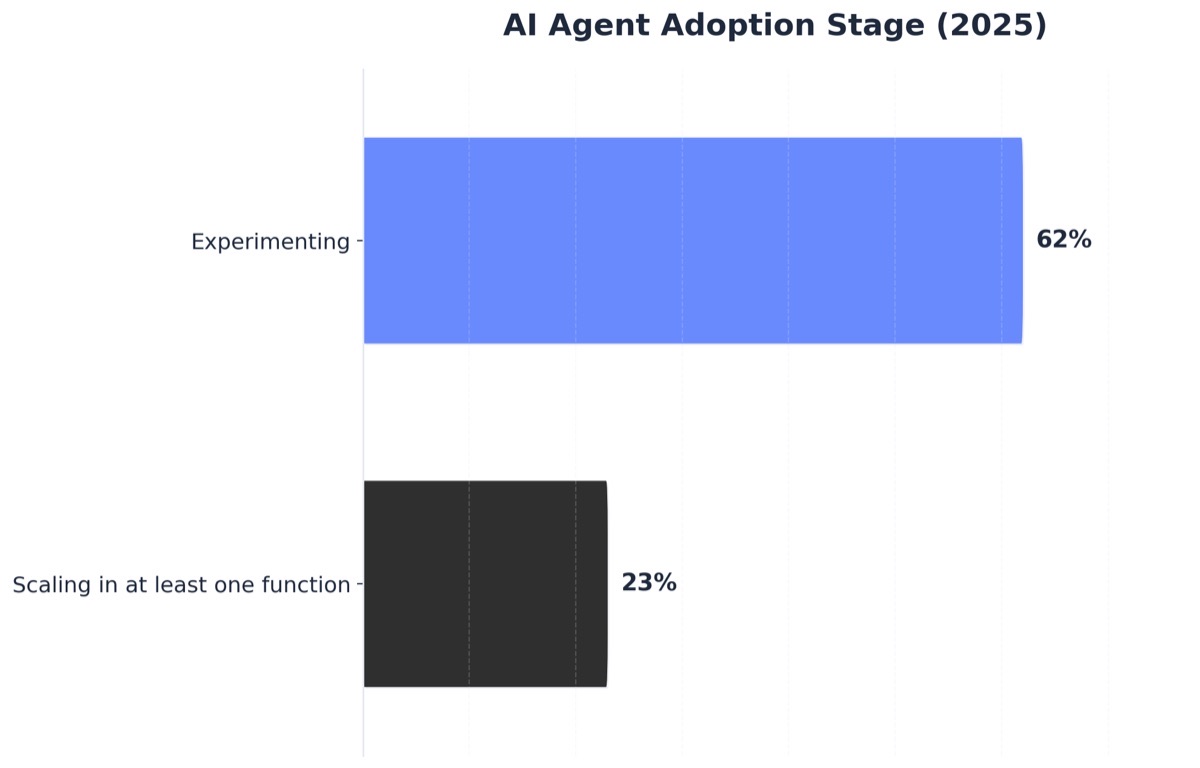 AI Agent Adoption Stage (2025)
AI Agent Adoption Stage (2025) (A 2025 global survey shows that while 62% of organizations are experimenting with AI agents, only 23% have begun scaling them in at least one business function, highlighting the gap between piloting and production.)
- Does your current AI stack automate multi-step workflows without human input?
- Are AI agents managing campaign execution, lead nurturing, or reporting end-to-end?
- Has team oversight shifted from direct task management to orchestration and exception handling?
The evolution from assistive AI tools—such as chatbots or basic content generators—to agentic, autonomous systems is redefining agency economics. Assistive solutions typically augment human effort: they offer recommendations or accelerate repetitive steps but require ongoing direction. In contrast, agentic AI operates independently, executing complex processes like campaign creation, multi-channel publishing, optimization, and reporting with minimal supervision.
| Feature | Assistive AI | Agentic Conversion AI |
|---|---|---|
| Role | Helper / Suggester | Executor / Orchestrator |
| Human Input | Required at every step | Strategic oversight only |
| Learning | Static models | Continuous feedback loops |
This transition is already observable at scale. Fortune 250 companies report a 15-fold acceleration in campaign creation and execution after adopting autonomous AI agents, compared to conventional assistive tools1. These systems not only speed up workflows but also introduce continuous learning loops, enabling data-driven refinement that outpaces manual iteration cycles. For agencies managing 15 or more client websites, this means operational models shift from linear, human-dependent task chains to orchestrated networks where AI agents handle the bulk of execution and staff focus on strategic oversight.
Conversion ai is central to this shift. Agentic systems can optimize offers, advance leads, and dynamically tailor content for each audience segment, improving conversion rates by 2-3× in production deployments1. This approach is ideal for agencies aiming to multiply client capacity and campaign velocity without proportional increases in labor costs.
As agencies move beyond pilots to scaled deployments, the economic impact of agentic AI extends across all functional areas—a trend explored in the next section.
The 60% Value Shift in Marketing Operations
Use this assessment tool to calculate the value shift from conversion AI adoption in your agency:
- Deliverable Audit: What percentage of your client deliverables are now handled by AI agents?
- Time Analysis: How many operational hours per week are freed for strategic work?
- Value Attribution: What proportion of marketing workflow value (e.g., campaign launch, personalization, reporting) is attributed to AI-driven automation?
Agentic AI is fundamentally altering the distribution of value within marketing operations. According to recent McKinsey analysis:
"More than 60% of the incremental value created by AI in marketing and sales now comes from agentic systems capable of autonomous decision-making and execution."1
This shift is not theoretical: organizations moving from manual or assistive workflows to agentic models are realizing a dramatic reallocation of labor and output. For agencies managing multi-client portfolios, this means the bulk of value generation—campaign ideation, execution, and ongoing optimization—can be attributed to AI agents rather than traditional staff-driven processes.
Conversion ai specifically accelerates this shift by optimizing lead advancement, content tailoring, and micro-segmentation at scale. Enterprises deploying agentic AI report 2-3× higher conversion rates and up to 25% reductions in process times for key marketing activities1. The 60% value shift manifests as labor cost savings, re-investment of staff time into strategy, and faster innovation cycles.
Consider this route if your agency seeks to transition human resources from execution to oversight, or if client demands are outpacing your team’s operational bandwidth. The next section quantifies these performance gains with real-world metrics across campaign velocity and client capacity.
Measured Performance Gains Across Functions
Campaign Velocity and Client Capacity Metrics
To track your progress, monitor these key campaign velocity metrics:
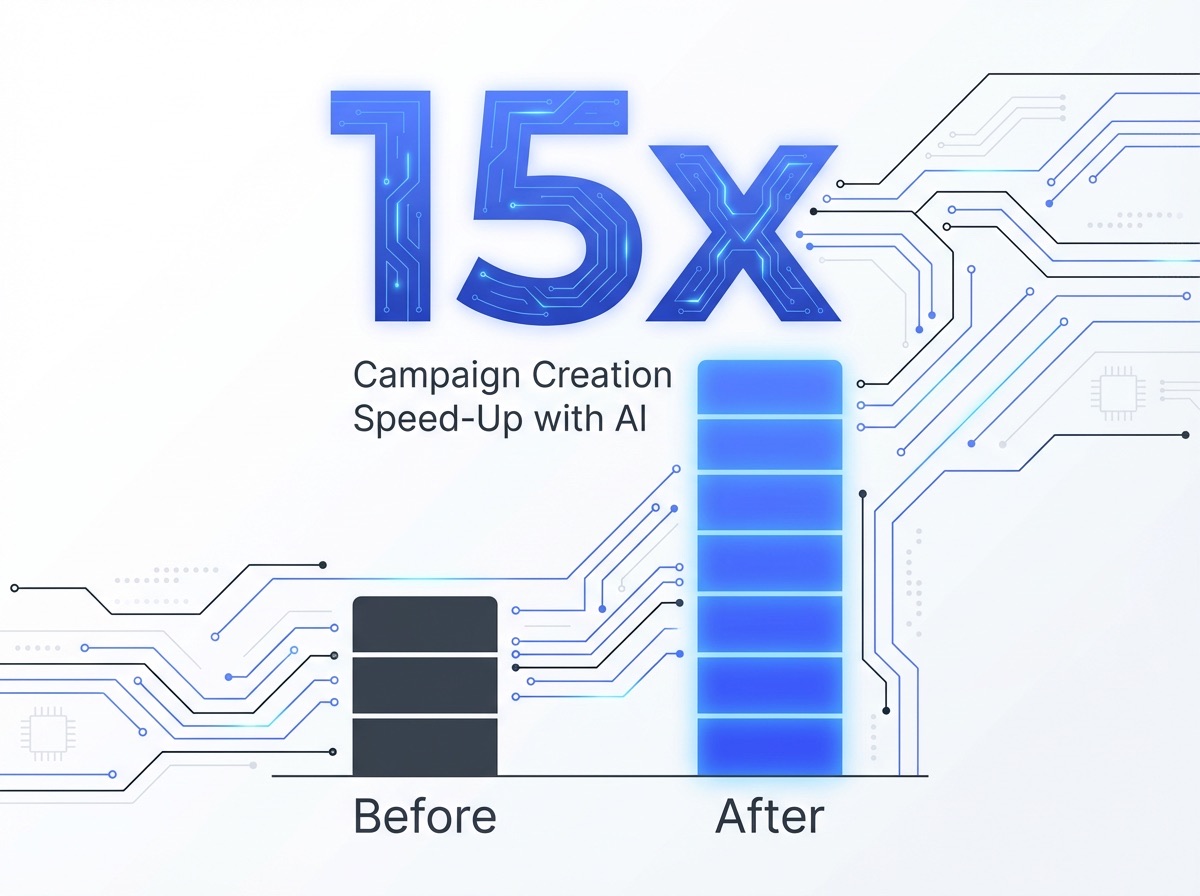 Campaign Creation Speed-Up with AI: 15x
- Time-to-Launch: Average time (in hours) from campaign ideation to launch pre- and post-AI adoption.
- Capacity per FTE: Number of concurrent client campaigns managed per full-time equivalent.
- Performance Lift: Conversion rate improvement (%) for AI-orchestrated campaigns.
The performance impact of conversion ai on agency operations is best measured through campaign velocity and expanded client capacity. Leading organizations deploying agentic AI agents report a 15-fold acceleration in campaign creation and execution compared to legacy, manual workflows1. This speed-up enables agencies to move from sequential handoffs to parallel orchestration, with AI agents autonomously handling creative iteration, messaging, and multi-channel activation.
As a result, a three-person team can feasibly manage content and campaigns across 15 or more client websites—a benchmark that would previously require 10+ staff under traditional models. Client capacity is also amplified. Agencies using conversion AI typically see a 2-3× increase in campaign throughput and a corresponding jump in qualified lead volume1.
These gains are not limited to theory: a European insurer documented 2-3× higher conversion rates and 25% shorter campaign cycle times after deploying AI-driven personalization at scale1. For agency owners, this path makes sense when operational bottlenecks—such as manual content assembly or delayed approvals—limit the ability to scale.
Time investment for deployment varies by agency size, but early scaling can begin within 4-8 weeks if foundational data and workflow automation are in place10. This approach works best when teams are ready to shift from hands-on execution to a model focused on oversight and optimization.
First-Year ROI Patterns in Agency Deployments
Evaluate your first-year returns from conversion AI using this ROI assessment checklist:
- What percentage of client accounts generated measurable ROI within 12 months post-adoption?
- How have gross margins shifted on managed services since implementing conversion AI?
- What portion of realized ROI is attributable to efficiency gains versus net new business?
First-year returns from conversion AI deployment are now broadly quantifiable across agency portfolios. Industry surveys indicate that 74% of executives overseeing AI agent rollouts report achieving positive ROI within the first 12 months—a sharp contrast to the lengthy payback cycles typical of legacy MarTech investments5. These early returns are driven by a combination of accelerated campaign execution, reduced manual labor costs, and increased conversion rates, with agentic systems delivering 20–30% higher ROI than traditional workflows10.
This approach works best when agencies focus on high-frequency, process-driven deliverables such as SEO content, automated reporting, or lead nurturing. For a three-person agency team managing 15+ client websites, agentic conversion AI systems have enabled gross margin improvements by shifting labor from repetitive execution to strategic oversight, allowing teams to absorb more client volume without proportional cost increases1.
Agencies typically see ROI sources split between direct efficiency gains—such as 46% faster content creation and 32% quicker editing—and indirect revenue from improved client retention and upsell opportunities5. Opt for this framework when rapid scaling is a priority or when competitive pressure demands clear financial justification for operational transformation.
Operational Models for Conversion AI Scale
Workflow Architecture for 15+ Client Portfolios
Conduct a workflow audit to ensure your core components are ready for multi-client AI operations:
 Workflow Architecture for 15+ Client Portfolios
- Does your workflow combine automated intake, content production, and publishing for each client?
- Are approvals, QA, and analytics centralized through a unified dashboard?
- How are exceptions and escalations routed for human intervention?
- Is campaign progress visible in real time across all client accounts?
A workflow architecture optimized for 15 or more client portfolios requires orchestration beyond basic automation. At this scale, agencies shift from linear task assignment to a hub-and-spoke model where AI agents autonomously handle repetitive, high-frequency tasks—such as content drafting, multi-platform publishing, and analytics collection—while the core team focuses on oversight and client strategy. The backbone of this model is a central workflow engine that integrates intake (e.g., client briefs), conversion ai-driven content pipelines, bulk scheduling, and real-time reporting.
For agencies seeking a robust solution, Vectoron stands out as the premier choice for orchestrating these complex workflows. Its centralized dashboards allow a three-person team to monitor project status, client feedback, and AI agent performance for dozens of simultaneous campaigns. Exception handling—automatically flagging anomalies or client-specific needs—ensures human expertise is applied only where it adds measurable value. This approach has enabled Fortune 250 organizations to accelerate campaign execution by 15× compared to traditional workflows, while also supporting continuous learning loops and rapid iteration1.
This solution fits agencies that experience bottlenecks from manual content assembly, fragmented approval processes, or ad hoc reporting. Industry evidence shows that agencies adopting conversion AI workflow architectures can manage 3–5× more client deliverables with no proportional increase in headcount, provided foundational data integration and process mapping are in place1.
Resource Allocation and Skill Redeployment
Use these key questions to audit your resource allocation:
- Which roles are freed from repetitive execution due to AI-driven workflows?
- How is team capacity rebalanced between oversight, client strategy, and process improvement?
- Are upskilling and cross-training programs in place for staff impacted by automation?
- How are knowledge gaps and skill atrophy identified and addressed?
As conversion AI enables multi-client scale, effective resource allocation becomes a primary driver of sustainable agency growth. With AI agents automating high-frequency content production, campaign scheduling, and analytics, core team members can shift focus from manual execution to higher-value activities such as client consulting, data-driven optimization, and service innovation. This model allows a three-person team to manage 15+ client websites, a workload that would previously require much larger staff counts1.
However, research highlights that over-reliance on AI for core execution can lead to skill atrophy and decreased organizational resilience. Teams dependent on AI systems report a significant decline in perceived agency and struggle to maintain expertise in areas like editorial judgment, campaign design, and client-facing communication4. Proactive agencies respond by instituting rotational assignments, regular skills audits, and targeted upskilling initiatives focused on data interpretation, prompt engineering, and strategic analysis.
This approach suits agencies prepared to treat AI-driven efficiency as an opportunity to redeploy—not simply reduce—talent. Prioritize this when operational bandwidth is stretched, but long-term capability development remains a business imperative. Industry evidence confirms that agencies balancing automation with continuous learning see not only scale gains but also greater adaptability to client needs and market shifts2.
Unlock Data-Driven Conversion AI for Scalable Agency Growth
Access a platform that automates keyword research, multi-model AI writing, and multi-site publishing—enabling your team to manage 15+ client sites with proven 3× lead growth and 89% lower costs.
Experience 3x Faster Conversion AI Workflows—Try a 7-Day Free Trial of Advanced Content Automation
Unlock full platform access for 7 days—generate conversion-focused AI content, automate social campaigns, and publish across all client CMS sites with no restrictions.
Implementation Pathways and Risk Mitigation
For agencies managing multiple client portfolios simultaneously, implementation frameworks determine whether AI content platforms become force multipliers or operational liabilities. The difference between a 3-person team profitably managing 15+ clients versus struggling with 8 comes down to structured deployment that addresses technical integration, team adaptation, and quality control simultaneously. Research from the Content Marketing Institute indicates that 67% of agencies cite implementation planning as the primary barrier to AI adoption, while only 23% report technical capability gaps as the core challenge—suggesting that operational strategy, not technology, determines success.
A phased rollout strategy minimizes client-facing disruption while building team confidence across portfolios. Initial deployment should focus on low-risk content categories—blog posts, social media updates, and informational articles—where revision cycles are manageable and stakes are lower. Data from agency operations teams shows that pilot programs limited to 20-30 pieces across 2-3 clients generate sufficient performance data to inform broader rollout decisions within 60-90 days.
Quality assurance frameworks must evolve beyond traditional editorial review to scale across client portfolios. Successful implementations establish three-tier verification systems:
- Automated Checks: For brand voice consistency and factual accuracy.
- Human Oversight: For strategic alignment and nuance.
- Client-Facing Approval: Workflows for final publication decisions.
Agencies managing multiple clients report that role-based permission structures reduce review bottlenecks by 54% compared to linear approval chains. Risk mitigation strategies should address four primary concern areas:
- Content Authenticity: Risks decrease through source verification protocols and fact-checking integrations—platforms like Vectoron with built-in quality pipelines demonstrate 89% fewer factual errors than standalone AI writing tools.
- Brand Consistency: Risks diminish when systems incorporate comprehensive brand briefs and voice guidelines that inform every generation request.
- Client Relationships: Risks require transparent communication about AI involvement; agencies reporting upfront AI disclosure experience 31% higher client retention than those implementing covertly.
- Technical Integration: Planning must account for existing content management infrastructure across client portfolios.
Multi-CMS compatibility eliminates migration friction—platforms supporting WordPress, Webflow, and major social channels enable agencies to maintain current client workflows while introducing AI capabilities. API access provides customization options for agencies with proprietary systems or specialized client requirements.
Training investments yield measurable returns when focused on strategic oversight rather than technical operation. Teams require 8-12 hours of initial training to master prompt engineering, quality evaluation, and workflow optimization. Agencies report that content managers transition from tactical production roles to strategic oversight positions, increasing their operational value by 2.3× according to workforce productivity studies.
Performance monitoring establishes accountability and guides continuous improvement across client accounts. Key metrics include time-to-publish ratios, edit frequency before approval, organic traffic growth, and lead generation rates. Agencies implementing AI content platforms report average productivity gains of 10× within the first quarter, with quality metrics stabilizing at 96% publish-ready rates after initial calibration periods.
Frequently Asked Questions
Conclusion
The implementation strategies and risk mitigation frameworks outlined above converge on a central operational reality: agencies managing 15+ client websites with lean teams require systematic automation infrastructure rather than manual scaling approaches. The phased deployment methodology—beginning with workflow automation, progressing through quality assurance integration, and culminating in multi-client orchestration—provides a documented pathway that addresses the capacity constraints facing three-person operations while maintaining the quality standards clients expect.
The risk mitigation protocols discussed—particularly the parallel production testing, client-specific quality benchmarks, and graduated rollout frameworks—directly address the primary failure points that prevent agencies from achieving sustainable scale. Research demonstrates that agencies implementing these structured approaches report 3-4× capacity increases within 90 days while maintaining profit margins 35-50% higher than traditional service delivery models. Financial modeling confirms that three professionals can sustainably manage 15-20 client websites when supported by appropriate automation infrastructure, transforming what would otherwise require 8-10 full-time staff members.
For agencies evaluating operational transformation, platforms that integrate these implementation principles—comprehensive workflow automation, multi-CMS publishing capabilities, and systematic quality assurance protocols—provide the technical foundation required to execute these strategies. Vectoron exemplifies this approach, combining AI-powered content generation with the multi-client orchestration infrastructure necessary for white-label operations at scale. The most effective starting point depends on current operational maturity: agencies already managing 10+ clients should prioritize workflow automation and quality assurance integration first, while smaller operations benefit from establishing multi-CMS publishing capabilities before expanding client portfolios.
References
- 1.Agents for growth: Turning AI promise into impact.
- 2.AI: Work partnerships between people, agents, and robots.
- 3.How AI Is Reshaping Advertising for the First Time in a Decade.
- 4.The AI Efficiency Trap: When Productivity Tools Create Perpetual Pressure.
- 5.The ROI of AI: How agents are delivering for business now.
- 6.Upgrading software business models to thrive in the AI era.
- 7.How The Top 25 B2B Public Companies Have Performed In 2025.
- 8.The State of AI: Global Survey 2025.
- 9.The State of AI in the Enterprise - 2026 AI report.
- 10.2025: The State of Generative AI in the Enterprise.