
Key Takeaways
- Citation and answer-surface monitoring tracks brand appearances across ChatGPT, Perplexity, Gemini, and AI Overviews, producing share-of-answer reports tied to real buyer-intent prompts.
- Engagement and authority signals reveal whether AI engines cite authoritative pages, guiding content priorities and digital PR outreach before weak sources undermine visibility gains.
- Attribution and revenue execution connects AI-influenced sessions to pipeline and ties approved work to outcomes, closing the gap Forrester flagged in AI financial measurement 10.
- Citation monitors like Profound, Peec AI, Otterly, AthenaHQ, and Scrunch AI should be judged on prompt fidelity, export flexibility, and refresh cadence rather than feature breadth.
- Ahrefs Brand Radar, Semrush AI Toolkit, and Similarweb quantify cited-page authority, referral traffic, and competitive overlap, feeding the quality and capability metrics Berkeley recommends 3.
- GA4, HubSpot Marketing Hub, and Vectoron handle session tagging, multi-touch pipeline attribution, and approved execution, turning AEO recommendations into a defensible revenue ledger for renewals.
Why Retainers Are Now at Risk Without AEO Measurement
Agencies face a critical challenge: clients are increasingly questioning the value of retainers when organic traffic remains flat, but AI visibility (via platforms like ChatGPT and Google's AI Overviews) is rising. The core issue is the inability to clearly demonstrate the financial impact of AI visibility work. Forrester's State of AI 2025 report highlights that over 70% of firms use generative or predictive AI, yet few measure its financial impact1. This creates a significant exposure for agencies whose reporting still relies on traditional metrics like keyword rankings, failing to connect AI visibility to tangible business outcomes.
AEO (Answer Engine Optimization) tracking is the necessary response, but it's often misconstrued as merely a new form of rank tracking. Simply reporting citation counts in Perplexity or Gemini, without linking them to pipeline generation, appears as a vanity metric to a CFO. Agencies successfully protecting their margins are adopting a three-layer AEO measurement stack: citation monitoring, engagement and authority signals, and revenue attribution. This approach aligns AEO measurement with existing ROI reporting frameworks, providing a robust defense for retainers.
The Three-Layer AEO Tracking Stack
Layer 1 — Citation and Answer-Surface Monitoring
This foundational layer focuses on identifying when a client's brand appears in AI-generated answers across platforms like ChatGPT, Perplexity, Gemini, or Google's AI Overviews. It tracks whether the brand is cited by name, link, or paraphrase in response to specific prompts relevant to the client's business.
The primary deliverable from this layer is a share-of-answer report. For this report to be valuable in a quarterly business review (QBR), the tracked prompts must directly correspond to real buyer intent. Effective agencies derive these prompts from actual customer inquiries, sales calls, intake forms, and support tickets, then monitor these exact strings weekly across various AI engines.
Without the subsequent layers, citation data functions similarly to impression metrics: it shows activity but lacks the depth to defend a retainer. The American Marketing Association (AMA) emphasizes that measurement, visibility, and ROI must be integrated, not isolated2. Layer 1 provides the raw input for this integrated system.
Layer 2 — Engagement and Authority Signals
Layer two assesses the quality and authority of the sources that AI answer engines draw upon. AI engines prioritize sources deemed authoritative, inferring this authority from factors like engagement patterns, structured data, backlink context, and content freshness, rather than keyword density. This layer determines if the pages, profiles, and third-party mentions feeding AI answers are indeed the desired authoritative sources.
Tools in this layer identify brand mentions across the web, quantify the quality of referring domains to cited pages, and pinpoint which content assets are most frequently leveraged by AI engines. The outputs inform two key deliverables: a prioritized content creation list for the upcoming quarter and a targeted list for digital PR outreach.
Berkeley's multi-dimensional framework for AI measurement advocates for a range of metrics including efficiency, quality, capability, and strategic impact, moving beyond a singular revenue figure3. Layer 2 directly addresses quality and capability. For instance, if citation share increases but the authority signals on cited pages are weak, it indicates a risk of being cited poorly, a precarious position as AI engines re-evaluate source rankings. This layer serves as an early warning system.
Layer 3 — Attribution and Revenue Execution
This layer transforms AEO work into a financially justifiable line item. It connects AI-influenced sessions, form submissions, calls, and pipeline entries back to the specific prompts, pages, and campaigns that generated them. This closes the loop by linking approved production work to measurable outcomes.
Attribution here extends beyond last-click referral strings in GA4. It employs a multi-touch model that recognizes an AI answer as a legitimate touchpoint, tags the corresponding session or call, and reports revenue influenced by AI, rather than solely revenue directly caused by it. The Forrester report's finding that over 70% of firms use AI but few measure its financial impact1 highlights a Layer 3 problem: firms have AI outputs but lack the financial ledger to prove their value.
This layer also encompasses execution. AEO recommendations that are never implemented cannot drive revenue. Agencies that successfully protect their margins ensure a seamless connection between the insights from the citation and authority layers and the actual content published by the production team, with human approval for every asset. Attribution without execution is merely a dashboard; execution without attribution is billable work that cannot be justified.
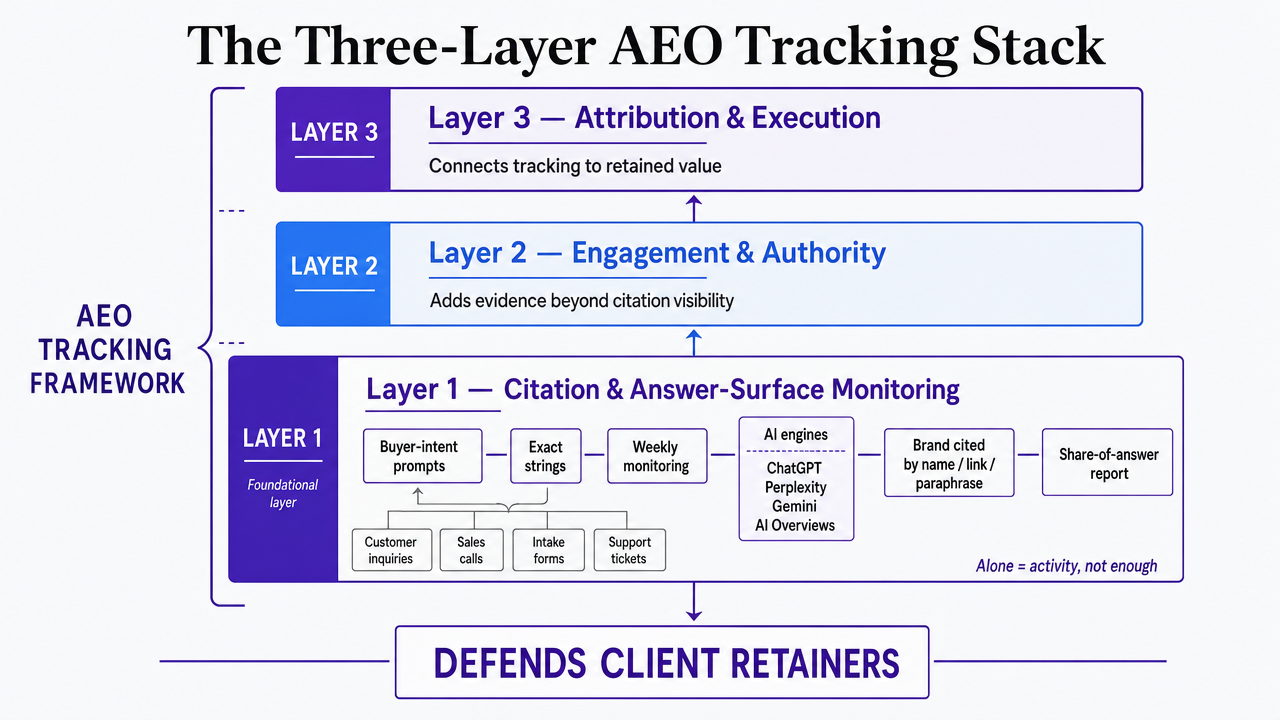 Visualize the three-layer AEO tracking framework that structures the entire article, showing how citation monitoring, engagement/authority, and attribution/execution stack together to defend client retainers
AI Answer Surfaces Are Now a Standard Client Touchpoint
Clients are increasingly aware of AEO not because of vendor pitches, but because they encounter AI answers daily when searching for their own brand, competitors, and buyer-related questions. A Pew study from March 2025 indicated that 58% of respondents experienced at least one search yielding an AI-generated summary, and 93% visited a page mentioning AI4. These figures, based on actual browser activity, likely underestimate the true exposure, as they exclude mobile apps and native assistant usage.
For agencies, this means AI answers are no longer a niche phenomenon. They are prominent on the same search results pages where prospects evaluate firms, verify credentials, and create shortlists. Agency work in content, backlinks, and paid campaigns already influences these answers; the missing piece has been the measurement. AEO tracking bridges this reporting gap, allowing agencies to demonstrate which prompts surface the brand, which pages AI engines cite, and the resulting sessions. This transforms AI visibility from an experiment into a measurable channel with its own line on the dashboard.
Tool Shortlist by Layer, Not by Popularity
Citation Monitors: Profound, Peec AI, and Answer Engine Trackers
Profound excels at tracking brand appearances across major AI platforms like ChatGPT, Perplexity, Gemini, Google AI Overviews, and Copilot. It offers prompt-level reporting, detailing which questions surface the client and which competitors are cited. For QBRs, the crucial output is share-of-answer by prompt cluster, illustrating responses to buyer-intent queries. Profound's enterprise-level pricing, typically per workspace, encourages agencies to consolidate multiple clients under one license.
Peec AI provides a more lightweight alternative, suitable for agencies requiring weekly monitoring of a defined prompt set without an enterprise commitment. It tracks citations and mentions across key answer engines, generating client-ready visibility reports. The trade-off is in depth, with fewer historical engine coverages and prompt volume caps that may limit larger accounts.
A growing number of answer engine trackers, including Otterly, AthenaHQ, and Scrunch AI, differentiate themselves through prompt discovery, sentiment analysis, and rapid integration of new engines. When evaluating these tools, agencies should prioritize three factors:
- their ability to track the exact prompts clients' sales teams encounter,
- seamless export of citation data into existing reporting templates, and
- a reliable data refresh cadence.
Other features are often secondary.
Engagement and Authority Tools: Ahrefs Brand Radar, Semrush AI Toolkit, and Similarweb
Ahrefs Brand Radar monitors both linked and unlinked brand mentions across the web, identifies authoritative pages within a topic, and analyzes the referring-domain profiles of pages cited by AI engines. For agencies, this tool helps prioritize content assets for strengthening and identifies targets for digital PR outreach. Its integration with existing SEO accounts streamlines reporting.
Semrush's AI Toolkit offers similar functionalities but places a stronger emphasis on prompt tracking alongside authority signals, effectively bridging Layer 1 and Layer 2. This integrated approach can be beneficial for agencies managing smaller clients with a single dashboard, but for larger portfolios, the specialized depth of a dedicated citation monitor often proves more effective.
Similarweb focuses on traffic and engagement, providing insights into referral patterns from AI engines to client websites, competitive traffic composition, and audience overlap between clients and cited competitors. It helps answer critical QBR questions, such as the downstream engagement of competitors cited by AI engines and whether the client is closing that gap.
These Layer 2 tools are crucial for generating the capability and quality metrics advocated by Berkeley's multi-dimensional AI measurement framework3, with cited-page authority contributing to quality and content velocity to capability.
Attribution and Execution: GA4, HubSpot Marketing Hub, and Vectoron
GA4 serves as the fundamental layer for session and event attribution. Its enhanced AI-referral segmentation now allows for the isolation of traffic from ChatGPT, Perplexity, and Gemini as distinct sources, rather than grouping them as "direct." This enables the creation of channel reports detailing AI-influenced sessions, form fills, and assisted conversions within a defined lookback window. Agencies that bypass this step risk defending AEO work solely on citation counts, which often fails to withstand scrutiny from client finance teams.
HubSpot Marketing Hub extends this model to multi-touch attribution for pipeline management. By tagging AI-referred sessions at the contact level, HubSpot can report revenue influenced by AI channels across the entire sales cycle. For B2B accounts, this layer is vital for connecting AI visibility to booked revenue, especially given Forrester's finding that 95% of B2B buyers plan to use generative AI in future purchases5.
Vectoron complements these attribution tools by addressing the execution gap. It streamlines the implementation of approved AEO recommendations—such as content priorities, structured-data updates, and outreach targets identified in Layers 1 and 2. Vectoron routes these through a specialized workflow, ensuring human approval for every asset before publication. This provides agencies with a ledger that links approved work directly to KPI impact, a critical element for successful renewal meetings.
Test AEO tracking workflows with real client data
Validate live AEO tracking impact on client reporting and delivery during your trial, using your actual campaigns.
AEO Tracking Cost vs. Retainer Impact Per Client
The attribution layer offers the most significant leverage for a portfolio. While citation monitoring has a relatively fixed cost per workspace and authority tools often integrate with existing SEO subscriptions, the attribution and execution layer—which directly defends retainers—scales with the pipeline value and offers the highest return. Forrester's projection that 95% of B2B buyers will use generative AI in future purchases5 underscores that attribution is not a niche concern but a fundamental aspect of the modern buyer journey for most B2B clients.
The following table outlines the trade-offs in operational terms. Costs are presented as ranges or variables due to fluctuating pricing models and contract specifics.
| Stack Layer | Representative Tool Type | Monthly Cost Per Client | Client Deliverable | Retainer Outcome |
|---|---|---|---|---|
| Citation Monitoring | Answer-engine tracker | Varies; enterprise workspace fee amortized across accounts | Share-of-answer prompt report | Renewal defense on visibility |
| Engagement & Authority | Brand mention + backlink authority | Bundled into existing SEO subscription | Content priority list, digital PR targets | Upsell trigger for content and outreach |
| Attribution & Execution | GA4 + CRM + execution workflow | Scales with pipeline value per account | Revenue-influenced ledger tied to approved work | Churn prevention on the reporting line |
For a portfolio, Layer 3 represents the highest-leverage component, not necessarily the most expensive. It transforms the insights from the other two layers into a compelling renewal argument that resonates with finance teams.
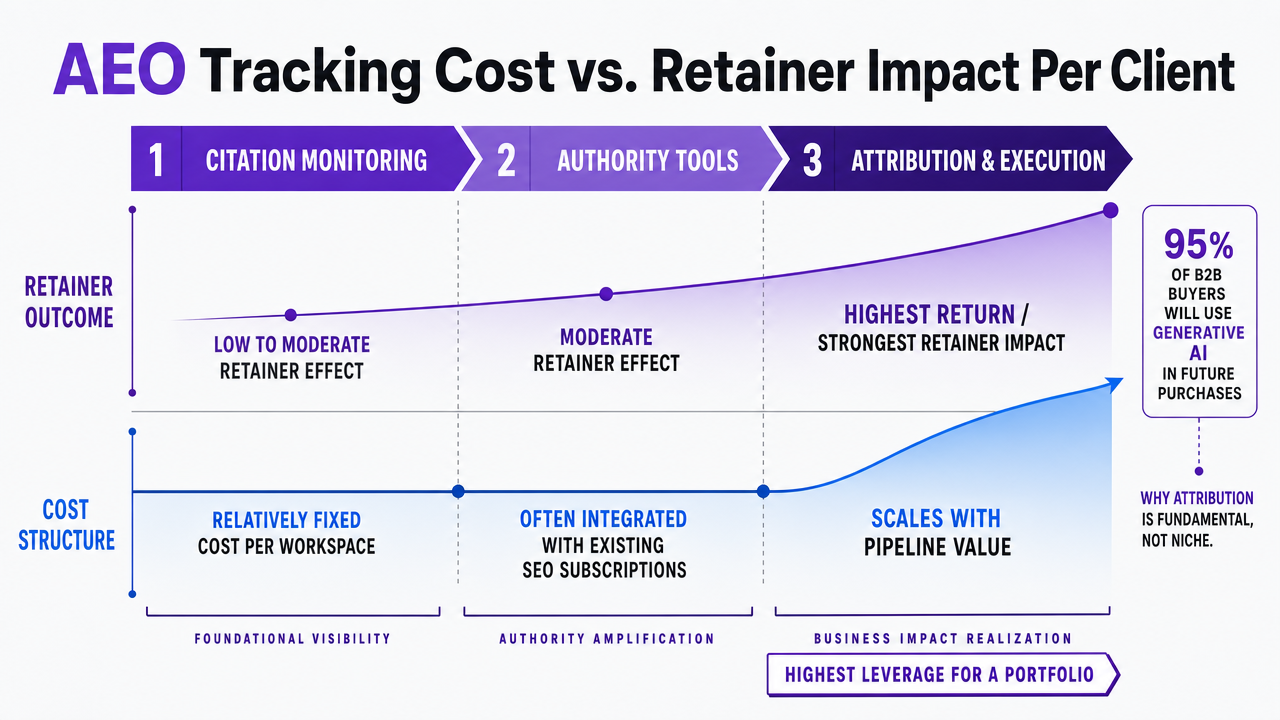 Reinforce the comparison table in this section by visualizing the trade-off between the three stack layers on cost structure and retainer outcome, directly supporting the section's operational argument
What Client Expectations Actually Look Like in QBRs
The QBR is the moment of truth for AEO tracking. Clients have already adapted to AI answers in their daily search routines. Pew's data reveals that 65% of U.S. adults encounter AI summaries in search results at least sometimes, with 45% seeing them often or extremely often6. This is no longer a technological novelty; it's the interface a client's CMO or director sees when searching for their brand before a review meeting.
Client stakeholders in a QBR seek specific, actionable insights: the exact prompts their buyers use, whether their brand appears in the AI answer, and the downstream impact. A concise three-slide sequence is effective:
- a share-of-answer table for tracked prompts,
- a list of cited pages ranked by authority signals, and
- an attribution view linking AI-referred sessions to booked revenue or qualified leads.
Generic screenshots of AI answers are insufficient; a clear ledger of impact is essential.
Why Citation Counts Alone Fail the ROI Test
Citation counts are essentially impression tallies with a new label. They indicate how often a brand appears in an AI answer but provide no information on whether a buyer saw the answer, clicked through, or if that click resulted in a form fill, call, or booked meeting. Agencies relying solely on citation totals in QBRs risk losing accounts when faced with a skeptical CFO.
Berkeley's critique of narrow AI measurement emphasizes that a comprehensive framework should include efficiency, quality, capability, strategic, and human metrics, as treating any single number as ROI misrepresents how AI creates value3. In AEO, a citation count is merely one input into the quality dimension, not the ultimate measure of success. A rising citation count coupled with declining authority on cited pages signals a problem. Similarly, a rising count without attribution tags on resulting sessions represents billable work that lacks defensible value.
The operational solution is a strict reporting rule: every citation metric presented must be accompanied by the cited page's authority signal and the downstream session, call, or pipeline record it generated. If any of these three columns are empty, the metric should not be included in the report.
See How Top Agencies Track and Optimize AEO Performance at Scale
Request a walkthrough of advanced AEO tracking workflows proven to increase client ROI, reduce manual oversight, and deliver actionable analytics across complex multi-channel campaigns.
What Not to Track: Vanity AEO Metrics
Certain metrics frequently appear in AEO reports but should be eliminated:
- raw mention volume,
- unweighted share-of-voice charts, and
- screenshot galleries of AI answers.
These metrics offer the illusion of insight but ultimately contribute noise.
Raw mention volume treats all citations equally, regardless of context or authority. An incidental reference in a low-authority answer is weighted the same as a primary citation in a high-intent buyer prompt. Share-of-voice charts exacerbate this issue by aggregating data across prompts that may not be relevant to the client's target audience. Screenshot galleries are particularly problematic, turning QBRs into anecdotal presentations without attribution, authority signals, or measurable downstream impact.
The guiding principle for reporting is strict: if a metric cannot be linked to a specific buyer prompt, a cited page's authority score, or a downstream session, call, or pipeline record, it has no place in a client report. This filter significantly streamlines reports and enhances the defensibility of the remaining data.
If You Manage a Multi-Location Portfolio
For agencies managing multi-location portfolios—such as dental support organizations, senior living operators, or personal injury firms with multiple offices—the standard AEO playbook requires significant adjustments. The challenge arises because prompt sets, cited pages, and attribution tags often fragment by geography. Consolidating this data for a single QBR necessitates structural decisions beyond what a smaller-scale approach demands.
Three key adjustments are critical:
- Prompt libraries must be templated by location and query type, ensuring that prompts like "best pediatric dentist near [neighborhood]" are automatically run for every practice.
- Citation reporting needs to aggregate share-of-answer at the brand level while retaining location-specific drilldowns for regional operators.
- Attribution tags in GA4 and the CRM must carry a location identifier from the AI-referred session through to the booked appointment or intake call.
Without this, roll-up reports will show brand-level lift without the ability to attribute it to specific locations.
The primary takeaway for operators is that multi-location AEO tracking is fundamentally a data-model decision before it is a tool decision. Agencies should select tools that facilitate the export and analysis of location-specific dimensions.
Assembling a Stack That Survives a Renewal Meeting
Agencies that will retain clients in 2026 are not those with the most extensive tool lists, but those whose AEO stack clearly aligns with the three-layer thesis and produces QBRs that function as a financial ledger. This means having:
- one robust citation monitor for prompt-level share-of-answer data,
- one authority tool integrated with existing SEO subscriptions, and
- one attribution and execution layer that connects AI-referred sessions to booked revenue and links that revenue back to approved work.
The litmus test is straightforward: if a stack cannot generate a single slide that simultaneously displays tracked prompts, cited-page authority, AI-influenced sessions, and pipeline outcomes, it has a critical coverage gap. Berkeley's argument for integrating efficiency, quality, capability, and strategic metrics for AI success applies directly here3. Agencies should select tools that fulfill each of these columns, eliminate those that only produce vanity charts, and implement an execution workflow with an audit trail for approvals. Vectoron is one solution for managing this crucial execution and approval process, ensuring that the investment in AEO tracking pays off in renewal meetings.
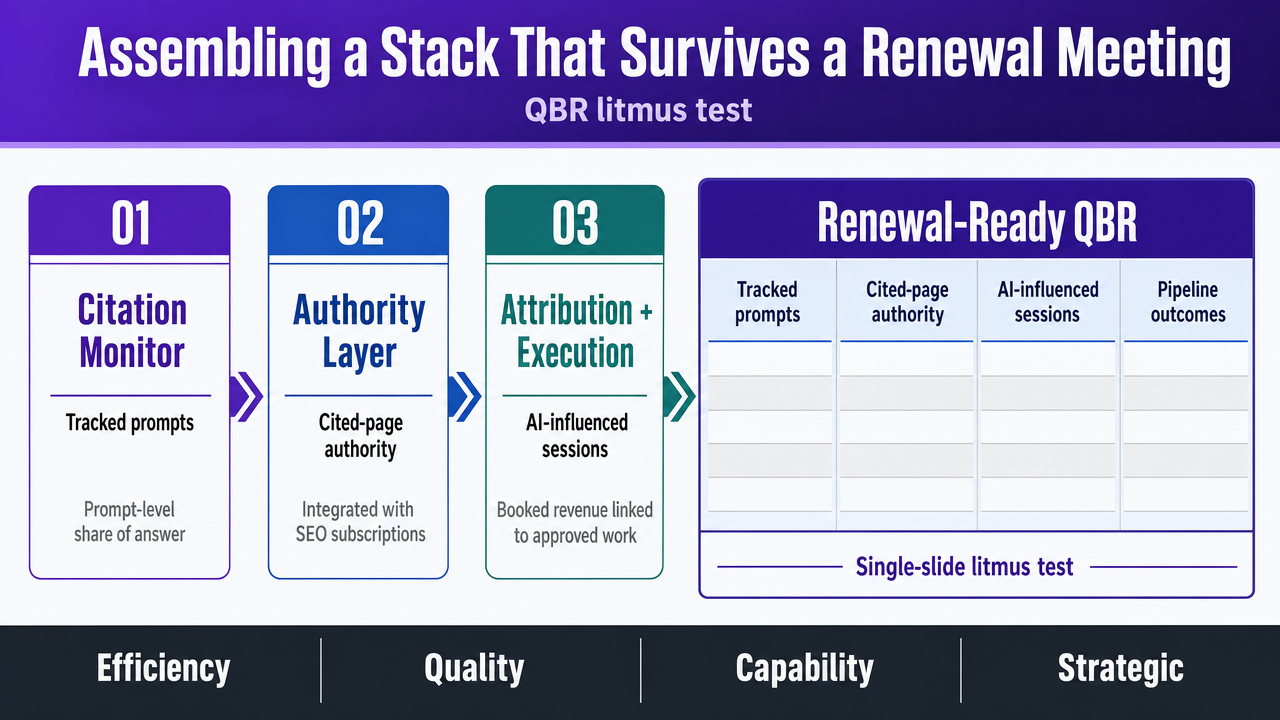 Summarize the article's closing litmus test as a single-slide QBR checklist infographic, showing the four required columns an AEO stack must produce
Frequently Asked Questions
References
- 1.Marketing Analytics and AI Program | Berkeley Executive Education.
- 2.The Modern Digital Marketing Stack: Analytics, AEO & ROI (3 Part Virtual Training).
- 3.Beyond ROI: Are We Using the Wrong Metric in Measuring AI Success?.
- 4.Americans have mixed feelings about AI summaries in search results.
- 5.What Web Browsing Data Tells Us About How AI Appears Online.
- 6.How the US Public and AI Experts View Artificial Intelligence.
- 7.How Americans View AI and Its Impact on People and Society.
- 8.On Future AI Use in Workplace, US Workers More Worried Than Hopeful.
- 9.From Keywords To Context: Impact And Opportunity For AI-Powered Search In B2B Marketing - Forrester.
- 10.The State Of AI, 2025 - Forrester.