
Key Takeaways
- Generative AI functions as a production compression layer, cutting 60 to 70 percent of execution-related task cost and shifting agency margin toward strategy, judgment, and approval rather than throughput 13.
- Variant economics break the linear cost curve, letting media teams enter market with more legitimate tests per dollar — but senior approval throughput, not designer capacity, becomes the binding constraint.
- AI-generated visual ads can lift click-through rates up to 19 percent over human-expert work, yet disclosing AI involvement cuts CTR by 31.5 percent, making the disclosure environment a creative-strategy input 10.
- Hour-based retainers no longer fit once execution compresses; outcome-linked, scope-based, or capacity fees price what remains scarce, and portfolio accounts gain the sharpest margin leverage from the shift.
The Margin Restructuring Beneath the Adoption Curve
The question inside U.S. agencies has already moved past whether to use generative AI. Forrester's 2024 survey of U.S. ad agencies found that 91% are using or exploring generative AI, and among those using it, 74% rated aiding creative ideation as a high or critical priority 1. This near-universal adoption, paired with a concentrated priority on creative ideation, signals something more specific than general enthusiasm: agencies are attaching AI to the most labor-intensive, most repeated, and highest-cost stage of their production stack.
The framing that treats AI ads as a creative novelty misses what is actually happening on the P&L. Production hours are the largest variable cost inside most agency accounts, and creative ideation cycles determine how many hours a senior team burns before a campaign reaches launch. When 74% of adopting agencies prioritize AI for ideation and brainstorming 1, the operational implication is direct: the workflow layer where agencies historically consumed the most senior time is the layer being compressed first.
That is a margin event, not a creative one. Agencies capturing gains treat AI as a production layer that shortens ideation-to-launch cycles, expands the volume of testable variants, and shifts human labor toward strategy, judgment, and approval. Production-heavy retainers lose value as the underlying execution cost falls. Senior-hour allocation becomes the constrained resource, not designer or copywriter throughput.
The rest of this article treats AI ads as a set of economic mechanisms — production compression, variant economics, targeting yield, workforce reallocation, and a compliance-adjusted performance profile — rather than a list of features. Each mechanism changes a specific line in the agency income statement, and each carries a specific constraint that determines whether the benefit shows up in gross margin per account or gets absorbed by rework, disclosure penalties, or misapplied automation.
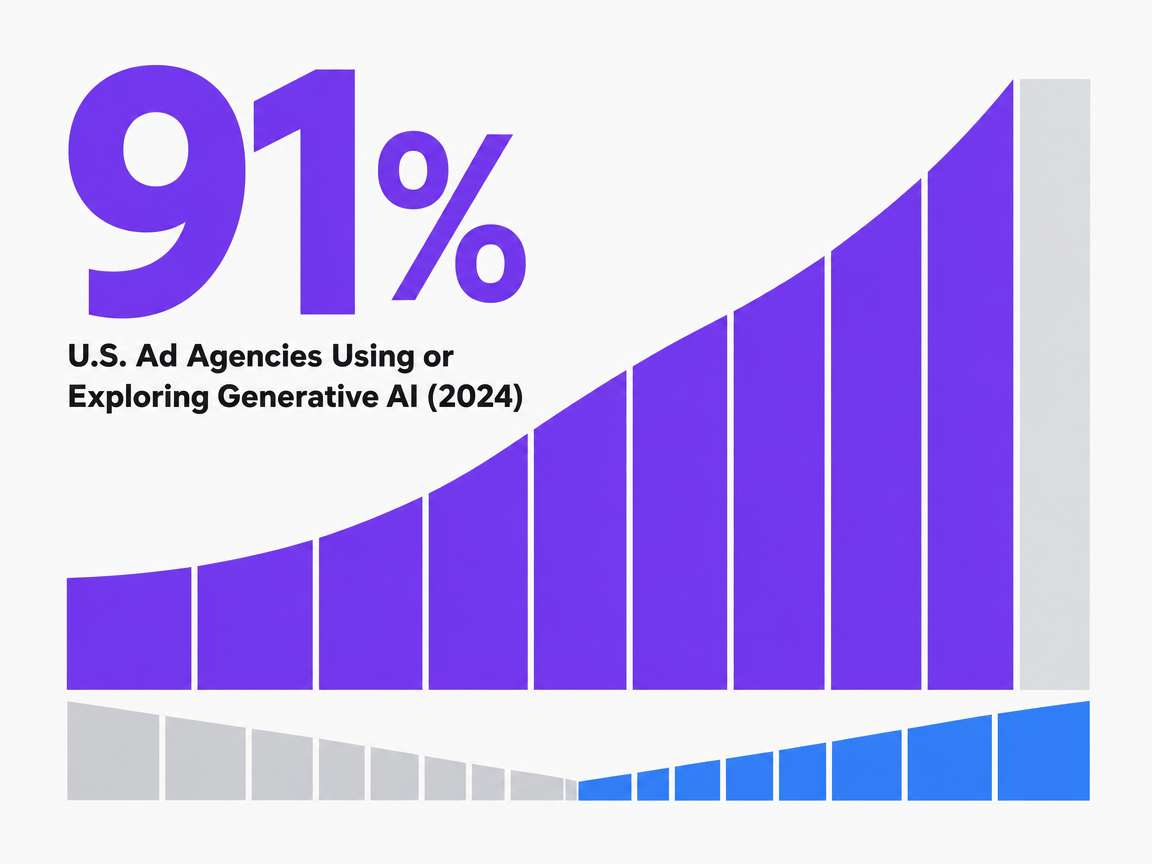 U.S. Ad Agencies Using or Exploring Generative AI (2024)
U.S. Ad Agencies Using or Exploring Generative AI (2024)
Production Compression as the Primary Economic Mechanism
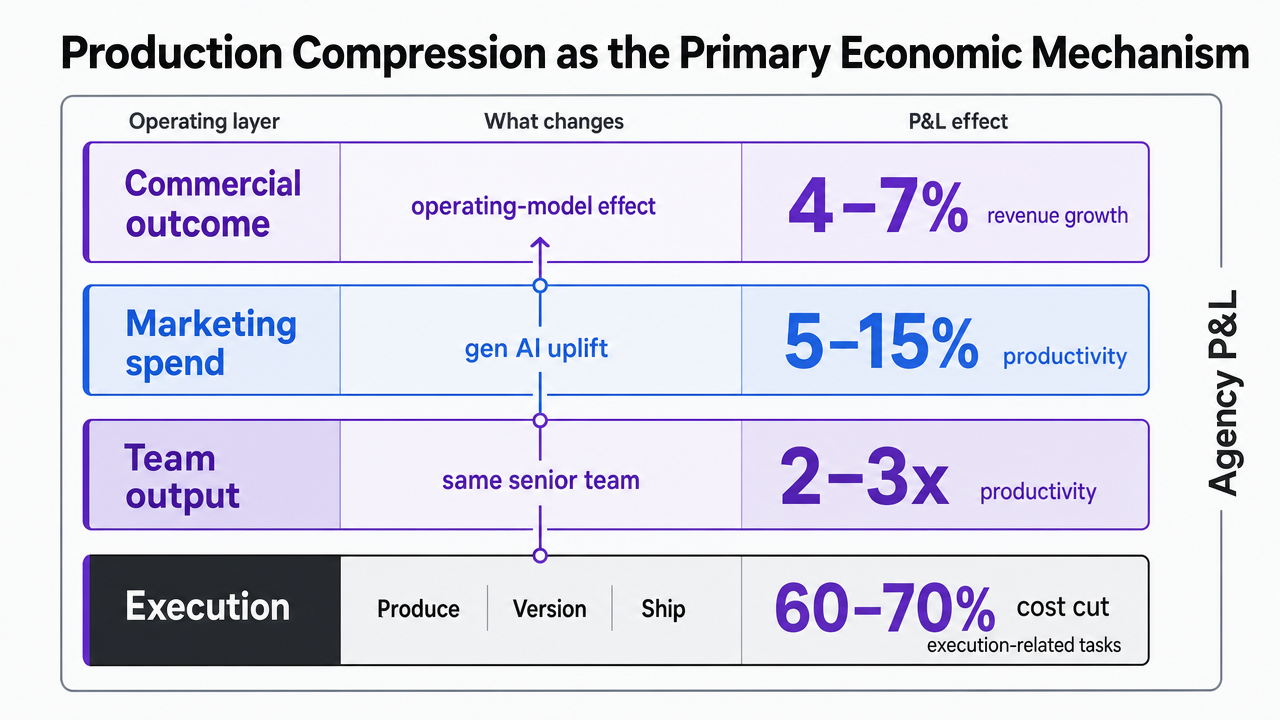
The clearest economic signal from generative AI in marketing sits in three overlapping benchmarks. McKinsey estimates that AI-enabled marketing operations can support 4 to 7 percent revenue growth, deliver two- to threefold productivity improvements, and cut 60 to 70 percent of execution-related task cost 13. A separate McKinsey analysis puts the productivity uplift from generative AI at 5 to 15 percent of total marketing spend 12. These are not campaign-level outcomes. They are operating-model figures, and they land directly on the line items agencies actually manage.
Read them as a system. The 60 to 70 percent execution savings describe what happens to the hours spent producing, versioning, and shipping creative. The two- to threefold productivity multiplier describes what a senior team can output against the same calendar. The 5 to 15 percent marketing productivity uplift captures the residual value returned to the client's budget once execution overhead falls 12. For an agency P&L, the first two numbers show up as gross margin. The third shows up as the client's willingness to reinvest saved dollars into media or additional scope.
The mechanism is compression, not substitution. A traditional agency workflow burns senior hours across concepting rounds, revision cycles, asset resizing, and platform-specific reformatting. Generative AI collapses the reformatting and variant-production stages first, then the drafting and comping stages, leaving the strategic framing and approval decisions in human hands. Campaigns that previously took months can be rolled out in weeks when creative production is treated as a compressible layer rather than a fixed cost 12.
The margin math follows from where the cuts land. If execution tasks account for a majority of billable production hours on a typical retainer, a 60 to 70 percent reduction in that layer 13 does not simply lower cost — it changes which activities generate the retainer's value. Strategy, media planning, measurement, and creative direction become the load-bearing services. Everything downstream of approval moves toward marginal cost.
Two caveats keep the benchmarks honest. First, the McKinsey ranges describe potential across marketing operations broadly, not guaranteed outcomes for any single agency 12, 13. Realized savings depend on how tightly the production stack is integrated with approval workflows and how much rework AI output requires before it ships. Second, the productivity uplift is a share of marketing spend, not a share of agency revenue 12. Agencies that price on hours will see the compression flow through as fewer billable hours per account unless the commercial model shifts to outcomes, scope-based fees, or expanded scope.
The operational read is simple. Production compression is the mechanism that makes every other benefit in this article possible. Without it, variant testing, targeting yield, and workforce reallocation are constrained by the same production bottleneck that has always defined agency economics. With it, the question stops being how many creative assets a team can make and starts being how many accounts a senior team can meaningfully oversee.
Variant Economics and the Collapse of the Per-Asset Cost
Traditional agency creative operates under a hard constraint: each additional variant carries a nearly linear cost. A second headline, a third aspect ratio, a fourth audience cut — each one draws senior time from the same team that produced the original. That linearity is what has historically capped how much testing an account can support. Media budgets could absorb more variants; production budgets could not.
Generative AI breaks the linearity. Once the strategic framing, brand system, and approval criteria are set, producing the tenth variant costs a small fraction of producing the first. McKinsey attributes 60 to 70 percent of the potential savings from AI-enabled marketing to execution-related tasks — the reformatting, versioning, and asset generation stages where variant production actually happens 13. The cost curve flattens after the first asset, and testing volume stops being gated by production capacity.
That changes what a media team can do inside a fixed budget. Instead of picking three creative directions and hoping one hits, an account can enter market with fifteen, kill twelve early, and concentrate spend on the survivors. The learning rate accelerates, and the same budget yields more information per dollar. McKinsey's broader analysis puts the productivity uplift from generative AI at 5 to 15 percent of total marketing spend 12, and a meaningful share of that gain comes from testing efficiency rather than headline cost cuts.
The constraint shifts upstream. When variant production is cheap, the bottleneck becomes the ability to define a testable hypothesis, review outputs against brand and compliance standards, and decide which winners to scale. Senior judgment — not designer throughput — determines how much value the variant expansion actually captures. Agencies that treat AI as a way to ship more of the same creative miss the mechanism. The point is not more assets. It is more legitimate tests per account, faster iteration on what works, and a media budget that compounds learning instead of paying repeatedly for the same production overhead.
Experience AI ad workflows with real campaigns
Test-drive AI-powered ad execution and analyze live campaign results before making a commitment.
Where AI Creative Outperforms Humans — and Where It Breaks
The performance case for AI creative has to be read carefully, because the same body of research that shows AI outperforming humans also shows that outperformance evaporating under specific conditions. Experimental work summarized by NYU Stern found that ads created entirely by generative AI increased click-through rates by up to 19 percent compared to ads made by human experts. The same research found that telling consumers an ad was made using generative AI caused a 31.5 percent decrease in click-through rates 10. Two findings, one dataset, opposite operational implications.
The scope matters. The NYU Stern research examined visual generative AI in digital advertising and measured click-through rates as the outcome variable 10. It is not a general claim that AI beats humans across every creative discipline, every channel, every funnel stage, or every brand context. It is a specific finding about a specific medium and a specific top-of-funnel metric. Treating it as a universal endorsement of AI creative is the same mistake as dismissing it because the study did not measure conversion or lifetime value.
What the finding does establish is that the ceiling on AI-generated visual ads is not lower than expert human work — it can be measurably higher in the metric most media teams use to judge creative in market. That resets a common assumption inside agencies: that AI is acceptable for volume production but human hands are required for the hero asset. In the tested condition, the fully AI-generated version was the hero asset.
The disclosure effect is where the mechanism breaks. A 31.5 percent drop in click-through rate when AI involvement is disclosed 10 is not a rounding error. It is large enough to erase the 19 percent upside and then some. Agencies operating in categories where disclosure is expected, regulated, or culturally enforced cannot model AI creative performance using the undisclosed baseline. The realistic performance envelope depends on which disclosure regime the campaign runs under, and that regime is not fully settled — the FTC's revised endorsement guides address virtual influencers and clear-and-conspicuous disclosure requirements without resolving every platform-specific case 3.
The operational read for creative directors is narrower than the headline suggests. AI-generated visual ads can win on click-through in undisclosed contexts, which covers most standard paid social and display placements today. In contexts that require disclosure — endorsements, testimonials, health claims, categories under active regulatory attention — the performance advantage inverts, and the calculation shifts from creative quality to trust cost. The break point is not the technology. It is the disclosure environment the ad ships into, and agencies need to know which one applies before they commit to an AI-heavy creative strategy for a given account.
Workforce Reallocation, Not Headcount Loss
Forrester projects that U.S. advertising agencies will automate 7.5 percent of work by 2030, and it frames that shift as an increase in the productivity of higher-wage skillsets rather than a headline cut to agency employment 2. The distinction matters. A 7.5 percent automation figure applied to junior production tasks reads as job displacement. Applied to the hours those tasks consumed inside senior roles, it reads as capacity returning to the people who set strategy, direct creative, and own client relationships.
The hours freed do not disappear. They move. Senior strategists spend less time reviewing execution artifacts and more time on the work that agencies have historically underinvested in — hypothesis design, media mix decisions, measurement architecture, and the client conversations that determine retention. Forrester's own adoption data reinforces the direction of travel: 74 percent of agencies using generative AI rate aiding creative ideation as a high or critical priority 1, which is a senior-time category, not a junior-production one.
Client-side pressure runs in the same direction. McKinsey's survey of senior marketers found respondents expect generative AI to cut costs by an average of 13 percent, with 78 percent expecting greater efficiency and nearly half predicting their internal teams will shrink 15. Agencies are not being asked to prove that AI works — their clients are already assuming it will, and are budgeting for the savings. That reshapes the conversation about retainer scope and headcount inside the agency at the same time.
The operational read is that the roles agencies need more of are senior creative directors, strategists, media leads, and account principals who can approve at speed. The roles that compress are the ones defined primarily by production throughput. Agencies still running a pyramid staffing model — a few seniors overseeing many juniors doing execution — carry the largest exposure to margin compression, because the base of the pyramid is exactly what the 60 to 70 percent execution-cost savings benchmark targets. The agencies gaining margin are the ones flattening the pyramid and paying for judgment, not hours.
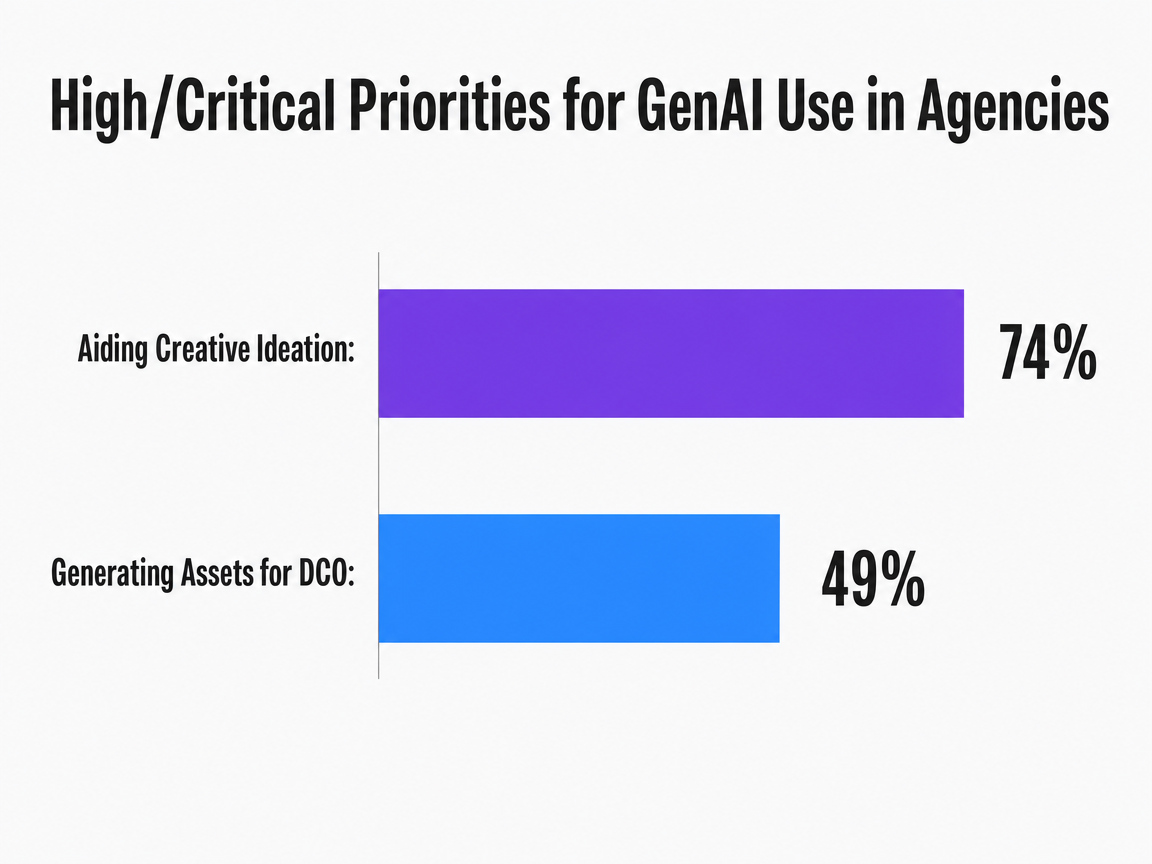 High/Critical Priorities for GenAI Use in Agencies
Forrester survey of agencies using generative AI, showing the percentage that rate specific tasks as a high or critical priority.
Compliance as an Operational Constraint on the Creative Pipeline
Compliance is where the AI creative pipeline meets its hardest external constraint. The FTC adopted revised Guides Concerning the Use of Endorsements and Testimonials in Advertising in July 2023, and that update is the governing document agencies need to operate against 8. It addresses fake reviews, virtual influencers, and clear-and-conspicuous disclosure requirements, and it applies whether the creative was produced by a copywriter or a model 3. AI does not create a separate compliance regime. It creates more surface area inside the existing one.
Three obligations carry through directly. Endorsements must reflect the honest opinions of the endorser, advertisers need adequate substantiation for performance claims, and material connections must be disclosed clearly and conspicuously 7. When AI is used to generate testimonial-style content, synthetic spokespeople, or before-and-after narratives, the substantiation burden does not shift to the model. It sits with the advertiser and, by extension, with the agency producing the asset. The FTC's guidance is explicit that endorsements must be honest and not misleading, and that disclosures should be clear and conspicuous 4.
The consumer-review rule tightens the second edge. The FTC's final rule on consumer reviews and testimonials states that AI-generated reviews fall within its scope and that creating, buying, or selling fake reviews and testimonials is prohibited 5. Agencies running reputation, social proof, or user-generated-content campaigns need to distinguish between compliant uses of synthetic personas and prohibited fabrication of consumer voice. The FTC's own FAQ draws that line: there is no blanket prohibition on AI-generated avatars in marketing, but fake or false testimonials remain prohibited 6. A virtual spokesperson clearly labeled as a brand character is a different object than a fabricated customer review, and the pipeline needs to encode that difference.
The operational read is that compliance functions as a gate inside the production stack, not a review layer bolted on afterward. Three checkpoints matter:
- Substantiation for every performance or outcome claim before the asset enters variant expansion — the compression benefit disappears if fifteen variants of an unsubstantiated claim have to be pulled.
- Disclosure logic tied to asset type, so testimonial-style content, synthetic endorsers, and AI-generated consumer voice route through a separate approval path than standard brand creative.
- A documented record of what was AI-generated, what was human-authored, and what claims were substantiated by which source, because the guides require adequate substantiation regardless of production method 7.
This is also where the disclosure penalty from the previous section becomes an operational variable rather than a debate. In categories where disclosure is required or platform-mandated, the AI performance ceiling drops, and the media plan has to account for that at the modeling stage — not after launch. Agencies serving regulated verticals cannot treat the disclosure question as a legal review. It is a creative-strategy input that determines which portions of the account should use AI-heavy production and which should not.
See How AI-Driven Ad Execution Reduces Overhead and Boosts Campaign Efficiency
Request a demo of an AI-powered platform that coordinates multi-channel ad campaigns, eliminates manual bottlenecks, and delivers measurable performance improvements for client accounts at scale.
What Agencies Can Credibly Promise Clients
The gap between what AI marketing vendors claim and what agencies can defend in a client review is where retention gets won or lost. The honest performance envelope sits inside a specific range. McKinsey's research on AI investment in marketing and sales finds a 3 to 15 percent revenue uplift and a 10 to 20 percent sales ROI uplift among players putting real capital behind AI 9. Those are the numbers an agency can put in a pitch deck without walking them back six months later.
The credibility test is in the framing. Revenue uplift of 3 to 15 percent is a range for organizations that invest in AI across marketing and sales — not a promise for a single campaign, a single channel, or the first quarter of engagement 9. Agencies that commit to the upper bound on a discovery call set a trap for themselves at renewal. The stronger commercial position is the range, with a clear statement of which conditions push a client toward the top or bottom of it: data quality, media budget elasticity, offer strength, and how quickly the client can approve variants once the production layer compresses.
Sales ROI uplift of 10 to 20 percent 9 is the number that lands hardest with clients who measure agencies on media efficiency. It is defensible because it describes what happens when AI is applied to targeting, creative testing, and orchestration together, not any one of them in isolation. Agencies promising ROAS improvements from creative alone are overreaching the evidence.
What should not be promised: guaranteed outperformance in disclosed contexts, uniform gains across every account, or savings that assume zero rework on AI output. What can be promised: faster time-to-market, more tests per dollar, and a measured share of the revenue and ROI ranges above, tied to specific operating conditions the client controls.
If You Service Multi-Location or Portfolio Accounts
The economics shift again for agencies whose book is weighted toward multi-location operators — DSO groups, home services franchises, senior living portfolios, regional health systems, multi-office law firms. The unit of work in these accounts is not a campaign. It is a campaign multiplied by location count, and traditional production economics have always broken down first at that multiplier.
The mechanics are worth stating plainly. A portfolio account with forty locations needs forty market-specific creative sets, forty geo-targeted variant trees, and forty measurement views. Under traditional production, each location either gets a diluted share of one national creative or a proportionally smaller share of senior time — usually the former, which is why multi-location performance benchmarks tend to sit below single-market equivalents. The production layer cannot scale linearly with location count without the retainer collapsing under its own hours.
Apply the McKinsey benchmarks to that structure and the constraint changes. A 60 to 70 percent reduction in execution-related task cost 13 falls hardest on exactly the work that location count multiplies: reformatting, localization, variant generation, and platform-specific asset production. Layer on the 5 to 15 percent marketing productivity uplift as a share of spend 12, and the media budget behind each location gains headroom that previously went to production overhead. The ratio that matters — accounts or locations per senior strategist — moves.
Directionally, if execution labor per location drops by more than half and variant output per hour rises two- to threefold 13, a senior strategist who could meaningfully oversee eight to twelve locations under a traditional model can plausibly oversee a materially larger portfolio under an approval-first workflow. The exact multiplier depends on account complexity, data integration, and how quickly the client approves at each gate. What does not depend on those variables is the direction: the binding constraint stops being production hours and becomes approval throughput.
That reframes the commercial pitch to portfolio clients. The credible offer is not cheaper creative per location. It is more locations receiving legitimate, market-specific testing under one senior team, with the revenue and ROI ranges from earlier — 3 to 15 percent and 10 to 20 percent respectively 9 — applied per location rather than diluted across a national average. For agencies that already price portfolio accounts on a per-location fee, the margin story is straightforward: the same senior team covers more locations, and the per-location fee falls only to the extent the agency chooses to share the compression with the client.
The Retainer Model After AI Ads
Once production compresses, the retainer stops making sense as a container for hours. It has to become a container for outcomes, scope, or capacity — because the thing the client was implicitly buying, execution throughput, is no longer scarce. Agencies that keep pricing on hours end up in a slow bleed: the compression benefit flows to the client as fewer billable hours, and the agency captures none of the margin it built the capability to deliver.
The client side is already moving. Senior marketers surveyed by McKinsey expect generative AI to cut costs by an average of 13 percent, and 78 percent expect greater efficiency 15. Clients arriving at renewal with those numbers in mind will not accept a flat retainer priced against the old production stack. The commercial conversation has to shift before the client opens it, not after.
Three pricing structures survive the transition:
- Outcome-linked fees tied to the revenue and ROI ranges an agency can credibly promise.
- Scope-based fees priced on the number of accounts, locations, or variant tests supported per period.
- Capacity fees priced on senior-strategist time and approval throughput, with execution treated as included cost.
Each one prices what remains scarce — judgment, strategy, approval — instead of what used to be scarce.
The retainer does not die. It gets repriced against the constraint that actually binds.
Frequently Asked Questions
References
- 1.The State Of Generative AI Inside US Agencies, 2024 - Forrester.
- 2.Advertising Agencies In The US Will Automate 7.5% Of ....
- 3.Revised FTC Endorsement Guides ....
- 4.FTC's Endorsement Guides: What People Are Asking.
- 5.Use of Consumer Reviews and Testimonials: Final Rule.
- 6.The Consumer Reviews and Testimonials Rule: Questions ....
- 7.[XML] CFR-2023-title16-vol1-part255.xml - GovInfo.
- 8.Federal Register, Volume 88 Issue 142 (Wednesday, July 26, 2023).
- 9.Marketing and sales soar with generative AI.
- 10.The AI Advertising Paradox.
- 11.Supercharging customer service with AI.
- 12.How generative AI can boost consumer marketing.
- 13.The future of marketing in the age of AI.
- 14.AI-powered marketing and sales reach new heights with generative AI.
- 15.On Point: Never too tired to make a sale, generative AI is reshaping marketing at lightning speed.