
Key Takeaways
- Integration happens at the workflow level, not the prompt level: redesigning the ten-stage content supply chain from intake to measurement is what closes the 64-to-39 adoption-to-impact gap 7.
- Governance acts as a production accelerator when provenance logs, authorship judgment, and substantiation rules are set upstream, reducing rework at legal review and aligning with NIST, Copyright Office, and FTC expectations 2, 3, 4.
- Cost-per-published-asset falls meaningfully only above roughly eight to twelve pillar assets a month, since prompt design, exemplar maintenance, and provenance logging are fixed costs that amortize with volume 5.
- Locate the team on the four-tier maturity model, then shift focus to voice specs versioned like code, named approval gates at every AI-led stage, and KPIs tied to pipeline contribution rather than word count 6, 8.
The Workflow Is the Unit of Integration
Most content teams treat AI as a faster keyboard. They paste a brief into a chat window, edit the output, and call it integration. The numbers say that approach has a ceiling. McKinsey's 2025 global survey of AI adoption found that 64% of organizations report AI is enabling innovation, but only 39% report measurable EBIT impact at the enterprise level 7. The gap is not a tooling gap. It is a workflow gap.
Content marketing managers running 4-to-20-person teams already know the symptoms: faster first drafts that still bottleneck at legal review, brand-voice drift across writers and prompts, and SEO gains that do not show up in pipeline contribution. The unit that produces those outcomes is not the prompt. It is the supply chain that runs from intake to measurement, and every stage in it.
This article maps where AI plugs into that supply chain, which stages stay human, where governance sets the floor, and which KPIs actually move once the workflow itself, rather than the writing tool, becomes the object of integration.
Why Tool Adoption Has Outpaced Business Impact
Generative AI tools are now standard kit on most content teams. License counts are up, prompt libraries exist, and writers can produce a 1,800-word draft before lunch. The business case is harder to find. McKinsey's 2025 State of AI survey reports that 64% of organizations say AI is enabling innovation, while only 39% report measurable EBIT impact at the enterprise level 7. That 25-point gap is the central problem this article addresses.
The same survey notes the underlying pattern: case-level cost and revenue benefits show up frequently, but those wins do not roll up into enterprise financials 7. A faster blog draft saves four hours. A faster blog draft inside a workflow that still bottlenecks at legal review, still produces voice-drifted copy, and still publishes assets that nobody measures against pipeline does not change the P&L.
Purdue's analysis of McKinsey's 2024 data frames 2024 as the year organizations began capturing tangible value from generative AI, with personalization and customer experience as the leading sources 9. The teams that captured value did not buy better tools than the teams that did not. They redesigned the work around the tools. Skills and process gaps, not model quality, separate the two groups 9.
The reframe for content marketing managers is straightforward. Tool adoption is a precondition, not a result. Business impact arrives when the supply chain that produces, governs, and measures content is itself redesigned, with explicit approval gates and KPIs attached to each stage. The remainder of this article maps that redesign.
Mapping AI to a Ten-Stage Content Supply Chain
Intake, Research, and Outline
A content supply chain starts before a single word is drafted. Intake captures the request: the asset type, the target keyword, the funnel stage, the stakeholder, and the deadline. In most in-house teams, intake is a Google Form, a Jira ticket, or a Slack thread. It is also where briefs go missing and scope creeps.
AI earns its place at intake by normalizing requests. A language model can convert a two-sentence Slack message into a structured brief with target audience, primary keyword, search intent, internal subject-matter experts to consult, and competing URLs to analyze. The human approval gate is the requester confirming the structured brief matches what they actually meant.
Research is the next stage and the one where most time disappears. AI-assisted research compresses SERP analysis, competitive teardown, and source aggregation from a half-day to under an hour. Harvard's Professional and Executive Education writeup on AI in marketing notes that the technology is shifting time away from repetitive research tasks toward higher-value strategy and creative work 8. The catch is verification. Model outputs that summarize sources must be checked against the sources themselves before any claim enters an outline.
Outlining is a human-led stage with AI as a sparring partner. The strategist decides the argument; the model proposes structures, counterarguments, and gaps.
Drafting, Brand-Voice Pass, and SEO Pass
Drafting is where AI displaces the most hours. A model working from an approved outline, an exemplar library, and a fact pack can produce a 1,800-word first draft in under five minutes. McKinsey's consumer marketing analysis describes early adopters generating and testing far more creative variations than previously feasible, with measurable reductions in time-to-market for campaigns 6. That speed is real and it is also the point where governance starts to matter.
The brand-voice pass is a separate stage, not an afterthought to drafting. A general-purpose model produces general-purpose prose. Voice-aligned output requires a system prompt loaded with the team's tone rules, banned phrases, sentence-length targets, and ten to twenty exemplar paragraphs the team considers on-brand. The pass itself is half model, half human. The model rewrites against the voice spec; an editor reads the result and either approves or sends it back with specific corrections that get folded into the next prompt iteration.
The SEO pass is mechanical and benefits from AI handling the first draft of optimization. Heading hierarchy, internal link suggestions, meta description, schema candidates, FAQ extraction, and entity coverage against the target keyword can all be generated and proposed in a single pass. The human SEO lead approves the changes, rejects what conflicts with the strategy, and pushes the asset to legal review. Two approval gates close this stage: voice editor approval and SEO lead approval.
Legal Review, Publish, Repurpose, and Measure
Legal review is the stage that breaks most AI content pipelines. Drafts arrive faster than reviewers can process them, and reviewers do not know which claims came from the model and which came from cited sources. The fix is provenance logging at every prior stage so the legal queue receives drafts with claims, sources, and AI involvement already tagged. NIST's GenAI Profile recommends content provenance risk management and alignment of generative AI use with applicable laws and policies, and that recommendation is what makes the ten-stage workflow defensible rather than theoretical 2. A printable diagram of the full pipeline, with AI-led stages, human-led stages, and approval gates marked, belongs on the wall of every content team running this model.
Publishing is a human approval gate followed by automated execution. The reviewer signs off; the CMS receives the asset, the metadata, and the schema. Repurposing is AI-led: the published asset becomes a LinkedIn post, three email subject lines, a 90-second video script, and a sales enablement one-pager, each routed back through a brand-voice check.
Measurement is where the workflow proves itself. Pipeline contribution, organic sessions, assisted conversions, and time-to-publish per asset get logged against the brief from stage one. Without that loop, the ten-stage chain is just a faster way to ship copy nobody reads.
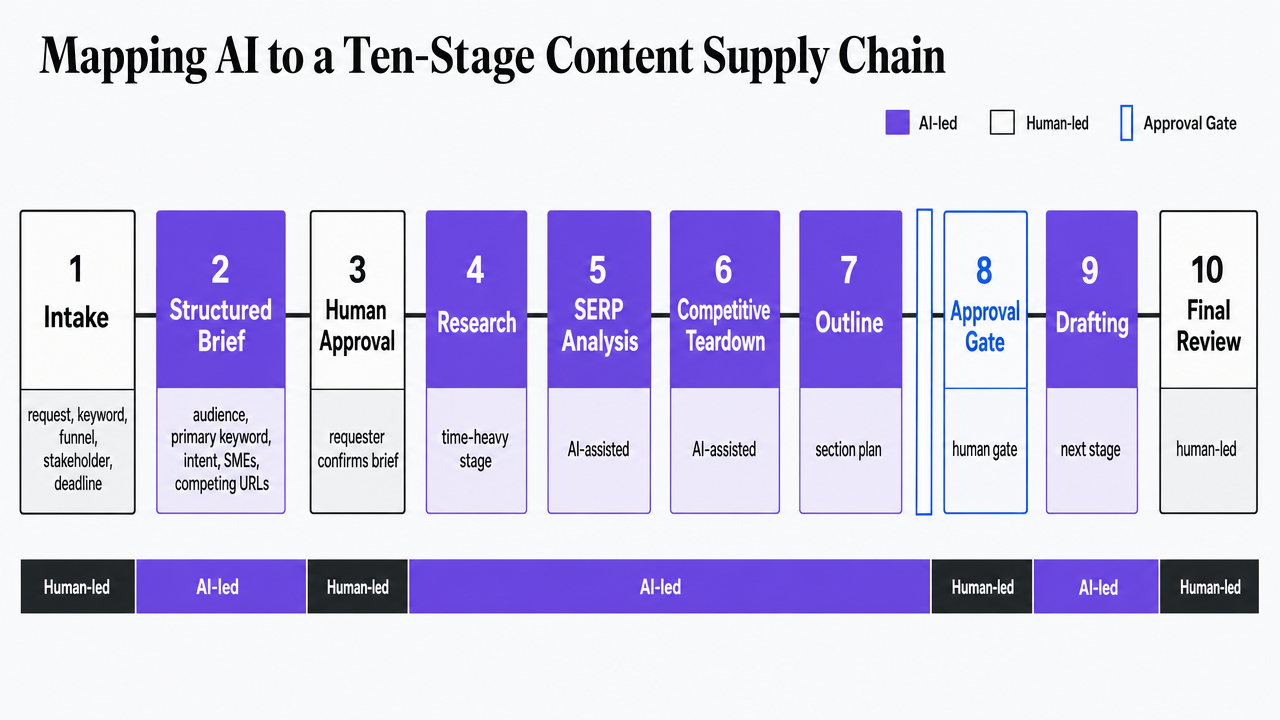 Visualize the ten-stage content supply chain described in the section, showing which stages are AI-led, which are human-led, and where approval gates sit. This is a process infographic directly mapped to the section's content
Test AI-driven content workflows on live campaigns
Experience measurable content output gains by running real marketing initiatives with full platform access for 7 days.
Governance as a Production Accelerator
Provenance, Authorship, and Substantiation Rules That Set the Floor
Governance is usually framed as the thing that slows AI workflows down. The opposite is closer to the truth. Teams without provenance, authorship, and substantiation rules send drafts back from legal review three and four times because nobody can answer where a claim came from. Teams with those rules in writing send drafts back once, or not at all.
Three regulatory inputs set the floor for any in-house content workflow:
- NIST's GenAI Profile recommends content provenance risk management and alignment of generative AI use with applicable laws and policies, which in practice means logging which model produced which passage, what sources it drew from, and which human approved it 2.
- The U.S. Copyright Office, in Part 2 of its 2025 AI report, clarified that AI-assisted outputs are copyrightable only where a human author has determined sufficient expressive elements, and that prompting alone does not meet the bar 3.
- The FTC's September 2024 enforcement sweep made clear that AI-generated claims, testimonials, and product positioning still require evidence and review, with the agency taking action against companies that used AI to supercharge deceptive or unfair conduct 4.
Translated to a content supply chain, those inputs produce three rules. Every asset carries a provenance log noting AI involvement at each stage. Every published asset shows enough human editorial judgment in structure, claims, and expression to meet the authorship threshold. Every factual claim has a source on file before it reaches legal review. Those rules are the production accelerator: they remove the ambiguity that creates rework.
Writing the Internal AI Usage Policy
The internal AI usage policy is a one-page document, not a forty-page framework. Harvard Business School's Marketing AI Guidelines offer a usable template. The HBS policy permits AI-assisted drafts, transcripts, chatbots, and original images, prohibits deceptive image generation, requires human proofreading for accuracy and quality, and mandates that AI-generated visuals carry a "Created using AI" label 1.
A content team's version of that document needs five sections:
- Approved use cases, which name the stages of the supply chain where AI is permitted.
- Prohibited use cases, which name the stages and asset types where it is not, such as testimonials, case study quotes, and original research claims.
- Disclosure rules, which specify when AI involvement is labeled externally and when it is logged internally only.
- Review requirements, which assign named human approvers to each gate.
- Substantiation requirements, which state that any claim about performance, outcomes, or comparison must have a source on file.
Policies that fit on one page get followed. Policies that read like legal briefs get ignored, and ignored policies are what regulators and plaintiffs find first.
Brand Voice as an Engineering Problem
Brand voice drift is usually treated as a creative failure. It is closer to a specification failure. A general-purpose model trained on the open internet will produce open-internet prose unless the team gives it a voice spec that is precise enough to compile.
The spec has four components:
- A written voice guide that names the tone, the formality level, the perspective, the average sentence length, and the banned phrases.
- An exemplar library of ten to twenty paragraphs the team considers on-brand, with short annotations explaining what makes each one work.
- A negative library of five to ten paragraphs the team has rejected, with annotations explaining the specific failures.
- A system prompt that loads all three into the model at the start of every drafting and rewriting pass.
That spec is the system prompt, and it gets versioned like code. When a writer notices the model has started producing a phrase the team would not ship, the fix is a prompt revision and a new exemplar, not a hand-edit on the asset. Hand-edits do not propagate. Prompt revisions do.
Harvard's Professional and Executive Education writeup notes that AI is shifting marketing time away from repetitive production toward higher-value strategy and creative work 8. That shift only holds if the voice problem is solved once at the system level rather than re-solved on every draft. The editor's job moves from rewriting sentences to maintaining the spec.
The Workflow Economics: Where Hours Move
The cost story for AI and content marketing is rarely as clean as the pitch decks suggest. Hours come out of some stages and go into others. The net is positive when the workflow is governed, and roughly neutral when it is not. McKinsey's analysis of generative AI value concentration places marketing and sales among the four domains capturing the bulk of the technology's economic potential, but the same analysis stresses that productivity gains depend on redesigning workflows rather than deploying tools 5.
Hours leave the workflow at three stages:
- Draft generation drops from a half-day of writing time to under an hour of editing time per 1,800-word asset.
- First-pass SEO, including heading hierarchy, meta description, FAQ extraction, and entity coverage, compresses from two hours to fifteen minutes.
- Repurposing one pillar into a LinkedIn post, three email subject lines, a video script, and a sales one-pager moves from a full day of writer time to roughly ninety minutes of editor time.
Hours enter the workflow at four stages:
- Prompt design and exemplar-library maintenance is a recurring cost, not a one-time setup.
- Fact-checking AI output adds time that ad-hoc workflows skip and then pay for in retractions.
- Provenance logging adds a few minutes per asset.
- Legal review takes longer per draft but happens less often because provenance tags arrive with the asset.
| Stage | Hours removed (H_r) | Hours added (H_a) |
|---|---|---|
| Intake and brief structuring | 0.5 | 0 |
| Research and source aggregation | 3 | 0.5 (verification) |
| Outline | 0.5 | 0 |
| Drafting | 4 | 0 |
| Brand-voice pass | 0 | 0.5 (prompt design) |
| SEO pass | 1.5 | 0 |
| Fact-check and provenance log | 0 | 0.75 |
| Legal review | 0.5 | 0.25 |
| Publish | 0.25 | 0 |
| Repurpose (per derivative asset) | 1.5 | 0.25 |
The net per pillar asset is hours out minus hours in, with the spread widening as volume scales because prompt design and exemplar maintenance amortize across every draft the system produces. Cost-per-published-asset falls fastest on teams that publish at least eight to twelve pieces a month. Below that volume, the fixed governance cost dominates, and the economics look closer to break-even than to the productivity headlines.
See How AI-Driven Workflows Streamline Enterprise Content Production
Request a walkthrough of unified AI content and SEO operations built for agency-scale teams seeking measurable gains in velocity, consistency, and approval governance.
A Four-Tier Maturity Model for Self-Location
Content teams rarely jump from ad-hoc prompting to a governed pipeline in one quarter. The path is staged, and the stages have distinct economics, risks, and KPIs. A four-tier model gives content marketing managers a way to locate the team honestly and pick the next move.
Tier 1: Ad-hoc prompting. : Writers use ChatGPT, Claude, or Jasper on personal accounts. There is no shared prompt library, no voice spec, and no provenance log. Output quality varies by writer. Legal review treats every draft as if no AI touched it because nobody can prove otherwise. Most in-house teams sit here and mistake license adoption for integration.
Tier 2: Embedded assistant. : The team has shared accounts, a basic prompt library, and informal norms about where AI is used. Drafting speeds up. Brand voice still drifts because the spec lives in a Google Doc, not a system prompt. Purdue's read of McKinsey's 2024 data places most teams capturing early value at roughly this tier, with personalization as the most common entry point 9.
Tier 3: Orchestrated workflow. : AI is mapped to specific stages of the supply chain with named approval gates, a versioned voice spec, and provenance logging. Cost-per-published-asset drops and legal review cycles shorten. This is the tier where the 64-to-39 adoption-to-impact gap starts to close 7.
Tier 4: Governed multi-channel system. : Content, SEO, paid, and social run on a shared approval workflow with KPI attribution back to each stage. Most teams are not here yet. The honest move is to name the current tier and plan one tier of advancement per two quarters.
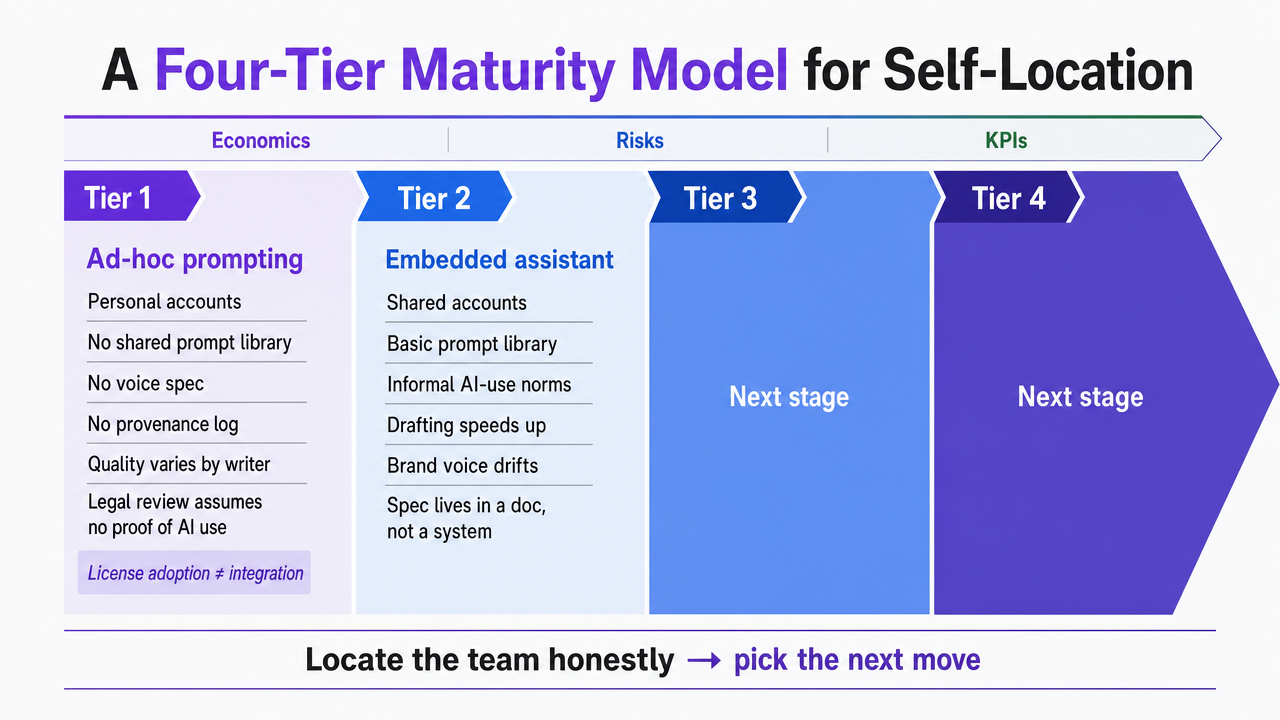 Visualize the four-tier maturity model explicitly described in the section, giving readers a self-location reference. Process/framework infographic tied directly to the section text
KPIs That Actually Move When the Workflow Is Integrated
Ad-hoc AI usage tends to move vanity metrics. Words per week climb, blog cadence accelerates, and writers report higher output in self-assessments. None of those numbers appear on a CMO's quarterly review. When AI is wired into the supply chain instead of bolted onto the keyboard, a different set of KPIs starts moving, and they are the ones that justify the headcount the team already has.
Four metrics matter:
- Time-to-publish per asset, measured from approved brief to live URL, drops sharply once drafting, SEO pass, and repurposing run on AI with human approval gates.
- Cost-per-published-asset, calculated as fully loaded team hours divided by assets shipped, falls fastest on teams publishing eight or more pieces a month.
- Pipeline contribution per asset, tracked through assisted conversions and sourced opportunities, separates content that ranks from content that sells.
- Revision-cycles-per-asset, counted as the number of times a draft returns from legal, brand, or SEO review, drops when provenance and voice specs are versioned upstream.
McKinsey's consumer marketing analysis ties integrated AI workflows to measurable reductions in time-to-market and uplift in conversion rates among early adopters 6. Those gains do not show up on teams still measuring word count. They show up on teams that stopped.
Restructuring the Team Around Approval-First Automation
A workflow redesign changes the org chart whether the manager intends it to or not. When drafting compresses from four hours to thirty minutes and repurposing collapses from a day to ninety minutes, the bottleneck moves. It moves to the people who set strategy, define voice, verify claims, and approve work. Teams that do not restructure end up with senior strategists wasting their day rewriting AI drafts and junior writers idle.
Three role shifts matter:
- The senior writer becomes a voice-spec owner and exemplar curator, responsible for the system prompts and the prompt revisions that propagate across every asset.
- The junior writer becomes a fact-checker, provenance logger, and SEO pass approver, learning the production pipeline rather than the keyboard.
- The content strategist moves earlier in the chain, owning intake, brief structuring, and the editorial calendar against pipeline contribution targets.
Harvard's writeup on AI in marketing frames this shift directly: the technology pulls time away from repetitive production toward strategy and creative judgment 8. The team that captures that time is the team where every AI-led stage has a named human approver and every approval gate has a queue, an SLA, and a metric. Approval-first is an operating model, not a slogan.
Frequently Asked Questions
References
- 1.Marketing AI Guidelines.
- 2.NIST.AI.600-1 GenAI Profile.
- 3.Copyright Office Releases Part 2 of Artificial Intelligence Report.
- 4.FTC Announces Crackdown on Deceptive AI Claims and Schemes.
- 5.The economic potential of generative AI: The next productivity frontier.
- 6.How generative AI can boost consumer marketing.
- 7.The State of AI: Global Survey 2025.
- 8.AI Will Shape the Future of Marketing.
- 9.What Businesses Can Learn from McKinsey's 2024 Global Survey on AI.