
Key Takeaways
- Content velocity gains come from reallocating work: AI compresses drafting while humans expand editing against a defined rubric, not from adding AI as another tool on top of existing processes 8.
- Controlled trials place realistic time reductions between 40% and 65%, with the higher end reached only when teams have explicit AI instruction, shared prompts, and style-guide-loaded system messages 2, 4.
- Prioritize AI on repeatable mid-level formats like press releases, product announcements, email sequences, and category pages, while keeping original analysis, positioning, and executive narratives human-led 8, 1.
- Focus next on building an approval-first operating model: versioned prompt and style layers, an editing rubric, and an approval log mapped to NIST's Generative AI Profile actions 5, 7.
Why drafting-to-editing ratios decide content velocity
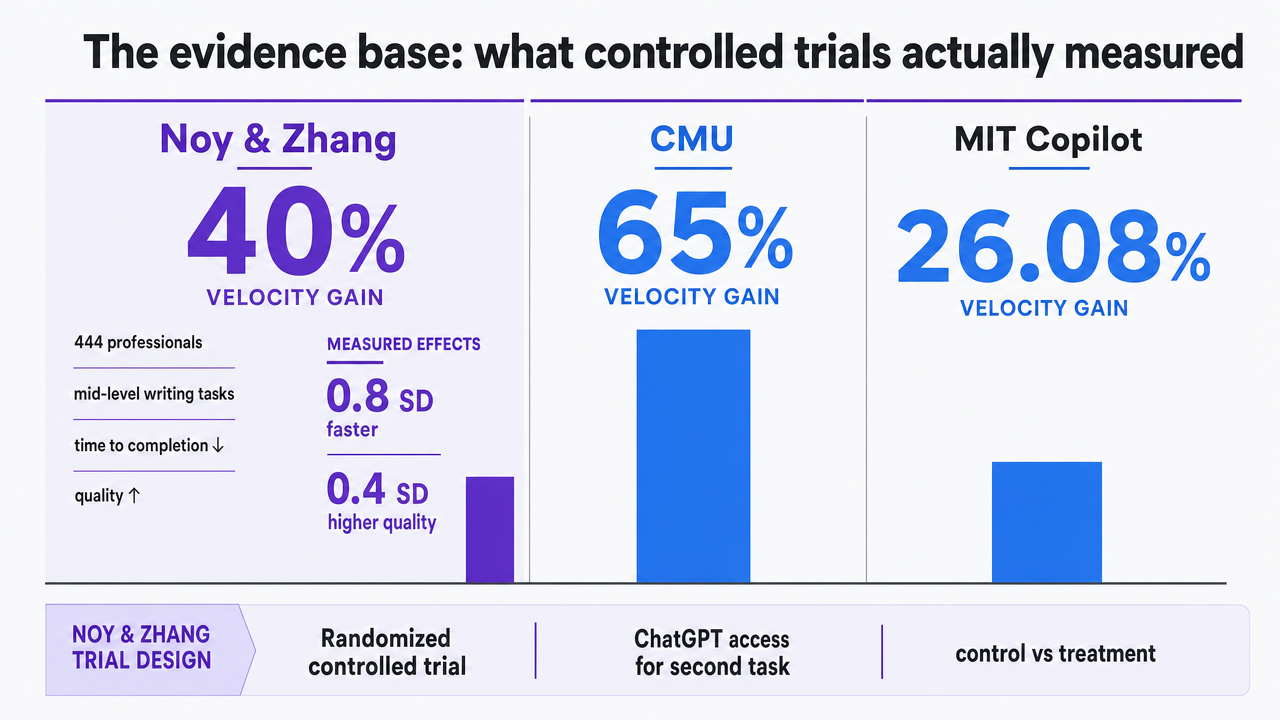
Content velocity is a workflow problem, not a model problem. A randomized trial by Noy and Zhang at MIT, involving 444 college-educated professionals on mid-level writing tasks, found that time to completion dropped by 0.8 standard deviations while output quality rose by 0.4 standard deviations 8. The key mechanism identified was a shift: workers spent less time drafting and more time editing. AI compressed the drafting step and expanded the review step.
This reallocation is the critical lever. Teams that maintain a human-first drafting process and use AI merely for spellcheck will quickly plateau. Conversely, teams that reverse this ratio—allowing AI to draft and humans to edit against a defined quality bar—can significantly increase throughput across their entire content calendar.
McKinsey's analysis of early consumer marketing deployments supports this. Teams achieving immediate value are those embedding generative tools into existing production workflows for copy and image generation, personalization, and feedback loops, rather than treating AI as a separate project 6. The velocity gain stems from redesigning where human effort is concentrated, not simply adding another tool.
For a content marketing manager overseeing 2–6 writers with an aggressive publishing schedule, the operational question is precise: what percentage of each asset's hours are currently dedicated to drafting versus editing, and what should that ratio be next quarter? This article explores the supporting evidence, identifies where gains are most significant, and outlines how to manage this new ratio at scale.
The evidence base: what controlled trials actually measured
The Noy and Zhang anchor: 444 professionals, mid-level writing tasks
The most frequently cited experimental result on AI writing assistance comes from a randomized controlled trial by Shakked Noy and Whitney Zhang at MIT. The study involved 444 college-educated professionals—including marketers, grant writers, consultants, data analysts, HR professionals, and managers—who completed mid-level writing tasks relevant to their professions, such as press releases, short reports, analysis plans, and sensitive emails. Half of the participants were given access to ChatGPT for the second task, while the other half were not.
The measured differences were substantial. The treatment group experienced a 0.8 standard deviation reduction in time to completion and a 0.4 standard deviation increase in evaluated output quality 8. Two aspects of the study design are particularly relevant for content managers: first, tasks were incentive-compatible, meaning participants were paid based on quality grades assigned by other professionals in their field, ensuring objective quality assessment. Second, graders were unaware of which submissions were AI-assisted.
The underlying mechanism provides a crucial operational lesson: the treatment group spent less time drafting and more time editing. The paper explicitly states that ChatGPT primarily substituted for drafting effort rather than complementing skill 8. This workflow reallocation is what content teams should plan around, rather than expecting a uniform percentage improvement across all hours for every writer.
It's important to note the scope limits: these were single-session, mid-length business writing tasks completed by individuals, not multi-week brand narrative projects managed by teams. The findings generalize well to the mid-level formats common in marketing calendars but less so to strategic positioning or original analytical work.
Instruction-dependent gains: the CMU graduate writing study
A classroom study with graduate students using ChatGPT and Microsoft Copilot reported a significantly larger impact than the Noy and Zhang benchmark: average writing time decreased by 65%, and average writing quality improved from a B+ to an A 4. Content managers should examine the study's setup before extrapolating these numbers.
These gains were observed only after participants received explicit instruction on how to use the AI tools. This is a critical finding. The same tools, given to the same population without instruction, would not be expected to yield the same results. The quality of implementation directly determined the magnitude of the improvement 4.
For a content team, this implies that prompt libraries, style-guide-loaded system messages, and structured feedback loops are not optional additions to AI adoption; they are fundamental to achieving significant results. Teams that simply provide writers with a chat interface and a monthly license are essentially operating under an "untrained" condition, limiting their potential gains. The study also reinforces the drafting-to-editing reallocation. Graduate students did not become better analytical thinkers due to AI; they spent fewer hours on the initial draft and more time refining it against a rubric, mirroring the pattern observed in the Noy and Zhang trial, albeit with a larger effect size. Training amplifies this reallocation.
Cross-domain analog: MIT Copilot developer throughput
While software development differs from marketing, their throughput dynamics share enough similarities to offer valuable insights. Randomized field experiments with GitHub Copilot among professional developers, analyzed in an MIT economics working paper, revealed a 26.08% productivity gain measured by completed tasks, with weekly builds increasing by 38.38% 3.
Three studies now provide benchmarks for velocity, showing a range of magnitudes:
- Noy and Zhang's study on mid-level business writing indicated a 40% reduction in completion time 2.
- The CMU graduate writing study, with explicit instruction, showed a 65% reduction 4.
- The Copilot developer trials demonstrated a 26.08% gain 3.
This spread itself is a key finding.
Task complexity and training are the primary determinants of where a team will fall within this range. Copilot suggestions require review against a compiler and codebase, just as marketing copy needs review against brand voice and factual accuracy. Both scenarios involve a compressed drafting phase and an expanded review phase. Neither achieves a 65% lift without deliberate workflow design.
For a content manager planning the next quarter's calendar, the question is not whether AI assistance boosts velocity—that is established by the evidence. Instead, the question is where the team currently operates within the 26–65% band, and what training and workflow adjustments could move them towards the higher end.
Matching task type to AI capability
Where velocity lift is largest: mid-level, repeatable formats
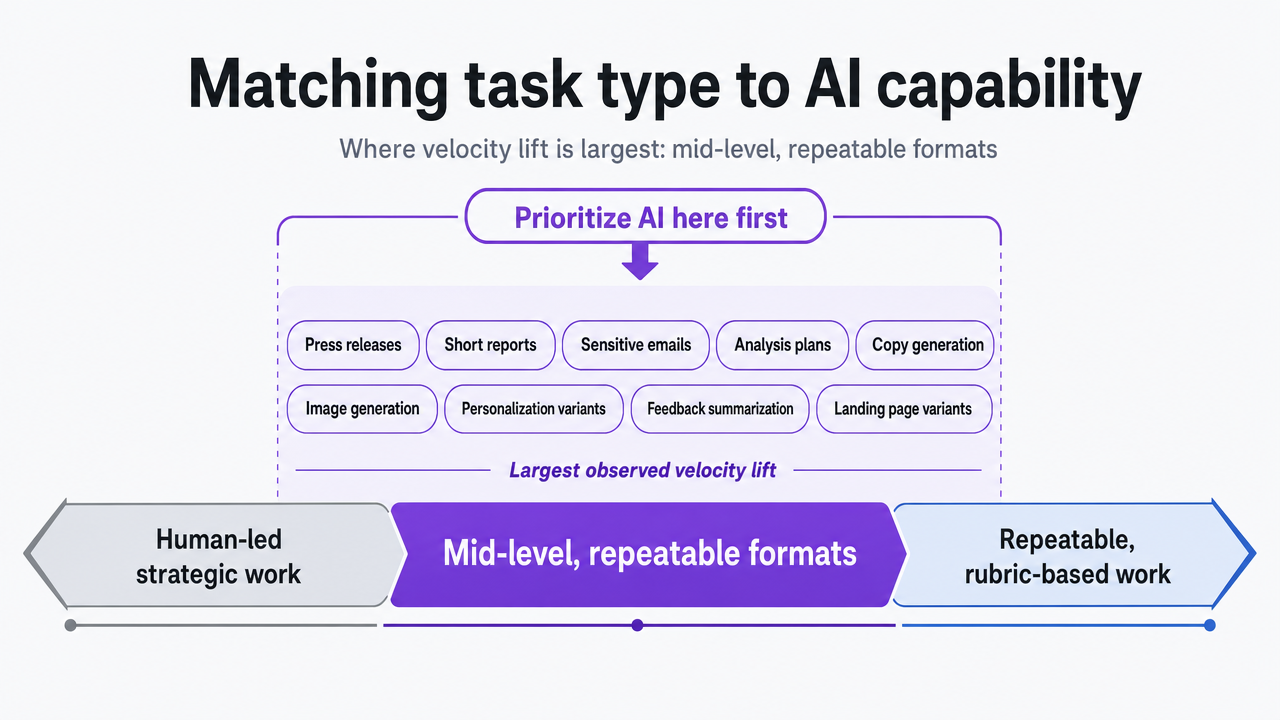
The Noy and Zhang trial specifically focused on a particular range of writing tasks: press releases, short reports, sensitive emails, and analysis plans—the mid-level formats that constitute a significant portion of most marketing calendars 8. This is the segment where the 0.8 standard deviation time reduction and 0.4 standard deviation quality improvement were observed. Content managers should prioritize applying AI to these types of tasks first.
McKinsey's analysis of early consumer marketing deployments corroborates this task profile. Immediate value was found in copy generation, image generation, personalization variants, and feedback summarization—work that is repeatable, constrained by format, and can be reviewed against clear rubrics 6. Examples include landing page variants for new geographies, follow-up emails in existing nurture sequences, product-update announcements, or webinar recaps. Each of these has a known structure, audience, and quality standard.
Three characteristics predict a high velocity lift:
- The format is repeatable, allowing the model to leverage strong priors.
- Success criteria are external and verifiable, making editing faster than drafting from scratch.
- The volume is high enough for per-asset time savings to compound monthly.
A task-fit matrix based on these characteristics clearly categorizes content. Press releases, product announcements, category pages, meta descriptions, email sequences, social captions, and short-form blog updates fall into the high-lift quadrant. Case-study first drafts, FAQ expansions, and webinar transcripts are adjacent, sharing similar mechanics but requiring slightly longer review cycles. This grouping covers the majority of most content calendars and is where the drafting-to-editing reallocation yields significant returns 8.
Where humans still lead: brand narrative, original analysis, positioning
The trial evidence is notably silent on other types of work, and this silence is telling. Noy and Zhang measured single-session, mid-length tasks with defined outputs 8. This design does not address category-defining brand narratives, repositioning memos, or original market analyses built on proprietary customer data. Such artifacts demand human judgment about what to communicate, not just efficiency in communication.
More recent RCT work on cognitive effort raises a related concern. While AI's effect sizes on writing tasks typically cluster around Cohen's d of 0.4–0.5, authors caution that substituting AI for drafting effort might have long-term consequences for analytical skill development 1. For work where the analysis itself is the primary value, compressing human time during drafting is counterproductive, as it removes the very reasoning the asset is meant to convey.
Based on this, three formats remain human-led:
- Original point-of-view pieces that establish a market position.
- Analyses built on first-party data where the interpretation is the core product.
- Founder or executive narratives where voice is the key differentiator.
AI can assist with research, outlining, and stress-testing these, but the drafting-to-editing flip that drives velocity elsewhere works against the objectives here.
The practical distinction is a calendar decision. Approximately 70–85% of a typical content calendar falls into the high-lift category. The remaining 15–30% warrants a slower cycle time. Treating both categories identically leads to either underutilizing AI or degrading assets crucial for brand equity.
Test AI-driven content production at scale now
Produce and publish live articles using AI workflows for measurable, real-world content velocity gains.
The workflow-economics math across a monthly calendar
The velocity discussion becomes tangible when a content manager applies the trial findings to an actual publishing calendar. Consider a team producing 20 high-lift assets per month—such as landing page variants, product announcements, email sequences, category pages, and short-form blog updates. Let's define the current baseline as H hours per asset for drafting under a human-only process, making the total monthly drafting load 20H.
Two sourced deltas define the achievable range. The Noy and Zhang RCT reported a 40% reduction in completion time for mid-level professional writing tasks among 444 college-educated professionals using ChatGPT 2. The CMU graduate writing study, conducted after participants received explicit AI instruction, recorded a 65% time reduction 4. Applied to the calendar, the "untrained" condition reduces monthly drafting load to 12H. The "trained" condition reduces it to 7H. The reclaimed hours—8H to 13H per month—become the budget for the expanded editing step required by the drafting-to-editing flip.
This reallocation is not without cost. Noy and Zhang found that the treatment group spent more of their remaining time on editing rather than drafting 8. If editing under the new ratio consumes, for example, 40% of the reclaimed hours for tighter review against brand voice and factual accuracy, the net calendar capacity still expands by 5H to 8H per month for 20 assets. This increased capacity can fund either a higher publishing cadence, deeper work on the 15–30% of the calendar that remains human-led, or both.
Two variables influence this math. The task mix determines how much of the calendar qualifies for the high-lift band. Training and prompt infrastructure dictate whether the team achieves closer to the 40% or 65% delta. A team using an ad hoc ChatGPT subscription without shared prompts, style-guide-loaded system messages, or an editing rubric will operate at the lower end of the band by default. This is the plateau many teams describe when they say AI "helped a little." The math isn't flawed; the workflow inputs are.
Team composition after AI: the skill-compression effect
The Noy and Zhang trial revealed a second finding that impacts hiring more than the headline productivity number. Access to ChatGPT reduced completion time by 40% and improved evaluated quality by 18%—with these gains disproportionately benefiting lower-performing writers in the sample 2. The gap between the bottom and top performers in the treatment group narrowed, indicating that AI compressed the skill distribution.
For a content function historically staffed with a bell curve—a few senior writers for voice-critical work, a middle tier for volume, and junior writers for ramping up—this compression has dual implications. The output of the middle tier on mid-level formats begins to resemble that of the top tier. The skill gap that once justified a senior premium for landing pages, product announcements, and email sequences shrinks. However, the gap for original analysis and brand narrative remains.
This reshapes what a content manager should prioritize in hiring. Editing judgment, brand-voice calibration, and factual review become the scarce skills, as these are the steps expanded by the drafting-to-editing flip. Raw drafting speed is now a commoditized input. A team of two senior editors and three mid-level writers using AI can achieve the output of four senior writers a year prior, specifically for the high-lift portion of the calendar.
The hiring implication is precise: for the next open requisition, emphasize editing rubrics, source verification, and voice governance in the job description over portfolio drafting samples. Reserve senior drafting hires for the 15–30% of the calendar where AI substitution would degrade the asset. Skill compression is a budgetary event, not just a productivity one.
Governance that holds up in front of legal and compliance
Velocity gains inevitably attract scrutiny. A team publishing three times as many landing pages, product announcements, and email sequences will face governance questions from legal, brand, or compliance—often all three. The defensible response is not an internal policy document, but a mapped alignment to an external framework.
NIST's AI Risk Management Framework Generative AI Profile, released in July 2024, serves as the essential reference point for content leaders. The profile identifies 12 risks specific to generative AI systems and outlines over 200 actions organizations can take to manage them 5. For a content function, the most operationally relevant risks are factual confabulation, intellectual property exposure, data leakage through prompts, and misuse of brand-authorized outputs. Mapping the team's editing rubric, source-verification steps, and prompt-input rules to the corresponding NIST actions transforms an ad hoc process into a documented set of controls.
Forrester's 2024 outlook highlighted the operational risk addressed by this framework. The report warns that generative AI scaled without governance can degrade customer experience, especially when content is produced at volume without review 9. This is the failure mode content managers are called upon to explain. The drafting-to-editing flip is the primary control against this: humans review every asset before publication, against a defined standard, with the AI-assisted origin logged.
Three governance artifacts address most legal and compliance concerns:
- A prompt-input policy specifying what customer data, unreleased product information, and third-party content cannot be entered into a model.
- A source-verification checklist integrated into the editing step, ensuring factual claims are traceable to a reviewed source.
- An approval log recording which human signed off on each AI-assisted asset before publication.
None of these meaningfully slow the calendar when built into the workflow rather than added as a separate review lane.
Discover How AI-Driven Writing Accelerates Content Pipelines for High-Volume Teams
See how leading marketing teams leverage AI to increase content output by up to 3x while maintaining editorial standards and SEO impact—without expanding headcount or manual oversight.
If you manage multiple locations or brands
For a content manager overseeing a single brand, workflow variations can be absorbed because one editor maintains the voice. However, an operator publishing across 15 dental practices, 40 senior living communities, or a portfolio of law firm brands cannot afford such drift. Coordination overhead becomes a tax that erodes velocity gains.
McKinsey's analysis of early marketing deployments is clear on this point: immediate value came from embedding generative tools into existing workflows, not from creating parallel systems for each brand 6. Multi-location operators who allow each location to manage its own prompts, editing standards, and approval processes will inadvertently recreate the agency-coordination problems that AI was intended to solve.
Two controls are essential for maintaining calendar cohesion at scale:
- A shared prompt and style-guide layer per brand, centrally versioned, ensuring location-specific variants inherit the brand voice rather than reinventing it.
- A single approval log across all locations, so the governance evidence outlined by NIST 5 withstands an audit, regardless of which market published the asset.
An approval-first operating model for scaled output
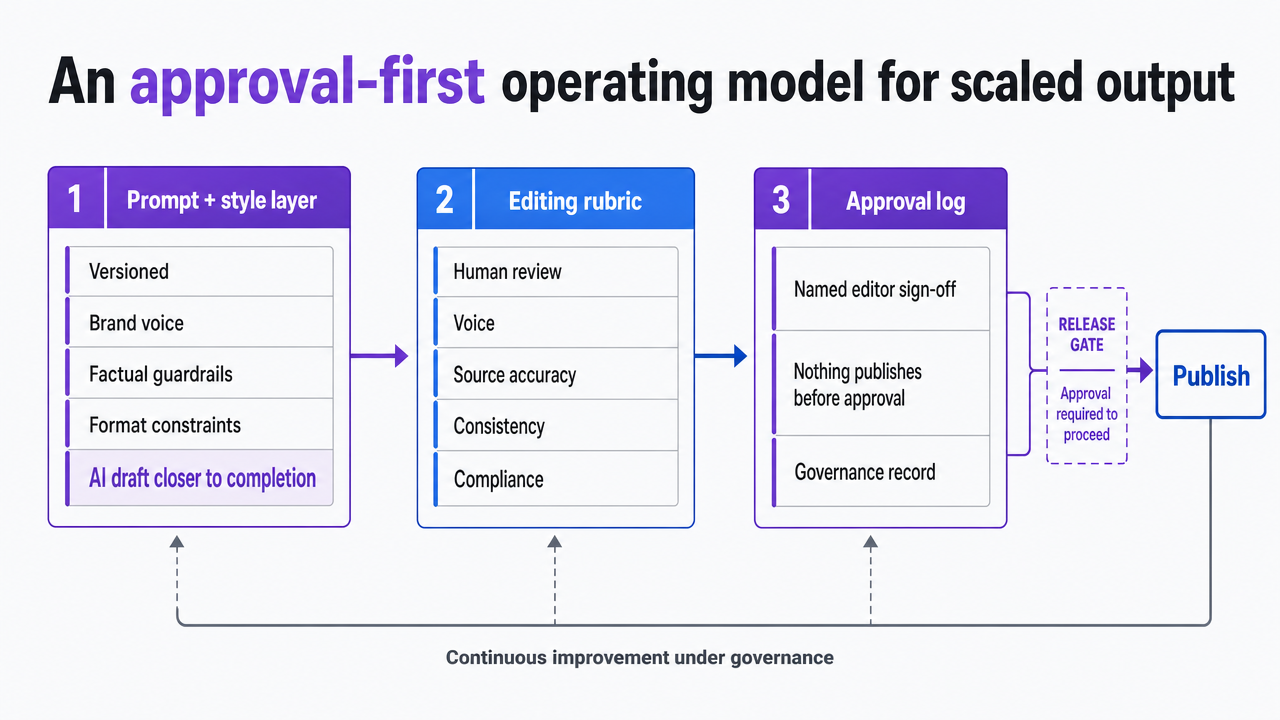
The evidence points to a specific operating pattern for content teams aiming to maximize the drafting-to-editing flip without compromising voice or governance. This "approval-first" model involves AI drafting against a versioned prompt and style layer, humans reviewing against a defined rubric, and nothing publishing until a named editor provides sign-off. This model is not new; it is the workflow that emerges when the Noy and Zhang reallocation 8, the CMU instruction-dependence finding 4, and the NIST risk actions 5 are integrated into a single, continuous loop.
Three components are crucial:
- A shared prompt and style layer that encodes brand voice, factual guardrails, and format constraints, ensuring the draft is closer to completion.
- An editing rubric that specifies what the human reviewer is checking—voice, source accuracy, claim substantiation, format compliance—thereby compressing review time to tasks only humans can perform.
- An approval log that records who signed off on each asset, linked to the source-verification checklist, providing governance evidence proactively.
The potential value is significant. McKinsey estimates generative AI could unlock $0.8–$1.2 trillion in incremental productivity across sales and marketing, but emphasizes that this realization depends on organizational change, data readiness, and talent upskilling, not just the technology itself 7. The approval-first model represents such an organizational change. It transforms a chat-window experiment into a governed production line, maintains the drafting-to-editing ratio rewarded by trials, and enables a small content team to manage a calendar that would otherwise require additional headcount. Platforms like Vectoron are designed around this pattern—AI execution behind a human approval gate—because it aligns with the evidence-backed operating model.
Frequently Asked Questions
References
- 1.Effects of generative artificial intelligence on cognitive effort and analytical writing performance: experimental protocol for a randomized controlled trial.
- 2.Study finds ChatGPT boosts worker productivity for some tasks.
- 3.The Effects of Generative AI on High-Skilled Work.
- 4.Study Finds Generative AI Significantly Boosts Graduate-Level Writing Efficiency and Quality.
- 5.Department of Commerce Announces New Guidance Tools 270 Days Following.
- 6.How generative AI can boost consumer marketing.
- 7.An unconstrained future: How generative AI could reshape B2B sales.
- 8.Experimental Evidence on the Productivity Effects of Generative Artificial Intelligence.
- 9.Forrester Predictions 2024.
- 10.Forrester's Predictions 2024: Sixty Percent Of Generative AI Skeptics Will Use The Technology.