
Key Takeaways
- LLM Coverage Breadth sets the ceiling for every other metric, so trackers should natively query ChatGPT, Perplexity, Gemini, and Google's AI Mode with locale variation 4.
- Citation-Source Transparency separates a buried mention from a linked citation, exposing which third-party domains carry the brand and where content or PR work belongs 5.
- Competitive Share-of-Voice Math only earns its budget line when computed against a VP-chosen competitor cohort, feeding the visibility axis a CEO already reads like impression share 7.
- Workflow Integration and Signal-to-Execution Latency is where budgets quietly leak, because a flagged gap unshipped within a week hands exposure directly to competitors 6.
- Cost-to-Insight Ratio matters more than sticker price: annualized license plus review hours plus execution cost, divided by gaps actually closed in a quarter 15.
Why AI Answer Surfaces Now Sit Inside the Marketing P&L
The mechanics of brand discovery have shifted. When a prospect asks ChatGPT for the best behavioral health provider in a metro, or asks Perplexity to compare three DSOs, the answer is assembled from third-party signals a marketing team never directly controls — sentiment, structured data, attribute consistency across the open web 3. Click-through rate stops being the primary read on whether the brand is winning the moment. Whether the model names the brand at all becomes the read.
That change now carries a paid-media consequence in the same surface. Ads appear in 25.5% of AI Overview results, a 394% jump from early 2025, based on an audit of Google AI Overview SERPs 4. The scope is narrow — Google's AI Overviews, not every LLM answer — but the direction is the pattern to watch. Paid inventory is compressing organic real estate inside AI answers on the surface most enterprise brands still rely on for demand capture.
For a marketing VP running a lean team, this reframes the tooling question. Rank tracking measures what the brand ranks for. Social listening measures what people say about the brand. Neither measures whether an LLM will surface the brand when a buyer asks a purchase-adjacent question. That third measurement is a new category of instrumentation, described in the tooling literature as LLMO or generative engine optimization monitoring 5, and it now belongs on the same line of the marketing P&L that funds SEO, paid, and analytics.
The rest of this review scores that category against a rubric a VP can defend upstairs.
The Category Is Not Social Listening With a New Coat of Paint
Three Tiers of AI Brand Visibility Tooling
The tooling literature draws a clean line: monitors purpose-built for LLM responses are a distinct category from classic social and web tracking, described as LLMO or generative engine optimization monitoring 5. Treating that line as decorative is how a marketing org ends up paying for three overlapping dashboards.
The market sorts into three tiers a VP should name before comparing features.
- Pure LLM visibility monitors. These platforms query ChatGPT, Perplexity, Gemini, and Google's AI Mode on a defined prompt set and record whether the brand is named, in what position, with which citations, and against which competitors. They report on model output — nothing else. The category exists precisely because model output is not observable through server logs, referrer data, or social APIs 5.
- Hybrid social-listening-plus-LLM platforms. Established listening vendors have bolted LLM prompt monitoring onto existing conversation, sentiment, and mention infrastructure. The pitch is one login, one contract, one export. The tradeoff is that LLM coverage is often the newest and thinnest module in a suite optimized for social conversation volume.
- Execution platforms that treat visibility as an input signal. A smaller tier ingests LLM visibility data alongside SEO, content performance, and paid signals, then uses those gaps to sequence what gets published or optimized next. Visibility is a trigger for work, not a report at the end of the quarter. Vectoron sits in this tier, coordinating specialist AI strategists across content, SEO, PPC, backlinks, social, and call intelligence in one approval workflow.
The rubric that follows scores each tier on the criteria that actually change pipeline.
What LLM Coverage Actually Means Across ChatGPT, Perplexity, Gemini, and AI Mode
Coverage is the word vendors use most loosely. A tracker that pings ChatGPT once a week on fifty prompts is not equivalent to one that runs a rotating prompt set across ChatGPT, Perplexity, Gemini, and Google's AI Mode with daily cadence and geographic variation. The recommendation in the field is explicit: audit brand citations and mentions across all four surfaces, not one 4.
Each surface behaves differently. ChatGPT and Gemini produce conversational answers with variable citation habits. Perplexity foregrounds sources and is the closest thing to a link-attributed answer engine. Google's AI Mode operates inside a search context where organic listings, ads, and generative summaries compete for the same pixel real estate. A tracker that measures brand presence in one surface tells the VP almost nothing about the other three.
The coverage question a VP should ask a vendor is specific. How many prompts, how often, across which surfaces, in which locales, and does the tool distinguish a brand mention from a brand citation with a linked source? Trackers that collapse those two into a single metric — mentioned versus not mentioned — hide the signal that matters most: whether the model is treating the brand as an authority worth attributing or as generic filler in a paragraph.
A Five-Criterion Rubric a VP Can Defend in a Budget Meeting
LLM Coverage Breadth
Breadth is the first line item because it defines the ceiling on everything else. A tracker that covers only ChatGPT is measuring roughly a quarter of the surfaces where a prospect might now form a brand impression. The published guidance is to audit citations and mentions across ChatGPT, Perplexity, Gemini, and Google's AI Mode as the baseline set 4.
Score a vendor on four sub-questions:
- How many AI answer surfaces are queried natively rather than scraped?
- How often does the query cadence run — daily, weekly, or on-demand?
- Does the prompt library scale into the hundreds without a per-query surcharge?
- Does the tool support locale variation, which matters for any brand operating across metros or states?
Citation-Source Transparency
A brand mention buried in a paragraph is not the same asset as a brand citation with a linked source. The second is what compounds. Models weight cited sources when assembling future answers, which means citation transparency is the criterion that ties tracking back to content strategy 5.
Vendors should surface, at minimum, the exact source URLs the model attributed for each answer, whether the brand's own domain appeared among them, and which third-party domains carried the brand into the response. Trackers that report only a binary mentioned-or-not flag hide the causal chain the marketing team needs to act on. If the model cites a review aggregator or a trade publication instead of the brand's site, that is a content and PR assignment, not a mystery.
Competitive Share-of-Voice Math
Share of voice is the metric a CEO already understands from paid and social reporting. Extending it to AI answers requires clean math the vendor should be able to explain in one screen. For a defined prompt set in a defined category, how often does the brand appear versus each named competitor, and at what position in the response?
The measurement framework for a zero-click environment treats visibility, sentiment, and indirect impact as the three axes worth reporting 7. Share of voice sits inside the visibility axis and only earns its keep when it is computed against a competitor set the VP chose, not a generic industry list. Ask the vendor whether custom competitor cohorts are supported and how prompt sets are constructed.
Workflow Integration and Signal-to-Execution Latency
This is the criterion most listicles skip and the one where budgets quietly leak. Signal-to-execution latency is the time between a tracker flagging a citation gap and the organization actually shipping content, schema fixes, or PR outreach that closes it. A dashboard that surfaces a visibility drop on Monday and generates no downstream action by the following Monday has cost the team a week of exposure to a competitor.
Score integration on three questions:
- Does the tracker export findings into the same system where content briefs, SEO tasks, or PR outreach are queued?
- Does it rank gaps by potential impact rather than dumping a flat list?
- Can approved fixes be executed without a handoff to a separate vendor or team?
Upstream content practices — semantic structure, cross-channel attribute consistency, credible source signals — are what actually move the numbers a tracker reports 6. If the tool cannot connect its own signal to those practices, it is a report generator, not an instrument.
Cost-to-Insight Ratio
Every tracker has a per-seat or per-prompt price. Few disclose the total cost per acted-on insight, which is the number that matters. Forrester's framing of marketing analytics maturity warns against building dashboards around metrics that do not tie to outcomes — a risk that grows when a new tooling category enters an already crowded stack 15.
Compute the ratio explicitly. Annual license, plus the internal hours to review outputs, plus the execution cost to close each flagged gap, divided by the number of gaps actually closed in a quarter. Trackers that score well on breadth and transparency but generate insights the team cannot act on within its existing capacity will underperform a cheaper tool wired into execution.
Test AI brand visibility tracking on live campaigns
Experience real-time brand visibility insights and measure the impact across your active marketing channels in one unified workflow.
Scoring the Three Tiers Against the Rubric
Pure LLM Visibility Monitors: Strong on Coverage, Weak on Loop Closure
Purpose-built LLM monitors score highest on the first two rubric lines. The best of them query ChatGPT, Perplexity, Gemini, and Google's AI Mode natively, run large prompt libraries at daily cadence, and separate a brand mention from a linked citation with source attribution 5. For a marketing VP who needs a defensible answer to the question of whether the brand shows up in AI answers, they deliver.
Share-of-voice math is usually competent in this tier because the entire product is built around it. Custom competitor cohorts, position-in-response scoring, and prompt-set versioning are standard features, not upgrades. A VP can walk into a board meeting with a clean chart showing how often the brand is named against a chosen peer set inside AI answers 7.
Where the tier falls off is loop closure. A pure monitor exports a report, a CSV, or an API feed. Closing the gap it flagged still requires a content brief written by a strategist, a page updated by a developer, or a PR pitch drafted by a communications lead. The tracker itself does not shorten signal-to-execution latency. It only clarifies where the latency is bleeding into competitor share.
Hybrid Social-Listening-Plus-LLM Platforms: Familiar Stack, Familiar Sprawl
The hybrid tier is the easiest sale to a procurement team because it consolidates on paper. One vendor, one login, one renewal. The problem is that the LLM module is usually the newest layer in a suite built for social conversation volume, and coverage across ChatGPT, Perplexity, Gemini, and AI Mode is often thinner than what a pure monitor delivers.
The economics of this tier already show a warning pattern. In the 2025 Social Intelligence Lab practitioner survey, more than 30% of respondents reported running two social listening tools, and the most common annual spend band was $100,000 to $199,000 2. That figure covers social listening alone, before an AI visibility line item is added. A hybrid platform pitches itself as the consolidator, but the same buyers who were supposed to consolidate five years ago are the ones now running two tools.
Rubric scores in this tier are mixed. Citation-source transparency tends to be weaker because the LLM module inherits the listening suite's mention-versus-not schema. Share-of-voice math is often calculated across social conversations and LLM answers in a blended metric, which sounds sophisticated and obscures which surface is actually moving. Workflow integration is real but stops at the suite's own reporting tools. Signal-to-execution latency is functionally the same as with a pure monitor because execution still lives elsewhere.
Execution Platforms: Treating Visibility as an Input Signal
The third tier is smaller and less familiar because it reframes the category. Instead of treating AI visibility as an output report, execution platforms treat it as an input signal that ranks what the marketing team should produce next. A citation gap on Perplexity for a category-defining prompt does not become a slide in the monthly deck. It becomes a content brief, a schema fix, or a PR target already sequenced against other pipeline priorities.
The rubric scores differently in this tier. LLM coverage breadth depends on the platform's monitoring layer and can match a dedicated tracker when built well. Citation-source transparency is a first-class requirement because the platform has to route the signal to the right execution lane — content, technical SEO, or backlinks — based on where the citation is missing. Share-of-voice math is scoped to the prompt sets that actually correlate with pipeline in the buyer's category 7. Workflow integration and signal-to-execution latency are the criteria the tier is built around, because the platform is the workflow.
Vectoron is one example of this tier. Its Command Center coordinates specialist AI strategists across content, SEO, PPC, backlinks, social, and call intelligence in one approval workflow, with visibility data feeding the ranking of what gets shipped after human sign-off. The category description matters more than the vendor name: any tool that closes the loop between tracker output and published work belongs in this tier, and any tool that does not, does not.
Building the KPI Layer the CEO Will Actually Read
A tracker earns its budget line when its output can be pasted into a board deck without translation. The measurement framework that holds up in a zero-click environment splits performance into three axes: visibility inside AI answers, sentiment of the surrounding language, and indirect impact on downstream demand 7. That structure gives a marketing VP three defensible slides, not fifteen scattered metrics.
Visibility is the top-line KPI. It reports how often the brand is named across a fixed prompt set on ChatGPT, Perplexity, Gemini, and Google's AI Mode, and at what position in the response. Reported alongside a chosen competitor cohort, it becomes share-of-voice inside AI answers — a number a CEO reads the same way as paid impression share.
Sentiment is the second axis and the one most often botched. The useful read is not a smiley-face score. It is whether the language the model uses to describe the brand matches the category authority the marketing team is trying to establish, and whether cited sources reinforce or undercut that positioning 5. A brand named in a lukewarm sentence next to a competitor cited by a trade publication is losing even when the mention count looks flat.
Indirect impact is the third axis and the one that ties the category to pipeline. Assisted conversions, branded search lift, and direct traffic movement after a visibility gain are the proxies available in a zero-click world 7. Forrester's guidance on analytics maturity applies directly here: dashboards should showcase marketing's value in terms stakeholders already use, or the new metric gets ignored 15. Report AI visibility in the same cadence as the paid and SEO reviews, on the same axes, or it will not survive the next budget cycle.
If You Manage Multiple Locations: The Consolidation Economics
The scope shifts here. Everything above holds for a single-brand marketing org. For multi-location operators — DSO groups, home services rollups, behavioral health platforms, senior living portfolios — the math changes because visibility is a per-location problem multiplied by the number of markets served. A tracker priced per brand becomes a tracker priced per location, and a stack that looked tolerable at one brand becomes a line item the CFO flags.
The anchor number worth keeping in mind: the 2025 Social Intelligence Lab survey found the most common annual spend on social listening alone was $100,000 to $199,000 2. That figure was collected before AI visibility tracking became a separate line item. Layering a dedicated LLM monitor, a maintained SEO suite, and an agency retainer for execution on top of that base is how a multi-location operator ends up with four vendor contracts covering overlapping surfaces.
The table below frames the pattern in variables rather than invented dollar figures.
L : the number of locations
P : content pieces produced per month
R : the agency retainer for execution
| Line item | Stacked approach | Consolidated execution platform |
|---|---|---|
| Social listening | $100K–$199K/yr base 2 | Included in platform |
| Dedicated LLM visibility tracker | Priced per brand or per L locations | Included as input signal |
| SEO suite | Priced per seat plus per L | Included |
| Content and PR execution | Agency retainer R × 12 | Approval-based execution across P pieces |
| Coordination overhead | Briefing cycles across four vendors | Single approval workflow |
The point is not that consolidation always wins on sticker price. It is that a stacked approach charges the operator for coordination the operator then has to supply internally — and coordination across L locations is where lean marketing teams break. A platform that treats AI visibility as an input to execution rather than a separate contract removes one vendor and one weekly status meeting from the operating rhythm.
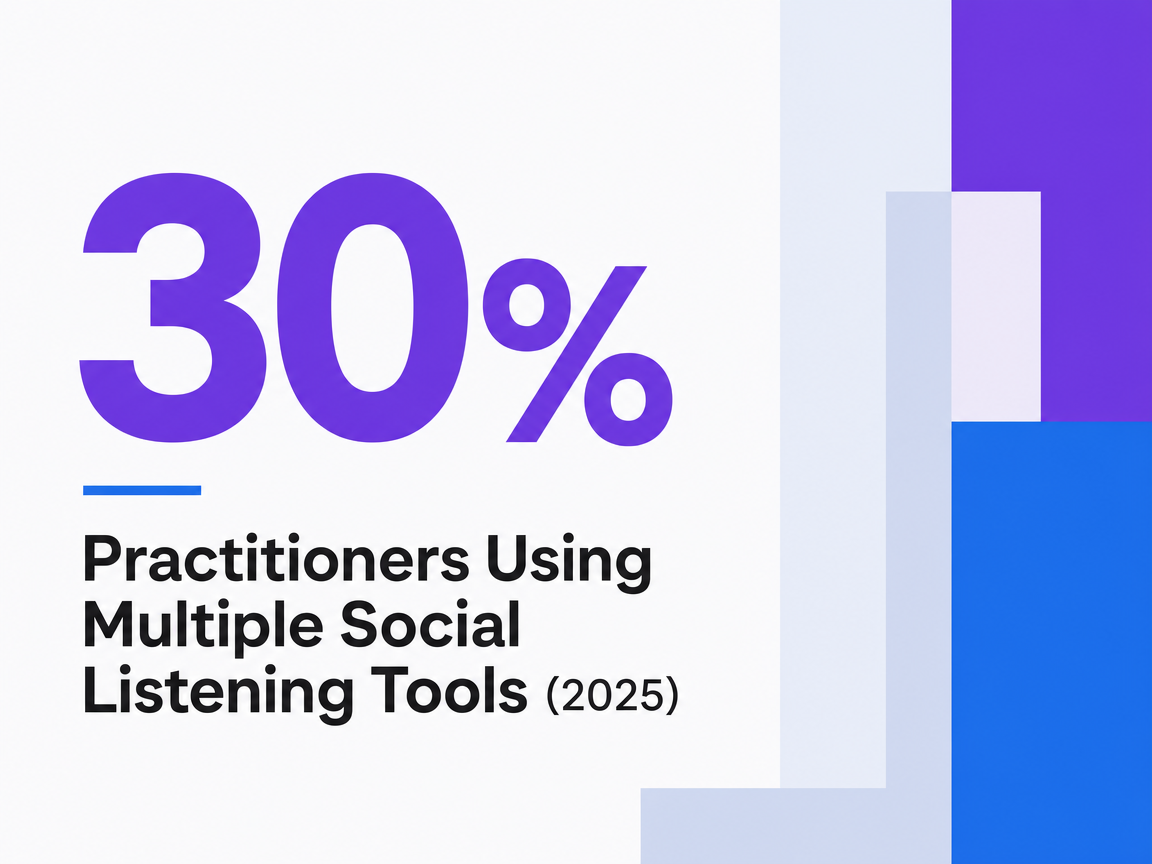 Practitioners Using Multiple Social Listening Tools (2025)
Practitioners Using Multiple Social Listening Tools (2025)
A Decision Framework for the Next Budget Cycle
The selection question is not which tracker has the widest surface coverage or the cleanest dashboard. It is which tracker changes what the marketing team ships in the next thirty days. That reframing collapses the vendor list quickly.
A three-step filter holds up in a budget meeting.
- Does the tool cover ChatGPT, Perplexity, Gemini, and Google's AI Mode natively, with citation-source transparency rather than a binary mention flag 4, 5? If not, it is a partial instrument and should be priced accordingly.
- Does the tool produce a ranked list of gaps the existing team can act on inside its current capacity, or does it produce a report that requires a separate briefing cycle to convert into work? The measurement framework worth adopting reports on visibility, sentiment, and indirect impact on the same cadence as paid and SEO reviews 7.
- Does the annualized cost of the tracker plus the execution needed to close its flagged gaps come in below the cost of a consolidated platform that treats visibility as an input to production?
Marketing analytics maturity is the tiebreaker. Dashboards that do not tie to outcomes stakeholders already value get cut in the next cycle 15. A tracker that survives the next budget review is one whose output the CEO reads as pipeline math, not novelty. For teams ready to close that loop in one workflow, Vectoron is built around it.
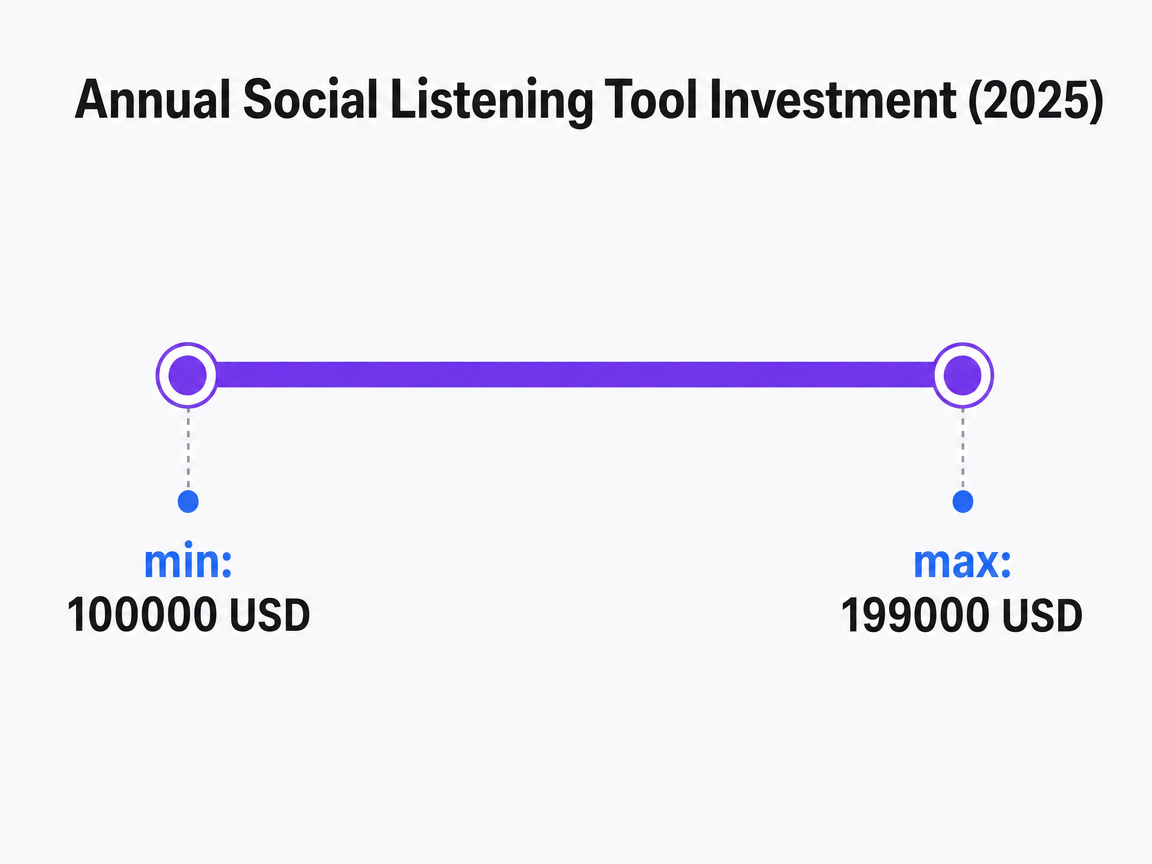 Annual Social Listening Tool Investment (2025)
The most common annual spending bracket for social listening tools among practitioners in 2025 was between $100,000 and $199,000.
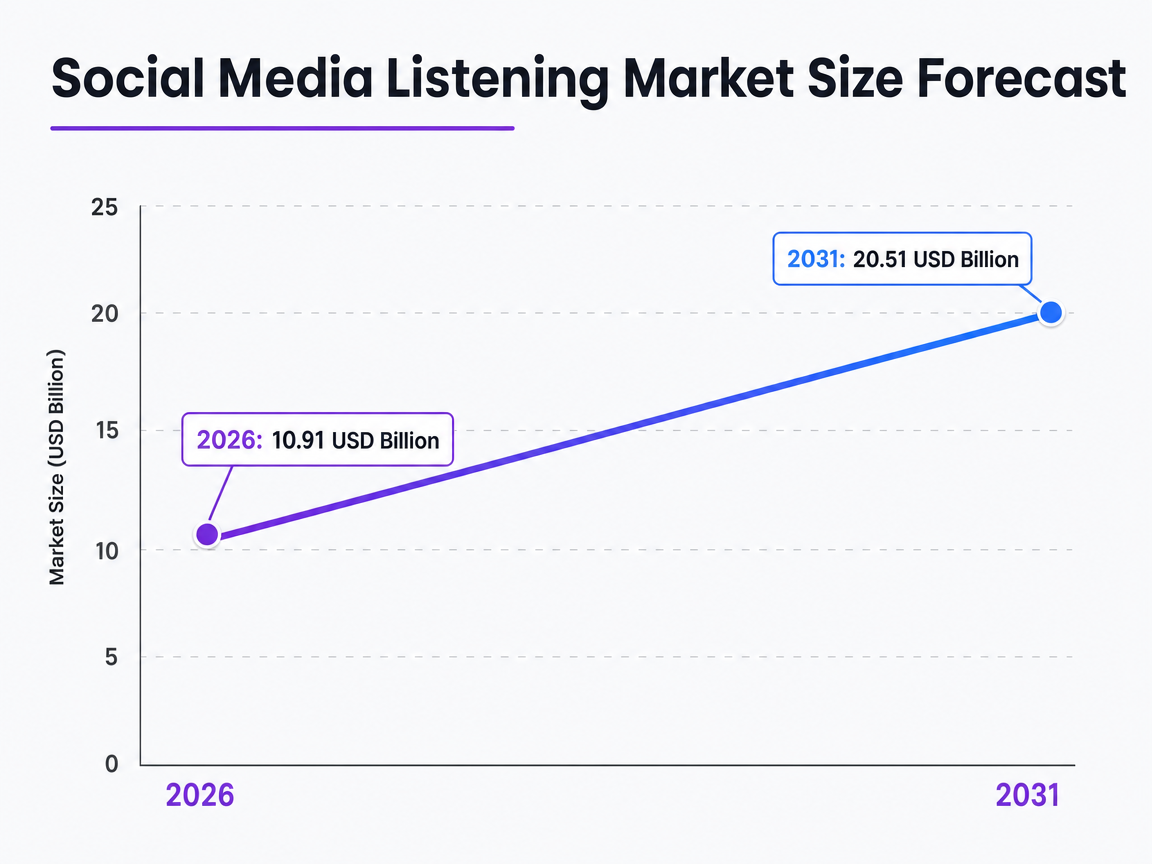 Social Media Listening Market Size Forecast
Projected growth of the social media listening market from USD 10.91 billion in 2026 to USD 20.51 billion by 2031.
Frequently Asked Questions
References
- 1.Social Listening Market Size, Trends & Forecast (2026–2031).
- 2.State of Social Listening - 2025.
- 3.AI Is Breaking Brand Visibility and Marketing Measurement.
- 4.The Click That Didn't Happen: Why Brand Visibility in AI Search Is ….
- 5.Brand Monitoring Tools for LLMO / Generative Engine Optimization.
- 6.AI Search Visibility: Best Strategies for Optimizing Content.
- 7.Measuring Brand Impact in an LLM-First world.
- 8.Choosing an AI Brand Visibility Monitoring Tool in 2026.
- 9.Unlocking the Next Frontier of Personalized Marketing.
- 10.Social Media Listening Market Size, Share & Growth Report 2035.
- 11.Social Media Listening Market Forecast, 2026–2033.
- 12.Social Media Listening Market Size, Trends | Analysis 2035.
- 13.Enhancing customer experience in the digital age.
- 14.How to Leverage Marketing Analytics to Improve Customer Relationships and Business Decisions.
- 15.Use Marketing Analytics To Support Your 2023 Marketing Strategy.