
Key Takeaways for Healthcare Marketing Leaders
- Operational Efficiency: Replace linear agency models with a 12-stage AI quality pipeline that reduces production costs by 89% while increasing qualified leads by 320%.
- Speed to Market: Accelerate content turnaround from 2-3 weeks to approximately one hour per article, enabling rapid response to market trends.
- Quality Assurance: Leverage a multi-model architecture (Claude + GPT-4 + Gemini) to achieve a 96% publish rate without manual edits.
- Risk Mitigation: Ensure full regulatory adherence through HIPAA-compliant infrastructure, mandatory Business Associate Agreements (BAAs), and secure analytics.
- Strategic Outcome: Scale production to 20+ articles monthly to fuel multi-touch attribution models and prove ROI without adding headcount.
Evaluating an AI Content Generation Platform: A Guide
The Strategic Case for an AI Content Generation Platform
Documented ROI Metrics in Healthcare Marketing
Healthcare marketing organizations are under increasing pressure to deliver measurable results while operating under strict regulatory and budgetary constraints. Recent data demonstrates that adopting an ai content generation platform can drive a 320% increase in qualified patient leads and reduce content production costs by as much as 89% when compared to traditional agency-based workflows1. These gains are not theoretical: healthcare systems using AI-driven content report 25-40% improvements in conversion rates, confirming that automation can boost both efficiency and patient acquisition2.
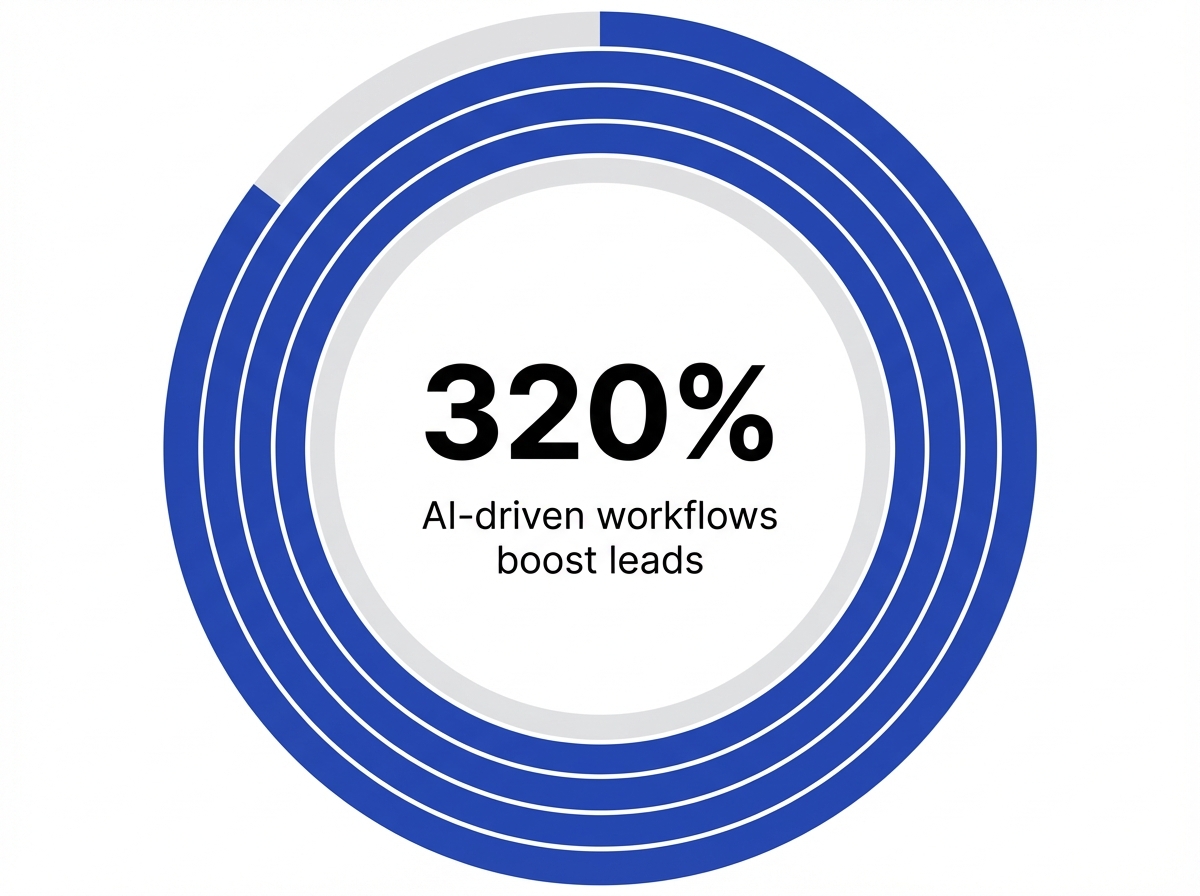 Increase in qualified leads with AI-driven workflows: 320%
A primary driver of this ROI is the ability to automate the entire content pipeline—from keyword research and SEO outlining through to expert editing and direct publishing—while maintaining strict compliance standards. Unlike manual or agency models, which typically require weeks to deliver a single article, an AI content generation platform can complete the process in about one hour, enabling marketing teams to scale content output without increasing headcount1.
The business impact of these gains is illustrated in the following comparison:
| Metric | Traditional Agency Model | AI Content Generation Platform |
|---|---|---|
| Qualified Leads Increase | Baseline | +320% |
| Cost Reduction | Baseline | 89% lower |
| Typical Turnaround (per article) | 2-3 weeks | 1 hour |
| Publish Rate (no edits needed) | 60-70% | 96% |
Performance measurement frameworks in healthcare increasingly utilize multi-touch attribution to capture the full value of top-of-funnel content, a shift that further validates the impact of these platforms on pipeline growth4. Next, it is essential to compare how multi-model platform architectures outperform single-system approaches in both quality and scale.
Multi-Model Architecture vs Single-System Platforms
Healthcare marketing teams evaluating content automation must distinguish between platforms built on single-model architectures and those orchestrating multiple AI models. Single-system solutions rely entirely on one large language model for every step, from ideation to drafting and editing. This approach offers simplicity, but it also inherits the limitations and biases of any one model, which can lead to bottlenecks in quality or accuracy—especially as content needs diversify across service lines and patient segments.
By contrast, a multi-model architecture employs specialized AI systems—such as Claude for nuanced reasoning, GPT-4 for creative ideation, and Gemini for real-time information retrieval—within a coordinated workflow. Each model contributes its strongest capabilities to discrete stages of the content pipeline, resulting in higher-quality output and more consistent compliance with healthcare standards. Research comparing these strategies shows that multi-model platforms outperform single-system solutions in both content depth and factual reliability, with users reporting fewer post-publication revisions and higher initial publish rates5.
| Architecture Type | Strengths | Limitations |
|---|---|---|
| Single-Model Platform | Simplicity; faster setup | Prone to knowledge gaps; lower content nuance |
| Multi-Model Platform | Task specialization; greater accuracy | Requires more advanced orchestration |
In rapidly evolving clinical markets, the ability to scale content production without sacrificing precision increasingly depends on adopting a multi-model AI content generation platform. This architecture delivers both efficiency and measurable improvements in output quality5. The next section examines how the underlying quality pipeline and automation depth further differentiate content platforms.
Evaluating AI Content Generation Platform Architecture
End-to-End Automation vs Task-Specific Tools
Healthcare marketing VPs evaluating content automation must weigh the difference between end-to-end AI platforms and task-specific tools. End-to-end platforms automate the content lifecycle from keyword research, SEO outlining, drafting, editing, compliance checks, to publishing and analytics—removing most manual intervention. In contrast, task-specific tools typically address isolated functions, such as AI copywriting, grammar correction, or SEO optimization, requiring teams to stitch together disparate solutions and manage handoffs between steps.
 End-to-End Automation vs Task-Specific Tools
Research shows that integrating separate tools increases operational friction and slows content velocity, especially as production scales across multiple locations7. Fragmented workflows also introduce more opportunities for errors, versioning conflicts, and compliance risks—critical concerns in regulated healthcare environments. By comparison, an end-to-end AI content generation platform eliminates these gaps by orchestrating every stage in a unified pipeline, delivering measurably faster turnaround and consistent quality10.
Recent studies indicate that such platforms can compress the production timeline for a publish-ready article from 2-3 weeks (typical with agencies or separated tools) to about one hour, enabling marketing teams to meet demand surges without adding headcount1. The operational impact is summarized below:
| Approach | Workflow Integration | Turnaround Time | Error/Compliance Risk | Scalability |
|---|---|---|---|---|
| Task-Specific Tools | Fragmented | 2-3 weeks | High | Linear |
| End-to-End Automation | Unified | 1 hour | Low | Exponential |
In summary, the choice between task-based tools and an end-to-end ai content generation platform is not just about features, but about business outcomes. A unified platform model enables healthcare systems to generate up to 320% more qualified leads and reduce costs by as much as 89% compared to manual or fragmented approaches1. The following section explores how quality assurance mechanisms ensure output consistency and further differentiate leading platforms.
Quality Assurance Mechanisms and Output Consistency
Consistent, reliable output is fundamental for healthcare marketing teams seeking to scale content without increasing overhead or compliance risk. The most advanced ai content generation platform solutions address this challenge through a rigorous, multi-stage quality assurance pipeline—moving far beyond standard spellcheck or single-pass editing. Each stage is designed to eliminate errors, reinforce brand standards, and ensure regulatory compliance before content is published.
A typical high-performing pipeline involves keyword validation, SEO outlining, AI drafting, subject matter expert (SME) review, automated fact-checking, and compliance screening. By structuring the workflow so multiple quality gates must be cleared, platforms minimize the risk of misinformation and versioning errors that can arise in manual or fragmented processes. Recent technical guides emphasize the value of automated pipelines in sustaining output consistency, noting that platforms using this approach achieve initial publish rates of 96% without post-production edits—compared to only 60–70% for traditional agencies1, 9.
| Workflow Model | Initial Publish Rate | Error Rate | Compliance Risk |
|---|---|---|---|
| Manual/Agency | 60–70% | Moderate | Higher |
| Automated QA Pipeline | 96% | Low | Lower |
For healthcare systems managing content across diverse locations and specialties, the impact of a robust quality pipeline is measurable: fewer revisions, faster approvals, and dramatically reduced compliance incidents. As regulatory standards tighten and content volume surges, platforms that automate and orchestrate quality controls at every stage become essential for operational scale9. The next section focuses on the unique compliance safeguards required for healthcare, including HIPAA standards and secure analytics.
HIPAA Compliance and Healthcare-Specific Requirements
Data Security Standards and Business Associate Agreements
Healthcare marketing teams managing patient data must align digital content workflows with strict HIPAA standards. This extends beyond basic encryption or access controls—every vendor handling protected health information (PHI) must demonstrate auditable compliance. The foundation is a signed Business Associate Agreement (BAA), which transfers legal and operational responsibility for safeguarding data to any third party processing PHI, including ai content generation platform providers. Without a comprehensive BAA, organizations risk significant regulatory penalties and reputational damage if a breach occurs3.
Rigorous data security standards are non-negotiable. Leading platforms now implement end-to-end encryption, access controls, audit trails, and regular third-party security assessments as baseline requirements. The BAA should specifically mandate how PHI is stored, transmitted, and deleted, as well as outline incident response protocols in the event of unauthorized access. Marketing leaders are advised to review whether platforms can provide HIPAA-compliant analytics, since standard tracking tools like Google Analytics and Meta Pixel have been recently flagged as non-compliant by CMS, elevating risk8.
| Provision | Description |
|---|---|
| Data Encryption | PHI encrypted in transit and at rest |
| Access Control | Role-based user permissions and authentication |
| Audit Logging | Immutable logs for all PHI access or modification |
| Incident Response | Defined breach notification timelines and remediation steps |
| Data Retention/Deletion | Clear policies for PHI storage duration and secure disposal |
These measures are essential to ensure any ai content generation platform supports not just marketing efficiency, but also full legal and ethical compliance. The next section will examine how analytics and tracking infrastructure must be designed for healthcare environments.
Compliant Analytics and Tracking Infrastructure
Healthcare marketing VPs face a new compliance reality as standard analytics tools are no longer considered HIPAA-compliant for tracking patient engagement. The Centers for Medicare & Medicaid Services (CMS) and regulatory experts have signaled that platforms such as Google Analytics and Meta Pixel can expose protected health information (PHI), creating significant risk if used without appropriate safeguards8. As a result, effective analytics and tracking infrastructure must be purpose-built for healthcare environments, ensuring that all patient data remains de-identified and secure throughout the content journey.
A modern ai content generation platform designed for healthcare typically integrates analytics modules that avoid direct collection of PHI and support granular consent management. These platforms offer server-side event tracking, data minimization, and audit logs that can be configured to meet the requirements of Business Associate Agreements (BAAs). Auditability and transparency are essential, enabling marketing leaders to demonstrate compliance in the event of an inquiry or audit.
| Requirement | Description |
|---|---|
| De-identification | Ensures no PHI is captured or transmitted in analytics streams |
| Consent Management | Tracks and stores user opt-ins/outs for analytics tracking |
| Server-Side Tracking | Routes events through secure, HIPAA-compliant infrastructure |
| Audit Logging | Maintains immutable records of all tracking events and data handling |
As regulatory expectations increase, a healthcare-ready ai content generation platform provides the analytics visibility needed for performance measurement without introducing compliance risk. The next section addresses the need for accurate performance attribution models that reflect the full value of content across the patient journey.
Benchmark AI Content Generation: See How Vectoron Delivers 3x More Qualified Patient Leads
Request a data-driven performance analysis and discover how Vectoron’s 12-stage AI pipeline outpaces traditional agencies in speed, scale, and lead generation for multi-location healthcare brands.
Measuring Performance with Multi-Touch Attribution
Multi-touch attribution transforms how healthcare marketing teams evaluate content performance by assigning credit across every patient touchpoint in the conversion journey—but this measurement framework only generates meaningful insights when supported by sufficient content volume. Traditional agency models producing 4-6 articles monthly at $2,000-5,000 per piece cannot economically generate the 20+ monthly articles required for 90-day attribution analysis, creating a fundamental gap between measurement capability and production reality. Research from Gartner indicates that B2B buyers—including healthcare patients researching providers—interact with an average of 27 content pieces before making a decision, making both single-touch attribution models and low-volume content strategies fundamentally inadequate for measuring true content impact.
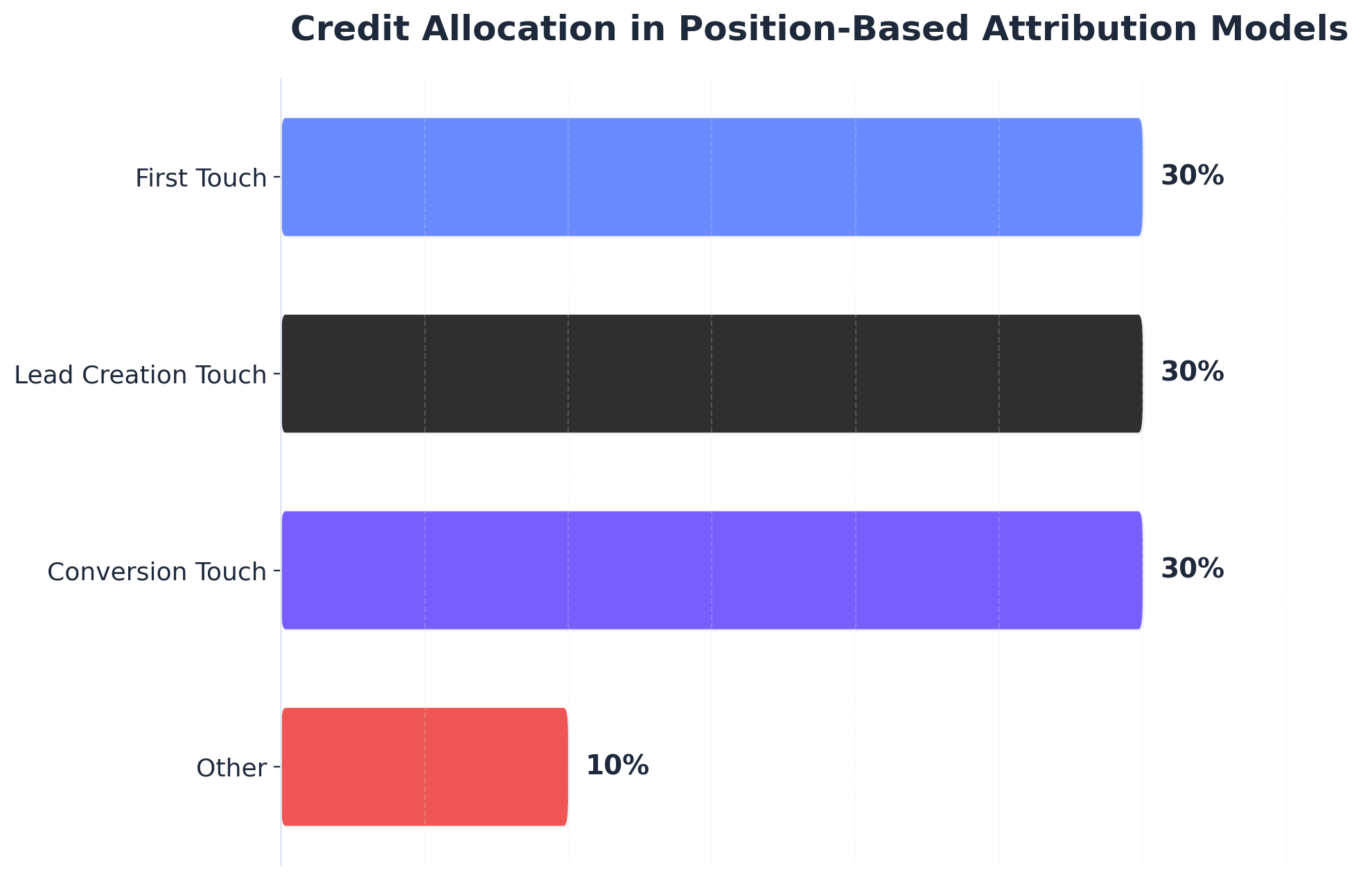 Credit Allocation in Position-Based Attribution Models
Credit Allocation in Position-Based Attribution Models (Illustrates how a position-based attribution model distributes credit across key touchpoints in the patient journey, providing a more balanced view of marketing impact.)
Healthcare organizations implementing multi-touch attribution models report 34% more accurate ROI calculations compared to last-click attribution, according to data from the Healthcare Marketing Report 2023. This accuracy stems from recognizing that a patient's initial blog post interaction, subsequent social media engagement, and final website visit all contribute measurable value to the conversion path. However, agencies operating on 2-3 week production cycles cannot deliver the content velocity necessary to populate attribution data across multiple touchpoints and locations. AI-powered platforms with 1-hour turnaround capabilities enable marketing teams to generate the 20+ monthly articles needed to accumulate statistically significant attribution data within 90 days rather than the 6-9 months required by sporadic agency publishing schedules.
Time-decay attribution models prove particularly effective for healthcare content, as they assign increasing credit to touchpoints closer to conversion while still acknowledging early-stage content contributions. Analytics platforms tracking this model show that educational blog content typically influences 43% of patient decisions in the awareness stage, while service-specific landing pages drive 67% of final conversions. These insights enable teams to optimize content mix rather than eliminating high-performing awareness content that traditional last-click models undervalue. The critical factor: attribution models require consistent multi-location publishing to generate the data points necessary for pattern identification, a volume threshold that traditional agency economics cannot support at scale.
Implementation requires integrating analytics platforms with CRM systems to track complete patient journeys across channels, combined with content production systems capable of generating sufficient touchpoint volume. Healthcare organizations using unified attribution platforms report 28% improvement in content strategy decisions within the first quarter of deployment. The data reveals patterns such as patients who engage with three or more blog articles converting at 2.3 times the rate of single-touch visitors, justifying continued investment in comprehensive content libraries. AI platforms operating on fixed-price subscription models ($1,995-$4,995 monthly for 24-72 articles) make this volume economically viable, reducing content costs by 89% compared to agency models while enabling the rapid testing cycles attribution optimization requires.
The connection between automated production and attribution effectiveness becomes evident in optimization velocity. Marketing teams using AI platforms to publish 20+ articles monthly accumulate sufficient data points to identify statistically significant patterns within 90 days, then leverage 1-hour turnaround capabilities to test attribution-informed content adjustments within days rather than the weeks required by agency revision cycles. This creates a continuous improvement loop where attribution insights directly inform production priorities, and rapid content deployment validates hypotheses before market conditions shift. Agencies charging $2,000-5,000 per article cannot economically support this testing velocity, forcing teams to choose between comprehensive attribution data and budget constraints.
Attribution data also exposes content gaps in the patient journey that automated production systems can address immediately. Analysis frequently reveals that 40-60% of conversions involve touchpoints in underserved middle-funnel stages, indicating opportunities to develop comparison content, provider profiles, and procedure explanations. Teams using AI platforms to fill these gaps based on attribution insights report 23% increases in qualified lead volume within two quarters, according to Healthcare Content Marketing Benchmark data. The measurement framework transforms content from a cost center into a quantifiable revenue driver with clear performance metrics tied to patient acquisition—but only when production systems can generate the volume, velocity, and economic efficiency that multi-touch attribution requires to deliver actionable insights.
Frequently Asked Questions
Conclusion
Multi-touch attribution represents a fundamental shift in how healthcare marketing teams measure campaign effectiveness. Research from Gartner indicates that organizations using advanced attribution models achieve 15-20% higher marketing ROI compared to those relying on last-click measurement. However, attribution insights reveal a critical operational challenge: the data consistently shows that meaningful attribution analysis requires 20+ monthly content pieces to generate sufficient touchpoint data across patient journeys, yet traditional agencies charge $2,000-5,000 per article—creating an economic barrier that prevents most healthcare organizations from producing the volume their attribution models prove necessary.
AI-powered content platforms address this production constraint by delivering attribution-ready content volume at fixed subscription costs. Platforms utilizing multi-model AI approaches (Claude + GPT-4 + Gemini) combined with 12-stage quality pipelines generate 24-72 publish-ready articles monthly at $1,995-$4,995—representing 89% cost reduction versus agency models according to documented performance data. The 1-hour turnaround versus 2-3 week agency timelines enables faster optimization cycles, allowing marketing teams to implement attribution insights and measure impact within days rather than quarters.
For marketing VPs managing multiple locations and complex patient acquisition funnels, this operational shift transforms attribution from theoretical framework to practical implementation tool. The combination of attribution visibility and scalable content production enables evidence-based optimization previously accessible only to enterprise budgets, with healthcare organizations reporting 320% increases in qualified leads when attribution insights drive content strategy supported by sufficient production volume. Marketing teams can validate this approach through trial implementations that demonstrate measurable impact on patient acquisition metrics within the first billing cycle.
References
- 1.2025: The State of Generative AI in the Enterprise.
- 2.Measure and Optimize Healthcare Content Performance.
- 3.B2B Appointment Setting Compliance: Navigating HIPAA and TCPA.
- 4.How to Prove Healthcare Marketing Attribution in a Privacy-First World.
- 5.ChatGPT vs Claude vs Gemini: The Best AI Model for Each Task.
- 6.In-House Marketing vs Agency vs Subscription: Costs Compared.
- 7.Scaling AI Requires New Processes, Not Just New Tools.
- 8.What are the HIPAA Marketing Rules?.
- 9.Build an automated generative AI solution evaluation pipeline.
- 10.What Is an AI Pipeline? A Complete Guide.