
Key Takeaways
- Adoption is no longer the strategic question—Forrester data shows 60%+ of agencies already use generative AI and 76% expect it to reshape client content production within two years 1, 4.
- McKinsey's 60–70% execution-task savings and 2–5x creative productivity gains will flow to clients as price concessions unless agencies restructure the production layer before the next renewal cycle 7.
- Pricing keystrokes competes against a seat license the client already owns; pricing judgment, personalization architecture, and outcome metrics defends retainers because in-house teams cannot replicate governed variant testing at scale 10.
- Principals should pick a delivery model before selecting tools, rewrite one retainer against outcomes, document disclosure and provenance governance, and set a portfolio ratio that protects signature work from volume dilution.
The Decision Has Already Been Made by Your Peers
Hesitation is now the risk position. Forrester's 2024 agency study found that more than 60% of US agency decision-makers report their agency is already using generative AI, another 31% are actively exploring use cases, and 78% of large agencies with 201+ employees have already deployed it 4. The sample covered US agency decision-makers across creative, media, and full-service shops, and the figures describe organizational adoption rather than individual experimentation with consumer tools.
That distribution leaves a narrow band of holdouts. A principal running a 40-person shop who has not formalized AI into content workflows is not being cautious relative to peers; that principal is roughly nine points behind the median large agency and increasingly exposed to competitors pricing against a lower cost base.
The strategic question has moved. It is no longer whether AI content generators belong inside an agency's delivery model. Forrester's own framing puts the impact squarely on client work, with 76% of decision-makers expecting generative AI to significantly affect how agencies produce content for clients over the next two years 1. When three-quarters of the peer set expects the production layer to change, the retainer built on the old production layer is the asset most at risk.
The rest of this analysis treats adoption as settled and focuses on the harder decisions that follow: how to restructure delivery economics, where AI content generators actively damage agency positioning, and what the value proposition looks like once keystrokes stop being the billable unit.
What AI Content Generators Actually Do Inside an Agency
The category label is misleading. Inside an agency, an AI content generator is rarely one tool doing one job. It is a set of production capabilities that touch nearly every deliverable that used to run through junior writers, editors, and coordinators.
Deloitte's 2024 enterprise survey put concrete boundaries around the work pattern: 85% of enterprise generative AI usage involves text generation, spanning document summarization, first-draft copy, and customer-facing materials 5. That distribution matters for agency principals because it describes what clients are already doing internally. The same tools that draft a retailer's product descriptions in-house are the ones a creative shop would deploy against a content retainer.
Inside a typical mid-size agency, the actual production surface breaks into four buckets:
- Long-form drafting, where blog posts, landing pages, and pillar content move from a 6-hour writer task to a 90-minute editorial pass. See long-form drafting.
- Variant generation, where a single approved concept spawns 20 or 40 versions for A/B testing, paid social, and email segmentation.
- Structured content, where product feeds, location pages, and metadata are produced against templates at volumes that were previously uneconomic.
- Research synthesis, where competitive audits and briefing documents compress from days to hours.
MIT's Initiative on the Digital Economy brief on persuasive content is blunt about the ceiling: generative AI can outperform human experts on specific advertising tasks and can substitute for some human labor in content generation 9. The caveat is doing real work in that sentence. Specific tasks, not all tasks. Some labor, not all labor. The agency's job is deciding which tasks fall on which side of that line.
The Margin Math That Reframes the Question
Productivity and Cost Compression at the Delivery Layer
The economic case for AI integration sits in a single McKinsey figure that agency principals should read twice. When AI marketing capabilities are properly orchestrated across the delivery stack, organizations report 4 to 7 percent revenue growth, two- to threefold improvements in productivity, and 60 to 70 percent savings in execution-related tasks 7. Scoped precisely: McKinsey is describing marketing organizations that have moved beyond point-tool experimentation into orchestrated deployment, not agencies that have licensed ChatGPT seats and left workflows untouched.
The creative-specific numbers in the same analysis land harder. McKinsey observes 2 to 5x increases in creative productivity and 10 to 30 percent reductions in creative costs, with campaign cycles compressing from a six-to-ten-week arc to same-day execution 7. For a shop running a $12K monthly content retainer priced against a 20-piece deliverable, a 2x productivity gain means the same output leaves 40 to 50 percent of production hours available for strategy, distribution analysis, or additional client volume. That is the margin surface agencies actually operate on.
The number that rarely gets discussed is the 60 to 70 percent execution savings figure applied to a specific line item. Junior production labor, freelance overflow, and coordination time typically consume the largest share of a content retainer's cost of delivery. Cutting that share by two-thirds does not eliminate the deliverable; it eliminates the layer of the organization that produced it manually.
A principal reading this data has two honest options. Restructure the production layer and hold pricing while margin expands. Or hold the production layer and watch an AI-native competitor bid the same work at 40 percent less within the next contract cycle.
Why the Savings Flow to Clients Within 12–18 Months
Agency principals sometimes read the McKinsey productivity data as a margin expansion story. It is not. It is a margin defense story, and the reason is that clients read the same reports.
Deloitte's 2024 enterprise survey found that 85 percent of enterprise generative AI usage is text generation, spanning document summarization, first-draft copy, and customer-facing materials 5. That figure describes what the CMO on the other side of the retainer is already doing with an internal team of two. When a marketing director has personally used a generator to draft a product description in ninety seconds, the anchor price for that output has already moved in her head. She will not pay legacy production rates for a deliverable she has watched her own team produce.
The procurement conversation follows a predictable arc:
- In the first six months, clients ask general questions about how the agency uses AI.
- Between months six and twelve, they ask for line-item transparency on production hours.
- By month twelve to eighteen, they arrive at renewal with a benchmarked counter-offer built from published productivity data.
Forrester's finding that 76 percent of agency decision-makers expect generative AI to significantly reshape client content production over the next two years is describing exactly this dynamic on the client-facing side of the same table 1.
The strategic implication is that the 60 to 70 percent execution savings will be captured somewhere in the value chain. The agency that restructures early captures it as gross margin. The agency that waits captures it as a price concession.
Test AI-Generated Content Workflows Risk-Free Today
Experience firsthand how AI content generation can cut production time and deliver measurable output within your agency's workflow.
Three Delivery Models, One Deliverable
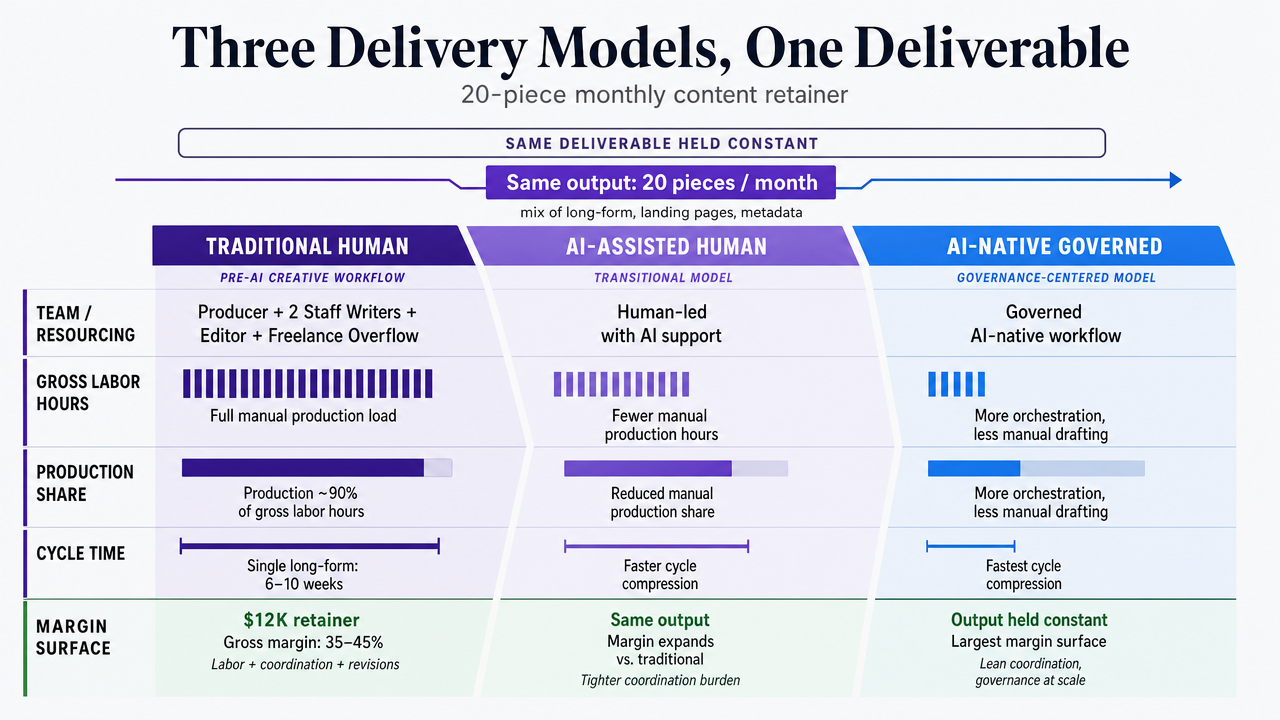
Hold the deliverable constant to make the economics legible. A 20-piece monthly content retainer — roughly a mix of long-form articles, landing pages, and structured metadata — is the unit of comparison. Three delivery models produce that same output, and the sourced McKinsey figures translate directly into hours, headcount, and margin surface on each.
Traditional human production runs the retainer through a producer, two staff writers, an editor, and freelance overflow. Production absorbs roughly 90 percent of gross labor hours. Cycle time on a single long-form piece sits in the six-to-ten-week arc McKinsey describes for pre-AI creative workflows 7. Gross margin on a $12K retainer typically lands in the 35 to 45 percent band once production labor, coordination, and revisions are counted. Pricing is defensible only as long as clients cannot see the production layer.
AI-assisted human workflow keeps the same headcount but routes drafting, variant generation, and research synthesis through AI tools with human editors on top. This is the model most Forrester-surveyed agencies now operate. Applying McKinsey's 2 to 3x productivity multiplier and 10 to 30 percent creative cost reduction 7, the same 20-piece output frees 40 to 60 percent of production hours. Principals typically redirect those hours into distribution, analytics, or additional client volume rather than cutting headcount. Margin expands modestly. Pricing holds until the next renewal cycle.
AI-native governed workflow rebuilds the production layer around approval queues rather than writer queues. Strategy, editorial judgment, and client relationships stay human; drafting, variant expansion, structured content, and first-pass QA run through orchestrated AI with human sign-off at defined checkpoints. McKinsey's 60 to 70 percent execution-task savings apply here in full 7 because the labor is not layered on top of the old workflow — it replaces it. The same 20-piece retainer runs with roughly one-third of the prior production headcount, cycle time compresses from weeks to days, and the freed capacity funds strategy work at higher billable rates.
The uncomfortable read across the three columns is that the AI-assisted model is transitional. It captures part of the productivity gain but leaves the old cost structure intact underneath. When a client benchmarks the retainer against published productivity data, the AI-assisted agency defends the same price with a slimmer justification. The AI-native agency defends a different offer entirely: judgment, governance, and outcomes, priced against results rather than hours.
The Value Shift: From Keystrokes to Judgment
Clients Already Generate Text Themselves
The retainer language most agencies still use — words like "copywriting," "content production," "editorial output" — describes work the client's own team now performs before lunch. Deloitte's 2024 enterprise survey found that 85 percent of enterprise generative AI usage is text generation: document summaries, first-draft copy, customer-facing materials 5. That figure is measuring the client, not the agency.
Once a marketing coordinator has drafted a landing page in a generator and edited it in twenty minutes, the deliverable stops reading as expertise. It reads as effort the client could have absorbed. Selling that same output at legacy production rates becomes a conversation about hours the client no longer believes exist.
The repositioning is narrow but sharp. Drafting is not the product. Deciding which drafts to run, against which audience, on which channel, tied to which downstream metric — that is the product. Agencies that keep pricing keystrokes are competing against a $20 seat license their client already pays for. Agencies that price judgment, editorial governance, and measurable outcomes are selling something the in-house team demonstrably cannot produce with the same tool.
Personalization Is the Deliverable Clients Cannot Replicate Alone
Personalization at scale is the specific capability that separates an agency operating an AI content generator from a client operating one. It requires audience segmentation, data pipelines, creative variant governance, and a testing loop — the parts of the stack a two-person in-house team rarely assembles.
McKinsey's consumer marketing analysis puts a concrete case behind the pattern. A retailer using generative AI moved personalized email coverage from 20 percent to 95 percent of its send volume and lifted SMS click-through rates by 41 percent 10. The scope matters: this is a single retailer case cited inside McKinsey's broader estimate that generative AI could increase marketing productivity by 5 to 15 percent of total marketing spend, worth roughly $463 billion annually across the function 10. It is illustrative, not universal, but it maps directly to what an agency can deliver that a client's internal generator seat cannot.
The experimental evidence reinforces the direction. A 2024 study running four experiments across consumer marketing and political domains found that messages personalized by ChatGPT exhibited significantly more persuasive influence than non-personalized versions 2. The studies used psychological tailoring against limited profile data, not full CRM integration, which suggests the ceiling on agency-run personalization is higher than the ceiling on ad hoc client experimentation.
An agency selling a $12K retainer for 20 generic articles is selling volume a generator undercuts. An agency selling 20 pieces expanded into 400 audience-tailored variants, governed against a testing matrix and tied to open, click, and pipeline metrics, is selling an operation the client cannot stand up with a seat license. That is the deliverable the next contract cycle will pay for.
Disclosure as an Operating Variable, Not a Compliance Line
Most agencies treat AI disclosure as a legal question routed through the MSA. The experimental evidence says it should be treated as a creative brief input, decided piece by piece.
A 2026 study on AI-generated marketing content ran experiments across value types and disclosure conditions and found a paradoxical result: AI disclosure amplified the cognitive empathy path for functional content but attenuated the affective empathy path for hedonic content 3. Translated into agency terms, telling readers that a comparison guide, a specification page, or a how-to explainer was AI-assisted tends to raise perceived credibility. Telling readers that a brand story, a founder profile, or an emotionally driven campaign was AI-assisted tends to reduce engagement on the exact dimension the piece was meant to move.
That asymmetry has a practical shape:
- On functional deliverables — product descriptions, technical documentation, comparison tables, FAQ libraries, service pages — a visible "AI-assisted, human-reviewed" line reinforces the trust signal the content is already trying to build.
- On hedonic deliverables — anniversary campaigns, patient stories in a behavioral health context, community narratives for a senior living operator — the same line depresses the affective response the creative was designed to produce.
The FTC's staff report on generative AI and the creative economy sharpens the compliance floor underneath this creative choice, warning that AI outputs can mislead consumers and displace human-authored work in ways regulators are actively tracking 8. Undisclosed AI use in contexts where consumers reasonably expect human authorship — testimonials, expert commentary, endorsements — is where legal exposure and trust erosion converge.
The operating rule that follows is narrow. Disclose by default on functional content and treat it as a credibility asset. Reserve non-disclosure for hedonic work only where human editorial rewriting is substantive enough that AI is a drafting tool, not the author. Document the standard in the client SOW so the decision is made once, at the account level, rather than piece by piece under deadline.
Benchmark AI Content Generation for Scalable Agency Delivery
See how leading agencies are integrating AI content generators to reduce production overhead, streamline approvals, and maintain quality—request a data-driven walkthrough tailored to your current operations.
Where AI Content Generators Actively Damage Agencies
The productivity case is real. The damage cases are also real, and principals who skip past them tend to discover the failure modes at renewal rather than in planning.
The first failure mode is quality collapse disguised as volume. The FTC's staff report on generative AI and the creative economy documents that low-quality AI-generated books have displaced human-authored titles in online retail and that AI outputs can make original human work harder for consumers to find 8. Translated to an agency context: a shop that ships 400 undifferentiated variants because the tool made it cheap has not delivered more value; it has trained the client's audience to skim past its brand. The same report notes reputational damage risks when AI mimics a creator's distinctive style, which lands directly on agencies producing thought-leadership content under a founder's byline.
The second failure mode is legal and IP exposure that sits on the agency, not the tool. Forrester's 2024 agency work identifies legal liability, copyright infringement, and data privacy as the top barriers cited by decision-makers, alongside employee readiness gaps 1. When a client's landing page draws a takedown notice or a training-data claim, the MSA typically routes the liability to the party that produced the deliverable. Agencies operating without documented provenance, prompt logs, or human-review checkpoints are absorbing risk their insurance policies were not written to cover.
The third failure mode is trust erosion through mismatched disclosure. The 2026 experimental work on AI-generated marketing content found that disclosure attenuates affective engagement on hedonic content 3. An agency that publishes a founder's origin story or a patient testimonial with a blanket AI-assisted label — applied out of caution rather than creative judgment — has depressed the exact response the piece was hired to produce. The damage is invisible in analytics until the campaign underperforms and the client asks why.
None of these failure modes argue against AI integration. They argue for governance: documented review checkpoints, disclosure decisions made at the SOW level, and a portfolio ratio between volume work and signature work that protects the brand asset the retainer is ultimately selling.
A Note for Agencies Serving Multi-Location Service Clients
A quick audience shift: this section speaks specifically to agencies whose retainers run across law firm groups, DSO portfolios, senior living operators, home services franchisors, and behavioral health networks. The economics look different when the deliverable is 40 location pages, not 20 blog posts.
Multi-location clients are where the AI-native model produces its most defensible spread. The same production layer that drafts one service page generates 40 geo-tailored variants against local intake data, referral patterns, and payer mix — content volumes that were uneconomic under a human-only model. McKinsey's retailer case, where personalized email coverage moved from 20 percent to 95 percent of send volume 10, describes the exact scaling pattern that separates a portfolio-ready agency from a per-site production shop.
The governance stakes rise in parallel. Legal, dental, and behavioral health verticals carry disclosure obligations, review requirements, and testimonial rules that make undocumented AI production a compliance exposure Forrester's respondents already flag as a top barrier 1. Agencies pitching these portfolios should price the review workflow, not just the output — that is where the retainer becomes structurally hard to replicate in-house.
A Decision Framework for the Next Quarter
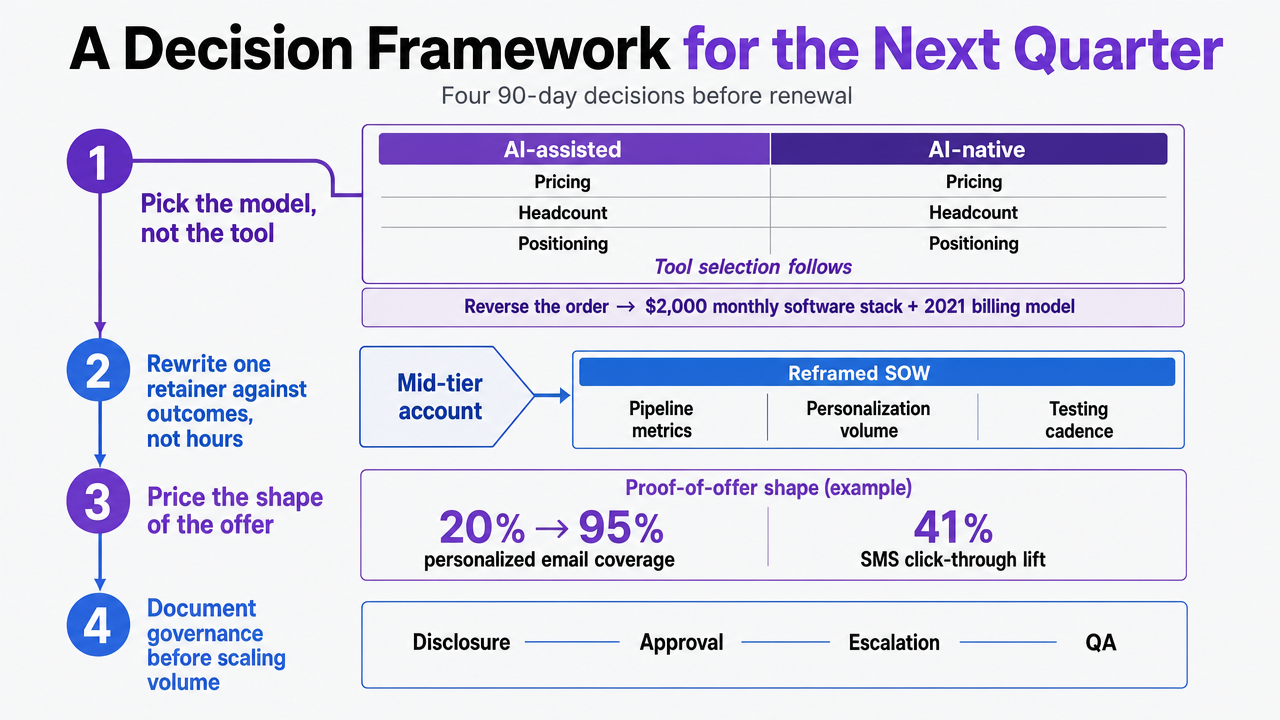
The analysis reduces to four decisions a principal can make in a 90-day window, before the next renewal cycle forces the conversation.
- Pick the model, not the tool. Choosing between AI-assisted and AI-native is the decision that governs pricing, headcount, and positioning. Tool selection follows. Agencies that reverse the order end up with a $2,000 monthly software stack layered on a production model that still bills like it is 2021.
- Rewrite one retainer against outcomes, not hours. Take a single mid-tier account and repackage the SOW around pipeline metrics, personalization volume, and testing cadence rather than deliverable counts. The retailer moving from 20 percent to 95 percent personalized email coverage with a 41 percent SMS click-through lift 10 is the shape of the offer worth pricing.
- Document governance before scaling volume. Disclosure standards at the SOW level, prompt and provenance logs, and defined human-review checkpoints address the legal liability, copyright, and privacy concerns Forrester's respondents flag as top barriers 1. Governance is the artifact clients will ask to see in 2025 procurement.
- Set a portfolio ratio. Cap AI-native volume work at a defined share of each account and protect signature work under human authorship. That ratio is the brand asset the retainer ultimately sells.
Frequently Asked Questions
References
- 1.US Agencies Are Currently Leading Generative AI Adoption.
- 2.The potential of generative AI for personalized persuasion at scale.
- 3.Value-dependent and empathy-mediated: how artificial intelligence disclosure shapes engagement with AI-generated marketing content.
- 4.The State Of Generative AI Inside US Agencies, 2024.
- 5.State of Generative AI in the Enterprise 2024.
- 6.The economic potential of generative AI: The next productivity frontier.
- 7.The future of marketing in the age of AI.
- 8.Generative Artificial Intelligence and the Creative Economy.
- 9.MIT IDE Research Brief: Generative AI in Persuasive Content.
- 10.How generative AI can boost consumer marketing.