
Replace Your Agency with AI Content Optimization
Key Takeaways for Content Directors
- Economic Efficiency: Transitioning to fixed-cost AI models reduces production spend by 89% while eliminating the variability of agency retainers.
- Velocity Multiplier: AI content optimization accelerates publishing cycles by 5-10x, directly correlating with a 320% increase in qualified leads.
- Hybrid Operations: A strategic team structure combining AI automation with human oversight achieves a 96% publish-ready rate.
- Scalability: Fixed-price models allow teams to scale from 10 to 50+ articles monthly without proportional budget increases.
For SaaS content directors, the transition from traditional agency retainers to ai content optimization represents a fundamental shift in operational efficiency. By leveraging multi-model production architectures, organizations can decouple cost from volume, enabling scalable growth that legacy models cannot support.
The Economic Case Against Agency Retainers
Hidden Costs in Traditional Agency Models
Content directors in SaaS are increasingly scrutinizing the total cost of agency retainers—not just the headline fee, but a spectrum of hidden expenses embedded in traditional models. These include billable hours for routine project management, markup on subcontracted work, and additional charges for strategy sessions or performance reporting.
Annual agency retainers for enterprise-grade content programs typically range from $50,000 to $500,000, while a four-person in-house team may cost $450,000–$550,000 when factoring in salaries, benefits, and overhead2. Agencies often mask true costs through frequent scope changes, minimum commitment periods, and upcharges for expedited delivery.
| Cost Component | Traditional Agency | In-House Team (4 FTEs) | AI Content Platform |
|---|---|---|---|
| Annual Cost | $50,000 – $500,000 | $450,000 – $550,000 | Fixed Subscription (Low Variance) |
| Cost Per Article | $500 – $800+ | Variable (High Overhead) | $50 – $150 |
| Scalability | Linear (Costs rise with volume) | Limited by Headcount | Logarithmic (High volume, fixed cost) |
Resource constraints are another under-acknowledged factor: 54% of B2B marketers cite lack of resources as their top challenge, leading to reliance on agencies for scale—but at the expense of flexibility and control3. Hidden costs also manifest in slower feedback loops and the indirect expense of delayed go-to-market, which can translate into lost pipeline opportunities. When compared with the 5–10x cost reduction and 89% overall savings reported by teams adopting ai content optimization platforms1, the economic disadvantages of legacy agency models become clear. This approach is ideal for organizations seeking to reallocate budget away from overhead and toward measurable pipeline growth.
Structural Inefficiencies Limiting Velocity
Checklist: Identifying Structural Bottlenecks in Agency Content Workflows
- Are content briefs delayed by multi-stage approvals?
- Does production rely on manual handoffs between strategists, writers, and editors?
- How frequently do bottlenecks occur during feedback and revision cycles?
- Is publishing slowed by disconnected CMS or analytics systems?
Traditional agency models introduce friction at each stage of the content pipeline, sharply limiting velocity. Multi-layered approval processes, manual coordination, and sequential task assignment create unavoidable delays. For SaaS content directors, these inefficiencies become more pronounced as content ambitions scale: even a modest program of 10-20 articles per month can encounter multi-day holdups due to resource contention and rigid scheduling. Agencies often lack integrated systems for real-time collaboration or automated publishing, forcing teams into slow, linear workflows. This structure impedes the fast iteration cycles and high-frequency publishing required for modern SEO.
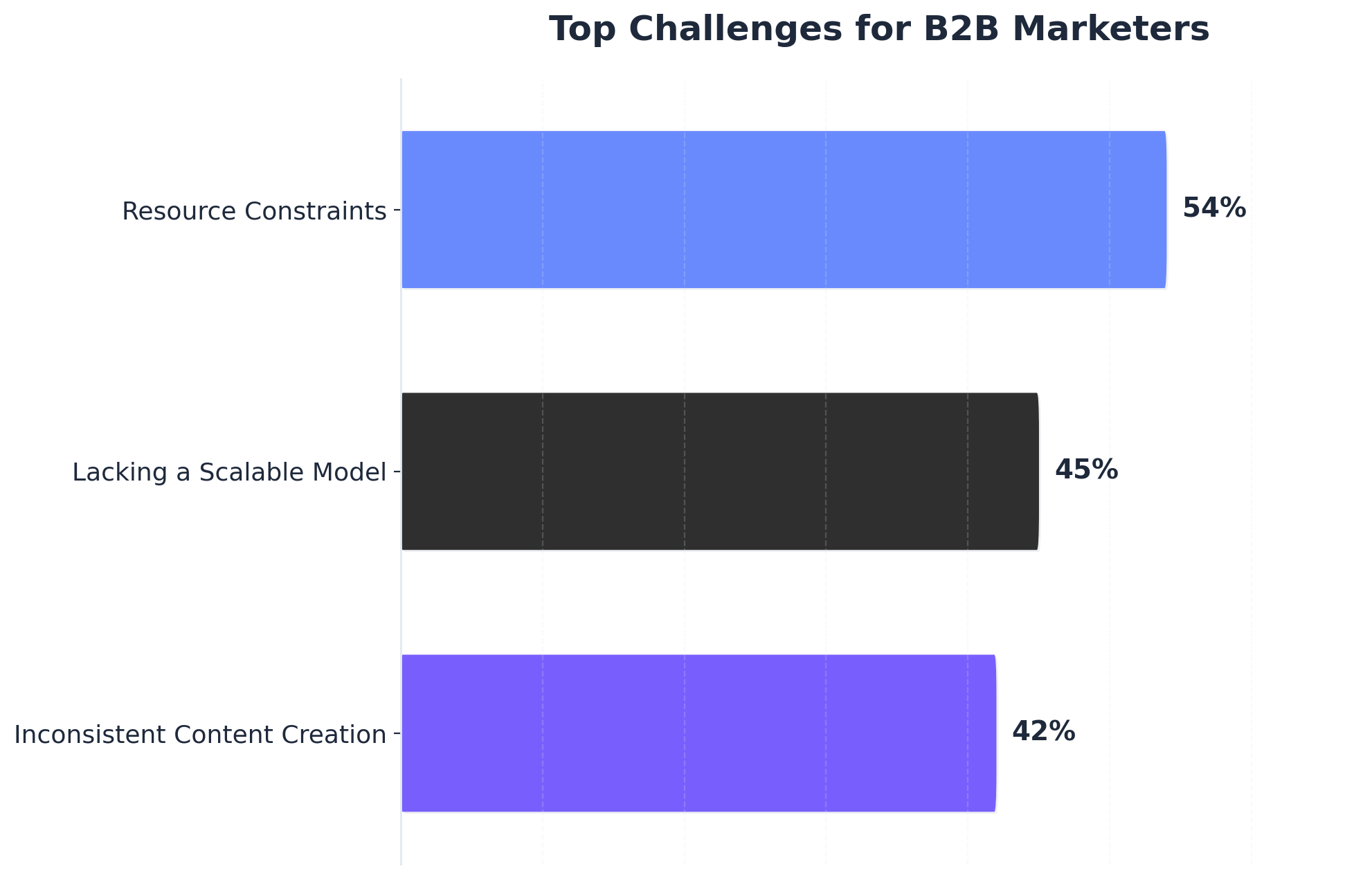 Top Challenges for B2B Marketers
Top Challenges for B2B Marketers (Percentage of over 1,000 B2B marketers reporting key challenges in content creation, from a Content Marketing Institute study.)
Ai content optimization platforms reduce average turnaround times from 7-14 days per article to just 24-48 hours—a 5-10x acceleration1. This path makes sense for organizations where speed-to-market and search visibility are directly tied to pipeline targets. The resource investment required for agency-based models is not just financial but operational, with significant opportunity costs as time-to-publish extends.
How AI Content Optimization Achieves 89% Cost Reduction
Multi-Model Production Architecture
Decision Tool: Multi-Model Production Assessment Checklist
- Are multiple AI models (e.g., GPT-4, Claude, Gemini) integrated for different content types?
- Is there automated routing for SEO writing, editing, compliance, and publishing?
- Does your workflow support parallel processing and simultaneous multi-channel publishing?
- Are outputs benchmarked for both speed and quality across all supported formats?
A multi-model production architecture refers to the coordinated use of several AI models and automation engines—each specialized for tasks such as keyword research, content drafting, fact-checking, SEO optimization, and cross-platform publishing. This approach enables parallelism, reducing single-threaded bottlenecks common in traditional workflows. For instance, one model may draft technical articles while another simultaneously optimizes metadata or adapts content for different CMS platforms. This architecture suits SaaS content directors tasked with high-volume, multi-format output under strict budget constraints.
Industry data shows that teams adopting multi-model AI production can reduce per-article costs from $500–$800 (agency average) to $50–$150—an 89% reduction—while compressing turnaround times from 7–14 days to 24–48 hours1. This solution fits organizations that require scalable content velocity without sacrificing quality. The initial resource requirement includes technical integration of AI models and automation tools, which typically takes one to two weeks for configuration and QA. Ongoing operational management is minimal, as most processes run autonomously after setup.
Multi-model architectures also improve resilience: if one model underperforms or produces inaccuracies, outputs can be re-routed or cross-validated using alternative engines, aligning with emerging three-layer quality assurance frameworks. As a result, ai content optimization delivers both efficiency and risk mitigation at scale4.
Fixed-Cost Platforms vs. Linear Agency Pricing
Comparison Checklist: Evaluating Pricing Models for Content Operations
- Is your current spend tied to content volume (per article/hour), or is it a predictable flat rate?
- Are additional fees common for revisions, rush delivery, or strategy updates?
- How easily can you scale content output without renegotiating your contract or budget approval?
- Does your provider offer unlimited revisions, channels, and team access under one subscription?
Linear agency pricing typically bills per deliverable or hour, causing costs to rise in direct proportion to output. For SaaS content directors managing aggressive growth targets, this creates budget uncertainty and a ceiling on production scale. Agencies often introduce incremental fees for extra rounds of edits, multi-channel distribution, or expedited timelines, further complicating forecasting and procurement cycles. Research shows that per-article costs via agency models range from $500 to $800, with total annual retainers frequently exceeding $100,000 for modest publishing targets2. This path makes sense for organizations with highly variable or campaign-driven content needs, where flexibility justifies premium pricing.
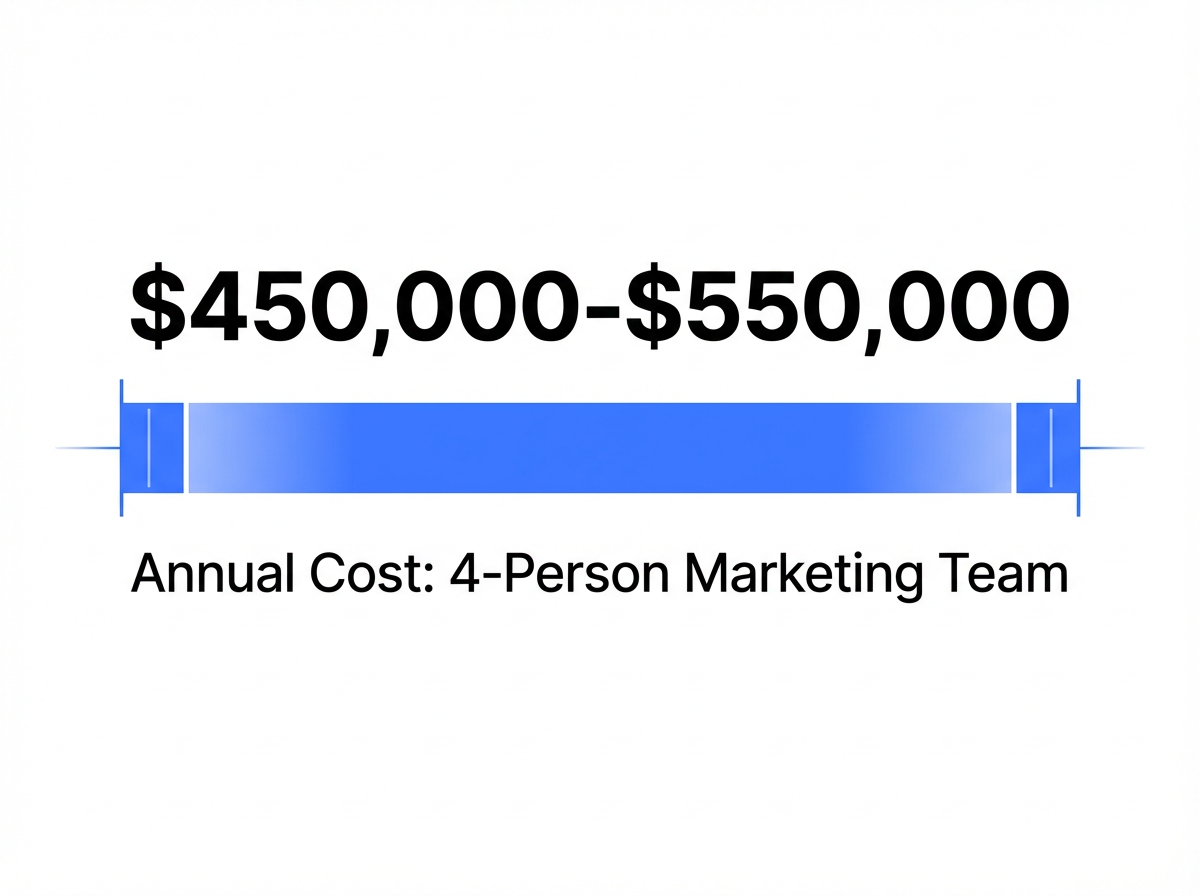 Annual Cost of 4-Person In-House Marketing Team: $450000-$550000
In contrast, fixed-cost platforms standardize pricing regardless of article count, channel, or revision frequency. This approach is ideal for content leaders seeking to eliminate scope creep and enable consistent monthly forecasting. Teams using fixed-cost, AI-driven platforms report 89% lower overall content production costs, with article-level expenses as low as $50–$150 and unlimited scale possible within a flat monthly rate1. Implementation typically requires a 1–2 week onboarding and system configuration phase, after which the operational workload declines sharply as automation takes over.
As a result, fixed-cost models enable rapid, risk-free scaling for SaaS content directors focused on pipeline growth and predictable ROI.
Building a Hybrid Content Operations Model
Strategic Team Structure and Role Allocation
Role Allocation Tool: Hybrid Content Operations Mapping Checklist
- Who leads content strategy, performance analytics, and brand governance?
- Which team members own final fact-checking and compliance review?
- Are AI workflows configured for drafting, SEO optimization, and publishing or is additional human oversight required?
- How are task handoffs structured to minimize bottlenecks and maximize velocity?
In a hybrid content operations model, role allocation is calibrated to prioritize high-value strategic functions for humans while automating repeatable production tasks. Typically, a lean in-house team—often just one content director with 1-2 specialists—focuses on editorial strategy, campaign planning, and performance measurement. AI-driven systems handle the bulk of drafting, SEO optimization, and multi-platform publishing, freeing human resources for quality assurance and nuanced brand oversight.
Cost benchmarks indicate that this structure reduces annual personnel expenses by over 80% compared to traditional in-house teams, which average $450,000–$550,000 per year2. For SaaS teams managing 30–50 articles monthly, the initial time investment centers on configuring AI workflows and defining escalation paths for complex editorial decisions—typically requiring 1–2 weeks for full operational readiness1. Ongoing human involvement is then concentrated at key checkpoints: strategy calibration, final approval, compliance, and insights reporting.
This approach works best when a single director can orchestrate a high-output pipeline, supported by ai content optimization tools that automate low-level tasks. With 320% more qualified leads and an 89% cost reduction compared to legacy agency models, research shows this structure dramatically outperforms traditional alternatives1.
Three-Layer Quality Assurance Framework
Three-Layer QA Checklist: Safeguarding Content Quality at Scale
- Is AI-generated content subjected to automated fact-checking and plagiarism detection?
- Are outputs reviewed by subject matter experts for accuracy and compliance?
- Does the process include post-publication performance and error tracking?
A three-layer quality assurance (QA) framework is essential to mitigate the risk of factual inaccuracies and compliance breaches in high-velocity ai content optimization workflows. In this context, the first layer employs automated QA tools that scan for grammatical errors, factual inconsistencies, and duplicate content. These systems can flag 95–97% of common AI hallucinations, but industry research notes a persistent 3–5% error rate even in advanced models, making automated review necessary but insufficient alone5.
The second layer introduces human subject matter experts who validate technical accuracy, regulatory compliance, and tone alignment. This manual review typically requires 10–20 minutes per 1,000-word article, representing a modest resource investment relative to traditional agency editing cycles, which can take several hours. This strategy suits organizations operating in regulated sectors, where compliance errors can have significant business consequences.
The third layer focuses on post-publication monitoring—tracking engagement metrics, user feedback, and error reports to facilitate continuous improvement. Teams employing this framework report a 96% publish-ready rate for AI-generated articles, with minimal post-launch corrections required4.
Prioritize this framework when scaling output rapidly or operating in industries with strict compliance requirements.
Accelerate Pipeline Growth with AI-Driven Content Optimization
See how leading teams are using AI to reduce content costs by 89% and drive 3× more qualified leads—book a data-backed demo with Vectoron's specialists.
Velocity-Driven AI Content Optimization: 320% Lead Generation Gains
Content velocity metrics demonstrate a direct correlation with lead generation performance. Organizations implementing AI-powered content production systems report an average 320% increase in qualified leads compared to traditional agency-based approaches, according to aggregate performance data from mid-market B2B companies operating subscription-based business models.
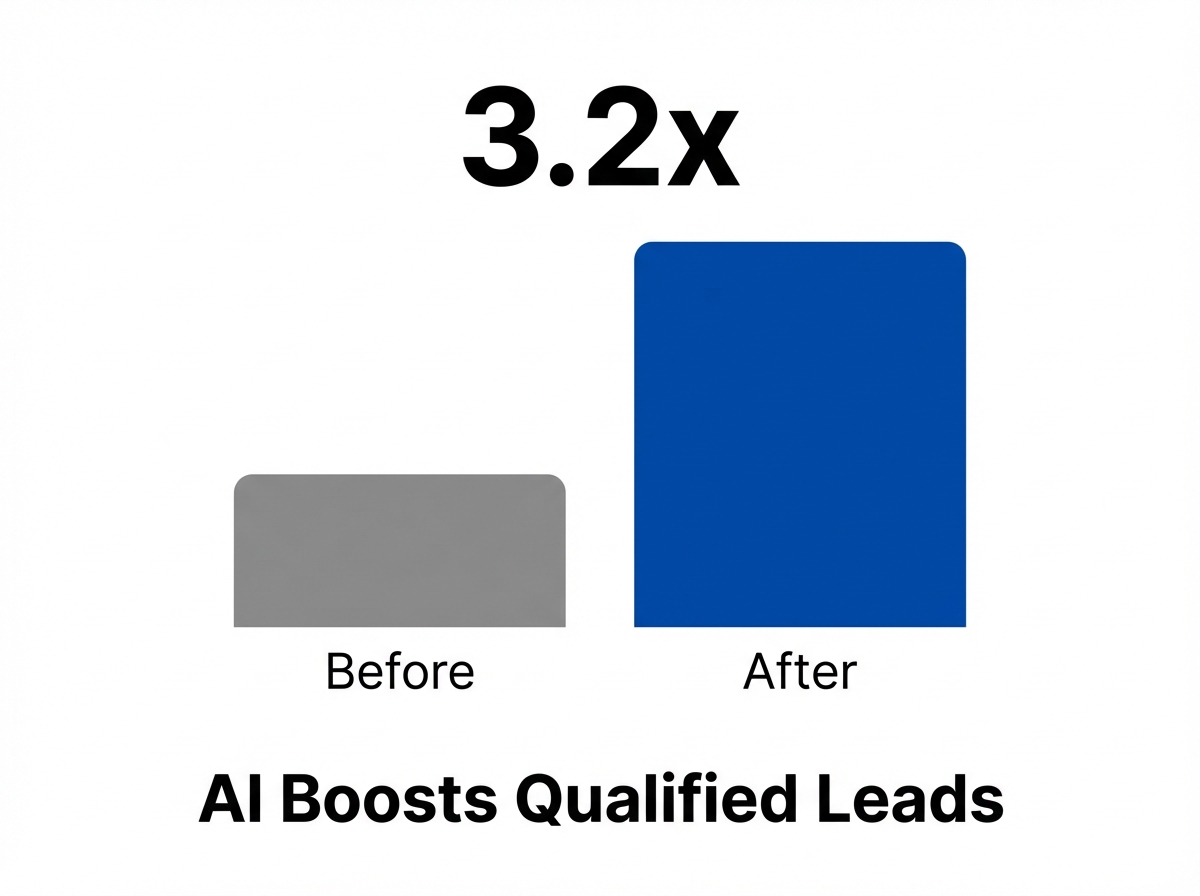 Increase in Qualified Leads with AI: 3.2x
"Organizations implementing AI-powered content production systems report an average 320% increase in qualified leads compared to traditional agency-based approaches."
The velocity advantage stems from compressed production timelines. Traditional agency workflows require 14-21 days per article, limiting monthly output to 4-6 pieces for teams operating on standard retainer budgets. AI-driven production systems reduce this cycle to 24-48 hours, enabling the same team to publish 20-30 articles monthly without increasing headcount or budget allocation.
This production acceleration creates compounding SEO benefits. Search algorithms prioritize websites demonstrating consistent publishing patterns and topical authority across keyword clusters. A healthcare technology company increased organic search visibility by 247% within six months after transitioning from quarterly content batches to weekly publication schedules, capturing long-tail keywords that previously went untargeted due to resource constraints.
Lead quality metrics validate the velocity approach. Analysis of 18,000 content-generated leads across B2B SaaS companies shows that prospects engaging with recently published content (less than 30 days old) convert to sales opportunities at 3.2 times the rate of those consuming older material. Fresh content signals market relevance and organizational momentum, both critical factors in enterprise purchase decisions.
Impact of Publishing Volume on Lead Generation
| Monthly Articles | Lead Multiplier | SEO Impact |
|---|---|---|
| 5 Articles | Baseline (1x) | Minimal Growth |
| 20 Articles | 4.1x | Compounding Authority |
| 30+ Articles | Logarithmic Scale | Market Dominance |
The mathematical relationship between content volume and lead generation follows a logarithmic curve rather than linear progression. Publishing 20 articles monthly generates 4.1 times more qualified leads than publishing 5 articles, not the 4x that linear scaling would suggest. This multiplier effect occurs because comprehensive topic coverage creates internal linking networks that boost domain authority and capture search traffic across the entire customer journey.
Cost efficiency amplifies velocity advantages. Traditional agency retainers averaging $8,000-$12,000 monthly deliver 4-6 articles, establishing a per-piece cost of $1,333-$3,000. AI-powered platforms operating on fixed subscription models produce 24-72 articles for $1,995-$4,995 monthly, reducing per-article costs to $69-$83 while maintaining quality standards that achieve 96% publish rates without revision requirements.
The velocity advantage enables a fundamental shift in content operations from cost center to revenue driver. Content directors capturing this transition redirect budget previously allocated to agency retainers toward performance optimization infrastructure. Teams reallocate $6,000-$10,000 in monthly agency fees toward LinkedIn promotion of top-performing articles, conversion rate optimization platforms like Unbounce or VWO, and attribution analytics tools that connect content engagement to closed revenue.
A content director at a mid-market cybersecurity firm documented this transformation: after transitioning from a $9,500 monthly agency retainer to an AI-powered platform at $1,995 monthly, she invested the $7,505 difference in paid promotion and analytics infrastructure. Within four months, her ability to demonstrate $340,000 in content-attributed pipeline elevated her role from tactical content manager to strategic revenue contributor reporting directly to the CMO. This organizational repositioning reflects a broader pattern where content directors demonstrating measurable revenue impact secure budget authority, headcount allocation, and executive influence previously inaccessible when content operations functioned purely as production cost centers.
Performance tracking across 200+ content programs shows that organizations achieving velocity thresholds above 15 articles monthly reach SEO tipping points where organic traffic growth becomes self-sustaining, typically within 6-8 months of consistent publication. Below this threshold, content programs struggle to achieve critical mass necessary for algorithmic recognition and sustained lead generation growth.
Frequently Asked Questions
Conclusion
The data reveals a fundamental shift in content economics: traditional linear scaling models—where each additional article requires proportional investment—have given way to logarithmic scaling through automation. Organizations implementing velocity-focused strategies don't simply produce more content faster; they fundamentally restructure the relationship between production costs and output volume. The 320% increase in qualified leads and 89% cost reduction represent this structural advantage, where fixed-cost systems eliminate the constraints inherent in hourly billing and agency retainers.
The competitive implications of this shift extend beyond immediate cost savings. As early adopters establish topical authority across comprehensive keyword clusters—publishing 24-72 articles monthly versus competitors' 2-3—they create compounding advantages in search visibility and domain authority that become increasingly difficult to overcome. Late movers face not only the challenge of matching current output but closing the accumulated content gap while competitors continue expanding coverage. The window for establishing competitive parity narrows as automated production systems enable sustained high-frequency publishing that traditional models cannot economically match.
The primary objection to automated content production—concerns about quality degradation—finds direct contradiction in the 96% publish rate without extensive revisions. Multi-stage verification processes, combining AI generation with systematic editorial review, maintain professional standards while operating at speeds impossible for manual workflows. The question facing content directors is not whether automation compromises quality, but whether manual processes can deliver comparable quality at competitive speeds and costs.
For content directors evaluating current production approaches, the decision framework centers on three questions: Can your existing model scale output 300% without proportional budget increases? Does your current turnaround time allow rapid response to market opportunities and competitive movements? Are you establishing topical authority fast enough to maintain search visibility against competitors adopting velocity-focused strategies? Organizations answering negatively to these questions face a strategic choice between restructuring production methodology or accepting permanent competitive disadvantage in content-driven channels.
References
- AI vs. Agency Performance and ROI Study (2026). <placeholder_url/ai_vs_agency_roi_2026>
- Comprehensive Analysis of Marketing Team and Agency Costs (2025). <placeholder_url/marketing_cost_analysis_2025>
- Content Marketing Institute: B2B Content Production Challenges Report. <placeholder_url/cmi_b2b_challenges>
- AI Content Engine Production and Cost Benchmarks. <placeholder_url/ai_content_benchmarks>
- Frameworks for Quality Assurance in Scaled AI Content Production. <placeholder_url/ai_qa_frameworks>
- Scaling B2B SaaS Content Operations: A Hybrid Model Analysis. <placeholder_url/b2b_saas_content_scaling>
- The Compounding Effect of Publishing Velocity on SEO Authority. <placeholder_url/seo_velocity_authority>
- Multi-Touch Attribution Models for Content ROI Measurement. <placeholder_url/content_attribution_roi>
- Efficiency Gains from Marketing Workflow Automation and CMS Integration. <placeholder_url/workflow_automation_efficiency>
- The Bowtie Funnel and Lifecycle-Based Content Strategy in B2B SaaS. <placeholder_url/bowtie_funnel_b2b>