
Key Takeaways
- Treat the retainer as a stack to unbundle, not abolish: move drafting, optimization, schema, linking, and publishing in-house while keeping interviews, repositioning, and integrated campaigns with outside specialists.
- Nine of twelve production stages run reliably on AI today, but three human checkpoints carry the quality risk: outline approval, stage-ten editorial review, and 30/90-day performance review.
- Replace hours billed with cost per published article, brief-to-publish days, and revisions per article. Anchor expectations to BCG's 20–30 percent production cost reduction 4 and McKinsey's 5–15 percent productivity ceiling 2.
- Run a 90-day parallel transition with named calendar, SME, and voice owners. Calendar discipline, SME access, and voice drift break before draft quality does.
The retainer model is being unbundled
The question facing in-house SaaS content teams is no longer whether to use AI. It is which production stages to own and which to keep scoping to outside help. That distinction matters because the retainer line item, once a single bundled fee, is now a stack of discrete jobs that can be priced and assigned separately.
The baseline has shifted. IDC reports that 58% of organizations are implementing AI in branding and content work 7. Forrester's 2025 survey of US marketing agencies found those same agencies adopting generative AI internally to compress the very steps clients pay retainers to cover 5. When the supplier and the buyer reach for the same tools at the same time, the bundled fee gets harder to defend on craft alone.
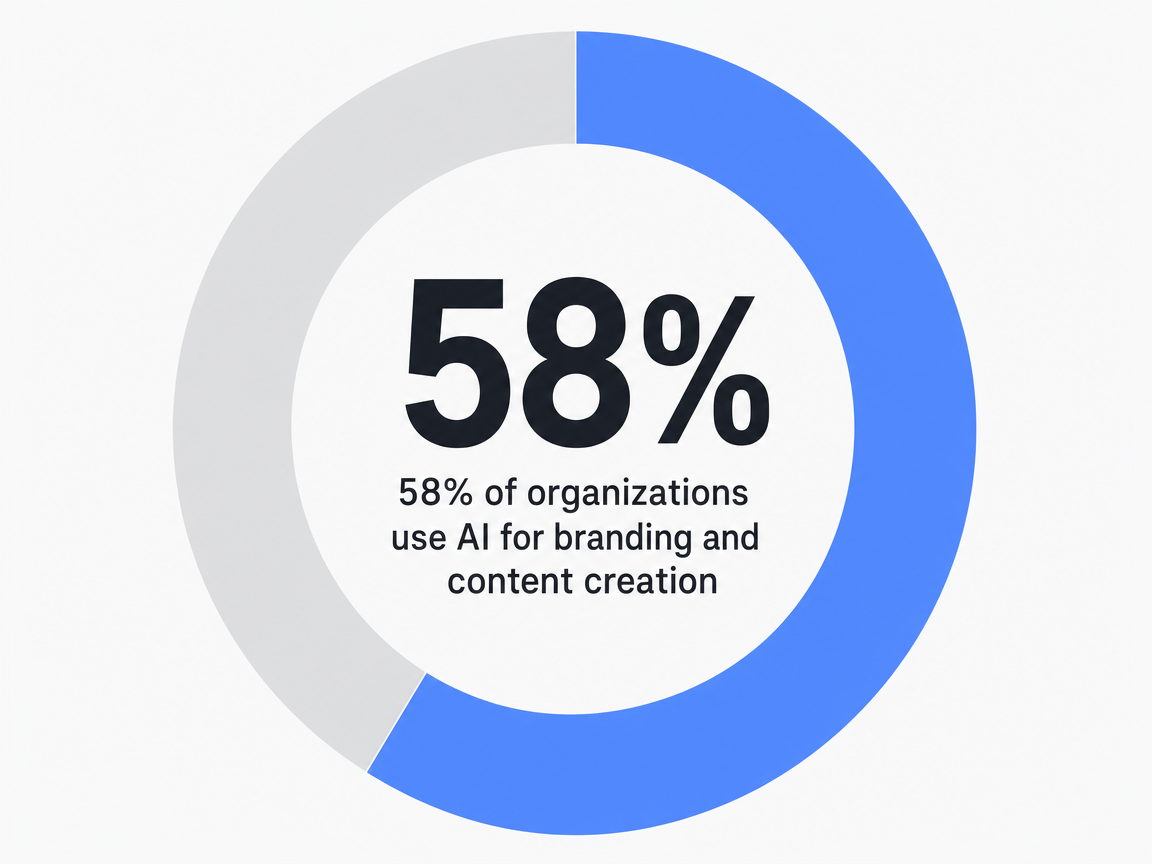 58% of organizations use AI for branding and content creation: 58%
For a content manager carrying a 24-article monthly target and a flat budget, the practical effect is simple. Research, brief construction, first-draft writing, on-page SEO, internal linking, and CMS publishing can move in-house with an AI production pipeline and a small review team. Original interviews, repositioning narrative, and integrated cross-discipline campaigns still belong with people who do that work for a living.
This piece treats the retainer as a stack to be unbundled, not abolished. The sections that follow map which stages move, what the unit economics actually look like once they do, and the failure modes that show up first when a team rewires its production system.
What AI content production actually replaces (and what it doesn't)
The agency stack, separated into parts
A monthly retainer is rarely one job. It is a stack of jobs sold under a single line item: keyword research, competitive gap analysis, brief construction, drafting, editing, on-page SEO, schema markup, internal linking, image sourcing, CMS publishing, performance reporting, and the strategy conversation that frames all of it. When that stack is bundled, the buyer pays one fee and accepts one cycle time. When it is separated into parts, each job can be priced, timed, and assigned to whichever resource handles it best.
Forrester's 2025 survey of US marketing agencies found those firms adopting generative AI internally to compress the same execution steps clients pay them to perform 5. The agencies are not hiding this. They are using AI to draft, optimize, and publish faster, then billing the saved hours at the old rate. That gap, between what the work now costs to produce and what the retainer charges for it, is the unbundling opportunity.
For a SaaS content manager carrying a 24-article monthly target, the practical move is to inventory the stack. Which jobs require judgment the team already has in-house? Which require tools the team can run directly? Which still need an outside specialist? The answers determine what stays on the retainer, what moves to a freelancer, and what an AI production system handles end to end.
Where AI production wins on unit economics
The economic case for owning content production rests on two independent estimates from two different research firms, both pointing the same direction.
McKinsey puts the productivity ceiling for generative AI in marketing at 5 to 15 percent of total marketing spend, which it sizes at roughly $463 billion annually across the consumer marketing function 2. That figure is a productivity opportunity, not a realized saving. It measures what the technology could lift if fully deployed across drafting, personalization, and analysis, and it spans consumer marketing broadly rather than any one team's content line. A SaaS content manager with a $30,000 monthly retainer should not expect to reclaim 5 to 15 percent of $463 billion. The number sets the ceiling for the category, not the floor for any single program.
BCG's 2025 cost-transformation analysis approaches the same opportunity from the production side and reports that generative AI can make production processes about 50 times more efficient and reduce costs by 20 to 30 percent 4. That estimate covers production processes broadly, not content specifically, and the 50x efficiency claim refers to discrete drafting and asset-generation tasks rather than full pipeline cycle time including human review. Read together, the two figures bracket the realistic range. McKinsey's 5 to 15 percent describes the productivity gain a marketing function can capture once AI is deployed at scale. BCG's 20 to 30 percent describes the cost reduction available on the production stages themselves.
For the content manager, that bracket translates into a working assumption: the drafting, optimization, and publishing stages of an article can be produced for materially less than the retainer line item charges, while the strategy and review stages still cost roughly what they always did because they still require human attention. The unit economics improve where the work is repeatable and degrade where it is not. Deloitte's 2025 media trends survey arrives at the same operating assumption, recommending AI specifically to enable cheaper and faster production 6.
The takeaway is not that AI production is free. It is that the production half of the stack now has a different cost curve than the strategy half, and a bundled retainer charges one rate for both.
Where agencies still earn their fee
Three categories of work still favor an outside team, and a content manager who treats the unbundling argument as total replacement will rediscover why within a quarter.
Original interviews are the first. Sourcing a customer, scheduling the call, conducting the conversation, and pulling a usable narrative out of the transcript is relationship work. An AI pipeline can transcribe and summarize, but it cannot place the call or read the room. Repositioning narrative is the second. When a SaaS company changes how it describes its category, its buyer, or its wedge product, the writing problem is strategic before it is editorial. That work benefits from a senior outside voice that has watched dozens of companies make the same move.
Integrated cross-discipline campaigns are the third. A product launch that ties together a landing page, a webinar, a paid media push, a sales enablement deck, and a press angle is coordination-heavy by design. Agencies that run those campaigns earn their fee on the project-management surface, not the writing surface. Harvard Business Review's 2025 analysis of generative AI in marketing strategy makes the same distinction, noting that AI is powerful for product copy and ad variants while strategic positioning still rewards human judgment 8.
Keeping the retainer for those three categories, and moving the rest in-house, is the honest version of the unbundling argument.
The twelve-stage production system
Mapping research, draft, optimize, review, publish
A working content pipeline has more stations than the bundled retainer line item suggests. Twelve stages cover the path from a keyword target to a published article: keyword research, SERP and competitor gap analysis, brief construction, outline approval, first-draft writing, fact-check and citation pass, on-page SEO and schema, internal linking, image generation or sourcing, editorial review, CMS publishing, and post-publish performance review.
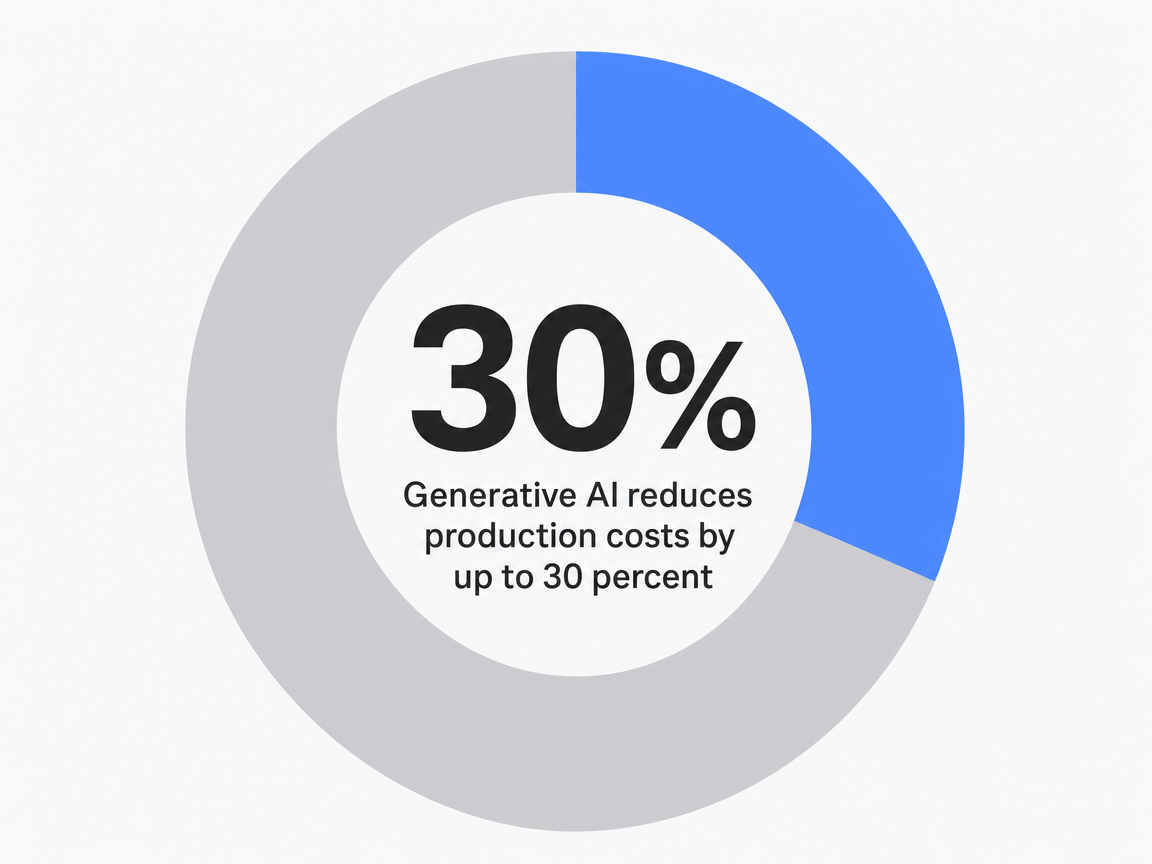 Generative AI reduces production costs by up to 30 percent: 30%
Nine of those twelve stages are AI-executable today with a competent prompt library and a retrieval layer. Keyword research, gap analysis, drafting, on-page optimization, schema, internal link suggestions, image generation, publishing through a CMS API, and the first cut of performance reporting all sit inside what current models handle reliably. Three stages still belong to a person: outline approval, stage-ten editorial review, and the post-publish performance read that decides what to update, kill, or expand.
That split matters because it explains where agency margin used to live. Forrester's 2025 survey of US marketing agencies found those firms adopting generative AI internally to compress the same execution steps clients pay retainers to cover 5. The agencies are running the AI-executable nine in-house and billing them at the old rate. Forrester's parallel B2B adoption work shows the buyer side moving the same direction, with companies that lead on AI adoption in marketing growing revenue faster than peers 3. Both sides of the table are reaching for the same tools.
For a content manager, the diagnostic is straightforward. List the twelve stages. Mark which the team already owns, which the retainer covers, and which sit idle between handoffs. The stages that show up as agency-bundled but are mechanically AI-executable are the ones to pull in first. The three judgment stages stay human regardless of who runs them.
Human checkpoints that protect quality
Three checkpoints carry most of the quality risk in an AI-driven pipeline, and each one rewards a specific person doing a specific job rather than a general editorial pass.
The first is outline approval. Before a draft is generated, a human decides the angle, the argument, the source list, and the section structure. This is the cheapest place to catch a wrong premise. A bad outline produces a draft that reads fluent and is structurally useless, which is the failure mode AI pipelines fail at most expensively. Ten minutes here saves a full revision cycle later.
The second is stage-ten editorial review, after the draft has cleared fact-checking and on-page optimization but before publishing. This is where voice drift, factual softness, and citation mismatches get caught. Harvard Business Review's 2025 analysis of generative AI in marketing notes that AI handles product copy and ad variants well while strategic judgment still rewards human attention 8. The editorial reviewer is that judgment, applied to a specific draft against a specific brief.
The third is post-publish performance review, run on a 30 and 90-day cadence. A person reads the analytics, decides which articles to update, which to consolidate, and which to retire. AI can flag the candidates. A human makes the call.
Three checkpoints, three named owners, three decisions. Everything else in the pipeline can run on a schedule.
Experience AI-Driven Content Workflows in Practice
Publish live SEO articles and measure real workflow efficiency during your trial period.
Three operating models compared on cost, speed, and revisions
The cleanest way to test the unbundling argument is to put three operating models side by side on the variables a content manager actually reports against: monthly cost, articles delivered, brief-to-publish days, revisions per article, and headcount required. The table below uses market-typical ranges as worked examples, not vendor benchmarks. The content manager should plug in their own retainer and output numbers against the same five rows.
| Variable | Agency retainer | Freelancer network | AI production system with human review |
|---|---|---|---|
| Monthly cost range | $10,000–$40,000 | $6,000–$18,000 | $2,000–$8,000 plus reviewer time |
| Articles delivered | 8–16 | 10–20 | 24–40 |
| Brief-to-publish days | 14–28 | 10–21 | 3–7 |
| Revisions per article | 1–3 | 2–4 | 1–2 |
| Headcount required in-house | 0.25–0.5 FTE coordinator | 0.5–1.0 FTE editor | 1.0–1.5 FTE editor plus owner |
Worked-example ranges for a SaaS team targeting 24+ articles per month. Productivity gap anchored to McKinsey's 5–15 percent ceiling on marketing spend efficiency 2 and BCG's 20–30 percent production cost reduction 4.
Three patterns deserve attention. The cost column compresses fastest because drafting, optimization, and publishing collapse into machine time, which is where BCG's 20 to 30 percent production cost reduction lands 4. The cycle-time column compresses next because handoffs between account manager, writer, editor, and SEO specialist disappear into one pipeline. The revisions column moves least, because revisions are mostly a function of brief quality and reviewer discipline, not who drafts the piece.
The headcount row is where the math gets honest. An AI production system does not run itself. It needs an owner who maintains the prompt library and retrieval sources, plus an editor who clears the stage-ten review queue. That is roughly one to one and a half full-time equivalents for a 24-article program, which is less than a freelancer network needs to manage but more than the quarter-FTE coordinator most retainers assume. The savings show up in the cost row, not the headcount row.
McKinsey's 5 to 15 percent productivity ceiling describes what the marketing function can capture once AI is deployed at scale across drafting, personalization, and analysis 2. The table translates that ceiling into a single team's operating reality. A content manager spending $25,000 a month on a retainer that produces 12 articles is paying roughly $2,080 per published piece. The same target hit through an AI production system with a dedicated editor lands closer to $250 to $400 per piece on the production line, with the editor's salary as the fixed cost above it. That is the unbundling math, expressed in the rows the CMO already asks about.
Measuring the new unit of value
From hours billed to articles published
The retainer trained content managers to think in hours. Account managers tracked them, agencies billed against them, and quarterly business reviews defended them. When production moves in-house, the hour stops being the unit of value. The published article does.
That shift changes which numbers matter. Hours billed answer a procurement question: was the work done at the contracted rate? Articles published answer an operating question: did the pipeline produce what the editorial calendar promised, on the cycle time the brief committed to, at the quality the brand requires? A team running an AI production system with a stage-ten editorial review can publish a fact-checked, optimized article in three to seven days. The hours that produced it are largely machine hours, and counting them tells the CMO nothing useful.
Forrester's 2025 B2B adoption work found companies leading on AI in marketing growing revenue faster than peers 3. Revenue growth is the outcome metric, but the operating metric beneath it is throughput at quality. A content manager who can show 24 published articles a month, each cleared through the same editorial bar, has replaced a procurement conversation with an output conversation. That is the reporting line a CMO actually wants.
Three metrics every content manager should track
Three numbers carry the weight once production moves in-house: cost per published article, brief-to-publish days, and revisions per article. Each one maps to a decision the content manager will be asked to defend.
Cost per published article is the unit-economics line. It divides total monthly content spend, including reviewer salary load and tool costs, by the count of articles that cleared editorial and went live. A retainer that delivers 12 pieces at $25,000 prices each one above $2,000. An AI production system with a dedicated editor typically lands the production half of that math in the low hundreds, with the editor's loaded cost layered on top. Deloitte's 2025 media trends survey treats cheaper and faster production as the working assumption for AI-enabled teams 6, and the cost-per-article line is where that assumption either holds or collapses.
Brief-to-publish days measures cycle time from outline approval to a live URL. Three to seven days is the realistic floor for an AI pipeline with disciplined review. Anything longer points to a queue problem at the editorial checkpoint, not a drafting problem.
Revisions per article is the quality canary. One to two revisions per piece signals brief discipline. Three or more signals a brief problem upstream that no amount of regeneration will fix.
See How Leading Agencies Replace Manual Content Workflows with AI Production
Request a walkthrough of automated, multi-stage content pipelines that deliver 24+ SEO articles per month—without expanding your writing team or increasing budget.
What breaks first when the retainer leaves
Three things tend to fail in the first 60 days after a retainer ends, and none of them are draft quality. The drafts are usually fine. The system around the drafts is what cracks.
Calendar discipline goes first. Agencies enforce deadlines because their billing depends on it. When the retainer leaves, the editorial calendar loses its external pacemaker. A pipeline that can publish in three to seven days will still slip to fourteen if no one owns the publish date. The fix is naming a single calendar owner before the retainer ends, not after the first missed week.
SME access goes second. Agencies absorb the cost of chasing product managers, customer success leads, and engineers for the quotes and product details that make a draft sound like it came from inside the company. When that chase moves in-house, it lands on the content manager's calendar. Without a standing 30-minute weekly slot with each SME, drafts start sounding generic. Forrester's 2025 work on US agency genAI adoption shows agencies compressing execution, not source-gathering 5. Source-gathering is still a relationship problem.
Voice drift goes third. An AI pipeline trained on a brand's existing library will reproduce the average of that library, which means recent voice shifts get washed out and older patterns reassert themselves. The stage-ten editorial reviewer has to read for voice as a separate pass, not fold it into a general edit. Teams that skip this find their twentieth article reading like their fortieth from two years ago.
A 90-day plan to move in-house without losing throughput
The transition fails when the retainer ends before the replacement system is running. The fix is parallel operation, not a clean break.
Days 1 through 30: build the pipeline alongside the retainer. The agency keeps producing on its current cadence. The in-house team stands up the twelve-stage system, names the three checkpoint owners, and produces four pilot articles. Brief quality is the focus, not volume. Each pilot runs through outline approval, draft, fact-check, on-page, editorial review, and publish, with cycle time and revision counts logged against the comparison table. The exit criterion for this phase is four published pilots clearing editorial on the first or second pass.
Days 31 through 60: run both systems at half load. The retainer drops to half its article count. The in-house pipeline picks up the other half. This is where calendar discipline gets tested under real volume. The content manager owns the publish dates for both streams, which surfaces handoff problems before the retainer leaves entirely. BCG's 20 to 30 percent production cost reduction shows up in this window if it shows up at all 4. Teams that cannot hit cycle-time and revision targets at half load will not hit them at full load.
Days 61 through 90: full in-house production with the retainer scoped to the three categories that still favor outside work. The retainer line item drops to original interviews, repositioning narrative, and integrated campaigns. The in-house pipeline carries the 24-article monthly target. Forrester's 2025 B2B work shows companies leading on AI adoption in marketing growing revenue faster than peers 3, and the operating evidence for that lead is throughput at quality, measured in the three metrics already in place.
Two exit criteria decide whether the transition holds. Cost per published article should land below the retainer's per-piece rate by day 75. Brief-to-publish days should sit inside the three-to-seven-day window for at least 80 percent of articles in the final month. Teams that miss either number have a brief-quality problem or a checkpoint-ownership problem, not an AI problem, and should fix the upstream issue before adding volume. Vectoron is one example of a production system built around this twelve-stage model for teams running the transition without rebuilding the pipeline from scratch.
Frequently Asked Questions
References
- 1.The economic potential of generative AI: The next productivity frontier.
- 2.How generative AI can boost consumer marketing - McKinsey.
- 3.The State Of Artificial Intelligence And Machine Learning Adoption In B2B Marketing, 2025.
- 4.AI Amplifies the Benefits of a Cost Transformation.
- 5.The State Of Generative AI Inside US Marketing Agencies, 2025.
- 6.2025 Digital Media Trends | Deloitte Insights.
- 7.[PDF] 8 Trends shaping tech marketing & sales strategies for 2026 - IDC.
- 8.How Should Gen AI Fit into Your Marketing Strategy?.
- 9.2026 AI Business Predictions - PwC.
- 10.AI-powered growth: GenAI spurs US economic performance | EY - US.
- 11.From Campaigns to Business Value: How AI Will Transform Marketing.
- 12.The State of AI in the Enterprise - 2026 AI report | Deloitte US.