
Key Takeaways
- ChatGPT and Claude anchor the drafting tier with fast first-pass copy, but every fact-bearing sentence needs human verification because both engines hallucinate citations and rewrite proper nouns.
- Jasper adds brand-voice profiles and shared templates on top of frontier models, earning its slot mainly in shops without disciplined in-house prompt libraries.
- Perplexity collapses research time by returning cited answers instead of raw links, giving editors a source trail to spot-check before writers start drafting.
- Surfer and Clearscope score drafts against ranking pages and enforce entity coverage, cutting revision cycles caused by drafts that miss SERP intent 3.
- Midjourney and Runway compress volume visual and video production, though editors must watch for anatomical errors, trademark collisions, and copyright complications on hero assets.
- Vectoron sits at the orchestration tier, coordinating drafting, SEO, and publishing through a Command Center where every recommendation requires named human sign-off before execution.
The Agency Stack Problem: Point Tools vs. Rewired Workflows
Most agency owners already have a drawer full of AI content tools. A ChatGPT seat for the copy team. Claude for longer briefs. A Jasper subscription no one uses anymore. Maybe Surfer or Clearscope for SEO. Add a Midjourney account, a Perplexity Pro login, and something for social scheduling, and a 20-person shop can easily run eight to twelve overlapping subscriptions before anyone asks whether throughput has actually improved.
The uncomfortable finding underneath that sprawl comes from McKinsey: generative AI alone could power as much as 60% of marketing tasks, but the compounding gains show up only when teams rewire workflows around human-AI collaboration rather than layer tools on top of the old process 1. In other words, the 60% ceiling is a workflow number, not a software number. Agencies that treat AI as a faster typewriter capture a slice of it. Agencies that redesign how briefs, drafts, approvals, and reporting move through the shop capture the rest.
That distinction reframes what a useful AI content tools list looks like for an operator. The question is not which nine apps produce the best paragraphs. It is which tools do specific jobs inside a production line, which ones create more review work than they save, and where a single orchestration layer starts to outperform a fragmented stack. The nine entries that follow are organized on those terms.
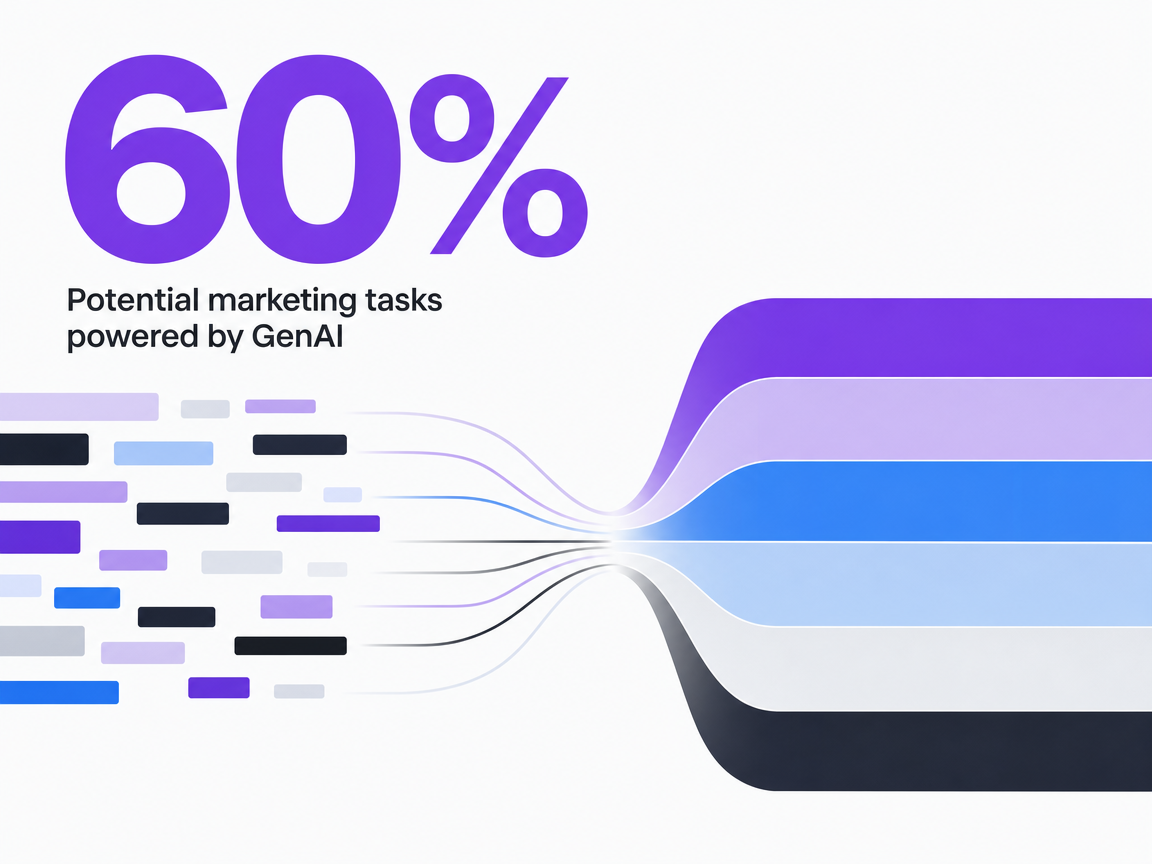 Potential marketing tasks powered by GenAI
Potential marketing tasks powered by GenAI
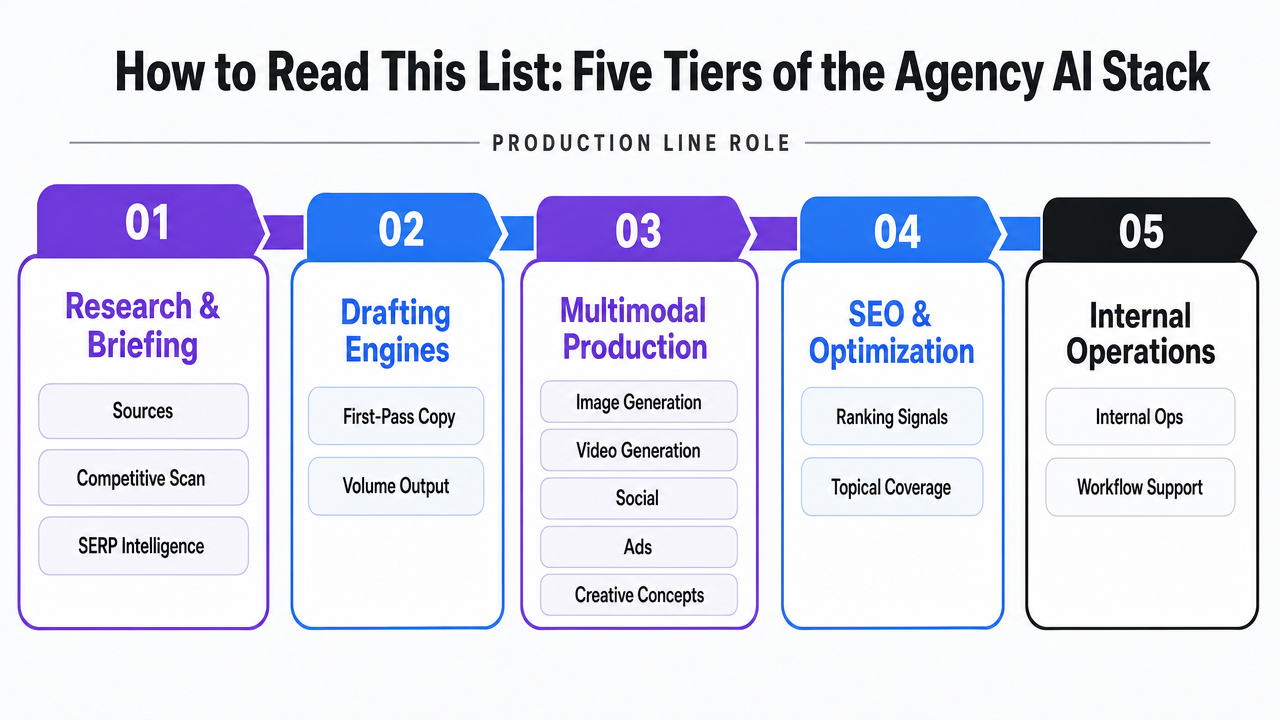
How to Read This List: Five Tiers of the Agency AI Stack
Forrester's 2024 read on US agencies found that generative AI usage clusters into a handful of jobs: content, media, SEO, and internal operations 3. That concentration is useful because it maps almost cleanly onto the tiers an agency owner has to staff and pay for anyway. Instead of grading tools by which one writes the smoothest paragraph, the list below sorts them by the role they play in a production line.
Five tiers do the work.
- Drafting engines are the general-purpose LLMs that produce first-pass copy at volume.
- Research and briefing tools handle source gathering, competitive scans, and SERP intelligence before a writer touches a page.
- Multimodal production covers image and video generation for social, ads, and creative concepts.
- SEO and optimization layers score drafts against ranking signals and enforce topical coverage.
- Orchestration and agentic platforms sit above the others, coordinating briefs, drafts, approvals, and publishing across channels rather than producing a single asset.
A sixth layer, governance, is not a tool tier but a policy layer that wraps the other four. It handles the review posture, disclosure rules, and substantiation checks that keep AI-assisted client work defensible. That layer gets its own section later in the piece so it stays out of each tool entry.
Each of the nine tools that follow is graded on three operator dimensions: throughput impact on billable output, review burden the tool creates for editors, and defensibility of the deliverable when a client asks how it was produced. Read the tiers as a stack diagram, not a ranking. A drafting engine and an orchestration platform solve different problems, and an agency running only one of the two is leaving throughput on the table.
The Nine Tools, Graded by Job in the Stack
Drafting Engines: ChatGPT and Claude
The base of the stack is boring on purpose. General-purpose LLMs are where most agencies already spend their first AI dollar, and both ChatGPT and Claude earn their seat by producing competent first-pass copy across email, landing pages, blog outlines, and internal memos at a speed no junior writer can match.
The operator-relevant difference between the two is temperament, not benchmark score. ChatGPT tends to produce shorter, more conversational drafts and holds custom instructions well across a session, which suits social copy, ad variants, and rapid brainstorming. Claude produces longer, more structured drafts with a lower tolerance for filler, which suits long-form briefs, technical explainers, and regulated-vertical work where tone drift is expensive to fix on the back end.
Throughput impact: High. A strategist can move from blank page to reviewable draft in a fraction of the time. Review burden: Also high. Both engines hallucinate citations, invent statistics, and quietly rewrite proper nouns, so every fact-bearing sentence needs a human check before it leaves the shop.
What they do not do: They do not know a client's brand voice, product catalog, or last quarter's performance data unless someone loads it in every session. Treat them as fast typists with no memory of the account, and the review posture that implies is closer to line-editing a freelancer than approving a finished asset.
Long-Form Production: Jasper
Jasper occupies an awkward but real slot in the stack: a wrapper around frontier models that adds brand-voice profiles, templates, and a marketing-flavored UI on top of the raw LLM layer. For agencies that need multiple writers producing on-brand long-form for the same client without each one prompting from scratch, that wrapper has value.
The throughput case rests on reuse. Once a brand voice, style guide, and product knowledge are loaded, subsequent briefs inherit them, which cuts the prompt-engineering tax a solo ChatGPT seat imposes on every new writer. Team-wide templates for pillar pages, ad sets, and email sequences reduce variance across a delivery pod.
Throughput impact: Moderate to high for shops running the same content pattern across many clients. Review burden: Comparable to raw LLMs; the wrapper does not fact-check.
What it does not do: It does not orchestrate work across channels, and it does not replace an SEO optimization layer. Agencies that already have disciplined prompt libraries in ChatGPT or Claude often find Jasper's incremental lift narrower than the seat cost implies. The honest read is that Jasper earns its slot in shops without in-house prompt engineering, and struggles to justify it in shops with it.
Research and Briefing: Perplexity
Every hour a strategist spends assembling sources for a brief is an hour that does not bill at production rates. Perplexity earns its place in the stack by collapsing that hour. It returns cited answers rather than raw links, which turns the pre-writing research phase into a scannable dossier instead of fourteen open browser tabs.
For agencies serving regulated verticals, that citation trail matters twice: once because it accelerates the brief, and again because it gives editors something to spot-check before a draft goes to the writer. A strategist can pull competitor claims, statute references, or clinical guidelines in minutes and hand the writer a source list rather than a topic.
Throughput impact: High on research-heavy accounts, modest on repeat-pattern content. Review burden: Low, because the tool surfaces sources rather than fabricating prose the editor then has to interrogate.
What it does not do: It does not write the piece, and its citations still need verification. Perplexity is a research accelerant, not a substitute for a strategist's judgment about which sources belong in a client-facing deliverable. Treat it as the fastest junior researcher on the team, and staff accordingly.
SEO Optimization: Surfer and Clearscope
The SEO tier is where drafting engines meet ranking reality. Surfer and Clearscope both score drafts against the top-ranking pages for a target query, flag topical gaps, and enforce entity coverage the drafting model has no way of knowing about on its own. Forrester's 2024 read on US agencies flagged SEO as one of the four concentrated genAI use cases, alongside content, media, and internal operations 3, which tracks with what these tools actually do inside a production line.
Clearscope tends to be favored by editorial teams for its cleaner reader-focused grading. Surfer leans more aggressive on keyword density and structural prescriptions, which some editors find useful and others find heavy-handed. The choice is less about which is objectively better and more about how much the shop wants the tool to influence editorial voice.
Throughput impact: Moderate. The gain is not in writing speed but in reducing the revision cycles caused by drafts that rank poorly. Review burden: Low, since the tool is scoring against public SERP data rather than generating claims.
What they do not do: Neither tool understands search intent nuance the way a human strategist does, and both will happily grade a page toward a competitor pattern that is itself misaligned with the query. The score is a floor, not a ceiling.
Multimodal Production: Midjourney and Runway
Copy is only part of what an agency ships. Social calendars, ad sets, and pitch decks all consume image and video assets that used to require a designer, a stock library subscription, or both. Midjourney handles still image generation with the highest aesthetic ceiling among current commercial tools; Runway extends the same logic into short-form video and clip editing.
For agencies serving multi-location clients with heavy social output, the throughput math is direct. A single strategist can produce dozens of on-brand visual concepts per hour, versus the previous cycle of brief, designer draft, revision, approval. For pitch and concept work, the tools compress the distance between an idea and a visual reference the client can react to.
Throughput impact: High on volume visual work, modest on brand-critical hero assets. Review burden: Moderate. Editors must watch for anatomical errors, unintended brand resemblances, and trademark collisions before assets go public.
What they do not do: They do not replace a designer on brand-system work, and their outputs carry the copyright complications the governance section addresses in detail. Use them for volume and concept; keep a human hand on hero assets and brand identity work.
Orchestration and Agentic Platforms: Vectoron
The top of the stack is where the McKinsey argument about workflow rewiring meets the P&L. Orchestration platforms do not compete with drafting engines; they coordinate them, along with SEO scoring, publishing, and reporting, inside a single approval workflow. That coordination is the tier where the largest productivity gains actually show up, and it is also the tier most agencies have not yet built.
The scale of that gap is visible in the McKinsey State of AI benchmark: only 21% of gen-AI-using organizations have fundamentally redesigned at least some workflows, while 27% report that employees review all gen-AI-produced content before use 4. Read together, those two numbers describe the operator problem cleanly. Most shops are producing more AI output than they can meaningfully review, and most have not restructured the work to make review tractable. An orchestration layer addresses both sides by routing every draft through named approval steps and by cutting handoff overhead between drafting, SEO, and publishing.
Vectoron sits in this tier, alongside a small but growing set of agentic platforms. Its specialist strategists cover content, SEO, PPC, backlinks, social, and call intelligence, and every recommendation routes through a Command Center for human approval before execution. The design choice worth noting is approval-first automation: nothing ships without sign-off, which keeps the review posture explicit rather than assumed.
What it does not do: It does not replace the drafting engines underneath it, and it does not eliminate the editor's job. It changes what the editor spends time on.
Test AI-driven content creation in real time
Experience hands-on workflow improvements by publishing live client content during your 7-day trial.
Stack Consolidation Economics for a 20-Person Agency
The stack sprawl described earlier has a price tag, and it is usually the first number that convinces a founder to redesign the production line. A 20-person agency running the tiers described above typically pays for drafting seats across the copy team, a research tool for strategists, an SEO scoring platform for editors, a multimodal subscription for the creative pod, and some form of project or workflow software to hold it all together. Each line item is defensible on its own. The sum is the problem.
The table below uses only publicly disclosed pricing where the writer could verify it at draft time. Where a line depends on how the shop is staffed, the cell shows the seat variable rather than a fabricated total. Vectoron's disclosed $599 per month trial rate anchors the orchestration line.
| Tier | Typical seats (20-person agency) | Monthly cost |
|---|---|---|
| Drafting engines (ChatGPT, Claude) | 8–12 writer/strategist seats | $X per seat × seats |
| Long-form wrapper (Jasper) | 4–6 content team seats | $X per seat × seats |
| Research and briefing (Perplexity) | 3–5 strategist seats | $X per seat × seats |
| SEO optimization (Surfer or Clearscope) | 2–4 editor seats | $X per seat × seats |
| Multimodal (Midjourney, Runway) | 2–3 creative seats | $X per seat × seats |
| Orchestration platform | 1 platform, agency-wide | $599/mo (Vectoron trial rate) |
The fragmented column adds five to six recurring bills, each with its own admin surface, SSO configuration, and renewal cycle. The consolidated row replaces the middle layers with a single approval workflow that coordinates drafting, SEO, and publishing. The margin argument is not that the orchestration line is cheaper than every subscription combined; it is that the review and handoff time the fragmented stack hides is where the actual cost lives. McKinsey's finding that gains compound only when workflows are redesigned around human-AI collaboration 1is the operator translation of that point. Consolidation pays when it removes handoffs, not when it merely trims seat licenses.
Governance Rails: What You Must Wire In Before Shipping AI Work
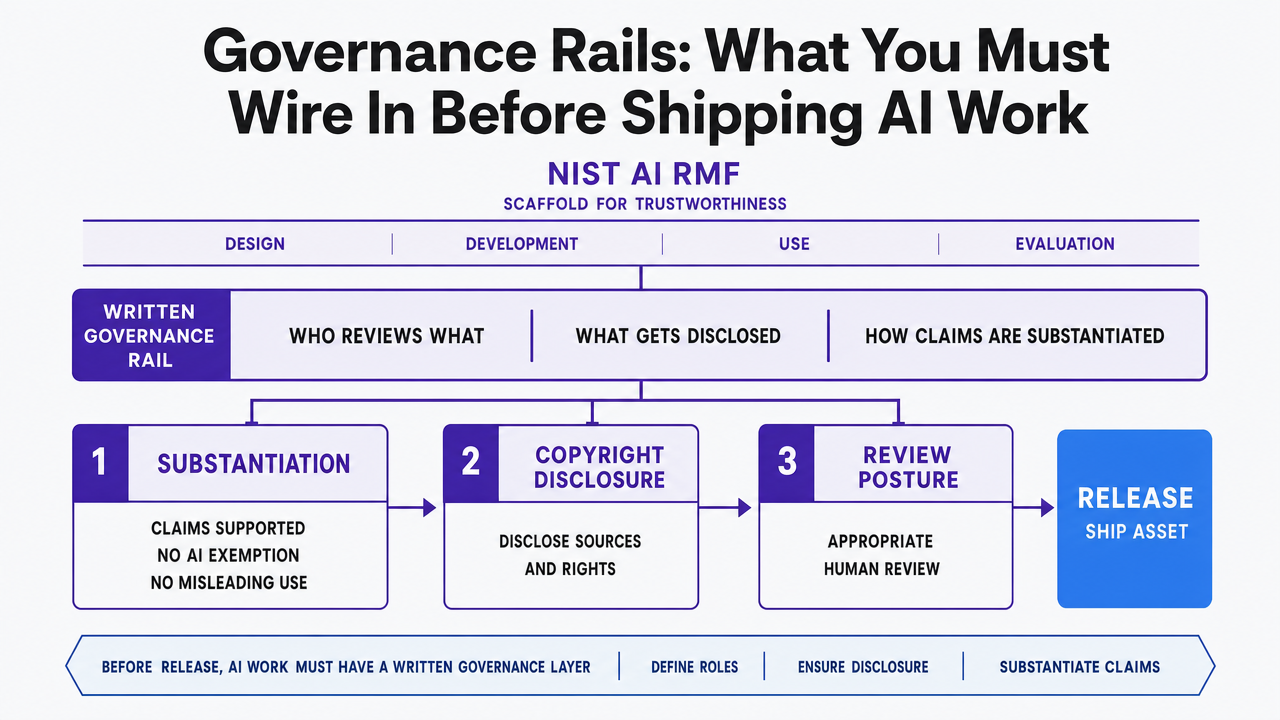
The tool tiers above assume one thing that many shops have not actually built: a written governance layer that says who reviews what, what gets disclosed, and how claims are substantiated before an asset leaves the shop. NIST's AI Risk Management Framework is the cleanest scaffold to map against, and it is explicitly designed to improve trustworthiness in the design, development, use, and evaluation of AI systems in production 5. Agencies do not need to adopt every element; they do need a written policy that answers the same questions NIST asks.
Three obligations sit above the rest for agency work. First, substantiation. The FTC has stated plainly that "there is no AI exemption from the laws on the books" and that using AI to mislead consumers is illegal, a position the agency reinforced in Operation AI Comply and again in its 2025 6(b) resolution examining disclosures, advertising, and representations of AI features 6, 7. Any performance claim, testimonial, or statistic that an AI tool surfaces into client copy needs the same source file behind it that a human-written claim would. If the editor cannot produce the source, the sentence does not ship.
Second, copyright disclosure on registrable deliverables. The U.S. Copyright Office has held that work whose traditional elements of authorship were produced by a machine lacks human authorship and will not be registered, and applicants must disclose more-than-de-minimis AI-generated material and, where necessary, correct prior registrations through supplementary filings 8, 9. For most social posts and ad variants this is a non-issue. For pillar content, brand books, and hero creative that clients may want to register, the production line needs a field that records what was AI-generated and what the human contribution was.
Third, review posture. The McKinsey State of AI finding that only 27% of gen-AI-using organizations review all AI-produced content before use 4is the number to design against, not to match. Agencies shipping client work do not have the luxury of the 73% posture. The practical rule is that every fact-bearing sentence and every visual asset with a person, place, or brand mark in it gets a named human sign-off recorded in the workflow, not a Slack thumbs-up. Wire that into the tool tier that holds the approval trail, not into the drafting tool that produced the asset.
See How Leading Agencies Automate Content Production with AI
Request a walkthrough of AI-driven workflows that eliminate manual bottlenecks, streamline approval cycles, and deliver measurable improvements in campaign efficiency for agencies managing multi-channel operations.
If You Manage Multiple Client Portfolios: Where Orchestration Actually Pays
Scope shift: this section is for owners running production across more than one account at a time, not for teams servicing a single flagship client. The economics of orchestration change sharply once a shop is coordinating parallel briefs, calendars, and approval cycles across five, ten, or thirty portfolios.
Point tools scale linearly with headcount. A drafting engine helps one writer move faster on one account; ten writers on ten accounts still produce ten parallel review queues, ten sets of brand-voice drift, and ten places where a missed substantiation source can escape the shop. Orchestration is where that math bends. McKinsey's agentic workflow guidance is explicit that gains compound only after granular mapping of tasks and systems across CRM, CMS, DAM, and analytics 2, which is precisely the surface area a multi-portfolio agency already juggles manually.
The operator signal is straightforward. If a delivery lead spends more time chasing status across accounts than editing work, the shop has outgrown its point-tool stack. Consolidating drafting, SEO scoring, and publishing into one approval trail turns portfolio review from ten Slack threads into one queue with named sign-offs. That is where orchestration pays, and it does not pay before it.
A Practical Sequencing Plan for the Next Two Quarters
Sequencing matters more than tool selection. Agencies that buy the full stack at once tend to end up with the same review bottleneck they started with, just faster upstream. The order below is designed to remove handoffs in the same order they cost the shop money.
- Quarter one, weeks one through six: standardize the drafting layer. Pick one primary engine, load brand voice and product knowledge into shared prompts, and retire duplicate seats. Add a research tool for strategists in the same window so briefs stop consuming production hours.
- Quarter one, weeks seven through twelve: wire in the SEO scoring layer and write the governance policy. NIST's framework is the scaffold to map against for review posture, substantiation, and disclosure 5. No new tool ships client work until the policy names who signs off on what.
- Quarter two: pilot an orchestration platform on two accounts before rolling it wider. McKinsey's agentic guidance is explicit that gains follow granular task mapping across CRM, CMS, and analytics, not tool installation 2. Measure review hours saved per account, then decide.
Frequently Asked Questions
References
- 1.The future of marketing in the age of AI.
- 2.Reinventing marketing workflows with agentic AI.
- 3.The State Of Generative AI Inside US Agencies, 2024.
- 4.The state of AI.
- 5.AI Risk Management Framework | NIST.
- 6.FTC Announces Crackdown on Deceptive AI Claims and Schemes.
- 7.Generative AI 6(b) resolution.
- 8.February 23, 2024 The Honorable Chris Coons Chair ....
- 9.Works Containing Material Generated by Artificial Intelligence.
- 10.CHAPTER 4: Economy.