
Key Takeaways
- Copy.ai suits go-to-market teams that need chained workflows across sales and marketing, not single drafts, so skip it when you only want a drafting panel.
- Rytr handles short-form jobs like subject lines, ad variants, and captions at an entry-level price, best for solo marketers or lean teams.
- Writer governs enterprise brand voice through agents, Playbooks, and Knowledge, and connects to tools such as Gmail, Slack, and Teams, built for governed output across a company 8.
- Scalenut covers keyword clustering, ready-to-rank GEO articles, article optimization, and workspaces, fitting lean content teams publishing weekly ranking articles against a keyword roadmap.
- Wordtune sits inside your draft to rewrite paragraphs and sharpen clarity, fluency, and vocabulary, making it a complement to drafters rather than a replacement 12.
- Hypotenuse AI handles ecommerce catalogs end to end with descriptions, metadata, tagging, and quality checking, matching catalog depth rather than article volume.
- Copysmith generates consistent product descriptions in bulk across catalogs from 10 to 10,000 SKUs, turning impossible manual queues into reviewable batches 14.
- LongShot AI grounds output in SERP results, uploaded files, domains, or URLs you choose, useful when writing must cite recent events or indexed information 15.
- Sudowrite serves fiction writers with Story Bible context and scene tools for continuity, not marketing copy, SEO articles, or brand-governed work 18.
- Bertha AI shut down and rescinded licenses, a reminder to check vendor funding, cadence, and support before wiring any tool into a publishing pipeline 20.
How to Match an AI Copywriting Tool to the Job You Actually Need Done
Shopping for an AI copywriting tool goes sideways the moment you treat the category as one product. It isn't. A tool that writes 8,000 product descriptions from a CSV has little in common with one that drafts a novel chapter, and neither is built for publishing an SEO article to WordPress on a schedule.
Your pick depends on four questions. What are you writing (product copy, articles, ads, fiction, enterprise comms)? Where does the output go (a draft, a CMS, a campaign)? How much brand-voice fidelity do you need? And who approves work before it ships? McKinsey's 2025 global survey of 1,993 respondents across 105 countries found marketing-strategy content support is among the most commonly reported AI use cases 3. The vendor list reflects that breadth by splitting into specialized lanes rather than converging on one winner.
The ten tools below are sorted by job-to-be-done. Match the tool to the work, not the feature list, and the shortlist builds itself.
The Six Jobs AI Copywriting Tools Were Built to Do
Group the market by output, not by model, and the shortlist collapses into six lanes. Each lane answers a different operator question about what gets written, where it ends up, and how much control you keep over voice and approval.
- Short-form drafting. Social posts, ad variants, email subject lines, and quick product blurbs. The job is speed and volume on a small canvas, usually inside a browser or a side panel.
- SEO article production. Keyword research, briefs, long-form drafts, and on-page optimization aimed at ranking. The output is a researched article, often routed to a CMS.
- Ecommerce catalog content. Hundreds or thousands of product descriptions, metadata, and category pages generated from structured feeds. The job is consistency at SKU scale.
- Enterprise brand voice. Delegated workflows that apply approved style, terminology, and compliance rules across internal and customer-facing writing. The job is governed output, not clever copy.
- Fiction and long-form narrative. Novels, short stories, and screenplay drafts with continuity tracking, character notes, and chapter-level expansion tools.
- End-to-end marketing production. Strategy, drafting, editing, publishing, and distribution tied together under approval rules you set. The job is finished work in the channel, not a draft in a doc.
McKinsey's 2025 global survey of 1,993 respondents across 105 countries found marketing-strategy content support is among the most commonly reported AI use cases 3. Pick the lane first. The product name comes after.
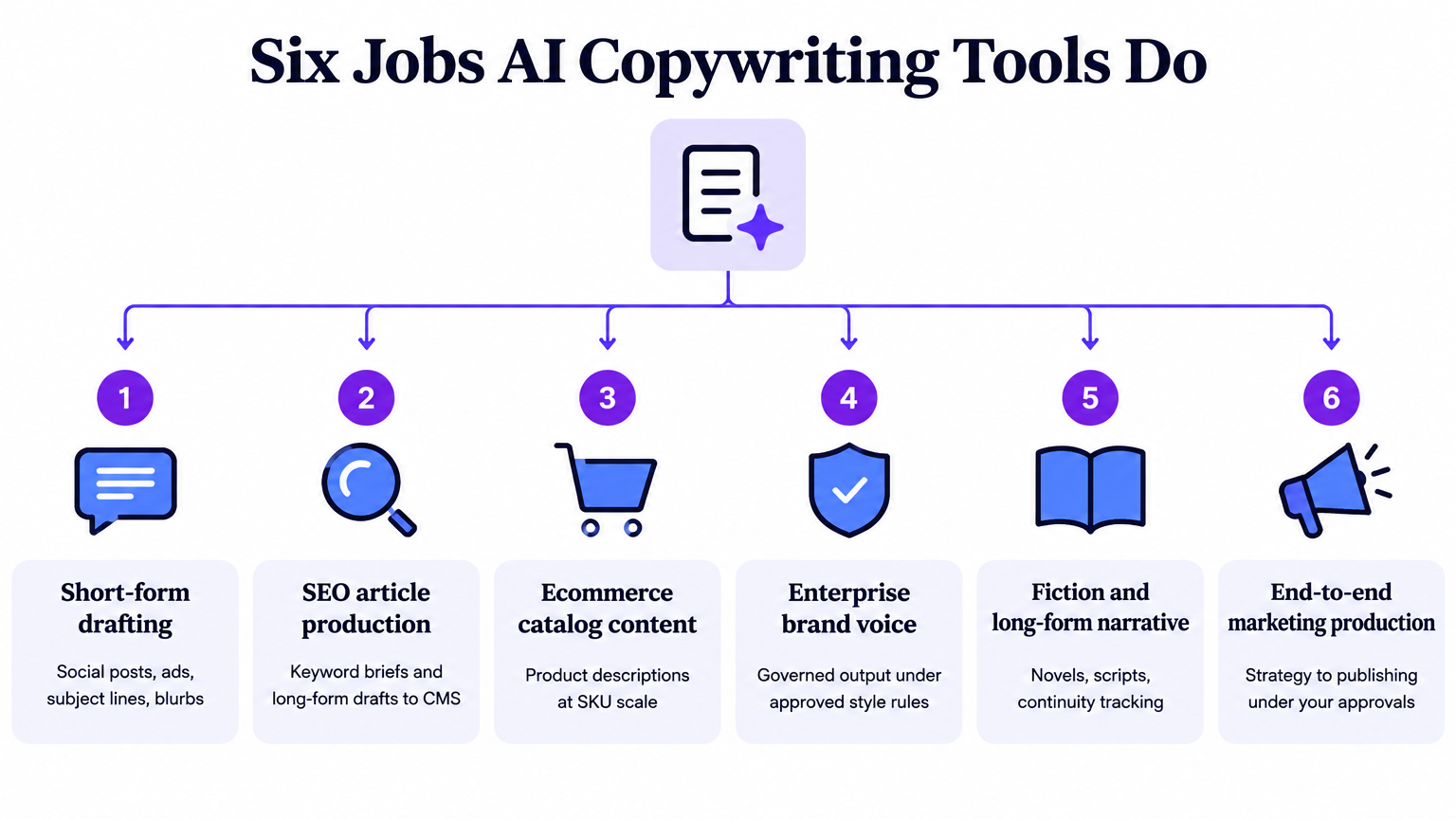 six jobs AI copywriting tools do, from short-form drafting to end-to-end marketing.
1. Copy.ai: Workflow Automation for Go-to-Market Teams
Copy.ai sits in the workflow-automation lane, not the single-draft lane. The platform's no-code builder lets you chain actions like text generation, web scraping, and research agents into multi-step workflows you can trigger by event, reuse across campaigns, and tune by adjusting prompts, parameters, and logic 21.
What that looks like in practice: a sales workflow that scrapes a prospect's site, pulls firmographic signals, drafts a tailored outbound email, and routes the result into your CRM. Or a content workflow that researches a topic, generates a brief, drafts the piece, and hands it off for review. The copy itself is one node in a longer pipeline.
Pick Copy.ai when the bottleneck is coordinating repeatable steps across sales, marketing, and ops, not writing a one-off blog post. If you only need a drafting side panel, you'll pay for orchestration you won't use. Teams running the same play across dozens of accounts, segments, or campaigns get the most mileage here.
2. Rytr: Low-Cost Drafting for Short-Form Use Cases
Rytr is the entry-level drafter in this roundup. It covers the short-canvas jobs an operator hits every day: email subject lines, ad variants, product blurbs, social captions, meta descriptions, and the first pass at a landing-page headline. The scope is deliberately narrow, and the pricing posture reflects that.
The vendor publishes Free, Lite, Personal, and Pro tiers, with yearly billing shaving 20% off the monthly rate. Plans scale by writing use cases, connected sources, relationship management, engagement actions, research runs, and briefings, so the ceiling you hit first depends on which of those you push hardest.
Reach for Rytr when the daily workload is a stack of small writing tasks and you want a cheap seat for a solo marketer or a lean team. Skip it if you need brand-voice fidelity enforced across a company, catalog-scale generation from a feed, or a publishing pipeline that pushes copy into a CMS. Those jobs belong to tools built further down this list.
3. Writer: Enterprise Brand Voice and Delegated Agents
Writer is built for the governance problem, not the blank-page problem. The platform lets teams delegate workflows to AI agents that plan, execute, and produce deliverables using organizational knowledge and approved standards, applying a defined brand voice across the output 8. Agents assemble work through Playbooks, Knowledge, Connectors, and Skills, and the system connects to tools your team already uses, including Gmail, Slack, and Teams 8.
That architecture matters when the writing has to pass legal, compliance, or brand review before it ships. Instead of pasting a style guide into a prompt, you load terminology, voice rules, and source material once and let agents reuse them across campaigns, product launches, and internal comms.
Pricing posture signals the buyer. Writer offers a Starter plan with monthly or annual per-seat pricing and fixed credit limits, plus an Enterprise plan with regular seats, unlimited free users, optional solution packs, and services. If you need a single drafting seat, Writer is heavier than the job. If you're coordinating governed output across a company, that's the lane it's built for.
4. Scalenut: SEO Article Production and Keyword Clustering
Scalenut lives in the SEO article lane. If your pipeline needs keyword research, topical clusters, and long-form drafts aimed at ranking, this is the category it serves.
The platform packages ready-to-rank GEO articles, article optimization, keyword clustering, prompt tracking, and AI search and writing integrations into workspaces, with plan limits scaling by tier. Subscriptions are billed monthly or annually, so the budgeting decision is the same one you make for most SEO tools: match the article and cluster allowance to your editorial calendar instead of over-buying seats you won't fill.
The useful mental model is a stack. Keyword clustering groups related terms into topic sets, those sets become article briefs, briefs become drafts, and optimization scoring tells you where the draft is thin before it goes to an editor. For a lean content team producing weekly ranking articles, that pipeline removes a lot of manual research time.
What you don't get here is a catalog engine for thousands of product SKUs, or an enterprise brand-voice layer with legal review built in. If your job is publishing a steady stream of SEO articles against a keyword roadmap, Scalenut fits. If the job is anything else on this list, keep reading.
Put AI Copywriting to Work
Create and publish real content during your trial, then assess how the workflow fits your marketing needs.
5. Wordtune: Rewriting and Editing Inside Your Draft
Wordtune doesn't try to write your post from scratch. It sits next to the draft you already have and tightens it. The editor rewrites paragraphs, cleans up grammar and spelling, and surfaces suggestions for clarity, fluency, and vocabulary while you work 12.
That makes it a complement to the drafters further up this list, not a replacement. If a junior marketer produces a serviceable first pass, Wordtune is where it gets sharper. If a subject-matter expert can brain-dump a 600-word explainer but hates editing, it collapses the revision cycle. The paid tier removes the free-plan ceiling on paragraph rewrites, so heavy editors aren't rationing suggestions mid-draft 12.
Pricing is published across free and paid plans, billed monthly or annually, with usage limits on rewrites, AI generations, and summarization varying by tier. Buy a seat for each person who edits daily; skip it for occasional users who can live inside the free limits.
6. Hypotenuse AI: Ecommerce Catalog Content and Product Information
Hypotenuse AI is built for the catalog, not the blog post. If you're responsible for a store with hundreds or thousands of SKUs, the job isn't writing one clever description. It's producing consistent product descriptions, metadata, and category pages at a scale that manual copywriting can't touch.
The platform covers that pipeline end to end. It generates product descriptions, metadata, category pages, and blog articles, then adds product information management features like enrichment, tagging, categorization, and quality checking. Bulk image editing, AI chat, social and advertising content, and custom integrations round out the kit, with pricing set custom by plan.
The decision point is whether your bottleneck is product data or marketing copy. If merchandising teams are hand-writing SKU descriptions, cleaning tags, and reconciling attributes across a feed, Hypotenuse AI collapses that work into one system. If you only need a handful of landing-page headlines a week, this is more infrastructure than the job calls for. Match it to catalog depth, not article volume.
7. Copysmith: Bulk Product Descriptions Across Large Catalogs
Copysmith is an ecommerce-first copywriter, and its signature move is bulk generation. Feed it a product list, and it produces consistent descriptions across catalogs ranging from 10 to 10,000 SKUs 14. That range matters: it's a tool sized for both a boutique Shopify store adding a seasonal line and a multi-brand retailer rewriting a feed before a replatform.
The operational question Copysmith answers is throughput with voice consistency. When a merchandiser is staring at 4,000 blank description cells in a spreadsheet, hand-writing isn't the slow option—it's the impossible one. Bulk generation turns that queue into a reviewable batch, where the editing pass becomes spot-checking tone and accuracy instead of composing from zero 14.
Reach for Copysmith when SKU count is the bottleneck and the output lives on product detail pages. Skip it when the job is a weekly SEO article, an enterprise brand-voice rollout, or a campaign that touches ads, email, and social together.
8. LongShot AI: Factual Grounding for Current-Topic Content
LongShot AI goes after the weakest spot in most AI drafts: outdated or invented facts on topics that moved last week. Its Fact GPT endpoint generates content grounded in sources you choose—SERP results, uploaded files, specific domains, or individual URLs—and supports multilingual output, with credits reported per request 15. You're not asking a model to recall a statistic from training data; you're telling it which pages to read first.
The platform also runs a product-copy endpoint that generates descriptions or reviews, optionally pulling in SERP data and Google product details to sharpen the output, with credits consumed per call 16. So the same grounding logic that keeps a current-events blog post honest can also tie product copy to live retail signals.
Reach for LongShot AI when the writing has to cite something that happened recently or match information already indexed on the web. Skip it when the job is pure brand-voice drafting with no factual spine.
9. Sudowrite: Fiction Writing with Story Bible and Continuity Tools
Sudowrite is the odd one in this roundup because it isn't built for marketing copy at all. It's an AI co-writer for fiction, and the architecture reflects that: Story Bible holds your characters, world rules, and plot beats, while Muse and the Write, Rewrite, Describe, and Expand tools draft, revise, and extend scenes against that context 18. Continuity support, brainstorming, research, and editing round out a kit tuned for novelists and screenwriters, not landing-page editors.
Every plan ships the full feature set. Hobby & Student, Professional, and Max tiers differ by monthly AI credit allowance, with unused credits rolling over for 12 months on the Max plan. Match the tier to how many chapters you draft a month, not how many features you unlock.
Reach for Sudowrite when the output is narrative fiction with a bible to protect. Skip it for product copy, SEO articles, or anything a brand voice guide governs.
10. Bertha AI: WordPress-Native Writing Assistant (Now Closed)
Bertha AI is on this list as a cautionary data point, not a recommendation. The tool was a writing assistant that lived inside WordPress itself, with templates for website copy, value propositions, calls to action, product and service descriptions, blog topics, outlines, introductions, conclusions, and content rephrasing across pages, posts, custom post types, and WooCommerce 19. For small operators publishing directly in WordPress, that native placement was the pitch.
Then the vendor shut down. Bertha AI's own pricing page states the service has closed to all users, licenses have been rescinded, and refunds would be arranged for the remaining subscription periods 20. If you were running Bertha AI inside a client's WordPress install, the plugin stopped being a dependable part of your stack.
The lesson for your shortlist: when you evaluate smaller AI copywriting tools, check the vendor's funding posture, publishing cadence, and support footprint before you wire them into a publishing pipeline. A closed tool is a migration project you didn't plan for.
See How AI Copywriting Can Fit Your Content Workflow
Talk with Vectoron about scaling content research, writing, editing, and publishing across your brands, with approval settings you control.
Comparing the Ten Tools: Job, Output Destination, Brand Voice, and Oversight
Here is the full shortlist mapped to four decision columns: the primary job it was built for, where the output lands, how it handles brand voice, and what oversight the vendor exposes. Only cells supported by the referenced vendor material are filled.
| Tool | Primary job | Output destination | Brand voice | Oversight controls |
|---|---|---|---|---|
| Copy.ai | Multi-step GTM workflows | Chained outputs across sales/marketing systems 21 | Prompt and parameter tuning per workflow 21 | Event triggers and reusable components 21 |
| Rytr | Short-form drafting | Draft in-app | Use-case templates | Plan-tier limits |
| Writer | Enterprise brand voice | Agent deliverables via Gmail, Slack, Teams 8 | Playbooks, Knowledge, Skills 8 | Per-seat credit limits; Enterprise seat tiers |
| Scalenut | SEO article production | Drafts in workspaces | Not specified in referenced material | Workspace and plan limits |
| Wordtune | Rewriting and editing | Inline edits to your draft 12 | Clarity, fluency, vocabulary suggestions 12 | Free vs. premium rewrite limits |
| Hypotenuse AI | Ecommerce catalog content | Product pages, metadata, categories | Not specified in referenced material | Quality checking; custom integrations |
| Copysmith | Bulk product descriptions | SKU-level copy, 10 to 10,000 SKUs 14 | Not specified in referenced material | Batch review of bulk output 14 |
| LongShot AI | Fact-grounded drafting | API output per request 15 | Not specified in referenced material | Source selection: SERP, URLs, files 15 |
| Sudowrite | Fiction writing | Scene and chapter drafts 18 | Story Bible context 18 | Credit allowances by tier |
| Bertha AI | WordPress-native drafting | Service closed 20 | Service closed 20 | Service closed 20 |
Read the table across, not down. The right tool is the row whose four columns match the work on your desk.
Where End-to-End Marketing Production Fits In
The nine tools above stop at a draft or a batch of drafts. Someone on your team still has to score the SEO brief, approve the voice, push the article into WordPress or Webflow, set internal links, and track whether it ranked. That handoff gap is where end-to-end marketing production platforms live.
The Vectoron AI Content Platform fits this category. It covers keyword research, multi-model drafting, automated editing, SEO optimization, internal linking, and publishing into WordPress or Webflow, with approval rules you define per website. You decide whether work ships autonomously, with light moderation, or only after full review. Deloitte's enterprise research found marketing represented roughly 10% of cited GenAI deployment distribution, with regulatory compliance and real-world errors cited as barriers to full production 4. A platform that routes strategy, draft, edit, and publish through the same approval layer closes that gap instead of adding another tool to coordinate.
Pick this lane when the bottleneck is finished, published work, not another doc.
The Oversight Layer: Governance, Disclosure, and Human Review
Every tool on this list produces text. None of them decides, on your behalf, whether that text is accurate, whether the audience should be told it was AI-assisted, or who signs off before it ships. That decision sits with you, and public expectations are moving in one direction.
Pew Research Center surveyed 5,023 U.S. adults in June 2025 and found that 76% said it was extremely or very important to be able to tell whether text, pictures, or videos were made by AI or people 5. That's your audience telling you disclosure is a trust requirement, not a legal footnote.
Use three controls to close the gap. First, apply a review step before publishing. NIST's Generative AI Profile frames accuracy, transparency, accountability, and human oversight as the risk-management practices organizations should build into generative-AI workflows, which is the structure any copy pipeline should mirror 2. Second, disclose AI assistance where it matters. If you plan to register copyright, the U.S. Copyright Office requires applicants to disclose more-than-de-minimis AI-generated material and describe the human-authored contributions; protection may extend to the creative human parts 6. Third, pick a tool whose approval settings match the risk level of the output. A product blurb and a medical explainer should not pass through the same gate.
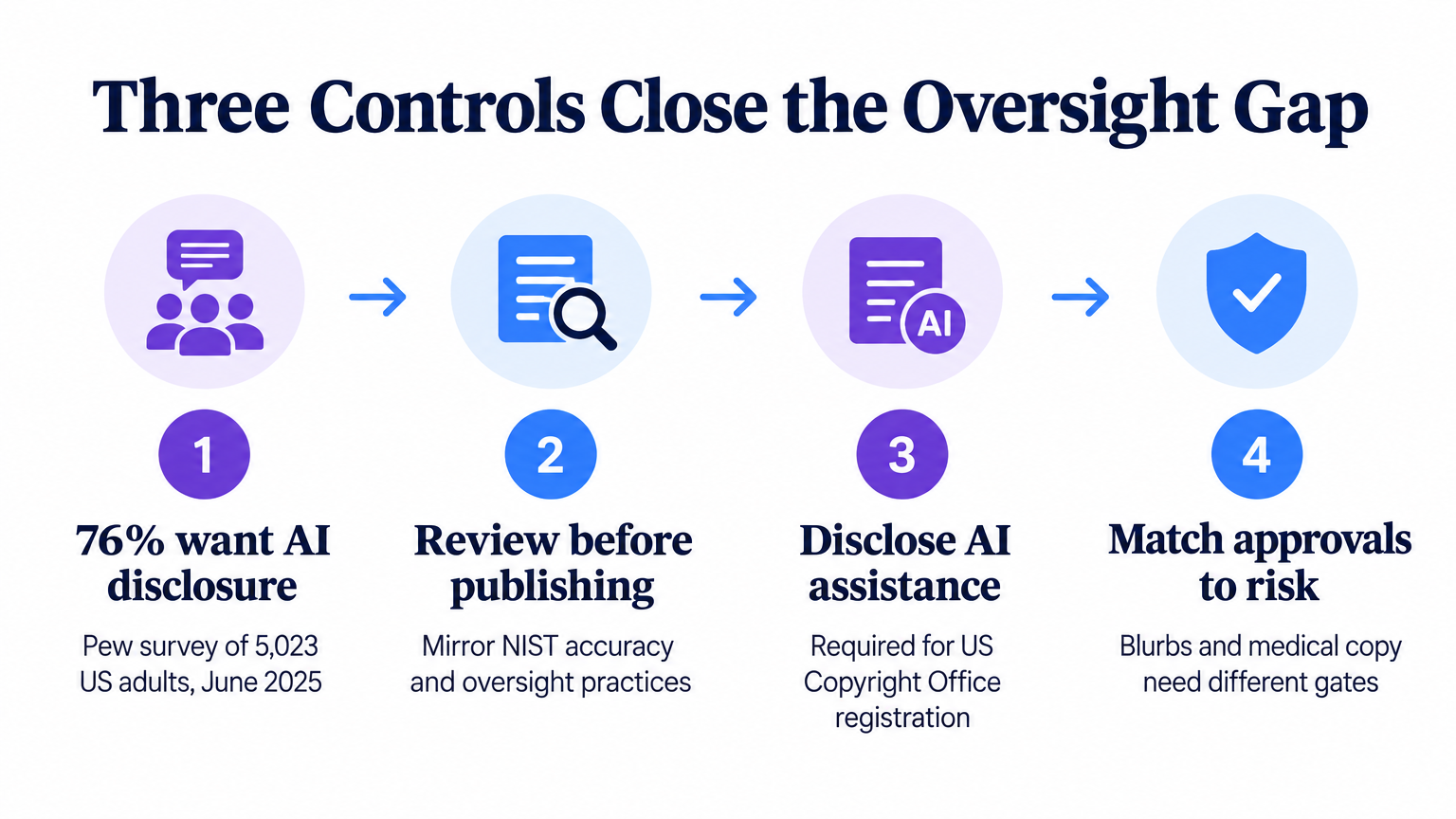 four oversight controls for AI copywriting tool disclosure and review.
A Shortlist Framework: How to Choose in Under an Hour
You don't need a six-week evaluation. You need a short checklist that cuts the field down fast. Run these five questions against your actual workload, not a hypothetical one, and the shortlist narrows to two or three names.
- 1. What's the output? Write the specific artifact on top of your backlog: product descriptions, SEO articles, ad variants, enterprise comms, fiction chapters, or a full campaign. The answer eliminates six of ten tools immediately.
- 2. Where does it land? A draft in a doc, a CMS, an API response, or a published, approved asset. Tools that stop at a draft shift the publishing burden back to a human.
- 3. How much brand voice fidelity do you need? A product blurb and a regulated patient explainer tolerate very different error rates. If legal or compliance reviews your work, you need a system that loads terminology and style once, not a prompt pasted every time.
- 4. Who approves before it ships? Decide now whether work moves autonomously, with light moderation, or only after full review. NIST's Generative AI Profile treats accuracy, transparency, and human oversight as core risk-management practices, so make this an explicit setting, not a vague team norm 2.
- 5. Can the vendor survive your contract term? The Bertha AI shutdown is the reminder. Check pricing posture, publishing cadence, and support footprint before you wire a tool into a pipeline you'd have to rebuild.
Picking the Tool That Fits Your Pipeline
The ten tools on this list don't compete head-to-head. They solve different problems, and the right pick is the one whose job description matches the artifact sitting on your backlog this week. A bulk product-description job doesn't need a fiction co-writer. A novel doesn't need a keyword cluster engine. An enterprise rollout under legal review doesn't need a solo drafter's side panel.
Pin down the output, the destination, the voice bar, and the approval rules before you compare vendor pages. If the bottleneck is finished, published work across content, SEO, and social under rules you set, that's the lane the Vectoron AI Content Platform is built for. To size it against your pipeline, reach the team through the contact page.
Frequently Asked Questions
References
- 1.2024 NIST GenAI (Pilot Study): Text-to-Text Evaluation Overview and Results.
- 2.Artificial Intelligence Risk Management Framework: Generative Artificial Intelligence Profile.
- 3.The state of AI in 2025: Agents, innovation, and transformation.
- 4.Deloitte's State of Generative AI in the Enterprise.
- 5.How Americans View AI and Its Impact on People and Society.
- 6.Works Containing Material Generated by Artificial Intelligence.
- 7.What is WRITER?.
- 8.Wordtune Editor: Writing Features.
- 9.Copysmith | AI Copywriting Software for eCommerce.
- 10.Fact GPT.
- 11.Generate Product Copies.
- 12.How Sudowrite Works: Story Bible, Muse, and the Tools.
- 13.Blurb Generator.
- 14.Taking a look at our value pricing - Bertha AI Co Pilot.
- 15.Workflows | The Future-Proofed Solution to Unlocking AI Responsibly.