
Key Takeaways
- ROI Reality Check: Only 15% of organizations see significant ROI in year one; success requires a shift from "plug-and-play" to structured governance.
- The Verification Tax: Human oversight and compliance checks can absorb up to 50% of efficiency gains, necessitating a realistic budget for review cycles.
- Revenue over Cost: Leading teams are moving beyond simple cost-cutting to measure AI's impact on pipeline velocity and organic traffic growth.
- Industry Nuance: Healthcare requires a compliance-first framework with longer payback periods, while B2B SaaS can leverage multi-touch attribution for faster insights.
- Strategic Payback: Plan for a 2-4 year horizon, using early quick wins (like SEO blogs) to fund the deeper integration required for scale.
The Business Case for AI Created Content
Why Organizations Invest in AI Created Content Now
The ROI Reality Gap: 15% vs 85% Investment
The current landscape for ai created content reveals a stark divide: 85% of organizations have increased investment in generative AI, yet only 15% report significant, measurable ROI at this stage. This reality gap is not unique to a single sector; it spans industries and organization sizes1. While optimism remains high—38% expect to achieve ROI within a year—the majority find that true returns require a longer horizon, often two to four years1.
Checklist: Assessing Your Organization’s Position in the AI ROI Gap
- Has your company increased investment in AI content in the past 12 months?
- Are you among the 15% realizing significant, measurable ROI, or the 85% still waiting?
- Do you have a structured program for aligning AI initiatives with business objectives?
This phenomenon can be traced to several factors. Many enterprises launch AI pilots without clearly defined success measures or integration plans, treating AI as a plug-and-play solution rather than a transformation initiative. As a result, only a minority see near-term, quantifiable gains. Those that do succeed typically invest in governance frameworks, human oversight, and selective use cases with clear business value. The rest face lagging returns as they navigate the complexity of change management, data quality, and process redesign1.
For marketing leaders, this means that simply adopting generative AI is insufficient. The organizations that bridge the ROI gap focus on disciplined execution, strategic alignment, and robust measurement. The next section examines how investment priorities are shifting from basic cost reduction to measurable revenue generation.
From Cost Reduction to Revenue Generation
Decision Tool: Cost vs. Revenue AI Investment Priority Matrix
- Is your primary goal reducing content production costs, or driving net new revenue?
- Do you have reliable attribution for revenue from content initiatives?
- Have you established quality controls for ai created content that enable monetizable outcomes?
The initial promise of generative AI focused heavily on reducing expenses and accelerating content workflows. Early results are significant: organizations report up to a 65% reduction in production costs when using AI-generated content compared to freelancers8. However, a growing share of marketing leaders are now shifting their focus from basic cost savings to quantifiable revenue impact. McKinsey research suggests that generative AI can increase marketing productivity by 5–15% of total spend, translating into approximately $463 billion in annual value when properly linked to business growth3.
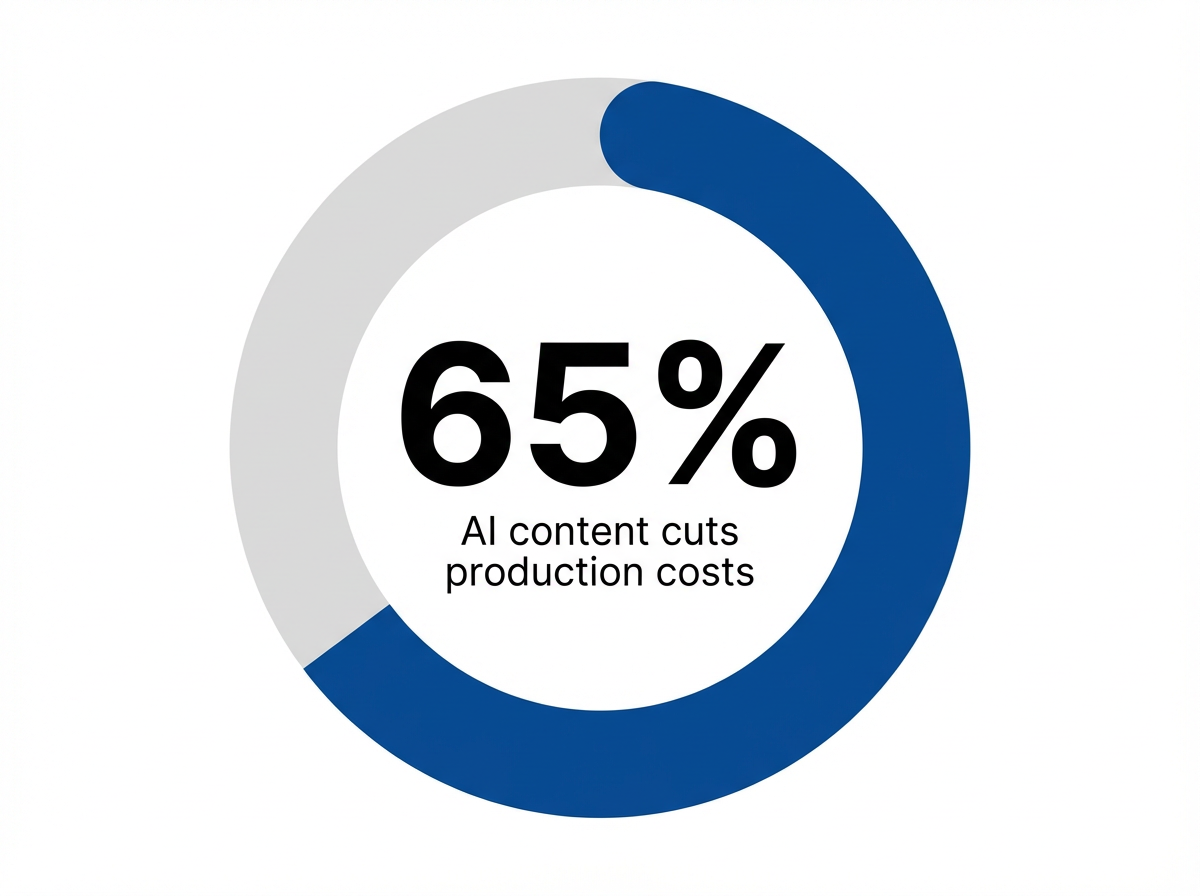 Production cost reduction with AI-generated content vs freelancers: 65%
This approach is ideal for organizations seeking to move beyond efficiency metrics and measure AI’s contribution to pipeline and closed revenue. For example, a SaaS company using AI-driven blog content documented a 35% increase in organic traffic in six months, directly supporting pipeline growth8. Companies that prioritize revenue-generating use cases—such as account-based marketing, conversion optimization, and advanced personalization—see the strongest long-term ROI.
As organizations graduate from cost-cutting pilots to revenue-focused strategies, the next step is to define and measure true ROI beyond generation speed.
Measuring True ROI Beyond Generation Speed
The Hidden Costs of Implementation
While the headline figures for ai created content promise dramatic savings—up to 65% in production costs compared to freelancers8—the total delivered cost involves several often-overlooked components. For example, prompt engineering talent for effective AI use is scarce, and organizations must allocate resources to train or hire specialists10.
Implementation Checklist: Identifying Hidden Costs in AI Content Rollouts
- Are prompt engineering and workflow automation skills available internally?
- Have you budgeted for human oversight and quality assurance on all AI-generated content?
- Is your compliance/legal review process integrated with AI workflows?
Human oversight, referred to as the "verification tax," significantly reduces theoretical efficiency gains, as every piece of AI-generated material requires thorough review for accuracy, brand alignment, and legal compliance. In large organizations, approval cycles can still stretch three to four weeks, even when content generation itself is nearly instantaneous10.
"95% of enterprise AI pilots fail to deliver measurable ROI: organizations often underestimate the time and resource investments needed for end-to-end deployment."6
Additionally, infrastructure costs such as API access fees, model hosting, and workflow integration can add up quickly—especially at scale. This path makes sense for teams prepared to rethink not just how they generate content, but also how they review, approve, and distribute it to realize sustainable long-term gains. The next section will outline attribution models that capture the full impact of AI on marketing outcomes.
Attribution Models That Capture AI Impact
Attribution Model Selector: Choosing the Right Approach for AI Content Impact
- Is your sales cycle short (e.g., e-commerce) or long (e.g., B2B SaaS)?
- Do you have multi-touchpoint journeys involving paid, owned, and earned media?
- Are your primary outcomes awareness, engagement, or direct revenue?
Traditional last-touch or first-touch attribution models often obscure the true value of ai created content, particularly as AI-driven assets increasingly support users at all stages of the funnel. Multi-touch attribution (MTA) and algorithmic attribution frameworks have become the new standard for organizations aiming to quantify AI’s incremental impact. Data-driven attribution approaches—which use statistical modeling to assign credit across all interactions—improve ROI measurement accuracy by 15-20% compared to single-touch models6.
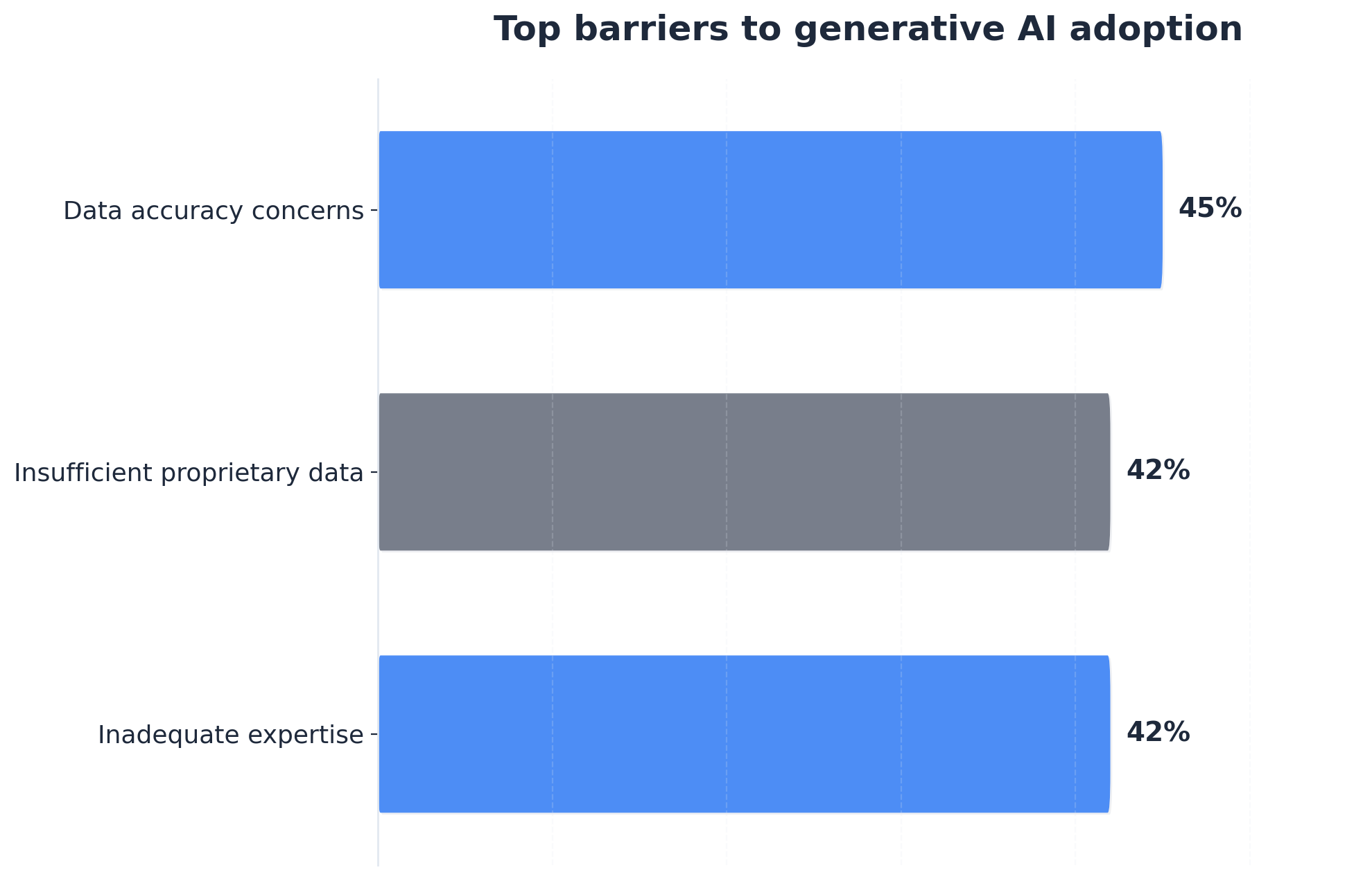 Top barriers to generative AI adoption
Top barriers to generative AI adoption (A breakdown of the top challenges organizations face when adopting generative AI, based on a survey by IBM.)
For example, a B2B SaaS provider using MTA was able to demonstrate that AI-generated blog posts contributed to a 35% increase in organic traffic and played a pivotal role in nurturing prospects who later converted via email or paid search8. This strategy suits marketing teams with robust analytics infrastructure and the ability to track user journeys across channels. Conversely, organizations with limited data maturity may opt for linear attribution, which splits credit evenly but is less precise.
The effectiveness of attribution modeling hinges on integration with CRM and analytics platforms, as well as clear tagging of AI-generated assets. As marketing teams refine their models, they gain deeper insight into which AI investments drive engagement and revenue. Next, the discussion turns to how industry-specific requirements shape the business case and ROI timeline for AI content initiatives.
Industry-Specific Business Cases for AI Created Content
Healthcare: Compliance-First ROI Framework
Healthcare’s approach to ai created content is fundamentally shaped by regulatory risk. Data shows that 43% of medical groups expanded AI adoption in 2024, with industry AI spending projected to triple from $467 million to $1.4 billion by 202510. However, the ROI realization timeline is slower than in less-regulated sectors due to the mandatory layers of human oversight and compliance verification.
Compliance-First ROI Framework: Healthcare AI Content Readiness Assessment
- Does your organization maintain dedicated legal and compliance review for all AI-generated patient or clinical content?
- Are human subject-matter experts involved in every step, from prompt engineering to approval?
- Is your AI content pipeline auditable and aligned with HIPAA, GDPR, and local regulatory standards?
The 'verification tax'—the resource cost of human review—can absorb over 50% of theoretical efficiency gains, as every asset must be meticulously checked for clinical accuracy, privacy, and legal risk10. This approach works best when organizations implement governance frameworks that make AI outputs traceable, require multi-stage expert validation, and integrate legal sign-off before publication. For example, while BCG found cost reductions of up to 30% in healthcare marketing campaigns using generative AI, those savings only materialized when workflows included robust compliance gates and human-in-the-loop review2.
Health systems and life sciences companies should expect a 2-4 year ROI horizon for AI content transformation, with early wins often limited to patient education and internal documentation. Next, the discussion explores how B2B SaaS firms optimize for revenue attribution and pipeline impact.
Unlock Scalable, High-Impact Content With AI—See Vectoron in Action
Connect with our experts to discover how Vectoron’s AI-driven platform empowers agencies and enterprises to produce consistent, on-brand content at scale—while reducing costs and accelerating timelines.
B2B SaaS: Pipeline Attribution Economics
Pipeline Attribution Economics Checklist for B2B SaaS
- Are your AI-generated assets clearly tagged for attribution in pipeline reports?
- Does your analytics stack support multi-touch attribution across sales and marketing?
- Are you tracking pipeline velocity and influenced revenue, not just lead counts?
In B2B SaaS, the business case for ai created content centers on its ability to accelerate pipeline growth and attribute influence across complex, multi-stage journeys. Data-driven attribution models—such as multi-touch and algorithmic frameworks—enable marketing teams to quantify AI's impact with greater precision, revealing that AI-powered content marketing can deliver ROI as high as 748%, outpacing all other channels in B2B settings6. For example, one SaaS company documented a 35% increase in organic traffic over six months using AI-generated blog content, directly correlating with pipeline expansion8.
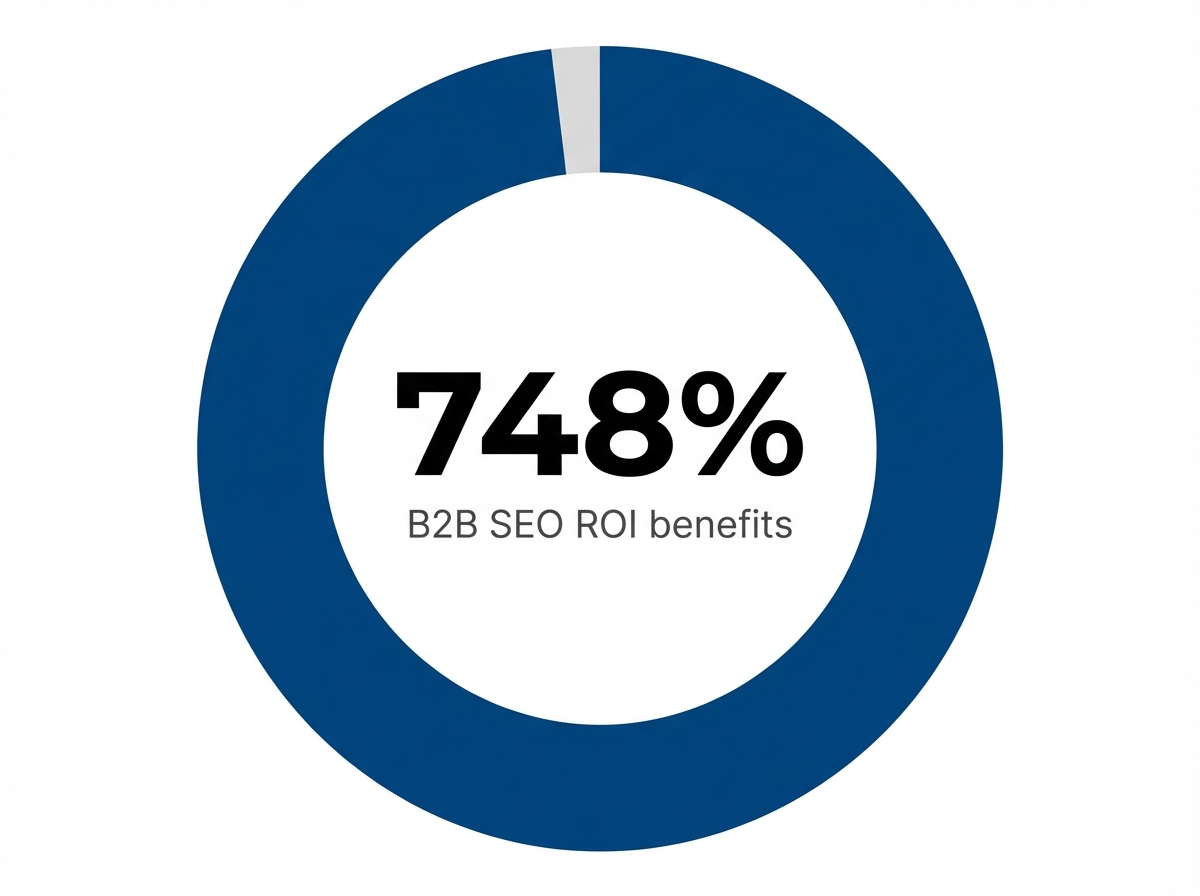 ROI of SEO for B2B companies: 748%
This solution fits organizations that invest in robust analytics infrastructure and routinely collaborate with sales to map content influence to opportunity stages. It is especially valuable for teams adopting account-based marketing or targeting long, considered purchase cycles. By combining systematic AI tagging, CRM integration, and granular reporting, B2B SaaS firms can demonstrate incremental pipeline contribution rather than relying on vanity metrics. The most successful implementations also blend AI with human editorial oversight, ensuring that content quality and relevance drive actual sales conversations.
As organizations adopt these practices, planning a 2-4 year payback horizon is realistic, given the time required for attribution models to mature and for pipeline influence to convert to closed revenue. The next section outlines how to structure a sustainable, multi-year ROI strategy for AI-driven content operations.
Building Your 2-4 Year Payback Strategy
Self-Assessment: Readiness Diagnostic
Readiness Diagnostic: AI Content Transformation Self-Assessment Checklist
- Is there executive sponsorship and a defined owner for your AI content initiative?
- Do you have clear business objectives and ROI benchmarks for ai created content?
- Are governance frameworks and human oversight built into your workflow from the start?
- Is your analytics stack capable of tracking content performance and attribution at a granular level?
- Have you budgeted for prompt engineering, quality assurance, and compliance resources?
A systematic readiness assessment is critical before scaling AI-driven content. Only 15% of organizations currently achieve significant, measurable ROI from generative AI, often because most skip crucial steps in planning, governance, and measurement1. This approach is ideal for teams seeking to avoid the pitfalls that cause 95% of enterprise pilots to fall short of expectations6. Having executive buy-in, well-defined KPIs, and a hybrid model that blends AI automation with expert human review increases the likelihood of hitting a 2-4 year payback window.
Organizations that succeed with ai created content consistently report robust governance, ongoing measurement, and a willingness to iterate as the market and technology evolve. Next, the focus shifts to resource planning and identifying pathways for early, measurable success.
Resource Planning and Quick-Win Pathways
Resource Allocation Planner: Key Functions and Early Success Checklist
- Have you mapped required roles for prompt engineering, human review, and compliance?
- Are quick-win use cases, such as SEO blog posts or email campaigns, prioritized for early measurement?
- Does your plan include integration with analytics systems to track AI content performance?
Effective resource planning for ai created content begins with identifying specialized roles beyond traditional content teams. Organizations achieving strong ROI consistently allocate talent to prompt engineering, workflow automation, and human quality assurance—functions cited as critical to reducing the 95% failure rate of enterprise AI pilots6. For example, marketing teams report up to 88% faster production cycles when these roles are clearly defined and resourced6.
Quick-win pathways typically center on use cases with rapid feedback loops, such as SEO-optimized articles or email automation, where AI-driven output can be objectively measured against traffic or open rate benchmarks. This path makes sense for organizations looking to demonstrate early impact within the first 6-12 months, building internal momentum for broader adoption. Teams that integrate AI content workflows with existing analytics platforms are best positioned to validate results and refine processes quickly.
As teams build on early wins, resource plans should evolve to support more complex, cross-channel initiatives, ensuring scalability and sustainable ROI. The following section will guide marketing leaders through the next 30 days of execution, from analysis to actionable steps.
Frequently Asked Questions
Your Next 30 Days: From Analysis to Action
After establishing a comprehensive competitive intelligence framework, the critical challenge becomes implementation. The gap between competitive intelligence and competitive advantage lies in execution. According to a 2024 Forrester Research study, companies implementing structured competitive analysis frameworks achieve 23% higher market share growth compared to those relying on ad-hoc monitoring.
Begin with a focused 30-day sprint:
| Week | Action Item | Goal |
|---|---|---|
| Week 1 | Establish baseline metrics | Audit top 3 competitors' content performance, keyword rankings, and engagement rates. |
| Week 2 | Identify pattern gaps | Find areas where competitors consistently outperform your current strategy. |
| Week 3 | Develop pilot initiatives | Create three pilot content initiatives targeting the identified gaps. |
| Week 4 | Launch and measure | Publish content and iterate based on initial performance data. |
This systematic approach transforms analysis paralysis into measurable momentum. Marketing teams using AI-powered competitive intelligence platforms report 40% faster time-to-insight and 3x more content output without expanding team size.
The traditional agency model requires months of discovery and strategy development before execution begins. Modern competitive analysis tools compress this timeline dramatically, enabling teams to move from insight to published content within days rather than quarters. Start small, measure rigorously, and scale what works.
References
- 1.AI ROI: The paradox of rising investment and elusive returns.
- 2.How Four Companies Capitalize on AI to Deliver Cost Transformations.
- 3.How generative AI can boost consumer marketing.
- 4.The Projected Impact of Generative AI on Future Productivity Growth.
- 5.The 5 biggest AI adoption challenges for 2025.
- 6.45 Statistics Every Marketing Leader Should Know in 2026.
- 7.2025 Marketing Statistics, Trends & Data.
- 8.The ROI of AI in Content Marketing: How to Measure and Maximize Results.
- 9.Top 10 AI Agents for Content Generation in 2025.
- 10.Marketers are keen to use generative AI in ads but hidden costs lurk.