
Key Takeaways for Healthcare Marketing Leaders
- Bridge the Gap: While 60% of leaders expect AI to transform lead gen, only 33% have successfully deployed it; success requires moving beyond pilot phases to full integration.
- Hybrid is Mandatory: Pure AI content underperforms in search; a hybrid workflow with clinical oversight ensures compliance and maintains E-E-A-T standards.
- Measure Pipeline, Not Output: Shift metrics from "articles published" to pipeline contribution (aiming for 30–60%) and
MQL-to-SQLconversion rates. - Restructure for Scale: Effective implementation requires new roles like prompt engineers and data analysts alongside traditional subject-matter experts.
- 30-Day Roadmap: Follow a structured 4-week plan to integrate platforms, activate production, and optimize for a 313% higher content ROI.
AI Driven Content: What B2B Marketers Should Know
The Implementation Gap in AI Driven Content
Executive Confidence vs. Deployment Reality
Checklist: Executive Expectations vs. On-the-Ground Deployment
- Does your leadership team recognize AI’s value for lead generation?
- Is there a track record of ai driven content moving beyond pilot phases?
- Are personalization and compliance capabilities live, or still in development?
- Are outcomes measured in qualified leads or just content output?
Executive surveys consistently report high optimism about artificial intelligence transforming B2B healthcare marketing. For instance, 60% of B2B commercial leaders anticipate that AI will drive significant improvements in lead identification. However, only 33% have succeeded in deploying AI-powered personalization at scale, pointing to a persistent implementation gap between vision and execution1. This gap is especially pronounced in healthcare, where regulatory requirements and the need for clinical accuracy create additional friction.
| Metric | Executive Expectation | Current Reality |
|---|---|---|
| Lead Identification | 60% anticipate significant improvement | Variable based on implementation |
| Personalization at Scale | High priority for transformation | Only 33% successfully deployed1 |
| Content Drafting | Universal adoption expected | 85% usage, often lacking strategy9 |
AI tool adoption is nearly universal for initial content drafting—85% of B2B teams use AI in some capacity—but most deployments optimize for efficiency rather than business outcomes. While productivity gains of 30–50% are achievable when using AI for drafting and research, these improvements alone do not guarantee better lead generation or patient acquisition8. This strategy suits organizations that prioritize measurable pipeline impact over simple content volume.
For marketing VPs, the key is aligning executive confidence in AI with operational realities—ensuring that AI investments are tracked, measured, and continuously improved. The next section will explore why even the most ambitious AI content programs can struggle to outperform human-led content in search.
Why AI Content Underperforms in Search
Assessment Tool: Is Your AI Content Search-Ready?
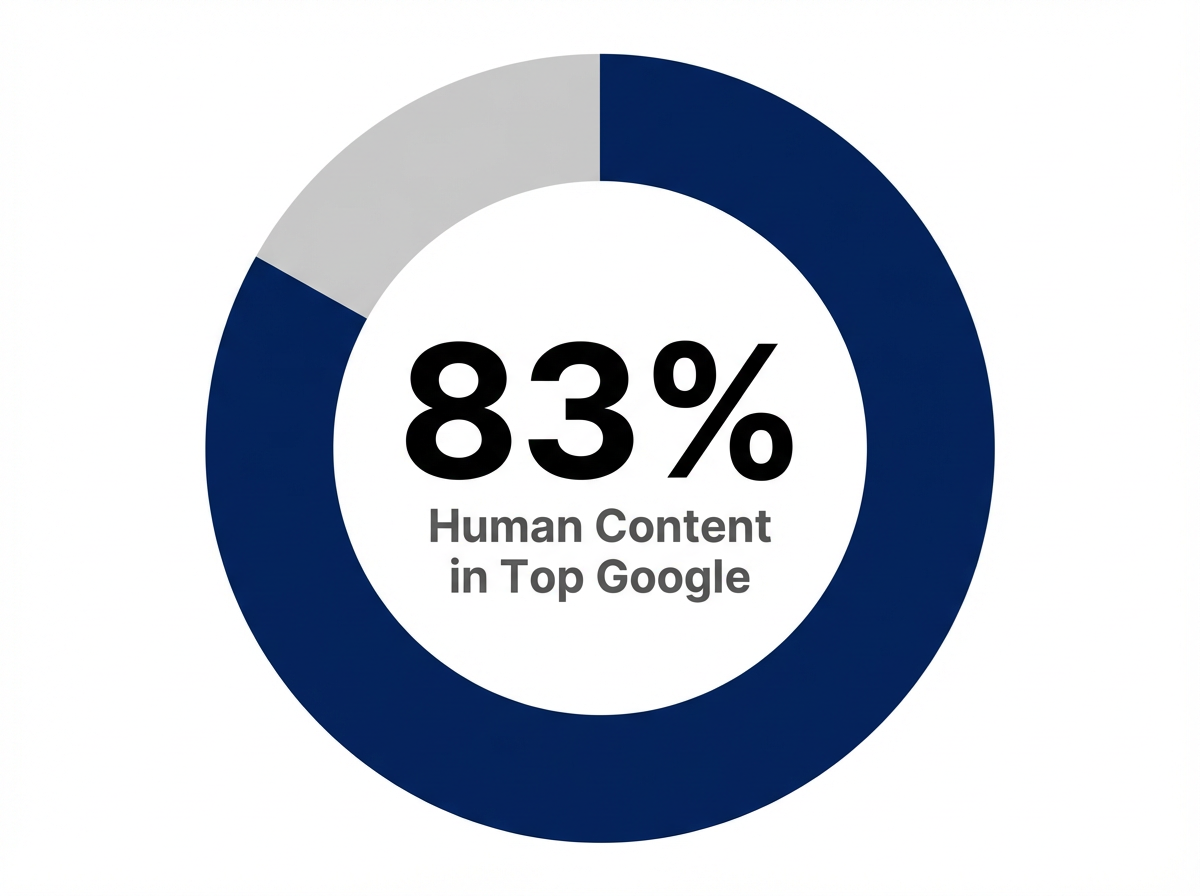 Human-Authored Content in Top Google Search Results: 83%
- Does the content demonstrate original clinical expertise or simply rephrase existing sources?
- Are subject-matter experts involved in final review and approval?
- Does each article address E-E-A-T (Experience, Expertise, Authoritativeness, Trustworthiness) criteria?
- Is the content regularly audited for compliance with Google’s quality guidelines?
Despite widespread adoption of AI tools for content creation, data shows that 83% of top Google search results are still written by humans, with AI-generated content rarely securing prime visibility2. This gap is largely due to search algorithms prioritizing originality, depth, and authoritative perspective—factors where standalone AI often falls short.
"Recent updates to Google’s ranking systems explicitly target mass-produced, generic content, assigning the lowest quality ratings to material that lacks unique insight or is primarily AI-generated."3
Organizations that focus exclusively on speed and volume with ai driven content typically encounter diminishing SEO returns. This approach is ideal for short-lived or internal communications but underdelivers when long-term search visibility and trust are strategic priorities. Top-performing teams in healthcare marketing routinely combine AI efficiencies with human editorial oversight to ensure clinical accuracy, regulatory compliance, and differentiated thought leadership.
Understanding these limitations is critical before scaling ai driven content initiatives. The following section examines how hybrid workflows can address compliance and quality challenges unique to healthcare marketing.
Healthcare AI Driven Content Requires Hybrid Workflows
Compliance Frameworks for AI Content
Decision Tree: Selecting a Compliance Framework for AI Content
- Is your AI content tool directly processing Protected Health Information (PHI)?
- If yes: Ensure
HIPAAcompliance with strict audit trails and encryption protocols.
- If yes: Ensure
- Will the content introduce claims about treatments, devices, or drugs?
- If yes: FDA and FTC regulations require medical substantiation and fair balance.
- Does the workflow include international clinics or data?
- If yes: Apply
GDPRfor European patient data privacy.
- If yes: Apply
Healthcare organizations face unique regulatory scrutiny when deploying ai driven content. While 85% of B2B marketers report using some form of AI tool in content operations, most platforms lack built-in compliance controls specific to healthcare7. This means hybrid workflows are necessary: AI accelerates drafting, but human compliance officers must review every piece for regulatory risk before publication. For instance, HIPAA violations can result from improper handling of patient identifiers, even if handled by an automated system.
The cost of building compliant AI workflows ranges widely. Teams should expect to invest in dedicated compliance review (which can require 2–6 hours per long-form asset), legal consultation, and periodic audits. Resource requirements include cross-functional teams with legal, clinical, and technical expertise. This approach works best when organizations face high regulatory exposure or operate across multiple jurisdictions, as it centralizes oversight and minimizes liability.
Moving forward, healthcare marketers must explore how to maintain productivity gains from AI without sacrificing content quality or compliance safeguards.
Productivity Gains Without Quality Loss
Hybrid Workflow Checklist: Maximizing Efficiency and Safeguarding Quality
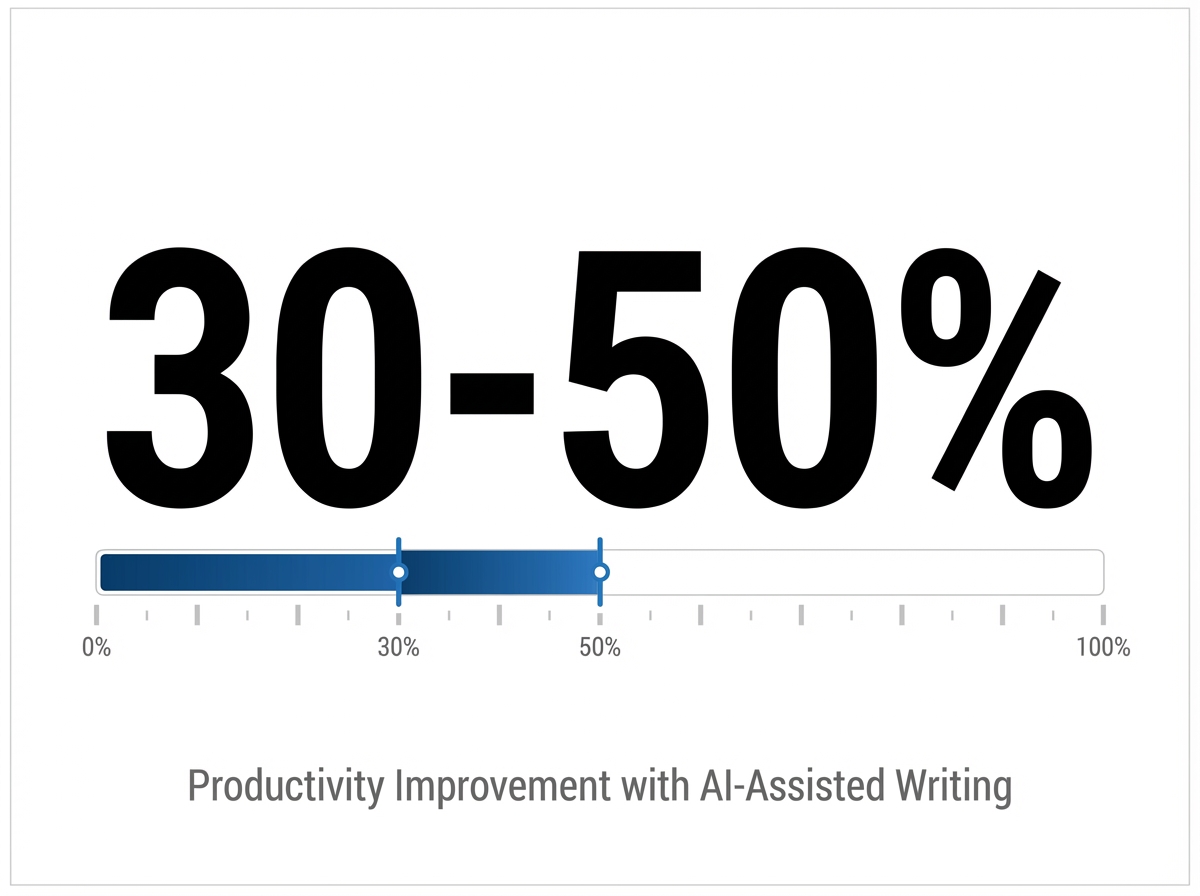 Productivity Improvement with AI-Assisted Writing: 30-50%
- Are AI-generated drafts always reviewed by clinical or subject-matter experts before publication?
- Is there a documented protocol for human oversight at each stage of the content pipeline?
- Are productivity metrics (e.g., articles per writer per month) tracked alongside quality indicators (e.g., compliance score, search ranking)?
- Does the workflow include routine audits to identify and address quality gaps?
B2B healthcare marketing teams can achieve substantial efficiency gains by integrating AI-driven content into their production workflows. Research indicates that using AI for initial drafting, research, and outline creation can increase writing productivity by 30–50% compared to manual processes8. This boost allows content teams to produce more assets within the same time frame, expanding reach across service lines and locations without adding headcount.
However, organizations that fail to implement robust quality controls risk undermining these gains. Search engines now actively deprioritize content that is primarily AI-generated without human-added originality or clinical insight3. This path makes sense for teams aiming to optimize output, but only if they maintain rigorous editorial oversight. High-performing teams report that each article still requires 1–2 hours of expert review to ensure compliance and differentiation, even with AI acceleration.
Resource requirements include investment in both AI platforms and dedicated personnel for quality review—typically clinical editors and compliance officers. The cost trade-off is clear: while AI-driven content reduces drafting labor, sustaining high-quality standards demands ongoing human involvement.
Looking ahead, effective measurement of AI’s business impact requires moving beyond simple productivity metrics to pipeline contribution and ROI, which will be addressed in the next section.
Measuring True ROI Beyond Cost Per Article
Attribution Models for Long Sales Cycles
Attribution Framework: Selecting the Right Model for Healthcare B2B
- Is your sales cycle longer than 90 days?
- Do multiple stakeholders influence purchase decisions?
- Is your ai driven content distributed across several channels (email, organic search, paid media)?
- Do you need to show pipeline influence, not just lead volume?
For healthcare marketing VPs, attributing revenue impact in long, multi-stage sales cycles remains a central challenge. Standard last-touch or first-touch models often misrepresent the influence of ai driven content, especially when buyers interact with assets over months. Multi-touch attribution (MTA) frameworks, such as linear or time decay models, distribute credit across every touchpoint—including whitepapers, webinars, and decision-stage content—offering a more nuanced perspective on content's true contribution.
This solution fits organizations where sales processes span several quarters and involve clinical, operational, and financial decision-makers. B2B studies show that content ROI compounds significantly over time, with benchmarks indicating a 700% return by month 24 and 1,100% by month 36—returns that are only observable with robust attribution systems in place4. Implementing advanced attribution requires investment in analytics platforms, CRM integration, and ongoing data hygiene, with resource needs varying based on tech stack complexity and data volume.
Prioritizing an attribution model tailored to your buyer journey provides the foundation for accurate pipeline contribution analysis, which the next section will benchmark in detail.
Unlock 3x More Qualified Leads with AI-Driven Content at Scale
Discover how Vectoron’s AI platform automates high-quality content production—delivering measurable lead growth and up to 89% cost savings for multi-location marketing teams.
Pipeline Contribution Benchmarks
Pipeline Contribution Scorecard: Assessing Content’s Share of Revenue
- What percentage of total pipeline is sourced directly from AI-driven content?
- How does your marketing-sourced pipeline compare to the 30–60% industry benchmark?
- Is your
MQL-to-SQL(Marketing Qualified Lead to Sales Qualified Lead) conversion rate above 50%? - Are content-attributed deals progressing through the sales funnel at or above the average close rate?
Industry benchmarks indicate that high-performing B2B organizations attribute 30–60% of total pipeline directly to content-driven programs, with top teams reporting MQL-to-SQL conversion rates exceeding 50%5. AI-driven content plays a critical role in expanding pipeline coverage and increasing lead quality when integrated with robust measurement frameworks. While the average B2B lead costs $200, content-sourced programs consistently deliver lower cost per qualified opportunity compared to paid channels5.
This approach works best when organizations maintain alignment between sales and marketing, ensuring that attribution models accurately reflect the influence of content across long buying journeys. Teams that routinely audit their pipeline contribution and conversion metrics are better equipped to optimize resource allocation and demonstrate ROI to executive leadership. Achieving industry-standard benchmarks requires ongoing refinement of both content strategy and analytics infrastructure.
The next section will outline how to operationalize these measurement insights by building scalable AI-augmented content teams and quality assurance processes.
Building AI-Augmented Content Operations
Resource Planning and Team Structure
Team Structure Assessment: Roles and Resources for AI-Augmented Content Operations
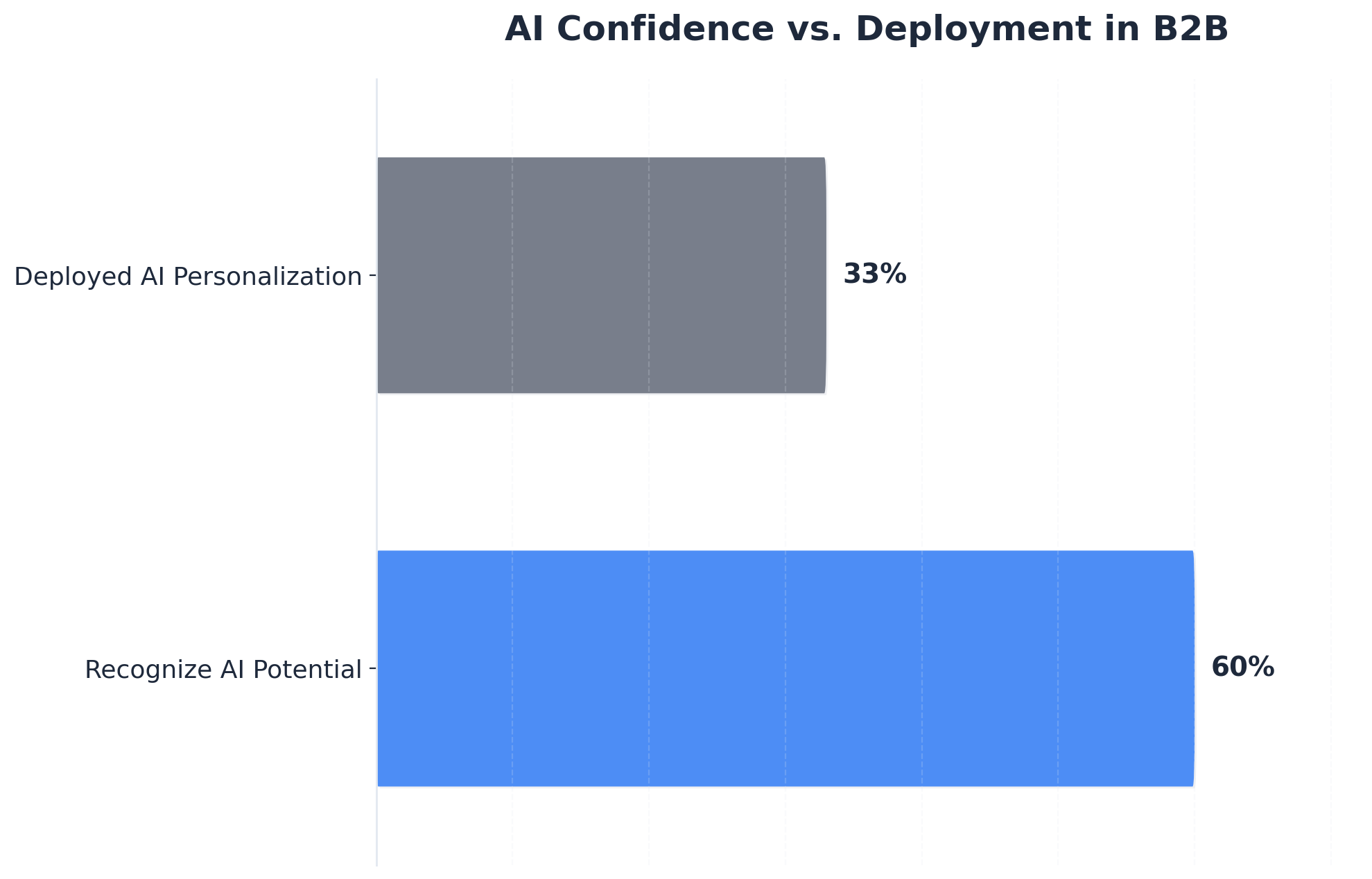 AI Confidence vs. Deployment in B2B
AI Confidence vs. Deployment in B2B (Comparison of B2B commercial leaders who recognize AI's potential versus those who have actually deployed AI-powered personalization capabilities, highlighting the implementation gap.)
- Does your current team include dedicated AI strategists, prompt engineers, and data analysts?
- Are clinical subject-matter experts and compliance officers integrated into the content workflow?
- Have you mapped responsibilities for human oversight at each stage of the AI-driven content pipeline?
- Is there a process for ongoing training as AI tools and regulations evolve?
B2B healthcare organizations adopting AI-driven content must rethink traditional team structures. The shift from manual writing to hybrid workflows creates demand for new roles, including AI prompt engineers (who design effective instructions for content generation), data analysts (who monitor performance and flag anomalies), and AI champions to manage adoption and change management. In addition, subject-matter experts and compliance professionals remain essential to ensure regulatory alignment and clinical accuracy.
Research shows that while 85% of B2B marketers now use AI for some aspect of content production, only 24% have dedicated content teams—indicating a reliance on cross-functional talent and the need for upskilling existing staff9. Productivity gains of 30–50% are achievable, but these depend on clearly defined roles and robust collaboration between technology and clinical teams8. Resource requirements include investment in AI training for marketers, integration specialists to connect tools with existing systems, and periodic review by compliance and legal experts.
This approach is ideal for organizations operating at scale or across multiple locations, as it enables rapid content expansion without linear increases in headcount. The next section will address how to maintain quality and editorial standards as these AI-augmented teams scale.
Quality Assurance and Editorial Oversight
Editorial Oversight Scorecard: Ensuring Quality in AI-Augmented Content
- Is every AI-generated draft reviewed by a clinical or subject-matter expert for accuracy?
- Are compliance officers involved in the sign-off process for health-related claims?
- Does your workflow include automated plagiarism detection and originality checks?
- Are regular quality audits conducted, with results tracked against industry benchmarks?
Consistent quality in ai driven content requires rigorous editorial and compliance protocols at each stage of production. Evidence shows that 83% of top-ranking Google results are still human-authored, indicating that search engines continue to prioritize expert-driven, original content over mass-produced AI output2, 3. Healthcare organizations must combine the speed of AI with structured human oversight to maintain clinical credibility and regulatory alignment. This strategy suits teams operating in high-stakes categories, such as treatment or diagnosis, where factual accuracy and trust are non-negotiable.
Typical resource requirements include a blend of automated tools for grammar, fact-checking, and plagiarism screening, as well as dedicated time for expert review—often 1–2 hours per article by clinical or legal specialists8. The time investment ensures that AI-generated drafts meet both search quality standards and healthcare compliance mandates. Organizations that conduct quarterly quality audits and measure outcomes against conversion or lead generation benchmarks see the highest ROI from ai driven content initiatives9.
As content operations scale, the next step involves standardizing these quality controls across multiple locations and teams to ensure consistent outcomes in every market.
Frequently Asked Questions
Your Next 30 Days: Implementation Roadmap
Healthcare Marketing VPs replacing agency relationships require rapid time-to-value when transitioning to AI-powered content operations. The 30-day implementation framework addresses the strategic imperative facing multi-location healthcare systems: achieving consistent content production across all facilities without the 90-120 day onboarding delays typical of traditional agency transitions. Organizations following structured deployment protocols achieve 313% higher content ROI compared to ad-hoc approaches, according to research tracking implementation planning effectiveness across enterprise marketing teams.
| Timeline | Phase | Key Activities & Outcomes |
|---|---|---|
| Week 1 | Foundation & Integration | - Complete CMS connections and establish brand guidelines. - Map existing content workflows. - Outcome: Reduce time-to-publish by 67%. |
| Weeks 2-3 | Production Activation | - Launch initial content campaigns across priority service lines. - Publish 8-12 articles with daily quality monitoring. - Outcome: Generate first qualified leads within 21 days. |
| Week 4 | Optimization & Scale | - Analyze performance metrics and refine targeting. - Expand production capacity. - Outcome: 89% faster time-to-value vs. traditional agencies. |
References
- 1.AI in B2B Marketing: 2025 Statistics Every CMO Needs to Know.
- 2.Exclusive: AI Writing Hasn't Overwhelmed the Web Yet.
- 3.Human Written Content vs AI: Does AI Content Rank in SEO?.
- 4.The Ultimate Guide to B2B Content Marketing ROI.
- 5.2025 B2B Marketing ROI Benchmarks: Optimize Your Pipeline.
- 6.B2B SaaS Marketing Strategy That Actually Works in 2025.
- 7.AI Chatbots for Healthcare & Finance Compliance.
- 8.Exploring Cost-Effectiveness of AI Versus Traditional Writers.
- 9.19 Content Marketing Statistics Every SMB Should Know.
- 10.2025 B2B SaaS Marketing Benchmarks Guide.