
Key Takeaways
- AI engine optimization for agencies means tuning the production system itself—models, prompts, retrieval sources, evaluation checks, and approval gates—rather than chasing citations inside AI answer surfaces.
- The engine operates in four layers: Signal inputs, Production drafting, Evaluation scoring, and Governance approval gates, with most agencies over-investing in production and under-investing in evaluation.
- Adoption no longer differentiates when nine in ten agencies already use generative AI 6; defensibility comes from proprietary retrieval indexes, evaluation harnesses, and audit trails clients cannot rebuild elsewhere.
- Portfolio economics compound only when evaluation logs, versioned prompts, and documented review cycles turn isolated prompt wins into a client-specific asset that sharpens each quarter 3.
The Definition Problem: What AI Engine Optimization Actually Means for Agencies
Search the phrase and the first page fills with advice on getting cited by ChatGPT, Perplexity, and Gemini overviews. That definition exists, and it matters for a narrow slice of visibility work. It is not what a Head of SEO managing dozens of client roadmaps needs to solve.
For an agency, AI engine optimization describes something more consequential: the discipline of tuning the production system itself. The engine is the stack of models, prompts, retrieval sources, evaluation checks, and approval gates that turns a client brief into published work. Optimizing that engine means measuring its outputs the way a technical SEO measures crawl efficiency—with defined inputs, defined quality signals, and defined thresholds for shipping.
The distinction has operational weight. McKinsey's analysis of generative AI's economic potential explicitly names SEO as a use case where the technology synthesizes ranking-relevant tokens and supports specialists in content creation, tying productivity gains to conversion and cost outcomes rather than to any single model's citation behavior 8. The value sits in the workflow, not the model.
That reframing changes what leaders should be planning against. Ranking inside AI answer surfaces is a downstream visibility question. Building an engine that produces defensible, on-brand, evaluatable content across a portfolio is an upstream production question. The rest of this analysis treats the second as the actual work, and the first as a byproduct of doing it well.
Why Marketing and Sales Are the First Place the Engine Pays Off
The economic case for concentrating AI engine investment in marketing operations is not a matter of preference. It is a matter of where the modeled value actually sits.
McKinsey's analysis of generative AI's economic potential puts the annual value pool at $2.6 trillion to $4.4 trillion across the use cases studied, with roughly 75% of that value concentrated in four functions: customer operations, marketing and sales, software engineering, and R&D 2. The figure is a modeled estimate of potential, not observed revenue, and it assumes both adoption and execution discipline. For a Head of SEO reading it, the operational implication is narrower and more useful than the headline: two of the four highest-value functions sit directly inside an agency's delivery scope.
That concentration matters because it tells leaders where the return on engine-building efforts is likely to compound first. A shared prompt library, a retrieval index of client brand voice, an evaluation harness for draft quality—these investments amortize faster against marketing and sales content than against, for example, internal HR or finance workflows. McKinsey's own framing notes that SEO is a specific application where generative AI synthesizes ranking-relevant tokens and supports specialists in content creation, tying the productivity case directly to conversion and cost outcomes 8.
The practical read for an agency: the engine should be built where the value pool is deepest and the feedback loop is fastest. Marketing content produces measurable signals within weeks—rankings, engagement, conversion—so evaluation and iteration cycles run tighter than in functions where outcomes lag by quarters. Engine discipline pays off first where measurement is already native.
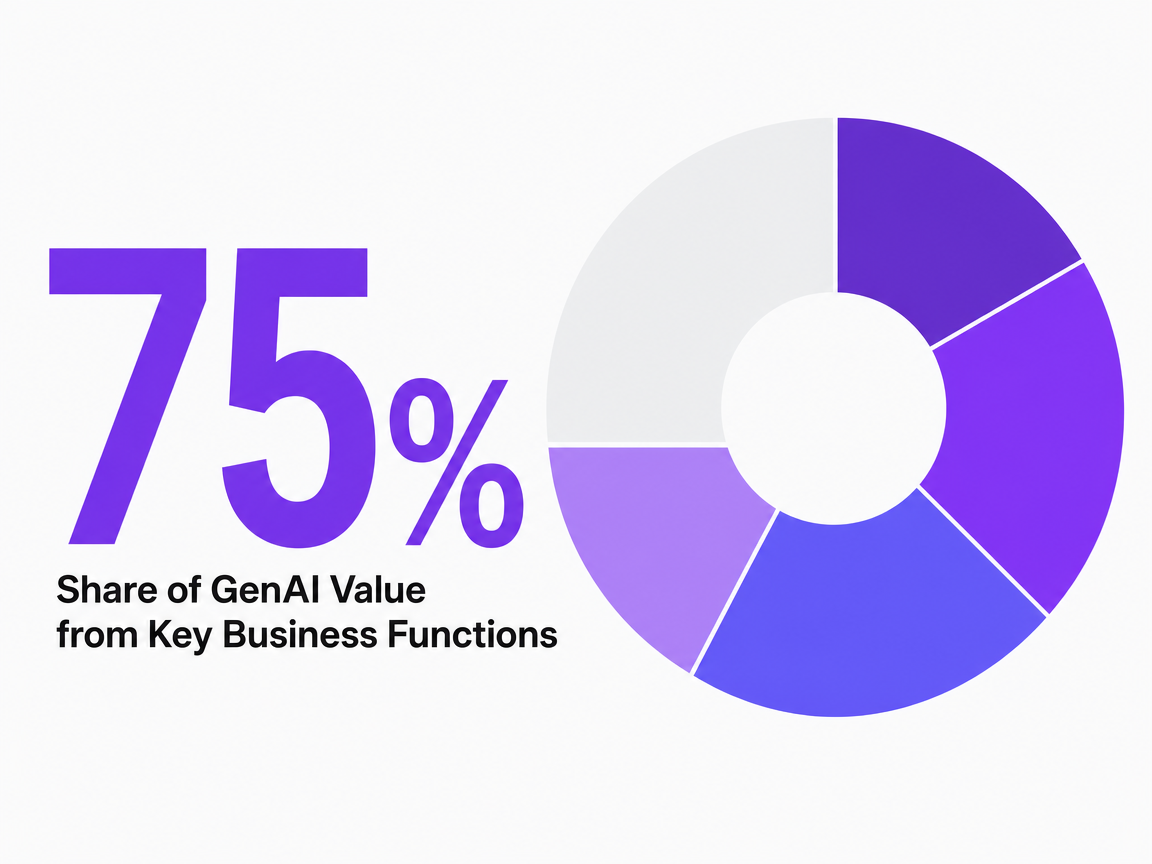 Share of GenAI Value from Key Business Functions
Share of GenAI Value from Key Business Functions
The Four-Layer Model of an Agency AI Engine
Signal Layer: SERP, Query, and Client Data Inputs
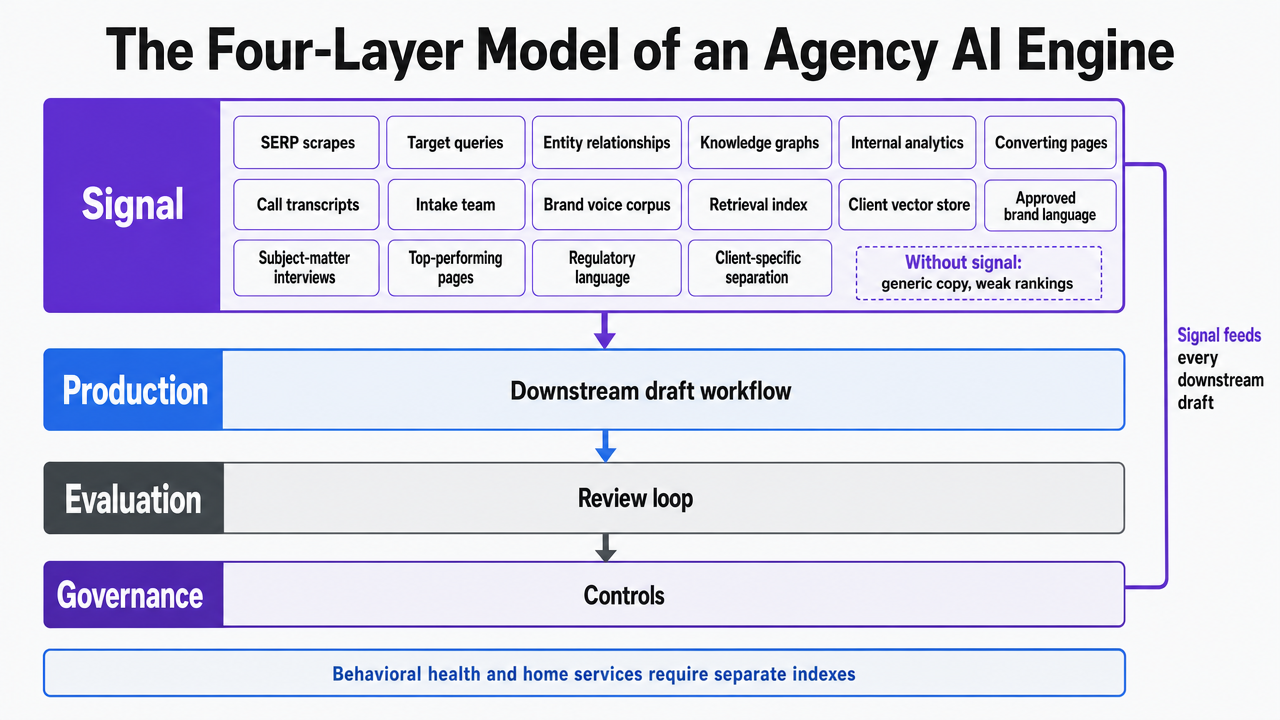
The engine starts with what it can see. The Signal Layer is the collection of structured inputs that feed every downstream draft: SERP scrapes for target queries, entity relationships pulled from knowledge graphs, internal analytics on which pages convert, call transcripts from the client's intake team, and the client's own brand voice corpus. Without this layer, a model produces generic copy that reads competent and ranks poorly.
The practical build is a retrieval index rather than a prompt library. Each client account gets its own vector store containing approved brand language, subject-matter interviews, prior top-performing pages, and vertical-specific regulatory language. A behavioral health client's index looks nothing like a home services client's. That separation is what prevents cross-contamination of tone and claims across the portfolio.
McKinsey's framing of SEO as a GenAI application specifically calls out the synthesis of ranking-relevant tokens and support of specialists in content creation as the mechanism through which productivity translates into conversion and cost outcomes 8. Synthesis is only as good as its inputs. An engine fed thin SERP data and generic prompts produces thin, generic drafts. An engine fed clean signals produces defensible drafts on the first pass.
Production Layer: Drafting, Synthesis, and Structured Output
The Production Layer is where signals become drafts. It is also the layer most agencies over-invest in, because it is the most visible and the easiest to demo. A better model for a Head of SEO is to treat production as commodity infrastructure: prompts, chains, retrieval calls, and structured output schemas that turn a brief into a first pass in minutes.
Structured output matters more than prompt cleverness. A draft that returns as a validated JSON object with fields for H1, meta description, schema markup type, primary entity, secondary entities, and body sections is testable. A draft that returns as a wall of prose is not. The engineering discipline here mirrors an API contract: the Production Layer produces predictable shapes, and the Evaluation Layer reads them.
Forrester's forecast that only around 7.5% of agency roles will be automated by decade's end reframes the staffing question at this layer 5. Production headcount does not disappear; it shifts. Writers become editors of first-pass drafts and stewards of the retrieval index. Strategists spend less time briefing and more time evaluating. The layer replaces keystrokes, not judgment.
Evaluation Layer: Where Quality Is Actually Determined
Most agency AI stacks end at production. That is the failure point. The Evaluation Layer is the difference between an engine that scales quality and an engine that scales embarrassment.
Evaluation runs in two modes: automated and human. Automated checks include reference-based metrics like BERTScore and COMET for translation and paraphrase fidelity, and LLM-as-judge scoring for coherence, factual grounding, and brand-voice adherence. The CMU evaluation-science survey reports that GPT-4-class evaluators correlate strongly with human ratings on generation tasks, which makes them viable as a first-pass filter across large content batches 7. That correlation does not eliminate human review; it triages what reaches human review.
A workable configuration: every draft passes an automated eval that scores it against the client's brand-voice reference set, checks entity coverage against the Signal Layer's target list, and flags any factual claim not traceable to a source document. Drafts scoring below threshold return to the Production Layer with structured feedback. Drafts above threshold move to human editorial review. Editors read fewer drafts, more carefully.
MIT Sloan's argument that GenAI value compounds only through verification and captured learning applies directly here: the eval scores themselves become training data for the next iteration of the engine 3. An agency that logs eval outcomes over a quarter builds a client-specific quality signal no competitor can replicate.
Governance Layer: Approval Gates and Risk Controls
Governance is the layer that decides what actually ships. It is a set of approval gates, not a compliance binder.
The practical shape is a routing rule: content classified as high-risk, meaning regulated verticals like legal, healthcare, and financial services, or claim-heavy content like case results and clinical outcomes, requires named human approval before publication. Lower-risk content, such as top-of-funnel educational articles for less regulated categories, can ship on strategist sign-off alone. The rules are explicit, logged, and auditable.
NIST's AI Risk Management Framework, and its generative AI profile specifically, provides the reference structure for identifying which risks matter for which use cases and mapping controls to them 1. The framework is voluntary, which is often read as a weakness. For an agency, it is a feature: the controls can be adapted to the client's risk tolerance rather than imposed uniformly across accounts where the stakes differ by orders of magnitude.
The Governance Layer also owns disclosure policy, model change management, and the audit trail linking every published asset back to the prompts, retrieval sources, eval scores, and human approvers that produced it. That trail is what turns AI production from a liability into a defensible operating asset.
Experience AI-driven execution efficiency risk-free
Test real campaign workflows and publish live content with approval-first control before making a commitment.
Adoption Is Table Stakes; Monetization Is the Gap
The competitive question inside agencies has already moved past whether to use generative AI. Forrester's commentary on productivity and creativity puts current adoption at roughly nine in ten marketing agencies using generative or agentic AI as part of creation and delivery, while fewer than 10% have successfully monetized those investments as a distinct line of business 6. The gap between those two numbers is where positioning actually gets decided.
Widespread adoption means the technology no longer differentiates. If nearly every competitor in a pitch is running the same commercial models against the same public prompt patterns, the resulting drafts converge. That convergence is what turns AI production into a commodity input rather than a defensible service. The agencies clustered in the sub-10% that monetize AI as a line of business are, by Forrester's read, the ones that have packaged something proprietary around the models: a brand-specific retrieval index, a documented evaluation harness, a governed workflow, or an outcome guarantee tied to measured performance.
For a Head of SEO, the implication is a planning shift. Budget spent on model access, seat licenses, and off-the-shelf prompt libraries buys parity, not advantage. Budget spent on the surrounding engine—the Signal, Evaluation, and Governance layers described earlier—buys something a client cannot get by signing up for a chatbot themselves. The monetization gap closes when the agency can point to specific artifacts the client would have to rebuild from scratch to leave: a validated evaluation harness scoring their content against their own voice, a retrieval index of their approved language and case history, and an audit trail linking every published asset to its approvers. That is the productized asset. The model is not.
Evaluation Science as Agency QA at Scale
The bottleneck in industrialized AI content production is not drafting. It is knowing which drafts are worth an editor's time. That is an evaluation problem, and evaluation is now a mature enough discipline to run as an operational function inside an agency, not an academic footnote.
The CMU evaluation-science survey catalogs the working toolkit: reference-based metrics like BERTScore and COMET score semantic similarity against a reference text, and LLM-as-judge scoring uses a capable model to rate outputs against a rubric. The survey reports that GPT-4-class evaluators correlate strongly with human ratings on generation tasks 7. That correlation is what makes automated triage defensible at portfolio scale. A first-pass filter can sort a batch of 200 drafts into confident-pass, needs-editor-review, and reject-and-regenerate buckets before a human opens the first file.
Mapping metrics to agency use cases keeps the science honest. BERTScore and COMET are appropriate for tasks with a clear reference, such as translating approved brand language into a new market or checking a rewrite against an editorial spec. LLM-as-judge is appropriate for open-ended tasks—coherence of a long-form article, adherence to a brand-voice rubric, presence of the entities named in the Signal Layer's target list. Human review remains the final call on anything that carries reputational or regulatory weight.
The operational payoff is in what editors stop doing. When automated evals catch structural failures, missing entities, unsupported claims, and off-voice paragraphs before human review, the editorial team spends its hours on the judgment calls no model handles well: whether an argument is actually differentiated, whether a case example fairly represents the client's work, whether the piece earns the reader's next click. That is the QA reallocation that makes scale possible without proportional headcount growth.
Eval scores also become an asset. Logging every draft's automated scores, the editor's decision, and the eventual performance of the published piece produces a longitudinal dataset that tunes the next iteration of the engine. Rubric weights get adjusted based on which signals correlate with client outcomes. That is the compounding loop that isolated prompt work never produces.
The Disclosure Paradox and Its E-E-A-T Consequences
The most inconvenient finding in the audience research on AI content is not that people dislike it. It is that they often prefer it, right up until they know what it is.
An MIT study on how people regard AI-created content ran a controlled comparison of AI-only, AI-edited, and human-only persuasive writing. When participants did not know how the content was produced, AI-only and AI-edited pieces were frequently rated higher in quality than human-only pieces. When production method was disclosed, the ratings shifted, with human-only work gaining relative preference 4. The sample was survey participants evaluating short persuasive texts, not search users assessing a client's practice-area page, so the effect size does not transfer one-for-one to organic traffic. The direction of the effect is what matters for agency positioning.
That direction creates a working paradox for E-E-A-T. The experience, expertise, authoritativeness, and trust signals that Google's quality guidelines reward are increasingly evaluated by humans and by algorithms that reference human signals. If disclosed AI authorship depresses perceived quality among readers, the downstream signals—time on page, return visits, cited-by patterns, expert commentary—soften with it. If undisclosed AI authorship carries reputational and regulatory risk for the client, especially in legal, healthcare, and financial verticals, the agency inherits that risk.
The operational response is to stop treating disclosure as a binary. Author attribution should name the human subject-matter expert who reviewed and stands behind the claims, with AI-assisted drafting handled the way an editor's role is handled: real, uncontroversial, and not the byline. The Evaluation Layer's audit trail supports that position because it can show, per asset, what a named expert approved and what evidence backed the claims. That is the E-E-A-T posture that survives both audience scrutiny and search-quality review.
See How Leading Agencies Automate AI Engine Optimization at Scale
Request a walkthrough of multi-channel AI optimization workflows proven to increase content throughput and strategic oversight—without expanding your headcount or losing quality control.
Compound Learning: Why Isolated Prompt Wins Do Not Scale
A single well-crafted prompt that produces a strong draft for one client, on one day, does not change an agency's output curve. It changes one file. The gap between that file and a portfolio-wide capability is what separates the agencies whose AI investments compound from those that stall at pilot.
MIT Sloan's analysis of where GenAI value actually accumulates is direct on this point: the return comes from systems that verify outputs, evaluate what those outputs reveal about the model's behavior, and capture the learning so each interaction becomes a building block for the next 3. The unit of value is not the prompt. It is the loop.
In practice, that loop has three artifacts an agency can inspect:
- A versioned prompt and retrieval configuration tied to a specific client account, so a change made in October is traceable in January.
- A log of evaluation outcomes—automated scores, editor decisions, and post-publication performance—linked to those versions.
- A review cadence where the strategist responsible for the account reads the log and adjusts the configuration, not just the next draft.
Without those artifacts, prompt improvements live in individual writers' heads and leave with them.
The operational consequence is a staffing and knowledge-management decision, not a tooling one. An agency that treats prompts as personal shortcuts produces uneven quality across accounts and loses institutional memory with every turnover. An agency that treats the prompt-eval-review cycle as a documented workflow builds a client-specific asset that gets sharper each quarter. That is the compounding curve. Isolated wins flatten; documented loops steepen.
If You Manage a Portfolio: Consolidation Economics Across Clients
The argument shifts here. The reader up to this point has been a Head of SEO thinking about quality and workflow. This section speaks to the portfolio operator running ten or more concurrent client accounts, where the engine's economics are less about any single piece of content and more about how per-client production cost behaves as the roster grows.
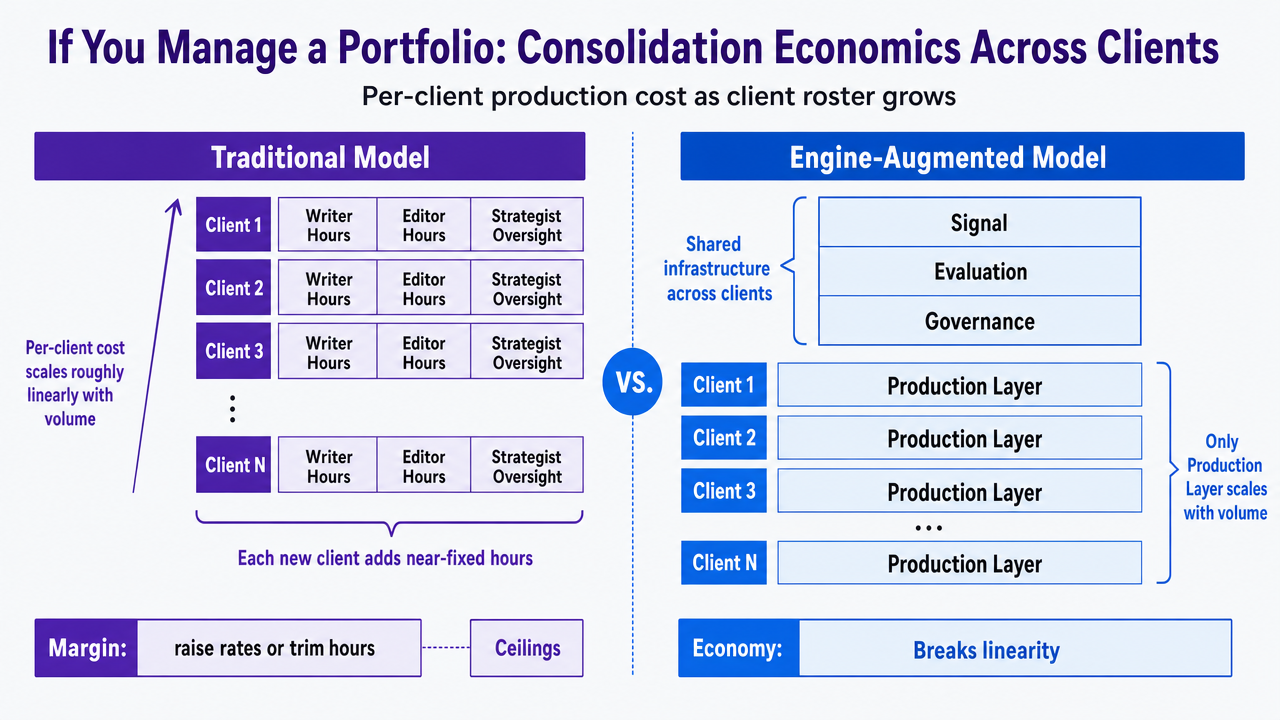
In a traditional model, per-client production cost scales roughly linearly with volume. Each new client adds writer hours, editor hours, and strategist oversight in near-fixed proportions. Margin comes from either raising rates or trimming hours per deliverable, both of which have ceilings.
An engine-augmented model breaks that linearity in a specific way: the Signal, Evaluation, and Governance layers are shared infrastructure, while only the Production Layer scales with volume. Forrester's forecast that only around 7.5% of agency roles will be automated by decade's end sets a realistic ceiling on how much headcount actually disappears 5. What changes is the ratio of billable hours per deliverable, not the elimination of the delivery team.
The framework below is a variable table, not a benchmark. Each cell is a formula the operator fills in with their own inputs.
| Cost Component | Traditional Per-Article Cost | Engine-Augmented Per-Article Cost |
|---|---|---|
| Drafting | Writer hours × blended writer rate | (Editor hours on first-pass draft) × blended editor rate |
| Editorial review | Editor hours × blended editor rate | (Editor hours × blended editor rate) × (1 − automated triage pass rate) |
| Strategy oversight | Strategist hours per piece × strategist rate | Strategist hours per piece × strategist rate (largely unchanged) |
| Signal/eval infrastructure | Not applicable | Monthly platform + retrieval cost ÷ articles produced that month |
| Governance and audit | Ad-hoc, unbilled | Fixed hours per month ÷ articles produced that month |
Two observations from the structure. Infrastructure and governance costs amortize across the portfolio, so the marginal cost per article falls as monthly volume rises. And the editorial review line only compresses if the automated triage pass rate is real and measured, which returns the operator to the Evaluation Layer as the pivot point for portfolio economics. MIT Sloan's framing of compound value applies at the portfolio level too: the eval outcomes logged across clients are what let the operator tune triage thresholds account by account rather than agency-wide 3. Without that data, the table's efficiency column is a projection. With it, the column is a forecast the operator can actually defend to a CFO.
Governance Without Compliance Theater
Governance work fails one of two ways inside agencies. It either lives in a slide deck no producer opens, or it calcifies into a review queue that slows every asset to the pace of the slowest reviewer. Neither state protects the client. Both waste the team's time.
The working alternative is narrower and more useful. NIST's AI Risk Management Framework, and its generative AI profile in particular, is structured as a catalog of risks and mapped controls rather than a prescription for how many approvers a document needs 1. The value for an agency is in the mapping, not the ceremony. Each client account gets a short risk register naming the specific harms the engine could produce for that vertical:
- Behavioral health accounts — unsupported clinical claims
- Legal accounts — misstatements of case outcomes
- Home services accounts — pricing or availability errors
Each risk points to the control that catches it: a retrieval constraint, an eval rule, a named human approver, or a publication hold.
Forrester's read of agency priorities shows the shift already underway: reliability and accuracy have overtaken legal and privacy as the dominant governance concerns in production workflows 6. That is the honest signal. Governance that produces cleaner drafts and defensible audit trails earns its cost. Governance that produces meeting invitations does not.
Frequently Asked Questions
References
- 1.AI Risk Management Framework | NIST.
- 2.The economic potential of generative AI.
- 3.How to Reap Compound Benefits From Generative AI.
- 4.HOW DO PEOPLE REGARD AI-CREATED CONTENT?.
- 5.Predictions 2024: AI Accelerates Agencies' Shift To Solutions.
- 6.The Cost Of AI Productivity Is Less Creativity.
- 7.The Science of Evaluation.
- 8.Economic potential of generative AI.