
Key Takeaways
- The strategic question is no longer whether pods use AI, but whether creative, media, and review move through one governed workflow or stay fragmented across tools and teams.
- Point-tool sprawl creates a coordination tax where hours saved in production get spent again on briefing duplication, review overhead, and compliance drift across seven to twelve subscriptions.
- Defensible AI advertising requires a written claim policy, a single approval layer, and logged records of what was approved and why, since the FTC confirms no AI exemption exists 3.
- Restructuring means pods reorganize around judgment density rather than production headcount, and billable units shift from hours to approved outputs, volume tiers, or performance thresholds.
The delivery model question agencies keep postponing
Most agency leaders have already answered the easy question about AI. Copywriters use it. Media buyers use it. Designers use it. The harder question—the one that decides margin structure for the next three years—is whether AI stays a private productivity habit inside individual pods or becomes the coordinated layer that runs client delivery.
That distinction matters because the two paths produce different P&Ls. A pod that quietly drafts ad copy with a chatbot saves hours but keeps the same billing model, the same briefing cycles, and the same review bottlenecks. An agency that rebuilds delivery around AI orchestration changes what humans are paid to do: judgment, client strategy, and approval, rather than production throughput.
The market has moved past pilot conversations. Forrester's 2026 assessment of US marketing agencies describes generative AI as nearly ubiquitous and agentic AI as accelerating inside agency offerings 5. Adoption is no longer the differentiator. How the work is coordinated is.
Three pressures are forcing the decision:
- Clients are asking directly what an agency's AI stance is and how it changes their fees.
- Point-tool sprawl is compounding review overhead faster than it saves creative hours.
- Regulators have signaled that AI-assisted advertising carries the same substantiation burden as any other claim 3.
The sections that follow treat AI for advertising as a delivery model question. What the ad lifecycle looks like when AI handles execution, what the coordination tax costs when it does not, and how agency owners can restructure pods, pricing, and governance without losing the client relationship that anchors the business.
Market state: adoption is table stakes, orchestration is the moat
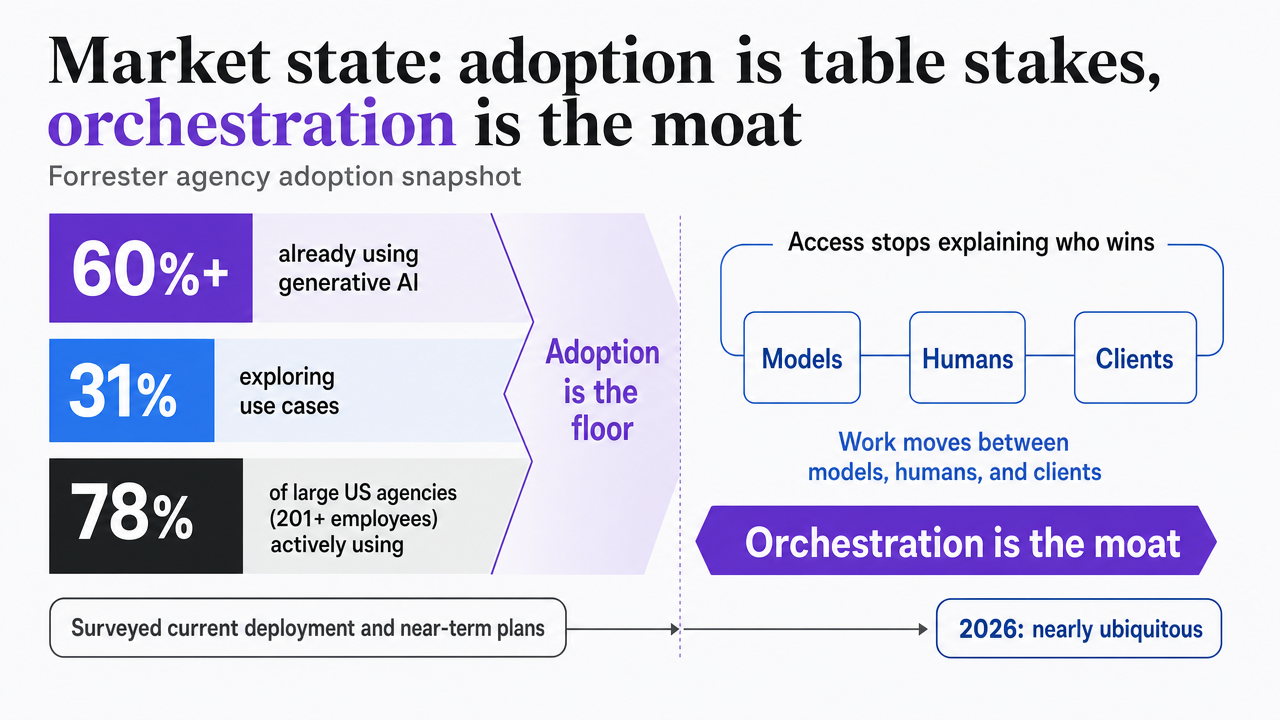
The headline number for anyone still framing AI as an emerging capability inside agencies: Forrester's 2024 primary research found that more than 60% of decision-makers said their agency was already using generative AI, another 31% were exploring use cases, and 78% of large US agencies with 201 or more employees were actively using it 2. The study surveyed agency decision-makers about current deployment and near-term plans, not aspirations or vendor forecasts.
Read those figures as a floor, not a ceiling. When four out of five large agencies have moved past pilots, access to AI stops explaining who wins new business. What separates agencies now is how the work moves between models, humans, and clients.
Forrester's 2026 follow-up assessment describes generative AI as nearly ubiquitous across US marketing agencies and agentic AI as accelerating inside agency offerings 5. The direction of travel is from scattered generative use to coordinated agentic execution—systems that monitor, decide, and act on approved guardrails rather than wait for a prompt.
The gap that matters is orchestration maturity. Agencies at the low end run seven to twelve point tools across pods, with each team drafting, briefing, and reviewing in isolation. Agencies at the high end route creative, media, and reporting through a single approval layer where the same brand rules, compliance checks, and performance signals apply across every channel.
That maturity gap does not show up in a pitch deck. It shows up in cycle time, in QA gaps, and in whether a client's fee structure survives the next renewal conversation. Forrester's 2024 research also identified the barriers agencies still name most often—legal liability, copyright, data privacy, and employee readiness—which are exactly the friction points a coordinated approval workflow is designed to absorb 2.
The competitive question has shifted. Not whether an agency uses AI, but whether it can prove the work is governed, repeatable, and cheaper to deliver than a competitor running the same tools in parallel silos.
The coordination tax: why point-tool sprawl erodes AI margin
The productivity math on AI looks clean in isolation. A copywriter drafts three ad variants in twenty minutes instead of two hours. A media analyst summarizes weekly performance in a paragraph the model wrote. Multiply those savings across a client roster and the margin story writes itself.
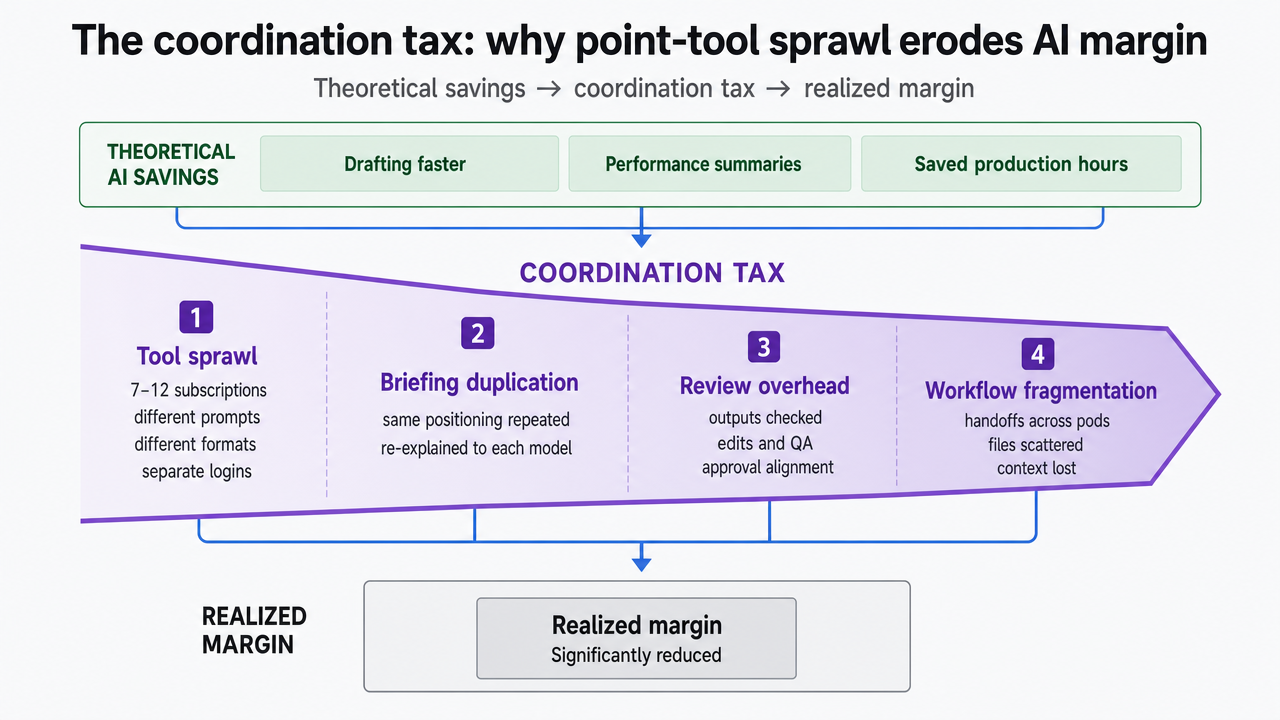
It rarely lands that way on the P&L. What most agency owners find, twelve to eighteen months into scattered adoption, is that the hours saved in production get spent again on coordination. That gap between theoretical and realized margin is the coordination tax.
It shows up in four places:
- Tool sprawl: a typical mid-size agency now runs seven to twelve AI subscriptions across pods, each with its own prompt library, output format, and login.
- Briefing duplication: the same client positioning gets re-explained to every model, every pod, every week.
- Review overhead: AI drafts arrive faster than the QA layer can vet them, so senior staff spend more time correcting outputs than they saved by generating them.
- Compliance drift: without a single approval layer, ad claims, testimonials, and disclosures move to clients in inconsistent forms—a live risk given that the FTC has stated there is no AI exemption from existing advertising laws 3.
Forrester's 2024 research found agencies focusing genAI on productivity across content, media, SEO, and internal use cases, but also named legal, commercial, and quality concerns as ongoing barriers to scaling those pilots into structured offerings 6. Those barriers are not model limitations. They are coordination problems dressed up as AI problems.
The agencies that convert AI hours into actual margin route production, review, and publishing through one governed workflow. The ones that do not keep paying the tax—in senior time, in cycle days, and in the fee compression that follows when a client can see the seams.
Test AI-Driven Campaign Execution in Real Time
Experience live campaign automation at scale with actual publishing to assess workflow efficiency and measurable results.
Where AI actually shifts revenue and cost across the ad lifecycle
Four revenue-lift use cases mapped to agency service lines
Most AI conversations inside agencies start with cost savings. The revenue conversation is the harder one to have with clients, and it is where fee defense actually happens. Deloitte's framing of generative AI in marketing and sales names four use cases that map cleanly to agency service lines: personalized campaigns, tailored pricing, enhanced product discovery, and real-time cross-sell and upsell suggestions 1.
Personalized campaigns are the closest fit for paid social and display pods. Instead of one creative concept tested in three variants, an agency can produce dozens of audience-specific executions from the same brief—message tuned to intent stage, offer tuned to segment, visual tuned to placement. The service line stays the same. The unit of creative output changes.
Tailored pricing lands most naturally with retail media, e-commerce, and lead-gen clients. Agencies that already run promo calendars can move to model-assisted price and offer testing across geographies, dayparts, or customer cohorts. For regulated verticals, the same mechanic applies to consultation offers and intake incentives, provided claims stay substantiated.
Enhanced product discovery sits inside SEO and content service lines. Deloitte points to conversion lift from better matching search intent to product or service explanation 1. For agencies serving multi-location operators, that means location pages, service pages, and FAQ content produced at a cadence a manual pod cannot match.
Real-time cross-sell and upsell suggestions belong to lifecycle and CRM pods. Email, SMS, and on-site recommendations move from batched calendar sends to trigger-based sequences the model reshapes as behavior changes.
The point is not that these use cases are new. It is that agencies can staff against them—assigning owners, defining outputs, and pricing them—rather than folding AI into whatever the pod was already doing.
From campaigns to continuous execution: what scaled creativity changes
The Deloitte taxonomy names where AI creates lift. McKinsey names how the work has to change to capture it. Their framing is a shift from discrete campaigns to continuous, data-driven growth, powered by what they call scaled creativity—
"the ability to produce large volumes of tailored content for consumers and context while maintaining a consistent brand"
7.
The operational implication is unfamiliar to most agency delivery leads. Campaign thinking assumes a start, a middle, and a wrap report. Continuous execution assumes the campaign never closes—creative variants, audience refinements, and bid adjustments run against a live signal loop. McKinsey describes AI agents that monitor LLMs, search, and social ecosystems for trend and intent shifts, then generate, test, and optimize content against those signals in real time 7.
Three things change in delivery when an agency actually adopts this model:
- Creative production stops being a request queue and becomes a rolling pipeline governed by brand rules.
- Media management stops being weekly optimization meetings and becomes a set of guardrails the system operates within.
- Reporting stops being a monthly deck and becomes a running record of what the system decided and why.
The role of the human account team shifts accordingly. Strategists set the guardrails—audience definitions, claim boundaries, creative principles, budget caps. Reviewers approve batched outputs against those rules. Client leads translate performance signals into strategic recommendations the system cannot make on its own.
Agencies that keep selling campaigns while running continuous execution behind the scenes will find the fee math stops working. The billable unit has to match the delivery unit, or the margin gains disappear into scope creep and unpriced iteration.
Coordination tax audit: traditional stack vs. AI-orchestrated execution
The clearest way to see where AI margin actually lives is to audit the same client work under two delivery models. The table below compares a traditional point-tool stack against a unified approval workflow across five cost centers. Figures are expressed as variables—hours per client per month, tool count, cycle days—rather than invented dollars, because the true cost varies by agency wage structure and client mix. What stays constant is where the coordination tax compounds.
| Cost center | Traditional point-tool stack | AI-orchestrated workflow |
|---|---|---|
| Creative production | 3–5 AI tools per pod; separate prompt libraries; 8–14 senior hours/client/month on revision cycles | Single brand-ruled pipeline; 2–4 senior hours/client/month on batched approval |
| Media management | Weekly optimization meetings; manual pacing checks across 3–6 platforms | Guardrail-based automation; strategist review of exceptions, not routine changes |
| SEO and content | Briefs re-explained per pod; cycle time 10–21 days from request to publish | Rolling pipeline against fixed brand rules; cycle time 3–7 days |
| Reporting | Analyst-authored monthly decks; data pulled and reformatted per client | Running performance record; strategist annotates decisions and outcomes |
| QA and compliance review | Ad-hoc claim checks; inconsistent disclosure handling across pods | Single approval layer applying substantiation and claim rules to every output |
Two numbers deserve attention. Total AI subscriptions typically fall from seven-to-twelve down to a handful when execution is coordinated. Senior time reallocates from correction toward strategy and client-facing judgment. Neither shift shows up on a rate card, but both change what a pod can carry.
Forrester's 2024 research on agency GenAI adoption identified productivity across content, media, SEO, and internal use cases as the primary objective, alongside the barriers that keep pilots from scaling: legal liability, copyright, data privacy, and employee readiness 6. The orchestrated column is where those barriers get absorbed by design rather than managed case by case. The traditional column is where they compound into the coordination tax that erodes the margin AI was supposed to create.
Governance that keeps AI advertising defensible
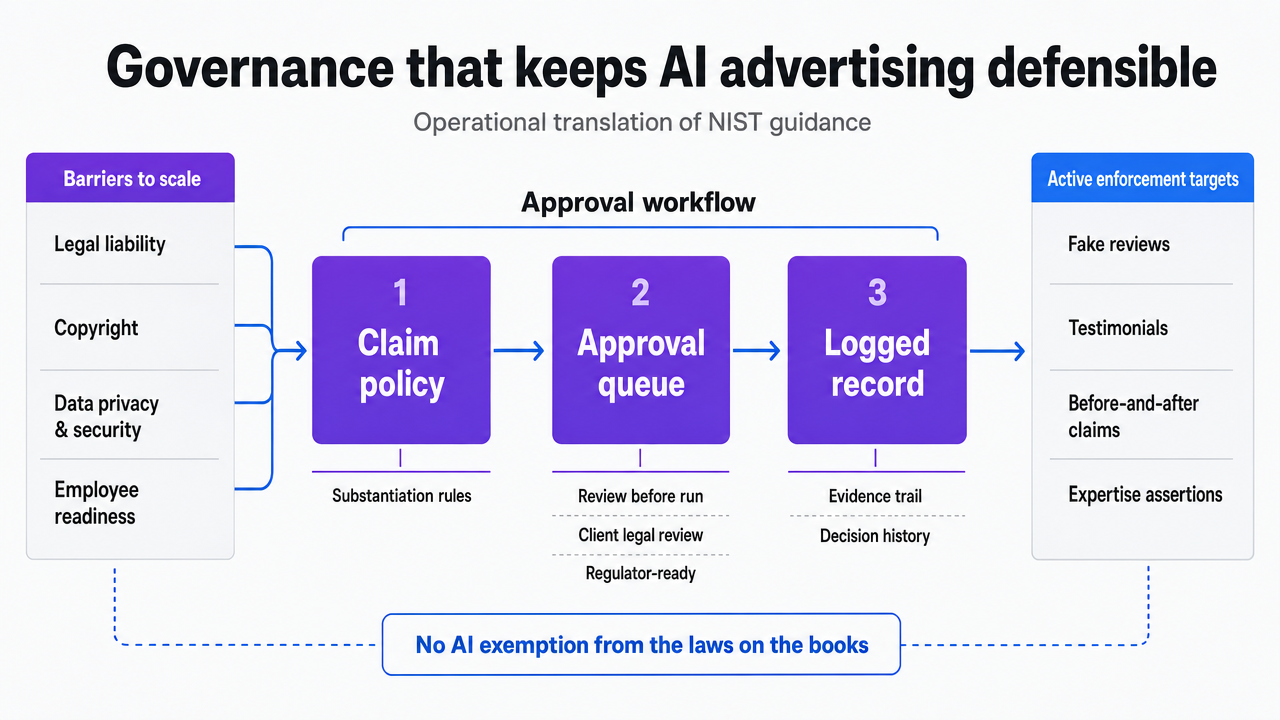
The four barriers agency owners name most often when they explain why AI pilots stall are the same ones that determine whether a scaled program survives a regulator's letter or a client's legal review. Forrester's 2024 research identified them as legal liability, copyright, data privacy and security, and lack of employee readiness 2. Each maps to a decision an approval workflow has to make before an ad ever runs.
Legal liability starts with substantiation. The FTC's Operation AI Comply sweep in September 2024 stated plainly that there is
"no AI exemption from the laws on the books,"
and named AI-facilitated fake reviews and unsubstantiated professional-substitution claims as active enforcement targets 3. For agencies, that means AI-drafted testimonials, before-and-after language, outcome claims, and expertise assertions carry the same evidentiary burden as human-written copy. The difference is volume. When a model produces fifty variants an afternoon, the review layer has to catch a claim drift no copywriter would have introduced.
Copyright and data privacy get resolved earlier in the stack—at the model, prompt, and training-input level. Agencies that pipe client CRM records, call transcripts, or proprietary creative into consumer AI tools without contractual clarity are exposing the client, not just themselves.
Employee readiness is the barrier operators tend to underestimate. Reviewers cannot enforce rules they have not been trained to see.
NIST's AI Risk Management Framework gives the review layer its structure. NIST recommends comparing generative AI outputs against organizational risk tolerance and reviewing AI-generated content against defined guidelines 4. Translated to an ad workflow, that means three artifacts:
- A written claim policy the model is prompted against.
- A batched approval queue where a human signs off before publish.
- A logged record of what was approved and why.
Agencies running that stack can answer a client's legal team in an afternoon. Agencies without it are one enforcement letter away from a fee conversation they will not enjoy.
See How Top Agencies Use AI to Eliminate Production Bottlenecks in Advertising
Request a walkthrough showing how leading agencies cut manual ad operations by up to 60% and improve campaign margin using AI-powered workflows—without sacrificing client oversight or quality.
Stress-testing AI ad workflows in regulated verticals
If an AI ad workflow survives a personal injury firm's intake compliance review, a behavioral health network's HIPAA-adjacent scrutiny, and a senior living operator's state advertising rules, it will survive almost any client. Regulated verticals are the stress test because the cost of a bad claim is not a make-good—it is a bar complaint, an enforcement letter, or a state attorney general inquiry.
Three pressure points expose whether an agency's AI stack is production-ready or still a pilot.
The first is claim substantiation at volume. A legal marketing pod generating fifty landing page variants for a mass tort campaign has to prove every outcome reference, every attorney credential, and every testimonial is either verifiable or clearly framed as a prior result that does not guarantee a similar outcome. The FTC's Operation AI Comply sweep specifically named AI-facilitated fake reviews and unsupported professional-substitution claims as active targets 3. The review layer either catches drift on the fiftieth variant with the same rigor as the first, or the workflow fails.
The second is data handling. Behavioral health and dental group clients push call transcripts, intake notes, and patient-adjacent data through analytics pipelines. Agencies that route that data through consumer AI tools without contractual clarity create client exposure that no productivity gain justifies.
The third is documented human oversight. NIST's framework calls for comparing generative outputs against defined organizational risk tolerance and reviewing them against written guidelines 4. In regulated verticals, that documentation is what an agency hands the client's compliance officer when questions arrive.
Agencies that build for these constraints tend to find the same stack works cleanly for home services, fintech, and multi-location retail. The reverse is not true.
Restructuring pods, pricing, and billable value around orchestration
Delivery model change forces a compensation model change. Agencies that keep the same pod structure, the same billable-hour math, and the same scope documents while quietly running AI behind the work end up with the worst version of both models: the fees compress as clients notice output speed, and the pods still carry the coordination overhead AI was supposed to remove.
Three shifts tend to hold up in practice.
Pods reorganize around judgment density, not production headcount. A traditional four-person account pod—strategist, copywriter, designer, media buyer—collapses toward a two-person structure: a strategist who sets guardrails and owns the client relationship, and a reviewer who governs the batched output the system produces. The junior production seat does not disappear; it moves to the workflow layer, where prompts, brand rules, and claim policies live.
Billable units move from hours to approved outputs and outcomes. Retainers built on time sheets stop mapping to what the pod actually delivers when creative variants triple and cycle time drops from weeks to days. Agencies restructuring around orchestration price against volume tiers (approved variants per month, publishing cadence), performance thresholds, or a hybrid retainer that separates strategy fees from execution fees.
Billable value shifts to the layer clients cannot self-serve. Deloitte's mapping of generative AI to personalized campaigns, tailored pricing, product discovery, and cross-sell suggestions describes lift agencies can price against directly 1. The strategist who defines the audience logic, the reviewer who defends the claim, and the operator who tunes the guardrails are the roles a client will still pay a premium for. The draft is not.
Operator diagnostic: seven questions to score AI delivery maturity
The gap between agencies capturing AI margin and agencies paying the coordination tax rarely shows up in tool inventories. It shows up in how the work moves. The following seven questions score delivery maturity honestly. Any answer of "no" or "sometimes" points to where the next quarter's operational work belongs.
- Does every AI-generated ad output pass through a single approval layer before publish? If review is distributed across pods, claim drift is a matter of when, not if 3.
- Is there a written claim and substantiation policy the model is prompted against? NIST's framework treats written guidelines as the baseline for defensible review 4.
- Have AI tool subscriptions consolidated in the past twelve months, or are they still growing per pod? Growth signals sprawl; consolidation signals orchestration.
- Do strategists spend more time setting guardrails than correcting drafts? If senior hours still flow into revision, the workflow layer is missing.
- Are billable units tied to approved outputs or outcomes, not hours? Retainers priced on time compress fastest when cycle time drops.
- Can the agency produce a logged record of what was approved, by whom, and against which rule? That artifact is what a client's legal team will ask for first.
- Do reviewers receive documented training on AI claim risk, not just tool access? Forrester named employee readiness as a persistent adoption barrier for a reason 2.
Agencies scoring five or more affirmative answers are running orchestrated delivery. Three or fewer, and AI is still a private habit inside pods—productive in moments, expensive in aggregate.
Frequently Asked Questions
References
- 1.Generative AI in Marketing and Sales | Deloitte US.
- 2.US Agencies Are Currently Leading Generative AI Adoption.
- 3.FTC Announces Crackdown on Deceptive AI Claims and Schemes.
- 4.Artificial Intelligence Risk Management Framework.
- 5.The State Of AI Inside US Marketing Agencies, 2026.
- 6.The State Of Generative AI Inside US Agencies, 2024.
- 7.The future of marketing in the age of AI.