
Key Takeaways
- The 33-point gap between marketers exploring generative AI and those seeing real gains is a workflow design problem, not a tooling or headcount problem 4.
- Keep brief definition, subject-matter editing, and competitive positioning human-led; move research, outline, drafting, and SEO tagging to AI behind explicit approval gates.
- A defensible planning band is 2x to 3x output per FTE within two quarters, with cost per published asset falling 10% to 30% once workflows are rewired 5.
- Follow the phased sequence: six weeks to prove the workflow on one content type, ninety days to scale across two or three types, six months to lock in publishing and measurement gates 7.
The productivity gap most content teams still haven't closed
Most in-house content teams have already run their AI pilots. The results, in aggregate, are underwhelming. Gartner data cited in Forrester's 2024 B2B predictions puts the picture in sharp relief: 77% of marketers are actively exploring generative AI, while only 44% report realizing significant benefits from it 4. That 33-point gap is the operating problem this article addresses.
The gap is not a tooling problem. Content managers running lean teams of two to eight people typically have access to the same model families as their larger competitors. What separates the 44% from the rest is workflow design. McKinsey's marketing research finds that organizations capturing serious gains from generative AI have rewired production stages rather than layering a chatbot onto an existing briefing cycle 5.
The teams closing the gap are not producing more of the same content faster. They are reassigning where human judgment sits in the pipeline, then pushing volume through the stages where AI outperforms a junior writer at a fraction of the cost. The teams still stuck at exploration are asking the wrong questions: which tool, how many seats, which prompt library. The productive question is narrower and harder. Which stages of content production actually require a person, and which do not.
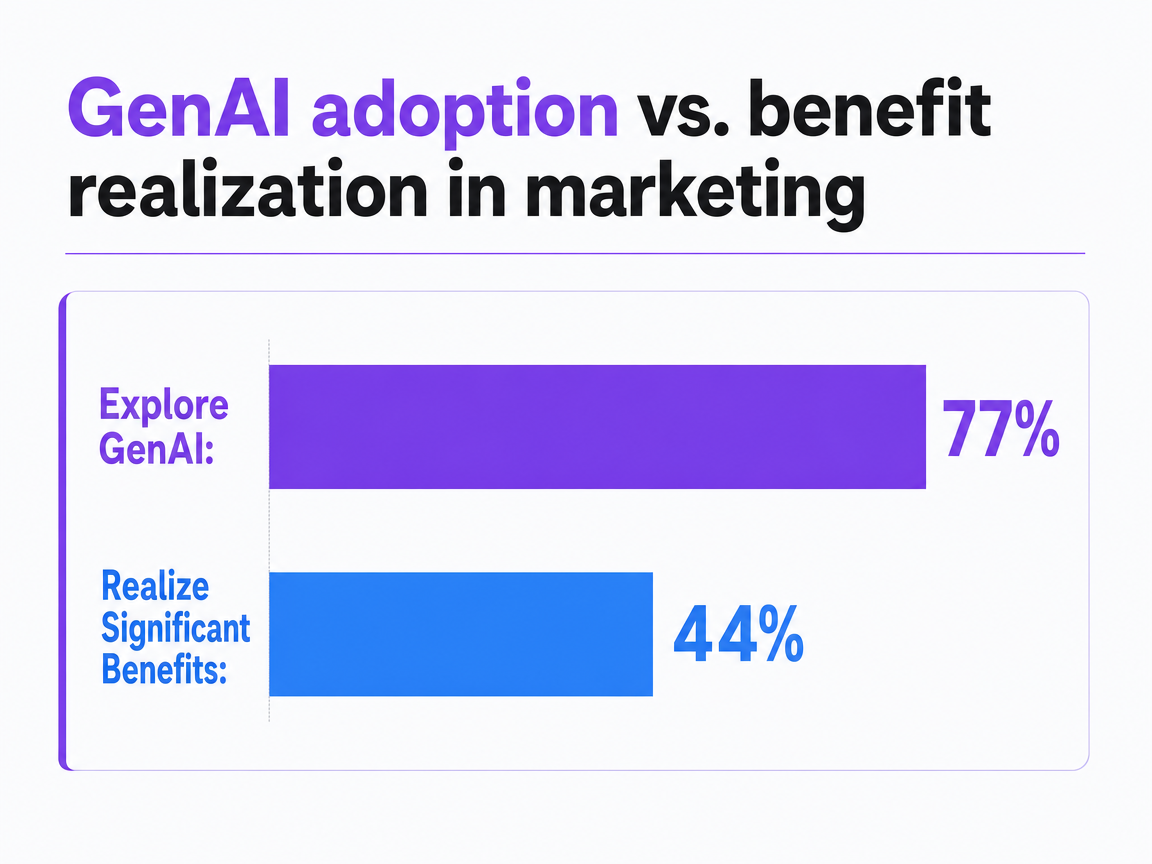 GenAI adoption vs. benefit realization in marketing
A Gartner survey shows a significant gap between exploration and value realization, with 77% of marketers exploring GenAI but only 44% realizing significant benefits.
Why headcount and tool selection are the wrong questions
The agency-briefing model breaks under AI
The default content operating system inside most marketing departments is still an agency-briefing model, even when no agency is involved. A manager writes a brief. A writer, internal or external, drafts against it. An editor cleans it up. SEO adds keywords late. Legal or subject-matter experts review at the end. Each handoff costs days, and the brief itself becomes the ceiling on quality.
Bolting a generative model onto that pipeline produces the outcome most teams have already seen: a faster first draft, a slower everything else. The draft arrives in an hour instead of a week, then sits in the same edit and approval queue for the same three weeks. Net gain, marginal. Cost per published asset, barely changed.
McKinsey's marketing research is explicit that the productivity story only works when organizations rewire the workflow itself, not when they insert AI into a stage that was designed around a human draft 5. The briefing model assumes drafting is the bottleneck. Under AI, drafting is the cheapest stage in the pipeline. The bottleneck moves upstream to angle and evidence, and downstream to edit and approval. Teams that do not move with it stay stuck.
What Forrester's agency data signals for in-house teams
The agencies in-house teams have historically bought from are converting to AI production faster than most of their clients. Forrester's 2024 agency research finds that 81% of US agencies name "enhancing the productivity and impact of staff" as their primary objective for generative AI, with creative content, SEO strategy, and internal productivity as the top use cases 1. Nine in ten US marketing agencies now use AI to cut costs and lift output 1.
The forward-looking numbers are sharper. Forrester reports that 76% of agency decision-makers expect generative AI to significantly change how agencies create content for clients within two years, and 69% expect a significant impact on how consumers interact with that content 2. Agencies are not planning to keep charging retainer fees for human-drafted blog posts. They are planning to charge the same fees for AI-augmented output at higher margin.
That reframes the buy-versus-build calculus for a content marketing manager. The question is no longer whether the in-house team can match agency output on a headcount budget. It is whether the team can match the workflow the agency is already rebuilding, using the same model families, without paying the retainer markup on top. Headcount is not the lever. Tool selection is not the lever. The workflow is.
Test AI-driven content workflows risk-free this week
Experience measurable gains in content output and approval speed using live projects during your trial period.
Where judgment lives in an AI-augmented content workflow
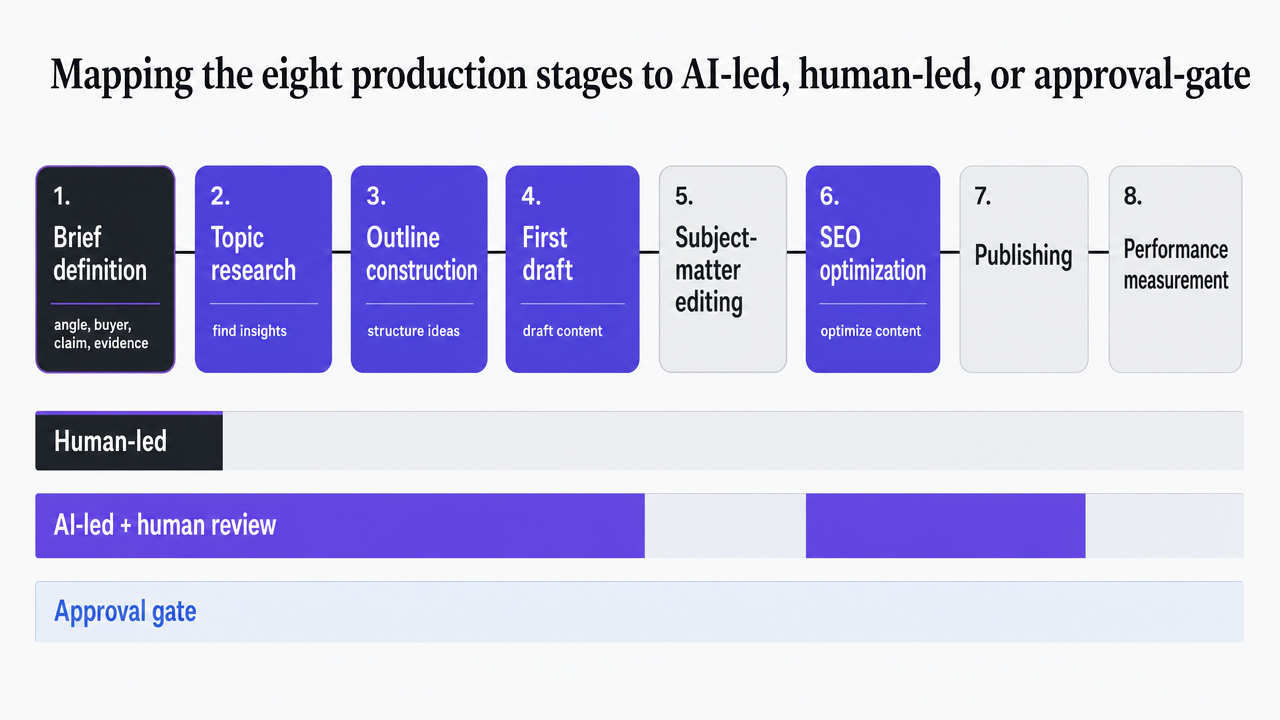
Mapping the eight production stages to AI-led, human-led, or approval-gate
A useful way to redesign the pipeline is to break content production into eight discrete stages and assign each one an owner: AI-led, human-led, or approval gate. The stages are brief definition, topic research, outline construction, first draft, subject-matter editing, SEO optimization, publishing, and performance measurement.
Brief definition sits with the human. It captures the angle, the buyer this piece is written for, the specific claim the content will defend, and the internal evidence that has to appear. This is the stage that most teams skip or delegate to a template, and it is the stage that determines whether the rest of the pipeline produces sharp content or filler.
Topic research, outline construction, first draft, and SEO optimization are AI-led with human review. These are the stages where generative models genuinely outperform a junior writer on speed and cost, and where McKinsey's research locates the two- to fivefold creative productivity gains reported by organizations that have rewired their workflows 5.
Subject-matter editing is human-led. A senior writer, subject expert, or content lead reads the draft for accuracy, positioning, and voice. This is the stage that catches the shallow, generically confident output that models produce when the brief was thin.
Publishing and measurement are AI-led with a human approval gate before anything goes live. The approval gate is not editorial trust theater. It is the control point where a person confirms the piece matches the brief, the evidence is real, and the SEO tagging aligns with the target intent. Nothing ships without that sign-off.
The four stages that degrade without a human owner
Four stages fail predictably when a team hands them fully to a model: angle definition, evidence selection, edit, and competitive positioning. Each one is where thin AI content gets exposed by buyers.
Forrester's 2024 B2B prediction is direct on the stakes. Thinly customized generative AI content is expected to degrade the purchase experience for 70% of B2B buyers, based on Forrester's analysis of early GenAI content deployments across B2B marketing programs 4. The degradation shows up as vertical veneers over generic advice, personalization that stops at the recipient's first name, and offers that miss the buyer's actual stage.
Buyers are not forgiving on this. Forrester's B2B personalization research finds that 82% of global B2B marketing decision-makers report their buyers expect experiences personalized to their needs, and 75% report buyers expect immediate responses 8. Volume without relevance moves a team in the wrong direction on both metrics simultaneously.
- Angle definition fails without a human because models optimize for coherence, not distinctiveness.
- Evidence selection fails because models cite plausibly rather than accurately.
- Edit fails because models cannot audit their own confidence.
- Competitive positioning fails because models do not know which claims a specific brand is willing to defend in a sales conversation.
The operational rule is narrow: any stage where the output will be tested by a buyer's skepticism needs a human owner, not a reviewer skimming a queue. Reviewer mode is where teams import the 70% degradation risk into their own funnel.
Reallocating writer time from drafting to judgment work
The productivity story is not that writers get replaced. It is that writers stop drafting.
Forrester projects that generative AI investment will augment employees' creative problem-solving time by up to 50%, based on its 2024 predictions research on how business leaders expect GenAI to reshape knowledge work 3, 6. For a content team of three, that reclaimed time is not vacation. It is the hours a senior writer now spends on the four stages that degrade without them: sharpening the angle, verifying evidence, editing for voice and positioning, and pressure-testing the competitive claim.
The practical reallocation looks like this. A writer who previously spent 60% of a week producing first drafts now spends 15% of a week reviewing AI drafts and 45% of a week on brief construction, evidence work, and edit. The output volume the team ships doubles or triples, but the writer's actual hours shift toward the work that models cannot do credibly.
That reallocation is the mechanism behind the productivity gains, not the volume of drafts a model can generate. Teams that skip it get more words and worse content. Teams that redesign around it get compounding capacity from the same headcount.
What the productivity math actually looks like
The 2–5x creative gain and its conservative counterweight
The headline number content managers keep hearing is real, but its scope matters. McKinsey's marketing research reports that some organizations are already seeing two- to fivefold increases in creative productivity and 10% to 30% reductions in creative costs after rewiring content workflows around human-AI collaboration 5. Those figures come from organizations that redesigned production stages, not from teams running pilots inside an unchanged briefing cycle.
The conservative counterweight sits in a separate McKinsey analysis of consumer marketing, which estimates the overall productivity boost for marketing from generative AI at roughly 9% 7. That number is a portfolio average across marketing functions, including work where AI has thinner leverage than in content production. A content manager forecasting to a CMO should carry both figures.
The realistic planning band for a content team specifically sits closer to the McKinsey creative range than the 9% marketing-wide average, provided the workflow is rebuilt. Teams that layer AI onto an unchanged process land near the low end or below it. Teams that reassign drafting to models and reclaim writer hours for judgment work land in the two- to threefold range within the first two quarters, with the higher multiples showing up once measurement and SEO stages are also automated with approval gates.
The number to defend in a budget conversation is not 5x. It is 2x to 3x with a documented workflow change, and a cost-per-published-asset reduction inside the 10% to 30% band 5.
Output capacity per FTE: in-house, agency-augmented, AI-augmented
The clearest way to pressure-test the productivity math is to hold headcount constant and vary the operating model. Consider a three-person in-house content team: one manager, two writers. The table below applies the sourced multipliers to a baseline of published assets per FTE per month, using ranges rather than invented dollar figures.
| Operating model | Assets per FTE / month | Cycle time per asset | Cost per asset |
|---|---|---|---|
| Traditional in-house drafting | Baseline (1x) | Weeks | Baseline |
| Agency-augmented briefing cycle | 1.2x–1.5x (volume added, cycle unchanged) | Weeks, plus handoff lag | Baseline + retainer markup |
| AI-augmented with approval workflow | 2x–5x 5 | Weeks or days 7 | 10%–30% reduction 5 |
The agency-augmented row is the one most in-house managers underestimate. Adding a retainer buys incremental volume, but the briefing cycle itself does not compress. Handoff lag between the internal brief writer and the external drafter often cancels the volume gain on cycle time. Forrester's finding that 81% of US agencies now name productivity as their primary GenAI objective indicates that agencies themselves are moving to the third row 1. Paying a retainer markup for work the agency has already automated internally is the calculation most managers have not yet run.
The AI-augmented row assumes the workflow redesign described earlier: brief and edit stay human-led, drafting and optimization move to AI, publishing and measurement run behind approval gates. Under that design, McKinsey's campaign-timeline research finds that content programs previously requiring months can ship in weeks or days 7. That compression is what converts a two- to threefold productivity gain from a headline number into cost per published asset that a CFO can verify against invoices.
The math holds only if the manager owns the workflow redesign. A team that buys AI seats without redesigning production sits in the first row with a higher software bill.
If a team runs content across multiple locations or brands
A brief note for content managers inside multi-location operators, franchise systems, or multi-brand portfolios: the productivity math compounds, and so does the risk.
The same AI-augmented workflow that produces a two- to threefold gain for a single-brand team produces disproportionate gains across locations because the judgment work — angle, evidence, positioning — is largely shared, while location-specific variables are the stages where AI has the strongest leverage. A single brief and a single edit standard can drive dozens of location-tailored assets through the drafting and optimization stages.
The risk compounds in the same direction. Forrester's prediction that thin AI content degrades the buyer experience for 70% of B2B buyers applies per location, not per brand 4. A shallow personalization pattern replicated across forty locations imports the same degradation forty times into the funnel. The approval gate has to hold at the location level, not just the brand level, which is where governance tooling becomes the constraint rather than model capacity.
Multi-location managers should forecast the productivity gain against location count, and the risk against location count in the same breath.
See How AI-Driven Content Teams Accelerate Production Without Sacrificing Control
Request a walkthrough of coordinated AI workflows proven to cut content cycle times by up to 65% while maintaining full oversight—engineered for agencies and enterprise marketing teams handling complex, multi-channel demands.
Approval-first execution as the governance model
Briefing-cycle production vs approval-first production
The briefing cycle assumes trust flows forward. A manager writes a brief, hands it to a drafter, and trusts that the output will come back close enough to correct in edit. Every stage inherits the assumptions of the stage before it. When the brief is thin, the draft is thin, and the edit becomes a rewrite.
Approval-first production inverts the flow. Trust does not move forward automatically; it is granted at explicit gates. The manager approves the brief before research runs. A senior writer approves the outline before drafting runs. The content lead approves the edited draft before SEO tagging runs. Publishing approves nothing without a match to the original brief.
The difference matters at scale. Under a briefing cycle, an AI model producing ten drafts a week creates ten downstream review problems, each carrying the compounding error of every prior stage. Under approval-first execution, the same ten drafts pass through gates that catch angle drift, evidence gaps, and voice failures before they consume editor hours.
McKinsey's marketing research locates the productivity gains specifically in organizations that redesigned production stages around human-AI task allocation rather than layering AI onto a linear handoff 5. The gate structure is what makes the two- to threefold gain repeatable rather than accidental. Volume without gates produces the shallow output Forrester warned would degrade the buyer experience 4.
Defending brand voice, SEO quality, and legal exposure at scale
Three failure modes show up when content teams double or triple output without governance: voice drift, SEO decay, and legal exposure. Each has a specific gate that contains it.
Voice drift is caught at the edit gate. A content lead reads for tone, positioning, and the specific claims the brand is willing to defend in a sales conversation. Models produce coherent prose; they do not produce distinctive prose without a human anchor on voice. Forrester's B2B research reports that 82% of global B2B marketing decision-makers say their buyers expect experiences personalized to their needs 8. Generic AI voice reads as the opposite of personalization even when the surface variables are correct.
SEO decay is caught at the optimization gate. AI-drafted content often over-optimizes for lexical match and under-optimizes for search intent, especially on middle-funnel queries where the model defaults to definitional framing. A human review confirms the piece answers the query a buyer actually types, not the query the outline assumed.
Legal and factual exposure is caught at the publishing gate. Models cite plausibly but not always accurately. In regulated verticals — law, healthcare, financial services — a citation-check step before publish is not optional. The approval gate is where a person confirms the evidence exists and the claim is defensible.
The governance model is what allows a three-person team to ship at agency volume without importing agency risk. Platforms built around approval-first execution, including Vectoron, formalize these gates as workflow rather than leaving them to individual discipline.
A phased implementation path: six weeks, ninety days, six months
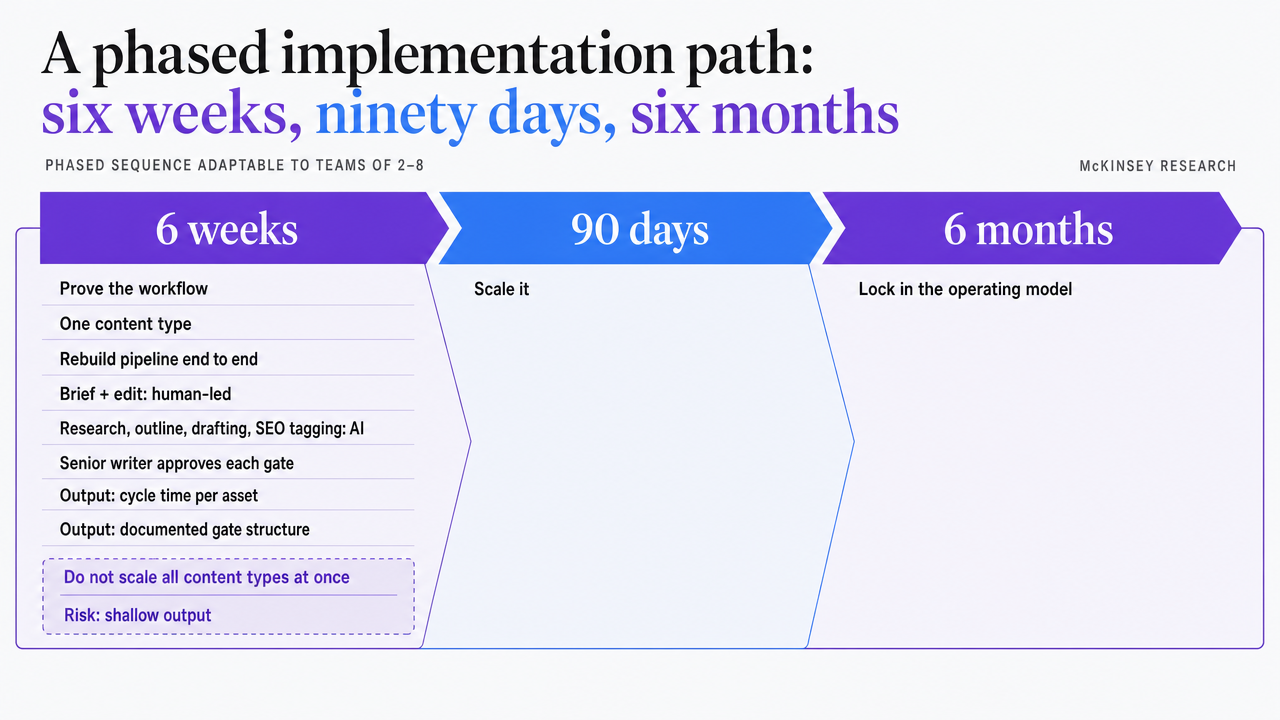
The redesign does not happen in a quarter. McKinsey's marketing research lays out a phased sequence that content managers can adapt to a team of two to eight: six weeks to prove the workflow, ninety days to scale it, six months to lock in the operating model 7.
- In the first six weeks, the work is narrow. Pick one content type — long-form SEO articles, product pages, or middle-funnel comparison content — and rebuild that pipeline end to end. Brief and edit stay human-led. Research, outline, drafting, and SEO tagging move to AI with a senior writer approving each gate. The measurable output at week six is not volume; it is cycle time per asset and a documented gate structure. Teams that skip this step and try to scale across all content types simultaneously produce the shallow output Forrester warns will degrade the buyer experience 4.
- By day ninety, the workflow extends to two or three additional content types and the team ships at two to three times its baseline volume. Writer hours have shifted measurably toward brief construction, evidence work, and edit — the reallocation Forrester's research locates behind the 50% creative problem-solving time gain 6. Cost per published asset should be tracking inside the 10% to 30% reduction band 5.
- At six months, publishing and measurement run behind approval gates, campaign timelines compress from months to weeks or days 7, and the manager is defending a two- to threefold productivity gain to the CMO with cycle-time data, not vendor stats. The team has not grown. The workflow has.
Frequently Asked Questions
References
- 1.The State Of Generative AI Inside US Agencies, 2024.
- 2.US Agencies Are Currently Leading Generative AI Adoption.
- 3.Forrester's Predictions 2024: Sixty Percent Of Generative AI Skeptics Will Embrace The Tech.
- 4.Predictions 2024: B2B Marketing Is In For A Wild Ride.
- 5.The future of marketing in the age of AI.
- 6.Forrester Announces 2024 Predictions.
- 7.How generative AI can boost consumer marketing.
- 8.Seven Ways To Use GenAI For B2B Personalization.