
Key Takeaways
- Agency AI value comes from redesigning the production line so AI handles drafting, variants, and reporting while humans move upstream to strategy, brand judgment, and named approval sign-off.
- McKinsey's 5% to 15% marketing productivity range is a planning band, not a promise 3: the low end reflects bolted-on tools, the high end reflects rewired workflows.
- The load-bearing decision is the approval gate. Signal ingestion feeds drafts, a named reviewer checks voice, claims, and distinctiveness, and rejection reasons loop back into the drafting layer.
- Focus next on workforce literacy, span-of-control math, and a documented brand-safety stance covering inauthentic engagement 10and platform data dependency 11before layering in agentic execution.
The Production Line Has Changed, Not the Client Promise
Agency owners are not shopping for another social media tool. They are re-engineering a production line that has run on billable hours since the discipline existed. The shift underway is not faster caption writing. It is a restructured workflow where AI drafts, personalizes, and reports inside a human approval loop, and the humans on payroll move upstream toward strategy and account judgment.
McKinsey describes campaigns that once took months collapsing into weeks or days once generative AI handles first-draft creative, segmentation, and testing 15. Forrester frames this as a competitive threshold, not a curiosity: agencies that adopt generative AI will serve brands better and keep pace with rivals 6. Neither finding changes what clients are paying for. They still want brand fit, measurable performance, and someone accountable when a post goes wrong.
What changes is the cost structure behind that promise, the span of control per account manager, and the governance layer that keeps AI output from becoming a liability. The rest of this piece works through that shift as an operating decision.
What the Numbers Actually Say About Agency AI
The Productivity Range Worth Planning Around
The most useful number in agency AI planning comes from McKinsey, which estimates that generative AI could lift marketing-function productivity by 5% to 15% of total marketing spending 3. Scope matters here. That range measures the marketing function overall, not agency revenue, and it applies to the full spend base a marketing team touches, from creative production to media operations. It is not a promise of 15% margin expansion on a social retainer.
For an owner building next year's plan, the range is defensible as a planning band rather than a headline. The low end covers agencies that graft AI onto existing briefing and approval cycles without rewiring them. The high end reflects teams that redesign the production line so AI handles first drafts, segment variants, and reporting, and humans concentrate on strategy and approval.
The delta between the two ends of that band is where operator decisions live. It is the difference between buying licenses and rebuilding the workflow. McKinsey's own campaign-timeline work reinforces the point: content, insight, and targeting cycles that once took months can move in weeks or days when the underlying process is reworked, not just accelerated 15.
Labor Restructuring, Not Labor Elimination
Forrester projects that US advertising agencies and related services companies will lose 32,000 jobs to automation by 2030, equal to 7.5% of the workforce 7. Read plainly, that is a restructuring signal, not a mass-layoff forecast. Roughly nine in ten agency roles are still expected to exist in some form at the end of the decade.
The roles most exposed sit where AI now performs credibly:
- first-draft caption writing
- image resizing
- routine reporting
- community response templates
The roles least exposed are the ones clients cite when they renew: strategy, brand judgment, senior creative direction, and account leadership. A 7.5% shift over six years is the pace of a hiring freeze plus attrition, not a cliff.
For owners, the practical read is a redesign brief. Job descriptions written in 2019 assumed that production hours filled the day. If AI compresses those hours, account manager span of control expands, junior roles move toward AI supervision and quality control, and senior roles carry more accounts of higher creative complexity. The workforce number changes shape before it changes size.
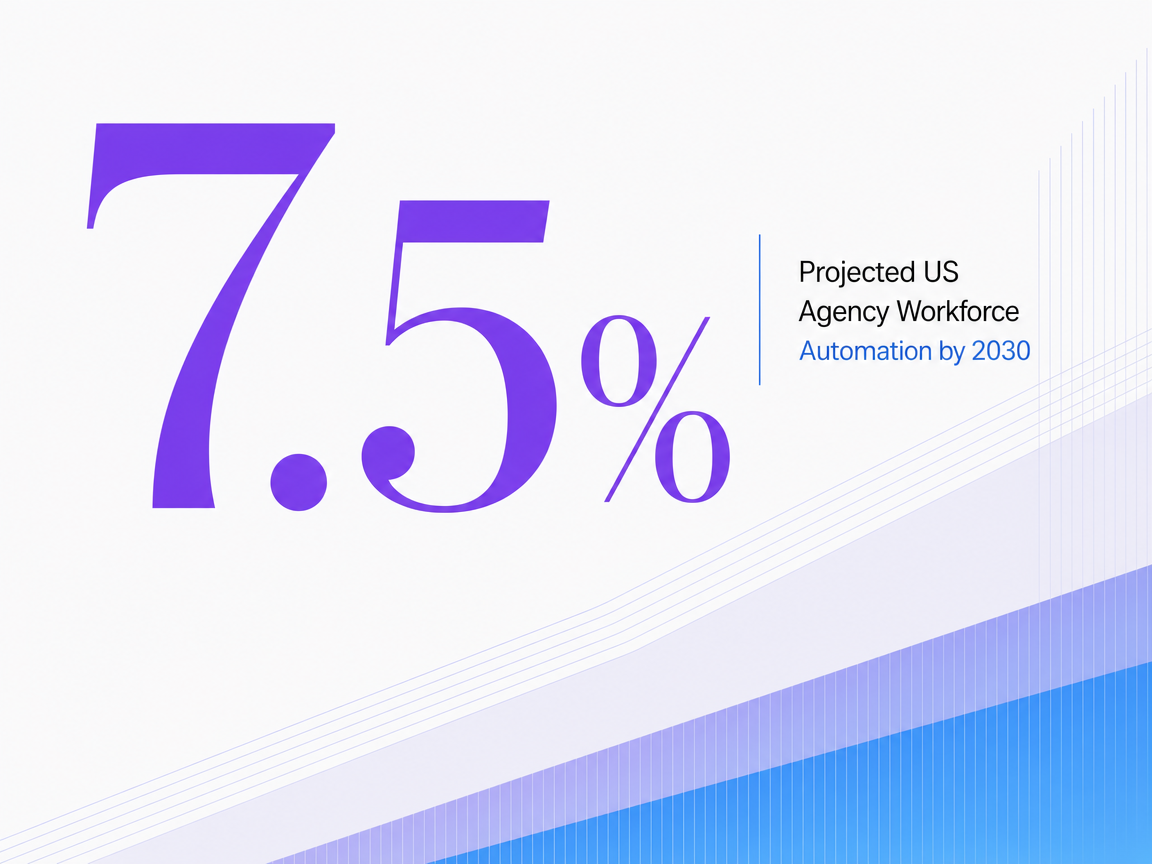 Projected US Agency Workforce Automation by 2030
Projected US Agency Workforce Automation by 2030
The Approval-First Workflow
Where AI Touches the Post and Where Humans Sign It
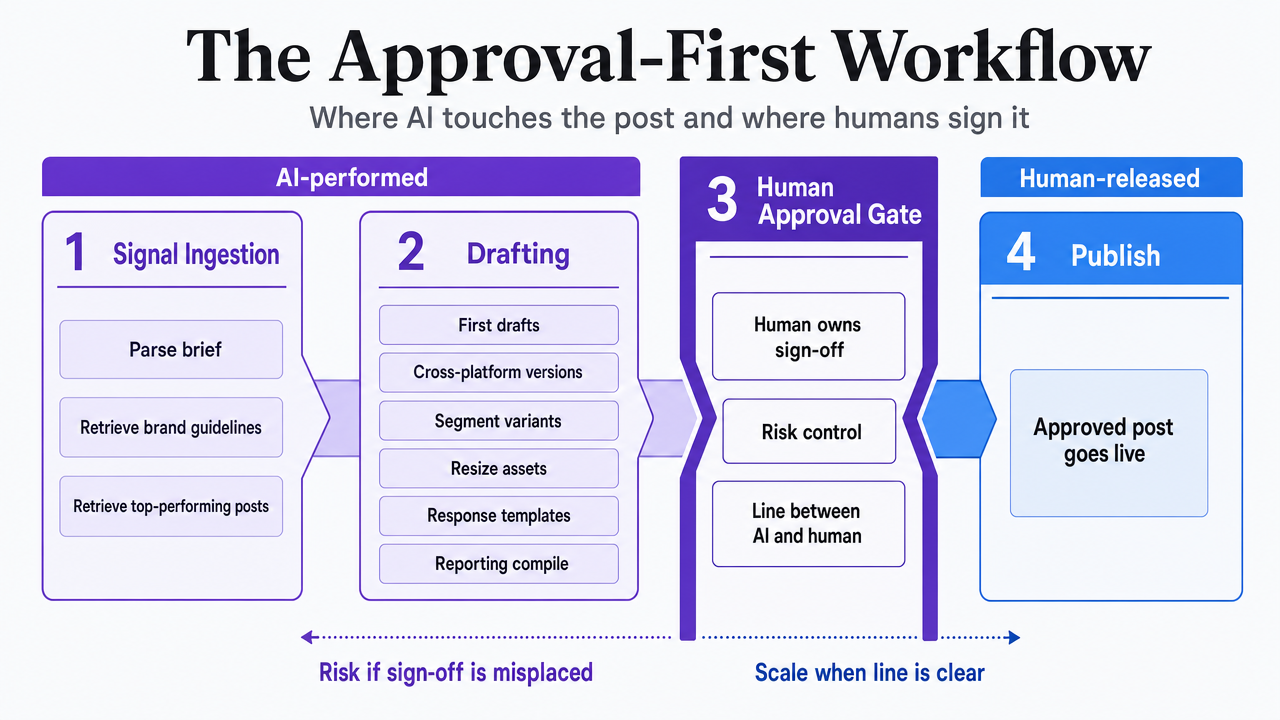
The operating question is not whether AI writes captions. It is which steps in the social production line AI performs, which steps a human owns, and where the sign-off gate sits between the two. Draw that line correctly and the workflow scales. Draw it wrong and the agency inherits the risk without the productivity.
A workable division puts AI on the mechanical steps:
- parsing the brief
- retrieving brand guidelines and past top-performing posts
- generating first drafts across platforms
- producing segment variants
- resizing assets
- drafting community-response templates
- compiling reporting
McKinsey identifies this exact pattern, noting that generative AI is now used to produce first drafts of brand advertising, headlines, slogans, and social media posts, and to personalize communications at scale 5.
Humans own the judgment steps. Strategy sits with the account lead. Brand voice calibration sits with senior creative. Final approval on every publishable asset sits with a named reviewer whose name is on the account. Client-facing communication sits with the account manager. The pattern is not new to agencies. What is new is that the mechanical layer beneath these judgments now runs at a fraction of the previous hour count.
The governance line matters more than the tool selection. An agency that lets AI publish without a named human approver has changed its liability profile, not just its cost structure. An agency that routes every AI-generated asset through a defined checkpoint keeps the client promise intact while the production line underneath runs faster.
Signal Ingestion: Briefs, Guidelines, and Performance Data
The quality of every downstream draft depends on what the system reads first. Signal ingestion is the unglamorous front end of the workflow, and it is where most bolt-on AI deployments fail. If the AI layer starts from a blank prompt each week, the agency has automated typing, not production.
Three inputs matter.
- Brand guidelines, including voice, prohibited claims, and visual rules, need to sit in a retrievable form the model can reference on every draft.
- Client briefs, campaign calendars, and product launch notes need to flow in without a separate re-keying step.
- Performance data from the last thirty to ninety days, including post-level engagement and any conversion signals the platforms return, needs to be available to the drafting layer so it can weight what has worked.
McKinsey's segmentation work shows why this matters. Marketers using generative AI can combine large datasets to identify micro-segments and then ask the model to draft tailored content such as social posts and landing pages against them 2. That capability collapses if the model cannot see the segments in the first place. Signal ingestion is what turns the drafting layer from a generic writer into a client-specific one.
Drafting, Personalization, and the Segment Layer
Once signals are in place, the drafting layer produces the first version of every asset the calendar calls for. For a mid-sized retainer, that means a week's worth of platform-native captions, image variants sized to each surface, segment-specific rewrites where the audience splits, and community-response drafts for common comment patterns.
McKinsey argues that generative AI lets marketers create and scale highly relevant messages with bespoke tone, imagery, copy, and experiences at high volume and speed 4. The operational value for agencies is not the volume itself. It is the ability to produce three or five segment variants of a post in the same time the old workflow produced one, which changes what personalization costs to deliver.
Evidence from a 2025 study of 893 consumers in the MENA region reports that AI-driven personalization significantly enhances social media marketing by delivering tailored content, optimizing influencer selection, and enabling real-time interaction, with measurable lifts in user experience and purchase intention 14. The scope is regional survey data, not a global benchmark, and it should be read as directional evidence that segment-level personalization moves the metrics agencies are hired to move. The drafting layer is where that personalization becomes affordable at portfolio scale.
The Human Approval Gate
Every publishable asset passes through a named reviewer before it ships. That is the load-bearing rule of the workflow. Without it, the agency has not built an AI-assisted production line; it has built an unsupervised one.
The reviewer's job is narrower than the old copy-edit pass. The mechanical checks, spelling, character limits, aspect ratios, and hashtag hygiene, have already happened upstream. The reviewer is looking for four things:
- Brand voice fidelity
- Factual accuracy on any claim
- Legal or regulatory exposure specific to the client's vertical
- Creative distinctiveness against the last four weeks of the client's own feed
Approval gates work when they are fast and specific. A queue of one hundred pending posts with no priority order and no rejection reason field will collapse under its own weight, and the agency will quietly start rubber-stamping to keep the calendar moving. A queue that surfaces the three highest-risk assets first, records why an item was rejected, and feeds that reason back into the drafting layer produces both faster reviews and better next-week drafts. The gate is where governance either holds or breaks.
Experience AI-led social publishing at scale now
Test real social content workflows risk-free and measure the operational impact before committing.
What Breaks When Agencies Bolt AI Onto Legacy Delivery
The failure mode most agencies hit is not the AI output. It is the workflow around it. When drafting tools get bolted onto a briefing-and-approval process built for human production, the productivity gain leaks out through the seams the moment it is generated.
Briefing cycles are the first leak. If an account manager still writes a full creative brief for every post before AI drafts a caption, the hour saved on drafting is spent on the brief. Forrester's 2024 agency work identifies exactly this pattern, noting that agencies pursuing productivity through generative AI hit legal, commercial, and emotional barriers that keep old processes intact even as new tools arrive 12. The tool changes; the throughput does not.
Approval bottlenecks migrate rather than disappear. A senior reviewer who once approved thirty posts a week now faces ninety, because AI made drafting cheap without making reviewing faster. The queue grows, review time per asset shrinks, and quality drift enters the calendar quietly. Clients notice the fourth week before the agency does.
The third failure is signal starvation. AI drafts written from a blank prompt each cycle produce generic output that ignores what the account's audience actually responded to last month. McKinsey's segmentation work makes the point plainly: the model has to see the segments and the performance data before it can draft usefully against them 2. Bolted-on deployments skip that plumbing and then blame the model for the result. The workflow, not the software, is what needs redesigning.
Account Economics After the Workflow Shift
If You Manage a Portfolio of Client Accounts: A Variable-Driven View
For owners running social media across multiple client accounts, the math worth doing is not a case-study lookup. It is a variable model of what one account costs to produce today and what it costs after the drafting layer moves upstream of the account manager. The inputs are already on the P&L. The output is a defensible gross margin per account.
Four variables carry the model:
- accounts under management
- posts per account per month
- human minutes per post under the current workflow
- loaded labor rate per hour for the roles that touch each post
Multiply them and the monthly production cost per account falls out. Apply McKinsey's 5% to 15% marketing-function productivity range as a planning band on the human-minutes variable, remembering that the range measures the marketing function overall, not a guaranteed retainer outcome 3. The low end applies when AI is bolted onto existing briefing and approval cycles. The high end applies when the drafting, resizing, variant, and reporting steps are actually removed from human hours.
| Input | Traditional workflow | AI-assisted workflow (planning band) |
|---|---|---|
| Accounts under management | A | A |
| Posts per account per month | P | P |
| Human minutes per post | M | M × (1 − 0.05 to 0.15) |
| Loaded labor rate per hour | R | R |
| Monthly production cost per account | (P × M × R) / 60 | (P × M × R × (0.85 to 0.95)) / 60 |
The useful discipline is to run the model twice, once at the low end of the band and once at the high end, and then subtract each from the current retainer price to get a gross-margin range per account. That range, multiplied by accounts under management, is the number that changes when the workflow changes. It is also the number to defend before adjusting pricing or renegotiating scopes.
Account Manager Span of Control
Span of control is the second output of the same model, and it is where the workforce shift in Forrester's forecast lands operationally. If the drafting, variant, and reporting steps come out of the account manager's week, the freed hours convert into either more accounts per AM or deeper strategy time on the existing book. Owners choose which.
The variable is straightforward: current accounts per AM, current hours per account per week, and the share of those hours the AI-assisted workflow removes. An AM carrying eight accounts at four production hours each is spending thirty-two hours a week on production. Move the drafting and reporting layer upstream and that number drops. Whether the AM then carries ten accounts, or the same eight with more strategy work billed against them, is a portfolio decision, not a tooling one.
The risk to name plainly is silent overload. Adding accounts without redesigning the approval queue described earlier pushes review time per asset down and quality drift up. Span of control expands only when the gate holds.
The Creativity Tax on Scale
Forrester's analysts have named the trade-off directly: efficiency gains from generative AI can arrive at the expense of creative distinctiveness 9. For agency owners, this is the uncomfortable half of the productivity story. The same drafting layer that collapses a week of caption work into an afternoon also pulls every account toward the statistical center of what has already been published online.
The mechanism is not mysterious. Large models optimize toward patterns that appeared frequently in training data and in reinforcement signals. Feed one into a client's brand voice, ask it to draft twenty posts across five accounts, and the outputs converge on a competent middle. Competent middle is what most social feeds already are. It is also what clients stop paying premium retainers to receive.
The operational counterweight is not to ship less AI-drafted work. It is to spend the hours the drafting layer returns on the parts of the calendar clients actually renew for: the campaign concepts, the point-of-view posts, the creative risks that a model averaging the internet will never suggest. AI handles the volume floor. Senior creative handles the peaks. The agencies that hold their creative reputation will be the ones that treat the freed hours as reinvestment capital, not margin to pocket.
See How AI-Driven Social Media Execution Reduces Agency Overhead by 40%
Request a walkthrough of platform workflows that automate content scheduling, approvals, and reporting—enabling your team to scale output while maintaining governance across multiple client accounts.
Brand-Safety Exposure Agencies Now Carry
The moment an agency wires AI into social delivery, its brand-safety perimeter widens. The exposure is not theoretical, and it does not sit only with the client. It sits with the shop that approved the post.
Inauthentic engagement is the first exposure. The FTC's report on social media bots documents that in one NATO StratCom COE experiment, more than 90% of the bots studied were used for commercial purposes, including both benign automation and deceptive tactics like inflated engagement, fake influence, and click spam 10. Agencies running AI-drafted campaigns need a documented stance on what their systems will and will not do: no bot-driven engagement, no synthetic reviews, no undisclosed AI-generated personas posing as real users. Clients in regulated verticals will start asking for that stance in writing, and the agencies that already have it will win the renewal.
Platform data dependency is the second exposure. The FTC's 2024 staff report on large social and video platforms describes how user and non-user data flows into automated systems, algorithms, and AI with little or no opt-out for the people whose data is being used 11. AI-driven targeting and personalization inherit that dependency. When a platform changes its data policy, restricts an audience signal, or faces regulatory action, every campaign built on that signal moves. Agencies should treat platform data access as a variable input to the workflow, not a fixed one, and keep at least one layer of first-party client data feeding the drafting layer independent of any single platform.
The third exposure is the one that shows up in the feed itself: AI drafts that reference a claim the client cannot substantiate, use imagery the client does not have rights to, or drift into regulated territory the reviewer missed. The approval gate described earlier is where this exposure gets caught or does not. A gate that runs at speed without a claims-check step is a liability disguised as productivity.
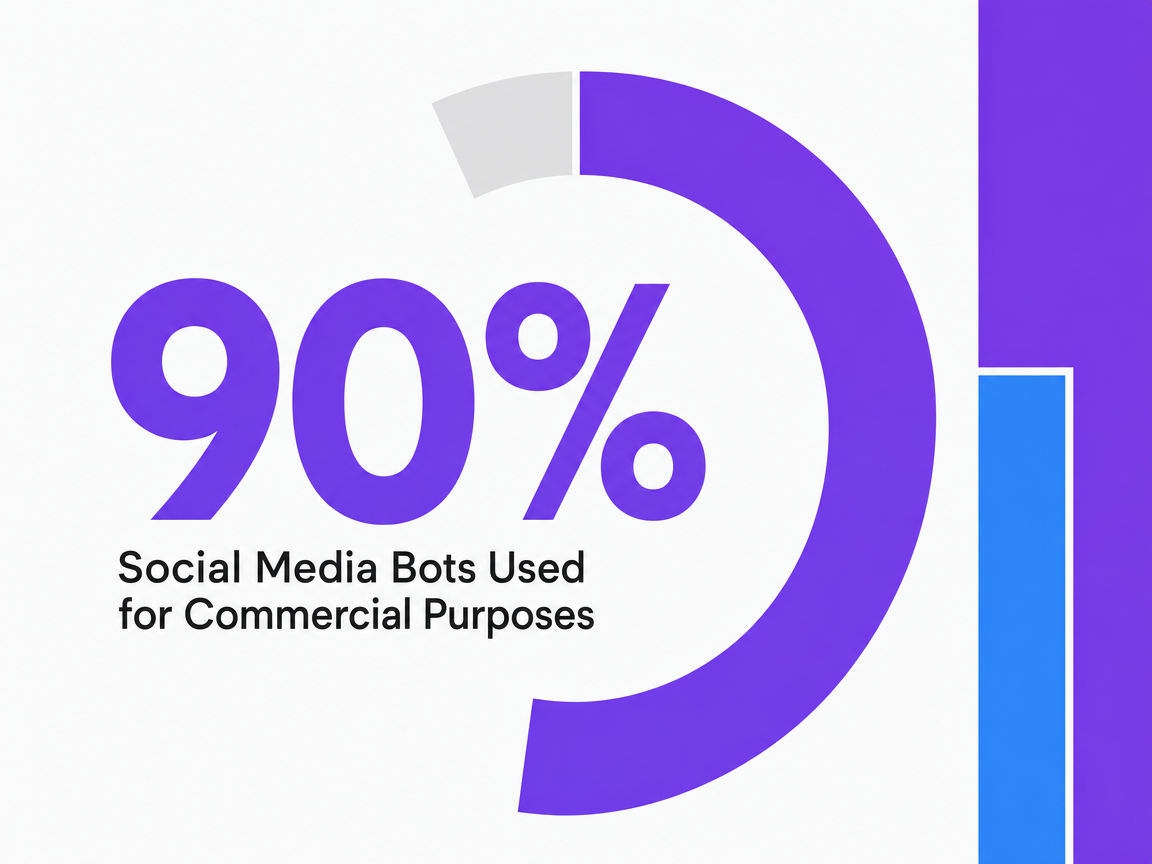 Social Media Bots Used for Commercial Purposes
Social Media Bots Used for Commercial Purposes
Workforce Literacy and the Adoption Ceiling
The ceiling on agency AI adoption is not model quality. It is what the people on payroll know how to do with the tools already licensed. Forrester's work on adoption barriers points to skills gaps and cultural resistance as the practical blockers to scaling AI-powered delivery, not procurement 8. The 2024 state-of-agency-AI report reinforces the pattern: agencies pursuing productivity gains hit legal, commercial, and emotional friction that keeps old habits in place even after new systems arrive 12.
Literacy here means three concrete competencies:
- Account managers need to write prompts that carry brand voice, segment definitions, and performance context, not blank requests.
- Reviewers need to spot the failure modes AI produces, including confident but wrong claims, drift toward generic phrasing, and quiet homogenization across accounts.
- Junior staff need to move from producing drafts to supervising them, which is a different job with a different rubric.
Agencies that treat training as a one-hour orientation stay near the 5% end of the productivity band. The ones that build role-specific literacy, measured against output quality rather than tool logins, are the ones whose margin math actually shifts.
Where Agentic Systems Fit Next
The next layer after AI-assisted drafting is agentic execution: systems that continuously monitor social signals, act on them, and loop the results back into the next cycle without a human triggering each step. McKinsey describes agents that can be embedded to continuously monitor search and social ecosystems, identify emerging trends and intent shifts, and then generate, test, and optimize relevant content 16. That is a meaningful shift from the current pattern, where a person still opens the queue each morning.
For agency owners, the practical read is not to wait for the fully autonomous version. It is to build the approval gate now so agentic capability slots into a governed workflow when it arrives. Agents that monitor and draft are usable today under human sign-off. Agents that publish without review change the liability profile described earlier and should stay behind the gate until the client, the vertical, and the regulator all catch up.
Frequently Asked Questions
References
- 1.The Role of Artificial Intelligence in Personalizing Social Media Marketing Strategies and Its Impact on Customer Experience.
- 2.Marketing and sales soar with generative AI.
- 3.Capturing the potential of AI and gen AI in tech, media, and telecom.
- 4.How gen AI can take customer personalization to the next level.
- 5.The economic potential of generative AI: The next productivity frontier.
- 6.US Agencies Are Currently Leading Generative AI Adoption.
- 7.Advertising Agencies In The US Will Automate 7.5% Of Their Workforce By 2030.
- 8.Rage Against The Machine: Confront The Agency AI Fear Factor With Workforce Literacy.
- 9.The Cost Of AI Productivity Is Less Creativity.
- 10.Social Media Bots and Deceptive Advertising.
- 11.FTC Staff Report Finds Large Social Media and Video Streaming Companies Have Engaged in Vast Surveillance.
- 12.The State Of Generative AI Inside US Agencies, 2024.
- 13.GenAI and the Creator Economy.
- 14.The Role of Artificial Intelligence in Personalizing Social Media Marketing Strategies and Its Impact on Customer Experience.
- 15.How generative AI can boost consumer marketing.
- 16.The future of marketing in the age of AI.