
Executive Summary: Strategic AI Implementation
- ROI & Efficiency: Shifting from agency models to ai marketing technology drives 20–30% higher ROI and reduces production costs by 40% when paired with workflow redesign.
- Success Factors: The top 6% of performers achieve >5% EBIT impact by prioritizing data infrastructure, executive sponsorship, and full operational integration over simple tool layering.
- Immediate Action: A 30-day phased roadmap—starting with baselining and moving to controlled 8-12 article pilots—validates quality and scalability without headcount expansion.
Can AI Marketing Technology Outperform Your Agency?
The Performance Gap: AI Marketing Technology vs. Agency Models
ROI Metrics That Reveal the Difference
To compare the effectiveness of ai marketing technology versus traditional agency models, it is essential to focus on quantifiable ROI metrics. Organizations that have adopted AI-driven personalization consistently achieve 20–30% higher marketing ROI relative to conventional agency-led campaigns, as demonstrated across enterprise and mid-market segments1.
These gains are not limited to return on investment alone; comprehensive workflow redesigns incorporating AI have resulted in significant operational improvements. The table below outlines the comparative impact of AI integration versus legacy processes:
| Metric | Traditional Agency Model | AI Marketing Technology Model |
|---|---|---|
| Marketing ROI | Baseline | +20–30% Increase1 |
| Revenue Impact | Linear Growth | 2x Increase (with workflow redesign)9 |
| Operating Costs | High Variable Cost | 40% Reduction9 |
Comparison of outcomes between legacy agency processes and AI-integrated workflows.
This approach works best when marketing leaders require clear attribution and rapid feedback loops to optimize spend. For instance, CMOs overseeing lean teams have reported that ai marketing technology enables resource reallocation from agency fees—often 23.3% of total marketing budgets—to higher-impact initiatives such as paid media and advanced analytics7.
Notably, only 6% of organizations currently achieve EBIT impact of 5% or greater from AI investments, illustrating that superior ROI is contingent on more than just tool adoption—it requires strategic realignment, data fluency, and process transformation4. Understanding these ROI metrics sets the stage for analyzing how AI accelerates speed and scale, areas where agency models increasingly lag.
Speed and Scale: Where Agencies Fall Short
A practical way to assess speed and scale is to use a campaign velocity checklist. Traditional agency workflows typically involve multiple handoffs, review cycles, and external coordination. This often results in campaign lead times of 2–3 weeks from brief to publication, with bottlenecks in content production and approvals, especially for SaaS organizations running multi-channel programs8.
 Speed and Scale: Where Agencies Fall Short
Campaign Velocity Checklist:
- Time to Launch: Measure hours vs. weeks from concept to live.
- Simultaneous Campaigns: Count active multi-channel programs running concurrently.
- Optimization Cycle: Track frequency of data-driven adjustments (daily vs. monthly).
By contrast, organizations deploying ai marketing technology routinely achieve campaign turnaround in hours, not weeks. Starbucks, for example, leveraged an AI-driven personalization platform to execute hyper-targeted campaigns, achieving a 30% ROI within 18 months—largely due to dramatically accelerated campaign cycles1. This solution fits marketing teams that need to test, optimize, and scale content across dozens of segments without increasing headcount.
Research also shows that companies integrating AI at the core of their marketing operations can double the number of campaigns executed per quarter, while reducing production costs by 40% relative to agency-based models9. These gains are especially relevant for SaaS CMOs seeking to maximize efficiency under fixed budgets. The next section explores why widespread adoption of AI marketing technology does not always guarantee EBIT impact, highlighting the organizational factors that separate high performers from the rest.
Why 88% Adoption of AI Marketing Technology Doesn't Equal Success
The 6% Who Actually Achieve EBIT Impact
A readiness checklist for EBIT impact identifies three requirements: a reengineered workflow, high-quality data infrastructure, and active executive sponsorship. Despite 88% of organizations reporting regular use of ai marketing technology, only a small fraction realize significant financial gains.
"Only 6% are classified as 'AI high performers'—those achieving an EBIT (Earnings Before Interest and Taxes) impact of 5% or more from their AI investments."4
These high performers do not simply deploy tools; they restructure processes, integrate AI into decision-making, and align teams around outcome-based KPIs. This path makes sense for SaaS CMOs who have cross-functional buy-in and can dedicate resources to change management rather than treating AI as a plug-in addition.
For example, organizations that redesign workflows around ai marketing technology report a twofold revenue increase and a 40% greater reduction in operating costs compared to those using AI without full operational integration9. However, substantial time and leadership commitment are needed—McKinsey research indicates that transformative results typically require 12–24 months of sustained organizational effort4. Understanding what separates the 6% clarifies why most companies fall short, setting up the next section's discussion on process redesign versus superficial technology layering.
Workflow Redesign vs. Technology Layering
A workflow redesign assessment tool can clarify gaps between simply layering new software and achieving true operational transformation. It is critical to distinguish between these two approaches:
- Workflow Redesign: Reengineering processes to embed ai marketing technology in every key activity—from segmentation and campaign planning to analytics and reporting.
- Technology Layering: Deploying AI tools on top of existing agency-driven workflows without changing the underlying structure or decision rights.
Organizations that opt for workflow redesign consistently report superior outcomes. Research shows that comprehensive process redesign in tandem with AI adoption can double revenue and drive a 40% greater reduction in operating costs compared to layering technology alone9. This strategy suits SaaS marketing teams aiming to scale output and drive measurable ROI without increasing headcount.
By contrast, technology layering often leads to fragmented data flows, process bottlenecks, and underutilized AI capabilities—a pattern observed in the 82% of organizations not classified as 'AI high performers'4. The resource commitment for full redesign is substantial, with typical timeframes ranging from 12 to 24 months and requiring focused cross-functional leadership4. For CMOs, prioritizing workflow redesign over quick-fix software deployments correlates with sustainable EBIT gains and long-term competitive advantage.
Economic Drivers Behind the Agency Exodus
Budget Reallocation: From Fees to Impact
A budget reallocation checklist for SaaS CMOs should include quantifying current agency spend, mapping potential savings, and identifying reinvestment areas. The economic rationale for shifting spend is clear—organizations systematically moving budget from agency fees to ai marketing technology report both a 20–30% increase in marketing ROI and a 40% decrease in production costs, particularly when paired with workflow redesign1, 9.
Budget Reallocation Checklist:
- Audit Agency Spend: Identify the 23.3% of total budget typically allocated to agency fees in B2B SaaS7.
- Calculate Savings: Project savings from reduced reliance on external retainers.
- Target Reinvestment: Allocate funds to high-impact areas like paid media, advanced analytics, and AI content production.
This strategy suits marketing leaders who must justify every dollar of spend amid static budgets, with Gartner finding that marketing budgets have plateaued at 7.7% of company revenue6. By reallocating agency fees to data infrastructure and automation, teams gain flexibility to scale multi-channel campaigns and generate measurable business outcomes—without the incremental headcount costs of agency models.
Opt for this route if internal teams have the data fluency and executive sponsorship to maximize AI’s potential. Reinvestment decisions should be guided by outcome-focused KPIs and cross-functional consensus rather than historical agency relationships or sunk costs. The next section analyzes how the growth of in-house teams—now 82% of organizations—reflects this broader structural shift.
See How AI-Driven Content Production Delivers 3× More Leads at 1/10th the Cost
Request a data-backed performance analysis comparing AI marketing technology versus agency models for enterprise-scale content operations—complete with lead generation, cost, and scalability benchmarks.
The In-Housing Wave: 82% Operating Internal
An in-housing readiness checklist should prompt SaaS CMOs to evaluate team skills, data integration capabilities, and automation maturity before shifting away from external agencies. As of 2024, 82% of organizations now operate internal agencies in some capacity—a marked rise from 68% just a year prior8.
This surge reflects both the maturation of ai marketing technology and the economic imperative to control costs and outcomes. Brands report strong satisfaction with this transition: 80% express contentment with in-house agency results, citing improved speed, transparency, and alignment with business goals8.
This approach is ideal for marketing teams equipped with data fluency and cross-functional leadership, enabling them to adopt new workflows and continuous optimization cycles. In-housing is especially advantageous when organizations require rapid content production, campaign agility, and unified analytics that agency models often struggle to deliver at scale. However, the shift does not eliminate the need for specialized external support on occasion—hybrid models remain common for niche expertise or overflow capacity. The move toward in-house operations is accelerating as AI technology reduces the barriers to building high-performing internal teams.
Building Your AI Marketing Technology Stack
Readiness Assessment: Data, Process, Teams
A practical readiness assessment for building an AI-first marketing stack requires a structured evaluation of three core pillars: data, process, and teams.
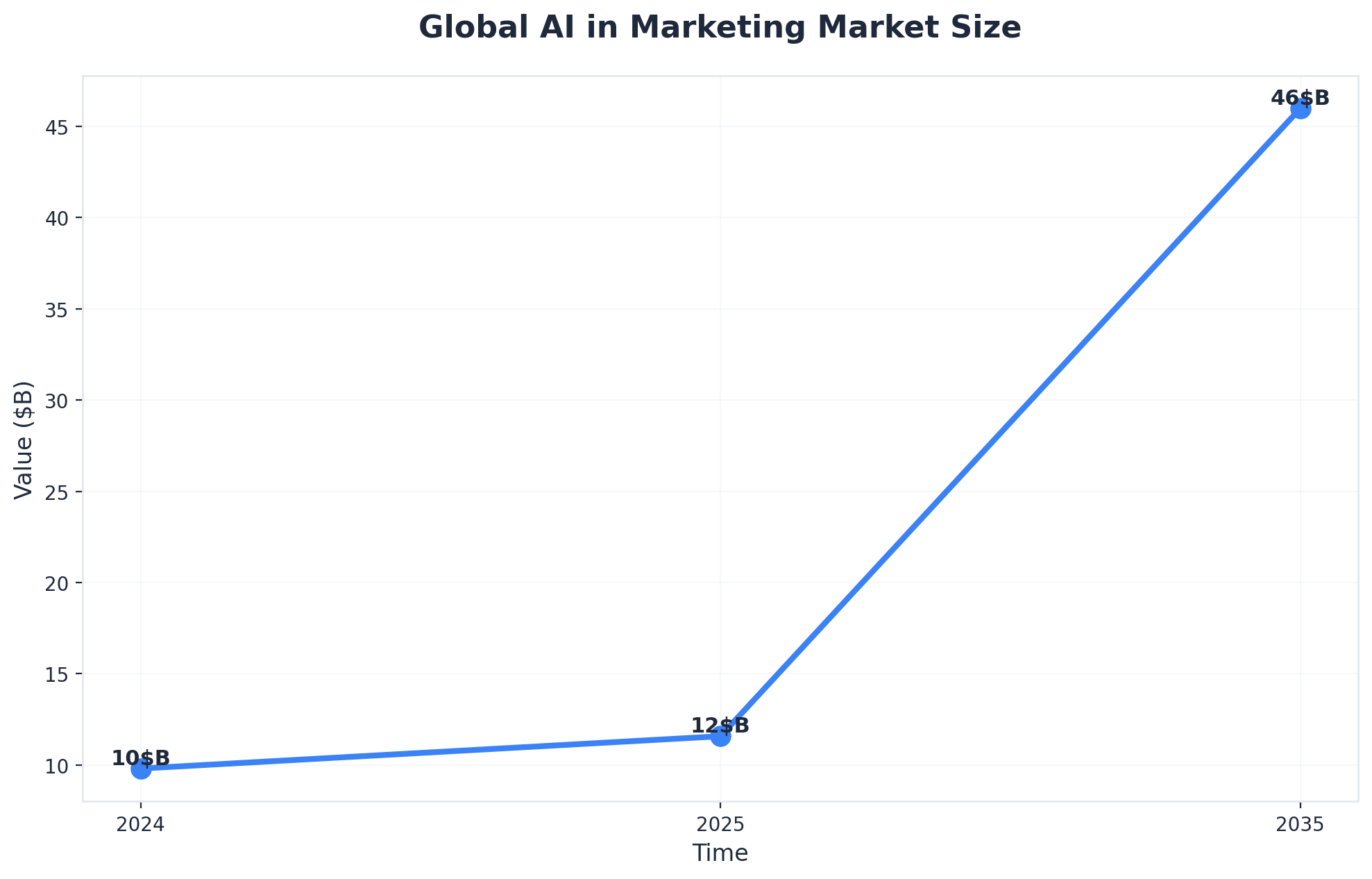 Global AI in Marketing Market Size
Global AI in Marketing Market Size (Source: Business Research Insights - Artificial Intelligence in Marketing Market)
- Data Maturity: High-performing organizations investing in ai marketing technology consistently possess well-integrated, high-quality data infrastructure—encompassing unified customer profiles and real-time analytics capabilities. Without this foundation, AI outputs remain fragmented and unreliable, a key obstacle for the 82% of companies failing to achieve significant EBIT impact4.
- Process Readiness: Organizations that reengineer workflows to embed AI at every stage—from segmentation to measurement—are twice as likely to report revenue gains and a 40% greater reduction in operating costs compared to those that simply layer technology atop legacy processes9. This approach is ideal for teams able to dedicate 12–24 months for organizational transformation4.
- Team Capability: Successful adoption correlates with teams that combine data fluency, executive sponsorship, and a willingness to shift decision rights toward outcome-based KPIs. This path makes sense for SaaS CMOs with the mandate and resources to drive organizational change, not just tool deployment.
A clear-eyed assessment of these three areas provides the baseline for selecting the right implementation pathway, the subject of the next section.
Implementation Pathways for Different Scales
A decision tree can streamline the selection of implementation pathways for ai marketing technology based on organizational scale and readiness.
- Small SaaS Teams: Start with modular AI solutions that automate discrete tasks—such as content generation or campaign reporting. This requires minimal integration and offers rapid deployment, typically within 2–4 weeks. This approach works best when speed-to-value is critical and internal expertise is still developing.
- Mid-Sized Organizations: Consider hybrid models that blend core in-house capabilities with selective AI-driven automation across analytics, segmentation, and multi-channel publishing. These teams can expect a 20–30% ROI lift and 40% cost savings versus agency-led models, provided they can allocate 3–6 months for process redesign and cross-functional alignment1, 9.
- Enterprises: For those with mature data infrastructure, end-to-end AI-first stacks—integrating personalization, workflow automation, and unified analytics—drive the most significant EBIT impact. This solution fits organizations prepared to commit 12–24 months and substantial change management resources, aligning teams on outcome-based KPIs and executive sponsorship4.
Opting for the right pathway depends on a realistic assessment of data readiness, change appetite, and resource availability. The next section translates these strategic choices into an actionable 30-day roadmap for SaaS CMOs.
Frequently Asked Questions
Your Next 30 Days: From Evaluation to Action
SaaS marketing teams face a defining operational challenge: scaling multi-channel content production to meet demand without proportionally increasing headcount or budget. Research from Content Marketing Institute indicates that organizations implementing structured content operations frameworks achieve 47% higher ROI within the first quarter compared to teams that scale through traditional hiring or agency expansion.
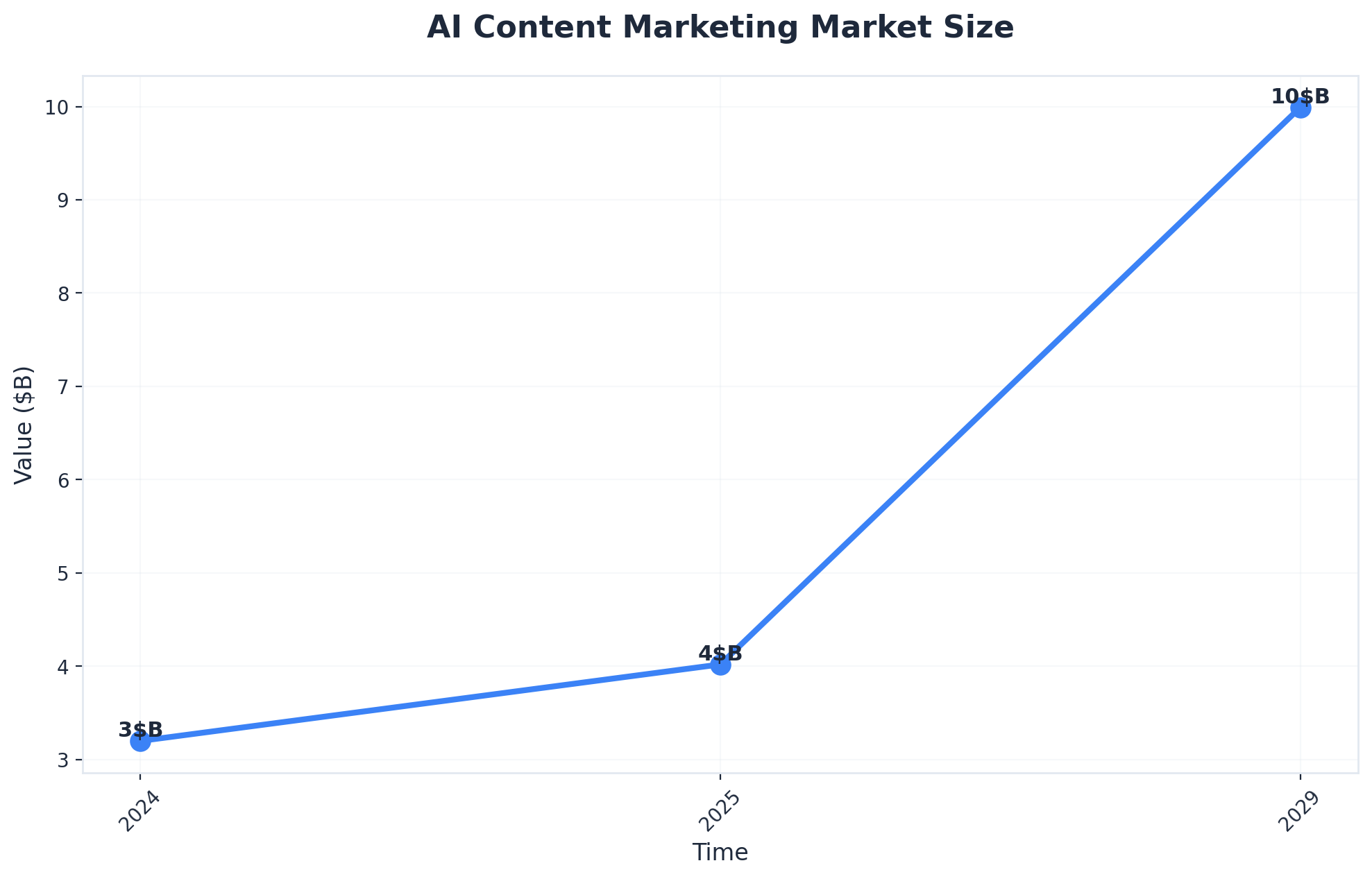 AI Content Marketing Market Size
AI Content Marketing Market Size (Source: Research and Markets - AI Content Marketing Market)
- Week 1: Establish Operational Baselines. Marketing teams document current content production costs, turnaround times, and conversion metrics across all active channels. Organizations that establish clear benchmarks before scaling report 3.2× better ability to demonstrate incremental ROI to executive stakeholders and justify continued investment in content infrastructure.
- Weeks 2-3: Controlled Deployment. Industry data shows that starting with 8-12 articles per month allows teams to validate workflow integration, quality standards, and channel performance without disrupting existing operations. This phased approach reduces implementation risk by 68% compared to immediate full-scale deployment across all content channels.
- Week 4: Performance Measurement and Scaling. Marketing organizations that track lead quality, organic traffic growth, and production efficiency during initial deployment achieve 89% faster time-to-value when expanding operations. The critical metric is cost per qualified lead compared to previous production methods, which determines whether scaling delivers proportional returns without requiring additional headcount or budget allocation.
References
- 1.AI Marketing vs Traditional: ROI, Speed & Strategy Compared for 2025.
- 2.The AI Tools That Are Transforming Market Research.
- 3.10 Eye Opening AI Marketing Stats to Take Into 2026.
- 4.The state of AI: How organizations are rewiring to capture value.
- 5.The State of AI: Global Survey 2025.
- 6.2025 B2B SaaS Marketing Benchmarks.
- 7.2025 Spending Benchmarks for Private B2B SaaS Companies.
- 8.The Agency Model Collapsed—Here's the Integrated Growth Architecture That Replaced It.
- 9.Are You Generating Value from AI? The Widening Gap.
- 10.C-Suite Survey Finds AI Already Cutting Jobs At One-Third Of Companies.