
Key Takeaways
- Reframe tracker ROI around citation share and retention risk rather than click recovery, since only 1% of users click in-summary links 15.
- Distinguish SERP-feature detectors, citation trackers, and generative visibility platforms, then match the tool mix to how a client's buyers actually search.
- Score vendors on coverage cadence, cited/uncited/displaced detection, portfolio roll-up, workflow integration, and closed-loop attribution to leads and revenue.
- Run a six-week cohort test on 200-400 matched queries per client, using impression-weighted CTR to isolate AI Overview impact from other variables 7.
- At 25+ accounts, calculate break-even as annual tracker cost divided by twelve times average MRR, expressed as cancellations the tool must prevent.
- Open QBRs with category-level AI Overview growth and citation share on money queries, not traffic decline charts that read as agency failure 17.
- Defend renewals by committing to monthly outputs the tracker measures, not fixed traffic recovery targets, since coverage nearly doubled in a single quarter 11.
- Execute a twelve-week rollout that ends with citation-led client decks and threshold alerts flagging accounts entering the upper impression-decay band 12.
The Question Every Client CMO Is Now Asking
The email arrives on a Tuesday. A client CMO wants to know whether her brand appears in the AI Overview for her three highest-value category queries, and whether that explains why organic sessions are down 12% quarter-over-quarter despite stable rankings. She has read the headlines. She wants an answer by Friday.
For a Head of SEO running delivery across dozens of accounts, that question is now standard. It arrives faster in verticals where AI Overview coverage has expanded most aggressively, with BrightEdge reporting 58% year-over-year growth in coverage while classic results still appear on 52% of queries 17. The mixed signal is exactly what makes portfolio-level tracking hard. Rankings look fine. Impressions may even be up. Clicks are decaying anyway.
The strategic question is not whether to answer the CMO. It is whether a dedicated AI Overviews tracker earns its line item across the portfolio, or whether existing Search Console and rank-tracking stacks are close enough. That answer requires an evaluation framework, not a tool review.
Why Click Recovery Is the Wrong ROI Denominator
Any tracker business case built on "we'll win back the lost clicks" collapses under the actual behavioral data. Pew Research's browsing panel of 900 U.S. adults found that in March 2025, users clicked a traditional search result on 8% of visits where an AI summary appeared, compared to 15% of visits without one. In-summary citation links were clicked on just 1% of visits, and 18% of searches produced a summary in the first place 15. That is not a gap a content refresh closes. It is a redistribution of attention that no amount of on-page optimization reverses at scale.
The ROI denominator therefore cannot be recovered clicks. It has to be something the tracker can actually influence: which client queries surface AI Overviews, whether the client is cited in the answer, and what that visibility does to downstream lead flow. Every one of those is a measurable output. "Clicks we would have gotten" is a counterfactual the SERP will not give back.
Reframing the denominator has three practical consequences for a Head of SEO defending the line item:
- The finance conversation shifts from traffic recovery to retention risk mitigation per client MRR, which is a number the CFO recognizes.
- The client conversation shifts from ranking dashboards to citation share and impression-to-click decay on tracked query cohorts.
- The delivery team stops chasing rewrites that were never going to move the needle and starts prioritizing the queries where citation is still contested.
Trackers that report only "AI Overview: yes/no" fail this test. The ones worth paying for connect presence, citation state, and downstream outcome in the same view.
Three Tracker Categories Agencies Keep Conflating
SERP-Feature Detectors: AI Overview Presence at Query Level
SERP-feature detectors answer one question: does an AI Overview appear for this query, on this device, in this location, right now. That is the floor of AI Overview tracking, not the ceiling. Most rank trackers have added this flag as a checkbox alongside featured snippets and People Also Ask modules.
The value of presence-only data is diagnostic. It tells a Head of SEO which portion of a client's tracked keyword set has been overtaken by an AI answer, and how that share is trending week over week. What it does not tell anyone is whether the client is inside that answer, whether impressions on those queries are decaying, or whether the pipeline is affected. Presence detection is table stakes. Paying a premium for a tool that only does this, when existing rank trackers already flag it, is hard to defend in a budget review.
Citation Trackers: Whether the Client Appears in the Answer
Citation trackers answer the follow-up question a CMO actually cares about: when the AI Overview shows up, is the client's domain one of the sources Google chose to cite. This is a materially different data point from presence, and it is the layer where most of the strategic decisions live.
Three states matter for reporting:
- Cited means the client's URL appears as a linked source inside the Overview, which is worth tracking as a soft visibility metric even though only about 1% of users click those in-summary links 15.
- Uncited means the Overview answers the query using competitor content while the client's ranking page sits below the fold.
- Displaced means the client previously ranked in the top three and no longer surfaces at all once the Overview expands.
Trackers that only report cited/not-cited miss the displaced state, which is often the one driving impression loss in Search Console. That distinction is the reason to pay for citation-level detection rather than approximate it with rank-tracker workarounds.
Generative Visibility Platforms: Perplexity, ChatGPT, and Gemini Answer Share
Generative visibility platforms track a different surface entirely: whether a client is named or linked when users query Perplexity, ChatGPT, Gemini, or Copilot directly. This is not an AI Overview problem. It is an AI answer engine problem, and it sits outside Google's SERP.
The category matters because Semrush projects AI search visitors could surpass traditional search visitors by roughly 2028, a forecast rather than a measured baseline 6. Publishers adapting to clickless search are already shifting KPIs toward AI citation position and AI-powered referrals rather than classic rank 20. For agencies with clients in high-consideration verticals where buyers research through chat interfaces, this is defensible spend. For agencies whose clients depend on local intent or transactional queries that still resolve in classic SERPs, generative visibility is a secondary layer. Do not pay for all three categories out of category anxiety. Match the tracker mix to how the client's buyers actually search.
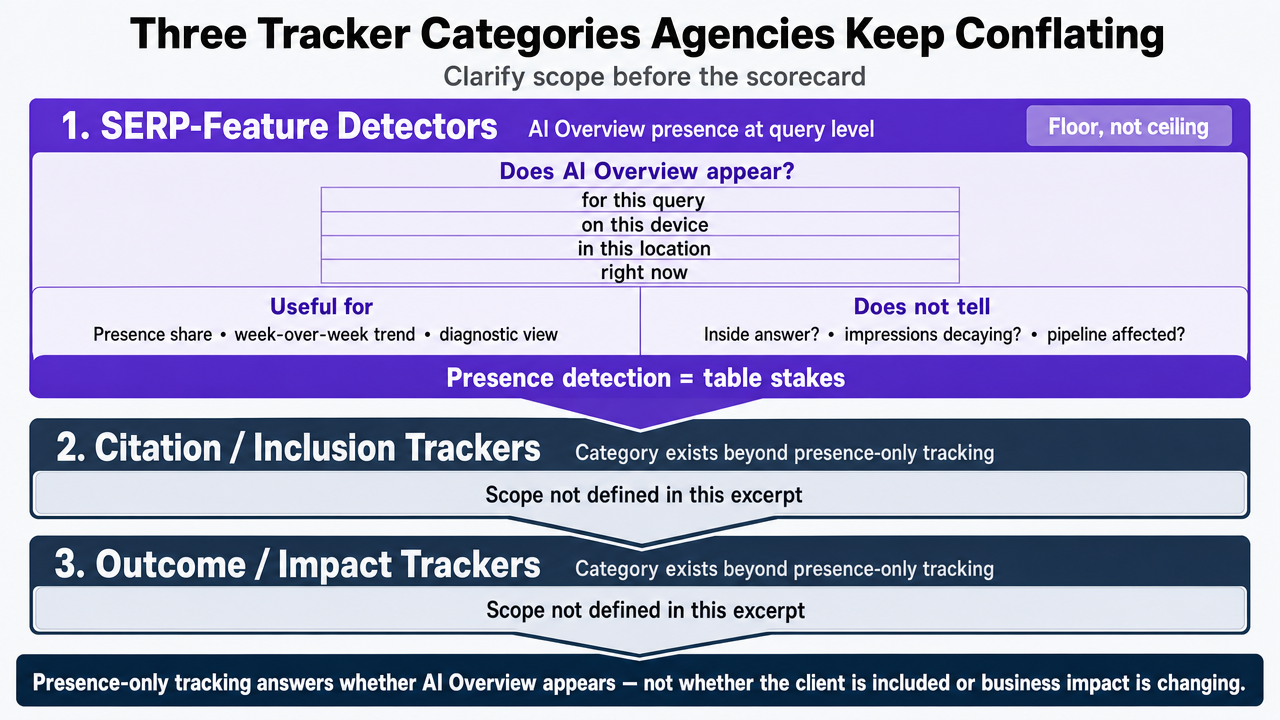 Visualize the three distinct tracker categories the section defines, clarifying scope differences before the reader hits the scorecard
Test AI Overviews Tracking on Live Campaigns Now
Measure AI overview visibility and ROI impact firsthand using your actual client content and data.
The Five-Criterion Scorecard for Any Vendor Pitch
Coverage: Query Volume, Refresh Cadence, and Vertical Fit
Coverage is where most vendor pitches sound identical and mean very different things. The number that matters is not "queries tracked per month" in aggregate, but queries tracked per client per week at a refresh cadence that catches AI Overview volatility. That volatility is not hypothetical. U.S. desktop AI Overview appearance more than doubled from 6.49% of searches in January 2025 to 13.14% by March 2025 11. A tracker refreshing weekly on a Tuesday will miss Overviews that appeared Thursday and disappeared Sunday.
Vertical fit is the second coverage question. AI Overview incidence differs materially between legal services, healthcare, home services, and B2B SaaS, so a tracker's default query universe should be inspectable and editable at the client level. If the vendor cannot show which of a client's actual money queries have triggered an Overview in the last 30 days, coverage claims are marketing.
Citation-Level Detection: Cited, Uncited, or Displaced
Presence detection is a boolean. Citation-level detection is a state machine, and the difference decides whether a tracker earns its price. A defensible tool distinguishes at least three states per query: the client is cited as a linked source inside the Overview, the client is uncited while competitors are named, or the client has been displaced from a previously held top-three position once the Overview expanded on-SERP.
Each state drives a different action. Cited queries feed the retention narrative in the QBR, even accepting that only about 1% of users click in-summary citation links 15. Uncited queries expose which competitors Google chose and where content depth may need to change. Displaced queries are the ones that show up as impression decay in Search Console and rarely recover through minor edits. Trackers that collapse these into a single "AI Overview: yes" flag force the agency to do the classification by hand, which erases most of the labor savings the tool is supposed to deliver.
Portfolio Roll-Up: Cross-Client Views Without Manual Stitching
For agencies running 25 or more accounts, the interface question outranks the data question. A tracker that surfaces beautiful per-client dashboards but forces an analyst to export CSVs and stitch them in a spreadsheet each Monday is a labor cost dressed as a software subscription.
Roll-up capability means three things:
- One screen showing AI Overview coverage percentage, citation share, and impression-to-click decay across every client in the book, sortable by vertical and MRR.
- Threshold alerts that fire when a client crosses a defined decay band, so the account lead does not learn about a problem from the client.
- Permissioned client-facing views so account managers can grant read-only access without exporting anything.
If those three exist, the head of SEO can run a 60-account portfolio review in under an hour. If they do not, the tracker scales linearly with headcount.
Workflow Integration: Search Console, GA4, and QBR Exports
A tracker that lives in its own tab is a research tool. A tracker that writes into the delivery workflow is an operating cost worth defending. Native integration with Search Console is the minimum bar, because impression-versus-click gap analysis on AI Overview-flagged queries is the diagnostic pattern that connects presence data to observed traffic loss 12. GA4 integration matters less for click data than for tying tracked query cohorts to landing-page engagement and downstream events.
The underrated integration is the QBR export. Account teams building quarterly decks in Google Slides or PowerPoint should not be recreating charts from the tracker UI. A vendor that ships branded, per-client export templates saves an hour per QBR across a 40-account portfolio, which is roughly one senior strategist week per quarter. That labor recovery is a line item finance can model, unlike "better insights."
Outcome Attribution: Closing the Loop to Leads and Revenue
The fifth criterion separates trackers from telemetry. A tracker that reports AI Overview presence and citation state without connecting to the client's CRM, call tracking, or booking system stops at the top of the funnel. That is where most vendor pitches end, and it is why finance keeps rejecting the renewal.
Closed-loop attribution means the tool ingests, or exports cleanly into, the systems where leads and revenue actually land. For agencies serving high-stakes verticals, that is call tracking data for qualified inbound calls, CRM data for form-fill quality scoring, and booking platforms where applicable. The KPI shift publishers are already making toward AI citation position and AI-powered referrals 20 only pays back when those visibility metrics can be tied to a pipeline event, even loosely.
A pragmatic test: ask the vendor to demonstrate, on a live account, how a change in citation state on ten tracked queries correlates with change in qualified lead volume over the same window. If the answer requires a services engagement or a data-science add-on, the tool is not closing the loop. It is generating another dashboard.
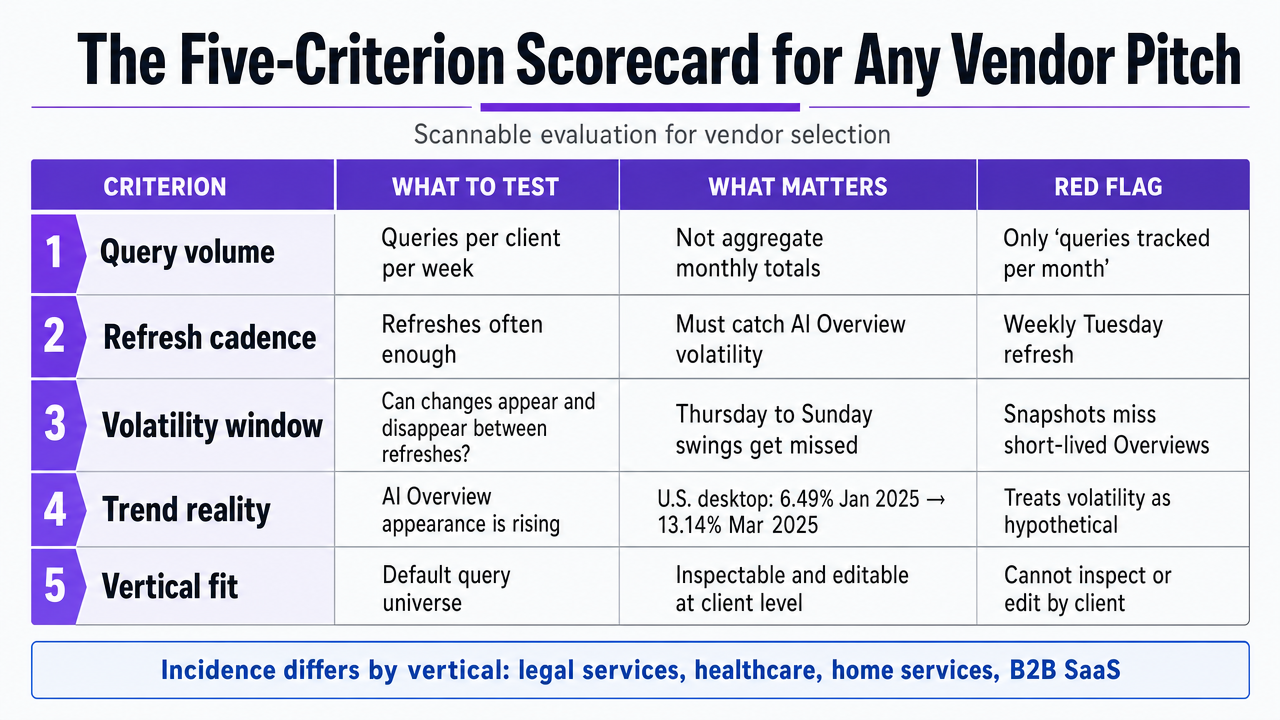 Turn the five evaluation criteria into a scannable scorecard readers can use during vendor selection
Designing a Before-and-After Cohort Test
The fastest way to prove or disprove a tracker's business case is a cohort test that isolates AI Overview impact from every other variable. Pick 200 to 400 tracked queries per client, split them into two matched cohorts based on whether an AI Overview currently appears, and hold search intent, average position, and query volume roughly constant across the split. Then run the comparison for at least six weeks, because AI Overview presence swings week to week and any window shorter than that mistakes volatility for trend.
Seer Interactive's segmented analysis shows what a defensible split looks like in the wild: organic CTR fell from 1.41% on queries without an AI Overview to 0.64% on queries where one appeared, measured across matched query cohorts rather than aggregate site traffic 7. That is the shape of the delta a Head of SEO should expect to reproduce inside a single client's Search Console data when the tracker's query classification is accurate.
Three design decisions determine whether the test yields a defensible number:
- Match cohorts on query intent, not just volume, because informational queries carry most of the CTR compression while transactional queries move less.
- Use impression-weighted CTR rather than a simple average, so a handful of high-volume terms do not distort the read.
- Freeze content changes on the tested URLs during the observation window.
A tracker that surfaces the cohort split automatically and exports it to Search Console-linked reports removes the manual work that usually kills these tests before they finish.
If You Manage 25+ Client Accounts, the Math Changes
Tracker Spend vs. Retention Risk Across the Portfolio
At single-client scope, tracker economics look like a marginal software decision. At portfolio scope, they look like an insurance calculation. The question is not "does this tool pay for itself in recovered clicks" but "how many months of one at-risk client's retainer does the annual subscription cost, and how many prevented cancellations does it need to trigger to break even."
The math resolves cleanly with three inputs the Head of SEO already knows: portfolio size, average monthly recurring revenue per client, and total annual tracker cost. Break-even churn prevented equals tracker cost divided by twelve times average MRR. Below that threshold, the tracker earns back through retention alone, before counting any labor savings or expansion revenue.
| Portfolio size | Tracked queries per client | Annual tracker cost | Avg client MRR | Break-even: clients retained |
|---|---|---|---|---|
| 10 clients | 250 | $C | $R | $C ÷ ($R × 12) |
| 25 clients | 250 | $C | $R | $C ÷ ($R × 12) |
| 50 clients | 250 | $C | $R | $C ÷ ($R × 12) |
| 100 clients | 250 | $C | $R | $C ÷ ($R × 12) |
Plug in the actual numbers before the renewal conversation. If a 50-client portfolio pays $60,000 annually for tracking and the average retainer is $5,000 MRR, the tool needs to prevent one cancellation per year to break even ($60,000 ÷ $60,000 annual value). Prevent two, and it funds a strategist. That framing survives finance review in a way "visibility across the AI landscape" does not.
Sizing the Churn Trigger with Publisher-Cohort Ranges
The break-even calculation only works if the tracker is defending against a real churn signal, not a hypothetical one. Digital Content Next member data supplies the base case: median year-over-year Google Search referral traffic to premium publishers fell 10% over an eight-week window 22, with individual member declines spanning 1% to 25% 2. That is a publisher cohort skewed toward news brands, so agencies should treat 10% as a plausible directional benchmark rather than a service-vertical prediction.
Anchor the churn-trigger conversation to that range. Clients seeing a 5% to 10% year-over-year referral decline on Google-sourced sessions typically absorb it without contract action. Clients trending toward the 20% to 25% end of the range start requesting emergency strategy calls, and those calls are where retainers get renegotiated or cancelled. A tracker that flags which clients are entering the upper band six to eight weeks before the CMO does is the difference between a scheduled QBR and a save conversation.
Get a Live Demo of Enterprise-Grade AI Overviews Tracking and ROI Analysis
See how leading agencies quantify AI Overview impacts, benchmark SERP shifts, and automate executive-level reporting for multi-client SEO operations. Request a walkthrough tailored to your agency’s workflow.
Presenting AI Overview Impact in a QBR Without Triggering Churn
The paradox of running an AI Overviews tracker is that the same data justifying the tool internally can panic a client externally. A slide showing a 20% decline in Google-sourced sessions, no matter how well contextualized, will get read as an SEO failure by a CMO whose board is asking about pipeline. The QBR narrative has to reframe the reality before the numbers land.
Three moves keep the conversation strategic rather than defensive:
- Open with category context, not client data: AI Overview coverage grew 58% year over year across nine industries while classic results still appeared on 52% of queries 17. That establishes the shift is happening to everyone in the vertical, not to this account specifically.
- Move to citation share on the client's tracked money queries, framed as visibility that competitors do not have.
- Save impression-to-click decay for the diagnosis section, paired with the specific queries where content investment can still change the citation state.
Retire the traffic chart from page one of the deck. Lead with citation share, competitor citation share, and the count of queries where the client is currently displaced but recoverable. That reframes the QBR from a loss report into a work plan, which is the conversation that renews contracts. Clients cancel when they feel the agency is watching the decline. They renew when the agency is naming the next ten queries to contest.
Budget Justification When the Baseline Keeps Moving
Every tracker renewal conversation runs into the same objection from finance: how do you justify an ongoing subscription when the thing it measures keeps changing shape? AI Overview coverage on U.S. desktop searches nearly doubled in a single quarter, from 6.49% in January 2025 to 13.14% by March 2025 11. A baseline set in Q1 is already stale by Q2. That volatility is not a reason to skip the budget request. It is the reason to make it.
The defensible framing rejects a fixed baseline entirely. Instead of promising "we will recover X% of traffic," the Head of SEO commits to three measurable outputs the tracker produces monthly:
- The percentage of tracked queries per client where an AI Overview now appears.
- The citation state distribution across those queries.
- The count of clients crossing a defined impression-decay threshold.
Those numbers move. That is the point. Finance can approve a tool that quantifies a moving target more easily than one that promises to hit a fixed one.
Semrush projects AI search visitors could surpass traditional search visitors by roughly 2028, a forecast rather than a measured baseline 6. Treat that projection as directional budget cover, not as a promise. The renewal case rests on current-quarter citation share and retention risk mitigation, with the forward-looking projection reserved for the multi-year budget conversation where it belongs.
A Twelve-Week Rollout Plan for the Chosen Tracker
Signing the contract is not the win. The win is having tracker data feeding QBRs and retention calls by the end of the quarter, before the next round of client CMO emails arrives. A twelve-week rollout keeps that timeline realistic.
- Weeks one through three: import the tracked query set for every active client from existing rank tracking, tag each query by intent, and connect Search Console so impression data flows in alongside AI Overview presence.
- Weeks four through six: establish citation-state baselines per client and identify the displaced queries driving the largest impression-to-click gaps 12.
- Weeks seven through nine: run the cohort test on two or three pilot accounts, wire in call tracking or CRM exports for outcome attribution, and build the portfolio roll-up view.
- Weeks ten through twelve: retrain account leads on the new QBR narrative, ship the first client decks that lead with citation share rather than session counts, and set the threshold alerts that flag clients entering the upper decline band.
By week twelve, the renewal case writes itself in numbers finance recognizes.
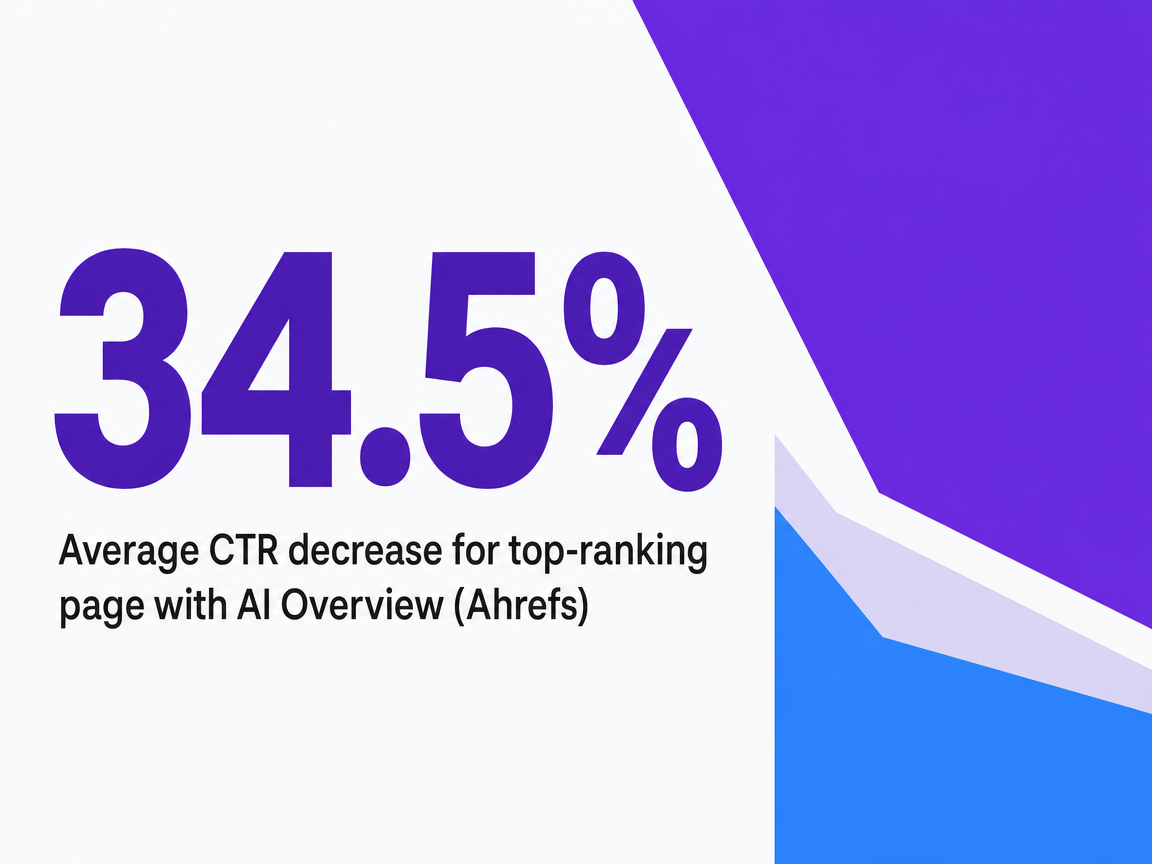 Average CTR decrease for top-ranking page with AI Overview (Ahrefs)
Average CTR decrease for top-ranking page with AI Overview (Ahrefs)
Frequently Asked Questions
References
- 1.Google's AI overviews linked to lower publisher clicks.
- 2.Google AI Overviews linked to 25% drop in publisher referral traffic.
- 3.AI Overviews Reduce Clicks by 34.5%.
- 4.New data: Google AI Overviews are hurting click-through rates.
- 5.Nearly 60% of Google searches end without a click in 2024.
- 6.We Studied the Impact of AI Search on SEO Traffic.
- 7.AIO Impact on Google CTR: September 2025 Update.
- 8.AI Overviews: Will They Affect Organic CTR?.
- 9.The 60% Problem — How AI Search Is Draining Your Traffic.
- 10.1% click-through rate: How Google AI Overviews is killing publishers.
- 11.Google AI Overviews: Key CTR and Traffic Insights.
- 12.Zero-Click Search and AI Overviews: How to Adapt in 2026.
- 13.AI Overviews ARE Impacting SEO. Here's What to Do About It.
- 14.[CASE STUDY] Impact of AI Search on User Behavior & CTR in 2026.
- 15.Do people click on links in Google AI summaries? | Pew Research Center.
- 16.Pew Research Confirms Google AI Overviews Is Eroding Web Ecosystem.
- 17.Google AI Overviews Surges Across 9 Industries.
- 18.Google AI Overviews decrease CTRs by 34.5%, per new study.
- 19.Google's AI Overviews are cutting off the oxygen to the web | Fortune.
- 20.AI overviews: How are publishers adapting to the rise of clickless search?.
- 21.Google AI Overviews Impact On Publishers & How To Adapt Into 2026.
- 22.Facts: Google's push to AI hurts publisher traffic - Digital Content Next.
- 23.Google AI Overview Drives Views, Lowers Clicks: BrightEdge.