
Key Takeaways
- Treating AI content as a four-layer system—codified brand voice, signal data, generation and workflow, and approval with measurement—separates teams that scale output from those that only draft faster.
- The productivity multiplier of 2x to 5x output and 10 to 30 percent lower creative costs comes from removing handoffs between briefing, drafting, and review, not from adding a drafting assistant to legacy processes 2.
- Governance is a design input, not an afterthought: substantiation, review routing for regulated verticals, and C2PA provenance metadata should be built in before publishing, since the FTC treats AI output identically to human claims 12, 13.
- Content managers already using point tools should start by codifying brand voice into machine-readable specs and centralizing performance signals, then consolidate workflow and approval rather than adding more subscriptions 8.
The content backlog outgrew the writer bench
Content demand is climbing faster than any hiring plan can absorb it. Deloitte's global research on generative AI in content marketing reports a 54% year-over-year increase in the volume of content marketers say they need to produce, while marketers using GenAI report reclaiming 11.4 hours per week in production time 9. This gap highlights the reality for most in-house teams: briefs accumulate, refresh cycles are delayed, and freelance coordination consumes time that was once dedicated to editorial judgment.
The macro picture confirms this is not a passing budget cycle. Stanford's 2025 AI Index found that business use of generative AI in at least one function more than doubled from 2023 to 2024, with private investment in generative AI reaching $33.9 billion that year 15. Marketing and sales are at the forefront of this adoption. The average organization using generative AI applies it across two functions, most often marketing and sales alongside product development 3.
For a content manager overseeing three to eight writers, the implications are direct. Demand is increasing rapidly, and peer teams are already using AI to bridge the gap. CMOs, aware of these trends, expect similar efficiencies in future plans.
This article assumes that expectation as a starting point. The question is no longer whether to use AI for content, but how to design a system that manages a 54% demand spike into steady output without compromising quality, brand consistency, or governance rules.
Why a tool stack is not a system
Most content teams already utilize several generative tools. A drafting assistant in the browser, a brief generator in an SEO platform, a social scheduler with its own caption model, and a separate app for transcription and repurposing. While these tools produce output, they do not constitute a cohesive system.
McKinsey's research on scaled creativity emphasizes that leading organizations have built AI-enabled content factories that generate and adapt assets based on continuously integrated performance data, rather than relying on disparate prompts across disconnected applications 2. These companies, treating creativity as infrastructure, report two- to fivefold increases in creative productivity and 10 to 30 percent reductions in creative costs 2. Teams using isolated tools rarely achieve these results, often seeing faster first drafts but the same downstream bottlenecks in review processes.
The architectural issue lies in how a tool stack fragments brand rules, performance signals, and approval trails across multiple vendors. Writers apply voice guidelines from memory, SEO refreshes start from scratch, and campaign results in one dashboard are inaccessible to drafting tools. This means speed at the keyboard does not translate into efficient publishing.
A separate McKinsey analysis on realizing value from generative AI suggests rewiring the business: centralizing AI competencies, building shared capabilities, and connecting models to internal systems based on shared standards 8. For content, this means brand voice, performance data, generation, and approval records all reference a single source of truth, with the output of one layer feeding into the next. This defines a content system, which the following sections will elaborate upon.
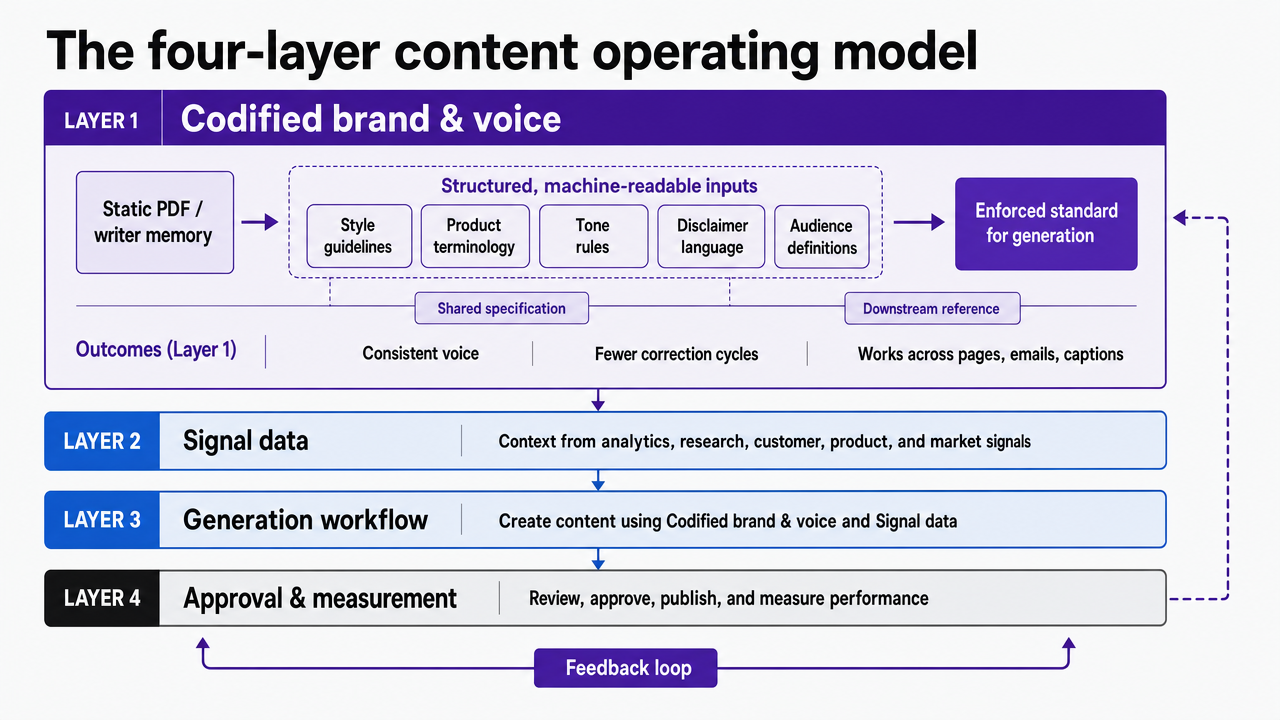
The four-layer content operating model
Layer one: codified brand and voice
The first layer transforms style guidelines, product terminology, tone rules, disclaimer language, and audience definitions into structured, machine-readable inputs. This ensures every downstream step can reference these specifications, moving beyond a static PDF for onboarding to an enforced standard for generation.
McKinsey highlights that companies excelling in scaled creativity treat it as infrastructure, codifying brand to allow AI systems to adapt assets without deviating from the established voice 2. When brand rules are solely in a writer's head, each new freelancer, tool, or campaign introduces inconsistencies. A shared specification ensures consistent voice across diverse content types, such as legal service pages, home services emails, or social media captions, minimizing correction cycles.
Practical artifacts for this layer include:
- a voice card detailing permitted and prohibited phrasing,
- named audience personas with specific vocabulary,
- a terminology list to resolve common editorial choices (e.g., "clients" vs. "patients"),
- and disclaimer libraries linked to content types.
These artifacts prioritize enforcement at the point of generation over aesthetic elegance.
Layer two: data and signal
The second layer provides the generation step with real-time market insights. This includes:
- search rankings by topic,
- landing page conversion rates,
- decaying blog posts,
- successful email subject lines,
- call intelligence data on prospect questions,
- and first-party CRM signals indicating content assets in closed-won deals.
Without this layer, AI produces well-written but unfocused content. With it, the generation step can draft specific content for specific segments at specific moments. McKinsey's research on GenAI in marketing notes that generative models can analyze vast amounts of data to identify audience segments and create personalized outreach content at scale 4. The signal layer is crucial for this capability.
For in-house teams, this involves integrating analytics, search console, CRM, and call data into a queryable system. Content assets must be tagged for performance attribution, and the signal set needs regular updates. The output is a data-backed, ranked list of content priorities, replacing subjective monthly brainstorms.
Layer three: generation and workflow
The third layer focuses on content creation and movement. Beyond just generation, it encompasses the entire workflow: briefing, drafting, editorial passes, SEO checks, legal reviews, and publishing. Teams that implement this layer effectively shift from hiring for coordination to hiring for judgment.
The economic benefits are substantial. McKinsey reports that organizations building AI-enabled content capabilities achieve two- to fivefold increases in creative productivity and 10 to 30 percent reductions in creative costs 2. These figures apply to organizations that integrate generation with workflow, not those merely adding a drafting assistant to existing processes. The productivity gain stems from eliminating handoffs between briefing, drafting, and review, rather than simply increasing typing speed.
A functional layer three features several characteristics:
- briefs are generated from the signal layer, not manually written;
- drafts automatically adhere to brand voice specifications;
- reviewers access assets in a consistent queue with attached reference materials;
- and publishing is a single, streamlined step.
The absence of any of these characteristics significantly diminishes the productivity multiplier.
Layer four: approval and measurement
The fourth layer ensures accountability and continuous improvement. Approval serves as the human control point where editors, legal reviewers, or marketing leads accept or reject system-generated content. Measurement closes the loop, feeding published asset performance back into the signal layer to refine future generation cycles.
Approval is critical, not just culturally. Regulators treat AI-assisted output identically to human-written claims. The FTC explicitly states,
"There is no AI exemption from the laws on the books"
12. Every shipped asset requires a responsible individual's approval. The system's role is to expedite this process, not eliminate it.
Measurement is often where content operations lose value. Without structured feedback, underperforming page templates are repeatedly reproduced. McKinsey's analysis on rewiring emphasizes that achieving value at scale requires connecting models to internal systems via shared standards, ensuring performance data flows back into the capability, not just into a dashboard reviewed weekly 8.
When layer four is effective, approval logs, publish records, and performance data reside in a unified location. The system's next generated brief will inherently leverage insights from past performance.
Experience Scalable AI Content Creation in Action
Test real-time AI-driven content workflows and publish live, production-ready assets during your free trial period.
Workflow automation and the agentic shift
After establishing the four layers, the next step is to enable software to coordinate traffic between them. McKinsey's research on agentic marketing workflows estimates that AI agents will power as much as two-thirds of current marketing activities, with campaign creation and execution accelerating by 10 to 15 times in early implementations 7. This estimate covers broad marketing activities and indicates a future direction rather than a current standard.
The distinction between a generative tool and an agentic workflow is important. A generative tool awaits a prompt. An agentic workflow, however, monitors the signal layer, identifies content needs, routes drafts through brand-voice checks, queues them for appropriate reviewers, and logs outcomes back to the measurement layer. Human approval remains essential, but the coordination between steps becomes automated.
For a content manager, this translates to a reallocation of hours. Low-judgment coordination tasks—chasing briefs, verifying SEO input, reformatting drafts, updating status documents—are eliminated. The remaining work focuses on editorial judgment, strategic prioritization, and approval. McKinsey's agentic analysis notes that organizations deploying these workflows report 10 to 30 percent revenue growth from hyperpersonalized marketing, shifting resources towards consumer reach instead of internal handoffs 7.
The risk in this shift is over-delegation. Agents that publish without human sign-off represent a failure pattern regulators are already scrutinizing. The principle from layer four remains: automate coordination, not accountability. Every asset still requires a person's name attached to its approval.
The economics of three operating models
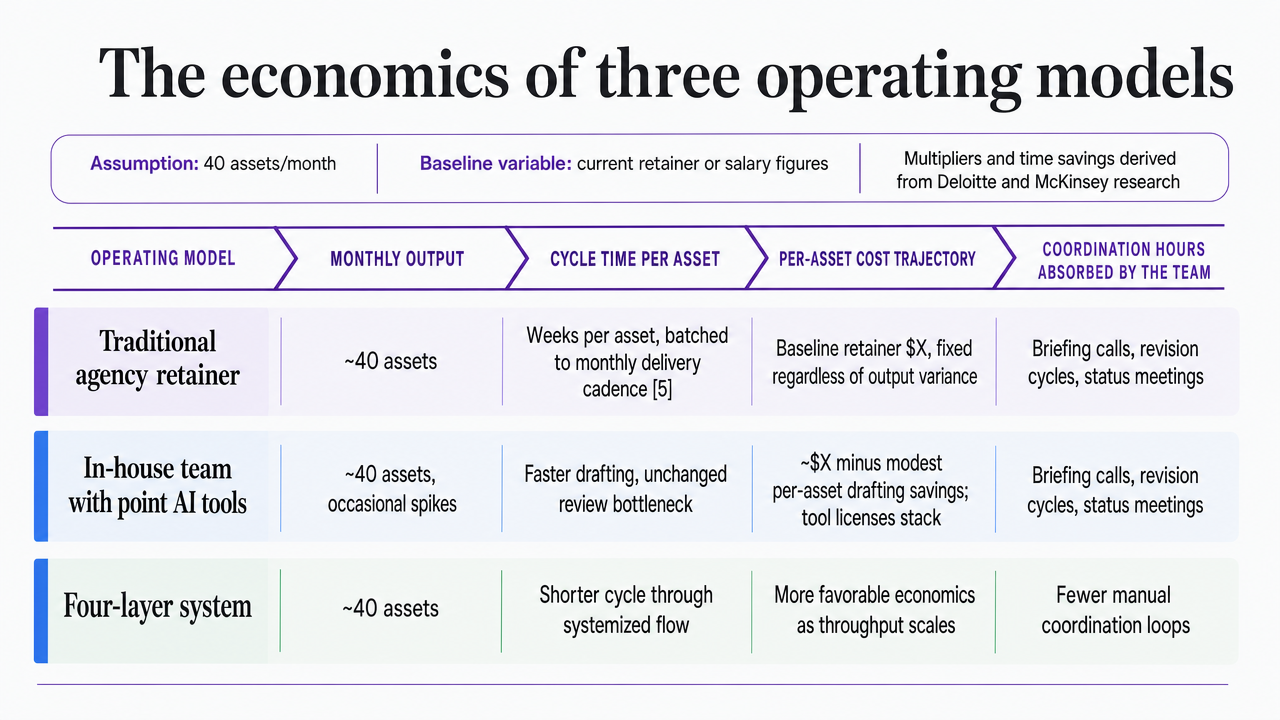
The financial justification for building a four-layer system becomes clear when comparing three operating models. The following comparison assumes a program producing 40 assets per month, with a variable baseline for content managers to input their current retainer or salary figures. Multipliers and time savings are derived from Deloitte and McKinsey research.
| Operating model | Monthly output | Cycle time per asset | Per-asset cost trajectory | Coordination hours absorbed by the team |
|---|---|---|---|---|
| Traditional agency retainer | ~40 assets | Weeks per asset, batched to a monthly delivery cadence 5 | Baseline retainer $X, fixed regardless of output variance | Briefing calls, revision cycles, status meetings |
| In-house team with point AI tools | ~40 assets, occasional spikes | Faster drafting, unchanged review bottleneck | ~$X minus modest per-asset drafting savings; tool licenses stack | Coordination between tools, brand-voice reconciliation, manual QA 8 |
| Integrated AI content system with human approval | 2x to 5x the baseline against the same headcount 2 | Days rather than weeks per asset 5 | 10 to 30 percent creative cost reduction against the baseline 2 | ~11.4 hours per week reclaimed per marketer using GenAI in content workflows 9 |
Two factors drive the financial benefits. First, the productivity multiplier achieved by integrating generation with workflow, rather than simply adding a drafting tool to an existing process 2. Second, the reclaimed coordination time, which frees up hours previously spent on briefs and status updates, allowing more focus on editorial judgment 9. The traditional agency model does not benefit from either, as agency coordination is part of the service provided.
The point-tools model captures some drafting speed but none of the workflow gains. Tool licenses accumulate, brand voice consistency suffers across vendors, and the review queue continues to throttle output. McKinsey's analysis on rewiring emphasizes that achieving value at scale requires centralized capabilities and shared standards, not fragmented subscriptions 8. The integrated system captures both effects because generation, brand rules, signal data, and approval share a unified infrastructure.
A content manager building an internal case can keep the multipliers constant and adjust the baseline. If the current retainer is $X per month for 40 assets, a 2x to 5x output range at a 10 to 30 percent lower per-asset cost is a supported outcome 2. The specific dollar figures will vary by budget, but the direction of the financial benefit is consistent.
Personalization at the local-market edge
While previous sections focused on a single brand and content calendar, this section addresses multi-location operators, such as law firm groups, DSOs, home services franchises, or senior living portfolios. Each location has unique service offerings, competitive landscapes, and search intent. The economics that once made local personalization a luxury now make it essential.
McKinsey's research on personalized marketing indicates that some generative AI deployments accelerate content development 50 times faster than manual approaches, making customized content for small groups economically viable at scale 6. This figure applies to specific deployments and the content development phase, not the entire publishing cycle. Even as a ceiling, it significantly alters content planning capabilities.
For multi-location operators, this translates to the ability to produce distinct landing pages for each location and service line, refreshed against local search data, without the prohibitive per-page cost that previously forced reliance on national templates. The signal layer provides local inputs, the brand layer maintains voice consistency across variants, and the approval layer ensures a single editor is accountable for content in each market. Market-specific variations are accommodated, while core standards remain within the system.
Scale Content Production with AI—Maintain Quality, Increase Output, and Reduce Bottlenecks
See how leading marketing teams are implementing AI-powered workflows to accelerate content velocity and ensure consistent brand voice—without increasing headcount or compromising governance.
The governance layer regulators actually check
Governance is not an afterthought but a fundamental design input for every asset. Deloitte's content marketing research found that 65% of companies are very or extremely concerned about IP and legal risks when using generative AI in marketing 9. This concern is valid, as the FTC's Operation AI Comply targeted deceptive AI claims, fake reviews, and unsupported performance statements, explicitly stating,
"There is no AI exemption from the laws on the books"
12. Any content system publishing into consumer-facing or regulated markets must adhere to these rules from inception.
Three checkpoints are paramount:
- Substantiation: any performance claim, statistic, or comparative statement in an AI-drafted page requires the same evidence trail as human-written content. The generation layer should prevent claims lacking a source in the brand's approved evidence library.
- Review routing: regulated verticals (e.g., legal, health, financial services) necessitate legal or compliance sign-off for specific asset types before publication. The approval layer should automate this routing, rather than relying on a writer's memory.
- Provenance: Content Credentials and the C2PA standard are emerging technical responses to synthetic media, being fast-tracked towards ISO standard 22144 13. Implementing provenance metadata now avoids retrofitting it later when platforms and buyers demand it.
A governance decision map operationalizes these checkpoints. It defines what ships automatically after brand-voice and factual checks, what requires editor review, and what needs legal or compliance sign-off. Each asset type fits into a category, and the system enforces the routing, attaching the approver's name to the record.
When treated this way, governance enhances velocity by ensuring defensible output.
What a Monday morning looks like when the system is running
The true measure of a content operation is its daily execution. In a functional four-layer system, the content queue is pre-sorted before the workday begins.
Overnight, the signal layer identifies issues: three service pages in two metros lost ranking, a high-margin landing page converted poorly, and two blog posts reached their refresh threshold. The generation layer has already drafted responses, incorporating codified brand voice, correct disclaimers for regulated markets, and evidence sources for all claims.
The content manager opens the approval queue to find eight assets awaiting review. Five are standard refreshes for editorial review. Two require legal sign-off due to outcome language, with the system having already flagged the appropriate reviewer. One is a new local-market variant needing practice lead approval. The editorial pass, which once took a week, is completed in a morning.
Hours previously spent on briefing calls, chasing freelancers, and status meetings are eliminated. This frees up time for the work McKinsey's agentic analysis describes: reallocating resources towards consumer reach and strategic judgment, rather than internal handoffs 7. Writers focus on editing, prioritizing, and strategic investment, rather than drafting content that the signal layer could have specified automatically.
By Friday, the assets published on Monday are integrated into the measurement layer, making the next queue even smarter. This is the advantage of building a comprehensive system over merely acquiring tools, defining a content operation that scales without requiring additional headcount. Platforms like Vectoron are designed around this approval-first loop.
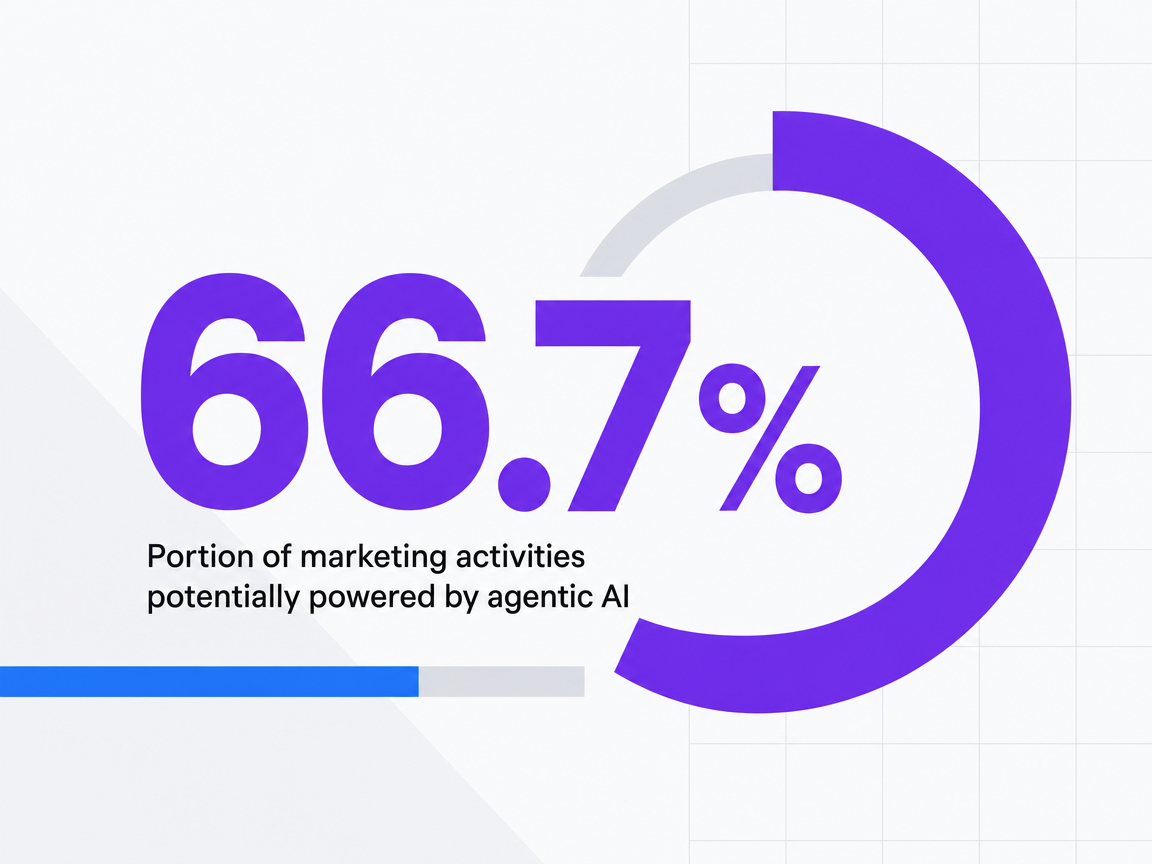 Portion of marketing activities potentially powered by agentic AI
Portion of marketing activities potentially powered by agentic AI
Frequently Asked Questions
References
- 1.The economic potential of generative AI: The next productivity frontier.
- 2.From campaigns to continuous growth: The future of marketing in the age of AI.
- 3.The state of AI in early 2024: Gen AI adoption unfolds.
- 4.AI-powered marketing and sales reach new heights with generative AI.
- 5.How generative AI can boost consumer marketing.
- 6.Unlocking the next frontier of personalized marketing.
- 7.Reinventing marketing workflows with agentic AI.
- 8.A generative AI reset: Rewiring to turn potential into value in 2024.
- 9.Deloitte Digital’s latest research forecasts generative AI’s transformation of content marketing.
- 10.Generative AI in Marketing and Sales.
- 11.The implications of Generative AI for businesses.
- 12.FTC Announces Crackdown on Deceptive AI Claims and Schemes.
- 13.Strengthening Multimedia Integrity in the Generative AI Era.
- 14.The 2025 AI Index Report.
- 15.CHAPTER 4: Economy.