
Key Takeaways
- Treating AI as a production system rather than a drafting shortcut is what converts efficiency gains into agency margin instead of client surplus.
- Approval-first workflows invert the pipeline: ranked recommendations, human sign-off gates, and logged provenance move the throughput constraint from writing to senior reviewer capacity.
- Personalization, insight generation, and variant production earn payback faster than raw drafting, because they multiply the value of assets clients have already paid for 4.
- Focus next on repricing deliverables around outcomes, staffing named reviewers per account queue, and running the production cost worksheet before expanding vendor commitments.
The Production System Is the Product
Most agency owners evaluating AI content generation tools ask the wrong question. They ask which model writes better. The sharper question is which production system captures the value once the model writes anything at all.
The distinction matters because the returns are real but narrow. McKinsey estimates that applying generative AI to marketing could increase the productivity of the marketing function by 5 to 15 percent of total marketing spend, with roughly 75 percent of GenAI's total value concentrated in four functions: customer operations, marketing and sales, software engineering, and R&D 1. That is a productivity envelope, not a revenue windfall. It only shows up on an agency's P&L if the operating model around the tool is redesigned to convert saved hours into billable capacity, sharper strategy, or lower delivery cost.
Agencies that treat AI as a drafting shortcut inside the old briefing-to-publish workflow tend to compress writing time and inflate revision cycles. Editors spend the reclaimed hours cleaning tone, checking sources, and rewriting sections that read fluent but say nothing. The tool changes; the throughput does not.
Agencies that treat AI as a production system change what senior humans do. Strategists move upstream to positioning, offer design, and client judgment. Editors move to approval gates rather than line edits. Automation handles variation, formatting, and distribution. The output of the system, not the output of any single model, becomes the product an agency actually sells.
The rest of this article maps that redesign: where AI earns its keep, what breaks, what governance is required, and what the margin math looks like when the workflow is rebuilt around approval rather than around drafting.
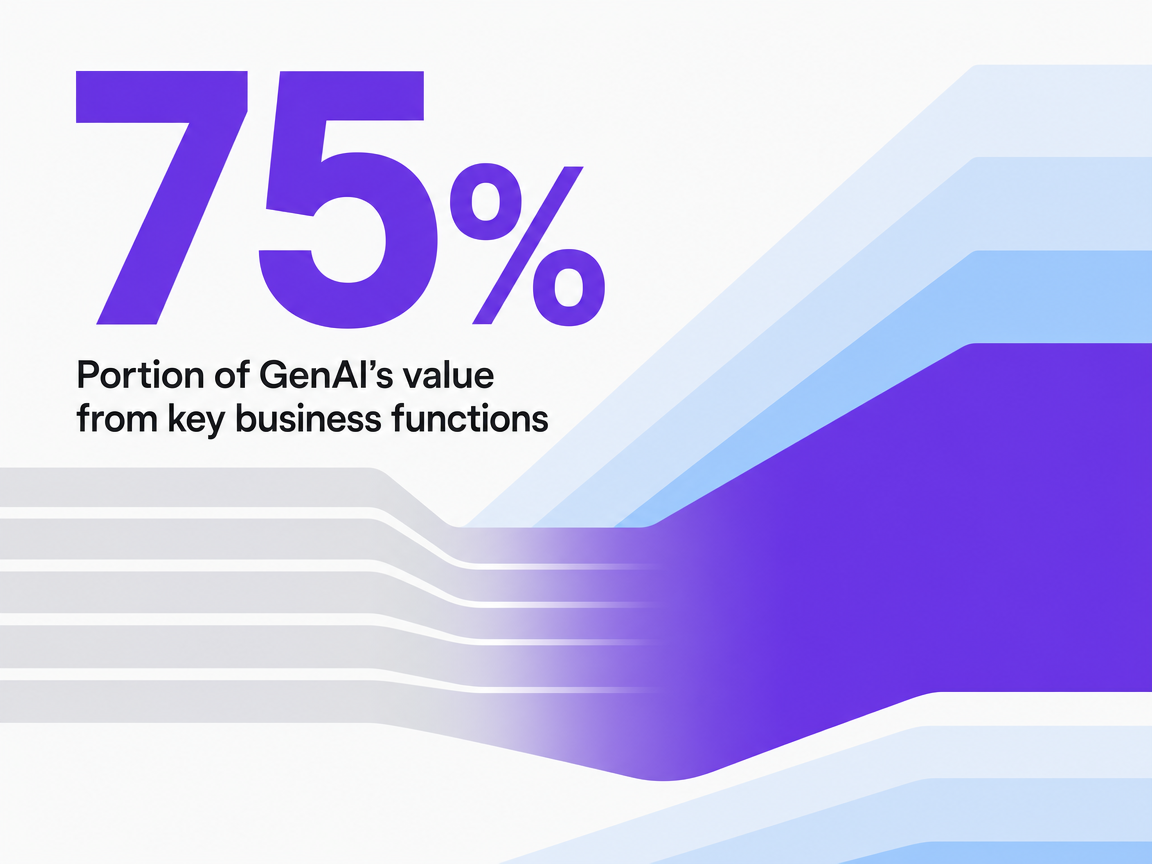 Portion of GenAI's value from key business functions
Portion of GenAI's value from key business functions
Why Agencies Are Losing Money on AI Right Now
The tension inside most agencies right now is not that AI content tools fail to deliver value. It is that the value shows up on the client's balance sheet, not the agency's. A BCG global survey cited in California Management Review reports that 91% of CMOs say generative AI has delivered positive efficiency impacts in marketing 4. Meanwhile, Forrester's 2025 analysis of US marketing agencies finds that AI is currently a cost center for agencies and not a revenue driver, despite broad integration into offerings 11. Clients feel the lift. Agencies absorb the cost.
The pattern is straightforward once the numbers are laid side by side. Agencies invest in tool subscriptions, prompt engineering, workflow retraining, and quality control. Deliverables get faster and often better. Fee structures, however, remain anchored to hourly billing or fixed-scope retainers priced against the pre-AI production stack. Every hour AI saves is an hour the agency can no longer bill. Every efficiency gain becomes a margin compression event unless the pricing model, scope definition, or output volume changes in parallel.
Three cost patterns show up repeatedly in agencies losing money on AI:
- Tool sprawl: overlapping subscriptions for drafting, editing, image generation, and detection, none of which are governed by a single approval workflow.
- Hidden editor overhead: senior staff quietly rewriting fluent-but-hollow AI drafts inside the same billable buckets they always used, so the hours vanish into revisions rather than showing up as productivity.
- Unchanged deliverable definitions: a monthly blog package still priced as 8 articles at a set rate, even though the underlying production cost has dropped by half.
The exit from cost-center status requires two moves executed together. Reprice deliverables around outcomes or output volume that reflects the new production economics, and consolidate the tooling stack into a governed workflow where editor time is measurable rather than absorbed. Agencies that only do the first end up overpromising volume they cannot review. Agencies that only do the second improve internal margins on flat revenue. Both moves, taken together, convert the 91% efficiency gain into agency P&L rather than client surplus.
Where AI Actually Earns Its Keep Inside Agency Workflows
The default assumption inside most agencies is that content creation is the primary place AI pays back. The data says otherwise. A BCG global survey cited in California Management Review found that among the 70% of organizations that had deployed GenAI, the leading operational use cases were personalization at 67%, insight generation at 51%, and content creation at 49% 4. Content creation ranks third, not first.
That ordering matters for how an agency sequences its investment. Personalization gains show up when AI adapts existing assets to segment, geography, vertical, or funnel stage. Insight generation gains show up when AI compresses the analysis layer between raw client data and a strategist's recommendation. Both categories create leverage on work an agency already sells. Content creation, treated as pure drafting, mostly compresses a cost line without changing the deliverable.
Inside a typical multi-client agency, the highest-return applications tend to cluster in four places:
- Variant production: taking an approved core asset and generating channel-specific, persona-specific, or location-specific versions at volume.
- Research synthesis: turning transcripts, call recordings, review corpora, and analytics exports into structured briefs a strategist can act on in minutes rather than hours.
- First-draft acceleration on high-volume, lower-stakes formats such as meta descriptions, ad variants, product descriptions, and internal linking copy.
- Quality assurance passes: consistency checks, brand voice audits, and structural reviews across a portfolio of pages before human sign-off.
Notice what is missing from that list. Flagship thought leadership. Original client interviews. Positioning documents. Anything that carries reputational risk for a law firm, a healthcare system, or a senior living operator. The pattern that shows up across agencies capturing real margin from AI is a sorting rule, not a tooling choice: AI produces where variation and volume dominate, humans produce where judgment and accountability dominate, and both meet at a single approval gate rather than in the middle of a draft.
Agency owners who sequence investment around personalization and insight generation before doubling down on drafting tend to find the payback curve steeper. The reason is structural. Personalization and insight work multiplies the value of assets the agency has already produced and already been paid for. Drafting, absent a repriced deliverable, mostly gives the savings to the client.
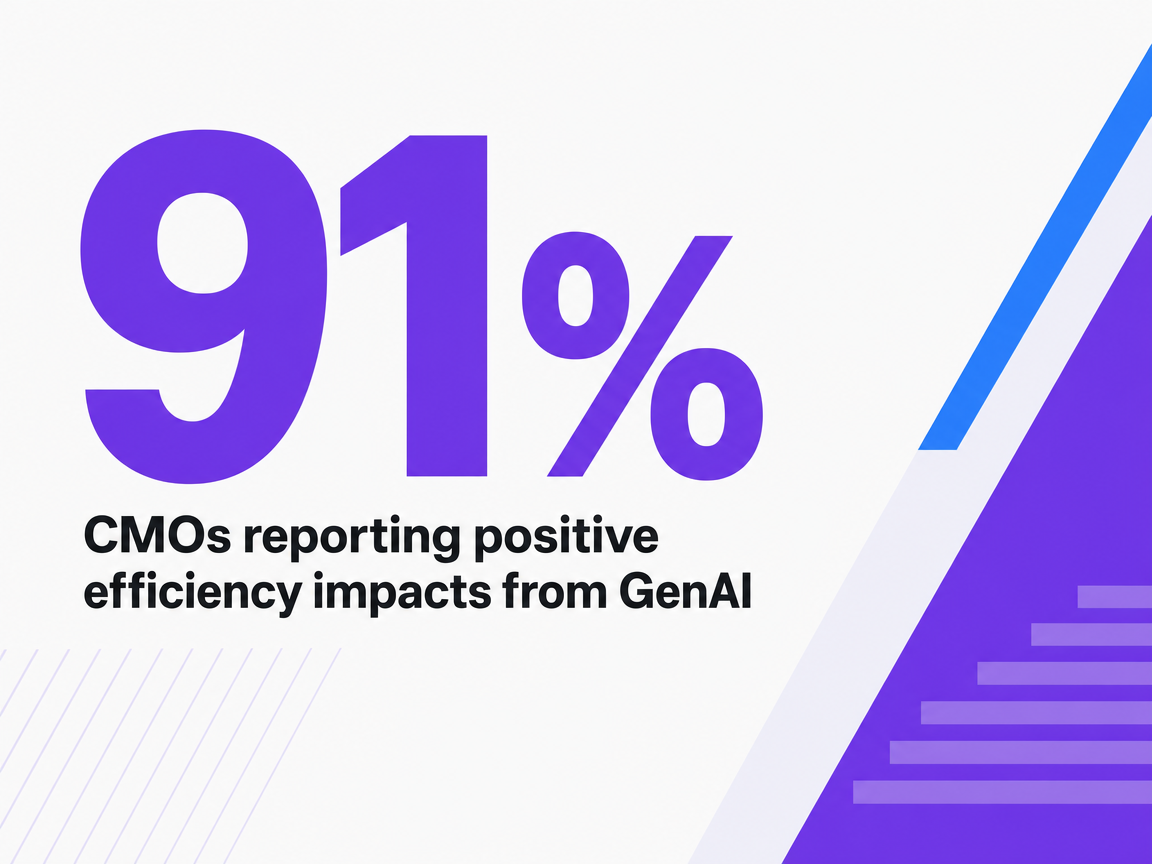 CMOs reporting positive efficiency impacts from GenAI
CMOs reporting positive efficiency impacts from GenAI
The Approval-First Workflow Architecture
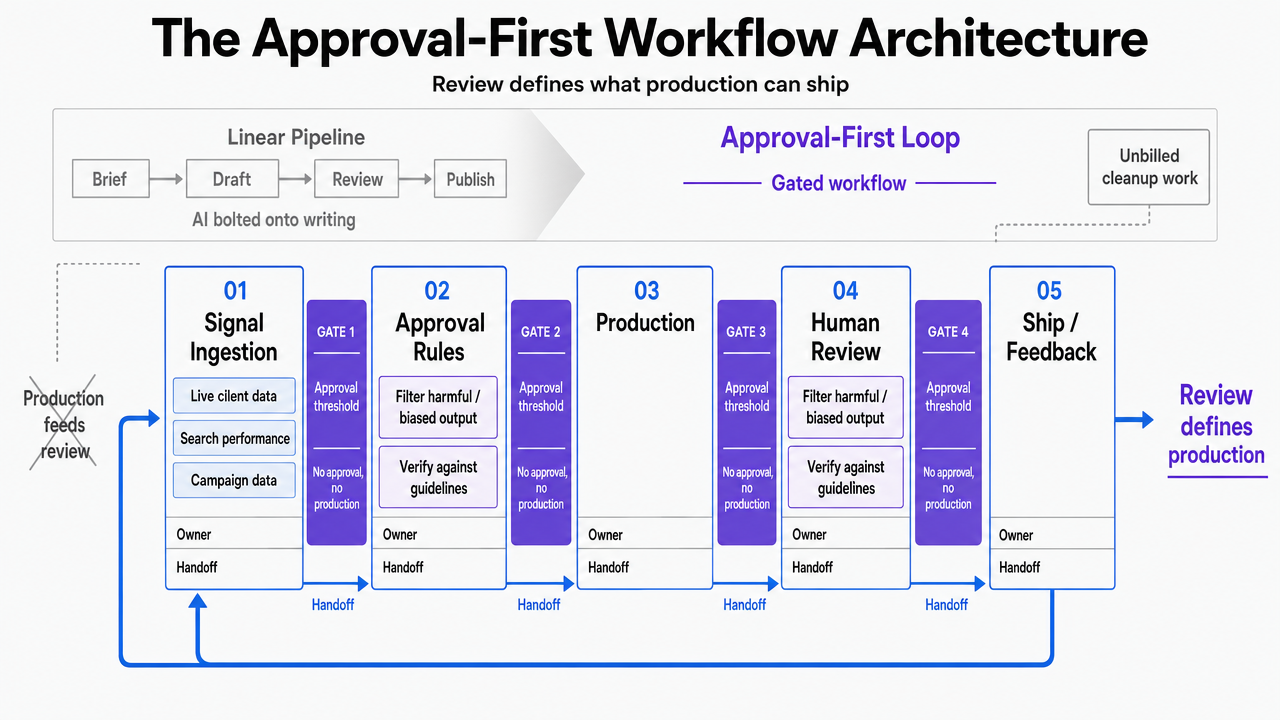
The failure mode inside most AI-enabled agencies is architectural, not editorial. Drafts move through the same linear briefing-to-publish pipeline that predated the tools, with AI bolted onto the writing step. Volume goes up, review capacity does not, and quality assurance quietly migrates into the editor's calendar as unbilled cleanup work.
An approval-first architecture inverts the sequence. Instead of production feeding review, review defines what production is allowed to ship. NIST's draft profile for generative AI recommends filtering outputs for harmful or biased content and incorporating human review processes that verify AI content against guidelines 5. That guidance points to a five-stage loop, each stage with an explicit handoff and an owner.
- Signal ingestion. The system pulls live client data — search performance, call intelligence, booking pipeline, ad spend, competitor movement — into a structured feed that a strategist can read without opening five dashboards.
- Ranked recommendation. AI proposes the next unit of work with the strategic reasoning attached: which asset, for which segment, tied to which KPI, and why now. Ranking replaces the briefing document.
- The human approval gate. A senior reviewer approves, edits, or rejects the recommendation before any drafting begins. This is where substantiation risk gets caught upstream, not after 2,000 words exist.
- Automated execution. Once approved, the system drafts, formats, variant-generates, and stages the asset for a second, lighter approval focused on factual accuracy and brand voice rather than strategic intent.
- KPI attribution. Published assets are tracked back to the pipeline metric that justified the recommendation, closing the loop and feeding the next signal ingestion cycle.
Two design rules keep the architecture from collapsing back into linear production. Approvals are logged, not verbal, so accountability survives staff turnover and client audits. And nothing ships between gates without a named human owner, which prevents the drift where AI output accumulates in a queue no one is authorized to release. The workflow scales because the constraint moves from writing capacity to reviewer capacity — and reviewer capacity is what senior agency talent already exists to provide.
Trial AI-driven content workflows in real time
Experience live client-ready content output before committing to a platform shift.
Staffing the Redesign: Who Stays, Who Shifts, Who Gets Hired
The staffing question inside an AI-enabled agency is rarely about headcount reduction. It is about which roles become the constraint on throughput once drafting is no longer the bottleneck. McKinsey's 2023 survey found that nearly four in ten AI-adopting respondents expect more than 20% of their workforce will need reskilling, with marketing and sales among the most commonly reported functions using generative AI tools 3. The reshaping is real, but it is a role migration more than a role elimination.
Three roles stay largely intact:
- Senior strategists gain leverage rather than losing relevance — their judgment now sets the prompts, ranks the recommendations, and signs off at the approval gate.
- Account leads keep client trust as the primary deliverable AI cannot replicate.
- Analytics owners become more valuable, not less, because attribution now closes the loop on every published asset.
Two roles shift substantially:
- Mid-level writers move toward editorial direction, prompt design, and quality review across a larger volume of AI-produced work.
- Production coordinators shift from trafficking briefs to managing approval queues, logging sign-offs, and enforcing gate discipline.
The skill mix leans toward editorial judgment and workflow governance rather than draft velocity.
Two hires tend to be net new:
- A prompt and workflow lead, sitting between strategy and production, owns the recommendation logic and the guardrails that keep AI output aligned to each client's voice and vertical.
- A governance owner — often a senior editor with compliance instincts — takes responsibility for substantiation, disclosure, and the audit trail across regulated accounts.
Both roles pay for themselves by preventing the quiet editor overhead that drags margin back to pre-AI levels.
Governance as an Operations Layer, Not a Footnote
Governance inside an AI-enabled agency is not a legal review that happens after production. It is a set of controls wired into the workflow itself, sitting alongside drafting and approval rather than downstream of them. For agencies serving law firms, healthcare systems, behavioral health providers, and dental groups, the operational consequences of getting this wrong land inside 24 hours: a hallucinated case citation in a firm's blog, a fabricated statistic in a treatment center's landing page, an unsubstantiated outcome claim in a paid ad.
Three regulatory signals define the current perimeter. NIST's draft profile for generative AI recommends filtering outputs for harmful or biased content and incorporating human review processes that verify AI content against guidelines 5. The FTC has already acted on unsupported AI performance claims — its order against Content at Scale addressed marketing that promised an AI detector could predict AI text with 98% accuracy without adequate proof, when the underlying complaint found the detector was likely accurate around half the time on some non-academic AI-generated content 6, 7. And the FCC has proposed on-air and written disclosure when AI-generated content is used in political ads 9, a leading indicator that labeling expectations will spread across advertising categories.
Translating those signals into workflow means three concrete controls at named stages of the production loop:
- A substantiation check at the recommendation gate: every claim that will appear in a paid ad, a case result, or a treatment outcome must be traceable to a source before drafting begins, not audited after publication.
- An output filter and human verification pass before staging, aligned to the NIST guidance, focused on hallucinated citations, fabricated data, and voice drift on regulated accounts.
- A disclosure and provenance log that records which assets used AI generation, which reviewer approved them, and when — the audit trail a client or regulator can request without a fire drill.
The GAO frames the tradeoff directly: generative AI may dramatically increase productivity, but can also displace workers and spread disinformation 8. Inside an agency, that tradeoff is not abstract. A single unsubstantiated outcome claim on a personal injury firm's site, or a fabricated efficacy statistic on a behavioral health landing page, undoes months of production savings and puts the client relationship at risk. Governance treated as an operations layer — logged, gated, and staffed — is what keeps the productivity gains from being consumed by a single downstream incident.
Margin Math: What Approval-First Production Actually Costs
The economics of approval-first production only make sense against a sourced productivity envelope. Two McKinsey ranges bound the conversation. Applying generative AI to marketing could increase the productivity of the marketing function by 5 to 15 percent of total marketing spending 1. Organizations investing in AI in marketing and sales are seeing a revenue uplift of 3 to 15 percent and a sales ROI uplift of 10 to 20 percent 2. Those are the bands. Anything an agency claims outside them is either narrower scope or fabrication.
Read carefully, those numbers describe value creation, not value capture. The 5 to 15 percent productivity band measures what the marketing function gains. The 3 to 15 percent revenue uplift measures what the advertiser earns. Neither figure is denominated in agency margin. An agency running an approval-first workflow captures a share of the productivity band through reduced production hours per deliverable, and a share of the revenue uplift only if its fee structure ties compensation to client outcomes rather than to hours logged.
Three cost lines shift under approval-first production:
- Drafting hours fall, often substantially, because AI absorbs first-pass writing, variant generation, and formatting.
- Review hours rise, because approval gates become the throughput constraint and senior reviewer time is the expensive input.
- Tooling and workflow overhead rises modestly, driven by subscription costs, prompt governance, and audit logging.
The net effect on cost per deliverable depends on how aggressively drafting hours compress relative to how much review discipline the agency adds.
Two failure modes distort the math. If an agency captures drafting savings without formalizing review, hidden editor overhead consumes the gain and the P&L barely moves. If an agency formalizes review without repricing deliverables, throughput improves but revenue stays flat against a higher fixed cost. The approval-first model earns its economics when both moves happen together: drafting compresses, review is measured and staffed, and pricing shifts toward outcome-linked or volume-tiered structures that let the agency retain a defensible share of the sourced productivity band.
See How AI Content Generation Cuts Production Time by 60% for Agencies
Request a walkthrough of workflow automation and content approval systems that let your team deliver high-quality campaigns at scale, without increasing headcount or compromising oversight.
If an Agency Runs a Multi-Client Portfolio: The Production Cost Worksheet
The audience shifts here. The prior sections assumed a single-agency lens. This one is for owners running a portfolio of 10 or more concurrent client accounts, where the unit of analysis is not one deliverable but hundreds moving through a shared production system each month. At that scale, small per-unit cost differences compound into the numbers that decide whether AI adoption expands margin or quietly erodes it.
The worksheet below compares three delivery models on the same variables an agency owner already tracks. It uses no fabricated benchmarks. Every dollar figure is a placeholder the operator fills in from their own rate cards, with sourced productivity ranges applied as multipliers. McKinsey's 5 to 15 percent marketing productivity band 1 and the 3 to 15 percent revenue uplift range for AI-adopting marketing and sales organizations 2 are the only sourced bounds. Anything else is agency-specific.
| Cost line per content unit | Traditional writer stack | AI-assisted human writer | Approval-first AI production |
|---|---|---|---|
| Drafting hours × blended writer rate | D1 × Rw | D1 × (1 − p) × Rw, where p = 0.05–0.15 1 | Near zero drafting labor; replaced by tooling cost T |
| Editor and review hours × editor rate | E1 × Re | E1 × (1 + h) × Re, where h = hidden cleanup uplift | E2 × Re, measured at the approval gate |
| Tooling and workflow overhead | Minimal | Subscription stack, ungoverned | Consolidated platform T + governance logging |
| Substantiation and audit cost per regulated unit | Absorbed in editor time | Absorbed, often unmeasured | Explicit line item at recommendation gate |
Two variables decide which column wins at portfolio scale. The first is the ratio of drafting-hour savings (p) to hidden editor uplift (h). If h approaches or exceeds p, the middle column collapses back to the left column on a portfolio P&L. The second is whether E2 is staffed and measured. An approval-first model without a named reviewer per account queue reverts to the middle column within a quarter.
The operator move is straightforward: run the worksheet across the current client roster before repricing anything, then decide which deliverables move to column three and which stay in column one because judgment or accountability dominates the unit.
Evaluating Vendors Without Buying the Pitch Deck
Vendor selection is where the approval-first model most often gets undone. Sales decks promise hallucination-free output, brand-perfect voice, and detection scores that no product actually clears. The FTC has already drawn a line here. Its order against Content at Scale addressed marketing that claimed an AI detector could predict AI text with 98% accuracy without adequate proof 6, and the underlying complaint found the detector was likely accurate around half the time on some non-academic AI-generated content 7. The gap between the pitch and the performance was roughly two-to-one.
Four diligence moves separate substantiated vendors from marketing theater:
- Ask for the exact test set behind any accuracy, quality, or detection claim, along with sample size and methodology. Vendors who cannot produce it are quoting internal marketing, not measurement.
- Require a governance walkthrough: how the platform logs approvals, records provenance, and produces an audit trail a regulated client can hand to counsel. NIST's guidance on output filtering and human verification 5 is a useful checklist to run against the demo, not a talking point to accept at face value.
- Run a paid pilot on a live client account with defined KPIs — approval throughput, editor hours per unit, substantiation catch rate — before signing an annual contract.
- Confirm how the vendor handles disclosure. The FCC's proposed rules for AI-generated political ads 9 signal where labeling expectations are moving, and vendors without a provenance layer today will be retrofitting one under deadline pressure later.
The operator move is to treat vendor evaluation as procurement, not partnership. Contracts should specify measured outcomes, exit rights, and audit access — the same terms an agency would demand from any production supplier handling regulated client work.
The 2026 Operator Decision
The choice facing agency owners heading into 2026 is not whether to adopt AI content generation tools. That decision has already been made by the market. Deloitte's enterprise survey shows GenAI already deployed inside marketing functions at roughly 10% of enterprises, alongside operations at 11% and customer service at 8% 10. Clients are building AI into their own stacks. The question is what the agency does with the production system on the other side of that adoption curve.
Two paths separate at the fork. The first keeps AI as a drafting accelerator inside the old briefing pipeline. Volume rises, margins compress, and the efficiency gain shows up on the client's side of the ledger. The second rebuilds the workflow around approval gates, ranked recommendations, logged sign-offs, and KPI attribution — the architecture that lets senior human judgment become the throughput multiplier rather than the bottleneck.
The operators who move first on the second path capture the productivity band before repricing catches up to it. Platforms built around approval-first automation, including Vectoron, are where that architecture is being productized. The decision worth making this quarter is which client accounts get moved into that loop next.
Frequently Asked Questions
References
- 1.The economic potential of generative AI: The next productivity frontier.
- 2.Marketing and sales soar with generative AI.
- 3.The state of AI in 2023: Generative AI's breakout year.
- 4.The Prompt Imperative: How Generative AI Is Rewriting the Rules of Advertising.
- 5.NIST AI Profile for Generative AI.
- 6.Decision and Order.
- 7.Andrew N. Ferguson, Chairman Melissa Holyoak, and others v. Content at Scale, LLC.
- 8.Artificial Intelligence: Generative AI Technologies and Their Commercial Applications.
- 9.FCC Proposes Disclosure Rules for the Use of AI in Political Ads.
- 10.Deloitte’s State of Generative AI in the Enterprise.
- 11.The State Of Generative AI Inside US Marketing Agencies, 2025.
- 12.The Prompt Imperative: How Generative AI Is Rewriting the Rules of Advertising.