
Key Takeaways
- Treat AI writing decisions as portfolio allocation across three modes: draft-first for templated low-risk assets, edit-assist for voice-driven work, and human-only for regulated claims and executive bylines.
- Adoption is nearly universal, but only about one in five marketers use AI daily, showing individual experimentation is outpacing true workflow integration 1, 2.
- Measurable ROI—McKinsey's 3–15% revenue uplift and 10–20% sales ROI uplift—comes from cost reduction on draft-first work, higher testing velocity, and freeing senior writers for strategic content 6.
- Governance sets the floor: log content provenance, require substantiation files before drafting claims, and assign named human reviewers, aligning workflows with NIST's GenAI Profile and FTC Operation AI Comply 3, 4.
The Allocation Problem Behind AI Writing Decisions
Most content marketing managers already have AI writing assistants. The challenge isn't whether to use them, but rather which drafts they should influence, which they shouldn't, and how to justify that distinction as teams scale.
This decision is a portfolio allocation problem, not merely a tool selection issue. Each content asset carries a unique combination of risk, iteration requirements, and strategic importance. A programmatic location page, a founder byline, a paid-social variant, and a health-services claim page may all appear on the same content calendar, but they do not share the same tolerance for automated drafting. Treating them as interchangeable inputs can quietly lead to brand debt and compliance exposure.
Teams achieving the strongest results are deliberately matching tasks to deployment modes. High-volume, low-stakes work is shifted to AI-first workflows with human review. Narrative pieces, regulated claims, and originality-dependent assets remain human-led, with AI serving as a research and editing layer. Forrester emphasizes that generative AI
"must be embedded in workflows with clear accountability, not treated as a magic black box for content"
5.
This article will explore this allocation systematically. We'll first examine adoption trends and the gap between individual use and workflow integration. Next, we'll present a task-allocation matrix based on content risk. We'll then discuss the sources of measurable ROI, the governance standards regulators now expect, and how multi-location operators apply this logic across diverse properties.
Adoption Is Near-Universal, But Integration Isn't
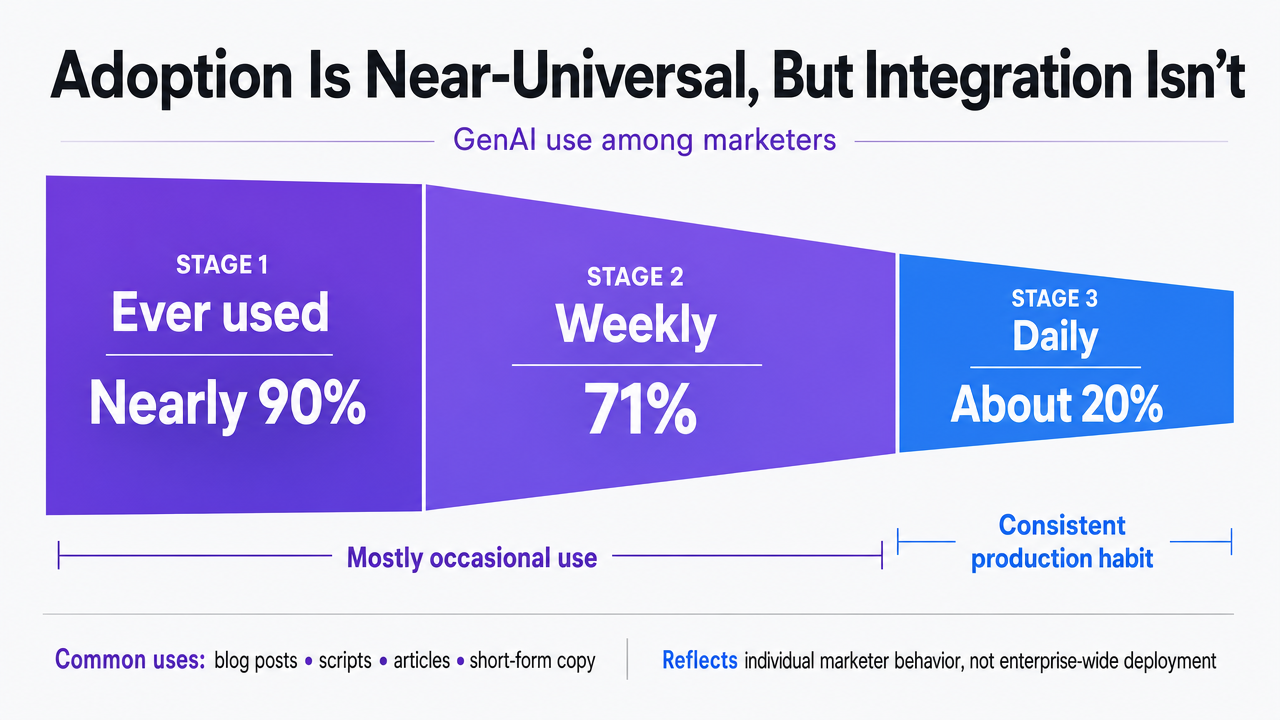
Data clearly shows widespread adoption. A September 2024 survey of over 1,000 marketers by the American Marketing Association and Lightricks revealed that nearly 90% have used generative AI tools for work, 71% use them weekly or more, and about 20% use them daily 1. Blog posts, scripts, articles, and short-form copy are the most common applications. This data reflects individual marketer behavior, not enterprise-wide deployment, and the sample leans towards practitioners already engaged with the field.
Despite high individual adoption, true integration into production habits is less common. The gap between those who have "ever used" AI, those who use it "weekly," and those who use it "daily" is significant. Roughly one in five marketers has integrated AI into a consistent production habit, while the majority use it occasionally, opportunistically, or for initial drafts. This indicates experimentation rather than full integration.
Organizational data supports this trend. McKinsey's early 2024 State of AI survey reported that 65% of organizations regularly use generative AI, nearly double the figure from ten months prior, with marketing and sales showing the largest year-over-year increase 2. This suggests individual habits are progressing faster than institutional workflows. Most content teams have AI in their browsers, but not yet fully integrated into their editorial calendars.
This distinction is crucial. A team where every writer uses an AI assistant on their own terms risks inconsistent voice, unpredictable quality, and difficulty in defending content origins to legal or brand departments. Conversely, a team that assigns AI to specific content categories, with defined review gates and prompt standards, achieves the opposite. The allocation question transforms mere adoption into strategic leverage.
Mapping Content to Risk: The Task-Allocation Matrix
Draft-First: Where AI Should Lead
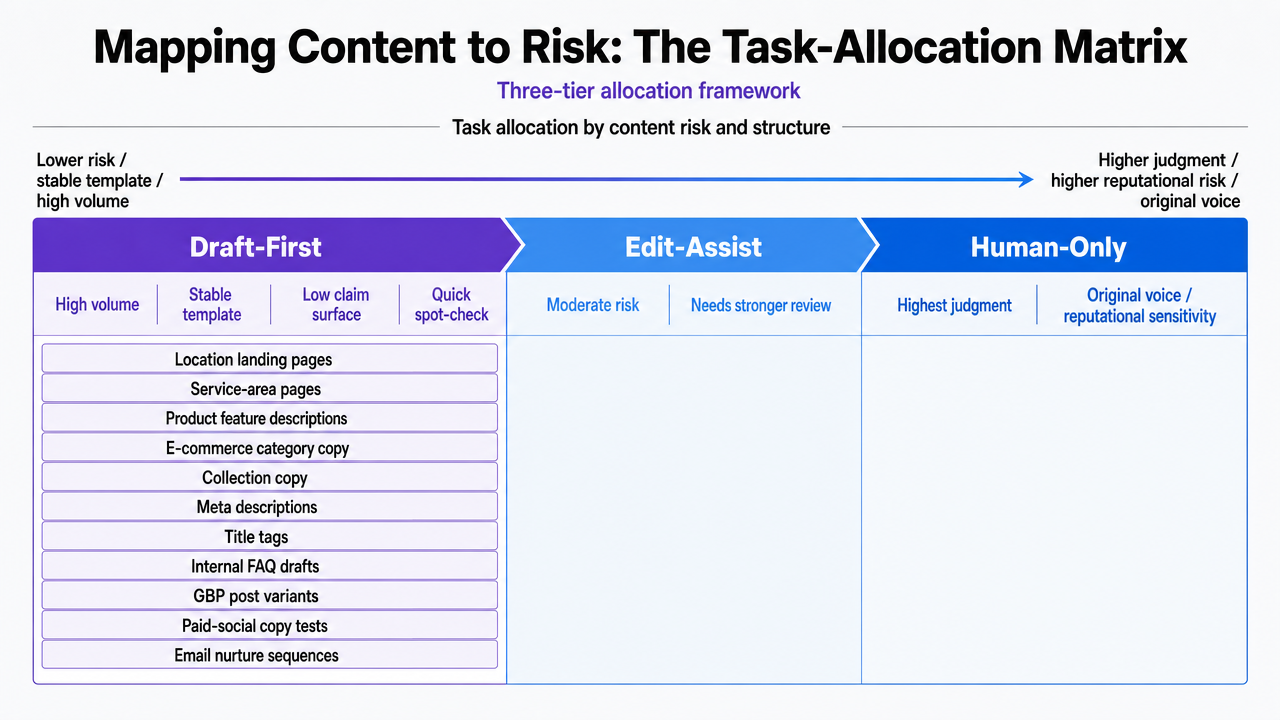
Draft-first work is characterized by high volume, minimal reputational risk per unit, and a stable template that allows for quick human spot-checking. Under these conditions, AI assistants are highly effective for initial drafts, freeing senior writers for more complex tasks.
Ideal candidates include programmatic and templated assets such as:
- Location and service-area landing pages
- Product feature descriptions derived from spec sheets
- E-commerce category and collection copy
- Scalable meta descriptions and title tags
- Internal FAQ drafts
- Google Business Profile post variants
- Paid-social copy tests
Each of these assets follows a predictable structure, has a limited claim surface, and benefits more from volume and rapid iteration than from an original voice.
Email nurture sequences below the consideration stage and initial drafts of top-of-funnel blog explainers on well-covered topics (where synthesis is key, not original reporting) also fit this category. McKinsey specifically highlights personalized email generation and landing page copy as marketing use cases where generative AI can reduce production costs and enhance content effectiveness at scale 6.
The operational rule is straightforward: if a human editor can review the AI output faster than it would take to write from scratch, and if any factual error would be caught before publication, the asset is suitable for a draft-first approach. Other content moves further down the matrix. Draft-first is not autonomous; it involves a human review gate applied to a machine-generated initial pass.
Edit-Assist: Where AI Sharpens Human Work
This middle tier represents where many content teams currently operate. A human writer creates the initial draft, and an AI assistant then refines it by tightening sentences, suggesting headline variations, identifying structural gaps, generating alternative calls to action, and evaluating the piece against target keywords or reading levels. The writer maintains ultimate control.
Edit-assist is suitable for content where voice, argument, and judgment are paramount, but the writer can benefit from a rapid "second reader." This includes consideration-stage blog content, category thought leadership, sales enablement one-pagers, webinar abstracts, case study drafts based on customer interviews, and mid-funnel email sequences. These assets are not templated, but they also do not carry high liability.
The productivity gains are real, though less dramatic than with draft-first. Instead of reducing a four-hour draft to a thirty-minute review, edit-assist typically shortens revision cycles by 20-40% and raises the baseline quality of every draft. Forrester's guidance directly applies here: generative AI should be integrated into workflows with clear accountability, with the writer's byline serving as the ultimate accountability anchor 5.
A potential pitfall is "drift." If a writer consistently accepts too many AI-generated sentence rewrites, the brand voice can gradually flatten towards the model's default. Teams using edit-assist mode need voice checkpoints—such as a style-guide comparison after each piece or a rotating peer review—to detect and correct this drift before it impacts a significant volume of content.
Human-Only: Where AI Creates More Risk Than It Removes
Some content categories are not improved by machine drafting and can even be actively harmed by it. "Human-only" work represents the third position on the matrix and should be narrowly defined and rigorously defended.
Regulated claims are at the top of this list. This includes medical outcomes, legal advice, financial performance projections, behavioral health treatment descriptions, and any statement that could be interpreted as a warranty or guarantee. Such content must be attributed to a named human author with subject-matter authority. Executive thought leadership and founder bylines also fall here; the value of these pieces lies in the individual, and an AI-paraphrased draft diminishes that value. Original research write-ups, customer stories based on direct interviews, crisis communications, and content responding to specific incidents or complaints also require human leadership.
Review responses warrant a separate mention. While they may appear templated, each is a public statement linked to a specific customer experience. Deploying AI-generated responses at scale risks the exact pattern the FTC targeted with Operation AI Comply in September 2024, which focuses on AI uses that facilitate deceptive or unfair conduct 4. A brand response that misrepresents an event, even unintentionally, creates a substantiation problem regardless of who—or what—drafted it.
The matrix below integrates these three modes, providing content managers with a framework for their editorial calendars. This framework is underpinned by Forrester's staged-deployment guidance and NIST's risk-mapping principles, ensuring accountability is built into the workflow rather than added as an afterthought 5, 3.
Test AI-assisted marketing content at scale now
Experience real-time AI content production and measure its impact across your live marketing channels during your trial.
Where the ROI Actually Comes From
The impressive headline figures for AI in marketing can sometimes skew planning discussions. McKinsey's research on generative AI in marketing and sales indicates a 3–15% revenue uplift and a 10–20% sales ROI uplift for organizations investing in AI 6. Another McKinsey analysis suggests that approximately 75% of generative AI's projected economic value is concentrated across four functions: customer operations, marketing and sales, software engineering, and R&D 7. These figures represent the potential ceiling for disciplined deployment, not a guaranteed floor simply by subscribing to a tool.
These gains originate from three specific areas, each aligning with the allocation matrix:
- Cost reduction for draft-first content. When assets like location pages, product descriptions, meta tags, and paid-social variants are moved to AI-drafted, human-reviewed workflows, the per-asset production cost decreases without a proportional drop in traffic or conversion. This is where McKinsey's observations on cost reduction for personalized content and creative production are most relevant 7.
- Revenue uplift from increased personalization and testing volume. AI assistants enable teams to produce more subject-line variants, landing-page permutations, and segmented nurture copy than human-only workflows could achieve in the same timeframe. The revenue uplift is compounded by testing velocity, rather than by any single piece of AI-drafted copy being inherently superior to a human draft 6.
- The reallocation of senior writer time. Every hour a strategist spends not writing a location page is an hour available for crafting pillar content, conducting customer interviews, or rebuilding sales enablement materials. The ROI manifests in the human-only tier because the AI tier has freed up the calendar.
Conversely, ROI disappears when AI is pushed into the human-only category—such as for executive bylines, regulated claims, or original research. In such cases, teams typically observe declining engagement, longer revision cycles, and increased legal scrutiny. The uplift ranges are predicated on disciplined allocation; when applied indiscriminately, the same tools may produce more content at a lower unit cost, but the overall pipeline they feed will slowly underperform.
Governance Before Volume: NIST, FTC, and the Compliance Floor
Scaling AI writing without a robust governance framework can expose content teams to liabilities they might not anticipate. Two key documents, both issued in 2024, now establish the minimum standards for this framework.
The first is the NIST Generative AI Profile, released on July 26, 2024, as a supplement to the AI Risk Management Framework. It provides organizations with a structured method to identify GenAI-specific risks—such as confabulation, data leakage, content provenance, and information integrity—and to select appropriate mitigations aligned with their objectives and risk tolerance 3. For content teams, this translates into a series of practical questions for every AI-involved workflow: What inputs are used? What outputs are generated? Who reviews content before publication? What information is logged, and for how long? Addressing these questions proactively is more cost-effective than doing so under legal review.
The second is the FTC's Operation AI Comply, announced in September 2024. This initiative targets AI uses that facilitate deceptive or unfair conduct, including exaggerated claims about AI capabilities and AI-generated content that misrepresents products, services, or reviews 4. The enforcement scope covers both vendors and end-users. A brand publishing AI-drafted product claims it cannot substantiate faces exposure, regardless of the tool used to produce the copy.
Three operational practices help teams comply with both frameworks:
- Meticulously log which content categories are AI-drafted and which are human-only, ensuring provenance can be verified on demand.
- Require substantiation files for any performance, outcome, or comparative claim before it reaches a draft stage, whether AI-generated or not.
- Assign a named human reviewer to every published asset, with recorded sign-off.
These measures do not hinder a disciplined team; instead, they formalize practices already adopted by top performers and transform the allocation matrix into an auditable policy.
Regulated Verticals: Legal, Healthcare, Financial, and Behavioral Health
Content teams in regulated industries operate under different constraints. The same AI writing assistant that saves a consumer brand hours on a category page can create significant substantiation challenges for a law firm, a dental group, or a behavioral health provider. The allocation matrix still applies, but with a smaller draft-first tier and a larger human-only tier.
Three categories of claims require particular scrutiny:
- Outcome statements—such as settlement figures, treatment success rates, patient recovery narratives, or financial return projections—mandate a documented substantiation file before any draft is written. The FTC's Operation AI Comply explicitly targets AI-generated content that misrepresents products, services, or reviews, and the agency has stated its focus on AI uses that supercharge deceptive or unfair conduct 4. The tool used to produce the copy is irrelevant to this exposure; the claim itself and its evidence trail are what matter.
- Comparative claims constitute the second category. Terms like "leading," "top-rated," "most effective," and similar language require verifiable backing, regardless of whether a human or an AI assistant drafted the statement. Healthcare marketers describing AI-enabled products face an additional layer of scrutiny: the FDA's guidance on AI/ML-enabled device software functions clarifies regulatory expectations regarding transparency, risk management, and performance monitoring 8. While this guidance governs the device itself, it sets the boundaries for what marketing content can credibly claim about such products.
- Testimonial and review content is the third category. Behavioral health, addiction treatment, and legal intake pages are particularly vulnerable here. AI-drafted patient stories or client outcomes—even if composited from real cases—can trigger the deceptive-review patterns flagged by the FTC 4. These assets must remain human-led, sourced from named individuals with signed releases.
A practical rule for regulated teams: AI assistants are valuable for research summarization, plain-language rewrites of already-approved claims, meta description drafting, and internal briefing documents. However, they should not be used for outcome claims, comparative superlatives, testimonials, or any statement that a regulator could later require a team to substantiate.
See How Top Brands Accelerate Content Velocity With AI Writing Assistants
Request a walkthrough of AI-powered workflows that let your team scale production, maintain brand voice, and measure SEO impact—without increasing headcount or manual oversight.
If You Manage Multiple Locations: Portfolio Allocation at Scale
The focus here shifts to content managers overseeing multi-location operations, such as dental support organizations, home services franchises, senior living groups, multi-office law firms, or regional healthcare networks. Unlike single-brand managers who apply the allocation matrix asset by asset, these managers apply it across a portfolio where the same content category recurs dozens or hundreds of times. This changes the economics and the potential failure modes.
Per-location landing pages are the clearest draft-first candidate at scale. A dental support organization with sixty practices needs sixty service pages for each treatment. Human-written variants at this volume yield diminishing returns after the first fifteen. AI-drafted templates, incorporating location-specific inputs like clinician names, addresses, accepted insurance, and verified procedure lists, can then be reviewed by a human who checks specifics rather than writing the prose. Location-specific blog content follows the same logic for evergreen topics with factual local angles. Paid-social copy variants and Google Business Profile post rotations also fit this tier.
Review responses and reputation content move in the opposite direction. Each response is a public statement tied to an identifiable patient, client, or customer experience. AI-generated responses deployed at portfolio scale align precisely with the pattern the FTC flagged when targeting AI uses that supercharge deceptive or unfair conduct 4. A named human, either at the location or the central marketing team, should draft these, with AI limited to suggesting phrasings that the reviewer accepts or rejects.
The portfolio-level economics mirror the uplift ranges seen in single-brand deployments—3–15% revenue uplift and 10–20% sales ROI uplift on AI investment, according to McKinsey's marketing and sales research 6. However, these benefits compound with location count only when governance is centralized. A network where each location develops its own AI workflow will produce diverse voices, varied substantiation trails, and a shared liability. Conversely, a network with centrally defined allocation, prompts, and review gates will achieve the higher end of the projected benefits.
The operating rule for portfolio content managers is concise: centralize the matrix, decentralize the inputs. This means one approved allocation policy, one prompt library, one review checklist, and one substantiation standard, all applied to location-specific facts provided by each site. This structure transforms AI adoption into scaled leverage, rather than scaled exposure.
Building the Decision Habit: How to Codify Allocation Across Your Team
Allocation logic is effective only when it withstands the demands of a busy editorial calendar. Teams achieving the higher end of McKinsey's 3–15% revenue uplift are not necessarily those with the best prompts, but rather those who have moved daily judgment calls from the writer's desk into established policy 6. The decision of when to use an AI writing assistant should be determined before a project brief is opened, not debated during its execution.
Four artifacts help embed this matrix into daily habits:
- A content-type register that lists every recurring asset the team produces and assigns it a deployment mode: draft-first, edit-assist, or human-led.
- A prompt library tailored to the draft-first categories, with input requirements and output templates versioned like any other production specification.
- A review checklist detailing the substantiation, voice, and factual checks required before publication, with a sign-off field for each asset.
- A quarterly audit that samples published work across categories, asking two key questions: Was the assigned mode followed, and did the output meet the checklist criteria?
NIST's Generative AI Profile provides the underlying discipline for such audits, offering teams a structured way to map, measure, and manage GenAI-specific risks against their own objectives 3. Forrester's guidance reinforces this: accountability is integrated into the workflow, not merely documented in an unread policy 5. Platforms like Vectoron are designed around this approval-first model, but the underlying discipline is adaptable, allowing any content team to codify it within a quarter.
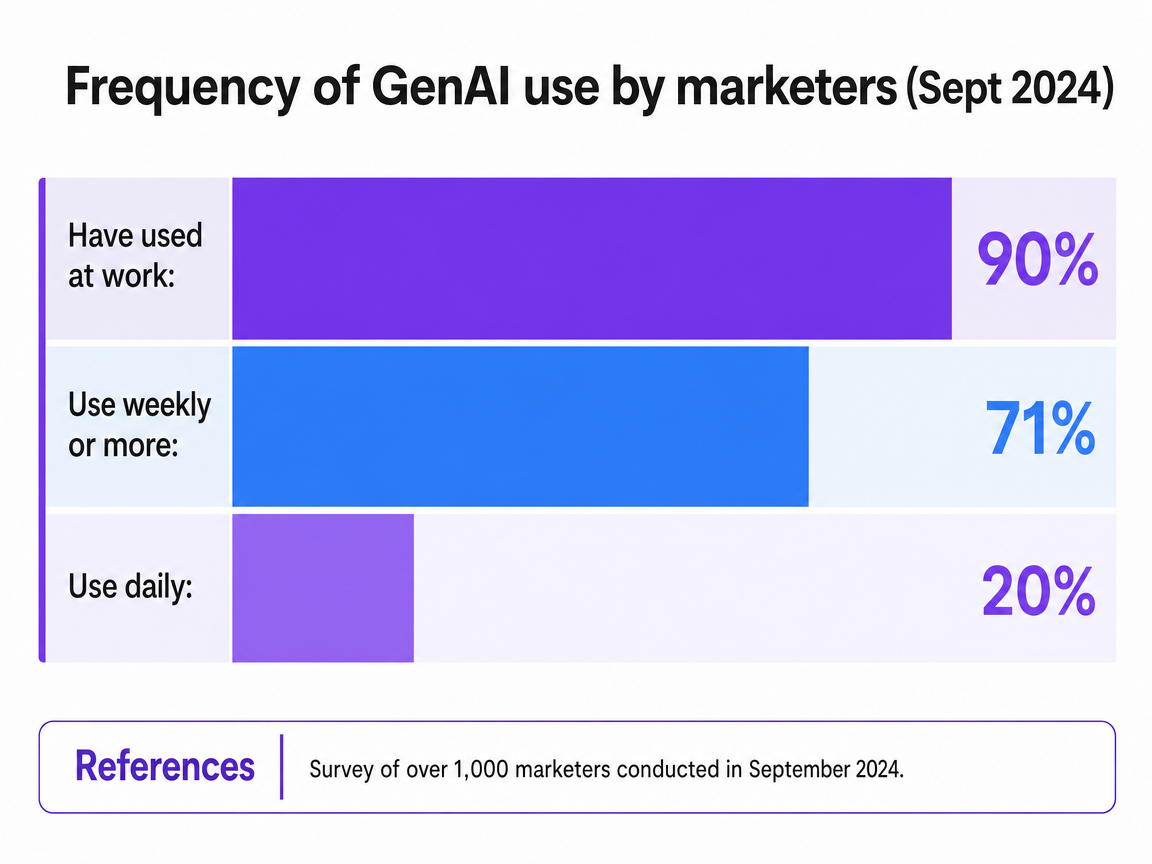 Frequency of GenAI use by marketers (Sept 2024)
A set of KPI visuals or a nested bar chart showing the depth of GenAI integration into marketers' workflows, from general use to daily habit. Based on a survey of over 1,000 marketers.
Frequently Asked Questions
References
- 1.Generative AI Takes Off with Marketers.
- 2.The state of AI in early 2024: Gen AI adoption spikes and begins to generate value.
- 3.AI Risk Management Framework | NIST.
- 4.FTC Announces Crackdown on Deceptive AI Claims and Schemes.
- 5.The Future of Generative AI for Marketing.
- 6.Marketing and sales soar with generative AI.
- 7.The economic potential of generative AI: The next productivity frontier.
- 8.Artificial Intelligence in Software as a Medical Device.