
Key Takeaways
- Visibility has shifted from ranking position to retrieval probability, meaning a page's value now depends on how often generative engines cite it when composing answers 12, 13.
- Buyer behavior moved upstream into AI answers, with 89% of B2B buyers using generative AI during purchasing and roughly 25% treating it as their primary research channel 5, 7.
- Citation frequency responds to specific inputs: entity clarity, evidence density, structural extractability, and verifiable authorship, with combined tactics lifting inclusion by over 5.5% in controlled tests 2, 3.
- Marketing leaders should retire session-based reporting and track answer inclusion rate, citation share, entity coverage, and assisted conversion from AI-referred journeys to connect visibility to pipeline velocity 4, 8.
Citation Probability Has Replaced Ranking as the Visibility Problem
The old visibility question was positional: where does a page rank for a given query. The new one is probabilistic: how likely is a generative engine to select a given page as a source when composing an answer. That reframing, articulated in recent GEO literature, treats AI search as a retrieval problem where the optimization target is expected inclusion in a generated response rather than a slot on a results page 12, 13.
The practical consequence for a Marketing VP is a different unit of account. A page can hold position three for a commercial keyword and still be invisible inside the AI Overview that sits above it. A page can also rank on page two of a traditional SERP and be quoted verbatim inside a Perplexity answer or a Copilot Search response, complete with a visible link in the source list Microsoft now displays alongside every generated answer 17. Rank and citation are no longer the same signal.
Retrieval probability is measurable, and it responds to specific inputs. Controlled experiments on generative engines show that combining fluency optimization with statistics addition lifted citation frequency by more than 5.5% over single-tactic baselines 2. That is a small number in isolation and a large one at scale, because it applies to every question a category leader wants to own. Forrester's B2B analysis reaches a compatible conclusion from the demand side: ranking for keywords is no longer sufficient, and content that answers buyer questions with extractable evidence is what appears in AI sourcing and citations 11.
The strategic implication is straightforward. Visibility, as reported to a CEO or CFO, has to move off session counts and onto citation share, answer inclusion rate, and entity coverage. Teams that keep measuring only sessions will report shrinking numbers while their category authority migrates, one cited paragraph at a time, into competitor names inside the answer itself 1.
The Buyer Behavior That Changed Underneath the Funnel
Buyers stopped opening ten tabs. They opened one prompt.
Forrester's 2024 Buyers' Journey Survey found that 89% of B2B buyers used generative AI in at least one part of their purchasing process, and 87% of those buyers said the tools helped them reach a better business outcome 5. The scope matters: this is Forrester's own buyer panel, measured across discovery, evaluation, and justification stages, not a broad consumer sample. The signal is that AI has already embedded itself in the research work buyers used to do inside a browser tab, and buyers report the substitution is working for them.
A separate 2025 read from Demand Gen Report puts a harder edge on the channel shift: for roughly 25% of B2B buyers, generative AI has overtaken traditional search as the primary research channel 7. That is one in four buyers whose first move on a category question is not Google's blue links. For a Marketing VP running a category with a long consideration window, the practical read is that a meaningful fraction of the top of the funnel is now happening inside a generated answer the brand does not control, cannot rank in through classic tactics, and often cannot see in a session-level analytics report.
The behavior underneath the funnel changed in two directions at once. The volume of research activity per buyer went up, because prompts compress work that used to take multiple queries. The visible traffic to any single brand's site went down, because a well-composed answer resolves the question before a click. Progress's 2025 analysis of the same dynamic recommends that marketers stop treating direct sessions as the primary signal and start measuring assisted conversions from multi-touch journeys that include AI answers 4. The buyer is still doing the work. They are doing more of it, in fact. They are just doing it somewhere the marketing team has not historically instrumented.
The consequence for pipeline planning is that the funnel has not shrunk. The observable part of it has. A buyer who reads a synthesized comparison inside an AI answer and arrives on a demo form three weeks later is not a bottom-of-funnel conversion; that buyer was influenced upstream in a channel that never appeared in the referral report. Column Five's analysis of this shift argues the primary indicator of visibility has to move from traffic to influence, meaning how often a brand is cited, summarized, or recommended inside the generated response itself 1. Reporting that keeps score with sessions will show decline while category authority is being redistributed inside answer panels the team is not measuring.
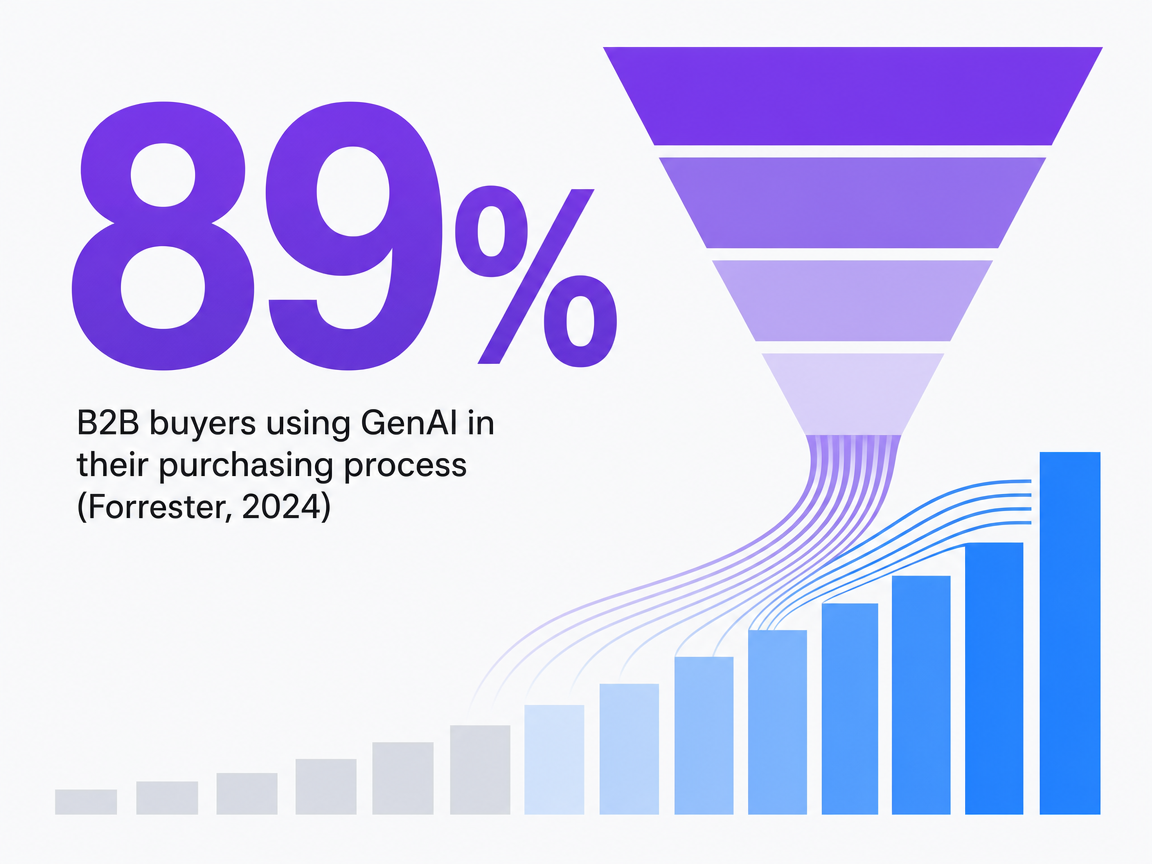 B2B buyers using GenAI in their purchasing process (Forrester, 2024)
B2B buyers using GenAI in their purchasing process (Forrester, 2024)
What AI Engines Actually Cite: The Retrieval Signals That Matter
Generative engines are not selecting sources at random. They are weighing a small set of signals that determine whether a passage gets pulled into an answer or ignored. The peer-reviewed GEO work is the clearest evidence that these signals are optimizable: controlled experiments across retrieval and generation models found that combining fluency optimization with statistics addition produced more than a 5.5% lift in citation frequency compared with single-tactic baselines 2. The number itself is less interesting than what it proves. Answer inclusion responds to inputs, and the inputs stack.
Four signal categories do most of the work.
- Entity clarity. Generative engines resolve queries against entities, not strings. A page that names the product, the category, the buyer segment, and the underlying concepts in unambiguous language gives the retriever a clean object to bind to. Forrester's B2B search analysis makes the same point in operator language: semantic depth and context alignment now outrank keyword density as selection criteria 11. Skyword's coverage adds the corollary that thin, entity-shallow content built for keyword volume tends to lose ground as engines lean harder on topical depth 14.
- Evidence density. Passages with specific numbers, dated studies, named sources, and quantified claims get selected more often than prose that asserts without substantiating. The GEO paper isolates statistics addition as one of the two highest-lift tactics tested 2. The mechanism is not mysterious: an engine composing an answer prefers extractable facts because they reduce the risk of hallucinated output, and evidence-dense passages transfer that risk protection to the model.
- Structural extractability. Google's SGE guidance is explicit about the format bias: nested headings, short paragraphs, and 40 to 60 word AI-digest blocks near the top of a page raise the probability that a section gets lifted verbatim 3. Schema type also matters. FAQPage, HowTo, Product, and AuthorPage markup give engines pre-parsed structure to work with, and pages that carry the right schema for their question type surface in overviews more consistently than pages that rely on prose alone 3.
- Authority signals the model can verify. Named authors with credentials, first-party data, and citations to authoritative external sources feed the E-E-A-T layer that generative engines inherit from their underlying ranking systems 14. The arXiv treatment of generative engine optimization reaches a compatible conclusion, listing content quality, authority, recency, and query-intent alignment as the primary drivers of inclusion probability 13.
The operational point is that a Marketing VP running an answer-first program can move each of these four dials independently and measure the effect. Inclusion rate is not a mood. It is a function of entity coverage, statistics per thousand words, schema completeness, and verifiable authorship, and each of those variables can be audited across a content library in an afternoon.
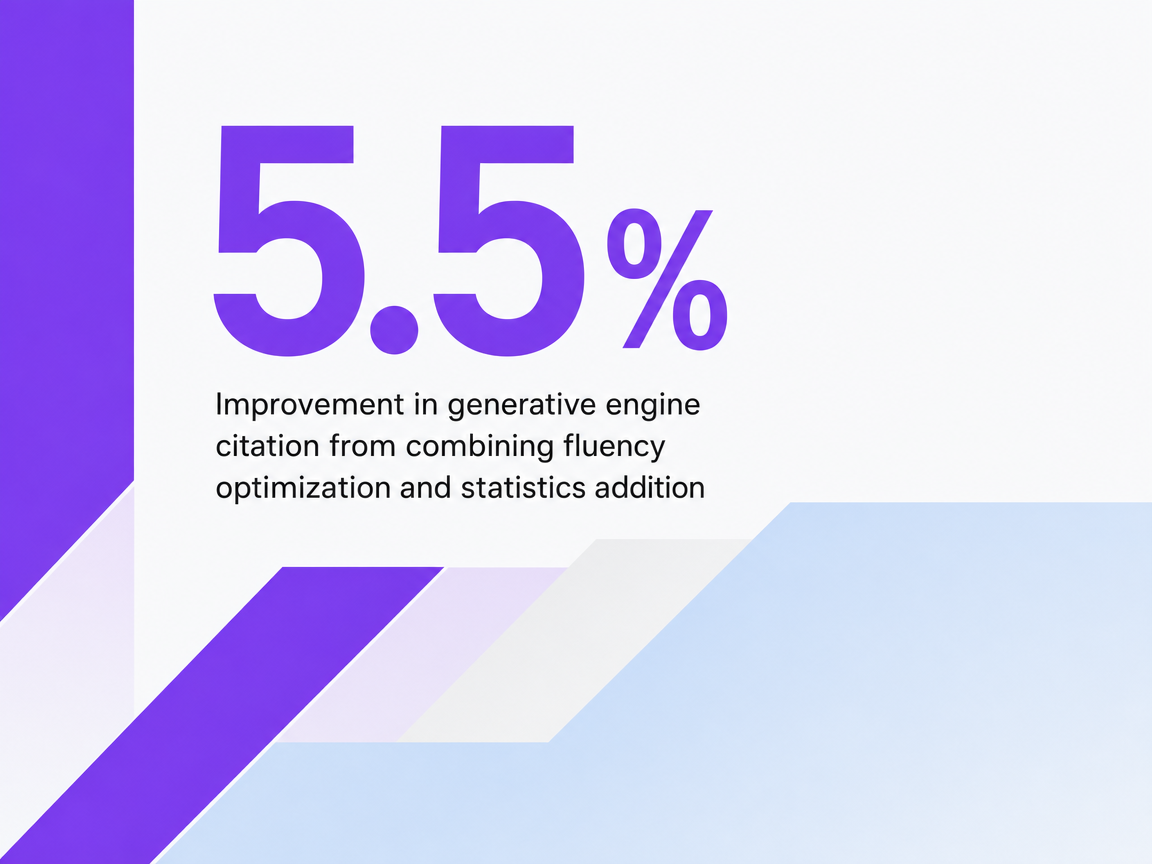 Improvement in generative engine citation from combining fluency optimization and statistics addition
Improvement in generative engine citation from combining fluency optimization and statistics addition
Test Real-Time AI Search Visibility Impact Now
Experience measurable pipeline impact from AI-driven organic visibility with full publishing access during your trial.
The Measurement Stack: Four Metrics That Predict Pipeline Influence
Session counts are not the report a Marketing VP can walk into a QBR with anymore. The dashboard has to reflect what generative engines actually do: select sources, compose answers, and route buyers to a shortlist the brand may or may not appear on. Four metrics carry the load.
- Answer inclusion rate. The share of tracked buyer questions where the brand appears anywhere inside the generated response. This is the closest analog to rank in the new environment, and it is directly observable on engines that expose their source lists. Copilot Search shows the sources and links used to generate each answer, which turns citation frequency into a metric a team can log rather than infer 17, 16. A defensible answer inclusion rate is built from a fixed question set per category, sampled on a schedule, across the engines the buyer actually uses.
- Citation share. Inside the answers where the brand appears, what percentage of the cited sources belong to the brand versus named competitors. Inclusion rate says whether a brand is in the room. Citation share says how much of the room it occupies. Forrester's B2B analysis frames the same idea from the demand side: content that shows up repeatedly in AI sourcing and citations is what compounds category authority, while single-mention inclusion tends to get outweighed by competitors quoted more densely 11. Column Five's read is compatible and blunter: influence, measured as how often a brand is cited or recommended inside AI responses, is the primary indicator of visibility now 1.
- Entity coverage. The percentage of the buyer-question map where the brand has a canonical, extractable answer page for the underlying entity, not just a blog post that mentions the keyword. Generative engines resolve queries against entities, and coverage gaps show up as competitor citations on questions the brand should own. Entity coverage is audited by mapping each question to its target entity, then checking whether a single page carries clean schema, an AI-digest block, and evidence density for that entity 3. A category leader with 80% entity coverage and dense evidence per page will outperform a competitor with more URLs and thinner extractability.
- Assisted conversion from AI-referred journeys. The pipeline metric that closes the loop. Progress's 2025 analysis argues explicitly for measuring assisted conversions from multi-touch journeys involving AI answers, because zero-click interactions upstream still influence downstream form fills, demo requests, and sales conversations 4. Practical instrumentation combines self-reported source fields on demo forms, referral data from the subset of AI engines that pass it, and cohort analysis of buyers whose first known touch was direct or branded search following a period of high answer inclusion. The number will be imperfect. It will also be the only metric on the stack that a CFO recognizes as revenue-adjacent.
Reported together, the four move in a defensible sequence. Entity coverage sets the ceiling. Answer inclusion rate measures how often the ceiling is reached. Citation share measures how much of each answer the brand owns. Assisted conversion translates the first three into pipeline the finance team can price.
The Truth Page: A Canonical Answer Unit Built for Extraction
A blog post per keyword was built for a ranking system. A truth page is built for a retrieval system.
The construct is simple: one canonical URL per buyer question, engineered so a generative engine can lift the answer without ambiguity. It is not a landing page, and it is not a long-tail SEO post. It is the single, evidence-dense answer a Marketing VP wants to be quoted verbatim when a buyer types the question into an AI engine. Everything else on the site links into it.
A working truth page carries six components. The question sits in the H1, worded the way buyers actually phrase it, not the way the internal team phrases it. Immediately below, a 40 to 60 word AI-digest block delivers the direct answer, which is the format Google's SGE guidance identifies as the highest-probability extraction target 3. Beneath the digest, an evidence table or bulleted set of specific numbers, dated studies, and named sources supplies the statistics density the GEO literature flagged as one of the two highest-lift citation tactics 2. Named author attribution with credentials sits in a visible byline, feeding the E-E-A-T layer generative engines inherit from underlying ranking systems 14. Schema markup, typically FAQPage or HowTo depending on question type, gives engines pre-parsed structure to bind to 3. Internal links to related entity pages complete the cluster, so the retriever sees a category-owning graph rather than an orphan URL.
The contrast with the standard content factory is sharp. A keyword-per-post model produces dozens of shallow pages that compete with each other for the same entity, dilute citation share, and give generative engines no clean object to select. A truth page model produces fewer URLs, each engineered to be the canonical answer for one question, with entity clarity, evidence, structure, and authorship stacked on the same page. Forrester's B2B analysis frames the same point from the retrieval side: content that directly answers buyer questions with extractable evidence is what appears in AI sourcing, while broad keyword coverage without depth tends to get outweighed 11.
Operational discipline is what makes the model work. Every truth page gets a fixed question, a single target entity, a refresh cadence tied to evidence recency, and an inclusion-rate audit on a defined engine set. Pages that fall out of the answer get diagnosed against the four signal categories and rebuilt. The library grows narrower and deeper over time, not wider and thinner.
Pipeline Velocity: Why Earlier Engagement Compresses Evaluation Cycles
The pipeline consequence of AI search visibility shows up in the calendar, not the traffic report.
Corporate Visions' 2026 buyer behavior compilation isolates two numbers that most VPs will want on a slide. First, 62% of B2B buyers say they needed sellers to clarify AI capabilities during their evaluation. Second, 58% engaged vendors earlier in the process than usual, specifically to get AI questions answered 8. The scope is B2B buyers reporting on their own behavior across recent purchases, and the two figures describe cause and effect: buyers hit questions inside AI-mediated research that the answer engine could not resolve, so they contacted a vendor sooner than their normal cadence would predict.
That is a pipeline velocity signal, not a brand awareness signal. Earlier vendor engagement means shorter time between first contact and qualified opportunity, because the buyer has already done more of the education work inside the AI layer. Forrester's 2024 data supports the upstream half of the same chain: 89% of B2B buyers used generative AI somewhere in their purchasing process, and 87% of those buyers reported it helped them reach a better outcome 5. Buyers arriving at a demo form after that kind of AI-mediated research are further down the education curve than a cold session from an organic listing.
The mechanism is worth naming. Answer inclusion exposes the brand to buyers upstream, in the synthesis layer where category framing happens. Buyers who see the brand cited repeatedly inside relevant answers form a shortlist earlier and reach out earlier to close specific gaps. Evaluation cycles compress because the discovery-to-shortlist phase runs in parallel with, rather than before, vendor contact.
The reporting consequence is that assisted conversion from AI-referred journeys becomes the metric that ties visibility to pipeline math. Progress's 2025 analysis argues for exactly this instrumentation, treating multi-touch journeys involving AI answers as the unit of measurement rather than direct sessions 4. A VP defending organic investment can then show two connected numbers: rising answer inclusion rate on category questions, and shrinking days-to-opportunity on inbound cohorts whose first known touch followed a period of high citation share.
Quantify the True Pipeline Impact of AI-Driven Search Visibility
Connect with a specialist to see how unified AI marketing execution platforms benchmark, track, and improve your organic search channel’s contribution to predictable pipeline—without adding headcount or managing multiple vendors.
If You Manage Multiple Locations: The Consolidation Math
A brief audience shift. This section is written for operators running content and search across multiple locations: dental groups and DSOs, law firm networks, senior living portfolios, behavioral health platforms, and home services franchises. The single-brand math above still applies. The cost structure does not.
Answer inclusion at the location level is a different problem than at the brand level. Generative engines resolve queries against entities, and a multi-location operator has an entity per location, each with its own service lines, provider bios, licensure signals, and buyer questions 11. A DSO with 40 offices is not running one truth-page library. It is running 40 overlapping ones, each requiring entity clarity, evidence density, schema, and citation-worthy authority signals to compete for local answer inclusion 3, 13. The workload does not divide; it multiplies.
Under the traditional vendor stack, so does the cost. Retainer agency fees, freelance writer rates per article, SEO consultant hours, schema and dev contractor time, and reporting analyst hours each scale with location count. Every new office adds a fresh set of truth pages, a fresh entity map, and a fresh audit cadence. The line items compound.
A coordinated execution model changes the slope of that line, not the presence of it. When entity infrastructure, content production, schema deployment, and inclusion-rate reporting run through one system, per-location marginal cost flattens because the fixed cost of the platform absorbs the coordination overhead that a vendor stack has to re-bill for every location.
The table below is a planning worksheet, not a vendor comparison. It uses only variables the operator supplies.
| Cost Component | Traditional Vendor Stack (per location) | Unified Execution Model (per location) |
|---|---|---|
| Retainer agency | Retainer $ ÷ locations, plus scope adds per location | Absorbed in platform fee |
| Freelance writers | Articles per location × $/article | Absorbed in platform fee |
| SEO consultant | Consultant $/hr × hours per location per month | Absorbed in platform fee |
| Schema and dev contractor | Setup $ per location, plus maintenance hours | Absorbed in platform fee |
| Reporting analyst | Analyst $/hr × hours per location per month | Absorbed in platform fee |
| Scaling behavior | Linear with location count | Fixed platform cost, flattening marginal per-location cost |
Two operator implications follow. First, the vendor-stack model penalizes portfolio growth: adding the 41st office recreates the same coordination overhead as the first. Second, answer inclusion audits per location are the checkpoint that keeps the model honest. If citation share is not rising per location as pages are built, the entity map is wrong, not the budget.
The Execution Problem Retainer Agencies Cannot Solve
The strategy is legible. The execution model is where most programs stall.
An answer-first content library requires four workstreams running in parallel on the same page: entity mapping tied to buyer questions, evidence-dense writing with named authorship, schema and structural markup deployed at publish time, and a citation-tracking layer that audits inclusion rate across engines on a fixed cadence. The traditional retainer stack was not designed to coordinate those four in a single loop. A writer files a draft. An SEO consultant reviews on a different clock. A dev contractor deploys schema in a later sprint. A reporting analyst assembles a dashboard that lags publication by weeks. The signals the GEO literature identifies as citation-lifting stop stacking, because they arrive at the page at different times 2, 13.
The cadence problem compounds it. Enterprise AI adoption is already past the pilot stage: 76% of AI use cases were at production level by 2025, meaning buyers are querying mature systems with sharper questions 10. Retainer scopes rebuilt quarterly cannot keep entity coverage current against that pace. The teams closing the gap run entity infrastructure, content production, schema deployment, and inclusion-rate reporting through one governed workflow, with human approval on every publish. That is the execution shape platforms like Vectoron are built for, and it is the reason the pipeline math in the earlier sections is defensible only when the four workstreams share a single system of record.
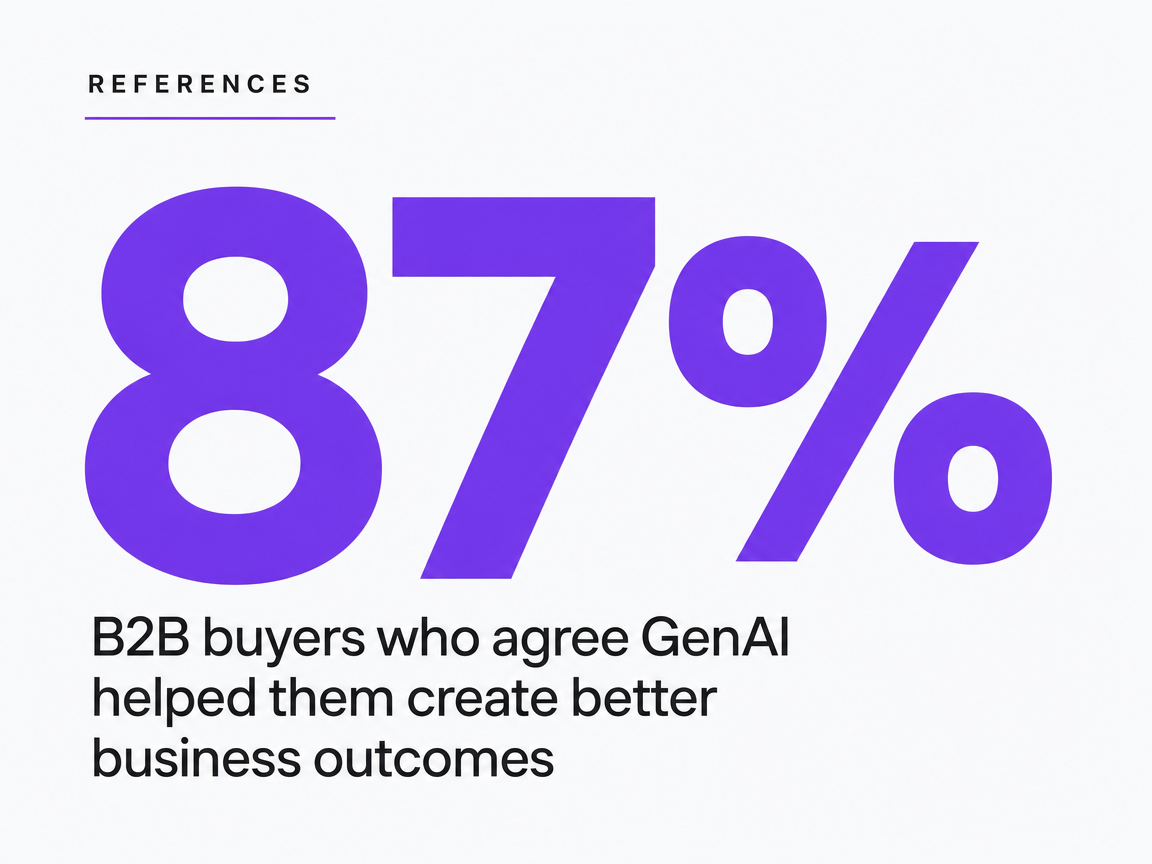 B2B buyers who agree GenAI helped them create better business outcomes
B2B buyers who agree GenAI helped them create better business outcomes
Frequently Asked Questions
References
- 1.AI Search Visibility Stats That Might Surprise B2B SaaS Marketers.
- 2.GEO: Generative Engine Optimization.
- 3.Google's Search Generative Experience (SGE): 2025 SEO Survival Guide.
- 4.Search in 2025 - Rise of AI, User-Generated Content & Future of SEO.
- 5.The Future Of B2B Buying Will Come Slowly And Then All At Once.
- 6.2024 Buyer Behavior Report.
- 7.GenAI Overtakes Search for a Quarter of B2B Buyers: Report.
- 8.B2B Buying Behavior in 2026: 57 Stats and Five Hard Truths.
- 9.AI Search Engine Market | Global Market Analysis Report - 2036.
- 10.2025: The State of Generative AI in the Enterprise.
- 11.Impact And Opportunity For AI-Powered Search In B2B Marketing.
- 12.AI Search: How Generative Engine Optimization Reshapes SEO.
- 13.Generative Engine Optimization: How to Dominate AI Search.
- 14.How Generative AI Is Changing SEO.
- 15.How Google's Search Generative Experience Will Change Digital Marketing.
- 16.Introducing Copilot Search in Bing.
- 17.Copilot Search | Microsoft Bing.